

Big data approaches to decomposing heterogeneity across the autism spectrum
Open accessPublished version of a preprint
The DOI matches its Crossref record; 111 of the 111 references it cites were found in a registry or an index.
Abstract
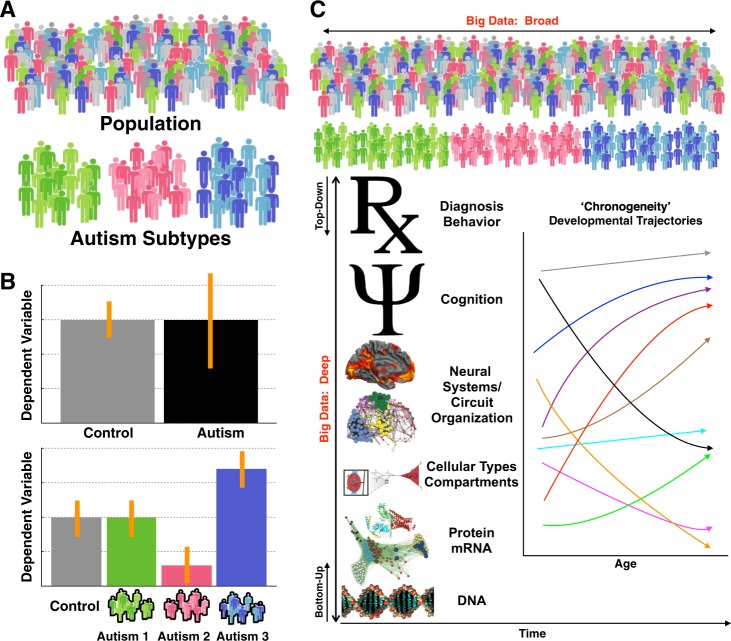
Autism is a diagnostic label based on behavior. While the diagnostic criteria attempt to maximize clinical consensus, it also masks a wide degree of heterogeneity between and within individuals at multiple levels of analysis. Understanding this multi-level heterogeneity is of high clinical and translational importance. Here we present organizing principles to frame research examining multi-level heterogeneity in autism. Theoretical concepts such as 'spectrum' or 'autisms' reflect non-mutually exclusive explanations regarding continuous/dimensional or categorical/qualitative variation between and within individuals. However, common practices of small sample size studies and case-control models are suboptimal for tackling heterogeneity. Big data are an important ingredient for furthering our understanding of heterogeneity in autism. In addition to being 'feature-rich', big data should be both 'broad' (i.e., large sample size) and 'deep' (i.e., multiple levels of data collected on the same individuals). These characteristics increase the likelihood that the study results are more generalizable and facilitate evaluation of the utility of different models of heterogeneity. A model's utility can be measured by its ability to explain clinically or mechanistically important phenomena, and also by explaining how variability manifests across different levels of analysis. The directionality for explaining variability across levels can be bottom-up or top-down, and should include the importance of development for characterizing changes within individuals. While progress can be made with 'supervised' models built upon a priori or theoretically predicted distinctions or dimensions of importance, it will become increasingly important to complement such work with unsupervised data-driven discoveries that leverage unknown and multivariate distinctions within big data. A better understanding of how to model heterogeneity between autistic people will facilitate progress towards precision medicine for symptoms that cause suffering, and person-centered support.
Overview
The claims and statistics of this paper haven’t been checked yet.
Free: it reads the open-access text and checks the first 5 claims that cite a source we can check. Create a free account to check every claim.
Integrity signals
Registry
Cites
Statistics
Figures
Verification
Claims the paper makes
The claims and statistics of this paper haven’t been checked yet.
Free: it reads the open-access text and checks the first 5 claims that cite a source we can check. Create a free account to check every claim.
Claims other papers make about this one
Each is checked against this paper’s own text: does it say what the citing paper says it does?
The source backs part of the claim, not all of it — or backs it for a different population, condition or comparison.
In the citing paper
“The scattered findings reported in studies about predictive coding and ASD may be related to a wide variety of factors, such as the dif ferences in tasks, the presence of co-occurring conditions, variations in medication use, potential cultural influences that shape responses and behaviors, as well as the intrinsic heterogeneity of ASD itself, which may manifest uniquely in each individual (Lomb”
From Predictive coding in neuropsychiatric disorders: a systematic transdiagnostic review. (2025) · cites this paper as Lombardo et al., 2019
Experimental — accuracy not yet measuredThe cited source says what the claim attributes to it.
In the citing paper
“Alongside the changes in classification systems, by now heterogeneity has already increased with regard to the expression and severity of the core and associated symptoms of ASD [4–6].”
From Autism spectrum disorder in ICD-11—a critical reflection of its possible impact on clinical practice and research (2024) · cites this paper as [4]
Self-check
Percentages, sums and reported differences re-computed from the paper’s own numbers.
The self-check needs the paper’s full text.
Citations
Cites
The Elements of Statistical Learning
Hastie, T., Tibshirani, R., & Friedman, J. (2009) · Springer Series in Statistics · doi:10.1007/978-0-387-84858-7 · Cited by 25,970
The Elements of Statistical Learning: Data Mining, Inference, and Prediction
John Lu, Z. Q. (2010) · Journal of the Royal Statistical Society Series A: Statistics in Society · doi:10.1111/j.1467-985x.2010.00646_6.x · Cited by 12,390
(1943) · The Nervous child · Cited by 8,870
Power failure: why small sample size undermines the reliability of neuroscience
Button, K. S., Ioannidis, J. P. A., Mokrysz, C., Nosek, B. A., Flint, J., Robinson, E. S. J., & Munafò, M. R. (2013) · Nature Reviews Neuroscience · doi:10.1038/nrn3475 · Cited by 7,641 · cited 2×
“Such inflated effects present an over-optimistic view on the identified effects and are prone to the winner’s curse [70].”
BackgroundInsel, T., Cuthbert, B., Garvey, M., Heinssen, R., Pine, D. S., Quinn, K., Sanislow, C., & Wang, P. (2010) · American Journal of Psychiatry · doi:10.1176/appi.ajp.2010.09091379 · Cited by 7,067
Baron-Cohen, S., Wheelwright, S., Skinner, R., Martin, J., & Clubley, E. (2001) · Journal of Autism and Developmental Disorders · doi:10.1023/a:1005653411471 · Cited by 6,450
Self-citationA New Initiative on Precision Medicine
Collins, F. S., & Varmus, H. (2015) · New England Journal of Medicine · doi:10.1056/nejmp1500523 · Cited by 5,202
Wing, L., & Gould, J. (1979) · Journal of Autism and Developmental Disorders · doi:10.1007/bf01531288 · Cited by 2,587 · cited 1×
“In the 1980s, Wing [56] and colleagues not only introduced the work of Hans Asperger into the English speaking world, but also conducted epidemiological studies that demonstrated the heterogeneity in social, language, motor, and cognitive abilities in the autistic and developmentally delayed population [57, 58].”
BackgroundLai, M.-C., Lombardo, M. V., & Baron-Cohen, S. (2014) · The Lancet · doi:10.1016/s0140-6736(13)61539-1 · Cited by 2,371
Self-citationDie „Autistischen Psychopathen” im Kindesalter
Asperger, H. (1944) · Archiv für Psychiatrie und Nervenkrankheiten · doi:10.1007/bf01837709 · Cited by 2,163 · cited 3×
“Moreover, both Leo Kanner and Hans Asperger recognized good cognitive potential in their child patients50, 52 and therefore autism was not necessarily tied to intellectual disability.”
Background
Research works printed but not linked: 1
- Loth E Ahmad J Mason L Crawley DV Hayward HL San Jose Caceres A Identifying cross-domain cognitive subtypes among children, adolescents, and adults with autism spectrum disorders 2017 San Francisco International Society for Autism Research
Cited by
Items 501–546 of 546
Smout, S., Jung, S., Udeshi, A., Caballero, M., Rapp, A. M., Kolevzon, A., & Mahjani, B. (2026) · medRxiv · doi:10.64898/2026.01.21.26344541
Alcaide, F. J., Illán, I. A., Ramirez, J. P., & Górriz, J. M. (2026) · Brain and Behavior · doi:10.1002/brb3.71121 · Cited by 2
“Autism spectrum condition (ASC), also referred to as autism, is a neurodevelopmental disorder with significant implications for communication, social interaction, and behavioral patterns (Lombardo et al. 2019 ; Masi et al. 2017 ; Szatmari 1999 ).”
Costanzo, F., Mongiovì, V. M., Alfieri, P., Pontrelli, G., Abbate, S., Palma, L. D., Chinali, M., Massella, L., Scorpecci, A., Rocchi, F., et al. (2026) · BMJ Open · doi:10.1136/bmjopen-2025-112826 · Cited by 1
“102 103 The primary outcome—visual long-term memory as assessed by the PROMEA subtest 82 —targets a hippocampus-dependent domain previously shown to be impaired in DS 21–24 and 43 95 sensitive to GABAergic modulation.”
Cheng, M., Hawco, C. S., Yang, D. Y. ‐., Ni, H., Yeh, C., Chang, J.-C., Tu, E., Hsu, M.-Y., Wu, Y.-Y., Chou, T., et al. (2026) · Journal of Neurodevelopmental Disorders · doi:10.1186/s11689-026-09683-3
“This heterogeneity challenges conventional group-aver-age neuroimaging approaches [23, 56] and has spurred interest in brain idiosyncrasy – individual-specific variations in brain structure and function [40, 66] – as a critical dimension for direct investigation [55].”
Shaw, T. J., Fok, M., Wang, M., Hornburg, C. B., Jeon, M., Scarpa, A., & Kim, S. (2026) · Interacting with Computers · doi:10.1093/iwc/iwag018
Applying multidimensional approaches to disentangle autism spectrum disorder heterogeneity
Mihailov, A. (2021) · theses.fr (ABES) · doi:10.70675/b9bfc6a7za998z4d56z9380z5ec7781bc4ac · Cited by 1
Menon, V., Li, L., Zhang, Y., Strock, A., Pruthi, S., & Ryali, S. (2026) · Research Square · doi:10.21203/rs.3.rs-9023571/v1
“Understanding autism through neurobiological signatures has been constrained by a fundamental methodological mismatch: we have studied a disorder of dynamic social cognition using paradigms that eliminate social context 29 .”
Pang, T., Zheng, X., Liu, J., Lu, L., Yang, L., & Chang, S. (2026) · Communications Biology · doi:10.1038/s42003-026-10059-5
“Integratingbothperspectiveswillthereforebeessentialforcon-structingacomprehensive,multi-levelaccountoftheheterogeneity underlyingASD,andfutureworkbridgingthesetwomethodologicaltra-ditionsholdsconsiderablepromiseforadvancingbothmechanistic understandingandprecisiontherapeuticdevelopment 2 .”
Bo, T., Huang, Y., Lu, Y., Song, Y., Zhang, J., Zhang, J., Wang, H., & Wang, Z. (2026) · Neuroscience Bulletin · doi:10.1007/s12264-026-01627-0 · Cited by 1
“These challenges have been linked to atypical activities in the ventromedial prefrontal cortex, thalamus, visual areas, amygdala, and posterior cingulate [101–103].”
Vocalization patterns distinguish toddlers later diagnosed with autism from TD at 18–23 months
Feng, M., LIANG, D., & Xu, J. (2026) · Journal of Communication Disorders · doi:10.1016/j.jcomdis.2026.106647
Wang, P. S. P., Kannan, L., Hodge, E., Sanchez-Singh, J. M., Carrillo, A. A., Milla, S., Stavropoulos, K. K. M., & Seitz, A. R. (2026) · Behavioral Sciences · doi:10.3390/bs16050702
“…restricted samples (Masoomi et al., 2025) and narrowly focused tasks (Kaldy et al., 2016; Remington & Fairnie, 2017), constraining both generalizability and the ability to capture the breadth of sensory and cognitive variability observed in ASD (Lenroot & Yeung, 2013; Lombardo et al., 2019).”
Srinivasan, H., Cascio, C. J., & Wallace, M. T. (2026) · Journal of Child and Adolescent Psychopharmacology · doi:10.1177/10445463261448490
“This direction aligns with person-centered approaches in developmental clinical science (Karalunas et al., 2014; Lombardo et al., 2019).”
Socially Assistive Robots for People with Neurodevelopmental Disabilities: Promises and Pitfalls
Mills, C., Pirborj, L. M., Wong, B., & Gorkin, R. A., III (2026) · Smart sensors, measurement and instrumentation · doi:10.1007/978-3-032-17804-6_6
Attenuated adaptive growth of interpersonal synchrony in autismPreprint
Kwon, J., & Kotani, H. (2026) · bioRxiv (Cold Spring Harbor Laboratory) · doi:10.64898/2026.06.02.729457
Lin, Y., Pellicano, E., Dickson, C., Trudel, N., Noonan, M. P., Lockwood, P. L., Luo, Y.-J., Fleming, S. M., & Wittmann, M. K. (2026) · bioRxiv (Cold Spring Harbor Laboratory) · doi:10.64898/2026.06.05.728761 · Cited by 1
“A key obstacle that limits our understanding is the lack of large-scale data sets to determine the relationship between autistic traits and social decision making [39, 40].”
Prospective memory and executive functions in adults across the wider autistic spectrum
Nürnberg, D., & Altgassen, M. (2026) · Scientific Reports · doi:10.1038/s41598-026-57092-2
Diversity of words and words for diversity
Arbey, A., Demily, C., & Soumier, A. (2026) · Frontiers in Psychiatry · doi:10.3389/fpsyt.2026.1834531
“…traditional norm-referenced statistical approaches, which de fi ne “ normality ” or “ typicality ” may not be fully suited to analyse the complex patterns of trait distribution, clustering, and co-occurrence inherent to the spectrum-based nature of neurodevelopmental conditions (21, 32, 33, 35, 36).”
dos Santos, J. C. C., Bolan, S. J., da Silva, G. L., Viana, G. L., Rico, E. P., & Gonçalves, C. L. (2026) · Journal of Psychiatric Research · doi:10.1016/j.jpsychires.2026.06.035
Greenlee, J. L. (2026) · Theory & Psychology · doi:10.1177/09593543261458008
Diagnostic inflation in autism spectrum disorder: an epistemological and methodological reappraisal
Croce, L., & Fusaro, I. (2026) · Frontiers in Psychiatry · doi:10.3389/fpsyt.2026.1847929 · Cited by 1
“Lombardo and colleagues (19) had earlier proposed a strati fi ed neuroimaging framework consistent with internal heterogeneity.”
Yue, Z., Zhu, J., Wang, Y., Guan, L., Yin, S., Fang, H., & Ke, X. (2026) · Molecular Autism · doi:10.1186/s13229-026-00728-x
“…that ASD heterogeneity spans multiple levels (behavioral, cognitive, neural, and genetic), and that single-axis traditional stratification may obscure cross-level dissociations and parallel developmental pathways, thereby limiting mechanistic understanding and translational progress [63].”
Huang, L.-W., Zhou, Y. R., Yeh, C., Ni, H., Mulsant, B. H., Husain, M. I., Chang, J.-C., Tu, E., Hsu, M.-Y., Wu, Y.-Y., et al. (2026) · BJPsych Open · doi:10.1192/bjo.2026.12035
Zhang, X., Song, X.-K., & So, W. (2026) · Autism & Developmental Language Impairments · doi:10.1177/23969415261464456
“Case – control studies that fail to consider heterogeneity may disproportionately represent speci fi c subgroups and yield contradictory results (Lombardo et al., 2019).”
Liu, D., Tao, K., Wang, Y., Sun, Y., & Wang, S. (2026) · Molecular Neurobiology · doi:10.1007/s12035-026-06035-z · Cited by 1
“Future studies should move beyond descriptive associations and increasingly focus on mechanistically defining how distinct mitochondrial stress states influence synaptic development, neural circuit plasticity, and therapeutic responsiveness across heterogeneous ASD populations [296].”
Definitions and classification of NDDs: Conceptual, Diagnostic, and Developmental Perspectives
Srivastava, A., Begum, S., Gupta, V., & Khan, M. E. (2026) · IGI Global eBooks · doi:10.4018/979-8-3373-7072-9.ch002
Ilaridou, I., Kojovic, N., Chataing, T., Latrèche, K., Journal, F., Akhavan, S., Sandini, C., & Schaer, M. (2026) · Autism Research · doi:10.1002/aur.70329
“…three distinct developmental trajectories support prior evidence that the cognitive outcome is variable among autistic children, with the observed trajectories varying depending on the methodological approach applied (Godel et al. 2022; Asta et al. 2024; Mandelli et al. 2024; Lombardo et al. 2019).”
Reproducible psychosocial–emotional profiles reveal population-level heterogeneity in young adultsPreprint
Zhang, F., Tan, Y., Pan, C., Qiu, S., Ping, R., Wang, F., Kang, J., & Zhang, W. (2026) · Research Square · doi:10.21203/rs.3.rs-10317962/v1
Predicting early intervention outcomes in autism via individual participant data mega-analysis
Mandelli, V., Busuoli, E. M., Godel, M., Kojovic, N., Sinai-Gavrilov, Y., Gev, T., Contaldo, A., Courchesne, E., Pierce, K., Golan, O., et al. (2026) · Molecular Autism · doi:10.1186/s13229-026-00736-x · Cited by 1
“…of the most common neurodevelopmental conditions in society today and represents a broad population of individuals that are heterogeneous across multiple scales, from genotype to phenotype [1], across development [2], and across important clinical outcomes (e.g., responses to intervention) [3–5].”
Self-citationNavigating Mixed-Neurotype Dialogue: Environmental and Affective Influences on Autistic Speakers
Miller, Z. A., Conner, C. M., Chang, J. C., & Mazefsky, C. A. (2026) · Autism · doi:10.1177/13623613261469909
“Finally, diagnostic variability, where the study included both self-identified and clinically diagnosed autistic individuals, adds another dimension of heterogeneity that may shape how participants perceive and report communication challenges (Lombardo et al., 2019).”
Gao, L., Dong, Q., Hu, X., Lu, H., Liu, J., & Guo, X. (2026) · Chaos Solitons & Fractals · doi:10.1016/j.chaos.2026.118931
Silleresi, S., de Villiers, J., Baumeister, F., Solaimani, E., Wolfer, P., & Durrleman, S. (2026) · Cognitive Development · doi:10.1016/j.cogdev.2026.101742
Lee, J.-W., Shayan, H., & Jo, H. (2026) · Psychiatry Research Neuroimaging · doi:10.1016/j.pscychresns.2026.112310 · Cited by 2
Charman, T., Bazelmans, T., Pasco, G., Ali, J. B., Jones, E. J. H., Johnson, M. H., The BASIS Team, Arthur, R., Baykoca, J., Blasi, A., et al. (2026) · Journal of Autism and Developmental Disorders · doi:10.1007/s10803-026-07481-3 · Cited by 1
Coutu-Nadeau, E., Arutiunian, V., Martin, C.-O., Fontaine, V. K., Bélanger, A.-M., Jizi, K., Knoth, I. S., Hosein, A., Davoudi, S., Caplette, L., et al. (2026) · Research Square · doi:10.21203/rs.3.rs-10692457/v1
Fuamba, Y. (2026) · Frontiers in Neuroinformatics · doi:10.3389/fninf.2026.1868068
Chen, H., Zhou, Z., Chen, D., Wang, Y., Gao, T., Liu, X., & Chen, J. (2026) · Journal of Neural Engineering · doi:10.1088/1741-2552/ae9ef0
Berley, N., Becker, S. P., & Stallings, M. C. (2026) · Research Square · doi:10.21203/rs.3.rs-10818692/v1
Rodeiro-Boliart, J., Nuñez-Jimenez, M., Olaya, B., Huerta‐Ramos, E., & Golobardes, E. (2026) · Frontiers in Psychiatry · doi:10.3389/fpsyt.2026.1952612
Impact of Child-Centered Play Therapy on Children with Autism Spectrum Disorder: A Scoping Review
Chen, J., Tang, S., & Wang, G. (2026) · Frontiers of digital education. · doi:10.1007/s44366-026-0098-7
“The real-time capture and analysis of behavioral, physiological, and affective data provide objective therapeutic benchmarks (Belpaeme et al., 2013; Lombardo et al., 2019).”
Ganai, U. J., & Bhushan, B. (2026) · Psychological Medicine · doi:10.1017/s003329172610556x
Snijder, M. I. J., Grieve, C. M., Pieters, S., Petersen, E., van Andel, M., Ruiter, E. L. M., Buitelaar, J. K., Dietz, C., & Oosterling, I. J. (2026) · European Child & Adolescent Psychiatry · doi:10.1007/s00787-026-03072-w
Gray matter subtyping with SuStaIn reveals neuroanatomical patterns in autism spectrum disorder
Ren, H., Duan, Y., Li, H., Jiang, S., Zhang, J., Meropi, P., Rodriguez-Labrada, R., Peng, T., Luo, C., & Liu, C. (2026) · Brain Imaging and Behavior · doi:10.1007/s11682-026-01203-0
“These exploratory associations suggest a possible domain-specific pattern consistent with previous work emphasizing neurobiologically informed subgrouping as a means of understanding ASD heterogeneity (Duan et al., 2025; Lombardo et al., 2019; Meijer et al., 2024).”
Pluta, A., Rosenblau, G., & Charpentier, C. J. (2026) · Personality Neuroscience · doi:10.1017/pen.2026.10010
“…diagnostic measures such as the Autism Diagnostic Observation Schedule, the Autism Diagnostic Interview-Revised, and the SRS, underscoring the limitations of relying exclusively on behavioral indices to capture the full heterogeneity of the condition (Liu et al., 2025; Lombardo et al., 2019).”
Matsuura, Y., Anderson, A. S., Lion, K. C., Myers, E., & Shic, F. (2026) · Review Journal of Autism and Developmental Disorders · doi:10.1007/s40489-026-00603-8
Li, A., Zhang, J., Yu, C., Tan, L., Yi, A., & Xiao, Y. (2026) · Psychiatry Research · doi:10.1016/j.psychres.2026.117529
The spectrum within the spectrum: Neural heterogeneity in autism
Bakul, F., Krafick, K. I., & Kana, R. K. (2026) · Behavioural Brain Research · doi:10.1016/j.bbr.2026.116546
Metadata
- Authors
- Lombardo, M. V., Lai, M.-C., & Baron-Cohen, S.
- Affiliations
- University of Cambridge (GB)
- Centre for Addiction and Mental Health (CA)
- Corresponding author
- Lombardo, Michael V.
- Venue
- Molecular Psychiatry
- Published
- 2019-01-07
- Volume
- 24
- Issue
- 10
- Pages
- 1435-1450
- ISSN
- 1359-4184 (ISSN-L)
- 1476-5578
- PMC
- PMC6754748
- OpenAlex
- W2951588804
- Cited by
- 537
- References
- 111
- Citations by year
- 2026: 75 · 2025: 65 · 2024: 84 · 2023: 77 · 2022: 75 · 2021: 74 · 2020: 64 · 2019: 20
- FWCI
- 7.38
- Type
- journal article
- Language
- en
- Open access
- hybrid
- doi.org
- Licence
- cc-by
- creativecommons.org/licenses/by/4.0 (tdm)
- Locations
- Molecular Psychiatry (publishedVersion, cc-by)
- bioRxiv (Cold Spring Harbor Laboratory) (acceptedVersion, cc-by-nc-nd)
- Europe PMC (PubMed Central) (publishedVersion, cc-by)
- PubMed Central (publishedVersion, cc-by)
- PubMed (publishedVersion)
- Apollo (University of Cambridge) (submittedVersion, cc-by)
- Apollo (cc-by)
- Funders
- EC | European Research Council (755816)
- Topics
- Life Sciences › Neuroscience › Cognitive Neuroscience › Autism Spectrum Disorder Research
- Life Sciences › Biochemistry, Genetics and Molecular Biology › Genetics › Genetics and Neurodevelopmental Disorders
- Social Sciences › Psychology › Experimental and Cognitive Psychology › Mental Health Research Topics
- Keywords
- autism spectrum disorder, autism heterogeneity, big data, dimensional versus categorical models, longitudinal development, precision medicine, person-centred support, sample size
- MeSH terms
- Autism Spectrum Disorder, Big Data, Humans, Longitudinal Studies, Case-Control Studies, Genetic Heterogeneity
About these checks
Registry, retraction, Cites and statistics results are computed, not judged, with one exception: a printed reference that no index lists is read once by a model before it counts as a citation error. Claims are extracted by a model and kept only when their quote appears verbatim in the text; each cited source is then checked, with a model’s help, for whether it says what the claim relies on. Those verdicts can be wrong — read the claim’s quote and the cited source before relying on one.
Statistics and arithmetic are recomputed, not judged.
Confidence bands are shown only for fields calibrated on our annotated test set. None is calibrated yet, so no band is shown.
What counts as a claim ›How we measure confidence ›How we check this ›
Are you an author, or do you see a problem with this page? Request a review
Data sources
Bibliographic data: Semantic Scholar, OpenAlex, Crossref.
Contains information from the Semantic Scholar Academic Graph Datasets, made available under the ODC Attribution License (ODC-BY 1.0).
Semantic Scholar’s data is described in: Kinney, R., et al. (2023). The Semantic Scholar Open Data Platform. arXiv:2301.10140.
