

Conceptualizing mental disorders as deviations from normative functioning
Open accessThe DOI matches its Crossref record; 45 of the 45 references it cites were found in a registry or an index.
Abstract
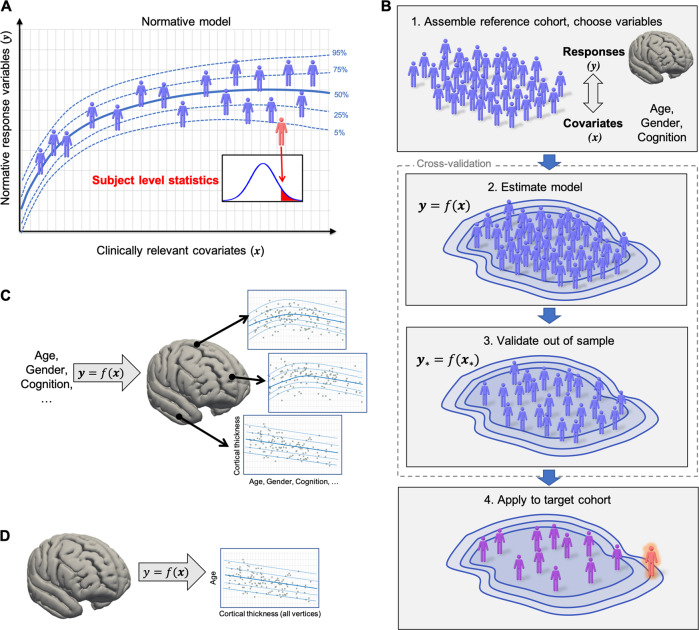
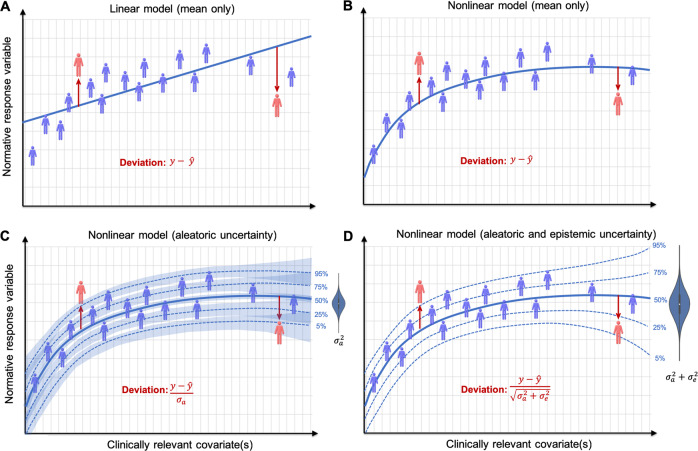
Normative models are a class of emerging statistical techniques useful for understanding the heterogeneous biology underlying psychiatric disorders at the level of the individual participant. Analogous to normative growth charts used in paediatric medicine for plotting child development in terms of height or weight as a function of age, normative models chart variation in clinical cohorts in terms of mappings between quantitative biological measures and clinically relevant variables. An emerging body of literature has demonstrated that such techniques are excellent tools for parsing the heterogeneity in clinical cohorts by providing statistical inferences at the level of the individual participant with respect to the normative range. Here, we provide a unifying review of the theory and application of normative modelling for understanding the biological and clinical heterogeneity underlying mental disorders. We first provide a statistically grounded yet non-technical overview of the conceptual underpinnings of normative modelling and propose a conceptual framework to link the many different methodological approaches that have been proposed for this purpose. We survey the literature employing these techniques, focusing principally on applications of normative modelling to quantitative neuroimaging-based biomarkers in psychiatry and, finally, we provide methodological considerations and recommendations to guide future applications of these techniques. We show that normative modelling provides a means by which the importance of modelling individual differences can be brought from theory to concrete data analysis procedures for understanding heterogeneous mental disorders and ultimately a promising route towards precision medicine in psychiatry.
Overview
The claims and statistics of this paper haven’t been checked yet.
Free: it reads the open-access text and checks the first 5 claims that cite a source we can check. Create a free account to check every claim.
Integrity signals
Registry
Cites
Statistics
Figures
Verification
Claims the paper makes
The claims and statistics of this paper haven’t been checked yet.
Free: it reads the open-access text and checks the first 5 claims that cite a source we can check. Create a free account to check every claim.
Claims other papers make about this one
Each is checked against this paper’s own text: does it say what the citing paper says it does?
The source backs part of the claim, not all of it — or backs it for a different population, condition or comparison.
In the citing paper
“A prerequisite for the application of growth charts in youth mental health is the availability of normative developmental data that comprise important domains of emerging psychopathology, such as cognition, emotion regulation, and sleep [92].”
From Towards a youth mental health paradigm: a perspective and roadmap (2023) · cites this paper as [92]
Experimental — accuracy not yet measuredThe source backs part of the claim, not all of it — or backs it for a different population, condition or comparison.
In the citing paper
“Newer hybrid models, such as normative modeling (19,59–61) or the functional random forest (FRF) (18,62), may overcome these limitations and enable new inferences from psychopathology studies.”
From Methods and challenges for assessing heterogeneity (2020) · cites this paper as [59]
Experimental — accuracy not yet measuredThe source backs part of the claim, not all of it — or backs it for a different population, condition or comparison.
In the citing paper
“Normative models (59) enable researchers to identify common (i.e., comorbid) mechanisms, identify potential subtypes or subfactors tied to an outcome of interest, and make pre- dictions on individual cases.”
From Methods and challenges for assessing heterogeneity (2020) · cites this paper as [59]
Experimental — accuracy not yet measuredThe cited source says what the claim attributes to it.
In the citing paper
“In this context, machine learning approaches have just recently embraced advances that allow the characterization of normative trajectories and parsing of the heterogeneity at the individual level 69 .”
From Candidate diagnostic biomarkers for neurodevelopmental disorders in children and adolescents: a systematic review (2023) · cites this paper as [69]
Self-check
Percentages, sums and reported differences re-computed from the paper’s own numbers.
The self-check needs the paper’s full text.
Citations
Cites
Insel, T., Cuthbert, B., Garvey, M., Heinssen, R., Pine, D. S., Quinn, K., Sanislow, C., & Wang, P. (2010) · American Journal of Psychiatry · doi:10.1176/appi.ajp.2010.09091379 · Cited by 7,067
The WU-Minn Human Connectome Project: An overview
Van Essen, D. C., Smith, S. M., Barch, D. M., Behrens, T. E. J., Yacoub, E., & Ugurbil, K. (2013) · NeuroImage · doi:10.1016/j.neuroimage.2013.05.041 · Cited by 5,651
Multimodal population brain imaging in the UK Biobank prospective epidemiological study
Miller, K. L., Alfaro-Almagro, F., Bangerter, N. K., Thomas, D. L., Yacoub, E., Xu, J., Bartsch, A. J., Jbabdi, S., Sotiropoulos, S. N., Andersson, J. L. R., et al. (2016) · Nature Neuroscience · doi:10.1038/nn.4393 · Cited by 2,020
Equifinality and multifinality in developmental psychopathology
Cicchetti, D., & Rogosch, F. A. (1996) · Development and Psychopathology · doi:10.1017/s0954579400007318 · Cited by 1,842
Kapur, S., Phillips, A. G., & Insel, T. R. (2012) · Molecular Psychiatry · doi:10.1038/mp.2012.105 · Cited by 980
The conception of the ABCD study: From substance use to a broad NIH collaboration
Volkow, N. D., Koob, G. F., Croyle, R. T., Bianchi, D. W., Gordon, J. A., Koroshetz, W. J., Pérez-Stable, E. J., Riley, W. T., Bloch, M. H., Conway, K., et al. (2018) · Developmental Cognitive Neuroscience · doi:10.1016/j.dcn.2017.10.002 · Cited by 970
Predicting Age Using Neuroimaging: Innovative Brain Ageing Biomarkers
Cole, J. H., & Franke, K. (2017) · Trends in Neurosciences · doi:10.1016/j.tins.2017.10.001 · Cited by 903
Insel, T. R., & Cuthbert, B. N. (2015) · Science · doi:10.1126/science.aab2358 · Cited by 840
Understanding heterogeneity in clinical cohorts using normative models: Beyond case-control studies
Marquand, A. F., Rezek, I., Buitelaar, J., & Beckmann, C. F. (2016) · Biological Psychiatry · doi:10.1016/j.biopsych.2015.12.023 · Cited by 683
Self-citationMapping the heterogeneous phenotype of schizophrenia and bipolar disorder using normative models
Wolfers, T., Doan, N. T., Kaufmann, T., Alnæs, D., Moberget, T., Agartz, I., Buitelaar, J. K., Ueland, T., Melle, I., Franke, B., et al. (2018) · JAMA Psychiatry · doi:10.1001/jamapsychiatry.2018.2467 · Cited by 508
Self-citation
Research works printed but not linked: 3
- 21. Bethlehem R, Seidlitz J, Romero-Garcia R, Lombardo M. Using normative age modelling to isolate subsets of individuals with autism expressing highly age-atypical cortical thickness features. BioRxiv 2018:1–23.
- 33. Gal Y Uncertainty in deep learning 2016 Cambridge University of Cambridge
- 43. Kia SM, Marquand A. Neural processes mixed-effect models for deep normative modeling of clinical neuroimaging data. arXiv. 2018;1812.04998.
Cited by
Items 401–433 of 433
Hewitt, P., Kim, H., & Vida, T. A. (2026) · Frontiers in Aging Neuroscience · doi:10.3389/fnagi.2026.1748671
“It is also a promising novel approach to investigate deviations in the brains of those diagnosed with neuropsychiatric disorders (Marquand et al., 2019).”
Normative EEG Effective Connectivity as a neural marker of Autism Spectrum DisorderPreprint
Amato, L. G., Fattorini, F., Vergani, A. A., Pagani, M., Meneghetti, N., Mazzoni, A., & Fabbrizzi, M. (2026) · medRxiv · doi:10.64898/2026.07.27.26359031
Hani, M., Betrouni, N., Melonou, J. T., Mahmoudi, S., & Benjelloun, M. (2026) · Electronics · doi:10.3390/electronics15153368
BIARD: Bayesian Individualized Abnormal Region Detection
Adhikary, A. C., Liu, Z., Huang, C., & Liu, R. (2026) · Statistics and data science in imaging. · doi:10.1080/29979676.2026.2700195
Berger, C., Höhne, E., Reis, O., Kölch, M. G., & Brehme, H. (2026) · Diagnostica · doi:10.1026/0012-1924/a000369
Site-Aware Longitudinal Deformation Markers from Structural MRI for Neurodegenerative Disease
López-Ríos, E. E., & Padilla, F. J. A. (2026) · Lecture notes in electrical engineering · doi:10.1007/978-981-95-7425-4_60
Verduyn, Y., Kia, S. M., & Brouwer, H. (2026) · Psychiatry Research Communications · doi:10.1016/j.psycom.2026.100279
Self-citationNeuroMorph: A Unified Morphological Reference Space for Cross-Disease Brain ProfilingPreprint
Dalby, C., Dibble, A. J., Benini, S., Ferrari, D., Lyall, D. M., Harvey, M., Quinn, T., Muckli, L. F., Fracasso, A., Svanera, M., et al. (2026) · medRxiv · doi:10.64898/2026.08.13.26359403 · Cited by 2
“Normative modeling has advanced the field by shifting the focus from average case-control differences to individual deviations from age-and sex-appropriate reference distributions [9, 10].”
Disentangling white matter correlates of symptom severity and general impairment in early psychosis
Penzel, N., Cho, K. I. K., Seitz‐Holland, J., Ruef, A., Cabras, G., Klein, P. C., Antonucci, L. A., Dwyer, D., Betz, L. T., Karayumak, S. C., et al. (2026) · Molecular Psychiatry · doi:10.1038/s41380-026-03832-9
Rengan, H., Valiyev, A.-M., Zhu, R. B., Wai, C., & Fu, E. Y. (2026) · IEEE Annual International Computer Software and Applications Conference (COMPSAC) · doi:10.1109/compsac69091.2026.00455
“Normative modeling inverts this approach [9], [10].”
Dhanik, K., Arya, A., Agarwal, V., & Kumar, U. (2026) · Epilepsy & Behavior · doi:10.1016/j.yebeh.2026.111260
Sun, Y., Fang, Y., Peng, P., Wu, Q., Tang, J., & Liao, Y. (2026) · Molecular Psychiatry · doi:10.1038/s41380-026-03859-y
Imagerie cérébrale et schizophrénie
Cachia, A., Jardri, R., & Plaze, M. (2026) · Encyclopédie médico-chirurgicale. Psychiatrie · doi:10.1016/s0246-1072(26)41500-x
Paliwal, V., Moiseev, A., Doesburg, S. M., Xi, P., Winston, J. S., Richardson, M. P., Rodionov, R., Ribary, U., Blaber, A., Medvedev, G., et al. (2026) · medRxiv · doi:10.64898/2026.09.19.26363457
Paliwal, V., Moiseev, A., Doesburg, S. M., Xi, P., Winston, J. S., Richardson, M. P., Rodionov, R., Ribary, U., Blaber, A., Medvedev, G., et al. (2026) · medRxiv · doi:10.64898/2026.09.19.26363458
Longitudinal Reliability of Cross-Sectional Normative Models Under Measurement Error
Ji, W., Long, J., Guan, Q., Li, X., Jiang, S., Li, J., & Wang, Y. (2026) · Lecture notes in computer science · doi:10.1007/978-3-032-38172-9_39
Fan, Y., Qin, H., Xie, J., Chen, Z., Luo, Y., Alam, U., Lip, G. Y. H., Cheng, L., Zheng, Y., & Zhao, H. (2026) · Lecture notes in computer science · doi:10.1007/978-3-032-38172-9_32
HiLoGraph: Hierarchical-Longitudinal Brain Network Representation Learning
Chen, T., Chen, M., Zhang, J., Cao, C., Su, L., Liu, T., & Zhu, D. (2026) · Lecture notes in computer science · doi:10.1007/978-3-032-38239-9_27
SIGMA-VAE: Sketched Isotropic Gaussian Multi-view Autoencoder for Normative Modeling
Zabihi, M., Dai, S., Schmidt, A., Preller, K. H., Watrous, A., Bornemann, K., Cole, J. H., Marquand, A. F., Yang, Y., & Wolfers, T. (2026) · Lecture notes in computer science · doi:10.1007/978-3-032-38239-9_51
Self-citationLong, H., Wu, H., Guan, Q., Fan, M., Yang, X., Xiao, J., Ma, G., zhang, Y., & Liu, S. (2026) · Medical Image Analysis · doi:10.1016/j.media.2026.104346
Opie, G. M. (2026) · Neuroscience & Biobehavioral Reviews · doi:10.1016/j.neubiorev.2026.107006
Amador‐Tejada, A., Danielli, E., & Noseworthy, M. D. (2026) · NeuroImage · doi:10.1016/j.neuroimage.2026.122283
Gurmendi, D. S. M. R., de Ávila-Armenta, E., Garza-Abdala, J. A., Lozano-Gutiérrez, D., Toledo-Rios, J. S., Fumagal-González, G. A., & Tamez‐Peña, J. G. (2026) · Proceedings - IEEE Symposium on Computer-Based Medical Systems · doi:10.1109/cbms69103.2026.00144
“This stratification approach complements recent work using normative modeling to map heterogeneous phenotypes in schizophrenia [21].”
Integrating the Hierarchical Taxonomy of Psychopathology and computational psychiatry
Allen, T. A., Schreiber, A., Blain, S. D., Carlisi, C. O., DeYoung, C. G., Fornito, A., Gillan, C. M., Goghari, V. M., Hall, N. T., Homan, P., et al. (2026) · Nature Reviews Psychology · doi:10.1038/s44159-026-00621-7 · Cited by 1
Structured missingness in biomedical research
Rehak-Bucova, B., Fraza, C., Lemvigh, C. K., Flaaten, C. B., Sæther, L. S., Cattarinussi, G., Ambrosen, K. S., Andreassen, O. A., Westlye, L. T., Beckmann, C. F., et al. (2026) · Communications AI & Computing · doi:10.1038/s44488-026-00025-9 · Cited by 2
Self-citationInterpreting ocular age estimates: source, output, evidence, and clinical meaning
Bair, H. (2026) · Biogerontology · doi:10.1007/s10522-026-10525-x
“An atypical difference falls outside a prespecified region of the joint reference distribution, which can be estimated conditionally on age and other covariates using normative modeling (Marquand et al. 2019).”
Wang, W., Yang, L., Wu, K., Li, S., Peng, S., & Gong, G. (2026) · Developmental Cognitive Neuroscience · doi:10.1016/j.dcn.2026.101839
“From these, a z-score can be derived for each infant, quantifying their deviation from the normative trajectory (Marquand et al., 2019, 2016; Wolfers et al., 2018).”
Nature Mental Health Earth–Brain–Health Commission
Schumann, G., Luterbacher, J., Marquand, A. F., Groß, C., Hunt, X., Stahl, B. C., Brandt, L., Чэн, Б., Damodharan, D., Ji, J. S., et al. (2026) · Nature Mental Health · doi:10.1038/s44220-026-00737-y
“Expand dataset coverage including LMIC and under-represented recruitment; when aggregation is constrained, apply federated approaches such as normative modeling to share parameters, not data 139,155 .”
Self-citationResting EEG as a condition-dependent ageing phenotype
Du, Y. (2026) · Neurobiology of Aging · doi:10.1016/j.neurobiolaging.2026.10.003
Positive–affective and negative–cognitive brain–behavior axes in clinical high risk for psychosis
Vieira, S., Aleman, Y., Bici, L., Meijer, J., Penzel, N., Jacobs, G. R., Yassin, W., Alameda, L., Baştürk, Ö., Pries, L.-K., et al. (2026) · Biological Psychiatry · doi:10.1016/j.biopsych.2026.09.029
Self-citationThe spectrum within the spectrum: Neural heterogeneity in autism
Bakul, F., Krafick, K. I., & Kana, R. K. (2026) · Behavioural Brain Research · doi:10.1016/j.bbr.2026.116546
Serin, E., Khan, K. R., Krueger, T. H. C., Sinke, C., Beier, K. M., Walter, M., Schiffer, B., Amelung, T. R., & Walter, H. (2026) · bioRxiv (Cold Spring Harbor Laboratory) · doi:10.64898/2026.10.21.760530
“Given this heterogeneity in clinical presentation, together with comorbidity and neurobiology, frameworks that model inter-individual variability explicitly, such as normative modeling (88), may be better suited to this population.”
Individualized brain mapping for neurosurgical planning
Voets, N. (2026) · Biological Psychiatry · doi:10.1016/j.biopsych.2026.10.016
Metadata
- Authors
- Marquand, A. F., Kia, S. M., Zabihi, M., Wolfers, T., Buitelaar, J. K., & Beckmann, C. F.
- Affiliations
- Radboud University Nijmegen (NL)
- Venue
- Molecular Psychiatry
- Published
- 2019-06-14
- Volume
- 24
- Issue
- 10
- Pages
- 1415-1424
- ISSN
- 1359-4184 (ISSN-L)
- 1476-5578
- PMC
- PMC6756106
- OpenAlex
- W2952396505
- Cited by
- 433
- References
- 45
- Citations by year
- 2026: 81 · 2025: 87 · 2024: 69 · 2023: 51 · 2022: 58 · 2021: 53 · 2020: 22 · 2019: 11
- FWCI
- 4.56
- Type
- journal article
- Language
- en
- Update notices
- correction (2019-06-26)
- Open access
- hybrid
- doi.org
- Licence
- cc-by
- creativecommons.org/licenses/by/4.0 (tdm)
- creativecommons.org/licenses/by/4.0 (vor)
- Locations
- Molecular Psychiatry (publishedVersion, cc-by)
- PubMed Central (publishedVersion, cc-by)
- Research portal (Tilburg University) (publishedVersion, cc-by)
- PubMed (publishedVersion)
- Radboud Repository (Radboud University) (submittedVersion)
- Radboud Repository (Radboud University) (submittedVersion, other-oa)
- Data Archiving and Networked Services (DANS) (submittedVersion, cc-by)
- Research Portal (King's College London) (submittedVersion, other-oa)
- Funders
- Nederlandse Organisatie voor Wetenschappelijk Onderzoek (016.156.415)
- Wellcome Trust (098369/Z/12/Z)
- Topics
- Life Sciences › Neuroscience › Cognitive Neuroscience › Functional Brain Connectivity Studies
- Social Sciences › Psychology › Experimental and Cognitive Psychology › Mental Health Research Topics
- Social Sciences › Arts and Humanities › Philosophy › Mental Health and Psychiatry
- Keywords
- normative modeling, mental illness, individual differences, clinical heterogeneity, neuroimaging biomarkers, precision psychiatry, psychiatric biomarkers
- MeSH terms
- Mental Disorders, Humans, Psychiatry, Models, Statistical, Biomarkers, Precision Medicine
About these checks
Registry, retraction, Cites and statistics results are computed, not judged, with one exception: a printed reference that no index lists is read once by a model before it counts as a citation error. Claims are extracted by a model and kept only when their quote appears verbatim in the text; each cited source is then checked, with a model’s help, for whether it says what the claim relies on. Those verdicts can be wrong — read the claim’s quote and the cited source before relying on one.
Statistics and arithmetic are recomputed, not judged.
Confidence bands are shown only for fields calibrated on our annotated test set. None is calibrated yet, so no band is shown.
What counts as a claim ›How we measure confidence ›How we check this ›
Are you an author, or do you see a problem with this page? Request a review
Data sources
Bibliographic data: Semantic Scholar, OpenAlex, Crossref.
Contains information from the Semantic Scholar Academic Graph Datasets, made available under the ODC Attribution License (ODC-BY 1.0).
Semantic Scholar’s data is described in: Kinney, R., et al. (2023). The Semantic Scholar Open Data Platform. arXiv:2301.10140.
