

Sex- and suicide-specific alterations in the kynurenine pathway in the anterior cingulate cortex in major depression
Open accessThe DOI matches its Crossref record; 58 of the 58 references it cites were found in a registry or an index.
Abstract
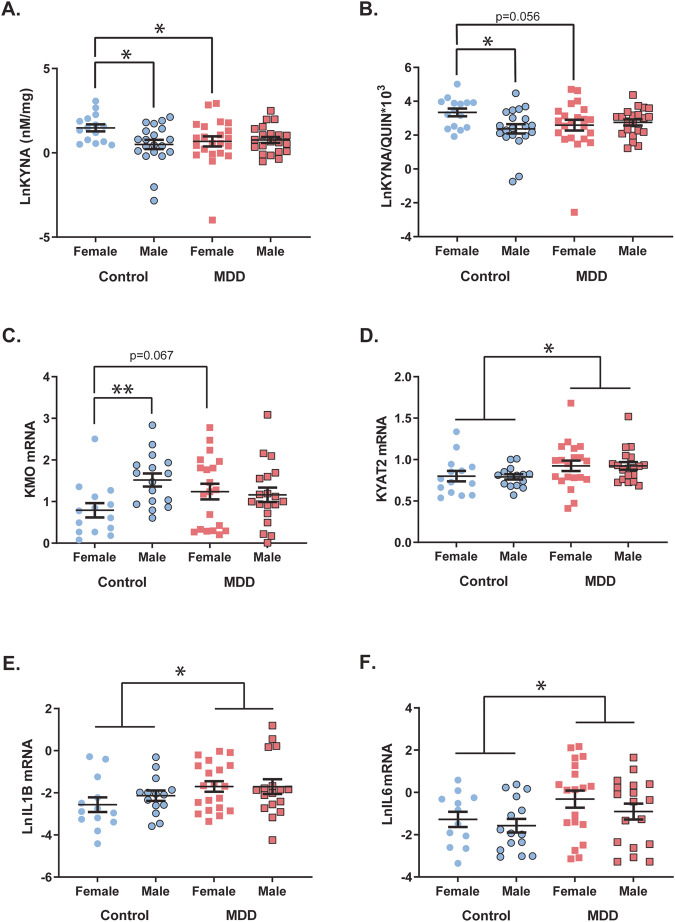
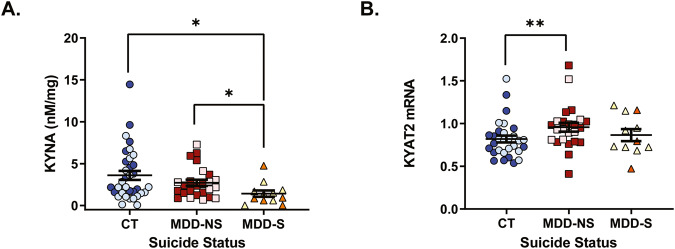
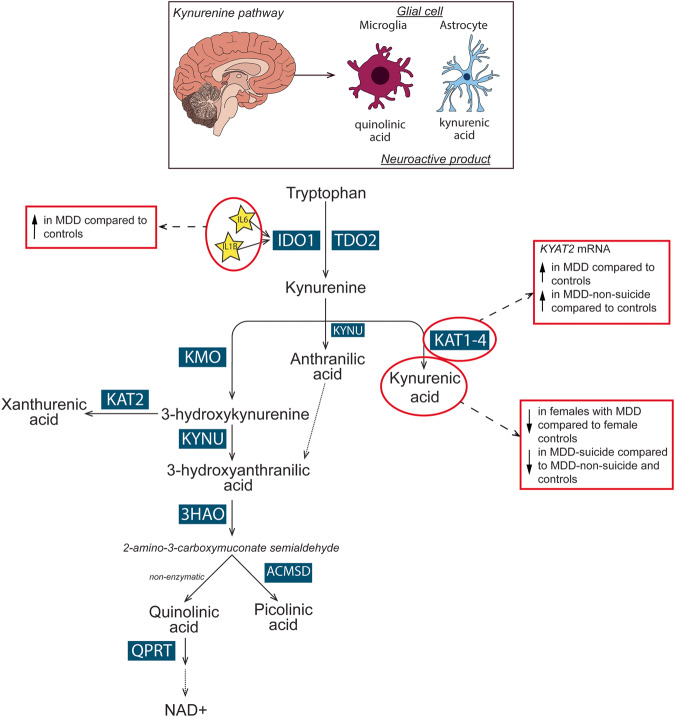
Major depressive disorder (MDD) is a serious psychiatric disorder that in extreme cases can lead to suicide. Evidence suggests that alterations in the kynurenine pathway (KP) contribute to the pathology of MDD. Activation of the KP leads to the formation of neuroactive metabolites, including kynurenic acid (KYNA) and quinolinic acid (QUIN). To test for changes in the KP, postmortem anterior cingulate cortex (ACC) was obtained from the National Institute of Health NeuroBioBank. Gene expression of KP enzymes and relevant neuroinflammatory markers were investigated via RT-qPCR (Fluidigm) and KP metabolites were measured using liquid chromatography-mass spectrometry in tissue from individuals with MDD (n = 44) and matched nonpsychiatric controls (n = 36). We report increased IL6 and IL1B mRNA in MDD. Subgroup analysis found that female MDD subjects had significantly decreased KYNA and a trend decrease in the KYNA/QUIN ratio compared to female controls. In addition, MDD subjects that died by suicide had significantly decreased KYNA in comparison to controls and MDD subjects that did not die by suicide, while subjects that did not die by suicide had increased KYAT2 mRNA, which we hypothesise may protect against a decrease in KYNA. Overall, we found sex- and suicide-specific alterations in the KP in the ACC in MDD. This is the first molecular evidence in the brain of subgroup specific changes in the KP in MDD, which not only suggests that treatments aimed at upregulation of the KYNA arm in the brain may be favourable for female MDD sufferers but also might assist managing suicidal behaviour.
Overview
The claims and statistics of this paper haven’t been checked yet.
Free: it reads the open-access text and checks the first 5 claims that cite a source we can check. Create a free account to check every claim.
Integrity signals
Registry
Cites
Statistics
Figures
Verification
Claims the paper makes
The claims and statistics of this paper haven’t been checked yet.
Free: it reads the open-access text and checks the first 5 claims that cite a source we can check. Create a free account to check every claim.
Claims other papers make about this one
Each is checked against this paper’s own text: does it say what the citing paper says it does?
The source backs part of the claim, not all of it — or backs it for a different population, condition or comparison.
In the citing paper
“In brain, KYN is metabolized by microglia to the neurotoxic metabolite QUIN and by astrocytes to the beneficial metabolite kynurenic acid (KynA), thus, QUIN is increased and KynA is decreased in MDD patients’ brain. 141 , 254 , 255”
From Major depressive disorder: hypothesis, mechanism, prevention and treatment (2024) · cites this paper as [254]
Experimental — accuracy not yet measured
Self-check
Percentages, sums and reported differences re-computed from the paper’s own numbers.
The self-check needs the paper’s full text.
Citations
Cites
Salk, R. H., Hyde, J. S., & Abramson, L. Y. (2017) · Psychological Bulletin · doi:10.1037/bul0000102 · Cited by 2,622 · cited 1×
“One of the most consistent fi ndings of MDD is the difference in prevalence rates according to sex, with females on average having double the rates of MDD compared to males [4 – 6].”
BackgroundCross-national epidemiology of DSM-IV major depressive episode
Bromet, E., Andrade, L. H., Hwang, I., Sampson, N. A., Alonso, J., de Girolamo, G., de Graaf, R., Demyttenaere, K., Hu, C., Iwata, N., et al. (2011) · BMC Medicine · doi:10.1186/1741-7015-9-90 · Cited by 2,221
Kessler, R. (1993) · Journal of Affective Disorders · doi:10.1016/0165-0327(93)90026-g · Cited by 2,207 · cited 1×
“In addition, symptom presentation is generally more severe in females [7, 8].”
BackgroundKynurenines in the mammalian brain: when physiology meets pathology
Schwarcz, R., Bruno, J. P., Muchowski, P. J., & Wu, H.-Q. (2012) · Nature Reviews Neuroscience · doi:10.1038/nrn3257 · Cited by 1,530 · cited 2×
“Lastly, our investigation of the enzymes of the KP was limited to gene expression and it is unclear if these changes would be re fl ected at the protein level.”
BackgroundEpidemiology of suicide and the psychiatric perspective
Bachmann, S. (2018) · International Journal of Environmental Research and Public Health · doi:10.3390/ijerph15071425 · Cited by 1,377 · cited 1×
“Most suicides worldwide are related to psychiatric disorders, with MDD being one of the most relevant risk factors [1].”
BackgroundAndrade, L., Caraveo‐anduaga, J. J., Berglund, P., Bijl, R. V., Graaf, R. D., Vollebergh, W., Dragomirecka, E., Kohn, R., Keller, M., Kessler, R. C., et al. (2003) · International Journal of Methods in Psychiatric Research · doi:10.1002/mpr.138 · Cited by 1,068 · cited 1×
“One of the most consistent fi ndings of MDD is the difference in prevalence rates according to sex, with females on average having double the rates of MDD compared to males [4 – 6].”
BackgroundBlood–Brain Barrier Transport of Kynurenines: Implications for Brain Synthesis and Metabolism
Fukui, S., Schwarcz, R., Rapoport, S. I., Takada, Y., & Smith, Q. R. (1991) · Journal of Neurochemistry · doi:10.1111/j.1471-4159.1991.tb03460.x · Cited by 761
Sex-specific transcriptional signatures in human depression
Labonté, B., Engmann, O., Purushothaman, I., Menard, C., Wang, J., Tan, C., Scarpa, J. R., Moy, G., Loh, Y.-H. E., Cahill, M., et al. (2017) · Nature Medicine · doi:10.1038/nm.4386 · Cited by 748
Gender Differences in Treatment Response to Sertraline Versus Imipramine in Chronic Depression
Kornstein, S. G., Schatzberg, A. F., Thase, M. E., Yonkers, K. A., McCullough, J. P., Keitner, G. I., Gelenberg, A. J., Davis, S. M., Harrison, W. M., & Keller, M. B. (2000) · American Journal of Psychiatry · doi:10.1176/appi.ajp.157.9.1445 · Cited by 702
Steiner, J., Walter, M., Gos, T., Guillemin, G. J., Bernstein, H.-G., Sarnyai, Z., Mawrin, C., Brisch, R., Bielau, H., zu Schwabedissen, L., et al. (2011) · Journal of Neuroinflammation · doi:10.1186/1742-2094-8-94 · Cited by 568 · cited 2×
“Lastly, our investigation of the enzymes of the KP was limited to gene expression and it is unclear if these changes would be re fl ected at the protein level.”
BackgroundGFAP mRNA increases with age in rat and human brain
Nichols, N. R., Day, J. R., Laping, N. J., Johnson, S. A., & Finch, C. E. (1993) · Neurobiology of Aging · doi:10.1016/0197-4580(93)90100-p · Cited by 413 · cited 1×
“Lastly, our investigation of the enzymes of the KP was limited to gene expression and it is unclear if these changes would be re fl ected at the protein level.”
BackgroundEmerging role of glutamate in the pathophysiology of major depressive disorder
Hashimoto, K. (2009) · Brain Research Reviews · doi:10.1016/j.brainresrev.2009.05.005 · Cited by 381
Connecting inflammation with glutamate agonism in suicidality
Erhardt, S., Lim, C. K., Linderholm, K. R., Janelidze, S., Lindqvist, D., Samuelsson, M., Lundberg, K., Postolache, T. T., Träskman-Bendz, L., Guillemin, G. J., et al. (2013) · Neuropsychopharmacology · doi:10.1038/npp.2012.248 · Cited by 345
Self-citationMarx, W., McGuinness, A. J., Rocks, T., Ruusunen, A., Cleminson, J., Walker, A. J., Gomes-da-Costa, S., Lane, M., Sanches, M., Diaz, A. P., et al. (2021) · Molecular Psychiatry · doi:10.1038/s41380-020-00951-9 · Cited by 322
Bay-Richter, C., Linderholm, K. R., Lim, C. K., Samuelsson, M., Träskman-Bendz, L., Guillemin, G. J., Erhardt, S., & Brundin, L. (2015) · Brain, Behavior, and Immunity · doi:10.1016/j.bbi.2014.07.012 · Cited by 304
Self-citationKynurenine pathway in depression: a systematic review and meta-analysis
Ogyu, K., Kubo, K., Noda, Y., Iwata, Y., Tsugawa, S., Omura, Y., Wada, M., Tarumi, R., Plitman, E., Moriguchi, S., et al. (2018) · Neuroscience & Biobehavioral Reviews · doi:10.1016/j.neubiorev.2018.03.023 · Cited by 301 · cited 1×
“Meta-regression comparing sex, irrespective of diagnosis, did not identify any speci fi c sex differences in the periphery [23, 24].”
BackgroundKindler, J., Lim, C. K., Weickert, C. S., Boerrigter, D., Galletly, C., Liu, D., Jacobs, K. R., Balzan, R., Bruggemann, J., O’Donnell, M., et al. (2020) · Molecular Psychiatry · doi:10.1038/s41380-019-0401-9 · Cited by 284
Self-citationOpposite Molecular Signatures of Depression in Men and Women
Seney, M. L., Huo, Z., Cahill, K., French, L., Puralewski, R., Zhang, J., Logan, R. W., Tseng, G., Lewis, D. A., & Sibille, E. (2018) · Biological Psychiatry · doi:10.1016/j.biopsych.2018.01.017 · Cited by 272 · cited 1×
“More recently, studies have begun exploring sex differences in MDD, showing that transcriptional abnormalities in cortico-limbic brain regions associated with MDD differ greatly between the sexes [11 – 14].”
BackgroundSex Differences in Antidepressant Response in Recent Antidepressant Clinical Trials
Khan, A., Brodhead, A. E., Schwartz, K. A., Kolts, R. L., & Brown, W. A. (2005) · Journal of Clinical Psychopharmacology · doi:10.1097/01.jcp.0000168879.03169.ce · Cited by 251
Sex differences in glutamate receptor gene expression in major depression and suicide
Gray, A. L., Hyde, T. M., Deep-Soboslay, A., Kleinman, J. E., & Sodhi, M. S. (2015) · Molecular Psychiatry · doi:10.1038/mp.2015.91 · Cited by 250 · cited 2×
“8).”
BackgroundPlasma kynurenine levels are elevated in suicide attempters with major depressive disorder
Sublette, M. E., Galfalvy, H. C., Fuchs, D., Lapidus, M., Grunebaum, M. F., Oquendo, M. A., John Mann, J., & Postolache, T. T. (2011) · Brain, Behavior, and Immunity · doi:10.1016/j.bbi.2011.05.002 · Cited by 250 · cited 1×
“Lastly, our investigation of the enzymes of the KP was limited to gene expression and it is unclear if these changes would be re fl ected at the protein level.”
BackgroundMiller, C. L., Llenos, I. C., Dulay, J. R., & Weis, S. (2006) · Brain Research · doi:10.1016/j.brainres.2005.12.056 · Cited by 242
Pu, J., Liu, Y., Zhang, H., Tian, L., Gui, S., Yu, Y., Chen, X., Chen, Y., Yang, L., Ran, Y., et al. (2021) · Molecular Psychiatry · doi:10.1038/s41380-020-0645-4 · Cited by 230
Kynurenines: from the perspective of major psychiatric disorders
Myint, A. M. (2012) · The FEBS Journal · doi:10.1111/j.1742-4658.2012.08551.x · Cited by 229
Meier, T. B., Drevets, W. C., Wurfel, B. E., Ford, B. N., Morris, H. M., Victor, T. A., Bodurka, J., Teague, T. K., Dantzer, R., & Savitz, J. (2016) · Brain, Behavior, and Immunity · doi:10.1016/j.bbi.2015.11.003 · Cited by 175
Tryptophan-Catabolizing Enzymes – Party of Three
Ball, H. J., Fedelis, F. F., Bakmiwewa, S. M., Hunt, N. H., & Yuasa, H. J. (2014) · Frontiers in Immunology · doi:10.3389/fimmu.2014.00485 · Cited by 174
Schlittler, M., Goiny, M., Agudelo, L. Z., Venckunas, T., Brazaitis, M., Skurvydas, A., Kamandulis, S., Ruas, J. L., Erhardt, S., Westerblad, H., et al. (2016) · American Journal of Physiology-Cell Physiology · doi:10.1152/ajpcell.00053.2016 · Cited by 172
Berlanga, C., & Flores‐Ramos, M. (2006) · Journal of Affective Disorders · doi:10.1016/j.jad.2006.04.029 · Cited by 157
Arnone, D., Saraykar, S., Salem, H., Teixeira, A. L., Dantzer, R., & Selvaraj, S. (2018) · Neuroscience & Biobehavioral Reviews · doi:10.1016/j.neubiorev.2018.05.031 · Cited by 130
Functional Connectivity of the Anterior Cingulate Cortex in Depression and in Health
Rolls, E. T., Cheng, W., Gong, W., Qiu, J., Zhou, C., Zhang, J., Lv, W., Ruan, H., Wei, D., Cheng, K., et al. (2019) · Cerebral Cortex · doi:10.1093/cercor/bhy236 · Cited by 130
Kynurenine 3-Monooxygenase: An Influential Mediator of Neuropathology
Parrott, J. M., & O’Connor, J. C. (2015) · Frontiers in Psychiatry · doi:10.3389/fpsyt.2015.00116 · Cited by 123
Zanos, P., Piantadosi, S. C., Wu, H., Pribut, H. J., Dell, M. J., Can, A., Snodgrass, H. R., Zarate, C. A., Schwarcz, R. M., & Gould, T. D. (2015) · Journal of Pharmacology and Experimental Therapeutics · doi:10.1124/jpet.115.225664 · Cited by 121
The kynurenine pathway in major depression: What we know and where to next
Brown, S. J., Huang, X.-F., & Newell, K. A. (2021) · Neuroscience & Biobehavioral Reviews · doi:10.1016/j.neubiorev.2021.05.018 · Cited by 113
Self-citationSchwieler, L., Samuelsson, M., Frye, M. A., Bhat, M., Schuppe-Koistinen, I., Jungholm, O., Johansson, A. G., Landén, M., Sellgren, C. M., & Erhardt, S. (2016) · Journal of Neuroinflammation · doi:10.1186/s12974-016-0517-7 · Cited by 106
Goldstein, J. M., Hale, T. M., Foster, S. L., Tobet, S. A., & Handa, R. J. (2018) · Neuropsychopharmacology · doi:10.1038/s41386-018-0146-1 · Cited by 105
The Metabolic Factor Kynurenic Acid of Kynurenine Pathway Predicts Major Depressive Disorder
Liu, H., Ding, L., Zhang, H., Mellor, D., Wu, H., Zhao, D., Wu, C., Lin, Z., Yuan, J., & Peng, D. (2018) · Frontiers in Psychiatry · doi:10.3389/fpsyt.2018.00552 · Cited by 104
Kynurenic acid is reduced in females and oral contraceptive users: Implications for depression
Meier, T. B., Drevets, W. C., Teague, T. K., Wurfel, B. E., Mueller, S. C., Bodurka, J., Dantzer, R., & Savitz, J. B. (2017) · Brain Behavior and Immunity · doi:10.1016/j.bbi.2017.08.024 · Cited by 103
Clark, S. M., Pocivavsek, A., Nicholson, J. D., Notarangelo, F. M., Langenberg, P., McMahon, R. P., Kleinman, J. E., Hyde, T. M., Stiller, J., Postolache, T. T., et al. (2016) · Journal of Psychiatry and Neuroscience · doi:10.1503/jpn.150226 · Cited by 94
Busse, M., Busse, S., Myint, A.-M., Gos, T., Dobrowolny, H., Müller, U., Bogerts, B., Bernstein, H., & Steiner, J. (2014) · European Archives of Psychiatry and Clinical Neuroscience · doi:10.1007/s00406-014-0562-0 · Cited by 86
Alterations in kynurenine precursor and product levels in schizophrenia and bipolar disorder
Miller, C. L., Llenos, I. C., Cwik, M. F., Walkup, J. T., & Weis, S. (2008) · Neurochemistry International · doi:10.1016/j.neuint.2008.01.013 · Cited by 82
Badawy, A. A. ‐., & Dougherty, D. M. (2016) · International Journal of Tryptophan Research · doi:10.4137/ijtr.s38189 · Cited by 79
Erabi, H., Okada, G., Shibasaki, C., Setoyama, D., Kang, D., Takamura, M., Yoshino, A., Fuchikami, M., Kurata, A., Kato, T. A., et al. (2020) · Scientific Reports · doi:10.1038/s41598-020-73918-z · Cited by 78
Hestad, K. A., Engedal, K., Whist, J. E., & Farup, P. G. (2017) · Frontiers in Psychology · doi:10.3389/fpsyg.2017.01561 · Cited by 72
Park, L. T., Kadriu, B., Gould, T. D., Zanos, P., Greenstein, D., Evans, J. W., Yuan, P., Farmer, C. A., Oppenheimer, M., George, J. M., et al. (2020) · International Journal of Neuropsychopharmacology · doi:10.1093/ijnp/pyaa025 · Cited by 63
Zhu, W.-L., Wang, S.-J., Liu, M.-M., Shi, H.-S., Zhang, R.-X., Liu, J.-F., Ding, Z.-B., & Lu, L. (2013) · Journal of Psychiatry and Neuroscience · doi:10.1503/jpn.120228 · Cited by 62
Deac, O. M., Mills, J. L., Shane, B., Midttun, Ø., Ueland, P. M., Brosnan, J. T., Brosnan, M. E., Laird, E. J., Gibney, E. R., Fan, R., et al. (2015) · Journal of Nutrition · doi:10.3945/jn.114.203091 · Cited by 61
Tryptophan breakdown and cognition in bipolar disorder
Platzer, M., Dalkner, N., Fellendorf, F. T., Birner, A., Bengesser, S., Queissner, R., Kainzbauer, N., Pilz, R., Herzog-Eberhard, S., Hamm, C., et al. (2017) · Psychoneuroendocrinology · doi:10.1016/j.psyneuen.2017.04.015 · Cited by 59
Eskelund, A., Li, Y., Budac, D. P., Müller, H. K., Gulinello, M., Sanchez, C., & Wegener, G. (2017) · Journal of Neurochemistry · doi:10.1111/jnc.14043 · Cited by 52
Indoleamine 2,3-Dioxygenase Activation and Depressive Symptoms: Results From the Young Finns Study
Elovainio, M., Hurme, M., Jokela, M., Pulkki-Råback, L., Kivimäki, M., Hintsanen, M., Hintsa, T., Lehtimäki, T., Viikari, J., Raitakari, O. T., et al. (2012) · Psychosomatic Medicine · doi:10.1097/psy.0b013e318266d0f5 · Cited by 37
Wu, Z., Fang, X., Yu, L., Wang, D., Liu, R., Teng, X., Guo, C., Ren, J., & Zhang, C. (2021) · Journal of Affective Disorders · doi:10.1016/j.jad.2021.09.104 · Cited by 33
Francis, H., Stevenson, R. J., Tan, L. S. Y., Ehrenfeld, L., Byeon, S., Attuquayefio, T., Gupta, D., & Lim, C. K. (2022) · Frontiers in Nutrition · doi:10.3389/fnut.2022.945538 · Cited by 33
Self-citationDeWitt, S. J., Bradley, K., Lin, N., Yu, C., & Gabbay, V. (2017) · Journal of Affective Disorders · doi:10.1016/j.jad.2017.11.040 · Cited by 32
Brown, S. J., Brown, A. M., Purves-Tyson, T. D., Huang, X., Weickert, C. S., & Newell, K. A. (2021) · Journal of Psychiatric Research · doi:10.1016/j.jpsychires.2021.12.039 · Cited by 26
Self-citationKocki, T., Urbańska, E. M., Kocki, J., Kloc, R., Kocka, K., Olajossy, M., & Owe‐Larsson, B. (2018) · Pharmacological Reports · doi:10.1016/j.pharep.2018.01.004 · Cited by 19
Depression in Late Life: Etiology, Presentation, and Management
Power, C., Greene, E., & LAWLOR, B. A. (2017) · Mental health and illness worldwide · doi:10.1007/978-981-10-2414-6_10 · Cited by 16
A Glimpse Into the Sexual Dimorphisms in Major Depressive Disorder Through Epigenetic Studies
Cahill, B., Poelker-Wells, S., Prather, J. F., & Li, Y. (2021) · Frontiers in Neural Circuits · doi:10.3389/fncir.2021.768571 · Cited by 11
Depression in Late Life: Etiology, Presentation, and Management
Power, C., Greene, E., & LAWLOR, B. A. (2016) · Mental health and illness worldwide · doi:10.1007/978-981-10-0370-7_10-1 · Cited by 9
Indoleamine 2,3-Dioxygenase Activation and Depressive Symptoms: Results From the Young Finns Study
Elovainio, M. J., Hurme, M., Jokela, M. M., Pulkki-Raback, L., Mika Kivimaki, B., Hintsanen, M., Hintsa, T., Lehtimäki, T. J., Viikari, J., Raitakari, O. T., et al. (2012) · UCL Discovery (University College London) · Cited by 4
Cited by
Major depressive disorder: hypothesis, mechanism, prevention and treatment
Cui, L., Li, S., Wang, S., Wu, X., Liu, Y., Yu, W., Wang, Y., Tang, Y., Xia, M., & Li, B. (2024) · Signal Transduction and Targeted Therapy · doi:10.1038/s41392-024-01738-y · Cited by 1,244
“141,254,255 Recently, growing evidence support that the occurrence of MDD are the results of the correlational disorders from multiple systems or organs, not only limiting in brain.”
BackgroundPocivavsek, A., Schwarcz, R. M., & Erhardt, S. (2024) · Pharmacological Reviews · doi:10.1124/pharmrev.124.000239 · Cited by 75
Neurobiological mechanisms in the kynurenine pathway and major depressive disorder
Bertollo, A. G., Mingoti, M. E. D., & Ignácio, Z. M. (2024) · Reviews in the Neurosciences · doi:10.1515/revneuro-2024-0065 · Cited by 45
Wilson, E. N., Umans, J., Swarovski, M. S., Minhas, P. S., Mendiola, J. H., Midttun, Ø., Ulvik, A., Shahid, M., Linortner, P., Mhatre, S. D., et al. (2025) · npj Parkinson's Disease · doi:10.1038/s41531-025-00964-7 · Cited by 33
From Microbial Switches to Metabolic Sensors: Rewiring the Gut–Brain Kynurenine Circuit
Tanaka, M., & Vécsei, L. (2025) · doi:10.20944/preprints202506.0880.v1 · Cited by 24
Metadata
- Authors
- Brown, S. J., Christofides, K., Weissleder, C., Huang, X.-F., Shannon Weickert, C., Lim, C. K., & Newell, K. A.
- Affiliations
- University of Wollongong (AU)
- Western Sydney University (AU)
- Institut des Maladies Génétiques Imagine (FR)
- Neuroscience Research Australia (AU)
- Corresponding author
- Brown, Samara J.
- Newell, Kelly A.
- ORCID
- Venue
- Neuropsychopharmacology
- Published
- 2023-09-21
- Volume
- 49
- Issue
- 3
- Pages
- 584-592
- ISSN
- 0893-133X (ISSN-L)
- 1740-634X
- PMC
- PMC10789861
- OpenAlex
- W4386929114
- Cited by
- 44
- References
- 58
- Citations by year
- 2026: 17 · 2025: 9 · 2024: 14 · 2023: 4
- FWCI
- 4.03
- Type
- journal article
- Language
- en
- Open access
- hybrid
- doi.org
- Licence
- cc-by
- creativecommons.org/licenses/by/4.0 (tdm)
- creativecommons.org/licenses/by/4.0 (vor)
- Locations
- Neuropsychopharmacology (publishedVersion, cc-by)
- PubMed Central (publishedVersion, cc-by)
- PubMed (publishedVersion)
- Research Online (University of Wollongong) (submittedVersion)
- Figshare (submittedVersion, cc-by)
- Funders
- Australian Government
- Office of Health and Medical Research
- NSW Ministry of Health (1117079)
- National Institutes of Health
- Medical Research Council
- National Health and Medical Research Council (1176503, 1117079)
- Topics
- Life Sciences › Neuroscience › Biological Psychiatry › Tryptophan and brain disorders
- Health Sciences › Medicine › Pharmacology (medical) › Treatment of Major Depression
- Life Sciences › Neuroscience › Behavioral Neuroscience › Stress Responses and Cortisol
- Keywords
- major depressive disorder, kynurenine pathway, anterior cingulate cortex, suicide, kynurenic acid, quinolinic acid, interleukin-6, IL1B, sex differences, neuroinflammation, postmortem brain
- MeSH terms
- Depression, Major Depressive Disorder, Female, Gyrus Cinguli, Humans, Kynurenic Acid, Kynurenine, RNA, Messenger, Suicide, Quinolinic Acid
About these checks
Registry, retraction, Cites and statistics results are computed, not judged, with one exception: a printed reference that no index lists is read once by a model before it counts as a citation error. Claims are extracted by a model and kept only when their quote appears verbatim in the text; each cited source is then checked, with a model’s help, for whether it says what the claim relies on. Those verdicts can be wrong — read the claim’s quote and the cited source before relying on one.
Statistics and arithmetic are recomputed, not judged.
Confidence bands are shown only for fields calibrated on our annotated test set. None is calibrated yet, so no band is shown.
What counts as a claim ›How we measure confidence ›How we check this ›
Are you an author, or do you see a problem with this page? Request a review
Data sources
Bibliographic data: Semantic Scholar, OpenAlex, Crossref.
Contains information from the Semantic Scholar Academic Graph Datasets, made available under the ODC Attribution License (ODC-BY 1.0).
Semantic Scholar’s data is described in: Kinney, R., et al. (2023). The Semantic Scholar Open Data Platform. arXiv:2301.10140.
