

The DOI matches its Crossref record; 36 of the 36 references it cites were found in a registry or an index; none of the 53 sources its claims cite is checked for support yet.
Association of maternal snuff use and smoking with Sudden Infant Death Syndrome: a national register study
Open accessAbstract
Background: The aim was to study whether non-combustible nicotine (Swedish snuff) use in pregnancy is associated with elevated risk of post neonatal mortality, Sudden Infant Death Syndrome (SIDS), and Sudden Unexpected Infant Death (SUID) and to study how cessation before the antenatal booking influenced these risks. Methods: This was a population-based register study of all infants with information on tobacco exposure in early pregnancy born in Sweden 1999–2019, n = 2,061,514. Self-reported tobacco use in early pregnancy was categorized as nonuse, snuff use, and moderate and heavy smoking. Multiple logistic regression models were used to estimate crude and adjusted odds ratios (aORs) with 95% confidence intervals (CIs). Results: Maternal snuff use was associated with increased risks of post neonatal mortality, SIDS, and SUID. The risks of snuff use and moderate smoking were of similar magnitude. Heavy smoking was associated with the highest risks. Cessation of smoking and snuff use before the antenatal booking was associated with lower risks of SIDS and SUID compared to that of continuous usage. Conclusions: Maternal snuff use was associated with increased risks of post neonatal mortality, SIDS, and SUID. Nicotine is the common substance in cigarette smoke and snuff. These findings support the hypothesis that nicotine contributes to an elevated risk of SIDS. Impact: Maternal snuff use and smoking in early pregnancy were associated with increased risks of post neonatal mortality, SIDS, and SUID. Cessation of smoking and snuff use before the first antenatal visit was associated with reduced risks of SIDS and SUID. The common substance in cigarette smoke and snuff is nicotine. Our findings suggest that nicotine contributes to an elevated risk of SIDS and SUID. The implication of our findings is that all forms of nicotine should be avoided in pregnancy.
Overview
AI snapshot
Written from the paper’s full text.
TL;DR
In a Swedish national register study of 2,061,514 births, maternal snuff use in early pregnancy was associated with increased risks of postneonatal mortality, SIDS, and SUID, with risks similar to moderate smoking and lower than heavy smoking. Cessation of snuff or smoking before the antenatal booking was associated with lower risks of SIDS and SUID, supporting the hypothesis that nicotine contributes to elevated SIDS risk.
Key findings
- Maternal snuff use vs nonuse was associated with postneonatal mortality aOR 1.71 (95% CI 1.16–2.52), SIDS aOR 3.70 (95% CI 2.06–6.65), and SUID aOR 2.90 (95% CI 1.75–4.80) in adjusted model 1.
- Heavy smoking carried the highest risks: postneonatal mortality aOR 2.72 (95% CI 2.17–3.41), SIDS aOR 7.03 (95% CI 5.04–9.79), and SUID aOR 5.44 (95% CI 4.10–7.22); moderate smoking risks were similar in magnitude to snuff use for SIDS (aOR 4.31, 95% CI 3.26–5.70) and SUID (aOR 3.20, 95% CI 2.53–4.05).
- Among mothers who stopped before the antenatal booking, SIDS risk remained elevated for former snuff users (aOR 2.13, 95% CI 1.04–4.34) but not significantly for former smokers (aOR 1.35, 95% CI 0.89–2.05); SUID risks were aOR 1.37 (95% CI 0.73–2.58) for stopped snuff and aOR 1.29 (95% CI 0.95–1.74) for stopped smoking.
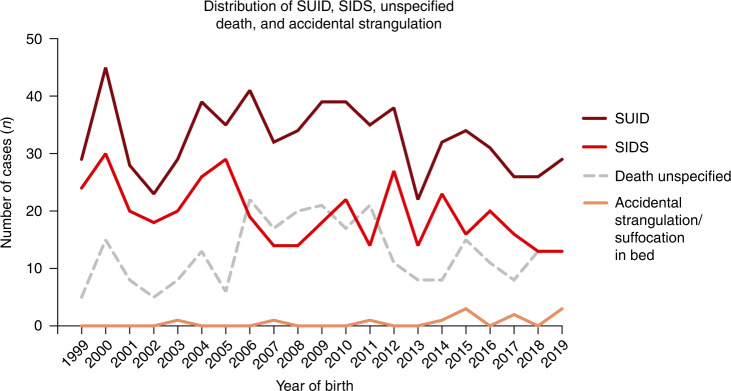
- Of 611 SUID cases, 60% were SIDS (n = 381), 11 were accidental strangulation in bed, and 219 were unspecified cause; postneonatal mortality rate was 0.8 per 1000 live-born infants.
Methods
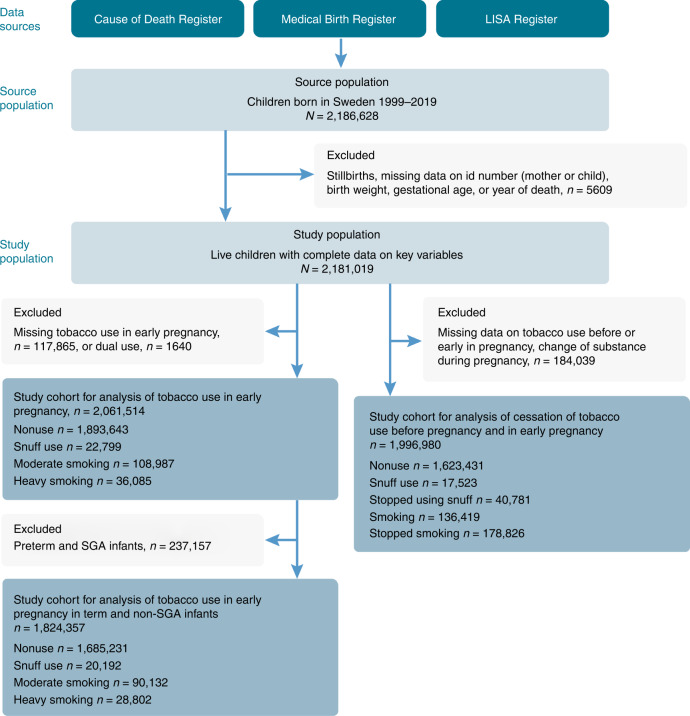
- Population-based register study of all live-born infants in Sweden born 1999–2019 with information on tobacco exposure in early pregnancy; main analyses included n = 2,061,514 births, and cessation analyses included n = 1,996,980 live births.
- Self-reported tobacco use at the antenatal booking was categorized as nonuse, snuff use, moderate smoking (1–9 cigarettes/day), or heavy smoking (≥10 cigarettes/day); cessation categories combined use 3 months before pregnancy with use in early pregnancy.
- Multiple logistic regression estimated crude and adjusted odds ratios with 95% CIs; adjusted model 1 included maternal age, parity, cohabitant with father-to-be, maternal education, and mother’s country of birth; model 2 additionally adjusted for gestational age and birth weight for gestational age. Outcomes were postneonatal mortality (28–364 days), SIDS (ICD-10 R95), and SUID (SIDS, unspecified cause R99, or strangulation/suffocation in bed W75).
Limitations
- Stated: diagnoses came from the Cause of Death Register without medical-record validation, and crime scene investigations are not routinely performed in Sweden, so some accidental strangulation/suffocation could have been misclassified as SIDS.
- Stated: self-reported tobacco use was not validated by cotinine levels, number of snuff pouches per day was unavailable, and exact quit timing between 3 months before pregnancy and the antenatal booking was unknown.
- Stated: causal conclusions are limited by lack of information on alcohol/substance use and prenatal/postnatal environmental tobacco smoke, residual confounding, and inability to conduct sibling/family designs due to limited power; the paper also notes possible collider stratification bias from stratifying on gestational age and birth weight.
Model-written summary. Check it against the paper before relying on it.
Integrity signals
Registry
Cites
Statistics
Figures
Verification
Claims the paper makes
39 Own result · 16 No full text of the sources · 16 Not checked yet · 11 Own method · 11 Own interpretation · 2 Sources not found · 2 Check pending · 1 No basis given
A result the paper reports from its own data — it cites no other source for it, so there is none to check. The quote shows it is in the paper.
In the paper
“Cessation of smoking and snuff use before the antenatal booking was associated with lower risks of SIDS and SUID.”
§ Association of maternal snuff use and smoking with Sudden Infant Death Syndrome: a national register study > Discussion
plainstates an association- Asserted: passes — The authors put it forward as true.
- Checkable: passes — It can be checked against evidence.
- Load-bearing: passes — The paper’s conclusions depend on it.
- Based: passes — The paper gives a reason why it holds.
A result the paper reports from its own data — it cites no other source for it, so there is none to check. The quote shows it is in the paper.
In the paper
“Maternal smoking was also associated with higher risk of SIDS, aORs were 4.31 (95% CI: 3.26–5.70) and 7.03 (95% CI: 5.04–9.79) for moderate and heavy smoking, respectively.”
§ Association of maternal snuff use and smoking with Sudden Infant Death Syndrome: a national register study > Results
plainstates an association- Asserted: passes — The authors put it forward as true.
- Checkable: passes — It can be checked against evidence.
- Load-bearing: passes — The paper’s conclusions depend on it.
- Based: passes — The paper gives a reason why it holds.
A result the paper reports from its own data — it cites no other source for it, so there is none to check. The quote shows it is in the paper.
In the paper
“Maternal smoking was also associated with higher risk of SUID, with aORs 3.20 (95% CI: 2.53–4.05) and 5.44 (95% CI: 4.10–7.22) for moderate and heavy smoking, respectively.”
§ Association of maternal snuff use and smoking with Sudden Infant Death Syndrome: a national register study > Results
plainstates an association- Asserted: passes — The authors put it forward as true.
- Checkable: passes — It can be checked against evidence.
- Load-bearing: passes — The paper’s conclusions depend on it.
- Based: passes — The paper gives a reason why it holds.
A result the paper reports from its own data — it cites no other source for it, so there is none to check. The quote shows it is in the paper.
In the paper
“Cessation of smoking and snuff use before the antenatal booking was associated with lower risks of SIDS and SUID compared to that of continuous usage.”
§ Association of maternal snuff use and smoking with Sudden Infant Death Syndrome: a national register study > Abstract > Results
plainstates an association- Asserted: passes — The authors put it forward as true.
- Checkable: passes — It can be checked against evidence.
- Load-bearing: passes — The paper’s conclusions depend on it.
- Based: passes — The paper gives a reason why it holds.
A result the paper reports from its own data — it cites no other source for it, so there is none to check. The quote shows it is in the paper.
In the paper
“In infants of mothers who had stopped using snuff or smoking before the antenatal booking, risks of SUID was substantially lower, aOR 1.37 (95% CI: 0.73–2.58) and aOR 1.29 (95% CI: 0.95–1.74), respectively (Table 4).”
§ Association of maternal snuff use and smoking with Sudden Infant Death Syndrome: a national register study > Results
plainstates an association- Asserted: passes — The authors put it forward as true.
- Checkable: passes — It can be checked against evidence.
- Load-bearing: unclear — It is unclear whether the paper’s conclusions depend on it.
- Based: passes — The paper gives a reason why it holds.
A result the paper reports from its own data — it cites no other source for it, so there is none to check. The quote shows it is in the paper.
In the paper
“Moderate smoker | 112 (0.10) | 4.94 (3.98–6.13) | 3.20 (2.53–4.05) | 2.87 (2.26–3.63)”
§ Association of maternal snuff use and smoking with Sudden Infant Death Syndrome: a national register study > Results
plainstates an associationn = 611- Asserted: passes — The authors put it forward as true.
- Checkable: passes — It can be checked against evidence.
- Load-bearing: passes — The paper’s conclusions depend on it.
- Based: passes — The paper gives a reason why it holds.
A result the paper reports from its own data — it cites no other source for it, so there is none to check. The quote shows it is in the paper.
In the paper
“Cessation of smoking and snuff use before the antenatal booking was associated with lower risks of SIDS and SUID compared to that of continuous usage.”
§ Association of maternal snuff use and smoking with Sudden Infant Death Syndrome: a national register study > Abstract > Results
plainstates an association- Asserted: passes — The authors put it forward as true.
- Checkable: passes — It can be checked against evidence.
- Load-bearing: passes — The paper’s conclusions depend on it.
- Based: passes — The paper gives a reason why it holds.
A result the paper reports from its own data — it cites no other source for it, so there is none to check. The quote shows it is in the paper.
In the paper
“Heavy smoker | 76 (0.21) | 9.50 (7.34–12.3) | 5.44 (4.10–7.22) | 4.66 (3.50–6.19)”
§ Association of maternal snuff use and smoking with Sudden Infant Death Syndrome: a national register study > Results
plainstates an association- Asserted: passes — The authors put it forward as true.
- Checkable: passes — It can be checked against evidence.
- Load-bearing: passes — The paper’s conclusions depend on it.
- Based: passes — The paper gives a reason why it holds.
A result the paper reports from its own data — it cites no other source for it, so there is none to check. The quote shows it is in the paper.
In the paper
“Heavy smoker | 63 (0.17) | 14.9 (11.1–20.1) | 7.03 (5.04–9.79) | 6.26 (4.48–8.75)”
§ Association of maternal snuff use and smoking with Sudden Infant Death Syndrome: a national register study > Results
plainstates an associationn = 381- Asserted: passes — The authors put it forward as true.
- Checkable: passes — It can be checked against evidence.
- Load-bearing: passes — The paper’s conclusions depend on it.
- Based: passes — The paper gives a reason why it holds.
A result the paper reports from its own data — it cites no other source for it, so there is none to check. The quote shows it is in the paper.
In the paper
“Maternal smoking was also associated with higher risk of SIDS, aORs were 4.31 (95% CI: 3.26–5.70) and 7.03 (95% CI: 5.04–9.79) for moderate and heavy smoking, respectively.”
§ Association of maternal snuff use and smoking with Sudden Infant Death Syndrome: a national register study > Results
plainstates an association- Asserted: passes — The authors put it forward as true.
- Checkable: passes — It can be checked against evidence.
- Load-bearing: passes — The paper’s conclusions depend on it.
- Based: passes — The paper gives a reason why it holds.
- It may state two separate claims as one. 25
- The quote only partly states this claim. 2
- Probably not a substantial claim. 26
A result the paper reports from its own data — it cites no other source for it, so there is none to check. The quote shows it is in the paper.
In the paper
“Heavy smoking was associated with the highest risks.”
§ Association of maternal snuff use and smoking with Sudden Infant Death Syndrome: a national register study > Abstract > Results
plainstates an association- Asserted: passes — The authors put it forward as true.
- Checkable: passes — It can be checked against evidence.
- Load-bearing: passes — The paper’s conclusions depend on it.
- Based: passes — The paper gives a reason why it holds.
It may state two separate claims as one. The quote only partly states this claim.
A result the paper reports from its own data — it cites no other source for it, so there is none to check. The quote shows it is in the paper.
In the paper
“However, among infants of mothers who had stopped using snuff before the antenatal booking the risk of SIDS was lower but still higher compared to that of nonusers, aOR 2.13 (95% CI: 1.04–4.34).”
§ Association of maternal snuff use and smoking with Sudden Infant Death Syndrome: a national register study > Results
plainstates an association- Asserted: passes — The authors put it forward as true.
- Checkable: passes — It can be checked against evidence.
- Load-bearing: passes — The paper’s conclusions depend on it.
- Based: passes — The paper gives a reason why it holds.
It may state two separate claims as one.
A result the paper reports from its own data — it cites no other source for it, so there is none to check. The quote shows it is in the paper.
In the paper
“The risks of snuff use and moderate smoking were of similar magnitude.”
§ Association of maternal snuff use and smoking with Sudden Infant Death Syndrome: a national register study > Abstract > Results
plain- Asserted: passes — The authors put it forward as true.
- Checkable: passes — It can be checked against evidence.
- Load-bearing: passes — The paper’s conclusions depend on it.
- Based: passes — The paper gives a reason why it holds.
The quote only partly states this claim.
A result the paper reports from its own data — it cites no other source for it, so there is none to check. The quote shows it is in the paper.
In the paper
“There were a total of 611 cases of SUID.”
§ Association of maternal snuff use and smoking with Sudden Infant Death Syndrome: a national register study > Results
plainn = 611- Asserted: passes — The authors put it forward as true.
- Checkable: passes — It can be checked against evidence.
- Load-bearing: fails — The paper’s conclusions may not depend on it.
- Based: passes — The paper gives a reason why it holds.
Probably not a substantial claim. The paper’s conclusions may not depend on it.
A result the paper reports from its own data — it cites no other source for it, so there is none to check. The quote shows it is in the paper.
In the paper
“In the cohort, only 0.2 per 1000 live-born infants died of SIDS and <7% of women smoked and only 1% used snuff in pregnancy.”
§ Association of maternal snuff use and smoking with Sudden Infant Death Syndrome: a national register study > Discussion
plain- Asserted: passes — The authors put it forward as true.
- Checkable: passes — It can be checked against evidence.
- Load-bearing: fails — The paper’s conclusions may not depend on it.
- Based: passes — The paper gives a reason why it holds.
Probably not a substantial claim. The paper’s conclusions may not depend on it.
A result the paper reports from its own data — it cites no other source for it, so there is none to check. The quote shows it is in the paper.
In the paper
“The associations were attenuated after adjustment for possible confounders in all analyses and were most pronounced in the analyses of maternal smoking (Table 3).”
§ Association of maternal snuff use and smoking with Sudden Infant Death Syndrome: a national register study > Results
plainstates an association- Asserted: passes — The authors put it forward as true.
- Checkable: passes — It can be checked against evidence.
- Load-bearing: passes — The paper’s conclusions depend on it.
- Based: passes — The paper gives a reason why it holds.
It may state two separate claims as one.
A result the paper reports from its own data — it cites no other source for it, so there is none to check. The quote shows it is in the paper.
In the paper
“Of these, 60% were due to SIDS (n = 381), 11 cases of accidental strangulation in bed, and 219 death by unspecified cause.”
§ Association of maternal snuff use and smoking with Sudden Infant Death Syndrome: a national register study > Results
plainn = 611- Asserted: passes — The authors put it forward as true.
- Checkable: passes — It can be checked against evidence.
- Load-bearing: fails — The paper’s conclusions may not depend on it.
- Based: passes — The paper gives a reason why it holds.
Probably not a substantial claim. The paper’s conclusions may not depend on it.
A result the paper reports from its own data — it cites no other source for it, so there is none to check. The quote shows it is in the paper.
In the paper
“In the cohort, only 0.2 per 1000 live-born infants died of SIDS and <7% of women smoked and only 1% used snuff in pregnancy.”
§ Association of maternal snuff use and smoking with Sudden Infant Death Syndrome: a national register study > Discussion
plain- Asserted: passes — The authors put it forward as true.
- Checkable: passes — It can be checked against evidence.
- Load-bearing: fails — The paper’s conclusions may not depend on it.
- Based: passes — The paper gives a reason why it holds.
Probably not a substantial claim. The paper’s conclusions may not depend on it. It may state two separate claims as one.
A result the paper reports from its own data — it cites no other source for it, so there is none to check. The quote shows it is in the paper.
In the paper
“The highest risks were found among infants of heavy smokers, with a more than sevenfold higher risk of SIDS compared to that of nonusers.”
§ Association of maternal snuff use and smoking with Sudden Infant Death Syndrome: a national register study > Discussion
plainstates an association- Asserted: passes — The authors put it forward as true.
- Checkable: passes — It can be checked against evidence.
- Load-bearing: passes — The paper’s conclusions depend on it.
- Based: passes — The paper gives a reason why it holds.
It may state two separate claims as one.
A result the paper reports from its own data — it cites no other source for it, so there is none to check. The quote shows it is in the paper.
In the paper
“Missing mandatory education, as well as being a teenage mother, was highly associated with both tobacco use in pregnancy, especially heavy smoking, and risk of postnatal death and SIDS.”
§ Association of maternal snuff use and smoking with Sudden Infant Death Syndrome: a national register study > Discussion > Strengths and limitations
boostedstates an association- Asserted: passes — The authors put it forward as true.
- Checkable: passes — It can be checked against evidence.
- Load-bearing: unclear — It is unclear whether the paper’s conclusions depend on it.
- Based: passes — The paper gives a reason why it holds.
It may state two separate claims as one.
In the paper
“Covariates were chosen based on their association with both tobacco use in pregnancy and neonatal death in previous research.2”
§ Association of maternal snuff use and smoking with Sudden Infant Death Syndrome: a national register study > Methods > Covariates
What the sources say
- Not checked — no full text of the sourcecites [2] Cnattingius, S. The epidemiology of smoking during pregnancy: smoking prevalence, maternal characteristics, and pregnancy outcomes. Nicotine Tob. Res. 6(Suppl 2), S125–S140 (2004). source
plainstates an association- Asserted: passes — The authors put it forward as true.
- Checkable: passes — It can be checked against evidence.
- Load-bearing: passes — The paper’s conclusions depend on it.
- Based: passes — The paper gives a reason why it holds.
Probably not a substantial claim.
In the paper
“Animal studies of prenatal nicotine exposure have shown similar disturbances in the cardiorespiratory control as seen in infants exposed to smoking in pregnancy, which suggests that nicotine is involved in the mechanisms behind smoking-related risks of SIDS.5”
§ Association of maternal snuff use and smoking with Sudden Infant Death Syndrome: a national register study > Introduction
What the sources say
- Not checked — no full text of the sourcecites [5] Hafstrom, O., Milerad, J., Sandberg, K. L. & Sundell, H. W. Cardiorespiratory effects of nicotine exposure during development. Respir. Physiol. Neurobiol. 149, 325–341 (2005). source
hedgedstates a possible cause- Asserted: passes — The authors put it forward as true.
- Checkable: passes — It can be checked against evidence.
- Load-bearing: fails — The paper’s conclusions may not depend on it.
- Based: passes — The paper gives a reason why it holds.
Probably not a substantial claim. The paper’s conclusions may not depend on it. It may state two separate claims as one.
In the paper
“As nicotine-acetylcholine receptors (nAChRs) are present as early as gestational week 4–5 in fetal development, before most women are aware of their pregnancy, nicotine may carry out teratogenic effects by binding these receptors, induce apoptosis, and affect cell programming.23”
§ Association of maternal snuff use and smoking with Sudden Infant Death Syndrome: a national register study > Discussion
What the sources say
- Not checked — no full text of the sourcecites [23] Slotkin, T. A. Fetal nicotine or cocaine exposure: which one is worse? J. Pharmacol. Exp. Ther. 285, 931–945 (1998). source
hedgedstates a possible cause- Asserted: passes — The authors put it forward as true.
- Checkable: passes — It can be checked against evidence.
- Load-bearing: fails — The paper’s conclusions may not depend on it.
- Based: passes — The paper gives a reason why it holds.
Probably not a substantial claim. The paper’s conclusions may not depend on it. It may state two separate claims as one.
In the paper
“In Sweden, unexpected infant death is thoroughly investigated with anamnesis, medical history, examination, and laboratory testing. However, in contrast to some others countries crime scene investigations are not routinely performed in Sweden.17”
§ Association of maternal snuff use and smoking with Sudden Infant Death Syndrome: a national register study > Methods > Post neonatal death, SIDS, and SUID
What the sources say
- Not matchedcites [17] The National Board of Health and Welfare, Sweden. Plötslig Oväntad död hos Spädbarn (The National Board of Health and Welfare, 2016).
Couldn’t be matched to a paper in Crossref, so it can’t be checked.
plain- Asserted: passes — The authors put it forward as true.
- Checkable: passes — It can be checked against evidence.
- Load-bearing: fails — The paper’s conclusions may not depend on it.
- Based: passes — The paper gives a reason why it holds.
Probably not a substantial claim. The paper’s conclusions may not depend on it.
- Not matched
None of the sources cited for this claim have been checked yet.
In the paper
“Although the risk of SIDS is multifactorial, maternal smoking, following sleeping position, remains the strongest modifiable risk factor for SIDS in developed countries.1,4”
§ Association of maternal snuff use and smoking with Sudden Infant Death Syndrome: a national register study > Introduction
What the sources say
- Not checked yetcites [1] Kinney, H. C. & Thach, B. T. The sudden infant death syndrome. N. Engl. J. Med. 361, 795–805 (2009). source
Checked before — its earlier verdict is held back until a new check runs.
- Not checked — no full text of the sourcecites [4] Moon, R. Y. & Task Force on Sudden Infant Death Syndrome. SIDS and other sleep-related infant deaths: evidence base for 2016 updated recommendations for a safe infant sleeping environment. Pediatrics 138, e20162940 (2016). source
plainstates an association- Asserted: passes — The authors put it forward as true.
- Checkable: passes — It can be checked against evidence.
- Load-bearing: fails — The paper’s conclusions may not depend on it.
- Based: passes — The paper gives a reason why it holds.
Probably not a substantial claim. The paper’s conclusions may not depend on it.
- Not checked yet
In the paper
“Further, snuff use in pregnancy is associated with increased risk of preterm birth, but only with modest effects on birth weight,25 which may explain why the risk of SIDS associated with snuff use was only slightly attenuated when adjusting for preterm and SGA births.”
§ Association of maternal snuff use and smoking with Sudden Infant Death Syndrome: a national register study > Discussion
What the sources say
- Not checked — no full text of the sourcecites [25] Baba, S., Wikstrom, A. K., Stephansson, O. & Cnattingius, S. Changes in snuff and smoking habits in Swedish pregnant women and risk for small for gestational age births. BJOG 120, 456–462 (2013). source
plainstates an association- Asserted: passes — The authors put it forward as true.
- Checkable: passes — It can be checked against evidence.
- Load-bearing: passes — The paper’s conclusions depend on it.
- Based: passes — The paper gives a reason why it holds.
It may state two separate claims as one.
None of the sources cited for this claim have been checked yet.
In the paper
“Maternal smoking is one of the most important preventable risk factors for infant morbidity and mortality and associated with increased risk of Sudden Infant Death Syndrome (SIDS).1,2”
§ Association of maternal snuff use and smoking with Sudden Infant Death Syndrome: a national register study > Introduction
What the sources say
- Not checked yetcites [1] Kinney, H. C. & Thach, B. T. The sudden infant death syndrome. N. Engl. J. Med. 361, 795–805 (2009). source
Checked before — its earlier verdict is held back until a new check runs.
- Not checked — no full text of the sourcecites [2] Cnattingius, S. The epidemiology of smoking during pregnancy: smoking prevalence, maternal characteristics, and pregnancy outcomes. Nicotine Tob. Res. 6(Suppl 2), S125–S140 (2004). source
plainstates an association- Asserted: passes — The authors put it forward as true.
- Checkable: passes — It can be checked against evidence.
- Load-bearing: passes — The paper’s conclusions depend on it.
- Based: passes — The paper gives a reason why it holds.
Probably not a substantial claim.
- Not checked yet
What the paper did — it cites no source for this, so there is none to check. The quote shows it is in the paper.
In the paper
“To examine the potential effect of missing information on tobacco use, we also conducted analyses assuming the extreme cases that all missing values were either related to tobacco users or nonusers.”
§ Association of maternal snuff use and smoking with Sudden Infant Death Syndrome: a national register study > Methods > Statistical analyses
plain- Asserted: passes — The authors put it forward as true.
- Checkable: passes — It can be checked against evidence.
- Load-bearing: fails — The paper’s conclusions may not depend on it.
- Based: passes — The paper gives a reason why it holds.
Probably not a substantial claim. The paper’s conclusions may not depend on it.
None of the sources cited for this claim have been checked yet.
In the paper
“Autopsy of the infant is routinely performed by the forensic pathologist and the diagnosis reported to the Cause of Death Register.18”
§ Association of maternal snuff use and smoking with Sudden Infant Death Syndrome: a national register study > Methods > Post neonatal death, SIDS, and SUID
What the sources say
- Not checked yetcites [18] Brooke, H. L. et al. The Swedish cause of death register. Eur. J. Epidemiol. 32, 765–773 (2017). source
Checked before — its earlier verdict is held back until a new check runs.
plain- Asserted: passes — The authors put it forward as true.
- Checkable: passes — It can be checked against evidence.
- Load-bearing: passes — The paper’s conclusions depend on it.
- Based: passes — The paper gives a reason why it holds.
Probably not a substantial claim. It may state two separate claims as one.
- Not checked yet
None of the sources cited for this claim have been checked yet.
In the paper
“The Cause of Death Register includes all deaths of Swedish citizens with annual updates, while LISA includes information on education for 98% of Swedish residents.16”
§ Association of maternal snuff use and smoking with Sudden Infant Death Syndrome: a national register study > Methods > Study population
What the sources say
- Not checked yetcites [16] Ludvigsson, J. F., Svedberg, P., Olen, O., Bruze, G. & Neovius, M. The longitudinal integrated database for health insurance and labour market studies (LISA) and its use in medical research. Eur. J. Epidemiol. 34, 423–437 (2019). source
Checked before — its earlier verdict is held back until a new check runs.
plain- Asserted: passes — The authors put it forward as true.
- Checkable: passes — It can be checked against evidence.
- Load-bearing: fails — The paper’s conclusions may not depend on it.
- Based: passes — The paper gives a reason why it holds.
Probably not a substantial claim. The paper’s conclusions may not depend on it. It may state two separate claims as one.
- Not checked yet
A claim is checked only against the cited paper’s full text, never its abstract, and none is available for its sources.
In the paper
“maternal snuff use has been associated with increased risk of stillbirth, preterm birth, neonatal apnea, and disturbed heart rate variability.12–15”
§ Association of maternal snuff use and smoking with Sudden Infant Death Syndrome: a national register study > Introduction
What the sources say
- Not checked — no full text of the sourcecites [12] Gunnerbeck, A., Wikstrom, A. K., Bonamy, A. K., Wickstrom, R. & Cnattingius, S. Relationship of maternal snuff use and cigarette smoking with neonatal apnea. Pediatrics 128, 503–509 (2011). source
- Not checked — no full text of the sourcecites [13] Dahlin, S., Gunnerbeck, A., Wikstrom, A. K., Cnattingius, S. & Edstedt Bonamy, A. K. Maternal tobacco use and extremely premature birth - a population-based cohort study. BJOG 123, 1938–1946 (2016). source
- Not checked — no full text of the sourcecites [14] Baba, S., Wikstrom, A. K., Stephansson, O. & Cnattingius, S. Influence of snuff and smoking habits in early pregnancy on risks for stillbirth and early neonatal mortality. Nicotine Tob. Res. 16, 78–83 (2014). source
- Not checked — no full text of the sourcecites [15] Nordenstam, F. et al. Prenatal exposure to snus alters heart rate variability in the infant. Nicotine Tob. Res. 19, 797–803 (2017). source
plainstates an association- Asserted: passes — The authors put it forward as true.
- Checkable: passes — It can be checked against evidence.
- Load-bearing: passes — The paper’s conclusions depend on it.
- Based: passes — The paper gives a reason why it holds.
It may state two separate claims as one.
In the paper
“In Sweden, unexpected infant death is thoroughly investigated with anamnesis, medical history, examination, and laboratory testing. However, in contrast to some others countries crime scene investigations are not routinely performed in Sweden.17”
§ Association of maternal snuff use and smoking with Sudden Infant Death Syndrome: a national register study > Methods > Post neonatal death, SIDS, and SUID
What the sources say
- Not matchedcites [17] The National Board of Health and Welfare, Sweden. Plötslig Oväntad död hos Spädbarn (The National Board of Health and Welfare, 2016).
Couldn’t be matched to a paper in Crossref, so it can’t be checked.
plain- Asserted: passes — The authors put it forward as true.
- Checkable: passes — It can be checked against evidence.
- Load-bearing: fails — The paper’s conclusions may not depend on it.
- Based: passes — The paper gives a reason why it holds.
Probably not a substantial claim. The paper’s conclusions may not depend on it.
- Not matched
None of the sources cited for this claim have been checked yet.
In the paper
“Swedish snuff is an oral moist powder and contains equally high levels of nicotine as cigarettes, but no combustion products and only low levels of tobacco-specific nitrosamines.8”
§ Association of maternal snuff use and smoking with Sudden Infant Death Syndrome: a national register study > Introduction
What the sources say
- Not checked yetcites [8] Rutqvist, L. E., Curvall, M., Hassler, T., Ringberger, T. & Wahlberg, I. Swedish snus and the GothiaTek(R) standard. Harm Reduct. J. 8, 11 (2011). source
Checked before — its earlier verdict is held back until a new check runs.
plain- Asserted: passes — The authors put it forward as true.
- Checkable: passes — It can be checked against evidence.
- Load-bearing: unclear — It is unclear whether the paper’s conclusions depend on it.
- Based: passes — The paper gives a reason why it holds.
It may state two separate claims as one.
- Not checked yet
In the paper
“Due to more advanced forensic techniques in recent years, there has been a diagnostic shift in many countries with increased reporting of accidental suffocation and strangulation in bed and a subsequent decline of reported cases of SIDS.3”
§ Association of maternal snuff use and smoking with Sudden Infant Death Syndrome: a national register study > Introduction
What the sources say
- Not checked — no full text of the sourcecites [3] American Academy of Pediatrics Task Force on Sudden Infant Death Syndrome. The changing concept of sudden infant death syndrome: diagnostic coding shifts, controversies regarding the sleeping environment, and new variables to consider in reducing risk. Pediatrics 116, 1245–1255 (2005). source
plainstates a cause- Asserted: passes — The authors put it forward as true.
- Checkable: passes — It can be checked against evidence.
- Load-bearing: fails — The paper’s conclusions may not depend on it.
- Based: passes — The paper gives a reason why it holds.
Probably not a substantial claim. The paper’s conclusions may not depend on it. It may state two separate claims as one.
What the paper did — it cites no source for this, so there is none to check. The quote shows it is in the paper.
In the paper
“The major strength with our study is the large study population of two million births and the nationwide design.”
§ Association of maternal snuff use and smoking with Sudden Infant Death Syndrome: a national register study > Discussion > Strengths and limitations
plain- Asserted: passes — The authors put it forward as true.
- Checkable: passes — It can be checked against evidence.
- Load-bearing: passes — The paper’s conclusions depend on it.
- Based: passes — The paper gives a reason why it holds.
Probably not a substantial claim. It may state two separate claims as one.
What the paper did — it cites no source for this, so there is none to check. The quote shows it is in the paper.
In the paper
“Third, we had information on tobacco use 3 months before pregnancy and at the antenatal booking, but we lack information on when in that time span the women stopped their tobacco use.”
§ Association of maternal snuff use and smoking with Sudden Infant Death Syndrome: a national register study > Discussion > Strengths and limitations
plain- Asserted: passes — The authors put it forward as true.
- Checkable: passes — It can be checked against evidence.
- Load-bearing: unclear — It is unclear whether the paper’s conclusions depend on it.
- Based: passes — The paper gives a reason why it holds.
It may state two separate claims as one.
None of the sources cited for this claim have been checked yet.
In the paper
“This is in agreement with other studies on NRT use in pregnancy and smoke cessation lacking strong evidence for successful smoke cessation with NRT use in pregnancy.31,36”
§ Association of maternal snuff use and smoking with Sudden Infant Death Syndrome: a national register study > Discussion > Strengths and limitations
What the sources say
- Not checked yetcites [31] Claire, R. et al. Pharmacological interventions for promoting smoking cessation during pregnancy. Cochrane Database Syst. Rev. 3, CD010078 (2020). source
- Not checked — no full text of the sourcecites [36] Coleman, T. et al. A randomized trial of nicotine-replacement therapy patches in pregnancy. N. Engl. J. Med. 366, 808–818 (2012). source
plain- Asserted: passes — The authors put it forward as true.
- Checkable: passes — It can be checked against evidence.
- Load-bearing: fails — The paper’s conclusions may not depend on it.
- Based: passes — The paper gives a reason why it holds.
Probably not a substantial claim. The paper’s conclusions may not depend on it.
What the paper did — it cites no source for this, so there is none to check. The quote shows it is in the paper.
In the paper
“By stratifying for gestational age and birth weight, we may have introduced collider stratification bias, suggesting those results must be interpreted with caution.”
§ Association of maternal snuff use and smoking with Sudden Infant Death Syndrome: a national register study > Discussion
hedgedstates a possible cause- Asserted: passes — The authors put it forward as true.
- Checkable: passes — It can be checked against evidence.
- Load-bearing: passes — The paper’s conclusions depend on it.
- Based: passes — The paper gives a reason why it holds.
It may state two separate claims as one.
None of the sources cited for this claim have been checked yet.
In the paper
“However, all infant deaths are thoroughly investigated in Sweden and the Cause of Death Register has been validated.18”
§ Association of maternal snuff use and smoking with Sudden Infant Death Syndrome: a national register study > Discussion > Strengths and limitations
What the sources say
- Not checked yetcites [18] Brooke, H. L. et al. The Swedish cause of death register. Eur. J. Epidemiol. 32, 765–773 (2017). source
Checked before — its earlier verdict is held back until a new check runs.
plain- Asserted: passes — The authors put it forward as true.
- Checkable: passes — It can be checked against evidence.
- Load-bearing: passes — The paper’s conclusions depend on it.
- Based: passes — The paper gives a reason why it holds.
It may state two separate claims as one.
- Not checked yet
None of the sources cited for this claim have been checked yet.
In the paper
“Snuff use leads to higher accumulated nicotine levels and a more continuous exposure on the nicotine receptors, compared with short, intermittent exposure in smoking, which may explain differences between effects of smoking and snuff use.29,30”
§ Association of maternal snuff use and smoking with Sudden Infant Death Syndrome: a national register study > Discussion
What the sources say
- Not checked — no full text of the sourcecites [29] Benowitz, N. L. Systemic absorption and effects of nicotine from smokeless tobacco. Adv. Dent. Res. 11, 336–341 (1997). source
- Not checked yetcites [30] Benowitz, N. L., Zevin, S. & Jacob, P. 3rd Sources of variability in nicotine and cotinine levels with use of nicotine nasal spray, transdermal nicotine, and cigarette smoking. Br. J. Clin. Pharmacol. 43, 259–267 (1997). source
Checked before — its earlier verdict is held back until a new check runs.
plainstates a cause- Asserted: passes — The authors put it forward as true.
- Checkable: passes — It can be checked against evidence.
- Load-bearing: passes — The paper’s conclusions depend on it.
- Based: passes — The paper gives a reason why it holds.
It may state two separate claims as one.
None of the sources cited for this claim have been checked yet.
In the paper
“The risk of SIDS is multifactorial, and prone sleeping position, bed sharing, and prenatal and postnatal exposure to tobacco smoke are regarded as important risk factors.1,26”
§ Association of maternal snuff use and smoking with Sudden Infant Death Syndrome: a national register study > Discussion
What the sources say
- Not checked yetcites [1] Kinney, H. C. & Thach, B. T. The sudden infant death syndrome. N. Engl. J. Med. 361, 795–805 (2009). source
Checked before — its earlier verdict is held back until a new check runs.
- Not checked yetcites [26] Alm, B. et al. A case-control study of smoking and sudden infant death syndrome in the Scandinavian countries, 1992 to 1995. The Nordic Epidemiological SIDS Study. Arch. Dis. Child. 78, 329–334 (1998). source
Checked before — its earlier verdict is held back until a new check runs.
plainstates an association- Asserted: passes — The authors put it forward as true.
- Checkable: passes — It can be checked against evidence.
- Load-bearing: fails — The paper’s conclusions may not depend on it.
- Based: passes — The paper gives a reason why it holds.
Probably not a substantial claim. The paper’s conclusions may not depend on it. It may state two separate claims as one.
- Not checked yet
In the paper
“The validation study also showed that women using NRT in pregnancy continued to consume snuff. Among the women who stopped using snuff, none was using NRT.35”
§ Association of maternal snuff use and smoking with Sudden Infant Death Syndrome: a national register study > Discussion > Strengths and limitations
What the sources say
- Not checked — no full text of the sourcecites [35] Gunnerbeck, A., Raaschou, P., Cnattingius, S., Edstedt Bonamy, A. K. & Wickstrom, R. Maternal snuff use and cotinine in late pregnancy-a validation study. Acta Obstet. Gynecol. Scand. 97, 1373–1380 (2018). source
plainstates an association- Asserted: passes — The authors put it forward as true.
- Checkable: passes — It can be checked against evidence.
- Load-bearing: unclear — It is unclear whether the paper’s conclusions depend on it.
- Based: passes — The paper gives a reason why it holds.
It may state two separate claims as one.
A statement the paper makes itself — it cites no source for it, so there is none to check. The quote shows it is in the paper.
In the paper
“However, safety studies of NRT use in pregnancy have not been conclusive due to lack of compliance to NRT.”
§ Association of maternal snuff use and smoking with Sudden Infant Death Syndrome: a national register study > Discussion > Strengths and limitations
plain- Asserted: passes — The authors put it forward as true.
- Checkable: passes — It can be checked against evidence.
- Load-bearing: fails — The paper’s conclusions may not depend on it.
- Based: passes — The paper gives a reason why it holds.
Probably not a substantial claim. The paper’s conclusions may not depend on it.
None of the sources cited for this claim have been checked yet.
In the paper
“Nevertheless, crime scene investigations are not routinely performed in Sweden following SIDS/SUID17,33 and potentially cases of accidental and strangulation in bed could have been misclassified as SIDS in the current study.33”
§ Association of maternal snuff use and smoking with Sudden Infant Death Syndrome: a national register study > Discussion > Strengths and limitations
What the sources say
- Not matchedcites [17] The National Board of Health and Welfare, Sweden. Plötslig Oväntad död hos Spädbarn (The National Board of Health and Welfare, 2016).
Couldn’t be matched to a paper in Crossref, so it can’t be checked.
- Not checked yetcites [33] Mollborg, P., Wennergren, G., Almqvist, P. & Alm, B. Bed sharing is more common in sudden infant death syndrome than in explained sudden unexpected deaths in infancy. Acta Paediatr. 104, 777–783 (2015). source
Checked before — its earlier verdict is held back until a new check runs.
hedgedstates a possible cause- Asserted: passes — The authors put it forward as true.
- Checkable: passes — It can be checked against evidence.
- Load-bearing: unclear — It is unclear whether the paper’s conclusions depend on it.
- Based: passes — The paper gives a reason why it holds.
It may state two separate claims as one.
- Not matched
In the paper
“The Cochrane systematic review by Clair et al.31 concluded that studies with higher doses of nicotine were needed to study safety.”
§ Association of maternal snuff use and smoking with Sudden Infant Death Syndrome: a national register study > Discussion > Strengths and limitations
What the sources say
- Not checked yetcites [31] Claire, R. et al. Pharmacological interventions for promoting smoking cessation during pregnancy. Cochrane Database Syst. Rev. 3, CD010078 (2020). source
plain- Asserted: passes — The authors put it forward as true.
- Checkable: passes — It can be checked against evidence.
- Load-bearing: fails — The paper’s conclusions may not depend on it.
- Based: passes — The paper gives a reason why it holds.
Probably not a substantial claim. The paper’s conclusions may not depend on it.
What the paper did — it cites no source for this, so there is none to check. The quote shows it is in the paper.
In the paper
“First, the diagnoses were collected from the Cause of Death Register, without further validation through the medical records.”
§ Association of maternal snuff use and smoking with Sudden Infant Death Syndrome: a national register study > Discussion > Strengths and limitations
plain- Asserted: passes — The authors put it forward as true.
- Checkable: passes — It can be checked against evidence.
- Load-bearing: fails — The paper’s conclusions may not depend on it.
- Based: passes — The paper gives a reason why it holds.
Probably not a substantial claim. The paper’s conclusions may not depend on it.
What the paper did — it cites no source for this, so there is none to check. The quote shows it is in the paper.
In the paper
“In addition, we lacked information on the number of snuff pouches consumed daily.”
§ Association of maternal snuff use and smoking with Sudden Infant Death Syndrome: a national register study > Discussion > Strengths and limitations
plain- Asserted: passes — The authors put it forward as true.
- Checkable: passes — It can be checked against evidence.
- Load-bearing: fails — The paper’s conclusions may not depend on it.
- Based: passes — The paper gives a reason why it holds.
Probably not a substantial claim. The paper’s conclusions may not depend on it.
In the paper
“Sibling comparisons or other family design analyses may have helped account for bias due to unmeasured and residual confounding shared by siblings but were not possible to conduct due to limited power.37”
§ Association of maternal snuff use and smoking with Sudden Infant Death Syndrome: a national register study > Discussion > Strengths and limitations
What the sources say
- Not checked yetcites [37] D’Onofrio, B. M., Lahey, B. B., Turkheimer, E. & Lichtenstein, P. Critical need for family-based, quasi-experimental designs in integrating genetic and social science research. Am. J. Public Health 103(Suppl 1), S46–S55 (2013). source
hedged- Asserted: passes — The authors put it forward as true.
- Checkable: passes — It can be checked against evidence.
- Load-bearing: unclear — It is unclear whether the paper’s conclusions depend on it.
- Based: passes — The paper gives a reason why it holds.
It may state two separate claims as one.
In the paper
“The metabolism of nicotine is elevated in pregnancy, which may partly explain why smoke cessation in pregnancy is difficult to obtain with NRT.32”
§ Association of maternal snuff use and smoking with Sudden Infant Death Syndrome: a national register study > Discussion > Strengths and limitations
What the sources say
- Not checked — no full text of the sourcecites [32] Benowitz, N. L. & Jacob, P. 3rd Individual differences in nicotine kinetics and metabolism in humans. NIDA Res. Monogr. 173, 48–64 (1997). source
hedgedstates a possible cause- Asserted: passes — The authors put it forward as true.
- Checkable: passes — It can be checked against evidence.
- Load-bearing: fails — The paper’s conclusions may not depend on it.
- Based: passes — The paper gives a reason why it holds.
Probably not a substantial claim. The paper’s conclusions may not depend on it. It may state two separate claims as one.
A conclusion the paper draws from its own results — it cites no other source for it, so there is none to check. The quote shows it is in the paper.
In the paper
“This is, to our knowledge, the first study exploring snuff use in pregnancy and risk of post neonatal mortality, SIDS, and SUID.”
§ Association of maternal snuff use and smoking with Sudden Infant Death Syndrome: a national register study > Discussion > Strengths and limitations
hedged- Asserted: passes — The authors put it forward as true.
- Checkable: passes — It can be checked against evidence.
- Load-bearing: passes — The paper’s conclusions depend on it.
- Based: fails — The paper may give no reason why it holds.
Probably not a substantial claim. The paper may give no reason why it holds.
A conclusion the paper draws from its own results — it cites no other source for it, so there is none to check. The quote shows it is in the paper.
In the paper
“The widespread use of snuff in Sweden, also in pregnancy, provides a unique opportunity to specifically study the effect of nicotine separated from the effect from other combustion products in smoking.”
§ Association of maternal snuff use and smoking with Sudden Infant Death Syndrome: a national register study > Discussion > Strengths and limitations
plain- Asserted: passes — The authors put it forward as true.
- Checkable: passes — It can be checked against evidence.
- Load-bearing: passes — The paper’s conclusions depend on it.
- Based: passes — The paper gives a reason why it holds.
Probably not a substantial claim.
In the paper
“Most SIDS deaths occur at around 2–4 months of age when the brain and cardiorespiratory systems mature.27”
§ Association of maternal snuff use and smoking with Sudden Infant Death Syndrome: a national register study > Discussion
What the sources say
- Not checked yetcites [27] Trachtenberg, F. L., Haas, E. A., Kinney, H. C., Stanley, C. & Krous, H. F. Risk factor changes for sudden infant death syndrome after initiation of Back-to-Sleep campaign. Pediatrics 129, 630–638 (2012). source
plain- Asserted: passes — The authors put it forward as true.
- Checkable: passes — It can be checked against evidence.
- Load-bearing: fails — The paper’s conclusions may not depend on it.
- Based: passes — The paper gives a reason why it holds.
Probably not a substantial claim. The paper’s conclusions may not depend on it.
In the paper
“The peak plasma concentration between cigarettes and snuff is similar. However, whereas smoking generates short peaks (30 min) of high plasma concentration intermittently during the day, snuff has a slower release and a longer peak duration, 1.5–2 h.29”
§ Association of maternal snuff use and smoking with Sudden Infant Death Syndrome: a national register study > Discussion
What the sources say
- Not checked — no full text of the sourcecites [29] Benowitz, N. L. Systemic absorption and effects of nicotine from smokeless tobacco. Adv. Dent. Res. 11, 336–341 (1997). source
plain- Asserted: passes — The authors put it forward as true.
- Checkable: passes — It can be checked against evidence.
- Load-bearing: passes — The paper’s conclusions depend on it.
- Based: passes — The paper gives a reason why it holds.
It may state two separate claims as one.
The paper relies on this without support.
Nicotine is the common substance in cigarette smoke and snuff.
“Nicotine is the common substance in cigarette smoke and snuff.”
“The common substance in cigarette smoke and snuff is nicotine.”
The paper relies on this without support.
Whether nicotine, in the form of Swedish snuff, increases the risk of post neonatal mortality and SIDS has not previously been studied.
“Whether nicotine, in the form of Swedish snuff, increases the risk of post neonatal mortality and SIDS has to our knowledge not previously been studied.”
The paper relies on this without support.
Preterm or SGA birth is highly associated with tobacco use, post neonatal mortality, and SIDS and potentially on the causal pathway between the exposure and the outcome.
“Preterm or small for gestational age (SGA) birth is highly associated with both tobacco use, post neonatal mortality, and SIDS and potentially on the causal pathway between the exposure and the outcome.”
The paper relies on this without support.
The MBR contains information on demography, maternal reproductive history, pregnancy, delivery, and neonatal period for 98% of all births in Sweden.
“The MBR is a national register containing information on the demography, maternal reproductive history, pregnancy, delivery, and neonatal period for 98% of all births in Sweden.”
The paper relies on this without support.
The common substance in cigarette smoke and snuff is nicotine.
“The common substance in cigarette smoke and snuff is nicotine.”
The paper relies on this without support.
No safe level of prenatal nicotine has been established.
“No safe level of prenatal nicotine has been established.”
The paper relies on this without support.
A proportion of women who used snuff or smoked pre-pregnancy and quit before pregnancy restarted later in pregnancy or in the postpartum period.
“It is also likely that a proportion of women who used snuff or smoked pre-pregnancy and quit before pregnancy restarted later in pregnancy or in the postpartum period.”
Self-check
Percentages, sums and reported differences re-computed from the paper’s own numbers.
Each contradiction between two passages listed here was confirmed by an independent check.
Rated minor: it would not touch a result — a value no result rests on, a p-value that stays on the same side of the significance level, or a conflict that is clerical, resolved elsewhere in the paper, or outside its own findings.
In the paper
“| 29–34 | 670,004 (35.4) | 7078 (31.1) | | 25,094 (23.0) | | 9715 (28.9) | |”
§ Association of maternal snuff use and smoking with Sudden Infant Death Syndrome: a national register study > Methods > Covariates
Reported 28.9 · recomputed 26.922544
Rated minor: it would not touch a result — a value no result rests on, a p-value that stays on the same side of the significance level, or a conflict that is clerical, resolved elsewhere in the paper, or outside its own findings.
In the paper
§ Association of maternal snuff use and smoking with Sudden Infant Death Syndrome: a national register study > Methods > Covariates
“Table: Table 1 Maternal and birth characteristics for tobacco use in early pregnancy, N = 2,061,154.”
§ Association of maternal snuff use and smoking with Sudden Infant Death Syndrome: a national register study > Methods > Study population
“A total of n = 2,061,514 births were included in the analyses with tobacco use in early pregnancy as exposure, Fig. 1.”
Rated minor: it would not touch a result — a value no result rests on, a p-value that stays on the same side of the significance level, or a conflict that is clerical, resolved elsewhere in the paper, or outside its own findings.
In the paper
“| 37–<42 | 875 (0.06) | Reference | 163 (0.02) | Reference | 356 (0.02) | Reference |”
§ Association of maternal snuff use and smoking with Sudden Infant Death Syndrome: a national register study > Results
Reported 381 · recomputed 281
Rated minor: it would not touch a result — a value no result rests on, a p-value that stays on the same side of the significance level, or a conflict that is clerical, resolved elsewhere in the paper, or outside its own findings.
In the paper
§ Association of maternal snuff use and smoking with Sudden Infant Death Syndrome: a national register study > Results
“Maternal smoking was more common among mothers born outside a Nordic country, whereas snuff use was more common among mothers born in a Nordic country.”
§ Association of maternal snuff use and smoking with Sudden Infant Death Syndrome: a national register study > Methods > Covariates
“| Nordic | 1,479,483 (78.2) | 21,203 (93.1) | | 88,765 (81,5) | | 30,747 (85.3) | | | Non-Nordic | 412,381 (21.8) | 1570 (6.9) | | 20,132 (18.5) | | 5314 (14.7) | |”
Citations
Cites
The Swedish cause of death register
Brooke, H. L., Talbäck, M., Hörnblad, J., Johansson, L. A., Ludvigsson, J. F., Druid, H., Feychting, M., & Ljung, R. (2017) · European Journal of Epidemiology · doi:10.1007/s10654-017-0316-1 · Cited by 1,280
Cnattingius, S. (2004) · Nicotine & Tobacco Research · doi:10.1080/14622200410001669187 · Cited by 1,126
Ludvigsson, J. F., Svedberg, P., Olén, O., Bruze, G., & Neovius, M. (2019) · European Journal of Epidemiology · doi:10.1007/s10654-019-00511-8 · Cited by 1,021
Fetal Nicotine or Cocaine Exposure: Which One is Worse?
Slotkin, T. A. (1998) · The Journal of Pharmacology and Experimental Therapeutics · doi:10.1016/s0022-3565(24)37495-6 · Cited by 676
Moon, R. Y., TASK FORCE ON SUDDEN INFANT DEATH SYNDROME, Darnall, R. A., Feldman-Winter, L., Goodstein, M. H., & Hauck, F. R. (2016) · Pediatrics · doi:10.1542/peds.2016-2940 · Cited by 583
Task Force on Sudden Infant Death Syndrome (2005) · Pediatrics · doi:10.1542/peds.2005-1499 · Cited by 526
The Sudden Infant Death Syndrome
Kinney, H. C., & Thach, B. T. (2009) · New England Journal of Medicine · doi:10.1056/nejmra0803836 · Cited by 431
Moon, R. Y., Horne, R. S., & Hauck, F. R. (2007) · The Lancet · doi:10.1016/s0140-6736(07)61662-6 · Cited by 365
Pharmacological interventions for promoting smoking cessation during pregnancy
Coleman, T., Chamberlain, C., Davey, M.-A., Cooper, S. E., & Leonardi-Bee, J. (2015) · Cochrane Database of Systematic Reviews · doi:10.1002/14651858.cd010078.pub2 · Cited by 357
D’Onofrio, B. M., Lahey, B. B., Turkheimer, E., & Lichtenstein, P. (2013) · American Journal of Public Health · doi:10.2105/ajph.2013.301252 · Cited by 343
Self-citationMitchell, E. A., Tuohy, P. G., Brunt, J. M., Thompson, J. M. D., Clements, M. S., Stewart, A. W., Ford, R. P. K., & Taylor, B. J. (1997) · Pediatrics · doi:10.1542/peds.100.5.835 · Cited by 224
Maternal Smoking Before and During Pregnancy and the Risk of Sudden Unexpected Infant Death
Anderson, T. M., Lavista Ferres, J. M., Ren, S. Y., Moon, R. Y., Goldstein, R. D., Ramirez, J.-M., & Mitchell, E. A. (2019) · Pediatrics · doi:10.1542/peds.2018-3325 · Cited by 201
A randomized trial of nicotine-replacement therapy patches in pregnancy.
Coleman, T., Cooper, S., Thornton, J. G., Grainge, M. J., Watts, K., Britton, J., & Lewis, S. (2012) · New England Journal of Medicine · doi:10.1056/nejmoa1109582 · Cited by 190
Pharmacological interventions for promoting smoking cessation during pregnancy
Claire, R., Chamberlain, C., Davey, M.-A., Cooper, S. E., Berlin, I., Leonardi-Bee, J., & Coleman, T. (2020) · Cochrane Database of Systematic Reviews · doi:10.1002/14651858.cd010078.pub3 · Cited by 188
Risk factor changes for sudden infant death syndrome after initiation of Back-to-Sleep campaign
Trachtenberg, F. L., Haas, E. A., Kinney, H. C., Stanley, C., & Krous, H. F. (2012) · Pediatrics · doi:10.1542/peds.2011-1419 · Cited by 186
England, L. J., Aagaard, K., Bloch, M., Conway, K., Cosgrove, K., Grana, R., Gould, T. J., Hatsukami, D., Jensen, F., Kandel, D., et al. (2017) · Neuroscience & Biobehavioral Reviews · doi:10.1016/j.neubiorev.2016.11.013 · Cited by 181
Kulak, J. A., Cornelius, M. E., Fong, G. T., & Giovino, G. A. (2016) · Nicotine & Tobacco Research · doi:10.1093/ntr/ntv228 · Cited by 124
Benowitz, N. L., Zevin, S., & Jacob, P. (1997) · British Journal of Clinical Pharmacology · doi:10.1111/j.1365-2125.1997.00566.x · Cited by 107
Sudden Infant Death Syndrome and Smoking in the United States and Sweden
MacDorman, M. F., Cnattingius, S., Hoffman, H. J., Kramer, M. S., & Haglund, B. (1997) · American Journal of Epidemiology · doi:10.1093/oxfordjournals.aje.a009260 · Cited by 103
Swedish snus and the GothiaTek® standard
Rutqvist, L. E., Curvall, M., Hassler, T., Ringberger, T., & Wahlberg, I. (2011) · Harm Reduction Journal · doi:10.1186/1477-7517-8-11 · Cited by 99
Alm, B., Milerad, J., Wennergren, G., Skjarven, R., Oyen, N., Norvenius, G., Daltveit, A.-K., Helweg-Larsen, K., Markestad, T., & Irgens, L. M. (1998) · Archives of Disease in Childhood · doi:10.1136/adc.78.4.329 · Cited by 86
Cardiorespiratory effects of nicotine exposure during development
Hafström, O., Milerad, J., Sandberg, K. L., & Sundell, H. W. (2005) · Respiratory Physiology & Neurobiology · doi:10.1016/j.resp.2005.05.004 · Cited by 82
Baba, S., Wikström, A., Stephansson, O., & Cnattingius, S. (2013) · BJOG: An International Journal of Obstetrics & Gynaecology · doi:10.1111/1471-0528.12067 · Cited by 80
Vaping in Pregnancy: A Systematic Review
Calder, R., Gant, E., Bauld, L., McNeill, A., Robson, D., & Brose, L. S. (2021) · Nicotine & Tobacco Research · doi:10.1093/ntr/ntab017 · Cited by 67
Systemic Absorption and Effects of Nicotine From Smokeless Tobacco
Benowitz, N. L. (1997) · Advances in Dental Research · doi:10.1177/08959374970110030501 · Cited by 60
Maternal tobacco use and extremely premature birth – a population‐based cohort study
Dahlin, S., Gunnerbeck, A., Wikström, A., Cnattingius, S., & Edstedt Bonamy, A. (2016) · BJOG: An International Journal of Obstetrics & Gynaecology · doi:10.1111/1471-0528.14213 · Cited by 59
Self-citationBaba, S., Wikstrom, A.-K., Stephansson, O., & Cnattingius, S. (2014) · Nicotine & Tobacco Research · doi:10.1093/ntr/ntt117 · Cited by 54
Relationship of Maternal Snuff Use and Cigarette Smoking With Neonatal Apnea
Gunnerbeck, A., Wikström, A.-K., Bonamy, A.-K. E., Wickström, R., & Cnattingius, S. (2011) · Pediatrics · doi:10.1542/peds.2010-3811 · Cited by 51
Self-citationIndividual Differences in Nicotine Kinetics and Metabolism in Humans: (495572006-006)
Benowitz, N. L., & Jacob, P. (1997) · PsycEXTRA Dataset · doi:10.1037/e495572006-006 · Cited by 49
Associations between adolescent socioeducational status and use of snus and smoking
Øverland, S., Tjora, T., Hetland, J., & Aarø, L. E. (2010) · Tobacco Control · doi:10.1136/tc.2009.034512 · Cited by 28
Möllborg, P., Wennergren, G., Almqvist, P., & Alm, B. (2015) · Acta Paediatrica · doi:10.1111/apa.13021 · Cited by 25
Cotinine Validation of Self-Reported Smoking During Pregnancy in the Swedish Medical Birth Register
Mattsson, K., Källén, K., Rignell-Hydbom, A., Lindh, C. H., Jönsson, B. A. G., Gustafsson, P., Olofsson, P., Ivarsson, S. A., & Rylander, L. (2015) · Nicotine & Tobacco Research · doi:10.1093/ntr/ntv087 · Cited by 23
Maternal and obstetrical predictors of sudden infant death syndrome (SIDS)
Friedmann, I., Dahdouh, E. M., Kugler, P., Mimran, G., & Balayla, J. (2017) · The Journal of Maternal-Fetal & Neonatal Medicine · doi:10.1080/14767058.2016.1247265 · Cited by 21
Prenatal Exposure to Snus Alters Heart Rate Variability in the Infant
Nordenstam, F., Lundell, B., Cohen, G., Tessma, M. K., Raaschou, P., & Wickström, R. (2017) · Nicotine & Tobacco Research · doi:10.1093/ntr/ntx035 · Cited by 21
DeVito, E. E., Fagle, T. R., Allen, A. M., Pang, R. D., Petersen, N., Smith, P. H., & Weinberger, A. H. (2021) · Current Addiction Reports · doi:10.1007/s40429-021-00381-9 · Cited by 12
Maternal snuff use and cotinine in late pregnancy—A validation study
Gunnerbeck, A., Raaschou, P., Cnattingius, S., Edstedt Bonamy, A., & Wickström, R. (2018) · Acta Obstetricia et Gynecologica Scandinavica · doi:10.1111/aogs.13410 · Cited by 10
Self-citation
Cited by
Sorted by citations
Yacoub, M. I., Aslanoğlu, A., Khraim, F., Alsharawneh, A., Abdelkader, R. H., Almagharbeh, W. T., Alhejaili, A. A., Alshahrani, B., Sobeh, D. E., Eltayeb, M. M., et al. (2024) · Biological Research For Nursing · doi:10.1177/10998004241287782 · Cited by 30
Vaping during pregnancy: a systematic review of health outcomes.
Ussher, M., Fleming, J., & Brose, L. (2024) · BMC pregnancy and childbirth · doi:10.1186/s12884-024-06633-6 · Cited by 27
“A more recent study reported that the use of nicotine-based snuff in early pregnancy was associated with an increased risk of infant mortality; however, this study failed to consider the potential effects of smoking during the periods before and after the assessment [22].”
BackgroundJavan, S., Eskandari, M., Babaei, Z., Aminisani, N., Ahmadi, R., & Ramezani, A. M. (2023) · Environmental Monitoring and Assessment · doi:10.1007/s10661-023-12121-9 · Cited by 6
Zengin, H., Yolcu, B., & Tiryaki, Ö. (2024) · Journal of Pediatric Nursing · doi:10.1016/j.pedn.2024.11.019 · Cited by 5
Digital health strategies for sudden infant death syndrome prevention: A scoping review
Ejezie, C. L., Sacca, L., Burgoa, S., Zerrouki, Y., Oladoyin, O. O., Anunobi, P. C., & Messiah, S. E. (2025) · Preventive Medicine · doi:10.1016/j.ypmed.2025.108412 · Cited by 4
Metadata
- Authors
- Gunnerbeck, A., Lundholm, C., Rhedin, S., Mitha, A., Chen, R., D’Onofrio, B. M., & Almqvist, C.
- Affiliations
- Karolinska Institutet (SE)
- Inserm (FR)
- Sun Yat-sen University (CN)
- Karolinska University Hospital (SE)
- Corresponding author
- Gunnerbeck, Anna
- Venue
- Pediatric Research
- Published
- 2023-02-09
- Volume
- 94
- Issue
- 2
- Pages
- 811-819
- ISSN
- 0031-3998 (ISSN-L)
- 1530-0447
- PMC
- PMC10382311
- OpenAlex
- W4319454736
- Semantic Scholar
- e26677a678fe7978338ee661bb80e8501f6e3348
- Cited by
- 27
- References
- 36
- Citations by year
- 2026: 11 · 2025: 6 · 2024: 6 · 2023: 4
- FWCI
- 5.97
- Type
- journal article
- Language
- en
- Open access
- hybrid
- doi.org
- Locations
- Pediatric Research (publishedVersion, cc-by)
- PubMed Central (publishedVersion, cc-by)
- PubMed (publishedVersion)
- Funders
- Hjärt-Lungfonden (2021-0416)
- Karolinska Institutet
- Stockholms Läns Landsting
- Vetenskapsrådet (2018-02640, 2018-)
- Stiftelsen Frimurare Barnhuset i Stockholm
- Topics
- Health Sciences › Medicine › Public Health, Environmental and Occupational Health › Smoking Behavior and Cessation
- Health Sciences › Medicine › Pediatrics, Perinatology and Child Health › Prenatal Substance Exposure Effects
- Life Sciences › Neuroscience › Endocrine and Autonomic Systems › Neuroscience of respiration and sleep
- Keywords
- sudden infant death syndrome, sudden unexpected infant death, nicotine, postneonatal mortality, infant mortality risk
- MeSH terms
- Female, Humans, Infant, Infant Mortality, Infant, Newborn, Nicotine, Pregnancy, Risk Factors, Smoking, Sudden Infant Death, Tobacco, Smokeless
About these checks
Registry, retraction, Cites and statistics results are computed, not judged, with one exception: a printed reference that no index lists is read once by a model before it counts as a citation error. Claims are extracted by a model and kept only when their quote appears verbatim in the text; each cited source is then checked, with a model’s help, for whether it says what the claim relies on. Those verdicts can be wrong — read the claim’s quote and the cited source before relying on one.
A language model drew the claims from the paper on 2026-11-11, under version 3 of the claim definition (model deepseek-v4.1-flash, prompt extract-v3).
A second model labelled each claim on 2026-11-11 (model jev-1.13-20260917, definition revision gold-guideline-v0.2).
Statistics and arithmetic are recomputed, not judged.
Confidence bands are shown only for fields calibrated on our annotated test set. None is calibrated yet, so no band is shown.
What counts as a claim ›How we measure confidence ›How we check this ›
Are you an author, or do you see a problem with this page? Request a review
