

Amyloid-beta uptake by blood monocytes is reduced with ageing and Alzheimer’s disease
Open accessThe DOI matches its Crossref record; 43 of the 43 references it cites were found in a registry or an index.
Abstract
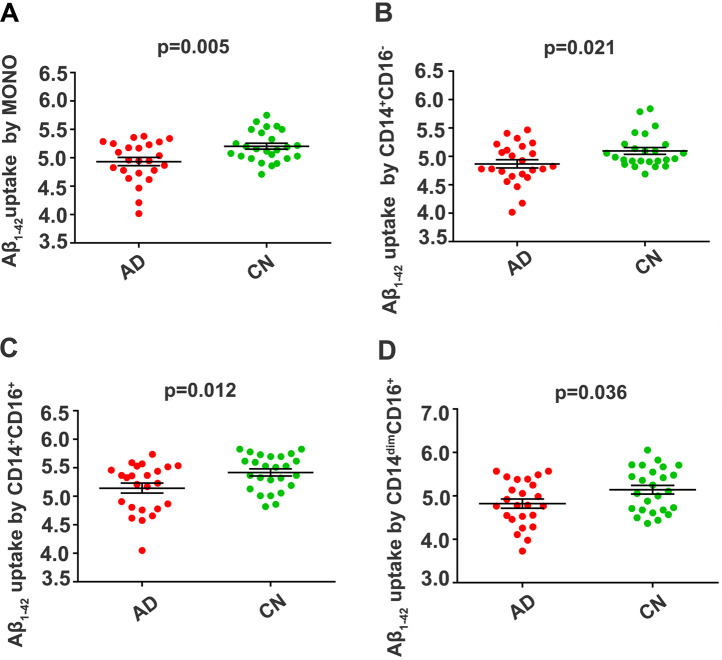
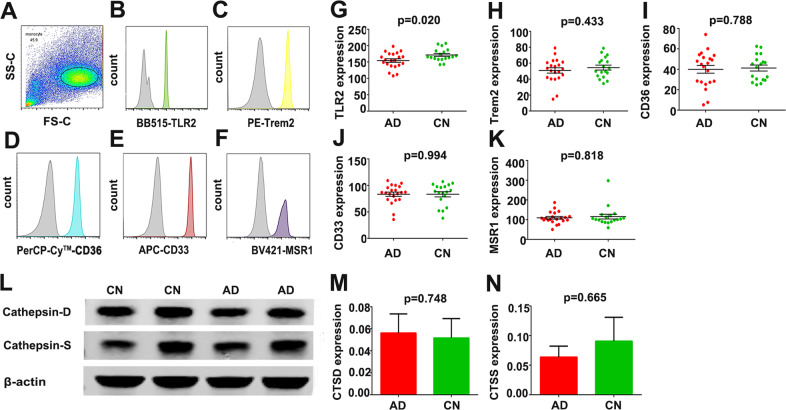
Deficits in the clearance of amyloid β-protein (Aβ) play a pivotal role in the pathogenesis of sporadic Alzheimer’s disease (AD). The roles of blood monocytes in the development of AD remain unclear. In this study, we sought to investigate the alterations in the Aβ phagocytosis function of peripheral monocytes during ageing and in AD patients. A total of 104 cognitively normal participants aged 22–89 years, 24 AD patients, 25 age- and sex-matched cognitively normal (CN) subjects, 15 Parkinson’s disease patients (PD), and 15 age- and sex-matched CN subjects were recruited. The Aβ uptake by blood monocytes was measured and its alteration during ageing and in AD patients were investigated. Aβ 1-42 uptake by monocytes decreased during ageing and further decreased in AD but not in PD patients. Aβ 1-42 uptake by monocytes was associated with Aβ 1-42 levels in the blood. Among the Aβ uptake-related receptors and enzymes, the expression of Toll-like receptor 2 (TLR2) was reduced in monocytes from AD patients. Our findings suggest that monocytes regulate the blood levels of Aβ and might be involved in the development of AD. The recovery of the Aβ uptake function by blood monocytes represents a potential therapeutic strategy for AD.
Overview
The claims and statistics of this paper haven’t been checked yet.
Free: it reads the open-access text and checks the first 5 claims that cite a source we can check. Create a free account to check every claim.
Integrity signals
Registry
Cites
Statistics
Figures
Verification
Claims the paper makes
The claims and statistics of this paper haven’t been checked yet.
Free: it reads the open-access text and checks the first 5 claims that cite a source we can check. Create a free account to check every claim.
Claims other papers make about this one
Each is checked against this paper’s own text: does it say what the citing paper says it does?
The cited source says what the claim attributes to it.
In the citing paper
“implying that impaired Aβ uptake by monocytes may play a role in the aetiology of AD.”
From Microglia and monocytes in inflammatory CNS disease: integrating phenotype and function (2022) · cites this paper as [56]
The cited source says what the claim attributes to it.
In the citing paper
“Monocytes in the peripheral circulation showed a reduced Aβ uptake capacity with age and in AD patients [56]”
From Microglia and monocytes in inflammatory CNS disease: integrating phenotype and function (2022) · cites this paper as [56]
In the citing paper
“The phagocytic capacity of aged peripheral myeloid cells decreases during ageing and in AD,329,330”
From Antiageing strategy for neurodegenerative diseases: from mechanisms to clinical advances (2025) · cites this paper as [329]
Self-check
Percentages, sums and reported differences re-computed from the paper’s own numbers.
The self-check needs the paper’s full text.
Citations
Cites
Hughes, A. J., Daniel, S. E., Kilford, L., & Lees, A. J. (1992) · Journal of Neurology, Neurosurgery & Psychiatry · doi:10.1136/jnnp.55.3.181 · Cited by 10,378
The global prevalence of dementia: a systematic review and metaanalysis.
Prince, M., Bryce, R., Albanese, E., Wimo, A., Ribeiro, W., & Ferri, C. P. (2013) · Alzheimer's & Dementia · doi:10.1016/j.jalz.2012.11.007 · Cited by 4,941
Ageing as a risk factor for neurodegenerative disease
Hou, Y., Dan, X., Babbar, M., Wei, Y., Hasselbalch, S. G., Croteau, D. L., & Bohr, V. A. (2019) · Nature Reviews Neurology · doi:10.1038/s41582-019-0244-7 · Cited by 3,310
Alzheimer Disease Genetics Consortium (ADGC), Kunkle, B. W., The European Alzheimer’s Disease Initiative (EADI), Cohorts for Heart and Aging Research in Genomic Epidemiology Consortium (CHARGE), Genetic and Environmental Risk in AD/Defining Genetic, P. A. E. R. F. A. D. C. (., Grenier-Boley, B., Sims, R., Bis, J. C., Damotte, V., Naj, A. C., et al. (2019) · Nature Genetics · doi:10.1038/s41588-019-0358-2 · Cited by 2,946
Self-citationVillemagne, V. L., Burnham, S., Bourgeat, P., Brown, B., Ellis, K. A., Salvado, O., Szoeke, C., Macaulay, S. L., Martins, R., Maruff, P., et al. (2013) · The Lancet Neurology · doi:10.1016/s1474-4422(13)70044-9 · Cited by 2,279
Decreased Clearance of CNS β-Amyloid in Alzheimer’s Disease
Mawuenyega, K. G., Sigurdson, W., Ovod, V., Munsell, L., Kasten, T., Morris, J. C., Yarasheski, K. E., & Bateman, R. J. (2010) · Science · doi:10.1126/science.1197623 · Cited by 2,078
Masters, C. L., Bateman, R., Blennow, K., Rowe, C. C., Sperling, R. A., & Cummings, J. L. (2015) · Nature Reviews Disease Primers · doi:10.1038/nrdp.2015.56 · Cited by 1,853
Simard, A. R., Soulet, D., Gowing, G., Julien, J.-P., & Rivest, S. (2006) · Neuron · doi:10.1016/j.neuron.2006.01.022 · Cited by 1,265
Identification and characterization of a novel monocyte subpopulation in human peripheral blood
Passlick, B., Flieger, D., & Ziegler-Heitbrock, H. (1989) · Blood · doi:10.1182/blood.v74.7.2527.2527 · Cited by 1,037
A systemic view of Alzheimer disease — insights from amyloid-β metabolism beyond the brain
Wang, J., Gu, B. J., Masters, C. L., & Wang, Y.-J. (2017) · Nature Reviews Neurology · doi:10.1038/nrneurol.2017.111 · Cited by 808
Self-citationCD33 Alzheimer's disease locus: altered monocyte function and amyloid biology
Initiative, T. A. D. N., Bradshaw, E. M., Chibnik, L. B., Keenan, B. T., Ottoboni, L., Raj, T., Tang, A., Rosenkrantz, L. L., Imboywa, S., Lee, M., et al. (2013) · Nature Neuroscience · doi:10.1038/nn.3435 · Cited by 570
Deane, R., Bell, R., Sagare, A., & Zlokovic, B. (2009) · CNS & Neurological Disorders - Drug Targets · doi:10.2174/187152709787601867 · Cited by 548
Krabbe, G., Halle, A., Matyash, V., Rinnenthal, J. L., Eom, G. D., Bernhardt, U., Miller, K. R., Prokop, S., Kettenmann, H., & Heppner, F. L. (2013) · PLoS ONE · doi:10.1371/journal.pone.0060921 · Cited by 478
Formation and maintenance of Alzheimer's disease β-amyloid plaques in the absence of microglia
Grathwohl, S. A., Kälin, R. E., Bolmont, T., Prokop, S., Winkelmann, G., Kaeser, S. A., Odenthal, J., Radde, R., Eldh, T., Gandy, S., et al. (2009) · Nature Neuroscience · doi:10.1038/nn.2432 · Cited by 401
Hawkes, C. A., & McLaurin, J. (2009) · Proceedings of the National Academy of Sciences · doi:10.1073/pnas.0805453106 · Cited by 397
Ineffective phagocytosis of amyloid-β by macrophages of Alzheimer's disease patients
Fiala, M., Lin, J., Ringman, J., Kermani-Arab, V., Tsao, G., Patel, A., Lossinsky, A. S., Graves, M. C., Gustavson, A., Sayre, J., et al. (2005) · Journal of Alzheimer's Disease · doi:10.3233/jad-2005-7304 · Cited by 330
Richard, K. L., Filali, M., Préfontaine, P., & Rivest, S. (2008) · The Journal of Neuroscience · doi:10.1523/jneurosci.1146-08.2008 · Cited by 298
Peripheral Blood CD14high CD16+ Monocytes are Main Producers of IL‐10
Skrzeczyńska‐Moncznik, J., Bzowska, M., Lo˝seke, S., Grage‐Griebenow, E., Zembala, M., & Pryjma, J. (2008) · Scandinavian Journal of Immunology · doi:10.1111/j.1365-3083.2007.02051.x · Cited by 288
Xiang, Y., Bu, X.-L., Liu, Y.-H., Zhu, C., Shen, L.-L., Jiao, S.-S., Zhu, X.-Y., Giunta, B., Tan, J., Song, W.-H., et al. (2015) · Acta Neuropathologica · doi:10.1007/s00401-015-1477-1 · Cited by 277
Self-citationClearance of cerebral Aβ in Alzheimer’s disease: reassessing the role of microglia and monocytes
Zuroff, L., Daley, D., Black, K. L., & Koronyo-Hamaoui, M. (2017) · Cellular and Molecular Life Sciences · doi:10.1007/s00018-017-2463-7 · Cited by 275
Amyloid‐β efflux from the central nervous system into the plasma
Roberts, K. F., Elbert, D. L., Kasten, T. P., Patterson, B. W., Sigurdson, W. C., Connors, R. E., Ovod, V., Munsell, L. Y., Mawuenyega, K. G., Miller‐Thomas, M. M., et al. (2014) · Annals of Neurology · doi:10.1002/ana.24270 · Cited by 254
The role of TREM2 in Alzheimer's disease and other neurodegenerative disorders
Carmona, S., Zahs, K., Wu, E., Dakin, K., Bras, J., & Guerreiro, R. (2018) · The Lancet Neurology · doi:10.1016/s1474-4422(18)30232-1 · Cited by 244
Udan, M. L. D., Ajit, D., Crouse, N. R., & Nichols, M. R. (2008) · Journal of Neurochemistry · doi:10.1111/j.1471-4159.2007.05001.x · Cited by 174
Butovsky, O., Kunis, G., Koronyo‐Hamaoui, M., & Schwartz, M. (2007) · European Journal of Neuroscience · doi:10.1111/j.1460-9568.2007.05652.x · Cited by 167
Koronyo, Y., Salumbides, B. C., Sheyn, J., Pelissier, L., Li, S., Ljubimov, V., Moyseyev, M., Daley, D., Fuchs, D.-T., Pham, M., et al. (2015) · Brain · doi:10.1093/brain/awv150 · Cited by 153
Qosa, H., Abuasal, B. S., Romero, I. A., Weksler, B., Couraud, P.-O., Keller, J. N., & Kaddoumi, A. (2014) · Neuropharmacology · doi:10.1016/j.neuropharm.2014.01.023 · Cited by 146
Amyloid Beta and Tau as Alzheimer’s Disease Blood Biomarkers: Promise From New Technologies
Lue, L.-F., Guerra, A., & Walker, D. G. (2017) · Neurology and Therapy · doi:10.1007/s40120-017-0074-8 · Cited by 116
Koronyo‐Hamaoui, M., Ko, M. K., Koronyo, Y., Azoulay, D., Seksenyan, A., Kunis, G., Pham, M., Bakhsheshian, J., Rogeri, P., Black, K. L., et al. (2009) · Journal of Neurochemistry · doi:10.1111/j.1471-4159.2009.06402.x · Cited by 113
ABCA7 expression is associated with Alzheimer's disease polymorphism and disease status
Vasquez, J. B., Fardo, D. W., & Estus, S. (2013) · Neuroscience Letters · doi:10.1016/j.neulet.2013.09.058 · Cited by 101
Blockage of CR1 prevents activation of rodent microglia
Crehan, H., Hardy, J., & Pocock, J. (2013) · Neurobiology of Disease · doi:10.1016/j.nbd.2013.02.003 · Cited by 98
Passage of human amyloid β-protein 1–40 across the murine blood-brain barrier
Maness, L. M., Banks, W. A., Podlisny, M. B., Selkoe, D. J., & Kastin, A. J. (1994) · Life Sciences · doi:10.1016/0024-3205(94)00331-9 · Cited by 97
Cathepsin D is involved in the clearance of Alzheimer's β‐amyloid protein
Hamazaki, H. (1996) · FEBS Letters · doi:10.1016/0014-5793(96)01087-3 · Cited by 92
Lysosomal processing of amyloid precursor protein to A β peptides: a distinct role for cathepsin S
Munger, J. S., Haass, C., Lemere, C. A., Shi, G. P., Wong, W. S. F., Teplow, D. B., Selkoe, D. J., & Chapman, H. A. (1995) · Biochemical Journal · doi:10.1042/bj3110299 · Cited by 85
Wilke, C., Bender, F., Hayer, S. N., Brockmann, K., Schöls, L. J., Kühle, J., & Synofzik, M. (2018) · Journal of Neurology · doi:10.1007/s00415-018-8893-9 · Cited by 76
Innate phagocytosis by peripheral blood monocytes is altered in Alzheimer’s disease
The Australian Imaging, B. A. L. (. S., Gu, B. J., Huang, X., Ou, A., Rembach, A., Fowler, C. J., Avula, P. K., Horton, A., Doecke, J. D., Villemagne, V. L., et al. (2016) · Acta Neuropathologica · doi:10.1007/s00401-016-1596-3 · Cited by 74
Koronyo-Hamaoui, M., Sheyn, J., Hayden, E. Y., Li, S., Fuchs, D.-T., Regis, G. C., Lopes, D. H. J., Black, K. L., Bernstein, K. E., Teplow, D. B., et al. (2020) · Brain · doi:10.1093/brain/awz364 · Cited by 70
Liuzzo, J. P., Petanceska, S. S., & Devi, L. A. (1999) · Molecular Medicine · doi:10.1007/bf03402069 · Cited by 66
Immune blood biomarkers of Alzheimer disease patients
Avagyan, H., Goldenson, B., Tse, E., Masoumi, A., Porter, V. R., Wiedau‐Pazos, M., Sayre, J. W., Ong, R., Mahanian, M., Koo, P., et al. (2009) · Journal of Neuroimmunology · doi:10.1016/j.jneuroim.2009.02.015 · Cited by 63
Yuede, C. M., Lee, H., Restivo, J. L., Davis, T. A., Hettinger, J. C., Wallace, C. E., Young, K. L., Hayne, M. R., Bu, G., Li, C.-Z., et al. (2016) · Journal of Experimental Medicine · doi:10.1084/jem.20151428 · Cited by 63
Darlington, D., Li, S., Hou, H., Habib, A., Tian, J., Gao, Y., Ehrhart, J. C., Sanberg, P. R., Sawmiller, D. R., Giunta, B. N., et al. (2015) · Cell Transplantation · doi:10.3727/096368915x688894 · Cited by 42
Li, W., Wang, Z., Fan, D., Shen, Y., Chen, D., Li, H., Li, L., Yang, H., Liu, Y.-H., Bu, X., et al. (2020) · Neuroscience Bulletin · doi:10.1007/s12264-020-00469-8 · Cited by 36
Self-citationKunkle, B., Grenier-Boley, B., Sims, R., Bis, J., Naj, A., Boland, A., Vronskaya, M., van der Lee, S., Amlie-Wolf, A., Bellenguez, C., et al. (2018) · doi:10.1101/294629 · Cited by 35
Self-citationQian, F., & Montgomery, R. R. (2015) · Methods in molecular biology · doi:10.1007/978-1-4939-2963-4_8 · Cited by 7
Cited by
Microglia and monocytes in inflammatory CNS disease: integrating phenotype and function
Spiteri, A. G., Wishart, C. L., Pamphlett, R., Locatelli, G., & King, N. J. C. (2022) · Acta Neuropathologica · doi:10.1007/s00401-021-02384-2 · Cited by 244
“Monocytes in the peripheral circulation showed a reduced Aβ uptake capacity with age and in AD patients [56], implying that impaired Aβ uptake by monocytes may play a role in the aetiology of AD.”
BackgroundAntiageing strategy for neurodegenerative diseases: from mechanisms to clinical advances
Jiang, Q., Liu, J., Huang, S., Wang, X.-Y., Chen, X., Liu, G.-H., Ye, K., Song, W., Masters, C. L., Wang, J., et al. (2025) · Signal Transduction and Targeted Therapy · doi:10.1038/s41392-025-02145-7 · Cited by 165
“The phagocytic capacity of aged peripheral myeloid cells decreases during ageing and in AD, 329,330 and adaptive immune cells produce a disordered antibody pro fi le, leading to impaired A β clearance.”
InfluentialSelf-citationThe role of the immune system in Alzheimer’s disease
Wu, K., Zhang, Y.-R., Huang, Y., Dong, Q., Tan, L., & Yu, J. (2021) · Ageing Research Reviews · doi:10.1016/j.arr.2021.101409 · Cited by 127
Hu, M., Li, T., Ma, X., Liu, S., Li, C., Huang, Z., Lin, Y., Wu, R., Wang, S., Lu, D., et al. (2023) · Nature Communications · doi:10.1038/s41467-023-39693-x · Cited by 126
Ullah, R., Park, T. J., Huang, X., & Kim, M. O. (2021) · Ageing Research Reviews · doi:10.1016/j.arr.2021.101451 · Cited by 78
“…of circulating Aβ peptides via phagocytosis, and a reduction in Aβ peptide phagocytosis led to full development of AD pathology, suggesting that these peripheral cells play essential roles in the systemic clearance of Aβ peptides (Chen et al., 2020; Krishnan et al., 2020; Munawara et al., 2021).”
Background
Metadata
- Authors
- Chen, S.-H., Tian, D.-Y., Shen, Y.-Y., Cheng, Y., Fan, D.-Y., Sun, H.-L., He, C.-Y., Sun, P.-Y., Bu, X.-L., Zeng, F., Liu, J., Deng, J., Xu, Z.-Q., Chen, Y., & Wang, Y.-J.
- Affiliations
- Army Medical University (CN)
- Corresponding author
- He, Chen-Yang
- Chen, Yang
- Wang, Yan-Jiang
- ORCID
- Venue
- Translational Psychiatry
- Published
- 2020-12-08
- Volume
- 10
- Issue
- 1
- Pages
- 423-423
- ISSN
- 2158-3188 (ISSN-L)
- PMC
- PMC7722845
- OpenAlex
- W3112519475
- Cited by
- 89
- References
- 42
- Citations by year
- 2026: 9 · 2025: 13 · 2024: 22 · 2023: 16 · 2022: 11 · 2021: 18
- FWCI
- 6.77
- Type
- journal article
- Language
- en
- Open access
- gold
- doi.org
- Licence
- cc-by
- creativecommons.org/licenses/by/4.0 (tdm)
- creativecommons.org/licenses/by/4.0 (vor)
- Locations
- Translational Psychiatry (publishedVersion, cc-by)
- PubMed Central (publishedVersion, cc-by)
- PubMed (publishedVersion)
- DOAJ (DOAJ: Directory of Open Access Journals) (submittedVersion, cc-by-sa)
- Funders
- National Natural Science Foundation of China (91749206, 81625007, 31921003)
- Topics
- Life Sciences › Neuroscience › Cellular and Molecular Neuroscience › Alzheimer's disease research and treatments
- Life Sciences › Neuroscience › Neurology › Neuroinflammation and Neurodegeneration Mechanisms
- Health Sciences › Medicine › Psychiatry and Mental health › Dementia and Cognitive Impairment Research
- Keywords
- amyloid-beta, blood monocytes, Alzheimer's disease, aging, amyloid-beta clearance, phagocytosis, amyloid-beta 42, TLR2, Parkinson's disease, peripheral blood mononuclear cells, treatment options
- MeSH terms
- Aging, Alzheimer Disease, Humans, Monocytes, Phagocytosis, Amyloid beta-Peptides
About these checks
Registry, retraction, Cites and statistics results are computed, not judged, with one exception: a printed reference that no index lists is read once by a model before it counts as a citation error. Claims are extracted by a model and kept only when their quote appears verbatim in the text; each cited source is then checked, with a model’s help, for whether it says what the claim relies on. Those verdicts can be wrong — read the claim’s quote and the cited source before relying on one.
Statistics and arithmetic are recomputed, not judged.
Confidence bands are shown only for fields calibrated on our annotated test set. None is calibrated yet, so no band is shown.
What counts as a claim ›How we measure confidence ›How we check this ›
Are you an author, or do you see a problem with this page? Request a review
Data sources
Bibliographic data: Semantic Scholar, OpenAlex, Crossref.
Contains information from the Semantic Scholar Academic Graph Datasets, made available under the ODC Attribution License (ODC-BY 1.0).
Semantic Scholar’s data is described in: Kinney, R., et al. (2023). The Semantic Scholar Open Data Platform. arXiv:2301.10140.
