

Delayed sleep timing and circadian rhythms in pregnancy and transdiagnostic symptoms associated with postpartum depression
Open accessThe DOI matches its Crossref record; 52 of the 52 references it cites were found in a registry or an index.
Abstract
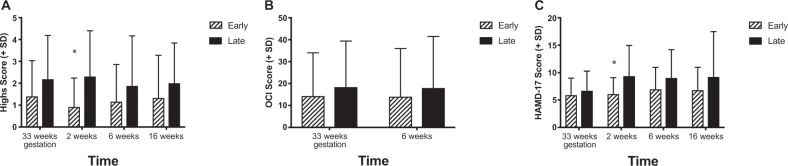
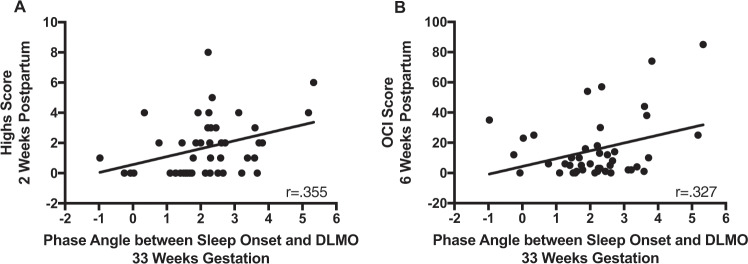
Later sleep timing, circadian preference, and circadian rhythm timing predict worse outcomes across multiple domains, including mood disorders, substance use, impulse control, and cognitive function. Disturbed sleep is common among pregnant and postpartum women. We examined whether sleep timing during third trimester of pregnancy predicted postpartum symptoms of mania, depression, and obsessive-compulsive disorder (OCD). Fifty-one women with a previous, but not active, episode of unipolar or bipolar depression had symptoms evaluated and sleep recorded with wrist actigraphy at 33 weeks of gestation and 2, 6, and 16 weeks postpartum. Circadian phase was measured in a subset of women using salivary dim light melatonin onset (DLMO). We divided the sample into “early sleep” and “late sleep” groups using average sleep onset time at 33 weeks of gestation, defined by the median-split time of 11:27 p.m. The “late sleep” group reported significantly more manic and depressive symptoms at postpartum week 2. Longer phase angle between DLMO and sleep onset at 33 weeks was associated with more manic symptoms at postpartum week 2 and more obsessive-compulsive symptoms at week 6. Delayed sleep timing in this sample of at-risk women was associated with more symptoms of mania, depression, and OCD in the postpartum period. Sleep timing may be a modifiable risk factor for postpartum depression.
Overview
The claims and statistics of this paper haven’t been checked yet.
Free: it reads the open-access text and checks the first 5 claims that cite a source we can check. Create a free account to check every claim.
Integrity signals
Registry
Cites
Statistics
Figures
Verification
Claims the paper makes
The claims and statistics of this paper haven’t been checked yet.
Free: it reads the open-access text and checks the first 5 claims that cite a source we can check. Create a free account to check every claim.
Claims other papers make about this one
Each is checked against this paper’s own text: does it say what the citing paper says it does?
The source backs part of the claim, not all of it — or backs it for a different population, condition or comparison.
In the citing paper
“In another study of postpartum mothers with preterm infants, wrist actigraphy demonstrated that higher levels of daytime activity correlated with decreased symptoms of postpartum depression, suggesting not only the importance of physical activity on its own, but also circadian activity rhythms, which are frequently disrupted in PMADs [39].”
From Technology-Based Approaches for Supporting Perinatal Mental Health (2022) · cites this paper as [39]
Experimental — accuracy not yet measured
Self-check
Percentages, sums and reported differences re-computed from the paper’s own numbers.
The self-check needs the paper’s full text.
Citations
Cites
Diagnostic and Statistical Manual of Mental Disorders
American Psychiatric Association (2013) · doi:10.1176/appi.books.9780890425596 · Cited by 116,369
Hamilton, M. (1960) · Journal of Neurology, Neurosurgery & Psychiatry · doi:10.1136/jnnp.23.1.56 · Cited by 32,817
A self-assessment questionnaire to determine morningness- eveningness in human circadian rhythms
Home, J. K. (1976) · Medical Entomology and Zoology · Cited by 4,783
(1976) · PubMed · Cited by 3,979
A Systematic Review Assessing Bidirectionality between Sleep Disturbances, Anxiety, and Depression
Alvaro, P. K., Roberts, R. M., & Harris, J. K. (2013) · Sleep · doi:10.5665/sleep.2810 · Cited by 1,573
Activity-Based Sleep-Wake Identification: An Empirical Test of Methodological Issues
Sadeh, A., Sharkey, M., & Carskadon, M. A. (1994) · Sleep · doi:10.1093/sleep/17.3.201 · Cited by 1,487
The sleep-deprived human brain
Krause, A. J., Simon, E. B., Mander, B. A., Greer, S. M., Saletin, J. M., Goldstein-Piekarski, A. N., & Walker, M. P. (2017) · Nature Reviews Neuroscience · doi:10.1038/nrn.2017.55 · Cited by 1,200
Wisner, K. L., Sit, D. K. Y., McShea, M. C., Rizzo, D. M., Zoretich, R. A., Hughes, C. L., Eng, H. F., Luther, J. F., Wisniewski, S. R., Costantino, M. L., et al. (2013) · JAMA Psychiatry · doi:10.1001/jamapsychiatry.2013.87 · Cited by 1,091
The validation of a new obsessive–compulsive disorder scale: The Obsessive–Compulsive Inventory
Foa, E. B., Kozak, M. J., Salkovskis, P. M., Coles, M. E., & Amir, N. (1998) · Psychological Assessment · doi:10.1037/1040-3590.10.3.206 · Cited by 719
Self-citationClark, L. A., Cuthbert, B., Lewis-Fernández, R., Narrow, W. E., & Reed, G. M. (2017) · Psychological Science in the Public Interest · doi:10.1177/1529100617727266 · Cited by 688
Parity and sleep patterns during and after pregnancy
Lee, K. (2000) · Obstetrics & Gynecology · doi:10.1016/s0029-7844(99)00486-x · Cited by 443
A systematic review of manic and depressive prodromes
Jackson, A., Cavanagh, J., & Scott, J. (2003) · Journal of Affective Disorders · doi:10.1016/s0165-0327(02)00266-5 · Cited by 399
Putnam, K. T., Wilcox, M., Robertson-Blackmore, E., Sharkey, K., Bergink, V., Munk-Olsen, T., Deligiannidis, K. M., Payne, J., Altemus, M., Newport, J., et al. (2017) · The Lancet Psychiatry · doi:10.1016/s2215-0366(17)30136-0 · Cited by 308
Self-citationEffects of pregnancy on mothers' sleep
Hedman, C., Pohjasvaara, T., Tolonen, U., Suhonen-Malm, A. S., & Myllylä, V. V. (2002) · Sleep Medicine · doi:10.1016/s1389-9457(01)00130-7 · Cited by 306
Farahani, N. S. (2019) · DOAJ (DOAJ: Directory of Open Access Journals) · doi:10.22070/cpap.2020.2902 · Cited by 275
Chronotype and psychiatric disorders
Kivelä, L., Papadopoulos, M. R., & Antypa, N. (2018) · Current Sleep Medicine Reports · doi:10.1007/s40675-018-0113-8 · Cited by 273
Sleep in Normal Late Pregnancy
Hertz, G., Fast, A., Feinsilver, S. H., Albertario, C. L., Schulman, H., & Fein, A. M. (1992) · Sleep · doi:10.1093/sleep/15.3.246 · Cited by 239
Risk of Obsessive-Compulsive Disorder in Pregnant and Postpartum Women: A Meta-Analysis
Russell, E. J., Fawcett, J. M., & Mazmanian, D. (2013) · The Journal of Clinical Psychiatry · doi:10.4088/jcp.12r07917 · Cited by 229
Suicide during Perinatal Period: Epidemiology, Risk Factors, and Clinical Correlates
Orsolini, L., Valchera, A., Vecchiotti, R., Tomasetti, C., Iasevoli, F., Fornaro, M., De Berardis, D., Perna, G., Pompili, M., & Bellantuono, C. (2016) · Frontiers in Psychiatry · doi:10.3389/fpsyt.2016.00138 · Cited by 218
Eveningness and Insomnia: Independent Risk Factors of Nonremission in Major Depressive Disorder
Chan, J. W. Y., Lam, S. P., Li, S. X., Yu, M. W. M., Chan, N. Y., Zhang, J., & Wing, Y.-K. (2014) · Sleep · doi:10.5665/sleep.3658 · Cited by 217
Sleep and perinatal mood disorders: a critical review
Ross, L. E., Murray, B. J., & Steiner, M. (2005) · Journal of Psychiatry and Neuroscience · doi:10.1139/jpn.0534 · Cited by 211
Depressive symptomatology is influenced by chronotypes
Gaspar-Barba, E., Calati, R., Cruz-Fuentes, C. S., Ontiveros-Uribe, M. P., Natale, V., De Ronchi, D., & Serretti, A. (2009) · Journal of Affective Disorders · doi:10.1016/j.jad.2009.02.021 · Cited by 202
The relationship between sleep and postpartum mental disorders: A systematic review
Lawson, A., Murphy, K. E., Sloan, E. P., Uleryk, E. M., & Dalfen, A. (2015) · Journal of Affective Disorders · doi:10.1016/j.jad.2015.01.017 · Cited by 194
Chan, M.-S., Chung, K.-F., Yung, K.-P., & Yeung, W.-F. (2017) · Sleep Medicine Reviews · doi:10.1016/j.smrv.2016.03.001 · Cited by 169
Waters, F., Chiu, V., Atkinson, A., & Blom, J. D. (2018) · Frontiers in Psychiatry · doi:10.3389/fpsyt.2018.00303 · Cited by 165
The dim light melatonin onset following fixed and free sleep schedules
BURGESS, H. J., & EASTMAN, C. I. (2005) · Journal of Sleep Research · doi:10.1111/j.1365-2869.2005.00470.x · Cited by 160
Sleep Disturbances in Mood Disorders
Rumble, M. E., White, K. H., & Benca, R. M. (2015) · Psychiatric Clinics of North America · doi:10.1016/j.psc.2015.07.006 · Cited by 158
Khazaie, H., Ghadami, M. R., Knight, D. C., Emamian, F., & Tahmasian, M. (2013) · Psychiatry Research · doi:10.1016/j.psychres.2013.08.017 · Cited by 138
Wolfson, A. R., Crowley, S. J., Anwer, U., & Bassett, J. L. (2003) · Behavioral Sleep Medicine · doi:10.1207/s15402010bsm0101_6 · Cited by 134
Sleep, arousal, and circadian rhythms in adults with obsessive–compulsive disorder: A meta-analysis
Nota, J. A., Sharkey, K. M., & Coles, M. E. (2015) · Neuroscience & Biobehavioral Reviews · doi:10.1016/j.neubiorev.2015.01.002 · Cited by 131
Self-citationSleep and Mood during Pregnancy and the Postpartum Period
Bei, B., Coo, S., & Trinder, J. (2015) · Sleep Medicine Clinics · doi:10.1016/j.jsmc.2014.11.011 · Cited by 122
New parenthood as a risk factor for the development of obsessional problems
Fairbrother, N., & Abramowitz, J. S. (2006) · Behaviour Research and Therapy · doi:10.1016/j.brat.2006.09.019 · Cited by 121
Perinatal psychiatric episodes: a population-based study on treatment incidence and prevalence
Munk-Olsen, T., Maegbaek, M. L., Johannsen, B. M., Liu, X., Howard, L. M., di Florio, A., Bergink, V, & Meltzer-Brody, S. (2016) · Translational Psychiatry · doi:10.1038/tp.2016.190 · Cited by 103
Sleep Disturbance in Late Pregnancy and Early Labor
Beebe, K. R., & Lee, K. A. (2007) · Journal of Perinatal & Neonatal Nursing · doi:10.1097/01.jpn.0000270626.66369.26 · Cited by 100
Glover, V., Liddle, P., Taylor, A., Adams, D., & Sandler, M. (1994) · British Journal of Psychiatry · doi:10.1192/bjp.164.4.517 · Cited by 97
Circadian rhythms and psychiatric profiles in young adults with unipolar depressive disorders
Robillard, R., Carpenter, J. S., Rogers, N. L., Fares, S., Grierson, A. B., Hermens, D. F., Naismith, S. L., Mullin, S. J., Feilds, K.-L., Glozier, N., et al. (2018) · Translational Psychiatry · doi:10.1038/s41398-018-0255-y · Cited by 92
Mania triggered by sleep loss and risk of postpartum psychosis in women with bipolar disorder
Lewis, K. S., Florio, A. D., Forty, L., Gordon‐Smith, K., Perry, A., Craddock, N. J., Jones, L. A., & Jones, I. R. (2017) · Journal of Affective Disorders · doi:10.1016/j.jad.2017.08.054 · Cited by 81
Factors associated with insomnia in pregnancy: A prospective Cohort Study
Román-Gálvez, R. M., Amezcua‐Prieto, C., Salcedo‐Bellido, I., Martínez‐Galiano, J. M., Khan, K. S., & Bueno‐Cavanillas, A. (2017) · European Journal of Obstetrics & Gynecology and Reproductive Biology · doi:10.1016/j.ejogrb.2017.12.007 · Cited by 79
Sharkey, K. M., Pearlstein, T. B., & Carskadon, M. A. (2013) · Journal of Affective Disorders · doi:10.1016/j.jad.2013.04.046 · Cited by 74
Self-citationSleep deprivation and the postnatal blues
Wilkie, G., & Shapiro, C. M. (1992) · Journal of Psychosomatic Research · doi:10.1016/0022-3999(92)90067-c · Cited by 71
Vetter, C., Chang, S.-C., Devore, E. E., Rohrer, F., Okereke, O. I., & Schernhammer, E. S. (2018) · Journal of Psychiatric Research · doi:10.1016/j.jpsychires.2018.05.022 · Cited by 71
KANG, M. J., MATSUMOTO, K., SHINKODA, H., MISHIMA, M., & SEO, Y. J. (2002) · Psychiatry and Clinical Neurosciences · doi:10.1046/j.1440-1819.2002.00992.x · Cited by 67
Bipolar postpartum depression: An update and recommendations
Sharma, V., Doobay, M., & Baczynski, C. (2017) · Journal of Affective Disorders · doi:10.1016/j.jad.2017.05.014 · Cited by 67
Sharkey, K. M., Iko, I. N., Machan, J. T., Thompson-Westra, J., & Pearlstein, T. B. (2016) · Archives of Women's Mental Health · doi:10.1007/s00737-015-0557-5 · Cited by 66
Self-citationPostnatal euphoria: are ‘the highs’ an indicator of bipolarity?
Heron, J., Craddock, N., & Jones, I. (2005) · Bipolar Disorders · doi:10.1111/j.1399-5618.2005.00185.x · Cited by 64
Sleep Disturbance and Neurobehavioral Performance among Postpartum Women
Insana, S. P., Williams, K. B., & Montgomery-Downs, H. E. (2013) · Sleep · doi:10.5665/sleep.2304 · Cited by 63
Sleep, circadian rhythms, and schizophrenia: where we are and where we need to go
Cosgrave, J., Wulff, K., & Gehrman, P. (2018) · Current Opinion in Psychiatry · doi:10.1097/yco.0000000000000419 · Cited by 60
Alfarra, R., Fins, A. I., Chayo, I., & Tartar, J. L. (2014) · Biological Psychology · doi:10.1016/j.biopsycho.2014.11.001 · Cited by 53
Circadian rhythms in obsessive–compulsive disorder
Lange, K. W., Lange, K. M., Hauser, J., Tucha, L., & Tucha, O. M. (2012) · Journal of Neural Transmission · doi:10.1007/s00702-012-0805-z · Cited by 42
Cox, R. C., & Olatunji, B. O. (2016) · Journal of Psychiatric Research · doi:10.1016/j.jpsychires.2016.01.007 · Cited by 38
Postpartum Sleep in New Mothers and Fathers
Montgomery‐Downs, H. E., Stremler, R., & Insana, S. (2013) · The Open Sleep Journal · doi:10.2174/1874620901306010087 · Cited by 37
Day-to-day alteration of 24-hour sleep pattern immediately before and after giving birth
Bei, B., Coo, S., Milgrom, J., & Trinder, J. C. (2012) · Sleep and Biological Rhythms · doi:10.1111/j.1479-8425.2012.00563.x · Cited by 24
Research works printed but not linked: 1
- First, M., Spitzer, R., Gibbon, M. & Williams J. Structured Clinical Interview for DSM-IV-TR Axis 1 Disorders, Research Version, Patient Edition (SCID-I/P) (New York State Psychiatric Institute, New York, 2002).
Cited by
Baattaiah, B. A., Alharbi, M. D., Babteen, N. M., Al-Maqbool, H. M., Babgi, F. A., & Albatati, A. A. (2023) · BMC Psychology · doi:10.1186/s40359-023-01043-3 · Cited by 142
“In addition, a study investigating sleeping time during pregnancy has shown that less sleep was associated with a higher risk of depression [93].”
BackgroundMeta-Analyses of Genome-Wide Association Studies for Postpartum Depression
Guintivano, J., Byrne, E. M., Kiewa, J., Yao, S., Bauer, A. E., Åberg, K. A., Adams, M. J., Campbell, A., Campbell, M. L., Choi, K. W., et al. (2023) · American Journal of Psychiatry · doi:10.1176/appi.ajp.20230053 · Cited by 91
Perinatal Obsessive–Compulsive Disorder: Epidemiology, Phenomenology, Etiology, and Treatment
Hudepohl, N. S., MacLean, J. V., & Osborne, L. M. (2022) · Current Psychiatry Reports · doi:10.1007/s11920-022-01333-4 · Cited by 81
The prevalence of sleep loss and sleep disorders in young and old adults
Jha, V. M. (2022) · Aging Brain · doi:10.1016/j.nbas.2022.100057 · Cited by 77
“They reported that the late sleeping women had a higher prevalence of developing symptoms of mania, depression, and obsessive–compulsive disorder during the postpartum period [99].”
BackgroundRecent advances in sleep and depression
Mirchandaney, R., Asarnow, L. D., & Kaplan, K. A. (2023) · Current Opinion in Psychiatry · doi:10.1097/yco.0000000000000837 · Cited by 61
Metadata
- Authors
- Obeysekare, J. L., Cohen, Z. L., Coles, M. E., Pearlstein, T. B., Monzon, C., Flynn, E. E., & Sharkey, K. M.
- Affiliations
- Brown University (US)
- University of North Carolina at Chapel Hill (US)
- Binghamton University (US)
- Corresponding author
- Sharkey, Katherine M.
- Venue
- Translational Psychiatry
- Published
- 2020-01-21
- Volume
- 10
- Issue
- 1
- Pages
- 14-14
- ISSN
- 2158-3188 (ISSN-L)
- PMC
- PMC7026062
- OpenAlex
- W3001990356
- Cited by
- 75
- References
- 52
- Citations by year
- 2026: 7 · 2025: 10 · 2024: 10 · 2023: 12 · 2022: 15 · 2021: 15 · 2020: 5
- FWCI
- 8.79
- Type
- journal article
- Language
- en
- Open access
- gold
- doi.org
- Licence
- cc-by
- creativecommons.org/licenses/by/4.0 (tdm)
- creativecommons.org/licenses/by/4.0 (vor)
- Locations
- Translational Psychiatry (publishedVersion, cc-by)
- PubMed Central (publishedVersion, cc-by)
- PubMed (publishedVersion)
- Funders
- U.S. Department of Health & Human Services | NIH | National Heart, Lung, and Blood Institute (T35HL094308)
- Topics
- Health Sciences › Medicine › Public Health, Environmental and Occupational Health › Maternal Mental Health During Pregnancy and Postpartum
- Life Sciences › Neuroscience › Endocrine and Autonomic Systems › Circadian rhythm and melatonin
- Social Sciences › Psychology › Experimental and Cognitive Psychology › Sleep and related disorders
- Keywords
- circadian rhythm, circadian preference, postpartum depression, pregnancy, third trimester, mania, obsessive-compulsive symptoms, dim light melatonin onset, sleep latency, transdiagnostic symptoms, bipolar depression, major depressive disorder, risk factors
- MeSH terms
- Circadian Rhythm, Female, Humans, Melatonin, Pregnancy, Sleep, Depression, Postpartum, Actigraphy
About these checks
Registry, retraction, Cites and statistics results are computed, not judged, with one exception: a printed reference that no index lists is read once by a model before it counts as a citation error. Claims are extracted by a model and kept only when their quote appears verbatim in the text; each cited source is then checked, with a model’s help, for whether it says what the claim relies on. Those verdicts can be wrong — read the claim’s quote and the cited source before relying on one.
Statistics and arithmetic are recomputed, not judged.
Confidence bands are shown only for fields calibrated on our annotated test set. None is calibrated yet, so no band is shown.
What counts as a claim ›How we measure confidence ›How we check this ›
Are you an author, or do you see a problem with this page? Request a review
Data sources
Bibliographic data: Semantic Scholar, OpenAlex, Crossref.
Contains information from the Semantic Scholar Academic Graph Datasets, made available under the ODC Attribution License (ODC-BY 1.0).
Semantic Scholar’s data is described in: Kinney, R., et al. (2023). The Semantic Scholar Open Data Platform. arXiv:2301.10140.
