

Liver stage malaria infection is controlled by host regulators of lipid peroxidation
Open accessPublished version of a preprint
The DOI matches its Crossref record; 47 of the 47 references it cites were found in a registry or an index.
Abstract
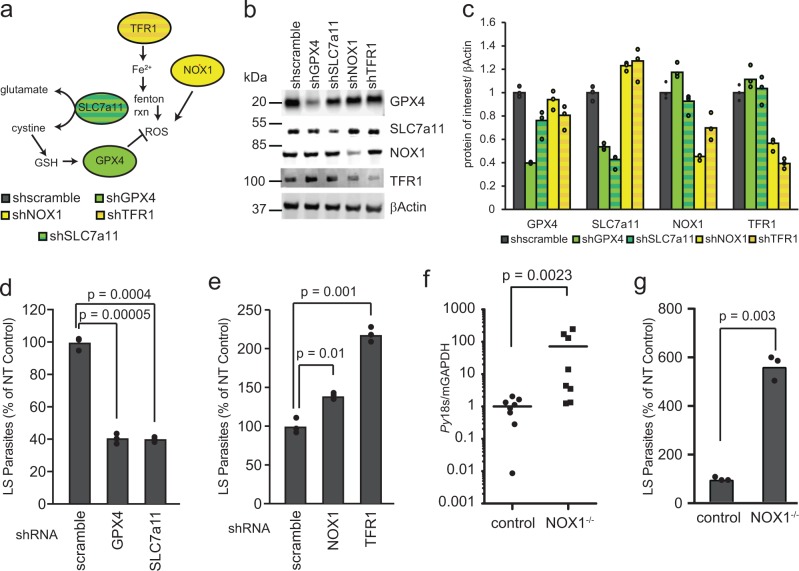
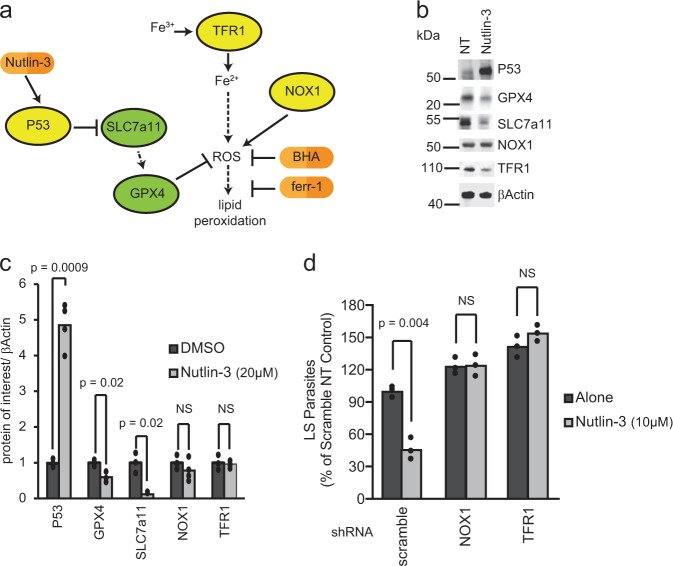
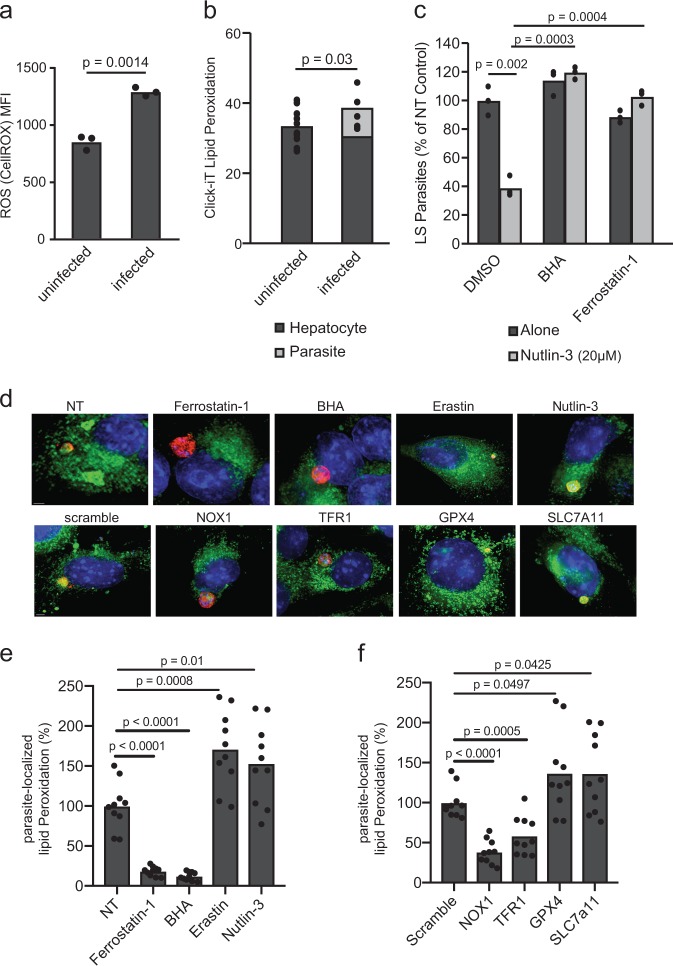
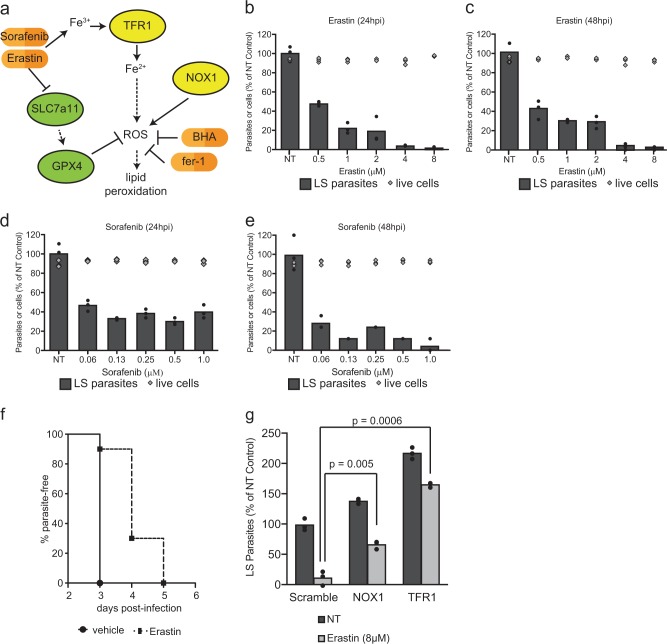
The facets of host control during Plasmodium liver infection remain largely unknown. We find that the SLC7a11-GPX4 pathway, which has been associated with the production of reactive oxygen species, lipid peroxidation, and a form of cell death called ferroptosis, plays a critical role in control of Plasmodium liver stage infection. Specifically, blocking GPX4 or SLC7a11 dramatically reduces Plasmodium liver stage parasite infection. In contrast, blocking negative regulators of this pathway, NOX1 and TFR1, leads to an increase in liver stage infection. We have shown previously that increased levels of P53 reduces Plasmodium LS burden in an apoptosis-independent manner. Here, we demonstrate that increased P53 is unable to control parasite burden during NOX1 or TFR1 knockdown, or in the presence of ROS scavenging or when lipid peroxidation is blocked. Additionally, SLC7a11 inhibitors Erastin and Sorafenib reduce infection. Thus, blocking the host SLC7a11-GPX4 pathway serves to selectively elevate lipid peroxides in infected cells, which localize within the parasite and lead to the elimination of liver stage parasites.
Overview
The claims and statistics of this paper haven’t been checked yet.
Free: it reads the open-access text and checks the first 5 claims that cite a source we can check. Create a free account to check every claim.
Integrity signals
Registry
Cites
Statistics
Figures
Verification
Claims the paper makes
The claims and statistics of this paper haven’t been checked yet.
Free: it reads the open-access text and checks the first 5 claims that cite a source we can check. Create a free account to check every claim.
Claims other papers make about this one
Each is checked against this paper’s own text: does it say what the citing paper says it does?
The cited source says what the claim attributes to it.
In the citing paper
“Blocking of Gpx4 dramatically reduced infection burden of Plasmodium in the liver, most likely by selectively elevation of lipid peroxides in infected cells, which localize within the parasite and lead to the elimination of liver stage parasites.”
From Iron in immune cell function and host defense (2021) · cites this paper as [109]
In the citing paper
“GPx4 has also been demonstrated to play a crucial role for the liver stage of Plasmodium infection”
From Iron in immune cell function and host defense (2021) · cites this paper as [109]
Self-check
Percentages, sums and reported differences re-computed from the paper’s own numbers.
The self-check needs the paper’s full text.
Citations
Cites
Ferroptosis: An Iron-Dependent Form of Nonapoptotic Cell Death
Dixon, S. J., Lemberg, K. M., Lamprecht, M. R., Skouta, R., Zaitsev, E. M., Gleason, C. E., Patel, D. N., Bauer, A. J., Cantley, A. M., Yang, W. S., et al. (2012) · Cell · doi:10.1016/j.cell.2012.03.042 · Cited by 18,691
Regulation of Ferroptotic Cancer Cell Death by GPX4
Yang, W. S., SriRamaratnam, R., Welsch, M. E., Shimada, K., Skouta, R., Viswanathan, V. S., Cheah, J. H., Clemons, P. A., Shamji, A. F., Clish, C. B., et al. (2014) · Cell · doi:10.1016/j.cell.2013.12.010 · Cited by 7,713
Genome-scale CRISPR-Cas9 knockout screening in human cells
Shalem, O., Sanjana, N. E., Hartenian, E., Shi, X., Scott, D. A., Mikkelsen, T. S., Heckl, D., Ebert, B. L., Root, D. E., Doench, J. G., et al. (2014) · Science · doi:10.1126/science.1247005 · Cited by 5,234
In Vivo Activation of the p53 Pathway by Small-Molecule Antagonists of MDM2
Vassilev, L. T., Vu, B. T., Graves, B., Carvajal, D., Podlaski, F., Filipovic, Z., Kong, N., Kammlott, U., Lukacs, C., Klein, C., et al. (2004) · Science · doi:10.1126/science.1092472 · Cited by 4,661
Ferroptosis: process and function
Xie, Y., Hou, W., Song, X., Yu, Y., Huang, J., Sun, X., Kang, R., & Tang, D. (2016) · Cell Death & Differentiation · doi:10.1038/cdd.2015.158 · Cited by 3,727
Ferroptosis as a p53-mediated activity during tumour suppression
Jiang, L., Kon, N., Li, T., Wang, S.-J., Su, T., Hibshoosh, H., Baer, R., & Gu, W. (2015) · Nature · doi:10.1038/nature14344 · Cited by 3,398
Easy quantitative assessment of genome editing by sequence trace decomposition
Brinkman, E. K., Chen, T., Amendola, M., & van Steensel, B. (2014) · Nucleic Acids Research · doi:10.1093/nar/gku936 · Cited by 2,390
Dixon, S. J., Patel, D. N., Welsch, M., Skouta, R., Lee, E. D., Hayano, M., Thomas, A. G., Gleason, C. E., Tatonetti, N. P., Slusher, B. S., et al. (2014) · eLife · doi:10.7554/elife.02523 · Cited by 2,088
Glutaminolysis and transferrin regulate ferroptosis
Gao, M., Monian, P., Quadri, N., Ramasamy, R., & Jiang, X. (2015) · Molecular Cell · doi:10.1016/j.molcel.2015.06.011 · Cited by 2,069
RAS–RAF–MEK-dependent oxidative cell death involving voltage-dependent anion channels
Yagoda, N., von Rechenberg, M., Zaganjor, E., Bauer, A. J., Yang, W. S., Fridman, D. J., Wolpaw, A. J., Smukste, I., Peltier, J. M., Boniface, J. J., et al. (2007) · Nature · doi:10.1038/nature05859 · Cited by 1,631
Cited by
Ferroptosis: molecular mechanisms and health implications
Tang, D., Chen, X., Kang, R., & Kroemer, G. (2021) · Cell Research · doi:10.1038/s41422-020-00441-1 · Cited by 4,256
p53 in ferroptosis regulation: The new weapon for the old guardian
Liu, Y., & Gu, W. (2022) · Cell Death & Differentiation · doi:10.1038/s41418-022-00943-y · Cited by 540
“Mechanistically, after Plasmodium infection, p53 promotes ferroptosis in infected cells, thus eliminating those cells together with the parasite via the p53/SLC7A11/GPX4 pathway [132].”
BackgroundStriking while the iron is hot: Iron metabolism and ferroptosis in neurodegeneration
Masaldan, S., Bush, A. I., Devos, D., Rolland, A. S., & Moreau, C. (2019) · Free Radical Biology and Medicine · doi:10.1016/j.freeradbiomed.2018.09.033 · Cited by 481
A Nuclear Long Non-Coding RNA LINC00618 Accelerates Ferroptosis in a Manner Dependent upon Apoptosis
Wang, Z., Chen, X., Liu, N., Shi, Y., Liu, Y., Ouyang, L., Tam, S., Xiao, D., Liu, S., Wen, F., et al. (2021) · Molecular Therapy · doi:10.1016/j.ymthe.2020.09.024 · Cited by 281
ESCRT-III–dependent membrane repair blocks ferroptosis
Dai, E., Meng, L., Kang, R., Wang, X., & Tang, D. (2020) · Biochemical and Biophysical Research Communications · doi:10.1016/j.bbrc.2019.11.110 · Cited by 273
“Oxidative stressmediated ferroptosis mediates inflammation and tissue injury in brain, liver, kidney, and heart [29-32].”
BackgroundFerroptosis: when metabolism meets cell death
Zheng, J., & Conrad, M. (2025) · Physiological Reviews · doi:10.1152/physrev.00031.2024 · Cited by 246
Double-edge sword roles of iron in driving energy production versus instigating ferroptosis
Zhang, S., Xin, W., Anderson, G. J., Li, R., Gao, L., Chen, S., Zhao, J., & Liu, S. (2022) · Cell Death & Disease · doi:10.1038/s41419-021-04490-1 · Cited by 241
“Ferroptosis has also been demonstrated to be activated to combat the infection of mice with Plasmodium falciparum [63] and rice with the fungus Magnaporthe oryzae [64].”
BackgroundThe role of iron homeostasis in remodeling immune function and regulating inflammatory disease
Mu, Q., Chen, L., Gao, X., Shen, S., Sheng, W., Min, J., & Wang, F. (2021) · Science Bulletin · doi:10.1016/j.scib.2021.02.010 · Cited by 221
Iron in immune cell function and host defense
Haschka, D., Hoffmann, A., & Weiss, G. (2021) · Seminars in Cell & Developmental Biology · doi:10.1016/j.semcdb.2020.12.005 · Cited by 188
The emerging role of ferroptosis in non-cancer liver diseases: hype or increasing hope?
Mao, L., Zhao, T., Song, Y., Lin, L., Fan, X., Cui, B., Feng, H., Wang, X., Yu, Q., Zhang, J., et al. (2020) · Cell Death and Disease · doi:10.1038/s41419-020-2732-5 · Cited by 148
“A recent study showed that hepatocellular SLC7A11-GPx4 signaling pathway modulates Plasmodium infection through the generation of ROS and lipid peroxidation 110 .”
Ferroptosis in Non-Small Cell Lung Cancer: Progression and Therapeutic Potential on It
Zou, J., Wang, L., Tang, H., Liu, X., Peng, F., & Peng, C. Y. (2021) · International Journal of Molecular Sciences · doi:10.3390/ijms222413335 · Cited by 151
“This signaling pathway can be initiated by cystine when the System Xc- is stimulated by P53 or erastin [64].”
Progress in Understanding Ferroptosis and Challenges in Its Targeting for Therapeutic Benefit
Zou, Y., & Schreiber, S. L. (2020) · Cell chemical biology · doi:10.1016/j.chembiol.2020.03.015 · Cited by 139
“For instance, lipid peroxidation and ferroptosis are used to guard against Plasmodium infection in mice (Kain et al., 2020), which is suppressed by erastin treatment.”
BackgroundTFRC upregulation promotes ferroptosis in CVB3 infection via nucleus recruitment of Sp1
Lu, Y., Hu, Y., Wu, Z., Li, Y., Kong, M., Kang, Z., Zuoyuan, B., & Yang, Z. (2022) · Cell Death and Disease · doi:10.1038/s41419-022-05027-w · Cited by 143
“During malaria infection, TFRC knockdown decreased parasite-localized lipid peroxides, and led to a substantial decrease in the efficacy of erastin in liver-stage parasite infection [37].”
BackgroundUnraveling Cell Death Pathways during Malaria Infection: What Do We Know So Far?
Sena-dos-Santos, C., Braga-da-Silva, C., Marques, D., Pinheiro, J. A. D. S., Ribeiro‐dos‐Santos, Â., & Cavalcante, G. C. (2021) · Cells · doi:10.3390/cells10020479 · Cited by 135
Ferroptosis in immunostimulation and immunosuppression
Tang, D., Kroemer, G., & Kang, R. (2023) · Immunological Reviews · doi:10.1111/imr.13235 · Cited by 133
“73 The consequences of pathogen infection can lead to the development of sepsis, a clinical syndrome associated with multiple organ dysfunction or failure.”
BackgroundPrecise Chemodynamic Therapy of Cancer by Trifunctional Bacterium-Based Nanozymes
Zhang, W., Liu, J., Li, X., Zheng, Y., Chen, L., Wang, D., Foda, M. F., Ma, Z., Zhao, Y., & Han, H. (2021) · ACS Nano · doi:10.1021/acsnano.1c05605 · Cited by 119
Zeng, C., Lin, J., Zhang, K., Ou, H., Shen, K., Liu, Q., Wei, Z., Dong, X., Zeng, X., Zeng, L., et al. (2022) · Cancer Science · doi:10.1111/cas.15531 · Cited by 129
Emerging role of ferroptosis in breast cancer: New dawn for overcoming tumor progression
Sui, S., Xu, S., & Pang, D. (2021) · Pharmacology & Therapeutics · doi:10.1016/j.pharmthera.2021.107992 · Cited by 120
Zhang, L., Wang, F., Li, D., Yan, Y.-F., & Wang, H. (2021) · Bioengineered · doi:10.1080/21655979.2021.1956403 · Cited by 117
“As a key member of the NOX family, NOX1 increases the release of ROS and facilitates ferroptosis, which further exacerbates plasmodium liver stage infection [39].”
BackgroundLi, Q., Chen, K., Zhang, T., Jiang, D., Chen, L., Jiang, J., Zhang, C., & Li, S. (2023) · European Journal of Pharmacology · doi:10.1016/j.ejphar.2023.175913 · Cited by 117
p53-regulated non-apoptotic cell death pathways and their relevance in cancer and other diseases
Liu, Y., Stockwell, B. R., Jiang, X., & Gu, W. J. (2025) · Nature Reviews Molecular Cell Biology · doi:10.1038/s41580-025-00842-3 · Cited by 112
“Other than cancer, activating p53-regulated ferroptosis by nutlin-3 is beneficial for blocking the liver stage infection of Plasmodium parasites 149,150 (Fig.”
Host-directed therapy, an untapped opportunity for antimalarial intervention
Wei, L., Adderley, J., Leroy, D., Drewry, D. H., Wilson, D. W., Kaushansky, A., & Doerig, C. (2021) · Cell Reports Medicine · doi:10.1016/j.xcrm.2021.100423 · Cited by 81
“As an example, the aforementioned tumor suppressor protein p53, which has been shown to regulate both liver-stage malaria in the laboratory 20,21,32 and clinical symptoms of malaria in the field, 64 has prompted nearly 100,000 publications in PubMed, approximately the same number of publications as…”
Wang, H., Qiao, C., Guan, Q., Wei, M., & Li, Z. (2023) · Asian Journal of Pharmaceutical Sciences · doi:10.1016/j.ajps.2023.100829 · Cited by 82
“[53] Kain HS , Glennon EKK , Vijayan K , Arang N , Douglass AN , Fortin CL , et al.”
BackgroundSui, Y., Geng, X., Wang, Z., Zhang, J., Yang, Y., & Meng, Z. (2024) · Metabolism · doi:10.1016/j.metabol.2024.155953 · Cited by 75
p53 Promotes Ferroptosis in Macrophages Treated with Fe3O4 Nanoparticles
Wu, C., zhang, B., Shen, Z., Sun, F., Lu, Y., Yuan, L., zhang, G., wang, Z., & Shi, H. (2022) · ACS Applied Materials & Interfaces · doi:10.1021/acsami.2c00707 · Cited by 66
Wang, Y., Shen, Z., Pei, C., Zhao, S., Jia, N., Huang, D., Wang, X., Wu, Y., Shi, S., He, Y., et al. (2022) · Biomedicine & Pharmacotherapy · doi:10.1016/j.biopha.2022.113982 · Cited by 59
Sun, K., Ren, W., Li, S., Zheng, J., Huang, Y., Zhi, K., & Gao, L. (2022) · Pathology - Research and Practice · doi:10.1016/j.prp.2022.153778 · Cited by 52
Research mechanisms of and pharmaceutical treatments for ferroptosis in liver diseases
Yu, J. G., & Wang, J. (2020) · Biochimie · doi:10.1016/j.biochi.2020.11.002 · Cited by 40
Host-parasite interactions during Plasmodium infection: Implications for immunotherapies
Chandley, P., Ranjan, R., Kumar, S., & Rohatgi, S. (2023) · Frontiers in Immunology · doi:10.3389/fimmu.2022.1091961 · Cited by 50
Ferroptosis in Cancer and Inflammatory Diseases: Mechanisms and Therapeutic Implications
Shen, G., Liu, J., Wang, Y., Deng, Z., & Deng, F. (2025) · MedComm · doi:10.1002/mco2.70349 · Cited by 58
Li, W., Zhou, X., Xu, S., Cao, N., Li, B., Chen, W., Yang, B., Yuan, M., & Xu, D. (2022) · Poultry Science · doi:10.1016/j.psj.2022.101725 · Cited by 41
Emerging roles of ferroptosis in infectious diseases
Bagayoko, S., & Meunier, É. (2021) · FEBS Journal · doi:10.1111/febs.16244 · Cited by 39
Human peroxiredoxin 6 is essential for malaria parasites and provides a host-based drug target
Wagner, M. P., Formaglio, P., Gorgette, O., Dziekan, J. M., Huon, C., Berneburg, I., Rahlfs, S., Barale, J.-C., Feinstein, S. I., Fisher, A. B., et al. (2022) · Cell Reports · doi:10.1016/j.celrep.2022.110923 · Cited by 39
Same, same but different: Exploring Plasmodium cell division during liver stage development
Roques, M., Bindschedler, A., Beyeler, R., & Heussler, V. T. (2023) · PLoS Pathogens · doi:10.1371/journal.ppat.1011210 · Cited by 42
“Nutrient restriction might be a prime factor and some studies clearly point in this direction for ABS parasite growth [38,39], but it remains to be proven for LS parasites at an experimental level [35,36].”
BackgroundFrom mechanisms to medicine: Ferroptosis as a Therapeutic target in liver disorders
He, Y., Lin, Y., Song, J., Song, M., Nie, X., Sun, H. J., Xu, C., Han, Z., & Cai, J. (2025) · Cell Communication and Signaling · doi:10.1186/s12964-025-02121-2 · Cited by 41
“The iron toxicity and oxidative damage regulated by the System Xc − /GPX4 axis in hepatocytes may control malaria parasite infection, according to an experimental research [238].”
Ferroptosis: A mixed blessing for infectious diseases
Xiao, L.-Y., Huang, H., Fan, S., Zheng, B., Wu, J., Zhang, J., Pi, J., & Xu, J.-F. (2022) · Frontiers in Pharmacology · doi:10.3389/fphar.2022.992734 · Cited by 38
“Notably, the SLC7A11-GPX4 pathway helps resist the infection of liver Plasmodium (Kain et al., 2020).”
BackgroundInfluentialEbert, G., Lopaticki, S., O’Neill, M. T., Steel, R. W. J., Doerflinger, M., Rajasekaran, P., Yang, A., Erickson, S. M., Ioannidis, L. J., Arandjelovic, P., et al. (2020) · Cell Reports · doi:10.1016/j.celrep.2020.03.032 · Cited by 33
“The evolution of human genetic mutations that confer erythrocyte resistance to malaria parasite infection suggests that manipulating host factors may represent a powerful approach to manage or treat Plasmodium infections, including during the liver stage (Douglass et al., 2015; Kain et al., 2020; Kaushansky et al., 20…”
BackgroundAdegboro, A. G., & Afolabi, I. S. (2024) · Frontiers in Cell and Developmental Biology · doi:10.3389/fcell.2024.1374735 · Cited by 35
“…plasmodium-induced biochemical alterations that can in fl uence the parasites and host red blood cells ’ susceptibility to ferroptosis as well as the involvement of ferroptosis in decreasing parasite viability at the liver stage (Gowda and Wu, 2018; Kain et al., 2020; Sena-dos-Santos et al., 2021).”
BackgroundBagayoko, S., Leon‐Icaza, S. A., Pinilla, M., Hessel, A., Santoni, K., Péricat, D., Bordignon, P., Moreau, F., Eren, E., Boyance, A., et al. (2021) · PLoS Pathogens · doi:10.1371/journal.ppat.1009927 · Cited by 38
“In addition, Kain and colleagues recently linked regulation of host lipid peroxidation and ferroptosis to restriction of liver-stage malaria, which suggests that host peroxidised phospholipids might play yet unsuspected functions in immunity or susceptibility to various pathogens [78].”
BackgroundLi, J., Yang, J., Xian, Q., Su, H., Ni, Y., & Wang, L. (2024) · Phytotherapy Research · doi:10.1002/ptr.8191 · Cited by 37
“The GPX4/SLC7A11 pathway crucially manages these lipid hydroper-oxides, serving as a defense against oxidative stress (Kain et al., 2020).”
BackgroundThe good and the bad about separation anxiety: roles of IL-22 and IL-22BP in liver pathologies
Lücke, J., Sabihi, M., Zhang, T., Bauditz, L. F., Shiri, A. M., Giannou, A. D., & Huber, S. (2021) · Seminars in Immunopathology · doi:10.1007/s00281-021-00854-z · Cited by 33
Ferroptosis in Chronic Liver Diseases: Opportunities and Challenges
Zhou, G., Fu, Y., Liu, W., Mu, Y., Zhang, H., Chen, J., & Liu, P. (2022) · Frontiers in Molecular Biosciences · doi:10.3389/fmolb.2022.928321 · Cited by 33
“In addition to the types of liver diseases mentioned in this article, it has also been reported (Kain et al., 2020) that Nutlin-3 (a commonly used, highly selective, membrane-permeable MDM2 antagonist) can reduce the plasmodium liver stage infection by activating the p53-SLC7A11-GPX4 signaling pathway.”
BackgroundTong, Q., Qin, W. D., Li, Z., Liu, C., Wang, Z., Chu, Y., & Xu, X. (2023) · Cancer Medicine · doi:10.1002/cam4.5605 · Cited by 27
Host-targeted Interventions as an Exciting Opportunity to Combat Malaria
Vijayan, K., Wei, L., Glennon, E. K. K., Mattocks, C., Bourgeois, N. M., Staker, B. L., & Kaushansky, A. (2021) · Chemical Reviews · doi:10.1021/acs.chemrev.1c00062 · Cited by 28
Antimalarial drug resistance and drug discovery: learning from the past to innovate the future
Theodoridis, L., & Carvalho, T. G. (2025) · International Journal for Parasitology Drugs and Drug Resistance · doi:10.1016/j.ijpddr.2025.100602 · Cited by 40
p53-Dependent ferroptosis pathways in sepsis
Gao, N., Tang, A.-L., Liu, X., Chen, J., & Zhang, G. (2023) · International Immunopharmacology · doi:10.1016/j.intimp.2023.110083 · Cited by 26
Recent Advances in Host-Directed Therapies for Tuberculosis and Malaria
Matteucci, K. C., Correa, A. A. D. S., & Costa, D. L. (2022) · Frontiers in Cellular and Infection Microbiology · doi:10.3389/fcimb.2022.905278 · Cited by 22
“Considering that, the tumor suppressor protein p53 can be considered a potential host target, since it was described to play an important role in the control of lipid peroxidation process in hepatocytes (Kain et al., 2020).”
BackgroundWang, H., Su, Z., Qian, Y., Shi, B., Li, H., An, W., Xiao, Y. Q., Qiu, C., Guo, Z., Zhong, J., et al. (2024) · Molecular Biomedicine · doi:10.1186/s43556-024-00227-6 · Cited by 21
“Inhibiting TFRC dramatically augments infection by mitigating lipid peroxidation, indicating potential resistance to infection with increased ferroptosis [7].”
Relationships of ferroptosis-related genes with the pathogenesis in polycystic ovary syndrome
Lin, S., Jin, X., He, G., & Bi, F. (2023) · Frontiers in Medicine · doi:10.3389/fmed.2023.1120693 · Cited by 20
“NOX1, a member of the NOX family, promotes ROS release and ferroptosis (32).”
BackgroundTargeting ferroptosis as a therapeutic strategy for hepatotoxicity
Hemmati, N., Anoush, M., Kiasari, B. A., & Torkamani, A. (2025) · Toxicology Reports · doi:10.1016/j.toxrep.2025.102137 · Cited by 25
“Finally, infectious diseases such as severe malaria can secondarily induce ferroptosis through hemolysis-driven iron overload and oxidative stress, although this evidence remains preliminary and less directly aligned with hepatotoxicity compared with other conditions [277, 279] (Fig.”
Olanlokun, J. O., Abiodun, W. O., Ebenezer, O., Koorbanally, N. A., & Olorunsogo, O. O. (2021) · Biomedicine & Pharmacotherapy · doi:10.1016/j.biopha.2021.112454 · Cited by 18
Hu, M., Men, Y., Chen, L., Huang, J., Duan, F., Zhang, Y., & Dong, S. (2022) · PubMed Central · doi:10.11817/j.issn.1672-7347.2022.210443 · Cited by 18
Crosstalk of ferroptosis and oxidative stress in infectious diseases
Hu, Y., He, B., Cao, Q., Li, Y., Tang, Y., Cao, T., Peng, B., Zhou, X., & Liu, S. (2023) · Frontiers in Molecular Biosciences · doi:10.3389/fmolb.2023.1315935 · Cited by 17
“A study by Kain et al. (Kain et al., 2020) indicates that interfering with the SLC7A11-GPX4 pathway in liver cells infected with P. yoelii leads to ferroptosis induction.”
BackgroundXiang, L., Li, Q., Guan, Z., Wang, G., Yu, X., Zhang, X., Zhang, G., Hu, J., Yang, X., Li, M., et al. (2025) · Frontiers in Pharmacology · doi:10.3389/fphar.2024.1527286 · Cited by 21
Lipid peroxidation and its repair in malaria parasites
Wagner, M. P., & Chitnis, C. E. (2023) · Trends in Parasitology · doi:10.1016/j.pt.2022.12.006 · Cited by 18
Cai, H., Luo, S., Liu, Q., Zhou, Q., Yan, Z., Kang, Z., Liao, S., Li, J., Lv, M., Lin, X., et al. (2023) · Parasites & Vectors · doi:10.1186/s13071-023-05855-5 · Cited by 19
“[40] reported that ferroptosis could be regulated by the SLC7a11-GPX4 signaling pathway to inhibit Plasmodium liver-stage infection.”
BackgroundEmerging Role for Ferroptosis in Infectious Diseases
Amaral, E. P., & Namasivayam, S. (2021) · Advances in experimental medicine and biology · doi:10.1007/978-3-030-62026-4_5 · Cited by 17
Malaria Pigment Hemozoin Impairs GM-CSF Receptor Expression and Function by 4-Hydroxynonenal
Skorokhod, O. A., Barrera, V., Mandili, G., Costanza, F., Valente, E., Ulliers, D., & Schwarzer, E. (2021) · Antioxidants · doi:10.3390/antiox10081259 · Cited by 14
Yang, B., Shu, W., Hu, J. J., Wang, Z., Wu, J., Su, J., Tan, J., Yu, B., & Zhang, X. (2024) · International Journal of Biological Sciences · doi:10.7150/ijbs.93592 · Cited by 17
“Recent studies have shown that intracellular ROS-induced lipid peroxidation of polyunsaturated fatty acids in the host helped eliminate various pathogens, including S. aureus [26, 30, 32].”
BackgroundLi, B., Lin, F., Song, B., Han, S., Ye, Z., Sun, Y., Wang, P., Xia, Y., Yu, W., Zhou, X., et al. (2025) · Nature Communications · doi:10.1038/s41467-025-62433-2 · Cited by 14
“GPX4 inactivation not only triggers ferroptosis but also sensitizes cells to apoptosis 45 , and erastin-mediated SLC7A11 inhibition increases ROS production that contributes to both ferroptotic and apoptotic pathways 46 .”
Plasmodium berghei-Mediated NRF2 Activation in Infected Hepatocytes Enhances Parasite Survival
Bindschedler, A., Schmuckli‐Maurer, J., Wacker, R., Kramer, N., Rehmann, R., Caldelari, R., & Heussler, V. T. (2022) · Cellular Microbiology · doi:10.1155/2022/7647976 · Cited by 13
Olanlokun, J. O., Babarinde, C. O., & Olorunsogo, O. O. (2020) · Journal of Basic and Clinical Physiology and Pharmacology · doi:10.1515/jbcpp-2020-0046 · Cited by 10
Hepatocytes and the art of killing Plasmodium softly
Marques-da-Silva, C., Schmidt-Silva, C., & Kurup, S. P. (2024) · Trends in Parasitology · doi:10.1016/j.pt.2024.04.004 · Cited by 8
MicroRNAs at the crossroads of exercise and ferroptosis: a regulatory bridge
Lin, Z. J., & Feng, Z. (2025) · Clinical and Experimental Medicine · doi:10.1007/s10238-025-01766-0 · Cited by 11
Yu, Q., Yang, J., Chen, H., Liu, R., Hu, R., Cai, J., Yang, S., Zheng, B., Guo, P., Cai, Z., et al. (2025) · Free Radical Biology and Medicine · doi:10.1016/j.freeradbiomed.2025.02.019 · Cited by 7
Navigating the Paradox of IL‐22: Friend or Foe in Hepatic Health?
Qin, J., Zhu, W., & Zhou, W. (2025) · Journal of Gastroenterology and Hepatology · doi:10.1111/jgh.16991 · Cited by 9
“These infections can range from systemic diseases such as malaria [55] to specific liver-targeting agents, such as HBV and hepatitis C virus (HCV) [56].”
Small Molecule Regulators of Ferroptosis
Debieu, S., Solier, S., Colombeau, L., Versini, A., Sindikubwabo, F., Forrester, A. R., Müller, S., Cañeque, T., & Rodriguez, R. (2021) · Advances in experimental medicine and biology · doi:10.1007/978-3-030-62026-4_6 · Cited by 6
Vijayan, K., Arang, N., Wei, L., Morrison, R., Geiger, R., Parks, K. R., Lewis, A. J., Mast, F. D., Douglass, A. N., Kain, H. S., et al. (2020) · bioRxiv (Cold Spring Harbor Laboratory) · doi:10.1101/2020.08.31.275867 · Cited by 9
Wang, X., Fang, R., Zhao, T., Ding, L., Cai, M., Zhang, D., Xu, N., Yang, S., Zhao, S., Zhang, H., et al. (2026) · Molecular Pharmaceutics · doi:10.1021/acs.molpharmaceut.5c01400 · Cited by 6
Elucidating Spatially-Resolved Changes in Host Signaling During Plasmodium Liver-Stage Infection
Glennon, E. K. K., Tongogara, T., Primavera, V. I., Reeder, S. M., Wei, L., & Kaushansky, A. (2022) · Frontiers in Cellular and Infection Microbiology · doi:10.3389/fcimb.2021.804186 · Cited by 6
PANoptosis in infectious Diseases: Mechanisms, therapeutic potential, and future directions
Zhang, R., Wang, Z., Shao, Y. W., Gan, J., Yang, L., & Jiang, X. (2025) · Biochemical and Biophysical Research Communications · doi:10.1016/j.bbrc.2025.152505 · Cited by 5
Li, T., Dang, D., Shen, Y., Wang, J., Huang, Y., Zhu, Q., Wang, Y., Yang, C., Li, G., Sun, J., et al. (2025) · Parasites & Vectors · doi:10.1186/s13071-025-07102-5 · Cited by 3
“Oxidative stress and lipoperoxidation play important roles in malaria pathogenesis [52, 53], and Hz is a key factor inducing the upregulation of ROS and lipoper-oxidation.”
Recent progress in understanding ferroptosis mechanisms in infectious diseases
Li, F., & Chen, X. (2026) · Frontiers in Cellular and Infection Microbiology · doi:10.3389/fcimb.2026.1778721 · Cited by 4
“Among these, Plasmodium spp. generate ROS and lipid peroxidation by inhibiting the SLC7A11/GPX4 pathway, thereby activating ferroptosis to clear hepatic-stage malaria (Kain et al., 2020).”
Host kinase regulation of Plasmodium vivax dormant and replicating liver stages
Glennon, E. K. K., Wei, L., Roobsoong, W., Primavera, V. I., van Zyl, E. M., Tongogara, T., Yee, C. B., Sattabongkot, J., & Kaushansky, A. (2026) · PLoS neglected tropical diseases · doi:10.1371/journal.pntd.0014053 · Cited by 7
“…P. yoelii, and P. berghei has demonstrated parasite dependence on a multitude of host cell processes including the blocking of apoptosis [26–29], regulation of lipid peroxidation [30], nutrient uptake [31,32], and re-orientation of vesicular trafficking to the parasitophorous vacuole [33–36].”
Yao, S., Zhou, X., Liao, T., Yao, C., Sun, M., Gou, H., Hu, X., Liu, J., Li, Z., Zhao, Y., et al. (2025) · International Journal for Parasitology Drugs and Drug Resistance · doi:10.1016/j.ijpddr.2025.100630 · Cited by 3
Wang, W., Wang, X., Zhou, Z.-D., Deng, X.-B., Luo, X.-W., Wang, Q., Zhang, G.-Y., Zhang, Z. G., Li, Z., He, X., et al. (2026) · Journal of Advanced Research · doi:10.1016/j.jare.2026.01.078 · Cited by 7
Can artemisinin and its derivatives treat malaria in a host-directed manner?
Dai, Y., Liang, Y., Liu, C., Liu, T., Chen, L., & Li, Y. (2024) · Biochemical Pharmacology · doi:10.1016/j.bcp.2024.116260 · Cited by 2
Tick HRF-dependent ferroptosis pathway to promote tick acquisition of Babesia microti
Chen, S., Hu, S., Zhou, Y., Cao, J., Zhang, H., Wang, Y., & Zhou, J. (2025) · Frontiers in Cellular and Infection Microbiology · doi:10.3389/fcimb.2025.1560152 · Cited by 2
“Furthermore, inducing ferroptosis in the liver has been found to effectively reduce Plasmodium infection (Kain et al., 2020).”
Karama, I., Ouédraogo, V., Rouamba, A., Compaoré, M., & Kiendrébeogo, M. (2022) · Journal of Drug Delivery and Therapeutics · doi:10.22270/jddt.v12i2.5378 · Cited by 2
Does attenuated plasmodial sporozoite-mediated protection require peroxynitrite?
Douradinha, B. G. (2023) · Trends in Parasitology · doi:10.1016/j.pt.2023.07.008 · Cited by 2
Exposing the hidden: establishing immunity to Plasmodium liver stage infection
Quin, J. E., Iturritza, M. U., Kina, U. Y., Matuschewski, K., & Ankarklev, J. (2025) · Trends in Parasitology · doi:10.1016/j.pt.2025.10.007 · Cited by 1
Ferroptosis and Infectious Diseases
Zhang, Y., & Chi, J. (2023) · Springer eBooks · doi:10.1007/978-3-031-39171-2_16
Addressing Artemisinin Resistance in Malaria Treatment: A Novel Ferrous ACT (FACT) FormulationPreprint
Wang, Y., & Tang, K. (2024) · bioRxiv (Cold Spring Harbor Laboratory) · doi:10.1101/2024.02.15.579727
“Studies have shown that host liver cells can control Plasmodium liver-stage infection by regulating the SLC7a11-GPX4 signaling pathway to induce lipid peroxidation and ROS [9].”
BackgroundCai, H., Luo, S., Liu, Q., Zhou, Q., Yan, Z., Kang, Z., Liao, S., Li, J., Lv, M., Lin, X., et al. (2023) · Figshare · doi:10.6084/m9.figshare.23797410
The organoid revolution to assess mycobacterial pulmonary infections
Leon‐Icaza, S. A. (2022) · theses.fr (ABES) · doi:10.70675/6e135d5fzb953z4ffcz9041z2684784040ad
Emergence of NLRP1 inflammasome as a sensor of microbial virulence in human epithelium
Pinilla, M. (2023) · theses.fr (ABES) · doi:10.70675/1209ef79zd7c9z4b14z8a56za9b7f12b4bd0
Yeh, Y., Huang, P.-J., Wu, Y.-L., Chen, C.-H., Chen, P.-Y., Hsu, Y.-T., & Cheng, W.-H. (2026) · International Journal for Parasitology Drugs and Drug Resistance · doi:10.1016/j.ijpddr.2026.100661
“RSL3 and erastin concentrations were selected based on previously published ferroptosis studies (Bogacz et al., 2018; Das et al., 2020; Silvestre et al., 2023), whereas the Fer-1 and DIP concentrations were selected based on previous studies of ferroptosis and iron regulation in T. vaginalis (Kose…”
Deferiprone Modulates Ferroptosis to Protect Macrophages and Liver during Neospora caninum Infection
Zhu, Z., Jiang, X., Huang, R., Guo, X., Wang, Y., Liu, T., Wang, J., Huang, J., Huang, W., Zhang, D., et al. (2026) · Acta Parasitologica · doi:10.1007/s11686-026-01343-9
Babarinde, C. O., Oloke, O. M., Toyib, A., Ogunparisa, E., Bodede, O., Olanlokun, J. O., & Prinsloo, G. (2026) · Next research. · doi:10.1016/j.nexres.2026.102567
Metadata
- Authors
- Kain, H. S., Glennon, E. K. K., Vijayan, K., Arang, N., Douglass, A. N., Fortin, C. L., Zuck, M., Lewis, A. J., Whiteside, S. L., Dudgeon, D. R., Johnson, J. S., Aderem, A., Stevens, K. R., & Kaushansky, A.
- Affiliations
- Center for Infectious Disease Research (US)
- University of Washington (US)
- Corresponding author
- Kaushansky, Alexis
- ORCID
- Venue
- Cell Death & Differentiation
- Published
- 2019-05-07
- Volume
- 27
- Issue
- 1
- Pages
- 44-54
- ISSN
- 1350-9047 (ISSN-L)
- 1476-5403
- PMC
- PMC7206113
- OpenAlex
- W2944572531
- Cited by
- 91
- References
- 47
- Citations by year
- 2026: 8 · 2025: 15 · 2024: 9 · 2023: 15 · 2022: 18 · 2021: 15 · 2020: 9 · 2019: 1
- FWCI
- 9.84
- Type
- journal article
- Language
- en
- Open access
- hybrid
- doi.org
- Licence
- cc-by
- creativecommons.org/licenses/by/4.0 (tdm)
- creativecommons.org/licenses/by/4.0 (vor)
- Locations
- Cell Death and Differentiation (publishedVersion, cc-by)
- bioRxiv (Cold Spring Harbor Laboratory) (acceptedVersion, cc-by-nc-nd)
- PubMed Central (publishedVersion, cc-by)
- PubMed (publishedVersion)
- Funders
- U.S. Department of Health & Human Services | National Institutes of Health (K99/R00AI111785, R01GM101183, R01AI032972, R01AI025032)
- Topics
- Health Sciences › Medicine › Public Health, Environmental and Occupational Health › Malaria Research and Control
- Life Sciences › Biochemistry, Genetics and Molecular Biology › Cancer Research › Ferroptosis and cancer prognosis
- Life Sciences › Immunology and Microbiology › Parasitology › Toxoplasma gondii Research Studies
- Keywords
- host-parasite interactions, lipid peroxidation, ferroptosis, SLC7A11, GPX4, reactive oxygen species, NOX1, transferrin receptor 1, p53, erastin, sorafenib
- MeSH terms
- NADPH Oxidase 1, Ferroptosis, Phospholipid Hydroperoxide Glutathione Peroxidase, Animals, Cell Line, Cells, Cultured, Liver Diseases, Malaria, Mice, Inbred C57BL, Receptors, Transferrin, Lipid Peroxidation, Signal Transduction, Tumor Suppressor Protein p53, Reactive Oxygen Species, Mice, Knockout, Amino Acid Transport System y+
About these checks
Registry, retraction, Cites and statistics results are computed, not judged, with one exception: a printed reference that no index lists is read once by a model before it counts as a citation error. Claims are extracted by a model and kept only when their quote appears verbatim in the text; each cited source is then checked, with a model’s help, for whether it says what the claim relies on. Those verdicts can be wrong — read the claim’s quote and the cited source before relying on one.
Statistics and arithmetic are recomputed, not judged.
Confidence bands are shown only for fields calibrated on our annotated test set. None is calibrated yet, so no band is shown.
What counts as a claim ›How we measure confidence ›How we check this ›
Are you an author, or do you see a problem with this page? Request a review
Data sources
Bibliographic data: Semantic Scholar, OpenAlex, Crossref.
Contains information from the Semantic Scholar Academic Graph Datasets, made available under the ODC Attribution License (ODC-BY 1.0).
Semantic Scholar’s data is described in: Kinney, R., et al. (2023). The Semantic Scholar Open Data Platform. arXiv:2301.10140.
