

Liver stage malaria infection is controlled by host regulators of lipid peroxidation
Open accessPublished version of a preprint
The DOI matches its Crossref record; 47 of the 47 references it cites were found in a registry or an index.
Abstract
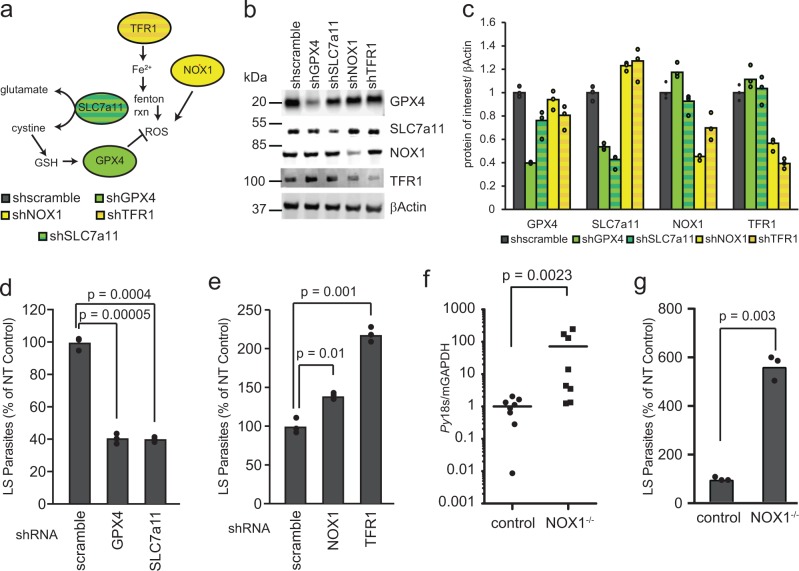
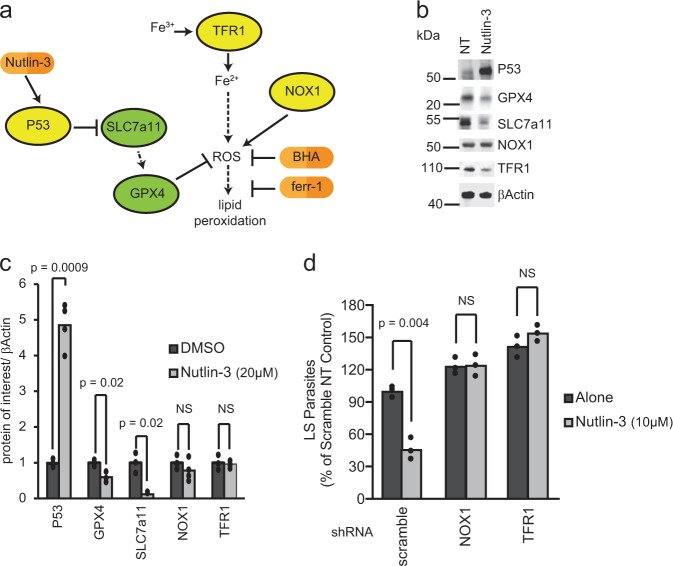
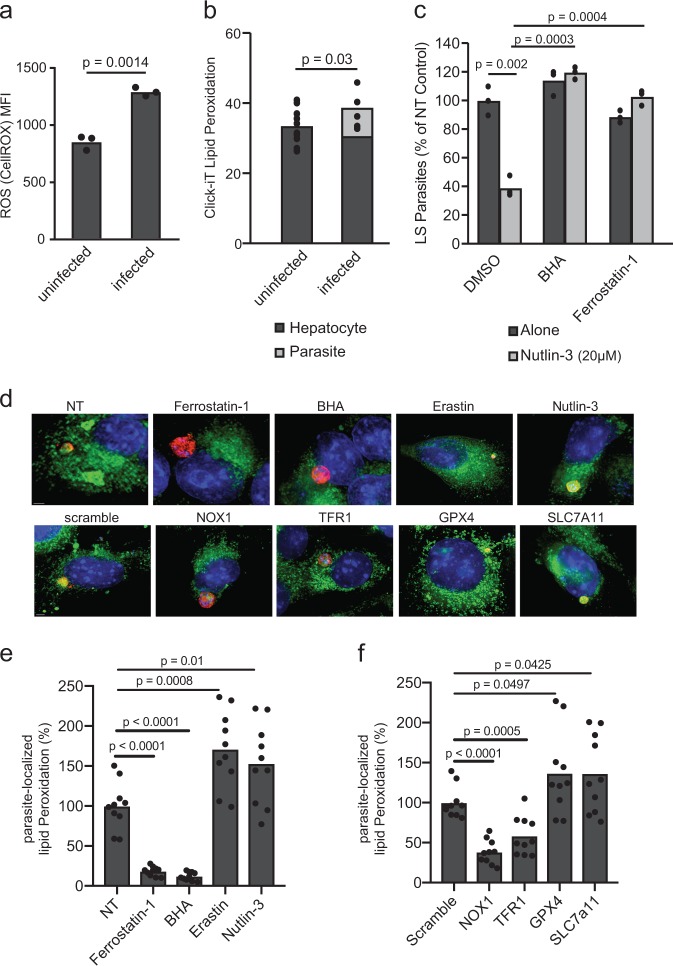
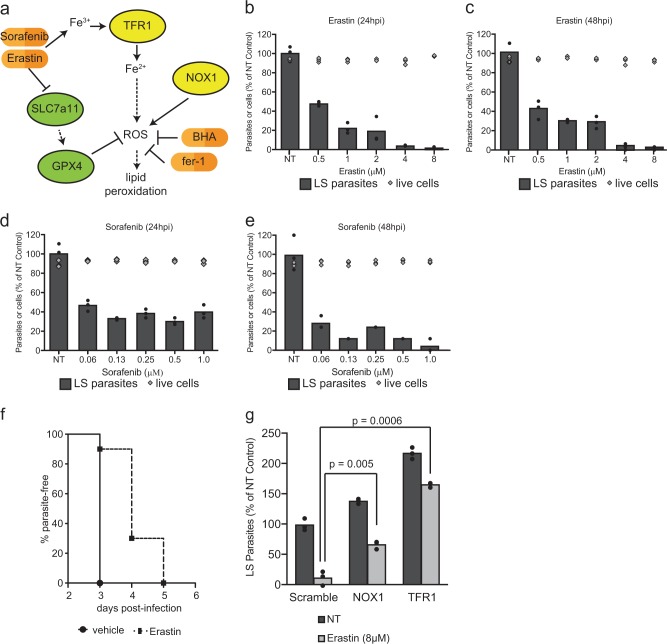
The facets of host control during Plasmodium liver infection remain largely unknown. We find that the SLC7a11-GPX4 pathway, which has been associated with the production of reactive oxygen species, lipid peroxidation, and a form of cell death called ferroptosis, plays a critical role in control of Plasmodium liver stage infection. Specifically, blocking GPX4 or SLC7a11 dramatically reduces Plasmodium liver stage parasite infection. In contrast, blocking negative regulators of this pathway, NOX1 and TFR1, leads to an increase in liver stage infection. We have shown previously that increased levels of P53 reduces Plasmodium LS burden in an apoptosis-independent manner. Here, we demonstrate that increased P53 is unable to control parasite burden during NOX1 or TFR1 knockdown, or in the presence of ROS scavenging or when lipid peroxidation is blocked. Additionally, SLC7a11 inhibitors Erastin and Sorafenib reduce infection. Thus, blocking the host SLC7a11-GPX4 pathway serves to selectively elevate lipid peroxides in infected cells, which localize within the parasite and lead to the elimination of liver stage parasites.
Overview
The claims and statistics of this paper haven’t been checked yet.
Free: it reads the open-access text and checks the first 5 claims that cite a source we can check. Create a free account to check every claim.
Integrity signals
Registry
Cites
Statistics
Figures
Verification
Claims the paper makes
The claims and statistics of this paper haven’t been checked yet.
Free: it reads the open-access text and checks the first 5 claims that cite a source we can check. Create a free account to check every claim.
Claims other papers make about this one
Each is checked against this paper’s own text: does it say what the citing paper says it does?
The cited source says what the claim attributes to it.
In the citing paper
“Blocking of Gpx4 dramatically reduced infection burden of Plasmodium in the liver, most likely by selectively elevation of lipid peroxides in infected cells, which localize within the parasite and lead to the elimination of liver stage parasites.”
From Iron in immune cell function and host defense (2021) · cites this paper as [109]
In the citing paper
“GPx4 has also been demonstrated to play a crucial role for the liver stage of Plasmodium infection”
From Iron in immune cell function and host defense (2021) · cites this paper as [109]
Self-check
Percentages, sums and reported differences re-computed from the paper’s own numbers.
The self-check needs the paper’s full text.
Citations
Cites
Ferroptosis: An Iron-Dependent Form of Nonapoptotic Cell Death
Dixon, S. J., Lemberg, K. M., Lamprecht, M. R., Skouta, R., Zaitsev, E. M., Gleason, C. E., Patel, D. N., Bauer, A. J., Cantley, A. M., Yang, W. S., et al. (2012) · Cell · doi:10.1016/j.cell.2012.03.042 · Cited by 18,691
Regulation of Ferroptotic Cancer Cell Death by GPX4
Yang, W. S., SriRamaratnam, R., Welsch, M. E., Shimada, K., Skouta, R., Viswanathan, V. S., Cheah, J. H., Clemons, P. A., Shamji, A. F., Clish, C. B., et al. (2014) · Cell · doi:10.1016/j.cell.2013.12.010 · Cited by 7,713
Genome-scale CRISPR-Cas9 knockout screening in human cells
Shalem, O., Sanjana, N. E., Hartenian, E., Shi, X., Scott, D. A., Mikkelsen, T. S., Heckl, D., Ebert, B. L., Root, D. E., Doench, J. G., et al. (2014) · Science · doi:10.1126/science.1247005 · Cited by 5,234
In Vivo Activation of the p53 Pathway by Small-Molecule Antagonists of MDM2
Vassilev, L. T., Vu, B. T., Graves, B., Carvajal, D., Podlaski, F., Filipovic, Z., Kong, N., Kammlott, U., Lukacs, C., Klein, C., et al. (2004) · Science · doi:10.1126/science.1092472 · Cited by 4,661
Ferroptosis: process and function
Xie, Y., Hou, W., Song, X., Yu, Y., Huang, J., Sun, X., Kang, R., & Tang, D. (2016) · Cell Death & Differentiation · doi:10.1038/cdd.2015.158 · Cited by 3,727
Ferroptosis as a p53-mediated activity during tumour suppression
Jiang, L., Kon, N., Li, T., Wang, S.-J., Su, T., Hibshoosh, H., Baer, R., & Gu, W. (2015) · Nature · doi:10.1038/nature14344 · Cited by 3,398
Easy quantitative assessment of genome editing by sequence trace decomposition
Brinkman, E. K., Chen, T., Amendola, M., & van Steensel, B. (2014) · Nucleic Acids Research · doi:10.1093/nar/gku936 · Cited by 2,390
Dixon, S. J., Patel, D. N., Welsch, M., Skouta, R., Lee, E. D., Hayano, M., Thomas, A. G., Gleason, C. E., Tatonetti, N. P., Slusher, B. S., et al. (2014) · eLife · doi:10.7554/elife.02523 · Cited by 2,088
Glutaminolysis and transferrin regulate ferroptosis
Gao, M., Monian, P., Quadri, N., Ramasamy, R., & Jiang, X. (2015) · Molecular Cell · doi:10.1016/j.molcel.2015.06.011 · Cited by 2,069
RAS–RAF–MEK-dependent oxidative cell death involving voltage-dependent anion channels
Yagoda, N., von Rechenberg, M., Zaganjor, E., Bauer, A. J., Yang, W. S., Fridman, D. J., Wolpaw, A. J., Smukste, I., Peltier, J. M., Boniface, J. J., et al. (2007) · Nature · doi:10.1038/nature05859 · Cited by 1,631
Zilka, O., Shah, R., Li, B., Friedmann Angeli, J. P., Griesser, M., Conrad, M., & Pratt, D. A. (2017) · ACS Central Science · doi:10.1021/acscentsci.7b00028 · Cited by 1,038
Programmed cell death as a defence against infection
Jorgensen, I., Rayamajhi, M., & Miao, E. A. (2017) · Nature Reviews Immunology · doi:10.1038/nri.2016.147 · Cited by 1,026
Single-cell RNA-seq reveals dynamic paracrine control of cellular variation
Shalek, A. K., Satija, R., Shuga, J., Trombetta, J. J., Gennert, D., Lu, D., Chen, P., Gertner, R. S., Gaublomme, J. T., Yosef, N., et al. (2014) · Nature · doi:10.1038/nature13437 · Cited by 1,000
Tumor Suppression in the Absence of p53-Mediated Cell-Cycle Arrest, Apoptosis, and Senescence
Li, T., Kon, N., Jiang, L., Tan, M., Ludwig, T., Zhao, Y., Baer, R., & Gu, W. (2012) · Cell · doi:10.1016/j.cell.2012.04.026 · Cited by 912
E-CRISP: fast CRISPR target site identification
Heigwer, F., Kerr, G., & Boutros, M. (2014) · Nature Methods · doi:10.1038/nmeth.2812 · Cited by 880
Hambright, W. S., Fonseca, R. S., Chen, L., Na, R., & Ran, Q. (2017) · Redox Biology · doi:10.1016/j.redox.2017.01.021 · Cited by 851
Long‐Term in Vitro Function of Adult Hepatocytes in a Collagen Sandwich Configuration
Dunn, J. C. Y., Tompkins, R. G., & Yarmush, M. L. (1991) · Biotechnology Progress · doi:10.1021/bp00009a007 · Cited by 694
HSPB1 as a novel regulator of ferroptotic cancer cell death
Sun, X., Ou, Z., Xie, M., Kang, R., Fan, Y., Niu, X., Wang, H., Cao, L., & Tang, D. (2015) · Oncogene · doi:10.1038/onc.2015.32 · Cited by 666
RIPK1 and NF-κB signaling in dying cells determines cross-priming of CD8 + T cells
Yatim, N., Jusforgues-Saklani, H., Orozco, S., Schulz, O., Barreira da Silva, R., Reis e Sousa, C., Green, D. R., Oberst, A., & Albert, M. L. (2015) · Science · doi:10.1126/science.aad0395 · Cited by 622
Iron‐dependent cell death of hepatocellular carcinoma cells exposed to sorafenib
Louandre, C., Ezzoukhry, Z., Godin, C., Barbare, J., Mazière, J., Chauffert, B., & Galmiche, A. (2013) · International Journal of Cancer · doi:10.1002/ijc.28159 · Cited by 602
Single-cell genomics unveils critical regulators of Th17 cell pathogenicity
Gaublomme, J. T., Yosef, N., Lee, Y., Gertner, R. S., Yang, L. V., Wu, C., Pandolfi, P. P., Mak, T., Satija, R., Shalek, A. K., et al. (2015) · Cell · doi:10.1016/j.cell.2015.11.009 · Cited by 575
Zille, M., Karuppagounder, S. S., Chen, Y., Gough, P. J., Bertin, J., Finger, J., Milner, T. A., Jonas, E. A., & Ratan, R. R. (2017) · Stroke · doi:10.1161/strokeaha.116.015609 · Cited by 526
Sorafenib induces ferroptosis in human cancer cell lines originating from different solid tumors.
Lachaier, E., Louandre, C., Godin, C., Saidak, Z., Baert, M., Diouf, M., Chauffert, B., & Galmiche, A. (2014) · PubMed · Cited by 477
Modeling the effects of lipid peroxidation during ferroptosis on membrane properties
Agmon, E., Solon, J., Bassereau, P., & Stockwell, B. R. (2018) · Scientific Reports · doi:10.1038/s41598-018-23408-0 · Cited by 344
Pathogen Cell-to-Cell Variability Drives Heterogeneity in Host Immune Responses
Avraham, R., Haseley, N., Brown, D., Penaranda, C., Jijon, H. B., Trombetta, J. J., Satija, R., Shalek, A. K., Xavier, R. J., Regev, A., et al. (2015) · Cell · doi:10.1016/j.cell.2015.08.027 · Cited by 335
Host-cell sensors for Plasmodium activate innate immunity against liver-stage infection
Liehl, P., Zuzarte-Luís, V., Chan, J., Zillinger, T., Baptista, F., Carapau, D., Konert, M., Hanson, K. K., Carret, C., Lassnig, C., et al. (2014) · Nature Medicine · doi:10.1038/nm.3424 · Cited by 313
Interferon-Mediated Innate Immune Responses against Malaria Parasite Liver Stages
Miller, J. L., Sack, B. K., Baldwin, M., Vaughan, A. M., & Kappe, S. H. I. (2014) · Cell Reports · doi:10.1016/j.celrep.2014.03.018 · Cited by 184
Heme Oxygenase-1 Is an Anti-Inflammatory Host Factor that Promotes Murine Plasmodium Liver Infection
Epiphânio, S., Mikolajczak, S. A., Gonçalves, L. A., Pamplona, A., Portugal, S., Albuquerque, S., Goldberg, M. S., Rebelo, S., Anderson, D. G., Akinc, A., et al. (2008) · Cell Host & Microbe · doi:10.1016/j.chom.2008.04.003 · Cited by 154
Houessinon, A., François, C., Sauzay, C., Louandre, C., Mongelard, G., Godin, C., Bodeau, S., Takahashi, S., Saidak, Z., Gutierrez, L., et al. (2016) · Molecular Cancer · doi:10.1186/s12943-016-0526-2 · Cited by 137
Malaria parasite pre-erythrocytic infection: preparation meets opportunity
Lindner, S. E., Miller, J. L., & Kappe, S. H. I. (2011) · Cellular Microbiology · doi:10.1111/j.1462-5822.2011.01734.x · Cited by 106
Suppression of Host p53 Is Critical for Plasmodium Liver-Stage Infection
Kaushansky, A., Ye, A. S., Austin, L. S., Mikolajczak, S. A., Vaughan, A. M., Camargo, N., Metzger, P. G., Douglass, A. N., MacBeath, G., & Kappe, S. H. I. (2013) · Cell Reports · doi:10.1016/j.celrep.2013.02.010 · Cited by 105
Tryparedoxin peroxidase-deficiency commits trypanosomes to ferroptosis-type cell death
Bogacz, M., & Krauth-Siegel, R. L. (2018) · eLife · doi:10.7554/elife.37503 · Cited by 104
Kaushansky, A., Metzger, P. G., Douglass, A. N., Mikolajczak, S. A., Lakshmanan, V., Kain, H. S., & Kappe, S. H. I. (2013) · Cell Death and Disease · doi:10.1038/cddis.2013.286 · Cited by 92
Vaughan, A. M., Mikolajczak, S. A., Camargo, N. M., Lakshmanan, V., Kennedy, M. F., Lindner, S. E., Miller, J. L., Hume, J. C. C., & Kappe, S. H. I. (2012) · Molecular and Biochemical Parasitology · doi:10.1016/j.molbiopara.2012.10.004 · Cited by 76
Susceptibility of different strains of mice to hepatic infection with Plasmodium berghei
Scheller, L. F., Wirtz, R. A., & Azad, A. F. (1994) · Infection and Immunity · doi:10.1128/iai.62.11.4844-4847.1994 · Cited by 67
Dietary alterations modulate susceptibility to Plasmodium infection
Zuzarte‐Luís, V., Mello-Vieira, J., Marreiros, I. M., Liehl, P., Chora, Â. F., Carret, C., Carvalho, T., & Mota, M. M. (2017) · Nature Microbiology · doi:10.1038/s41564-017-0025-2 · Cited by 66
Arang, N., Kain, H. S., Glennon, E. K. K., Bello, T., Dudgeon, D. R., Walter, E. N. F., Gujral, T. S., & Kaushansky, A. (2017) · Nature Communications · doi:10.1038/s41467-017-01345-2 · Cited by 59
Modulation of p53 during bacterial infections
Siegl, C., & Rudel, T. (2015) · Nature Reviews Microbiology · doi:10.1038/nrmicro3537 · Cited by 57
Susceptibility toPlasmodiumliver stage infection is altered by hepatocyte polyploidy
Austin, L. S., Kaushansky, A., & Kappe, S. H. I. (2014) · Cellular Microbiology · doi:10.1111/cmi.12282 · Cited by 35
The TLR2 is activated by sporozoites and suppresses intrahepatic rodent malaria parasite development
Zheng, H., Tan, Z., Zhou, T., Zhu, F., Ding, Y. P., Liu, T., Wu, Y., & Xu, W. (2015) · Scientific Reports · doi:10.1038/srep18239 · Cited by 35 · cited 1×
“receptor (TLR) 3, TLR4 and the type I interferon receptor have little to no impact on initial LS burden [6, 7], and the elimination of TLR2 modestly increases liver stage infection [8].”
BackgroundHost-based Prophylaxis Successfully Targets Liver Stage Malaria Parasites
Douglass, A. N., Kain, H. S., Abdullahi, M., Arang, N., Austin, L. S., Mikolajczak, S. A., Billman, Z. P., Hume, J. C. C., Murphy, S. C., Kappe, S. H. I., et al. (2015) · Molecular Therapy · doi:10.1038/mt.2015.18 · Cited by 34
Kaushansky, A., Austin, L. S., Mikolajczak, S. A., Lo, F. Y., Miller, J. L., Douglass, A. N., Arang, N., Vaughan, A. M., Gardner, M. J., & Kappe, S. H. I. (2014) · Infection and Immunity · doi:10.1128/iai.02230-14 · Cited by 27
Selection and refinement: the malaria parasite's infection and exploitation of host hepatocytes
Kaushansky, A., & Kappe, S. H. I. (2015) · Current Opinion in Microbiology · doi:10.1016/j.mib.2015.05.013 · Cited by 27
Host ER stress during malaria parasite infection
Kaushansky, A., & Kappe, S. H. I. (2015) · EMBO Reports · doi:10.15252/embr.201540792 · Cited by 16
Hanson, K. K., March, S., Ng, S., Bhatia, S. N., & Mota, M. M. (2014) · Eukaryotic Cell · doi:10.1128/ec.00166-14 · Cited by 12
Effects of iron deficiency on the hepatic development of Plasmodium yoelii.
Goma, J., Rénia, L., Miltgen, F., & Mazier, D. (1995) · PubMed · Cited by 9
Hanson, K. K., March, R., Ng, C. S., Bhatia, D. S. N., & Motaa, F. M. M. (2015) · Cited by 1
Cited by
Ferroptosis: molecular mechanisms and health implications
Tang, D., Chen, X., Kang, R., & Kroemer, G. (2021) · Cell Research · doi:10.1038/s41422-020-00441-1 · Cited by 4,256
p53 in ferroptosis regulation: The new weapon for the old guardian
Liu, Y., & Gu, W. (2022) · Cell Death & Differentiation · doi:10.1038/s41418-022-00943-y · Cited by 540
“Mechanistically, after Plasmodium infection, p53 promotes ferroptosis in infected cells, thus eliminating those cells together with the parasite via the p53/SLC7A11/GPX4 pathway [132].”
BackgroundStriking while the iron is hot: Iron metabolism and ferroptosis in neurodegeneration
Masaldan, S., Bush, A. I., Devos, D., Rolland, A. S., & Moreau, C. (2019) · Free Radical Biology and Medicine · doi:10.1016/j.freeradbiomed.2018.09.033 · Cited by 481
A Nuclear Long Non-Coding RNA LINC00618 Accelerates Ferroptosis in a Manner Dependent upon Apoptosis
Wang, Z., Chen, X., Liu, N., Shi, Y., Liu, Y., Ouyang, L., Tam, S., Xiao, D., Liu, S., Wen, F., et al. (2021) · Molecular Therapy · doi:10.1016/j.ymthe.2020.09.024 · Cited by 281
ESCRT-III–dependent membrane repair blocks ferroptosis
Dai, E., Meng, L., Kang, R., Wang, X., & Tang, D. (2020) · Biochemical and Biophysical Research Communications · doi:10.1016/j.bbrc.2019.11.110 · Cited by 273
“Oxidative stressmediated ferroptosis mediates inflammation and tissue injury in brain, liver, kidney, and heart [29-32].”
Background
Metadata
- Authors
- Kain, H. S., Glennon, E. K. K., Vijayan, K., Arang, N., Douglass, A. N., Fortin, C. L., Zuck, M., Lewis, A. J., Whiteside, S. L., Dudgeon, D. R., Johnson, J. S., Aderem, A., Stevens, K. R., & Kaushansky, A.
- Affiliations
- Center for Infectious Disease Research (US)
- University of Washington (US)
- Corresponding author
- Kaushansky, Alexis
- ORCID
- Venue
- Cell Death & Differentiation
- Published
- 2019-05-07
- Volume
- 27
- Issue
- 1
- Pages
- 44-54
- ISSN
- 1350-9047 (ISSN-L)
- 1476-5403
- PMC
- PMC7206113
- OpenAlex
- W2944572531
- Cited by
- 91
- References
- 47
- Citations by year
- 2026: 8 · 2025: 15 · 2024: 9 · 2023: 15 · 2022: 18 · 2021: 15 · 2020: 9 · 2019: 1
- FWCI
- 9.84
- Type
- journal article
- Language
- en
- Open access
- hybrid
- doi.org
- Licence
- cc-by
- creativecommons.org/licenses/by/4.0 (tdm)
- creativecommons.org/licenses/by/4.0 (vor)
- Locations
- Cell Death and Differentiation (publishedVersion, cc-by)
- bioRxiv (Cold Spring Harbor Laboratory) (acceptedVersion, cc-by-nc-nd)
- PubMed Central (publishedVersion, cc-by)
- PubMed (publishedVersion)
- Funders
- U.S. Department of Health & Human Services | National Institutes of Health (K99/R00AI111785, R01GM101183, R01AI032972, R01AI025032)
- Topics
- Health Sciences › Medicine › Public Health, Environmental and Occupational Health › Malaria Research and Control
- Life Sciences › Biochemistry, Genetics and Molecular Biology › Cancer Research › Ferroptosis and cancer prognosis
- Life Sciences › Immunology and Microbiology › Parasitology › Toxoplasma gondii Research Studies
- Keywords
- host-parasite interactions, lipid peroxidation, ferroptosis, SLC7A11, GPX4, reactive oxygen species, NOX1, transferrin receptor 1, p53, erastin, sorafenib
- MeSH terms
- NADPH Oxidase 1, Ferroptosis, Phospholipid Hydroperoxide Glutathione Peroxidase, Animals, Cell Line, Cells, Cultured, Liver Diseases, Malaria, Mice, Inbred C57BL, Receptors, Transferrin, Lipid Peroxidation, Signal Transduction, Tumor Suppressor Protein p53, Reactive Oxygen Species, Mice, Knockout, Amino Acid Transport System y+
About these checks
Registry, retraction, Cites and statistics results are computed, not judged, with one exception: a printed reference that no index lists is read once by a model before it counts as a citation error. Claims are extracted by a model and kept only when their quote appears verbatim in the text; each cited source is then checked, with a model’s help, for whether it says what the claim relies on. Those verdicts can be wrong — read the claim’s quote and the cited source before relying on one.
Statistics and arithmetic are recomputed, not judged.
Confidence bands are shown only for fields calibrated on our annotated test set. None is calibrated yet, so no band is shown.
What counts as a claim ›How we measure confidence ›How we check this ›
Are you an author, or do you see a problem with this page? Request a review
Data sources
Bibliographic data: Semantic Scholar, OpenAlex, Crossref.
Contains information from the Semantic Scholar Academic Graph Datasets, made available under the ODC Attribution License (ODC-BY 1.0).
Semantic Scholar’s data is described in: Kinney, R., et al. (2023). The Semantic Scholar Open Data Platform. arXiv:2301.10140.
