

Toward a universal decoder of linguistic meaning from brain activation
Open accessThe DOI matches its Crossref record; 54 of the 54 references it cites were found in a registry or an index.
Abstract
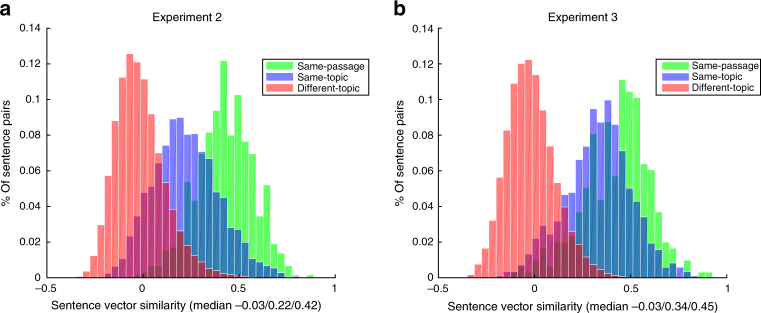
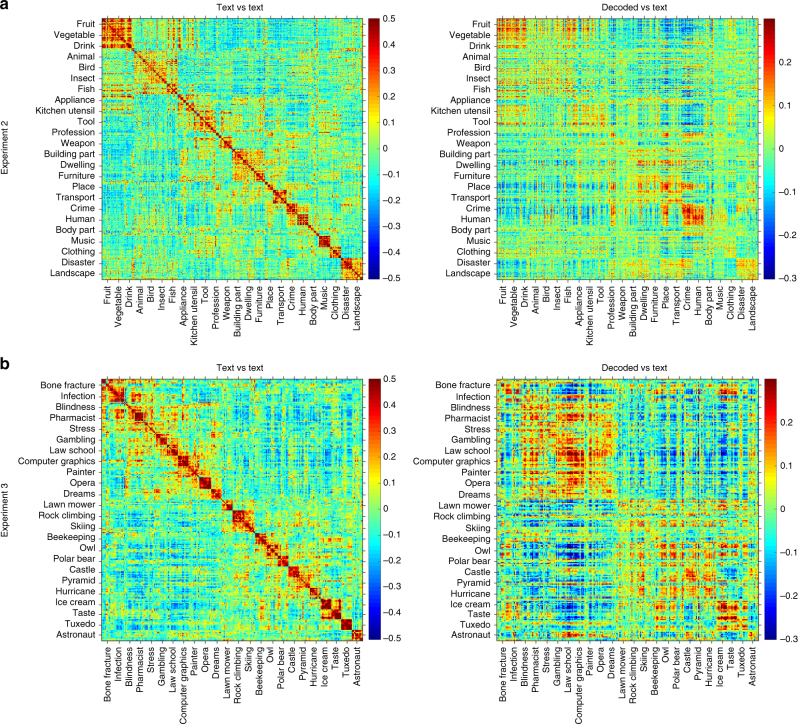
Prior work decoding linguistic meaning from imaging data has been largely limited to concrete nouns, using similar stimuli for training and testing, from a relatively small number of semantic categories. Here we present a new approach for building a brain decoding system in which words and sentences are represented as vectors in a semantic space constructed from massive text corpora. By efficiently sampling this space to select training stimuli shown to subjects, we maximize the ability to generalize to new meanings from limited imaging data. To validate this approach, we train the system on imaging data of individual concepts, and show it can decode semantic vector representations from imaging data of sentences about a wide variety of both concrete and abstract topics from two separate datasets. These decoded representations are sufficiently detailed to distinguish even semantically similar sentences, and to capture the similarity structure of meaning relationships between sentences.
Overview
The claims and statistics of this paper haven’t been checked yet.
Free: it reads the open-access text and checks the first 5 claims that cite a source we can check. Create a free account to check every claim.
Integrity signals
Registry
Cites
Statistics
Figures
Verification
Claims the paper makes
The claims and statistics of this paper haven’t been checked yet.
Free: it reads the open-access text and checks the first 5 claims that cite a source we can check. Create a free account to check every claim.
Claims other papers make about this one
Each is checked against this paper’s own text: does it say what the citing paper says it does?
The source backs part of the claim, not all of it — or backs it for a different population, condition or comparison.
In the citing paper
“Large Language Models (LLMs) have shown success in predicting neural signals associated with narrative processing”
From Incremental accumulation of linguistic context in artificial and biological neural networks (2025) · cites this paper as [1]
Experimental — accuracy not yet measuredThe source backs part of the claim, not all of it — or backs it for a different population, condition or comparison.
In the citing paper
“Previous studies in the neural encoding literature all used LLMs that were only aware of the short-term context, i.e., where the context window size was as large as several tens of words1–10.”
From Incremental accumulation of linguistic context in artificial and biological neural networks (2025) · cites this paper as [1]
Experimental — accuracy not yet measuredThe cited source says what the claim attributes to it.
In the citing paper
“This was the case even though the participants in these studies were exposed to language stimuli that encompassed hundreds and even thousands of words.”
From Incremental accumulation of linguistic context in artificial and biological neural networks (2025) · cites this paper as [1]
Self-check
Percentages, sums and reported differences re-computed from the paper’s own numbers.
The self-check needs the paper’s full text.
Citations
Cites
Glove: Global Vectors for Word Representation
Pennington, J., Socher, R., & Manning, C. (2014) · Proceedings of the 2014 Conference on Empirical Methods in Natural Language Processing (EMNLP) · doi:10.3115/v1/d14-1162 · Cited by 34,071
Distributed Representations of Words and Phrases and their Compositionality
Mikolov, T., Sutskever, I., Chen, K., Corrado, G., & Dean, J. (2013) · arXiv · doi:10.48550/arxiv.1310.4546 · Cited by 24,533
The Elements of Statistical Learning
Hastie, T., Friedman, J., & Tibshirani, R. (2001) · Springer Series in Statistics · doi:10.1007/978-0-387-21606-5 · Cited by 24,162
Indexing by latent semantic analysis
Deerwester, S., Dumais, S. T., Furnas, G. W., Landauer, T. K., & Harshman, R. (1990) · Journal of the American Society for Information Science · doi:10.1002/(sici)1097-4571(199009)41:6<391::aid-asi1>3.0.co;2-9 · Cited by 12,751
Ambrose, A., Wittgenstein, L., & Anscombe, G. E. M. (1954) · Philosophy and Phenomenological Research · doi:10.2307/2103745 · Cited by 12,192
Jenkinson, M., Beckmann, C. F., Behrens, T. E. J., Woolrich, M. W., & Smith, S. M. (2012) · NeuroImage · doi:10.1016/j.neuroimage.2011.09.015 · Cited by 11,314
A tutorial on spectral clustering
von Luxburg, U. (2007) · Statistics and Computing · doi:10.1007/s11222-007-9033-z · Cited by 10,349
The Brain's Default Network: Anatomy, Function, and Relevance to Disease
Buckner, R. L., Andrews‐Hanna, J. R., & Schacter, D. L. (2008) · Annals of the New York Academy of Sciences · doi:10.1196/annals.1440.011 · Cited by 9,761
Power, J. D., Barnes, K. A., Snyder, A. Z., Schlaggar, B. L., & Petersen, S. E. (2012) · NeuroImage · doi:10.1016/j.neuroimage.2011.10.018 · Cited by 7,429
Functional Network Organization of the Human Brain
Power, J. D., Cohen, A. L., Nelson, S. M., Wig, G. S., Barnes, K. A., Church, J. A., Vogel, A. C., Laumann, T. O., Miezin, F. M., Schlaggar, B. L., et al. (2011) · Neuron · doi:10.1016/j.neuron.2011.09.006 · Cited by 4,124
Research works printed but not linked: 1
- Ringgaard, M., Gupta, R., and Pereira, F. C. N. SLING: a framework for frame semantic parsing. Preprint arXiv:1710.07032 (2017). · arXiv
Cited by
Items 201–300 of 445
Structural Similarities Between Language Models and Neural Response MeasurementsPreprint
Li, J., Karamolegkou, A., Kementchedjhieva, Y., Abdou, M., Lehmann, S., & Søgaard, A. (2023) · arXiv (Cornell University) · doi:10.48550/arxiv.2306.01930 · Cited by 11
“Pereira et al. [9] were the first to build regression models to predict sentence representations from brain scans.”
BackgroundMapping the neuronal building blocks of human language with language models
Cai, J., Kfir, Y., Jamali, M., Huang, H., Kim, Y. J., Cash, S. S., & Williams, Z. M. (2026) · Nature · doi:10.1038/s41586-026-10691-5 · Cited by 11
Billot, A., Jhingan, N., Varkanitsa, M., Wolna, A., Shain, C., Blank, I., Ryskin, R. A., Kiran, S., & Fedorenko, E. G. (2026) · Nature Communications · doi:10.1038/s41467-026-76598-x · Cited by 10
“109,122,198,199) and include three regions in the left frontal cortex: two located in the inferior frontal gyrus (LH IFG overlapping with pars opercularis and triangularis, and LH IFGorb overlapping with pars orbitalis), and one located in the middle frontal gyrus (LH MFG); and two regions in the…”
Self-citationLiang, Y., Xu, K., & Ran, Q. (2024) · Scientific Reports · doi:10.1038/s41598-024-56571-8 · Cited by 10
Mapping and modeling the semantic space of math concepts
Debray, S., & Dehaene, S. (2024) · Cognition · doi:10.1016/j.cognition.2024.105971 · Cited by 10
“Finally, beyond behavioral judgements, such embeddings have also been shown to predict neuroimaging data (Huth, de Heer, Griffiths, Theunissen, & Gallant, 2016; Millet et al., 2022; Mitchell et al., 2008; Pereira et al., 2018; Tong et al., 2022).”
Using EEG to decode semantics during an artificial language learning task
Foster, C., Williams, C. C., Krigolson, O. E., & Fyshe, A. (2021) · Brain and Behavior · doi:10.1002/brb3.2234 · Cited by 10
Abdou, M. (2022) · arXiv (Cornell University) · doi:10.48550/arxiv.2203.05300 · Cited by 10
“…and grounded semantic models — including more recent skip-gram and bag-of-words word embeddings (Mikolov et al., 2013) — can predict fMRI measuremets; Pereira et al. (2018) presented a new fMRI dataset of subjects reading words and passages, showing that a decoder trained to predict word…”
BackgroundMethodInfluentialImplantable Neural Speech Decoders: Recent Advances, Future Challenges
Jhilal, S., Marchesotti, S., Thirion, B., Soudrie, B., Giraud, A., & Mandonnet, E. (2025) · Neurorehabilitation and neural repair · doi:10.1177/15459683251369468 · Cited by 9
“For example, the phonological system involves bilateral frontal and temporal areas, 92 while the semantic system is even more distributed (see, e.g., the review of Binder et al 93 and the recent work of Pereira et al 94 ).”
Query Augmentation with Brain Signals
Ye, Z., Zhan, J., Ai, Q., Liu, Y., de Rijke, M., Lioma, C., & Ruotsalo, T. (2024) · ACM International Conference on Multimedia (ACM MM) · doi:10.1145/3664647.3681658 · Cited by 9
“Subsequently, manual review and revision are performed to address these typos.”
BackgroundMethodResultInfluentialSemantic memory space becomes denser with age
Cutler, R. A., Mirjalili, S., Pham, P., Devulapalli, H., Zafar, S., & Duarte, A. (2025) · Neuropsychologia · doi:10.1016/j.neuropsychologia.2025.109083 · Cited by 9
“In the current study, we create multi-word feature vectors by averaging the vectors of each of the content words within a feature (Pereira et al., 2018).”
de Varda, A. G., Malik-Moraleda, S., Tuckute, G., & Fedorenko, E. G. (2025) · bioRxiv (Cold Spring Harbor Laboratory) · doi:10.1101/2025.02.01.636044 · Cited by 9
Self-citationBrain-inspired computing based on deep learning for human-computer interaction: A review
Yu, B., Zhang, S., Zhou, L., Wei, J., Sun, L., & Bu, L. (2025) · Neurocomputing · doi:10.1016/j.neucom.2025.130928 · Cited by 8
Bruera, A., & Poesio, M. (2022) · Frontiers in Artificial Intelligence · doi:10.3389/frai.2022.796793 · Cited by 8
“To learn the mapping, we use Ridge regression with default parameters, following recent work (Pereira et al., 2018; Sassenhagen and Fiebach, 2020), implemented in the Python package Scikit-learn (Pedregosa et al.”
BackgroundMethodBranco, A., Rodrigues, J. A., Salawa, M., Branco, R., & Saedi, C. (2020) · International Conference on Computational Linguistics · doi:10.18653/v1/2020.coling-main.354 · Cited by 8
Shen, G., Zhao, D., Dong, Y., Zhang, Q., & Zeng, Y. (2025) · Research Square · doi:10.21203/rs.3.rs-6950065/v1 · Cited by 8
Affective Color Scales for Colormap Data Visualizations
Braun, H. C., Mukherjee, K., Gorelik, S. R., & Schloss, K. B. (2025) · IEEE Transactions on Visualization and Computer Graphics · doi:10.1109/tvcg.2025.3634775 · Cited by 7
AI‐Enhanced Semantic Feature Norms for 786 Concepts
Suresh, S., Mukherjee, K., Giallanza, T., Yu, X., Patil, M., Cohen, J. D., & Rogers, T. T. (2025) · Topics in Cognitive Science · doi:10.1111/tops.70037 · Cited by 7
“…fail to capture the semantic structure perceived by humans as effectively as feature norms, and their dimensions lack the transparent interpretability of feature-based representations, at 1 Published as a conference paper at ICLR 2025 least for for concrete objects (Suresh et al., 2023b;a).”
Bhardwaj, N., Sood, M., & Gill, S. S. (2024) · Current Medical Imaging Formerly Current Medical Imaging Reviews · doi:10.2174/0115734056288248240309044616 · Cited by 7
Surprisal from Larger Transformer-based Language Models Predicts fMRI Data More Poorly
Lin, Y.-C., & Schuler, W. (2026) · Conference of the European Chapter of the Association for Computational Linguistics · doi:10.18653/v1/2026.eacl-short.11 · Cited by 7
Ongoing thoughts at rest reflect functional brain organization and behaviour
Ke, J., Chamberlain, T. A., Song, H., Corriveau, A., Zhang, Z., Martinez, T., Sams, L., Chun, M. M., Leong, Y. C., & Rosenberg, M. D. (2026) · Nature Human Behaviour · doi:10.1038/s41562-026-02563-9 · Cited by 7
Assessing kinetic meaning of music and dance via deep cross-modal retrieval
Raposo, F., de Matos, D. M., & Ribeiro, R. (2021) · Neural Computing and Applications · doi:10.1007/s00521-021-06090-8 · Cited by 7
“We compute pair and rank accuracies for instance-level evaluation (similar to [63]).”
MethodLanguage Reconstruction with Brain Predictive Coding from fMRI Data
Yin, C., Ye, Z., & Li, P. (2026) · Proceedings of the conference - Association for Computational Linguistics. Meeting · doi:10.18653/v1/2026.acl-long.949 · Cited by 7
Djokic, V. G., Maillard, J., Bulat, L., & Shutova, E. (2019) · Proceedings of the conference - Association for Computational Linguistics. Meeting · doi:10.18653/v1/p19-1508 · Cited by 7
“Moving beyond words, other studies have shown that DSMs can predict brain activity patterns associated with larger linguistic units (Wehbe et al., 2014; Huth et al., 2016; Pereira et al., 2018).”
BackgroundResultData-driven models and computational tools for neurolinguistics: a language technology perspectivePreprint
Artemova, E., Bakarov, A., Artemov, A., Burnaev, E. V., & Sharaev, M. (2020) · arXiv (Cornell University) · doi:10.48550/arxiv.2003.10540 · Cited by 7
“…leaps from the early attempts on relating separate words with the imaging data (Friederici et al., 2000; Fiebach & Friederici, 2004), to the whole-brain mapping from the natural stimuli (Huth et al., 2016), to decoding of the linguistic meaning from the brain activation data (Pereira et al., 2018).”
BackgroundMethodInfluentialBoyce-Jacino, C., & DeDeo, S. (2021) · PsyArXiv (OSF Preprints) · doi:10.31234/osf.io/5mgn2 · Cited by 7
Ling, S., Murphy, A., & Fyshe, A. (2024) · Computational Linguistics · doi:10.1162/coli_a_00533 · Cited by 6
“…brain areas to corresponding timescales during comprehension of words (Mitchell et al. 2008; Huth et al. 2016), phrases (Fyshe et al. 2019), syntax and parts-of-speech (Hale et al. 2018; Murphy et al. 2022), sentence segments (Wehbe et al. 2014a), and complete sentences (Pereira et al. 2018).”
BP-GPT: Auditory Neural Decoding Using fMRI-prompted LLM
Chen, X., Du, C., Liu, C., Wang, Y., & He, H. (2025) · IEEE International Conference on Acoustics Speech and Signal Processing · doi:10.1109/icassp49660.2025.10890142 · Cited by 6
An fMRI visual neural encoding method with multimodal large language model
Ma, S., Wang, L., Hou, L., Hou, S., & Yan, B. (2025) · Knowledge-Based Systems · doi:10.1016/j.knosys.2025.114049 · Cited by 6
Compositionality in the semantic network: a model-driven representational similarity analysis
Ciapparelli, M., Marelli, M., Graves, W. W., & Reverberi, C. (2025) · Cerebral Cortex · doi:10.1093/cercor/bhaf246 · Cited by 6
“Importantly for our purpose, many studies have demonstrated representational similarities between these models and fine-grained activation patterns in the brain ( Mitchell et al. 2008; Carota et al. 2017; Pereira et al. 2018; Zhang et al. 2020).”
BrainDEC: A Multimodal LLM for the Non-Invasive Decoding of Text from Brain Recordings
Hmamouche, Y., Chihab, I., Kdouri, L., & Seghrouchni, A. E. F. (2025) · Information Fusion · doi:10.1016/j.inffus.2025.103589 · Cited by 6
Task-relevant representational spaces in human memory traces
Heinen, R. M., Rau, E. M. B., Herweg, N. A., & Axmacher, N. (2025) · PLoS Computational Biology · doi:10.1371/journal.pcbi.1013476 · Cited by 6
“Indeed, recent studies found that representations of these language models matches human neural and behavioral similarities during language processing and narrative tasks [18–22].”
In Silico Mapping of Visual Categorical Selectivity Across the Whole Brain
Hwang, E., Adeli, H., Guo, W., Luo, A., & Kriegeskorte, N. (2025) · neural information processing systems · doi:10.52202/085713-5490 · Cited by 6
“Some approaches leverage large image datasets to build decoders [19, 22, 66, 36, 62, 74, 14, 44] or models for generating optimal stimuli [13, 46, 45, 28, 58, 47], while others use cross-domain (e.g. vision-language) mapping [33, 32, 37, 9, 50, 51, 55, 64, 30].”
Constructing Meaning: The Role of Aristotelian Ethos, Pathos, and Logos Through a Neurosemantic Lens
Mannesa, M. N. H. I. S., & Kuswanjono, A. (2025) · Jurnal Filsafat · doi:10.22146/jf.102028 · Cited by 6
A Comprehensive Neural and Behavioral Task Taxonomy Method for Transfer Learning in NLP
Zhang, Y., Li, C., Zhang, X., Dong, X., & Wang, S. (2023) · doi:10.18653/v1/2023.findings-ijcnlp.21 · Cited by 6
Bryndin, E. (2023) · Journal of Progress in Engineering and Physical Science · doi:10.56397/jpeps.2023.12.07 · Cited by 6
“Also, decoding of spoken language using intracortical electrode arrays in the dorsal precentral gyrus and syllable recognition (Pereira, F. et al., 2018; Anumanchipalli, G. K., Chartier, J. & Chang, E. F., 2019).”
MethodAn inclusive multivariate approach to neural localization of language components
Graves, W. W., Levinson, H., Staples, R., Boukrina, O. V., Rothlein, D., & Purcell, J. J. (2024) · Brain Structure and Function · doi:10.1007/s00429-024-02800-9 · Cited by 6
“Several studies using the sentences > pseudowords contrast have sought to draw a bright line between what cortex can and cannot be considered to be specifically processing language (Fedorenko et al. 2012; Grand et al. 2022; Mac-Gregor et al. 2022; Pereira et al. 2018; Schrimpf et al. 2021).”
BackgroundRemaining Puzzles about Morpheme Production in the Posterior Temporal Lobe
Fedorenko, E. G., Williams, Z. M., & Ferreira, V. S. (2018) · Neuroscience · doi:10.1016/j.neuroscience.2018.09.032 · Cited by 6
Self-citationNeural networks as a critical level of description for cognitive neuroscience
Rogers, T. T. (2020) · Current Opinion in Behavioral Sciences · doi:10.1016/j.cobeha.2020.02.009 · Cited by 6
Computations, optimization and tuning of deep feedforward neural networksPreprint
Rahman, M. S. (2019) · bioRxiv (Cold Spring Harbor Laboratory) · doi:10.1101/2019.12.27.889311 · Cited by 6
Comprehension of computer code relies primarily on domain-general executive resourcesPreprint
Ivanova, A. A., Srikant, S., Sueoka, Y., Kean, H. H., Dhamala, R., O'Reilly, U.-M., Bers, M., & Fedorenko, E. (2020) · bioRxiv (Cold Spring Harbor Laboratory) · doi:10.17605/osf.io/9jfn5 · Cited by 48
“This result is somewhat surprising given the language system’s strong sensitivity to word meanings (e.g., Anderson et al., 2019; Binder et al., 2009; Fedorenko et al., 2010, 2020; Pereira et al., 2018).”
ResultSelf-citationLeveraging Cognitive Processing Signals for Natural Language Understanding
Hollenstein, N. (2021) · Repository for Publications and Research Data (ETH Zurich) · doi:10.3929/ethz-b-000472454 · Cited by 6
Large language models converge toward human-like concept organizationPreprint
Gammelgaard, M. L., Christiansen, J. G., & Søgaard, A. (2023) · arXiv (Cornell University) · doi:10.48550/arxiv.2308.15047 · Cited by 6
“The methodology of using a separate ridge regression model for each dimension of the reference/target vector space has previously been used to decode linguistic meaning from brain activation [18].”
MethodModality-Agnostic fMRI Decoding of Vision and LanguagePreprint
Nikolaus, M., Mozafari, M., Asher, N. M., Reddy, L., & VanRullen, R. (2024) · HAL · doi:10.48550/arxiv.2403.11771 · Cited by 6
“…which classify or reconstruct stimuli that subjects were seeing based on their brain activations (Naselaris et al., 2009; Nishimoto et al., 2011; Pereira et al., 2018; VanRullen & Reddy, 2019; Ozcelik & VanRullen, 2023; Scotti et al., 2023; Tang et al., 2023b; Benchetrit et al., 2023;…”
BackgroundIn Silico Mapping of Visual Categorical Selectivity Across the Whole BrainPreprint
Hwang, E., Adeli, H., Guo, W., Luo, A., & Kriegeskorte, N. (2025) · arXiv (Cornell University) · doi:10.48550/arxiv.2510.21142 · Cited by 6
“Some approaches leverage large image datasets to build decoders [19, 22, 66, 36, 62, 74, 14, 44] or models for generating optimal stimuli [13, 46, 45, 28, 58, 47], while others use cross-domain (e.g. vision-language) mapping [33, 32, 37, 9, 50, 51, 55, 64, 30].”
Negative emotional events retroactively disrupt semantic scaffolding of temporal-order memory.
McClay, M., Rouhani, N., & Clewett, D. (2025) · Emotion · doi:10.1037/emo0001523 · Cited by 5
“A total of 560 words (20 words for each of 28 semantic categories) were selected from Pereira et al. (2018) and the ANEW word database (Bradley & Lang, 1999).”
MethodRethinking Cross-Subject Data Splitting for Brain-to-Text Decoding
Yin, C., Yu, Q., Fang, Z., Peng, C., & Li, P. (2025) · Conference on Empirical Methods in Natural Language Processing (EMNLP) · doi:10.18653/v1/2025.emnlp-main.289 · Cited by 5
“Human brain responds similarly to the same stimuli, despite the individual discrepancy (Hasson et al., 2004; Pereira et al., 2018).”
Akullo, W. N., & Nsibirwa, Z. (2023) · Journal of Library Metadata · doi:10.1080/19386389.2023.2286857 · Cited by 5
“One of the primary objectives of Linked Data is to extend the Web of documents using the Hypertext Markup Language (HTML), whereby documents are interconnected through hyperlinks to a Web of Data (Pereira et al., 2018).”
MethodBruera, A., & Poesio, M. (2024) · PLoS ONE · doi:10.1371/journal.pone.0291099 · Cited by 5
“As a consequence of 52 the need for sufficient training data, previous work has focused on generic concepts for 53 whom a representation could be obtained from large corpora [17, 18] – or, in the case of 54 individual entities, on famous entities which are mentioned with enough frequency in 55 corpora [29].”
When Computational Representation Meets Neuroscience: A Survey on Brain Encoding and Decoding
Cao, L., Huang, D., & Zhang, Y. (2021) · International Joint Conference on Artificial Intelligence · doi:10.24963/ijcai.2021/594 · Cited by 5
“We can observe the high variance in performance among subjects [Mitchell et al. , 2008; Gauthier and Levy, 2019; Pereira et al. , 2018; Cao et al. , 2021].”
ResultLearning Low-Dimensional Semantics for Music and Language via Multi-Subject fMRI
Raposo, F., de Matos, D. M., & Ribeiro, R. (2022) · Neuroinformatics · doi:10.1007/s12021-021-09560-5 · Cited by 5
“…(all but one), yielding a final dataset of 19 subjects and 75 clip segments (fMRI data is sampled every 2 seconds), hereafter, referred to as MG. Pereira et al. (2018) presented 180 linguistic concepts to 16 subjects using 3 different presentation paradigms, 8 of whom were presented with…”
MethodResultInfluentialPerceived similarity as a window into representations of integrated sentence meaning
Arana, S., Hagoort, P., Schoffelen, J., & Rabovsky, M. (2023) · Behavior Research Methods · doi:10.3758/s13428-023-02129-x · Cited by 5
“Indeed, several research groups have shown that internal representations in ANNs, emerging during training, predict brain activity above chance (Pereira et al., 2018; Mitchell et al., 2008; Abnar et al., 2019; Schrimpf et al., 2021; Toneva et al., 2020).”
BackgroundZero-shot neural decoding of visual categories without prior exemplarsPreprint
O’Connell, T. P., Chun, M. M., & Kreiman, G. (2019) · bioRxiv (Cold Spring Harbor Laboratory) · doi:10.1101/700344 · Cited by 5
Understanding and Improving Word Embeddings through a Neuroscientific LensPreprint
Fereidooni, S., Mocz, V., Radev, D., & Chun, M. M. (2020) · bioRxiv (Cold Spring Harbor Laboratory) · doi:10.1101/2020.09.18.304436 · Cited by 5
Get the gist of the story: Neural map of topic keywords in multi-speaker environmentPreprint
Park, H., & Groß, J. (2022) · bioRxiv (Cold Spring Harbor Laboratory) · doi:10.1101/2022.05.05.490770 · Cited by 5
“…not only to the area of artificial intelligence (AI), for example, speech/text recognition, machine translations (e.g., speech-to-text), but also to the neuroscientific study of rich, naturalistic speech stimuli (Broderick et al., 2018; Pereira et al., 2018) or movie (Nishida et al., 2021).”
BackgroundHow Many Bytes Can You Take Out Of Brain-To-Text Decoding?Preprint
Antonello, R., Sarma, N., Tang, J., Song, J., & Huth, A. G. (2024) · arXiv (Cornell University) · doi:10.48550/arxiv.2405.14055 · Cited by 5
“These semantic decoding models are typically built either as direct decoders [11, 12] or as Bayesian decoders [8, 10, 13].”
MethodZhang, Y., Wang, S., Dong, X., Yu, J., & Zong, C. (2024) · arXiv (Cornell University) · doi:10.48550/arxiv.2404.19364 · Cited by 5
A Novel Multimodal Method for Decoding Speech Perception from Brain Activities
Zhang, A., Wang, B., Xi-hong, W., & Chen, J. (2025) · IEEE International Conference on Acoustics Speech and Signal Processing · doi:10.1109/icassp49660.2025.10889637 · Cited by 4
“Brain-computer interface (BCI) attracts much attention due to the ability to build connections between the human brain and the outside world, which provides the potential to explore the mechanisms of cognitive processes [1], [2] and even benefits mankind through various applications [3], [4].”
Does Visual Grounding Enhance the Understanding of Embodied Knowledge in Large Language Models?
Yang, Z., Wang, Y., Mo, K., Zhao, Z., & Hu, R. (2025) · Findings of the Association for Computational Linguistics: EMNLP (Findings of EMNLP) · doi:10.18653/v1/2025.findings-emnlp.920 · Cited by 4
“Bavaresco et al. (2024) compared word embedding alignment to brain activity using the fMRI dataset by Pereira et al. (2018).”
Mapping meaning in the brain's language
Brouwer, H. (2025) · Cortex · doi:10.1016/j.cortex.2025.10.012 · Cited by 4
Modality-agnostic decoding of vision and language from fMRI
Nikolaus, M., Mozafari, M., Berry, I., Asher, N. M., Reddy, L., & VanRullen, R. (2026) · eLife · doi:10.7554/elife.107933.3 · Cited by 6
Cortical time-course of evidence accumulation during semantic processing
Ghazaryan, G., van Vliet, M., Lammi, L., Lindh‐Knuutila, T., Kivisaari, S. L., Hultén, A., & Salmelin, R. H. (2023) · Communications Biology · doi:10.1038/s42003-023-05611-6 · Cited by 4
Ye, C., Zhang, Y., Sun, J., Li, C., Zhao, Y., & Wang, S. (2026) · Findings of the Association for Computational Linguistics: ACL (Findings of ACL) · doi:10.18653/v1/2026.findings-acl.1131 · Cited by 4
Action features dominate cortical representation during natural vision
Jung, H., Jain, H., Han, X., Feilong, M., Han, J., Shokeen, D., Uden, C. V., Hanson, I., Connolly, A. C., Wager, T. D., et al. (2026) · Proceedings of the National Academy of Sciences · doi:10.1073/pnas.2625018123 · Cited by 4
Liuzzi, A. G., Meersmans, K., Storms, G., Deyne, S. D., Dupont, P. J., & Vandenberghe, R. R. (2023) · Neurobiology of Language · doi:10.1162/nol_a_00095 · Cited by 4
Dharmaretnam, D., Foster, C., & Fyshe, A. (2021) · Neural Networks · doi:10.1016/j.neunet.2020.12.009 · Cited by 4
Greer, J., Ali, A., Laksman, C., Huang, R., McClay, M., & Clewett, D. (2024) · Cognition · doi:10.1016/j.cognition.2024.105908 · Cited by 4
“Words were selected based on previously compiled semantic categories (Pereira et al., 2018) and supplemented with other words from the expanded ANEW database (Warriner et al., 2013).”
MethodCheng, F. (2021) · arXiv · doi:10.48550/arxiv.2110.03529 · Cited by 4
Query Augmentation by Decoding Semantics from Brain SignalsPreprint
Ye, Z., Zhan, J., Ai, Q., Liu, Y., de Rijke, M., Lioma, C., & Ruotsalo, T. (2024) · arXiv (Cornell University) · doi:10.48550/arxiv.2402.15708 · Cited by 4
“The data from Pereira et al. (2018) is available under the CC BY 4.0 license.”
BackgroundMethodInfluentialTraining Compute-Optimal Vision Transformers for Brain EncodingPreprint
Ahmadi, S., Paugam, F., Glatard, T., & Bellec, P. (2024) · arXiv (Cornell University) · doi:10.48550/arxiv.2410.19810 · Cited by 4
“Inspired by these advancements, neuroscientists have developed transformer-based brain encoding models that significantly improve the accuracy of fMRI encoding across the entire brain [16, 10, 11, 12, 17].”
MethodIaia, C., Choksi, B., Wiebers, E., Roig, G., & Fiebach, C. J. (2025) · arXiv (Cornell University) · doi:10.48550/arxiv.2505.15682 · Cited by 4
“Following Pereira et al. (2018), we performed spectral clustering of these nouns using the pretrained word embeddings from fastText: First, we constructed a cosine similarity matrix from the word vectors (fastText), normalized between 0 and 1.”
Zhang, S., Baber, J., Alam, E., Bianco, F., Turner, E., Chamanzar, M., & Dehghani, H. (2024) · arXiv (Cornell University) · doi:10.13140/rg.2.2.20046.88648 · Cited by 4
LITcoder: A General-Purpose Library for Building and Comparing Encoding ModelsPreprint
Binhuraib, T. O. A., Gao, R., & Ivanova, A. A. (2025) · arXiv (Cornell University) · doi:10.48550/arxiv.2509.09152 · Cited by 4
Yehudai, A., Karidi, T., Stanovsky, G., Goldstein, A., & Abend, O. (2024) · arXiv (Cornell University) · doi:10.48550/arxiv.2405.14863 · Cited by 4
“…their behavior to humans (Futrell et al., 2019; Binz & Schulz, 2023b), drawing insights from fields such as cognitive psychology, psycholinguistics, and neuroscience (Huth, De Heer, Griffiths, Theunissen, & Gallant, 2016; Pereira et al., 2018; Futrell et al., 2019; Goldstein et al., 2022).”
BackgroundZidan, A. H., Jahin, A., Bao, Y., & Zhang, W. (2024) · IBRO Neuroscience Reports · doi:10.1016/j.ibneur.2024.11.014 · Cited by 3
“…an ICN should expand beyond those identified in previous time points, aligning with adolescent neural developments (Deen et al., 2017; Isik et al., 2017; Kanwisher, 2017; Pereira et al., 2018; Malkova et al., 2006; Knickmeyer et al., 2008; Knickmeyer et al., 2010; Machado and Bach-evalier, 2003).”
Gao, S., Nash, R., Burns, S. M., & Leong, Y. C. (2025) · Social Cognitive and Affective Neuroscience · doi:10.1093/scan/nsaf043 · Cited by 3
“…work, we demonstrated that an encoding model trained to predict BOLD time courses from semantic embeddings of the movie content exhibited above-chance accuracy, confirming that the BOLD time courses captured semantic information (Huth et al. 2016, Pereira et al. 2018, Caucheteux et al. 2023 ).”
A distinctive meaning makes a sentence memorable
Clark, T. H., Tuckute, G., Medina, B., & Fedorenko, E. G. (2025) · Journal of Memory and Language · doi:10.1016/j.jml.2025.104700 · Cited by 3
Self-citationLópez-Cardona, Á., Idesis, S., Masias-Bruns, M., Abadal, S., & Arapakis, I. (2025) · UPCommons institutional repository (Universitat Politècnica de Catalunya) · doi:10.48550/arxiv.2510.17833 · Cited by 3
Brain-aligning of semantic vectors improves neural decoding of visual stimuli
Vafaei, S., Fukuma, R., Yanagisawa, T., Huixiang, Y. A. N. G., Oshino, S., Tani, N., Khoo, H. M., Sugano, H., Iimura, Y., Suzuki, H., et al. (2026) · Communications Biology · doi:10.1038/s42003-025-09482-x · Cited by 3
“Additionally, when decoding accuracy was determined via stimulus identi fi cation, this accuracy increased in speci fi c category types; improvements varied depending on the original vector space that was used for brain-alignment, and consistent improvements were observed across all neuroimaging…”
Lin, Y., Verlinde, L., Wagemans, J. P., & de Beeck, H. O. (2026) · iScience · doi:10.1016/j.isci.2026.116232 · Cited by 3
Brain-CLIPLM: semantic compression for EEG-to-text decoding
Yang, X., Tian, H., Li, Y., Zhang, J., Li, S., & Pan, G. (2026) · Frontiers in Neuroscience · doi:10.3389/fnins.2026.1899770 · Cited by 4
He, D., Siok, W. T., & Wang, N. (2026) · Artificial Intelligence Review · doi:10.1007/s10462-026-11728-x · Cited by 3
“…representations (e.g., articulatory or phonological features), user-correctable outputs, richer control of lexical tone where relevant, expressive prosody, and paralinguistic cues, and longitudinal adaptation strategies that reduce daily recalibration burden while preserving user agency [156].”
Improving Brain Decoding Methods and Evaluation
Pascual, D., Egressy, B., Affolter, N., Cai, Y., Richter, O., & Wattenhofer, R. P. (2022) · IEEE International Conference on Acoustics Speech and Signal Processing · doi:10.1109/icassp43922.2022.9747137 · Cited by 3
“For example, even if we train the model to decode brain scans into vector representations from models for fields like machine translation and sentimental analysis, we can still obtain results close to the one in Pereira et al. [1].”
BackgroundMethodResultInfluentialWang, J., Lin, H., & Cai, Q. (2023) · Journal of Neuroscience · doi:10.1523/jneurosci.0599-23.2023 · Cited by 3
“Other two studies included small samples (six to eight subjects in a task), acquired large within-subject dataset (over 4 h of scan per subject), and yielded above-chance accuracy on all subjects (Wang et al., 2017; Pereira et al., 2018).”
Generalization and Abstraction: Human Memory as a Magic Library
Rogers, T. T. (2024) · Oxford University Press eBooks · doi:10.1093/oxfordhb/9780190917982.013.7 · Cited by 3
Wang, Y., Xue, T., & Xing-yu, Y. (2025) · Frontiers in Neuroscience · doi:10.3389/fnins.2025.1656519 · Cited by 3
“Recently, contextual and word embeddings have been leveraged in studies investigating how the brain processes language (Goldstein et al., 2024; Heilbron et al., 2022; Pereira et al., 2018).”
States of idiosyncratic idealized cognitive models in acts of pragmatic meaning
Александрович, П. Е., & Rastvorova, J. S. (2022) · Language Sciences · doi:10.1016/j.langsci.2022.101498 · Cited by 3
Huebner, P. A., & Willits, J. A. (2023) · Machine Learning with Applications · doi:10.1016/j.mlwa.2023.100478 · Cited by 3
Bruera, A., & Poesio, M. (2024) · Journal of Cognitive Neuroscience · doi:10.1162/jocn_a_02125 · Cited by 3
“Subjects were instructed to think about the referent of the proper name, as in (Pereira et al., 2018), and mentally picture it.”
MethodDistributed neural encoding of binding to thematic rolesPreprint
Lalisse, M., & Smolensky, P. (2021) · arXiv (Cornell University) · doi:10.48550/arxiv.2110.12342 · Cited by 3
“structure-indiscriminate pattern components (Anderson et al., 2017; Pereira et al., 2018) are clear non-starters.”
Decoding Continuous Character-based Language from Non-invasive Brain RecordingsPreprint
Zhang, C., Zheng, X., Yin, R., Geng, S., Xu, J., Gao, X., Lv, C., Ling, Z., Huang, X., Cao, M., et al. (2024) · bioRxiv (Cold Spring Harbor Laboratory) · doi:10.1101/2024.03.19.585656 · Cited by 3
Fodor, J., Murawski, C., & Suzuki, S. (2025) · eLife · doi:10.7554/elife.108442.1 · Cited by 3
Saha, S., Li, S., Tuckute, G., Li, Y., Zhang, R., Wehbe, L., Fedorenko, E. G., & Khosla, M. (2025) · arXiv (Cornell University) · doi:10.48550/arxiv.2510.02354 · Cited by 3
“Pereira et al. (2018), who recorded brain responses from 16 native English speakers as they silently read short, syntactically and semantically diverse passages.”
InfluentialSelf-citationNeural decoding of autobiographical mental image features with a general semantic model
Anderson, A. J., Fernandino, L., Gross, W. L., Rey, H. G., & Binder, J. R. (2025) · Nature Communications · doi:10.1038/s41467-025-65541-1 · Cited by 2
“Also,byprovidingproof-of-principlethatfeaturesassociatedwithself-generatedmentalimages and language comprehension can be recovered from brain activity with the same computational model, the work is relevant to initiatives to build AI language model-based brain decoders 4,5 .”
Izuma, K., Ito, A., Yoshida, K., & Aoki, R. (2025) · Communications Psychology · doi:10.1038/s44271-025-00365-9 · Cited by 2
Yu, Z., Liu, Y., & Chen, Q.-C. (2026) · Engineering applications of artificial intelligence · doi:10.1016/j.engappai.2026.115017 · Cited by 3
Zhao, M., & Liu, B. (2024) · Applied Intelligence · doi:10.1007/s10489-024-05873-5 · Cited by 2
“Vodrahalli et al. constructed an encoder-decoder model of fMRI responses and natural language representations when watching movies to achieve bidirectional mapping [15].”
Brain Encoding using Randomized Recurrent Networks
Cognitive Science Society 2023, Atmakuri, U. K. R., Jonnala, N. Y. R., Marreddy, M., & Yeruva, M. R. (2023) · eScholarship (California Digital Library) · doi:10.48448/s1ey-y909 · Cited by 2
Digital Humanities: New Tools and New Knowledge
Musgrave, S. (2019) · KnE Social Sciences · doi:10.18502/kss.v3i18.4770 · Cited by 2
“4770 Page 813 Pereira and his colleagues (Pereira et al. 2018) acquired fMRI images of the brains of subjects reading words and sentences.”
BackgroundInvestigating Rich Feature Sources for Conceptual Representation Encoding
Cao, L., Chen, Y., Huang, D., & Zhang, Y. (2020) · Cited by 2
Acunzo, D. J. (2023) · Journal of Scientific Exploration · doi:10.31275/20233195 · Cited by 2
Metadata
- Authors
- Pereira, F., Lou, B., Pritchett, B., Ritter, S., Gershman, S. J., Kanwisher, N., Botvinick, M., & Fedorenko, E.
- Affiliations
- Siemens (United States) (US)
- Massachusetts Institute of Technology (US)
- Google DeepMind (United Kingdom) (GB)
- Harvard University (US)
- McGovern Institute for Brain Research (US)
- Corresponding author
- Pereira, Francisco
- Fedorenko, Evelina
- ORCID
- Venue
- Nature Communications
- Published
- 2018-03-06
- Volume
- 9
- Issue
- 1
- Pages
- 963-963
- ISSN
- 2041-1723 (ISSN-L)
- PMC
- PMC5840373
- OpenAlex
- W2782213998
- Cited by
- 324
- References
- 52
- Citations by year
- 2026: 23 · 2025: 49 · 2024: 45 · 2023: 46 · 2022: 38 · 2021: 39 · 2020: 39 · 2019: 37 · 2018: 8
- FWCI
- 18.28
- Type
- journal article
- Language
- en
- Open access
- gold
- doi.org
- Licence
- cc-by
- creativecommons.org/licenses/by/4.0 (tdm)
- creativecommons.org/licenses/by/4.0 (vor)
- Locations
- Nature Communications (publishedVersion, cc-by)
- PubMed Central (publishedVersion, cc-by)
- PubMed (publishedVersion)
- Digital Access to Scholarship at Harvard (DASH) (Harvard University) (submittedVersion, cc-by)
- RePEc: Research Papers in Economics (submittedVersion)
- DOAJ (DOAJ: Directory of Open Access Journals) (submittedVersion)
- DOAJ (DOAJ: Directory of Open Access Journals) (submittedVersion, cc-by-sa)
- DSpace@MIT (Massachusetts Institute of Technology) (submittedVersion, cc-by-nc)
- OSF Preprints (OSF Preprints) (submittedVersion)
- Funders
- Johns Hopkins University
- Office of the Director of National Intelligence
- National Institutes of Health (5k99hd057522-02)
- Intelligence Advanced Research Projects Activity (FA8650-14-C-7358)
- McGovern Institute for Brain Research, Massachusetts Institute of Technology
- NIH Office of the Director
- Eunice Kennedy Shriver National Institute of Child Health and Human Development (K99 HD-057522, DP1HD091947, R00HD057522)
- Air Force Research Laboratory (FA8650-14-C-7358)
- Topics
- Life Sciences › Neuroscience › Cognitive Neuroscience › Neurobiology of Language and Bilingualism
- Social Sciences › Psychology › Developmental and Educational Psychology › Reading and Literacy Development
- Physical Sciences › Computer Science › Artificial Intelligence › Topic Modeling
- Keywords
- semantic decoding, brain decoding, linguistic meaning, semantic space, semantic vectors, text corpora, sentence meaning
- MeSH terms
- Adult, Brain Mapping, Female, Humans, Magnetic Resonance Imaging, Male, Physical Stimulation, Semantics
About these checks
Registry, retraction, Cites and statistics results are computed, not judged, with one exception: a printed reference that no index lists is read once by a model before it counts as a citation error. Claims are extracted by a model and kept only when their quote appears verbatim in the text; each cited source is then checked, with a model’s help, for whether it says what the claim relies on. Those verdicts can be wrong — read the claim’s quote and the cited source before relying on one.
Statistics and arithmetic are recomputed, not judged.
Confidence bands are shown only for fields calibrated on our annotated test set. None is calibrated yet, so no band is shown.
What counts as a claim ›How we measure confidence ›How we check this ›
Are you an author, or do you see a problem with this page? Request a review
Data sources
Bibliographic data: Semantic Scholar, OpenAlex, Crossref.
Contains information from the Semantic Scholar Academic Graph Datasets, made available under the ODC Attribution License (ODC-BY 1.0).
Semantic Scholar’s data is described in: Kinney, R., et al. (2023). The Semantic Scholar Open Data Platform. arXiv:2301.10140.
