

Toward a universal decoder of linguistic meaning from brain activation
Open accessThe DOI matches its Crossref record; 54 of the 54 references it cites were found in a registry or an index.
Abstract
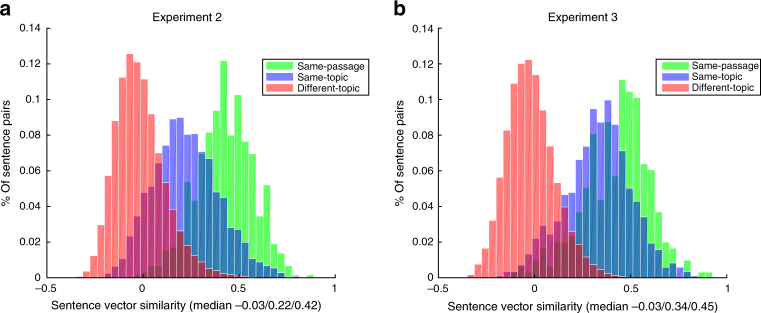
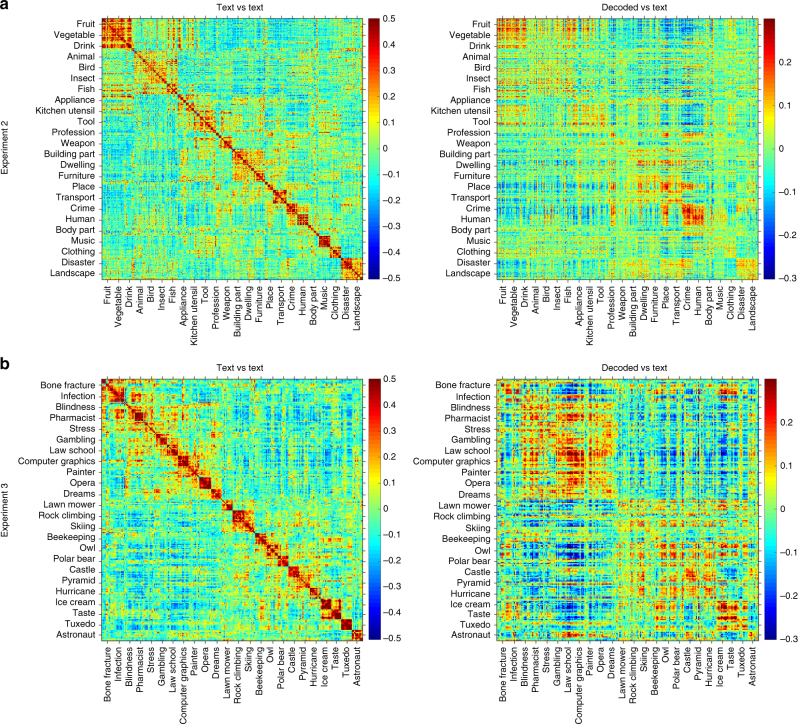
Prior work decoding linguistic meaning from imaging data has been largely limited to concrete nouns, using similar stimuli for training and testing, from a relatively small number of semantic categories. Here we present a new approach for building a brain decoding system in which words and sentences are represented as vectors in a semantic space constructed from massive text corpora. By efficiently sampling this space to select training stimuli shown to subjects, we maximize the ability to generalize to new meanings from limited imaging data. To validate this approach, we train the system on imaging data of individual concepts, and show it can decode semantic vector representations from imaging data of sentences about a wide variety of both concrete and abstract topics from two separate datasets. These decoded representations are sufficiently detailed to distinguish even semantically similar sentences, and to capture the similarity structure of meaning relationships between sentences.
Overview
The claims and statistics of this paper haven’t been checked yet.
Free: it reads the open-access text and checks the first 5 claims that cite a source we can check. Create a free account to check every claim.
Integrity signals
Registry
Cites
Statistics
Figures
Verification
Claims the paper makes
The claims and statistics of this paper haven’t been checked yet.
Free: it reads the open-access text and checks the first 5 claims that cite a source we can check. Create a free account to check every claim.
Claims other papers make about this one
Each is checked against this paper’s own text: does it say what the citing paper says it does?
The source backs part of the claim, not all of it — or backs it for a different population, condition or comparison.
In the citing paper
“Large Language Models (LLMs) have shown success in predicting neural signals associated with narrative processing”
From Incremental accumulation of linguistic context in artificial and biological neural networks (2025) · cites this paper as [1]
Experimental — accuracy not yet measuredThe source backs part of the claim, not all of it — or backs it for a different population, condition or comparison.
In the citing paper
“Previous studies in the neural encoding literature all used LLMs that were only aware of the short-term context, i.e., where the context window size was as large as several tens of words1–10.”
From Incremental accumulation of linguistic context in artificial and biological neural networks (2025) · cites this paper as [1]
Experimental — accuracy not yet measuredThe cited source says what the claim attributes to it.
In the citing paper
“This was the case even though the participants in these studies were exposed to language stimuli that encompassed hundreds and even thousands of words.”
From Incremental accumulation of linguistic context in artificial and biological neural networks (2025) · cites this paper as [1]
Self-check
Percentages, sums and reported differences re-computed from the paper’s own numbers.
The self-check needs the paper’s full text.
Citations
Cites
Glove: Global Vectors for Word Representation
Pennington, J., Socher, R., & Manning, C. (2014) · Proceedings of the 2014 Conference on Empirical Methods in Natural Language Processing (EMNLP) · doi:10.3115/v1/d14-1162 · Cited by 34,071
Distributed Representations of Words and Phrases and their Compositionality
Mikolov, T., Sutskever, I., Chen, K., Corrado, G., & Dean, J. (2013) · arXiv · doi:10.48550/arxiv.1310.4546 · Cited by 24,533
The Elements of Statistical Learning
Hastie, T., Friedman, J., & Tibshirani, R. (2001) · Springer Series in Statistics · doi:10.1007/978-0-387-21606-5 · Cited by 24,162
Indexing by latent semantic analysis
Deerwester, S., Dumais, S. T., Furnas, G. W., Landauer, T. K., & Harshman, R. (1990) · Journal of the American Society for Information Science · doi:10.1002/(sici)1097-4571(199009)41:6<391::aid-asi1>3.0.co;2-9 · Cited by 12,751
Ambrose, A., Wittgenstein, L., & Anscombe, G. E. M. (1954) · Philosophy and Phenomenological Research · doi:10.2307/2103745 · Cited by 12,192
Jenkinson, M., Beckmann, C. F., Behrens, T. E. J., Woolrich, M. W., & Smith, S. M. (2012) · NeuroImage · doi:10.1016/j.neuroimage.2011.09.015 · Cited by 11,314
A tutorial on spectral clustering
von Luxburg, U. (2007) · Statistics and Computing · doi:10.1007/s11222-007-9033-z · Cited by 10,349
The Brain's Default Network: Anatomy, Function, and Relevance to Disease
Buckner, R. L., Andrews‐Hanna, J. R., & Schacter, D. L. (2008) · Annals of the New York Academy of Sciences · doi:10.1196/annals.1440.011 · Cited by 9,761
Power, J. D., Barnes, K. A., Snyder, A. Z., Schlaggar, B. L., & Petersen, S. E. (2012) · NeuroImage · doi:10.1016/j.neuroimage.2011.10.018 · Cited by 7,429
Functional Network Organization of the Human Brain
Power, J. D., Cohen, A. L., Nelson, S. M., Wig, G. S., Barnes, K. A., Church, J. A., Vogel, A. C., Laumann, T. O., Miezin, F. M., Schlaggar, B. L., et al. (2011) · Neuron · doi:10.1016/j.neuron.2011.09.006 · Cited by 4,124
Research works printed but not linked: 1
- Ringgaard, M., Gupta, R., and Pereira, F. C. N. SLING: a framework for frame semantic parsing. Preprint arXiv:1710.07032 (2017). · arXiv
Cited by
The neural architecture of language: Integrative modeling converges on predictive processing
Schrimpf, M., Blank, I. A., Tuckute, G., Kauf, C., Hosseini, E. A., Kanwisher, N., Tenenbaum, J. B., & Fedorenko, E. (2021) · Proceedings of the National Academy of Sciences · doi:10.1073/pnas.2105646118 · Cited by 517
Self-citationShared computational principles for language processing in humans and deep language models
Goldstein, A., Zada, Z., Buchnik, E., Schain, M., Price, A., Aubrey, B., Nastase, S. A., Feder, A., Emanuel, D., Cohen, A., et al. (2022) · Nature Neuroscience · doi:10.1038/s41593-022-01026-4 · Cited by 447
Semantic reconstruction of continuous language from non-invasive brain recordings
Tang, J., LeBel, A., Jain, S., & Huth, A. G. (2023) · Nature Neuroscience · doi:10.1038/s41593-023-01304-9 · Cited by 442
“Although previous studies have shown that the BOLD signal contains rich semantic information 5,11 , our results show that this information is captured at the granularity of individual words and phrases.”
BackgroundSemantic reconstruction of continuous language from non-invasive brain recordings
(2022) · doi:10.1101/2022.09.29.509744 · Cited by 442
The language network as a natural kind within the broader landscape of the human brain
Fedorenko, E., Ivanova, A. A., & Regev, T. I. (2024) · Nature Reviews Neuroscience · doi:10.1038/s41583-024-00802-4 · Cited by 293
“…manipulations at these different scales 19,76 (see ‘The internal structure and core computations of the language network’), and the ability of researchers to decode and encode 77 diverse linguistic features (phonological, syntactic and semantic) using the language network’s activity 78–82 .”
BackgroundSelf-citationTHINGS: A database of 1,854 object concepts and more than 26,000 naturalistic object images
Hebart, M. N., Dickter, A. H., Kidder, A., Kwok, W. Y., Corriveau, A., Van Wicklin, C., & Baker, C. I. (2019) · PLOS ONE · doi:10.1371/journal.pone.0223792 · Cited by 281
The “Narratives” fMRI dataset for evaluating models of naturalistic language comprehension
Nastase, S. A., Liu, Y.-F., Hillman, H., Zadbood, A., Hasenfratz, L., Keshavarzian, N., Chen, J., Honey, C. J., Yeshurun, Y., Regev, M., et al. (2021) · Scientific Data · doi:10.1038/s41597-021-01033-3 · Cited by 148
Deniz, F., Nunez-Elizalde, A. O., Huth, A. G., & Gallant, J. L. (2019) · The Journal of Neuroscience · doi:10.1523/jneurosci.0675-19.2019 · Cited by 214
“However, the semantic feature space that we used here is only one possible way of representing semantics (Mitchell et al., 2008; Huth et al., 2016; Pereira et al., 2018), and it has some limitations.”
BackgroundImagined speech can be decoded from low- and cross-frequency intracranial EEG features
Proix, T., Delgado Saa, J., Christen, A., Martin, S., Pasley, B. N., Knight, R. T., Tian, X., Poeppel, D., Doyle, W. K., Devinsky, O., et al. (2022) · Nature Communications · doi:10.1038/s41467-021-27725-3 · Cited by 212
Decoding Visual Neural Representations by Multimodal Learning of Brain-Visual-Linguistic Features
Du, C., Fu, K., Li, J., & He, H. (2023) · IEEE Transactions on Pattern Analysis and Machine Intelligence · doi:10.1109/tpami.2023.3263181 · Cited by 210
“This method of obtaining sentence vector by average pooling of word vectors has been successfully applied in many linguistic neural encoding and decoding studies [30], [55], and has achieved impressive decoding results.”
BackgroundMethodDiachek, E., Blank, I., Siegelman, M., Affourtit, J., & Fedorenko, E. (2020) · The Journal of Neuroscience · doi:10.1523/jneurosci.2036-19.2020 · Cited by 198
Self-citationToward a Realistic Model of Speech Processing in the Brain with Self-Supervised Learning
Millet, J., Caucheteux, C., Orhan, P., Boubenec, Y., Gramfort, A., Dunbar, E., Pallier, C., & King, J.-R. (2022) · neural information processing systems · doi:10.52202/068431-2422 · Cited by 198
Decoding the information structure underlying the neural representation of concepts
Fernandino, L., Tong, J., Conant, L. L., Humphries, C., & Binder, J. R. (2022) · Proceedings of the National Academy of Sciences · doi:10.1073/pnas.2108091119 · Cited by 196
“Recent developments in functional neuroimaging and computational linguistics have sparked renewed interest in elucidating the information structures and neural circuits underlying concept representation (1–5).”
Knowledge Across Reference Frames: Cognitive Maps and Image Spaces
Bottini, R., & Doeller, C. F. (2020) · Trends in Cognitive Sciences · doi:10.1016/j.tics.2020.05.008 · Cited by 152
“Indeed, there is increasing agreement that semantic representations can be modeled as points in high-dimensional spaces that span both concrete and abstract dimensions (Box 4), and high-dimensional representational geometries have proved to be very effective in predicting the neural activity related to semantic repres…”
BackgroundDual coding of knowledge in the human brain
Bi, Y. (2021) · Trends in Cognitive Sciences · doi:10.1016/j.tics.2021.07.006 · Cited by 172
Driving and suppressing the human language network using large language models
Tuckute, G., Sathe, A., Srikant, S., Taliaferro, M., Wang, M., Schrimpf, M., Kay, K., & Fedorenko, E. (2024) · Nature Human Behaviour · doi:10.1038/s41562-023-01783-7 · Cited by 69
“All experiments were performed with ethical approval from the Committee on the Use of Humans as Experimental Subjects at the Massachu-setts Institute of Technology (MIT) (protocol number 2010000243).”
InfluentialSelf-citationVerbal Working Memory as Emergent from Language Comprehension and Production
Schwering, S. C., & MacDonald, M. C. (2020) · Frontiers in Human Neuroscience · doi:10.3389/fnhum.2020.00068 · Cited by 168
Incorporating Context into Language Encoding Models for fMRI
Jain, S., & Huth, A. G. (2018) · doi:10.1101/327601 · Cited by 155
“Encoding models that use word embeddings have proven quite successful at predicting brain responses to both single words (14; 25) and continuous language (22; 8; 7; 16).”
BackgroundShared functional specialization in transformer-based language models and the human brain
Kumar, S., Sumers, T. R., Yamakoshi, T., Goldstein, A., Hasson, U., Norman, K. A., Griffiths, T. L., Hawkins, R. D., & Nastase, S. A. (2024) · Nature Communications · doi:10.1038/s41467-024-49173-5 · Cited by 86
Comprehension of computer code relies primarily on domain-general executive brain regions
Ivanova, A. A., Srikant, S., Sueoka, Y., Kean, H. H., Dhamala, R., O'Reilly, U.-M., Bers, M. U., & Fedorenko, E. (2020) · eLife · doi:10.7554/elife.58906 · Cited by 111
“This result is somewhat surprising given the language system’s strong sensitivity to word meanings (e.g., Anderson et al., 2019; Binder et al., 2009; Fedorenko et al., 2010; Fedorenko et al., 2020; Pereira et al., 2018).”
ResultSelf-citationThe neural architecture of language: Integrative modeling converges on predictive processing
(2020) · doi:10.1101/2020.06.26.174482 · Cited by 129
“We used the data from Pereira et al.’s (2018) Experiments 2 (n=9) and 3 (n=6) (10 unique participants).”
BackgroundMethodInfluentialSelf-citationHow does hemispheric specialization contribute to human-defining cognition?
Hartwigsen, G., Bengio, Y., & Bzdok, D. (2021) · Neuron · doi:10.1016/j.neuron.2021.04.024 · Cited by 129
Reconstructing meaning from bits of information
Kivisaari, S. L., van Vliet, M., Hultén, A., Lindh‐Knuutila, T., Faisal, A., & Salmelin, R. H. (2019) · Nature Communications · doi:10.1038/s41467-019-08848-0 · Cited by 130
Tuckute, G., Feather, J., Boebinger, D., & McDermott, J. H. (2023) · PLoS Biology · doi:10.1371/journal.pbio.3002366 · Cited by 123
Marinucci, L., Mazzuca, C., & Gangemi, A. (2022) · AI & Society · doi:10.1007/s00146-022-01474-3 · Cited by 125
“…strands, ranging from the study of decision-making (Bhatia 2017; Bhatia and Walasek 2019), language learning processes (Hollis 2017), brain imaging (Pereira et al. 2018; Zhang et al. 2020) In the following, we first focus on the debate among computer scientists on whether debiasing is necessary or…”
BackgroundConnecting concepts in the brain by mapping cortical representations of semantic relations
Zhang, Y., Han, K., Worth, R. M., & Liu, Z. (2020) · Nature Communications · doi:10.1038/s41467-020-15804-w · Cited by 119
The Autonomous Mind: The Right to Freedom of Thought in the Twenty-First Century
McCarthy‐Jones, S. (2019) · Frontiers in Artificial Intelligence · doi:10.3389/frai.2019.00019 · Cited by 112
“A major advance has been the ability to decode thoughts individuals are having which the decoding system has not previously been trained to recognize (Anderson et al., 2016; Pereira et al., 2018).”
BackgroundXu, Q., Peng, Y., Nastase, S. A., Chodorow, M. S., Wu, M., & Li, P. (2025) · Nature Human Behaviour · doi:10.1038/s41562-025-02203-8 · Cited by 112
Abnar, S., Beinborn, L., Choenni, R., & Zuidema, W. H. (2019) · BlackboxNLP Workshop on Analyzing and Interpreting Neural Networks for NLP (BlackboxNLP) · doi:10.18653/v1/w19-4820 · Cited by 107
“Pereira et al. (2018), for instance, used a bag of words model of sentence meaning to decode sentences from brain activation.”
Linking artificial and human neural representations of language
Gauthier, J., & Levy, R. (2019) · Proceedings of the 2019 Conference on Empirical Methods in Natural Language Processing and the 9th International Joint Conference on Natural Language Processing (EMNLP-IJCNLP) · doi:10.18653/v1/d19-1050 · Cited by 70
“…representations as proxies for sentence meaning, and demonstrated that human brain activations in response to sentences can match with these meaning representations at well above chance performance (see e.g. Mitchell et al., 2008; Wehbe et al., 2014; Huth et al., 2016; Pereira et al., 2018).”
BackgroundMethodResultInfluentialCogniVal: A Framework for Cognitive Word Embedding Evaluation
Hollenstein, N., de la Torre, A., Langer, N., & Zhang, C. (2019) · Conference on Computational Natural Language Learning · doi:10.18653/v1/k19-1050 · Cited by 97
“PEREIRA (Pereira et al., 2018) text/image 15 180 180 99% NOUNS (Mitchell et al.”
Human Hippocampal Neurons Track Moments in a Sequence of Events
Reddy, L., Zoefel, B., Possel, J. K., Peters, J. C., Dijksterhuis, D. E., Poncet, M., van Straaten, E. C. W., Baayen, J. C., Idema, S., & Self, M. W. (2021) · Journal of Neuroscience · doi:10.1523/jneurosci.3157-20.2021 · Cited by 96
Fedorenko, E. (2021) · Current Opinion in Behavioral Sciences · doi:10.1016/j.cobeha.2021.02.023 · Cited by 88
Self-citationDecoding semantic representations in mind and brain
Frisby, S. L., Halai, A. D., Cox, C. R., Ralph, M. A. L., & Rogers, T. T. (2023) · Trends in Cognitive Sciences · doi:10.1016/j.tics.2022.12.006 · Cited by 95
“The recovered vector is interpreted by comparing its similarity to vectors corresponding to known words or sentences [1,74].”
BackgroundResultInfluentialSemantic encoding during language comprehension at single-cell resolution
Jamali, M., Grannan, B. L., Cai, J., Khanna, A. R., Muñoz, W., Caprara, I., Paulk, A. C., Cash, S. S., Fedorenko, E. G., & Williams, Z. M. (2024) · Nature · doi:10.1038/s41586-024-07643-2 · Cited by 92
“Yet, despite a growing understanding of the neural substrates of linguistic 4–12 and semantic processing 11,37,41 , understanding how individual neurons represent semantic information during comprehension in humans has largely remained out of reach.”
BackgroundMethodInfluentialSelf-citationRyskin, R., Levy, R. P., & Fedorenko, E. (2020) · Neuropsychologia · doi:10.1016/j.neuropsychologia.2019.107258 · Cited by 75
Self-citationNeurocomputational Models of Language Processing
Hale, J., Campanelli, L., Li, J., Bhattasali, S., Pallier, C., & Brennan, J. (2021) · Annual Review of Linguistics · doi:10.1146/annurev-linguistics-051421-020803 · Cited by 124
“Such grammars served as the “base component” in transfor-mational grammar (see Partee et al. 1993, chapter 16).”
BackgroundComprehensive review of Transformer‐based models in neuroscience, neurology, and psychiatry
Cong, S., Wang, H., Zhou, Y., Wang, Z., Yao, X., & Yang, C. (2024) · Brain‐X · doi:10.1002/brx2.57 · Cited by 82
Grounding the Vector Space of an Octopus: Word Meaning from Raw Text
Søgaard, A. (2023) · Minds and Machines · doi:10.1007/s11023-023-09622-4 · Cited by 46
“Most, if not all, philosophers agree that computers cannot learn what words refers to from raw text alone. While many attacked Searle’s Chinese Room thought experiment, no one seemed to question this most basic assumption. For how can computers learn something that is not in the data? Emily Bender and Alexander Koller…”
BackgroundKauf, C., Tuckute, G., Lévy, R., Andreas, J., & Fedorenko, E. G. (2024) · Neurobiology of Language · doi:10.1162/nol_a_00116 · Cited by 81
“…’ s language system as measured/measurable by fMRI (e.g., Fedorenko et al., 2016; Gauthier & Levy, 2019; Huth et al., 2016; Mollica et al., 2020; Pereira et al., 2018), and another from NLP that shows that ANNs do not necessarily need to use word-order information to solve many current…”
BackgroundMethodInfluentialSelf-citationBrain2Char: a deep architecture for decoding text from brain recordings
Sun, P., Anumanchipalli, G. K., & Chang, E. F. (2020) · Journal of Neural Engineering · doi:10.1088/1741-2552/abc742 · Cited by 77
“For dilated CNN, the filter size is fixed as 11, and the dilated ratios for five sub-layer are [1, 2, 4, 8, 16].”
MethodDecoding Word Embeddings with Brain-Based Semantic Features
Chersoni, E., Santus, E., Huang, C.-R., & Lenci, A. (2021) · International Conference on Computational Logic · doi:10.1162/coli_a_00412 · Cited by 66
Thinking ahead: spontaneous prediction in context as a keystone of language in humans and machines
Goldstein, A., Zada, Z., Buchnik, E., Schain, M., Price, A., Aubrey, B., Nastase, S. A., Feder, A., Emanuel, D., Cohen, A., et al. (2020) · bioRxiv (Cold Spring Harbor Laboratory) · doi:10.1101/2020.12.02.403477 · Cited by 51
“Past research has leveraged language models and machine learning to extract information about semantic representation structure in the brain 13–19 .”
BackgroundResultFrankland, S., & Greene, J. D. (2020) · Cerebral Cortex · doi:10.1093/cercor/bhaa001 · Cited by 75
Distributed semantic representations for modeling human judgment
Bhatia, S., Richie, R., & Zou, W.-L. (2019) · Current Opinion in Behavioral Sciences · doi:10.1016/j.cobeha.2019.01.020 · Cited by 60
Exploring What Is Encoded in Distributional Word Vectors: A Neurobiologically Motivated Analysis
Utsumi, A. (2020) · Cognitive Sciences · doi:10.1111/cogs.12844 · Cited by 58
Anderson, A. J., Kiela, D., Binder, J. R., Fernandino, L., Humphries, C. J., Conant, L. L., Raizada, R. D. S., Grimm, S., & Lalor, E. C. (2021) · The Journal of Neuroscience · doi:10.1523/jneurosci.1152-20.2021 · Cited by 70
subs2vec: Word embeddings from subtitles in 55 languages
van Paridon, J., & Thompson, B. (2020) · Behavior Research Methods · doi:10.3758/s13428-020-01406-3 · Cited by 73
The Language Network Is Recruited but Not Required for Nonverbal Event Semantics
Ivanova, A. A., Mineroff, Z., Zimmerer, V., Kanwisher, N., Varley, R., & Fedorenko, E. (2021) · Neurobiology of Language · doi:10.1162/nol_a_00030 · Cited by 65
“Multiple recent studies found that semantic information is not uniquely localized to any given brain region but rather distributed across the cortex (e.g., Anderson et al., 2017; Huth et al., 2016; Pereira et al., 2018; X. Wang et al., 2018).”
BackgroundSelf-citationGoldstein, A., Grinstein-Dabush, A., Schain, M., Wang, H., Hong, Z., Aubrey, B., Nastase, S. A., Zada, Z., Ham, E., Feder, A., et al. (2024) · Nature Communications · doi:10.1038/s41467-024-46631-y · Cited by 64
“Groundbreaking work by Mitchell and colleagues 22 begins to synthesize these parallel developments by using co-occurrence-based semantic vectors (similar to GloVe embeddings) to predict multivoxel patterns of brain activity associated with single words (see also 23,24 ).”
InfluentialTowards Sentence-Level Brain Decoding with Distributed Representations
Sun, J., Wang, S., Zhang, J., & Zong, C. (2019) · Proceedings of the AAAI Conference on Artificial Intelligence · doi:10.1609/aaai.v33i01.33017047 · Cited by 64
Hosseini, E. A., Schrimpf, M., Zhang, Y., Bowman, S., Zaslavsky, N., & Fedorenko, E. (2024) · Neurobiology of Language · doi:10.1162/nol_a_00137 · Cited by 63
“Using an fMRI benchmark (Pereira et al., 2018), we established that even with a developmentally realistic amount of training data (~100 million words, comparable to what humans”
MethodInfluentialSelf-citation(2022) · doi:10.1101/2022.10.04.510681 · Cited by 62
Concreteness ratings for 62,000 English multiword expressions
Muraki, E. J., Abdalla, S., Brysbaert, M., & Pexman, P. M. (2022) · Behavior Research Methods · doi:10.3758/s13428-022-01912-6 · Cited by 64
“, 2016; Humphreys & Wang, 2018) – Estimating text sophistication (Kyle & Crossley, 2015) – Selection of stimuli for behavioral, clinical, and brain imaging studies (Anderson et al., 2017; Bailey et al., 2020; Fini et al., 2022; Pereira et al., 2018; Ponari et al., 2018; Winter et al., 2017) – Historical changes in wor…”
BackgroundBayesian Surprise Predicts Human Event Segmentation in Story Listening
Kumar, M., Goldstein, A., Michelmann, S., Zacks, J. M., Hasson, U., & Norman, K. A. (2023) · Cognitive Science · doi:10.1111/cogs.13343 · Cited by 63
“Embeddings from neural network models such as Glove (Pennington, Socher, & Manning, 2014) and Word2Vec (Mikolov, Sutskever, Chen, Corrado, & Dean, 2013) have been shown to correlate with human semantic similarity judgments (Pereira, Gershman, Ritter, & Botvinick, 2016; Pereira et al., 2018).”
Relational Integration in the Human Brain: A Review and Synthesis
Holyoak, K. J., & Monti, M. M. (2020) · Journal of Cognitive Neuroscience · doi:10.1162/jocn_a_01619 · Cited by 63
“having been detected up to 1 hr after exposure (see Nitsche et al., 2008, for a review). Consistent with prior work, Green et al. (2017) reported that application of anodal tDCS to the”
BackgroundPrompting is not a substitute for probability measurements in large language models
Hu, J., & Levy, R. (2023) · Proceedings of the 2023 Conference on Empirical Methods in Natural Language Processing · doi:10.18653/v1/2023.emnlp-main.306 · Cited by 60
“Our first dataset, taken from Pereira et al. (2018) (“P18”), consists of 384 simple declarative sentences that state a fact about familiar concepts, such as accordion or butterfly .”
MethodNaturalistic stimuli: A paradigm for multiscale functional characterization of the human brain
Zhang, Y., Kim, J., Brang, D., & Liu, Z. (2021) · Current Opinion in Biomedical Engineering · doi:10.1016/j.cobme.2021.100298 · Cited by 60
Semantic Representations during Language Comprehension Are Affected by Context
Deniz, F., Tseng, C., Wehbe, L., la Tour, T. D., & Gallant, J. L. (2023) · Journal of Neuroscience · doi:10.1523/jneurosci.2459-21.2023 · Cited by 102
Neural Encoding and Decoding With Distributed Sentence Representations
Sun, J., Wang, S., Zhang, J., & Zong, C. (2020) · IEEE Transactions on Neural Networks and Learning Systems · doi:10.1109/tnnls.2020.3027595 · Cited by 61
“Following [20], we pick four brain networks: language networks [39], visual networks [36], default mode network (DMN) [38], and multiple demand (MD) network.”
BackgroundMethodInfluentialGenerative technology for human emotion recognition: A scoping review
Ma, F., Yuan, Y., Xie, Y., Ren, H., Liu, I., He, Y., Ren, F., Yu, F. R., & Ni, S. (2024) · Information Fusion · doi:10.1016/j.inffus.2024.102753 · Cited by 62
Armeni, K., Güçlü, U., van Gerven, M. A. J., & Schoffelen, J. (2022) · Scientific Data · doi:10.1038/s41597-022-01382-7 · Cited by 59
Rogers, T. T., Cox, C. R., Lu, Q., Shimotake, A., Kikuchi, T., Kunieda, T., Miyamoto, S., Takahashi, R., Ikeda, A., Matsumoto, R., et al. (2021) · eLife · doi:10.7554/elife.66276 · Cited by 59
An Integrated Neural Decoder of Linguistic and Experiential Meaning
Anderson, A. J., Binder, J. R., Fernandino, L., Humphries, C. J., Conant, L. L., Raizada, R. D. S., Lin, F., & Lalor, E. C. (2019) · The Journal of Neuroscience · doi:10.1523/jneurosci.2575-18.2019 · Cited by 51
“…commonplace strategy of using multiple regression to map between model and brain (Mitchell et al., 2008; Chang et al., 2011; Sudre et al., 2012; Pereira et al., 2013, 2018; Wehbe et al., 2014; Fernandino et al., 2015, 2016; Huth et al., 2016a; Anderson et al., 2017a, 2019; Wang et al., 2017;…”
BackgroundMethodInfluentialNeural Language Taskonomy: Which NLP Tasks are the most Predictive of fMRI Brain Activity?
Oota, S. R., Arora, J., Agarwal, V., Marreddy, M., Gupta, M., & Bapi, R. S. (2022) · Conference of the North American Chapter of the Association for Computational Linguistics: Human Language Technologies (NAACL-HLT) · doi:10.18653/v1/2022.naacl-main.235 · Cited by 55
“Semantic representation models include distributed word embed-dings (Pereira et al., 2016; Anderson et al., 2017a; Pereira et al., 2018; Toneva and Wehbe, 2019; Hol-lenstein et al., 2019; Wang et al., 2020), sentence representation models (Sun et al., 2019; Toneva and Wehbe, 2019; Sun et al.,…”
Instruction-tuning Aligns LLMs to the Human BrainPreprint
Aw, K. L., Montariol, S., AlKhamissi, B., Schrimpf, M., & Bosselut, A. (2023) · arXiv (Cornell University) · doi:10.48550/arxiv.2312.00575 · Cited by 55
“P EREIRA 2018 (experiments 2 and 3 from Pereira et al., 2018): In experiment 2, nine participants read 384 sentences organized into 96 text passages.”
BackgroundMethodThe LLM Language Network: A Neuroscientific Approach for Identifying Causally Task-Relevant Units
AlKhamissi, B., Tuckute, G., Bosselut, A., & Schrimpf, M. (2025) · Conference of the North American Chapter of the Association for Computational Linguistics: Human Language Technologies (NAACL-HLT) · doi:10.18653/v1/2025.naacl-long.544 · Cited by 57
Carota, F., Nili, H., Pulvermüller, F., & Kriegeskorte, N. (2020) · NeuroImage · doi:10.1016/j.neuroimage.2020.117408 · Cited by 54
González-Castillo, J., Caballero‐Gaudes, C., Topolski, N., Handwerker, D. A., Pereira, F., & Bandettini, P. A. (2019) · NeuroImage · doi:10.1016/j.neuroimage.2019.116129 · Cited by 53
Self-citationBruffaerts, R., Deyne, S. D., Meersmans, K., Liuzzi, A. G., Storms, G., & Vandenberghe, R. R. (2019) · Neuroscience & Biobehavioral Reviews · doi:10.1016/j.neubiorev.2019.05.015 · Cited by 93
Increasing alignment of large language models with language processing in the human brain
Gao, C., Ma, Z., Chen, J., Li, P., Huang, S., & Li, J. (2025) · Nature Computational Science · doi:10.1038/s43588-025-00863-0 · Cited by 52
“As GPT-2 has been shown to predict more variance relative to the ceiling in some neuroimaging datasets 41,42 —where the ceiling is defined as the mean of the neural responses from all participants in these datasets—smaller models may have reached their performance”
Graves, W. W., Purcell, J. J., Rothlein, D., Bolger, D. J., Rosenberg‐Lee, M., & Staples, R. (2022) · Brain Structure and Function · doi:10.1007/s00429-022-02590-y · Cited by 51
Predicting eye movement patterns from fMRI responses to natural scenes
O’Connell, T. P., & Chun, M. M. (2018) · Nature Communications · doi:10.1038/s41467-018-07471-9 · Cited by 47
“To date, applications of fMRI reconstruction have been primarily focused on reconstructing the input stimulus 22 – 26 and more recently computationally-de fi ned representations 15,16,27 – 32 .”
BackgroundMethodInfluentialSemantic Drift in Multilingual Representations
Beinborn, L., & Choenni, R. (2020) · Computational Linguistics · doi:10.1162/coli_a_00382 · Cited by 51
Owen, L. L. W., Chang, T. H., & Manning, J. R. (2021) · Nature Communications · doi:10.1038/s41467-021-25876-x · Cited by 45
From Language to Cognition: How LLMs Outgrow the Human Language Network
AlKhamissi, B., Tuckute, G., Tang, Y., Binhuraib, T. O. A., Bosselut, A., & Schrimpf, M. (2025) · Conference on Empirical Methods in Natural Language Processing (EMNLP) · doi:10.18653/v1/2025.emnlp-main.1237 · Cited by 44
Pasquiou, A., Lakretz, Y., Thirion, B., & Pallier, C. (2023) · Neurobiology of Language · doi:10.1162/nol_a_00125 · Cited by 45
“This approach has led to several discoveries, such as wide networks associated with semantic processing uncovered by Huth et al. (2016) using word embeddings (see also Pereira et al., 2018), or context-sensitivity maps discovered by Jain and Huth (2018) and Toneva and Wehbe (2019).”
BackgroundResultLMMS reloaded: Transformer-based sense embeddings for disambiguation and beyond
Loureiro, D., Jorge, A., & Camacho-Collados, J. (2022) · Artificial Intelligence · doi:10.1016/j.artint.2022.103661 · Cited by 43
“In Pereira et al. (2018), word embeddings have proven useful for decoding words and sentences from brain activity, after learning a mapping between corpus-based embeddings (i.e., GloVe and word2vec) and fMRI activation.”
BackgroundA CNN-transformer hybrid approach for decoding visual neural activity into text
Zhang, J., Li, C., Liu, G., Min, M., Wang, C., Li, J., Wang, Y., Yan, H., Zuo, Z., Huang, W., et al. (2021) · Computer Methods and Programs in Biomedicine · doi:10.1016/j.cmpb.2021.106586 · Cited by 43
Deep Neural Networks and Brain Alignment: Brain Encoding and Decoding (Survey)
Oota, S. R., Chen, Z., Gupta, M., Bapi, R. S., Jobard, G., Alexandre, F., & Hinaut, X. (2025) · Transactions on machine learning research · doi:10.48550/arxiv.2307.10246 · Cited by 43
Leveraging shared connectivity to aggregate heterogeneous datasets into a common response space
Nastase, S. A., Liu, Y.-F., Hillman, H., Norman, K. A., & Hasson, U. (2020) · NeuroImage · doi:10.1016/j.neuroimage.2020.116865 · Cited by 42
Acunzo, D. J., Low, D. M., & Fairhall, S. L. (2022) · NeuroImage · doi:10.1016/j.neuroimage.2022.119005 · Cited by 39
Neural decoding of semantic concepts: a systematic literature review
Rybář, M., & Daly, I. P. (2022) · Journal of Neural Engineering · doi:10.1088/1741-2552/ac619a · Cited by 43
“In these cases, several studies used rank accuracy [36, 37, 39–42, 45, 55, 56, 58, 60, 61, 67, 72, 73], which is defined as the percentile rank of the correct class in the classifier’s rank output.”
InfluentialUniCoRN: Unified Cognitive Signal ReconstructioN bridging cognitive signals and human language
Xi, N., Zhao, S., Wang, H., Liu, C., Qin, B., & Liu, T. (2023) · Proceedings of the conference - Association for Computational Linguistics. Meeting · doi:10.18653/v1/2023.acl-long.741 · Cited by 42
Mumuni, F., & Mumuni, A. (2023) · Cognitive Systems Research · doi:10.1016/j.cogsys.2023.101188 · Cited by 42
“Previously, research aimed at decoding visual stimuli from brain activity recordings mainly concentrated on unimodal approaches that rely on either natural language descriptions of viewed images (e.g., [252], [253], [254]) or visual semantic information (e.g., [255]).”
BackgroundHigh-level visual prediction errors in early visual cortex
Richter, D., Kietzmann, T. C., & de Lange, F. P. (2024) · PLoS Biology · doi:10.1371/journal.pbio.3002829 · Cited by 39
Malik-Moraleda, S., Jouravlev, O., Taliaferro, M., Mineroff, Z., Cucu, T., Mahowald, K., Blank, I., & Fedorenko, E. G. (2024) · Cerebral Cortex · doi:10.1093/cercor/bhae049 · Cited by 41
Self-citationChineseEEG: A Chinese Linguistic Corpora EEG Dataset for Semantic Alignment and Neural Decoding
Mou, X., He, C., Tan, L., Yu, J., Liang, H., Zhang, J., Tian, Y., Yang, Y., Xu, T., Wang, Q., et al. (2024) · Scientific Data · doi:10.1038/s41597-024-03398-7 · Cited by 39
“By analyzing such neural activities, we can uncover the encoding mechanisms of semantics in the brain 3 .”
BackgroundThe ZuCo benchmark on cross-subject reading task classification with EEG and eye-tracking data
Hollenstein, N., Tröndle, M., Płomecka, M. B., Kiegeland, S., Özyurt, Y., Jäger, L. A., & Langer, N. (2023) · Frontiers in Psychology · doi:10.3389/fpsyg.2022.1028824 · Cited by 39
“In addition, several research groups provide publicly available fMRI data to study naturalistic reading comprehension (Dehghani et al., 2017; Lopopolo et al., 2018; Pereira et al., 2018; Shain et al., 2020; Nastase et al., 2021).”
BackgroundYu, S., Gu, C., Huang, K., & Li, P. (2024) · Science Advances · doi:10.1126/sciadv.adn7744 · Cited by 40
“…number of neurocognitive studies have begun to explore how model embed-dings can capture human brain activities during language processing ( 1 – 4 ), and some argue that the rise of LLMs has enabled us to test the neural mechanisms of language learning and representation in a more…”
BackgroundMethodInfluentialThe cerebellar components of the human language network
Casto, C., Poliak, M., Tuckute, G., Small, H., Sherlock, P., Wolna, A., Lipkin, B., D’Mello, A. M., & Fedorenko, E. G. (2026) · Neuron · doi:10.1016/j.neuron.2025.12.030 · Cited by 39
Self-citationDoes the brain represent words? An evaluation of brain decoding studies of language understanding
Gauthier, J., & Ivanova, A. (2018) · 2018 Conference on Cognitive Computational Neuroscience · doi:10.32470/ccn.2018.1237-0 · Cited by 29
Modeling Semantic Encoding in a Common Neural Representational Space
Uden, C. V., Nastase, S. A., Connolly, A. C., Feilong, M., Hansen, I. S., Gobbini, M. I., & Haxby, J. V. (2018) · Frontiers in Neuroscience · doi:10.3389/fnins.2018.00437 · Cited by 37
“Typically, encoding models are estimated separately for each subject using a relatively large volume of data (e.g., Huth et al., 2012; Mitchell et al., 2008; Pereira et al., 2018).”
BackgroundMethodFine-grained neural decoding with distributed word representations
Wang, S., Zhang, J., Wang, H., Lin, N., & Zong, C. (2019) · Information Sciences · doi:10.1016/j.ins.2019.08.043 · Cited by 37
Visio-Linguistic Brain EncodingPreprint
Oota, S. R., Arora, J., Rowtula, V., Gupta, M., & Bapi, R. S. (2022) · arXiv (Cornell University) · doi:10.48550/arxiv.2204.08261 · Cited by 37
“Hence, we experiment with BOLD5000 and Pereira Pereira et al. (2018) datasets in this work.”
InfluentialUnveiling Thoughts: A Review of Advancements in EEG Brain Signal Decoding Into Text
Murad, S. A., & Rahimi, N. (2024) · IEEE Transactions on Cognitive and Developmental Systems · doi:10.1109/tcds.2024.3462452 · Cited by 37
“In contrast, when utilizing fMRI for data collection [42], [43], researchers often employ 32-channel head coils.”
Generative language reconstruction from brain recordings
Ye, Z., Ai, Q., Liu, Y., de Rijke, M., Zhang, M., Lioma, C., & Ruotsalo, T. (2025) · Communications Biology · doi:10.1038/s42003-025-07731-7 · Cited by 38
Bornkessel‐Schlesewsky, I., Sharrad, I., Howlett, C. A., Alday, P. M., Corcoran, A. W., Bellan, V., Wilkinson, E. M., Kliegl, R. M., Lewis, R. L., Small, S. L., et al. (2022) · Frontiers in Psychology · doi:10.3389/fpsyg.2022.817516 · Cited by 36
Understanding models understanding language
Søgaard, A. (2022) · Synthese · doi:10.1007/s11229-022-03931-4 · Cited by 37
“…language models encode words in ways that are near-isomorphic to where neural activation occurs when listening to or reading these words (Pereira et al., 2018; Caucheteux & King, 2021), 10 to how our perceptual spaces are organized (Abdou et al., 2021; Patel & Pavlick, 2022), as well as…”
Background
Metadata
- Authors
- Pereira, F., Lou, B., Pritchett, B., Ritter, S., Gershman, S. J., Kanwisher, N., Botvinick, M., & Fedorenko, E.
- Affiliations
- Siemens (United States) (US)
- Massachusetts Institute of Technology (US)
- Google DeepMind (United Kingdom) (GB)
- Harvard University (US)
- McGovern Institute for Brain Research (US)
- Corresponding author
- Pereira, Francisco
- Fedorenko, Evelina
- ORCID
- Venue
- Nature Communications
- Published
- 2018-03-06
- Volume
- 9
- Issue
- 1
- Pages
- 963-963
- ISSN
- 2041-1723 (ISSN-L)
- PMC
- PMC5840373
- OpenAlex
- W2782213998
- Cited by
- 324
- References
- 52
- Citations by year
- 2026: 23 · 2025: 49 · 2024: 45 · 2023: 46 · 2022: 38 · 2021: 39 · 2020: 39 · 2019: 37 · 2018: 8
- FWCI
- 18.28
- Type
- journal article
- Language
- en
- Open access
- gold
- doi.org
- Licence
- cc-by
- creativecommons.org/licenses/by/4.0 (tdm)
- creativecommons.org/licenses/by/4.0 (vor)
- Locations
- Nature Communications (publishedVersion, cc-by)
- PubMed Central (publishedVersion, cc-by)
- PubMed (publishedVersion)
- Digital Access to Scholarship at Harvard (DASH) (Harvard University) (submittedVersion, cc-by)
- RePEc: Research Papers in Economics (submittedVersion)
- DOAJ (DOAJ: Directory of Open Access Journals) (submittedVersion)
- DOAJ (DOAJ: Directory of Open Access Journals) (submittedVersion, cc-by-sa)
- DSpace@MIT (Massachusetts Institute of Technology) (submittedVersion, cc-by-nc)
- OSF Preprints (OSF Preprints) (submittedVersion)
- Funders
- Johns Hopkins University
- Office of the Director of National Intelligence
- National Institutes of Health (5k99hd057522-02)
- Intelligence Advanced Research Projects Activity (FA8650-14-C-7358)
- McGovern Institute for Brain Research, Massachusetts Institute of Technology
- NIH Office of the Director
- Eunice Kennedy Shriver National Institute of Child Health and Human Development (K99 HD-057522, DP1HD091947, R00HD057522)
- Air Force Research Laboratory (FA8650-14-C-7358)
- Topics
- Life Sciences › Neuroscience › Cognitive Neuroscience › Neurobiology of Language and Bilingualism
- Social Sciences › Psychology › Developmental and Educational Psychology › Reading and Literacy Development
- Physical Sciences › Computer Science › Artificial Intelligence › Topic Modeling
- Keywords
- semantic decoding, brain decoding, linguistic meaning, semantic space, semantic vectors, text corpora, sentence meaning
- MeSH terms
- Adult, Brain Mapping, Female, Humans, Magnetic Resonance Imaging, Male, Physical Stimulation, Semantics
About these checks
Registry, retraction, Cites and statistics results are computed, not judged, with one exception: a printed reference that no index lists is read once by a model before it counts as a citation error. Claims are extracted by a model and kept only when their quote appears verbatim in the text; each cited source is then checked, with a model’s help, for whether it says what the claim relies on. Those verdicts can be wrong — read the claim’s quote and the cited source before relying on one.
Statistics and arithmetic are recomputed, not judged.
Confidence bands are shown only for fields calibrated on our annotated test set. None is calibrated yet, so no band is shown.
What counts as a claim ›How we measure confidence ›How we check this ›
Are you an author, or do you see a problem with this page? Request a review
Data sources
Bibliographic data: Semantic Scholar, OpenAlex, Crossref.
Contains information from the Semantic Scholar Academic Graph Datasets, made available under the ODC Attribution License (ODC-BY 1.0).
Semantic Scholar’s data is described in: Kinney, R., et al. (2023). The Semantic Scholar Open Data Platform. arXiv:2301.10140.
