

Toward a universal decoder of linguistic meaning from brain activation
Open accessThe DOI matches its Crossref record; 54 of the 54 references it cites were found in a registry or an index.
Abstract
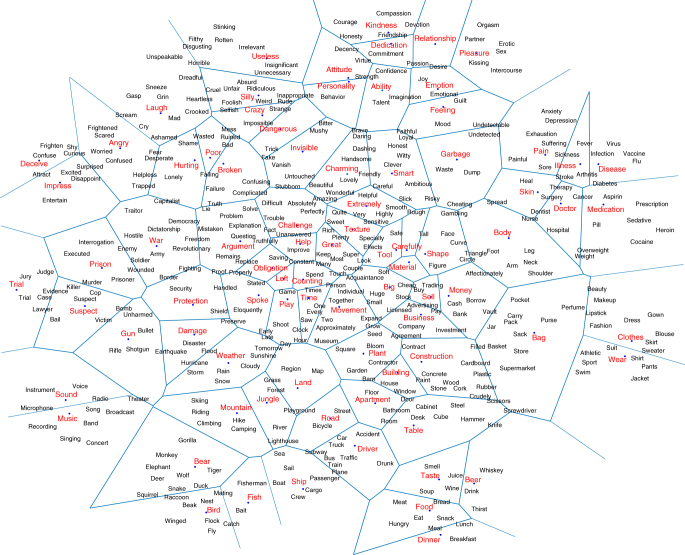
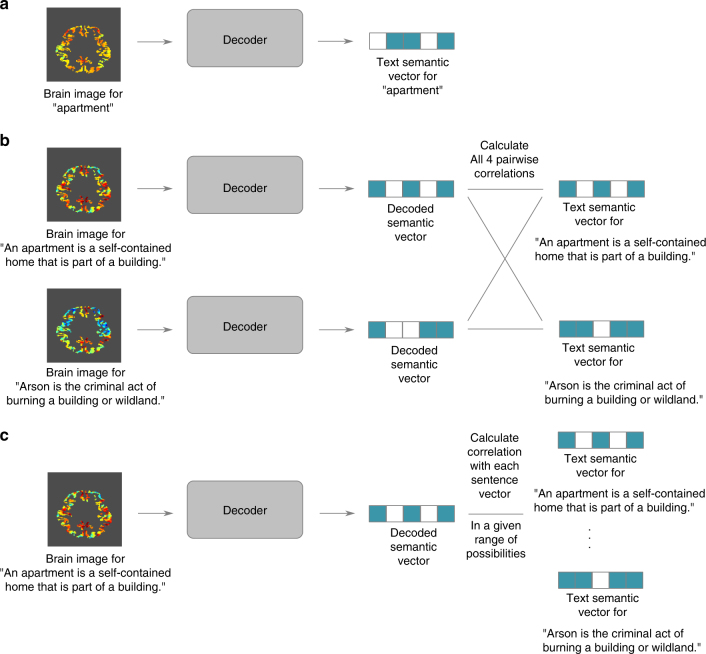
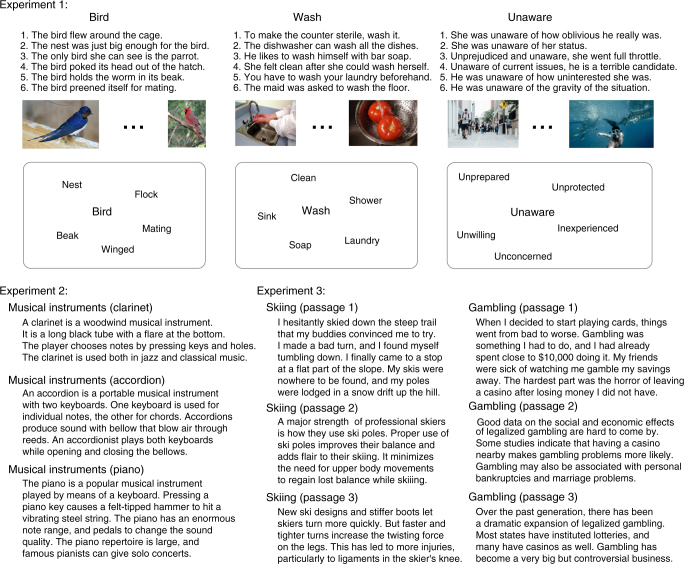
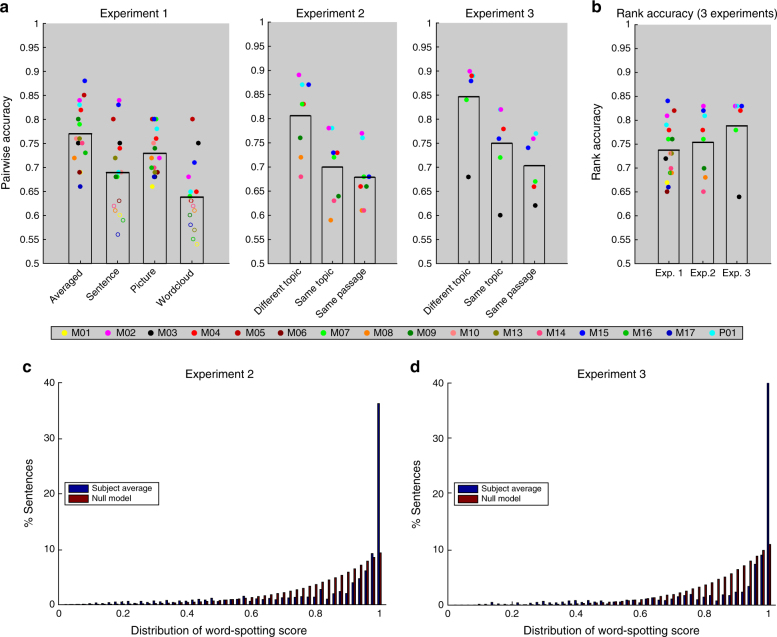
Prior work decoding linguistic meaning from imaging data has been largely limited to concrete nouns, using similar stimuli for training and testing, from a relatively small number of semantic categories. Here we present a new approach for building a brain decoding system in which words and sentences are represented as vectors in a semantic space constructed from massive text corpora. By efficiently sampling this space to select training stimuli shown to subjects, we maximize the ability to generalize to new meanings from limited imaging data. To validate this approach, we train the system on imaging data of individual concepts, and show it can decode semantic vector representations from imaging data of sentences about a wide variety of both concrete and abstract topics from two separate datasets. These decoded representations are sufficiently detailed to distinguish even semantically similar sentences, and to capture the similarity structure of meaning relationships between sentences.
Overview
The claims and statistics of this paper haven’t been checked yet.
Free: it reads the open-access text and checks the first 5 claims that cite a source we can check. Create a free account to check every claim.
Integrity signals
Registry
Cites
Statistics
Figures
Verification
Claims the paper makes
The claims and statistics of this paper haven’t been checked yet.
Free: it reads the open-access text and checks the first 5 claims that cite a source we can check. Create a free account to check every claim.
Claims other papers make about this one
Each is checked against this paper’s own text: does it say what the citing paper says it does?
The source backs part of the claim, not all of it — or backs it for a different population, condition or comparison.
In the citing paper
“Large Language Models (LLMs) have shown success in predicting neural signals associated with narrative processing”
From Incremental accumulation of linguistic context in artificial and biological neural networks (2025) · cites this paper as [1]
Experimental — accuracy not yet measuredThe source backs part of the claim, not all of it — or backs it for a different population, condition or comparison.
In the citing paper
“Previous studies in the neural encoding literature all used LLMs that were only aware of the short-term context, i.e., where the context window size was as large as several tens of words1–10.”
From Incremental accumulation of linguistic context in artificial and biological neural networks (2025) · cites this paper as [1]
Experimental — accuracy not yet measuredThe cited source says what the claim attributes to it.
In the citing paper
“This was the case even though the participants in these studies were exposed to language stimuli that encompassed hundreds and even thousands of words.”
From Incremental accumulation of linguistic context in artificial and biological neural networks (2025) · cites this paper as [1]
Self-check
Percentages, sums and reported differences re-computed from the paper’s own numbers.
The self-check needs the paper’s full text.
Citations
Cites
Glove: Global Vectors for Word Representation
Pennington, J., Socher, R., & Manning, C. (2014) · Proceedings of the 2014 Conference on Empirical Methods in Natural Language Processing (EMNLP) · doi:10.3115/v1/d14-1162 · Cited by 34,071
Distributed Representations of Words and Phrases and their Compositionality
Mikolov, T., Sutskever, I., Chen, K., Corrado, G., & Dean, J. (2013) · arXiv · doi:10.48550/arxiv.1310.4546 · Cited by 24,533
The Elements of Statistical Learning
Hastie, T., Friedman, J., & Tibshirani, R. (2001) · Springer Series in Statistics · doi:10.1007/978-0-387-21606-5 · Cited by 24,162
Indexing by latent semantic analysis
Deerwester, S., Dumais, S. T., Furnas, G. W., Landauer, T. K., & Harshman, R. (1990) · Journal of the American Society for Information Science · doi:10.1002/(sici)1097-4571(199009)41:6<391::aid-asi1>3.0.co;2-9 · Cited by 12,751
Ambrose, A., Wittgenstein, L., & Anscombe, G. E. M. (1954) · Philosophy and Phenomenological Research · doi:10.2307/2103745 · Cited by 12,192
Jenkinson, M., Beckmann, C. F., Behrens, T. E. J., Woolrich, M. W., & Smith, S. M. (2012) · NeuroImage · doi:10.1016/j.neuroimage.2011.09.015 · Cited by 11,314
A tutorial on spectral clustering
von Luxburg, U. (2007) · Statistics and Computing · doi:10.1007/s11222-007-9033-z · Cited by 10,349
The Brain's Default Network: Anatomy, Function, and Relevance to Disease
Buckner, R. L., Andrews‐Hanna, J. R., & Schacter, D. L. (2008) · Annals of the New York Academy of Sciences · doi:10.1196/annals.1440.011 · Cited by 9,761
Power, J. D., Barnes, K. A., Snyder, A. Z., Schlaggar, B. L., & Petersen, S. E. (2012) · NeuroImage · doi:10.1016/j.neuroimage.2011.10.018 · Cited by 7,429
Functional Network Organization of the Human Brain
Power, J. D., Cohen, A. L., Nelson, S. M., Wig, G. S., Barnes, K. A., Church, J. A., Vogel, A. C., Laumann, T. O., Miezin, F. M., Schlaggar, B. L., et al. (2011) · Neuron · doi:10.1016/j.neuron.2011.09.006 · Cited by 4,124
Research works printed but not linked: 1
- Ringgaard, M., Gupta, R., and Pereira, F. C. N. SLING: a framework for frame semantic parsing. Preprint arXiv:1710.07032 (2017). · arXiv
Cited by
Items 401–445 of 445
Caracterización de mesturas de arxilas e Nannochloropsis sp para uso en benestar
Kashyap, A. (2024) · Investigo Institutional repository of UVigo (Universidade de Vigo)
Scaling up Machine Learning Models for fMRI Brain Encoding
Ahmadi, S. (2025) · Spectrum Research Repository (Concordia University)
Modeling brain activity associated with metaphor processing with distributional semantic models
G. Djokic, V., & Shutova, E. (2020) · Goldsmiths Research Online
Manhaes, M., Miller, C., & Schroeder, N. (2025) · arXiv (Cornell University) · doi:10.48550/arxiv.2508.18563
MRI Datasets for Language Processing
Li, J., Ma, Z., & Wang, C. (2025) · Elsevier eBooks · doi:10.1016/b978-0-323-95504-1.01258-8
Reinstating motivational states: Electrical signatures of craving and neural mind reading
Proverbio, A. M., & Zanetti, A. (2026) · PLoS ONE · doi:10.1371/journal.pone.0315068
Do Recent Advances in Neuroimaging Provide New Insights into the Mind-Brain Problem?
Knyazev, G. G. (2026) · Mind and Matter · doi:10.53765/mm2025.147
Masís, J. (2026) · Revista de Filosofía de la Universidad de Costa Rica · doi:10.15517/revfil.2026.2022
An End-to-End Framework for Reconstructing Continuous Language from fMRI Data
Lv, C., Li, X., & Wang, W. (2025) · IEEE International Conference on Bioinformatics and Biomedicine (BIBM) · doi:10.1109/bibm66473.2025.11356045
“Decoding fMRI signals into natural language generally follows two paradigms: mapping brain activity to fixed vocabularies for word-level decoding [3], or integrating neural features into language models for sentence-level generation [4].”
Bruera, A., & Hartwigsen, G. (2026) · Neurobiology of Language · doi:10.1162/nol.a.244
“In recent years, the cognitive neuroscience of language has started taking seriously the investigation of how our brains store and use individual concepts, as opposed to binary, mutually exclusive categories (Fernandino et al., 2022; Huth et al., 2016; Mitchell et al., 2008; Pereira et al., 2018).”
Neuro-Symbolic Decoding of Neural Activity
Wang, Y., Hsu, J., Adeli, E., & Wu, J. (2026) · International Conference on Learning Representations · doi:10.48550/arxiv.2603.03343
“…rather than generating pixel-level images or videos, our work targets decoding of fine-grained semantic concepts and their relations from neural activity. introduced a general decoder that maps fMRI into a shared semantic space, enabling generalization from limited data (Pereira et al., 2018).”
Arle, J. E. (2026) · Philosophies · doi:10.3390/philosophies11020041
“Mitchell et al. [21] used linear regression to predict fMRI voxel patterns for 60 concrete nouns, and Pereira et al. [22] extended this to a cross-subject “universal decoder” for distributed semantic spaces.”
Decoding the representation of source code categories in the brain of expert programmers
Ikutani, Y. (2021) · Institutional Repositories DataBase (IRDB) · doi:10.34413/dr.01740
Modelling non-native speech perception using automatic speech processing
Millet, J. (2022) · theses.fr (ABES) · doi:10.70675/86b4843az71c8z41d4za9dcz3db2229b1254
Qu, J., Ranjan, A., & Steinert‐Threlkeld, S. (2026) · arXiv (Cornell University) · doi:10.48550/arxiv.2604.15503
“The highest performing models are the English models pre-trained on the mixed dataset of English Wikipedia and Project Gutenberg, which covers different domains in English and achieves close performance in the two experiments from Pereira et al. (2018).”
InfluentialIndependent-Component-Based Encoding Models of Brain Activity During Story ComprehensionPreprint
Hari, K., Binhuraib, T. O. A., Li, J., Shain, C., & Ivanova, A. A. (2026) · arXiv (Cornell University) · doi:10.48550/arxiv.2604.24942
“Most prior work fits encoding models at the voxel level, predicting each voxel’s response (independently) from stimulus-derived features (Antonello et al., 2024; Mitchell et al., 2008; Pereira et al., 2018).”
Semantic-guided Contrastive Learning for EEG Decoding of Video Semantics
Fan, J., Li, Z. H., Xiao, B., Zhang, Q., Shen, X., & Liu, Q. (2025) · China Automation Congress (CAC) · doi:10.1109/cac67268.2025.11487820
“…works adopt contrastive or representation-based objectives, supervision in EEG semantic decoding remains largely discrete (e.g., class labels or one-to-one pairing), with limited use of graded semantic simi-larity—despite evidence that neural responses may vary continuously with meaning [6, 7].”
KOLO, H., & OGALA, F. A. (2026) · International Journal of African Research Sustainability Studies · doi:10.70382/caijarss.v11i2.051
Do Language Models Align with Brains? Prediction Scores Are Not EnoughPreprint
Jia, X. (2026) · arXiv (Cornell University) · doi:10.48550/arxiv.2605.14025
“Studies now routinely compare model features with fMRI, ECoG, MEG, eye tracking, and behavioral data in order to ask whether model representations capture brain-relevant structure [1, 2, 3, 4, 5, 6, 7, 8, 9, 10, 11, 12, 13, 14, 15, 16, 17, 18].”
MFD: Modality-Aware Fusion of FMRI and MEG for Noninvasive Speech Decoding
Yun, P. J., Liu, C., Du, C., He, H., & Shen, D. G. (2026) · IEEE International Symposium on Biomedical Imaging (ISBI) · doi:10.1109/isbi61048.2026.11515359
“Speech decoding from brain signals offers a powerful window into how the human brain represents continuous speech and enables assistive systems that transform neural activity into language [1].”
Rahman, M. R. (2026) · bioRxiv (Cold Spring Harbor Laboratory) · doi:10.64898/2026.05.27.728259
“…open-source decoding pipeline with documented sensitivity characteristics provides a practical tool for cognitive neuroscientists studying how the brain organises semantic knowledge across individuals, brain regions, and experimental conditions [Huth et al., 2016, Pereira et al., 2018].”
Liu, M., Kobayashi, I., & Nishida, S. (2026) · arXiv (Cornell University) · doi:10.48550/arxiv.2606.20696
“…experience and recall) → text (descriptive captions generated by language models) subject-agnostic MindAlign (Ours) fMRI (image-evoked inner speech) + image → text (subject-generated inner speech) subject-wise (Pereira et al., 2018), but were limited to small lexicons and per-subject tuning.”
Heterogeneous Neural Predictivity from Language Models During Naturalistic ComprehensionPreprint
Jia, X. (2026) · arXiv (Cornell University) · doi:10.48550/arxiv.2606.26880
“…a tractable way to relate unfolding linguistic context to neural activity (Caucheteux & King, 2022; Goldstein et al., 2022; Hosseini et al., 2024; Huth et al., 2016; Jain et al., 2024; Pereira et al., 2018; Schrimpf et al., 2021; Toneva & Wehbe, 2019; Tuckute et al., 2024; Wehbe et al., 2014).”
Estimation of neuronal tuning for word meaning from passively recorded naturalistic speechPreprint
Ismail, T., Chavez, A. G., Yan, X., Zhu, H., Franch, M. C., Belanger, J. L., Chamarthi, S., Kabotyanski, K. E., Katlowitz, K. A., Chericoni, A., et al. (2026) · bioRxiv (Cold Spring Harbor Laboratory) · doi:10.64898/2026.06.23.733980
“…strictly localized to specific language network regions, but is consistent with a growing body of neuroimaging work showing widespread brain representation of language (Huth et al., 2016; Tang & Huth, 2025; Ryskina et al., 2025; Popham et al., 2021; Caucheteux & King, 2022; Pereira et al., 2018).”
Brain-to-Text Decoding with Brain Atlases and Brain Foundation Models
Akama, H., Yoshida, R., Müller-Eberstein, M., & Oseki, Y. (2026) · Language Resources and Evaluation Conference (LREC) · doi:10.63317/2g3i568sqo6p
“For an even higher level of flexibility, Pereira et al. (2018) further introduced universal decoders generating semantic vectors via ridge regression.”
Wang, G., & Shao, B. (2026) · Language and Cognition · doi:10.1017/langcog.2026.10102
“…linguistics, to investigate topics ranging from word processing and memory to bilingual cognition and semantic representation, thereby establishing its reliability and validity as a measure of conceptual concreteness (e.g., Pereira et al., 2018; Peters, 2019; Tang et al., 2023; Trott, 2024).”
Elements of the neurobiology of language: A neurostimulation model
Williamson, T. R., Hartwigsen, G., Kinsey, K., Barua, N. U., Heffer, N., Kuhnke, P., Mariotti, S., McKnight, E., Wiernik, L., Sedgmond, J., et al. (n.d.) · UWE Research Repository (UWE Bristol)
Predictor Construction Can Reverse Multimodal Neural ContrastsPreprint
Nadolskis, L., Pogoncheff, G., & Beyeler, M. (2026) · arXiv (Cornell University) · doi:10.48550/arxiv.2609.16430
“Vision-model features are compared with neural responses in model-to-brain benchmarks and encoding analyses [4, 33], while language-model features have been used to predict or decode cortical activity [16, 28].”
Xie, B., Hu, Y., & Zhao, L. (2026) · Frontiers in Neurorobotics · doi:10.3389/fnbot.2026.1930227
Fodor, J., Murawski, C., & Suzuki, S. (2026) · eLife · doi:10.7554/elife.108442.3.sa0
Cognitive Expert Language Models Better Align with the Corresponding Brain SystemsPreprint
Sourati, Z., Wu, M. H., Ghazizadeh, N., Kaplan, J., Dehghani, M., & Nastase, S. A. (2026) · arXiv (Cornell University) · doi:10.48550/arxiv.2609.36239
“…alignment on three fMRI datasets: three densely sampled subjects listening to spoken narratives (“LeBel”; LeBel et al., 2023), the 49-subject English cohort of Le Petit Prince (“LPP”; Li et al., 2022a), and ten subjects reading passages one sentence at a time (“Pereira”; Pereira et al., 2018).”
SENSE: Semantic Neural Speech Synthesis from Brain Dynamics via Spatial Graph EncodingPreprint
Park, J., Lee, S., Park, H., & Kwon, J. (2026) · arXiv (Cornell University) · doi:10.48550/arxiv.2609.37601
“Prior work shows that such information is encoded in brain activity: semantic organization across cortex has been mapped during natural speech [23], and conceptual meaning can be decoded from fMRI [8].”
Understanding Understanding: Reconnecting Theories of Human Semantic Knowledge
Rogers, T. T. (2026) · Annual Review of Psychology · doi:10.1146/annurev-psych-032526-071359
The Score Is Not the Structure: Brain Alignment and Cross-Lingual TransferPreprint
Rahbar, S. (2026) · arXiv (Cornell University) · doi:10.48550/arxiv.2610.03827
“We use the two Pereira et al. (2018) sentence-reading experiments via the Brain-Score language package, which distributes responses already restricted to language-network voxels: the 243-sentence experiment (six participants, 8,031 voxels) and the 384-sentence experiment (nine participants, 12,155…”
Huebner, P. A. (2022) · Illinois Digital Environment for Access to Learning and Scholarship (University of Illinois at Urbana-Champaign)
MindVLM: Neural-Grounded Visual Captioning via Subject-Aware Semantic Evidence SelectionPreprint
Yin, Z., Wang, Y.-P., & Ding, Z. (2026) · arXiv (Cornell University) · doi:10.48550/arxiv.2610.12673
“Early and ongoing lines of work study how to decode fMRI or other neural signals during story listening [49, 55, 27, 3, 61, 31] or reading visually presented text in a sentence-by-sentence manner [37, 15, 41, 59, 62].”
Neural networks are more modular than single neurons suggestPreprint
Saha, S., Bergen, B., & Khosla, M. (2026) · arXiv (Cornell University) · doi:10.48550/arxiv.2610.12842
“Pereira 2018 - Pereira et al. [2018], who recorded brain responses from 16 native English speakers as they silently read short, syntactically and semantically diverse passages.”
Decoding Naturalistic Speech from fMRI with Temporal Modeling and Multimodal AlignmentPreprint
Caris, C., Jalouzot, L., Rajabi, N., Ilinca, G., Hassayoune, A., Muminov, A., Delebarre, T., Fonteneau, C., Maussion, C., Thirion, B., et al. (2026) · arXiv (Cornell University) · doi:10.48550/arxiv.2610.22049
“Pereira et al. (2018) showed that fMRI can reconstruct the semantic content of words and sentences, primarily by leveraging spatial patterns of brain activity, while D´efossez et al. (2023) showed that M/EEG support speech decoding through their finer temporal dynamics.”
Semantic Alignment of EEG and Text: A Contrastive Learning Framework for Decoding Imagined SpeechPreprint
Namdari, S. G., Iacomi, F., Barbieri, R., & Mainardi, L. (2026) · arXiv (Cornell University) · doi:10.48550/arxiv.2610.20766
“Early demonstrations in fMRI mapped brain activity to distributional semantic vectors for words and sentences, enabling identification and generalization in a shared semantic space [8].”
InfluentialDecomposing Brain-LLM Alignment with Interpretable Semantic RepresentationsPreprint
Kolling, C., & Toneva, M. (2026) · arXiv (Cornell University) · doi:10.48550/arxiv.2610.21508
“Contextual language-model representations predict neural responses during language comprehension [11, 9, 10], with brain predictivity generally increasing with model scale and performance [1].”
What compositionality reveals about meaning, cognition, and machines
Mondal, P. (2026) · Frontiers in Language Sciences · doi:10.3389/flang.2026.1979638
Language, Not Code Abstraction: Natural-language Training Shapes Brain-aligned GeometryPreprint
Parra, I. (2026) · arXiv (Cornell University) · doi:10.48550/arxiv.2611.09027
Bornkessel-Schlesewsky, I., Sharrad, I., Howlett, C. A., Alday, P. M., Corcoran, A. W., Bellan, V., Wilkinson, E., Kliegl, R., Lewis, R. L., Small, S. L., et al. (2022) · doi:10.3389/fpsyg.2022.817516.s001
Hollenstein, N., Tröndle, M., Plomecka, M., Kiegeland, S., Özyurt, Y., Jäger, L. A., & Langer, N. (2023) · doi:10.3389/fpsyg.2022.1028824.s001
Assessing Cognitive Performance in Language Models: A Framework for Cognitive Impairment Simulation
Guerne, J., Ghorbel, H., & Coţofrei, P. (2026) · Lecture notes in computer science · doi:10.1007/978-3-032-44475-2_7
Metadata
- Authors
- Pereira, F., Lou, B., Pritchett, B., Ritter, S., Gershman, S. J., Kanwisher, N., Botvinick, M., & Fedorenko, E.
- Affiliations
- Siemens (United States) (US)
- Massachusetts Institute of Technology (US)
- Google DeepMind (United Kingdom) (GB)
- Harvard University (US)
- McGovern Institute for Brain Research (US)
- Corresponding author
- Pereira, Francisco
- Fedorenko, Evelina
- ORCID
- Venue
- Nature Communications
- Published
- 2018-03-06
- Volume
- 9
- Issue
- 1
- Pages
- 963-963
- ISSN
- 2041-1723 (ISSN-L)
- PMC
- PMC5840373
- OpenAlex
- W2782213998
- Cited by
- 324
- References
- 52
- Citations by year
- 2026: 23 · 2025: 49 · 2024: 45 · 2023: 46 · 2022: 38 · 2021: 39 · 2020: 39 · 2019: 37 · 2018: 8
- FWCI
- 18.28
- Type
- journal article
- Language
- en
- Open access
- gold
- doi.org
- Licence
- cc-by
- creativecommons.org/licenses/by/4.0 (tdm)
- creativecommons.org/licenses/by/4.0 (vor)
- Locations
- Nature Communications (publishedVersion, cc-by)
- PubMed Central (publishedVersion, cc-by)
- PubMed (publishedVersion)
- Digital Access to Scholarship at Harvard (DASH) (Harvard University) (submittedVersion, cc-by)
- RePEc: Research Papers in Economics (submittedVersion)
- DOAJ (DOAJ: Directory of Open Access Journals) (submittedVersion)
- DOAJ (DOAJ: Directory of Open Access Journals) (submittedVersion, cc-by-sa)
- DSpace@MIT (Massachusetts Institute of Technology) (submittedVersion, cc-by-nc)
- OSF Preprints (OSF Preprints) (submittedVersion)
- Funders
- Johns Hopkins University
- Office of the Director of National Intelligence
- National Institutes of Health (5k99hd057522-02)
- Intelligence Advanced Research Projects Activity (FA8650-14-C-7358)
- McGovern Institute for Brain Research, Massachusetts Institute of Technology
- NIH Office of the Director
- Eunice Kennedy Shriver National Institute of Child Health and Human Development (K99 HD-057522, DP1HD091947, R00HD057522)
- Air Force Research Laboratory (FA8650-14-C-7358)
- Topics
- Life Sciences › Neuroscience › Cognitive Neuroscience › Neurobiology of Language and Bilingualism
- Social Sciences › Psychology › Developmental and Educational Psychology › Reading and Literacy Development
- Physical Sciences › Computer Science › Artificial Intelligence › Topic Modeling
- Keywords
- semantic decoding, brain decoding, linguistic meaning, semantic space, semantic vectors, text corpora, sentence meaning
- MeSH terms
- Adult, Brain Mapping, Female, Humans, Magnetic Resonance Imaging, Male, Physical Stimulation, Semantics
About these checks
Registry, retraction, Cites and statistics results are computed, not judged, with one exception: a printed reference that no index lists is read once by a model before it counts as a citation error. Claims are extracted by a model and kept only when their quote appears verbatim in the text; each cited source is then checked, with a model’s help, for whether it says what the claim relies on. Those verdicts can be wrong — read the claim’s quote and the cited source before relying on one.
Statistics and arithmetic are recomputed, not judged.
Confidence bands are shown only for fields calibrated on our annotated test set. None is calibrated yet, so no band is shown.
What counts as a claim ›How we measure confidence ›How we check this ›
Are you an author, or do you see a problem with this page? Request a review
Data sources
Bibliographic data: Semantic Scholar, OpenAlex, Crossref.
Contains information from the Semantic Scholar Academic Graph Datasets, made available under the ODC Attribution License (ODC-BY 1.0).
Semantic Scholar’s data is described in: Kinney, R., et al. (2023). The Semantic Scholar Open Data Platform. arXiv:2301.10140.
