

Toward a universal decoder of linguistic meaning from brain activation
Open accessThe DOI matches its Crossref record; 54 of the 54 references it cites were found in a registry or an index.
Abstract
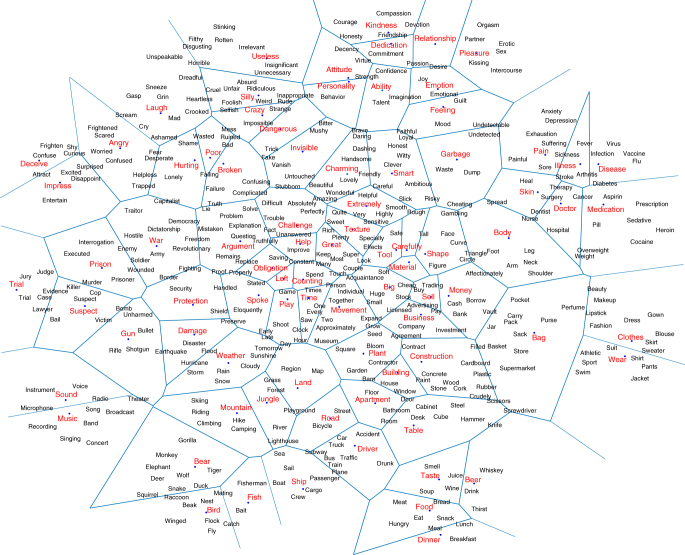
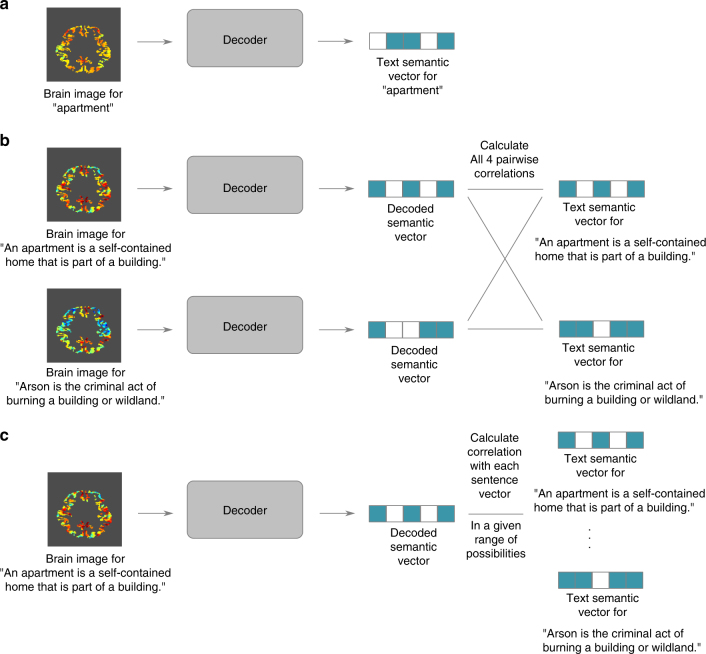
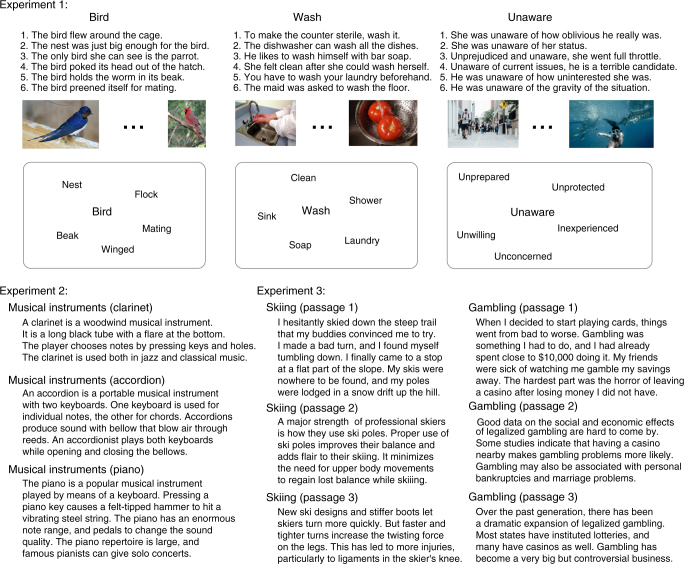
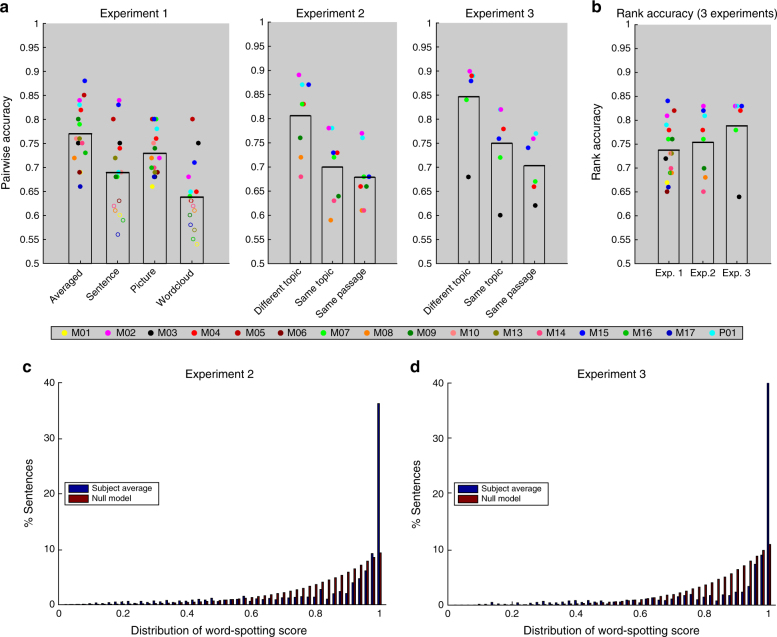
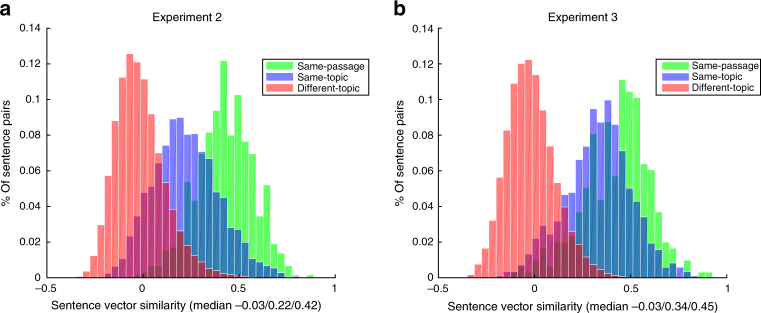
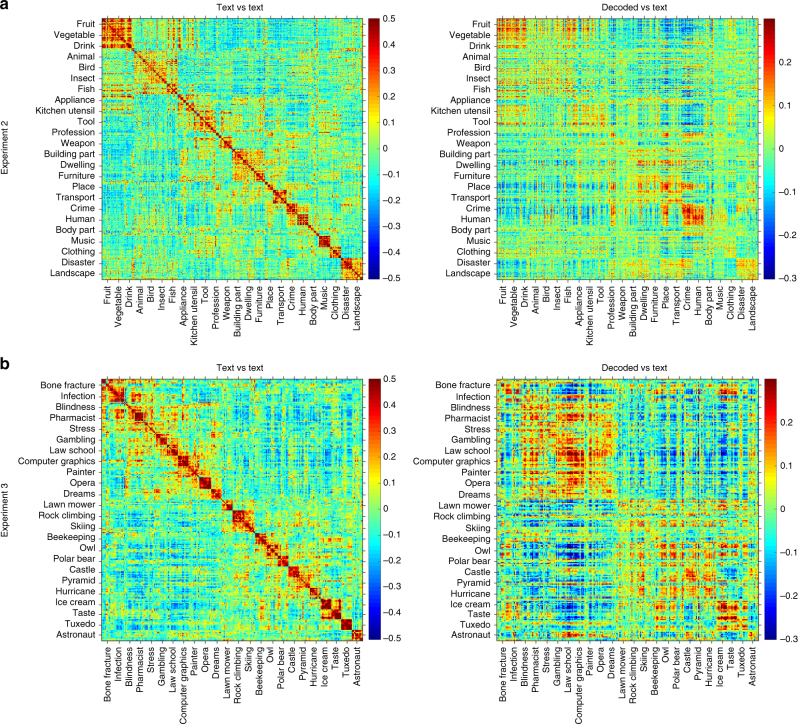
Prior work decoding linguistic meaning from imaging data has been largely limited to concrete nouns, using similar stimuli for training and testing, from a relatively small number of semantic categories. Here we present a new approach for building a brain decoding system in which words and sentences are represented as vectors in a semantic space constructed from massive text corpora. By efficiently sampling this space to select training stimuli shown to subjects, we maximize the ability to generalize to new meanings from limited imaging data. To validate this approach, we train the system on imaging data of individual concepts, and show it can decode semantic vector representations from imaging data of sentences about a wide variety of both concrete and abstract topics from two separate datasets. These decoded representations are sufficiently detailed to distinguish even semantically similar sentences, and to capture the similarity structure of meaning relationships between sentences.
Overview
The claims and statistics of this paper haven’t been checked yet.
Free: it reads the open-access text and checks the first 5 claims that cite a source we can check. Create a free account to check every claim.
Integrity signals
Registry
Cites
Statistics
Figures
Verification
Claims the paper makes
The claims and statistics of this paper haven’t been checked yet.
Free: it reads the open-access text and checks the first 5 claims that cite a source we can check. Create a free account to check every claim.
Claims other papers make about this one
Each is checked against this paper’s own text: does it say what the citing paper says it does?
The source backs part of the claim, not all of it — or backs it for a different population, condition or comparison.
In the citing paper
“Large Language Models (LLMs) have shown success in predicting neural signals associated with narrative processing”
From Incremental accumulation of linguistic context in artificial and biological neural networks (2025) · cites this paper as [1]
Experimental — accuracy not yet measuredThe source backs part of the claim, not all of it — or backs it for a different population, condition or comparison.
In the citing paper
“Previous studies in the neural encoding literature all used LLMs that were only aware of the short-term context, i.e., where the context window size was as large as several tens of words1–10.”
From Incremental accumulation of linguistic context in artificial and biological neural networks (2025) · cites this paper as [1]
Experimental — accuracy not yet measuredThe cited source says what the claim attributes to it.
In the citing paper
“This was the case even though the participants in these studies were exposed to language stimuli that encompassed hundreds and even thousands of words.”
From Incremental accumulation of linguistic context in artificial and biological neural networks (2025) · cites this paper as [1]
Self-check
Percentages, sums and reported differences re-computed from the paper’s own numbers.
The self-check needs the paper’s full text.
Citations
Cites
Glove: Global Vectors for Word Representation
Pennington, J., Socher, R., & Manning, C. (2014) · Proceedings of the 2014 Conference on Empirical Methods in Natural Language Processing (EMNLP) · doi:10.3115/v1/d14-1162 · Cited by 34,071
Distributed Representations of Words and Phrases and their Compositionality
Mikolov, T., Sutskever, I., Chen, K., Corrado, G., & Dean, J. (2013) · arXiv · doi:10.48550/arxiv.1310.4546 · Cited by 24,533
The Elements of Statistical Learning
Hastie, T., Friedman, J., & Tibshirani, R. (2001) · Springer Series in Statistics · doi:10.1007/978-0-387-21606-5 · Cited by 24,162
Indexing by latent semantic analysis
Deerwester, S., Dumais, S. T., Furnas, G. W., Landauer, T. K., & Harshman, R. (1990) · Journal of the American Society for Information Science · doi:10.1002/(sici)1097-4571(199009)41:6<391::aid-asi1>3.0.co;2-9 · Cited by 12,751
Ambrose, A., Wittgenstein, L., & Anscombe, G. E. M. (1954) · Philosophy and Phenomenological Research · doi:10.2307/2103745 · Cited by 12,192
Jenkinson, M., Beckmann, C. F., Behrens, T. E. J., Woolrich, M. W., & Smith, S. M. (2012) · NeuroImage · doi:10.1016/j.neuroimage.2011.09.015 · Cited by 11,314
A tutorial on spectral clustering
von Luxburg, U. (2007) · Statistics and Computing · doi:10.1007/s11222-007-9033-z · Cited by 10,349
The Brain's Default Network: Anatomy, Function, and Relevance to Disease
Buckner, R. L., Andrews‐Hanna, J. R., & Schacter, D. L. (2008) · Annals of the New York Academy of Sciences · doi:10.1196/annals.1440.011 · Cited by 9,761
Power, J. D., Barnes, K. A., Snyder, A. Z., Schlaggar, B. L., & Petersen, S. E. (2012) · NeuroImage · doi:10.1016/j.neuroimage.2011.10.018 · Cited by 7,429
Functional Network Organization of the Human Brain
Power, J. D., Cohen, A. L., Nelson, S. M., Wig, G. S., Barnes, K. A., Church, J. A., Vogel, A. C., Laumann, T. O., Miezin, F. M., Schlaggar, B. L., et al. (2011) · Neuron · doi:10.1016/j.neuron.2011.09.006 · Cited by 4,124
Research works printed but not linked: 1
- Ringgaard, M., Gupta, R., and Pereira, F. C. N. SLING: a framework for frame semantic parsing. Preprint arXiv:1710.07032 (2017). · arXiv
Cited by
Items 301–400 of 445
BrainLM: Estimation of Brain Activity Evoked Linguistic Stimuli Utilizing Large Language Models
Luo, Y., & Kobayashi, I. (2023) · Conference proceedings/Conference proceedings - IEEE International Conference on Systems, Man, and Cybernetics · doi:10.1109/smc53992.2023.10394227 · Cited by 2
“• Pereira dataset [13]: the Pereira dataset, collected by Pereira et al. We selected partial data from their Experiments 2 and 3 of watching sentences.”
MethodVenhuizen, N. J., & Brouwer, H. (2025) · The Psychology of learning and motivation/The psychology of learning and motivation · doi:10.1016/bs.plm.2025.07.007 · Cited by 2
Mapping the mind’s landscape: Common neural encoding for spatial and morality concepts
Wang, J., Qian, M., & Cai, Q. (2025) · NeuroImage · doi:10.1016/j.neuroimage.2025.121485 · Cited by 2
Lin, Y.-C., Zhu, H., & Schuler, W. (2026) · Findings of the Association for Computational Linguistics: EMNLP (Findings of EMNLP) · doi:10.18653/2026.findings-emnlp.1903 · Cited by 2
Instruction-tuned LLMs with World Knowledge are More Aligned to the Human Brain
Aw, K. L., Montariol, S., AlKhamissi, B., Schrimpf, M., & Bosselut, A. (2024) · Infoscience (Ecole Polytechnique Fédérale de Lausanne) · Cited by 2
Ogg, M., & Kitchell, L. M. (2026) · eNeuro · doi:10.1523/eneuro.0370-25.2026 · Cited by 2
How Does the Experimental Setting Affect the Conclusions of Neural Encoding Models?
Zhang, X., Wang, S., & Zong, C. (2022) · Language Resources and Evaluation Conference (LREC) · doi:10.63317/2cq3s8usqyrf · Cited by 2
Cox, C. R., & Rogers, T. T. (2018) · bioRxiv (Cold Spring Harbor Laboratory) · doi:10.1101/390534 · Cited by 2
Interpretability of statistical approaches in speech and language neurosciencePreprint
Bouton, S., Chambon, V., Golestani, N., Formisano, E., Proix, T., & Giraud, A. (2019) · PsyArXiv (OSF Preprints) · doi:10.31234/osf.io/8vwcs · Cited by 2
Tikochinski, R., Goldstein, A., Yeshurun, Y., Hasson, U., & Reichart, R. (2021) · bioRxiv (Cold Spring Harbor Laboratory) · doi:10.1101/2021.11.22.469596 · Cited by 2
Get the gist of the story: Neural map of topic keywords in multi-speaker environmentPreprint
Park, H., & Groß, J. (2023) · doi:10.7554/elife.89703 · Cited by 2
Get the gist of the story: Neural map of topic keywords in multi-speaker environmentPreprint
Park, H., & Groß, J. (2023) · doi:10.7554/elife.89703.1 · Cited by 2
Concreteness and Imageability Norms
Brysbaert, M. (2025) · Elsevier eBooks · doi:10.1016/b978-0-323-95504-1.00496-8 · Cited by 2
Neural Correlates of Language Models Are Specific to Human Language
Parra, I. (2026) · Proceedings of Machine Learning Research · doi:10.48550/arxiv.2510.03156 · Cited by 2
“We address these issues through a comprehensive transformer-brain comparison using fMRI data [37] and 19 text -trained transformers.”
BP-GPT: Auditory Neural Decoding Using fMRI-prompted LLMPreprint
Chen, X., Du, C., Liu, C., Wang, Y., & He, H. (2025) · arXiv (Cornell University) · doi:10.48550/arxiv.2502.15172 · Cited by 2
Sparse Autoencoders Map Brain-LLM Alignment onto Cortical Semantic TopographyPreprint
Guo, D., Wu, J., & Yiu, S. (2026) · arXiv (Cornell University) · doi:10.48550/arxiv.2605.23035 · Cited by 2
“…question, rooted in decades of neu-rolinguistic theory (Hale, 2001; Levy, 2008; Huth et al., 2016; Mitchell et al., 2008), has gained new urgency as large language models (LLMs) predict neural responses with remarkable accuracy (Schrimpf et al., 2021; Goldstein et al., 2022; Pereira et al., 2018).”
Sun, K., & Wang, R. (2026) · arXiv (Cornell University) · doi:10.48550/arxiv.2607.04107 · Cited by 2
Cross-Subject Generalization in Decoding Perceived Speech from Non-Invasive Brain RecordingsPreprint
Zhang, A., Wang, B., Wu, X., Cheng, H., & Chen, J. (2026) · arXiv · doi:10.48550/arxiv.2608.22420 · Cited by 2
“These two evaluation metrics are commonly used in speech decoding tasks [4], [65], facilitating comparison with prior work.”
The Semantic Bottleneck: Leveraging Semantic Representations for Non-Invasive Speech DecodingPreprint
Landau, G., Jayalath, D., & Jones, Ō. P. (2026) · arXiv (Cornell University) · doi:10.48550/arxiv.2609.10296 · Cited by 2
“Pereira et al. [2018] demonstrated that fMRI responses to sentences could be mapped into semantic embedding spaces, providing early evidence that distributed neural activity can be aligned with sentence-level meaning.”
Becerra, J. R. J., Rivas, N. Y. P., Dominguez, Á. A. O., Chaglla, J. A. C., López, J. J. S., & Alcivar, J. M. I. (2024) · Ciencia Sociales y Económicas · doi:10.18779/csye.v8i2.768 · Cited by 1
Luo, Y., & Kobayashi, I. (2025) · Journal of Advanced Computational Intelligence and Intelligent Informatics · doi:10.20965/jaciii.2025.p0754 · Cited by 1
Kim, J. S., Seol, J.-M., Lee, C.-H., Lee, I., & Lee, S. A. (2025) · iScience · doi:10.1016/j.isci.2025.114241 · Cited by 1
Using computational semantics to study meaning in the brain.
Fodor, J., & Suzuki, S. (2025) · Neuroscience and Biobehavioral Reviews · doi:10.1016/j.neubiorev.2025.106514 · Cited by 1
Diseño y metodología de un etiquetador semántico-ontológico multilingüe: ESMAS-ES+
Vázquez, M. J. D. (2025) · Revista de Investigación Lingüística · doi:10.6018/ril.662171 · Cited by 1
Zhuang, K., Liang, X., Smallwood, J., Jefferies, E., & Vatansever, D. (2026) · Nature Communications · doi:10.1038/s41467-026-75841-9 · Cited by 1
Privileged representational axes in biological and artificial neural networks
Khosla, M., Srivastava, S., Williams, A. H., McDermott, J. H., & Kanwisher, N. (2026) · Nature Human Behaviour · doi:10.1038/s41562-026-02515-3 · Cited by 1
Self-citationThe Neural Representation of Concrete and Abstract Concepts
Vargas, R., & Just, M. A. (2021) · Cambridge University Press eBooks · doi:10.1017/9781108635462.029 · Cited by 1
“be explored for its semantic properties (Pereira et al., 2018).”
BackgroundMethodInfluentialThe Encoding of Meaning in Cerebral Activity
Knyazev, G. G. (2023) · Neuroscience and Behavioral Physiology · doi:10.1007/s11055-023-01454-0 · Cited by 1
“Cerebral activity, as we have seen, correlates with the semantic vector at a level of 0.35 [Pereira et al., 2018].”
BackgroundMethodInfluentialInvestigating Neural Fit Approaches for Sentence Embedding Model Paradigms
Balabin, H., Liuzzi, A. G., Sun, J., Dupont, P. J., Vandenberghe, R. R., & Moens, M. (2023) · Frontiers in artificial intelligence and applications · doi:10.3233/faia230267 · Cited by 1
استخدام النموذج الشبكات العصبية الاصطناعية للتنبؤ بإستهلاك الطاقة الكهربائية في الجزائر
SARI-HASSOUN, S., NAMANE, M. A., & MALIOUI, A. (2024) · Dirassat Journal Economic Issue · doi:10.34118/djei.v15i2.3900 · Cited by 1
Fodor, J., Murawski, C., & Suzuki, S. (2026) · eLife · doi:10.1101/2025.07.19.665701 · Cited by 1
“Dorsolateral prefrontal cortex: 67,68,71,73,83,84,85,86,87; dorsomedial prefrontal cortex: 26,43,63,69; precuneus: 15,27,29,30,31,45,121,142; posterior cingulate: 14,32,33,34,35,38,161,162; primary visual cortex: 1,4,5,6; primary somatosensory cortex: 9,51,52,53.”
Which Sense Dominates Multisensory Semantic Understanding? A Brain Decoding Study
Huang, D., Cao, L., Li, Z., & Zhang, Y. (2024) · Language Resources and Evaluation Conference (LREC) · doi:10.63317/4wcyooanq75o · Cited by 1
“Part of studies adopted plain texts as stimuli (Pereira et al., 2018; Murphy et al., 2022).”
BackgroundMethodInfluentialCognitive Resonant Communication by Internal Speech through Intelligent Bioinformation Systems
Bryndin, E. (2023) · Budapest International Research in Exact Sciences (BirEx Journal) · doi:10.33258/birex.v5i4.7757 · Cited by 2
Preserved Structure Across Vector Space RepresentationsPreprint
Amatuni, A., He, E., & Bergelson, E. (2018) · arXiv (Cornell University) · doi:10.48550/arxiv.1802.00840 · Cited by 1
“…suggest that these algorithms learn representations the way children do, though we note that CNN architectures were originally inspired by primary visual cortex (Fukushima & Miyake, 1982) and GloVe has recently been used to decode semantic representations from brain activity (Pereira et al., 2018).”
BackgroundMixture of Regression Experts in fMRI EncodingPreprint
Oota, S. R., Avvaru, A., Manwani, N., & Bapi, R. S. (2018) · arXiv (Cornell University) · doi:10.48550/arxiv.1811.10740 · Cited by 1
“Current encoding methods attempt to learn either weights in case of linear models (Mitchell et al., 2008; Pereira et al., 2018) or complex representations in non-linear models (Oota et al., 2018).”
BackgroundMethodInfluentialCross-view Brain DecodingPreprint
Oota, S. R., Arora, J., Gupta, M., & Bapi, R. S. (2022) · arXiv (Cornell University) · doi:10.48550/arxiv.2204.09564 · Cited by 1
“(3) We augment the popular Pereira et al. (2018)’s dataset with pairwiseview relationships and use it to demonstrate the efficacy of our proposed methods.”
BackgroundMethodResultInfluentialThe Fluidity of Concept Representations in Human Brain SignalsPreprint
Hendrikx, E. H. H., & Beinborn, L. (2020) · arXiv (Cornell University) · doi:10.48550/arxiv.2002.08880 · Cited by 1
“The results of computational studies using brain data from humans processing full sentences (Pereira et al., 2018) and even full stories (Jain and Huth, 2018; Dehghani et al., 2017; Brennan et al., 2016; Wehbe et al., 2014) are hard to generalize because the interpretation of language–brain…”
BackgroundMethodInfluentialvan der Velde, F. (2022) · arXiv (Cornell University) · doi:10.48550/arxiv.2210.10543 · Cited by 1
Ensemble of Task-Specific Language Models for Brain EncodingPreprint
Arun, A., John, J., & Kumaran, S. Y. (2023) · arXiv (Cornell University) · doi:10.48550/arxiv.2310.15720 · Cited by 1
“We utilize the data from sentence-based experiments (experiments 2 and 3) conducted by Pereira et al. (2018) [4].”
MethodLanguage representations in deep learning algorithms and the brain
Caucheteux, C. (2023) · theses.fr (ABES) · doi:10.70675/9258df96z16fbz4531zb578za0d6684b0d14 · Cited by 1
Image retrieval based on closed-loop visual–semantic neural decodingPreprint
Fukuma, R., Yanagisawa, T., Sugano, H., Tamura, K., Oshino, S., Tani, N., Iimura, Y., Khoo, H. M., Suzuki, H., Yang, H., et al. (2024) · bioRxiv (Cold Spring Harbor Laboratory) · doi:10.1101/2024.08.05.606113 · Cited by 1
Fodor, J., Murawski, C., & Suzuki, S. (2026) · eLife · doi:10.7554/elife.108442 · Cited by 1
AI-enhanced semantic feature norms for 786 conceptsPreprint
Suresh, S., Mukherjee, K., Giallanza, T., Yu, X., Patil, M., Cohen, J. D., & Rogers, T. T. (2025) · PubMed Central · doi:10.48550/arxiv.2505.10718 · Cited by 1
“…fail to capture the semantic structure perceived by humans as effectively as feature norms, and their dimensions lack the transparent interpretability of feature-based representations, at 1 Published as a conference paper at ICLR 2025 least for for concrete objects (Suresh et al., 2023b;a).”
What if Othello-Playing Language Models Could See?Preprint
Chen, X., Yuan, Y., Li, J., Belongie, S., de Rijke, M., & Søgaard, A. (2025) · arXiv (Cornell University) · doi:10.48550/arxiv.2507.14520 · Cited by 1
“A growing body of research explores cross-modal alignment as a lens to understand the extent to which language models can internalize and generalize knowledge from text-only inputs (Pereira et al., 2018; Caucheteux et al., 2022; Li et al., 2024a; Ngo and Kim, 2024).”
Exploring the frontiers of word understanding and language model evaluation in NLP
Şenel, L. K. (2025) · Electronic Theses of LMU Munich (Ludwig-Maximilians-Universität München) · doi:10.5282/edoc.35312 · Cited by 1
Arachne’s Loom: How emotion weaves the temporal tapestry of memory
McClay, M. (2025) · eScholarship (California Digital Library) · Cited by 1
Cortical localization and dynamics of elementary mathematical conceptsPreprint
Debray, S., Karami, A., Valério, D., Cauté, M., Pallier, C., & Dehaene, S. (2026) · bioRxiv (Cold Spring Harbor Laboratory) · doi:10.64898/2026.04.30.721827 · Cited by 1
Gao, X., Tian, H., Zhu, Y., Yin, X., & Liew, A. W. (2026) · arXiv (Cornell University) · doi:10.48550/arxiv.2605.16923 · Cited by 1
“Decoding visual information from electroencephalography (EEG) signals is a central task in brain-computer interface research [24, 8], with broad implications for neu-rorehabilitation [31], visual cognition [3], and brain-inspired artificial intelligence [18, 4].”
SCRIBE: Scalable Contextual Representations of Interpretable Brain-Grounded SemanticsPreprint
Kolling, C., Moussa, O., Çelik, E., & Toneva, M. (2026) · arXiv (Cornell University) · doi:10.48550/arxiv.2610.21518 · Cited by 1
“These representations are contextual, scalable, and have been shown to predict neural responses during natural language comprehension (Toneva & Wehbe, 2019; Pereira et al., 2018).”
NeuroCogMap Reveals Cognitive Organization of Large Language ModelsPreprint
Sun, Z. X., Ҫirkinoğlu, H. O., Ma, Q. L., Li, Q., Wang, Q., Pang, L., Liu, C., Li, Q., Sun, H., Wang, K., et al. (2026) · arXiv (Cornell University) · doi:10.48550/arxiv.2607.00397 · Cited by 1
Behavioral and Brain Responses to Language Reflect Different Levels of Linguistic RepresentationPreprint
de Varda, A. G., Berzak, Y., Fedorenko, E. G., & Lévy, R. (2026) · bioRxiv (Cold Spring Harbor Laboratory) · doi:10.64898/2026.08.21.746238 · Cited by 1
Self-citationBrain-to-Language Decoding: Paradigms, Signals, Methods, Evaluation, Practical Use and BeyondPreprint
Yang, Y., Duan, Y., Liu, C., Wang, Y., Zhou, X., Lin, C.-T., & Zhang, Y. (2026) · arXiv (Cornell University) · doi:10.48550/arxiv.2609.27650 · Cited by 1
Fodor, J., Murawski, C., & Suzuki, S. (2026) · eLife · doi:10.7554/elife.108442.3 · Cited by 1
Event Structure In Vision And Language
Hafri, A. (2019) · ScholarlyCommons (University of Pennsylvania)
Expert2Coder: Capturing Divergent Brain Regions Using Mixture of Regression ExpertsPreprint
Oota, S. R., Manwani, N., & Bapi, R. S. (2019) · arXiv (Cornell University) · doi:10.48550/arxiv.1909.12299
“We used data from paradigm 1 of fMRI experiment 1 (Pereira et al., 2018”
BackgroundMethodInfluentialFunctional MRI Investigation on Paradigmatic and Syntagmatic Lexical Semantic ProcessingPreprint
Ying, S., & Ploux, S. (2020) · bioRxiv (Cold Spring Harbor Laboratory) · doi:10.1101/2020.01.11.899831
“Previous studies [1]–[6] revealed a distributed pattern of cortical areas’ correlation with word semantic models.”
BackgroundNaturalistic language comprehension : a fMRI study on semantics in a narrative context
Kurkinen, K. (2019) · Helda - University of Helsinki Institutional Repository · doi:10.13140/rg.2.2.14203.03364
The Fluidity of Concept Representations in Human Brain SignalsPreprint
Hendriks, E., & Beinborn, L. (2019) · Data Archiving and Networked Services (DANS)
Jat, S., Laing, E. J. C., Talukdar, P. P., & Mitchell, T. M. (2020) · bioRxiv (Cold Spring Harbor Laboratory) · doi:10.1101/2020.06.22.163808
“Prior research by multiple papers has established a general correspondence between a computational model and the brain’s response to naturalistic language [21, 32, 24, 33, 31, 30].”
BackgroundModeling brain activity associated with metaphor processing with distributional semantic models
Djokic, V. G., & Shutova, E. (2020) · Cognitive Science
Data-driven modeling of the neural dynamics underlying language processing
Berezutskaya, J. (2020) · Utrecht University Repository (Utrecht University) · doi:10.33540/103
CogniFNN: A Fuzzy Neural Network Framework for Cognitive Word Embedding EvaluationPreprint
Liu, X., Cao, Z., & Tran, S. N. (2020) · arXiv (Cornell University) · doi:10.48550/arxiv.2009.11485
Computational Mechanisms of Language Understanding and Use in the Brain and Behaviour
Kajić, I. (2020) · UWSpace (University of Waterloo)
The impact of visual speech on neural processing of auditory speech
O’Sullivan, A. E. (2021) · Arrow@dit (Dublin Institute of Technology)
Validating Word Embedding as a Tool for the Psychological Sciences
Swift, V. (2021) · TSpace (University of Toronto)
Translating Research on the Neuroscience of Intelligence into Action
Barbey, A. K., Karama, S., & Haier, R. J. (2021) · Cambridge University Press eBooks · doi:10.1017/9781108635462.023
Zero-Shot Neural Decoding with Semi-Supervised Multi-View Embedding
Akamatsu, Y., Maeda, K., Ogawa, T., & Haseyama, M. (2023) · Sensors · doi:10.3390/s23156903
“Subsequent neural decoding methods [5–13] estimate images or words that were not trained before, i.e., zero-shot neural decoding, by projecting fMRI activity into an intermediate-level feature space (e.g., visual feature space [6] and semantic feature space [12,13]).”
BackgroundMethodA Multimodal Visual Encoding Model Aided by Introducing Verbal Semantic InformationPreprint
Ma, S., Wang, L., & Yan, B. (2023) · arXiv (Cornell University) · doi:10.48550/arxiv.2308.15142
“Recent studies have revealed that verbal information is not solely localized to specific brain regions but distributed across the entire cortex (Anderson et al., 2016; Huth et al., 2016; Pereira et al., 2018; Xu et al., 2018).”
BackgroundKI als Werkzeug in der Hirnforschung
Krauß, P. (2023) · Springer eBooks · doi:10.1007/978-3-662-67179-5_20
Beinborn, L., & Hollenstein, N. (2023) · Synthesis lectures on human language technologies · doi:10.1007/978-3-031-43260-6_5
Deciphering the neural bases of language comprehension using latent linguistic representations
Pasquiou, A. (2023) · theses.fr (ABES) · doi:10.70675/a663b393z47f4z478az86e8zef8a23210092
Decoding models: From brain representation to machine interfaces
Takagi, Y., & Nishimoto, S. (2024) · Elsevier eBooks · doi:10.1016/b978-0-443-13480-7.00013-2
AI as a Tool in Brain Research
Krauß, P. (2024) · Springer eBooks · doi:10.1007/978-3-662-68980-6_20
Bruera, A., Zamani, F., & Poesio, M. (2024) · Joint Conference on Lexical and Computational Semantics · doi:10.18653/v1/2024.starsem-1.3
“It was originally introduced in cognitive neuroscience, to quantify how well a model could distinguish between two brain images referring to two different concepts (Mitchell et al., 2008; Pereira et al., 2018).”
BackgroundDomain embeddings for generating complex descriptions of concepts in Italian language
Maisto, A. (2024) · Cognitive Processing · doi:10.1007/s10339-024-01234-9
“Anderson et al. (2017); Pereira et al. (2018) also tried to simulate human conceptual representation collected in Binder et al. (2016) with the information encoded in a word vector.”
Mora-ERP-based RNN-Transformer for decoding single-trial EEGs during silent Japanese speechesPreprint
Yamazaki, T., Kudo, S., Kamata, S., Fujii, S., Tsukiyama, S., Yata, T., & Aoki, S. (2024) · bioRxiv (Cold Spring Harbor Laboratory) · doi:10.1101/2024.11.18.624218
Implementation of Artificial Intelligence on Brain-Computer Interface: Review
Liu, L. (2024) · Science and Technology of Engineering Chemistry and Environmental Protection · doi:10.61173/xw35y605
Electroencephalographic and Magnetoencephalographic Datasets for Language Sciences
Lopopolo, A. (2025) · Elsevier eBooks · doi:10.1016/b978-0-323-95504-1.00594-9
Modulation of decodable semantic features of brain activity via selection attentionPreprint
Okuno, A., Yamaguchi, H. Q., Nishimoto, S., & Nakai, T. (2025) · bioRxiv (Cold Spring Harbor Laboratory) · doi:10.1101/2025.06.13.659505 · Cited by 1
“The significant intra-modal decoding of latent semantic features in unimodal experiments ( Figure 2 ) observed is consistent with previous studies (Pereira et al. 2018; Nishida and Nishimoto 2018; Kivisaari et al. 2019; Fernandino et al. 2022; Frisby et al. 2023), indicating that semantic…”
Language Models and Brain Alignment: Brain Encoding and Decoding
Oota, S. R., & Bapi, R. S. (2024) · Joint International Conference on Data Science & Management of Data (CODS-COMAD) · doi:10.1145/3703323.3704280
The Semantic Underpinnings of Speech Disorganization in SchizophreniaPreprint
Fradkin, I., Moran, R., Adams, R. A., Jefferies, E., & Dolan, R. J. (2025) · bioRxiv (Cold Spring Harbor Laboratory) · doi:10.1101/2025.08.10.669589
Modality-Agnostic Decoding of Vision and Language from fMRIPreprint
Nikolaus, M., Mozafari, M., Berry, I., Asher, N. M., Reddy, L., & VanRullen, R. (2025) · eLife · doi:10.7554/elife.107933.1
Bowers, J. S. (2025) · PsyArXiv (OSF Preprints) · doi:10.31234/osf.io/5wt9m_v2
How Large Language Models Align with the Brain: A Multidataset Neuroimaging StudyPreprint
Fodor, J., & Suzuki, S. (2025) · Research Square · doi:10.21203/rs.3.rs-7614621/v1
Đulović, D. (2025) · SSRN Electronic Journal · doi:10.2139/ssrn.5489806
Ubaldi, S., Rabini, G., & Fairhall, S. L. (2025) · Journal of Neuroscience · doi:10.1523/jneurosci.1126-25.2025
Test-retest reliability of edge-level resting-state functional connectivity in people with aphasia
Johnson, J. P., Dickey, M. W., Bohland, J. W., & Hula, W. D. (2025) · Neuroimage Reports · doi:10.1016/j.ynirp.2025.100296
“…functionally defined brain areas with a high probability of containing language-responsive tissue across subjects) that were created and used by Fedorenko and colleagues in their extensive research on language in the brain (e.g., Fedorenko et al., 2010; Pereira et al., 2018; Hu et al., 2023).”
What if Othello-Playing Language Models Could See?
Chen, X., Yuan, Y., Li, J., Belongie, S., de Rijke, M., & Søgaard, A. (2025) · Findings of the Association for Computational Linguistics: EMNLP (Findings of EMNLP) · doi:10.18653/v1/2025.findings-emnlp.673
Jackson, R. L., Orban, G. A., & Tiesinga, P. H. E. (2026) · Neurobiology of Language · doi:10.1162/nol.a.220
Author response: Modality-Agnostic Decoding of Vision and Language from fMRI
Nikolaus, M., Mozafari, M., Berry, I., Asher, N. M., Reddy, L., & VanRullen, R. (2025) · eLife · doi:10.7554/elife.107933.2.sa0
Modality-Agnostic Decoding of Vision and Language from fMRIPreprint
Nikolaus, M., Mozafari, M., Berry, I., Asher, N. M., Reddy, L., & VanRullen, R. (2025) · eLife · doi:10.7554/elife.107933.2
Auditory representations of words during silent visual readingPreprint
Li, J., Doerig, A., & Cichy, R. M. (2025) · bioRxiv (Cold Spring Harbor Laboratory) · doi:10.64898/2025.12.12.693932
“Accordingly, computational models of reading focus on either the visual encoding of text 24,29,30 , or the semantic representations that capture its meaning 10,25,31 .”
Extending self-supervised natural language models through human brain
Loukas, N. (2022) · DSpace - NTUA (National Technical University of Athens) · doi:10.26240/heal.ntua.22182
Frisby, S. L. (2024) · Apollo (University of Cambridge) · doi:10.17863/cam.115286
Cognitive methods for image captioning
Σωτηρίου, Δ. (2022) · DSpace - NTUA (National Technical University of Athens) · doi:10.26240/heal.ntua.22187
Explainable Artificial Intelligence for Brain Functional Magnetic Resonance Imaging Analysis
dos Santos, J. D. M. (2024) · Portuguese National Funding Agency for Science, Research and Technology (RCAAP Project by FCT) · doi:10.34626/gx1a-af11
Διαθεματικές και γνωστικές μέθοδοι για αναπαραστάσεις φυσικής γλώσσας
Athanasiou, N. (2020) · DSpace - NTUA (National Technical University of Athens) · doi:10.26240/heal.ntua.17666
Multi-level models of language comprehension in the mind and brain
Gauthier, J. (2023) · DSpace@MIT (Massachusetts Institute of Technology)
Metadata
- Authors
- Pereira, F., Lou, B., Pritchett, B., Ritter, S., Gershman, S. J., Kanwisher, N., Botvinick, M., & Fedorenko, E.
- Affiliations
- Siemens (United States) (US)
- Massachusetts Institute of Technology (US)
- Google DeepMind (United Kingdom) (GB)
- Harvard University (US)
- McGovern Institute for Brain Research (US)
- Corresponding author
- Pereira, Francisco
- Fedorenko, Evelina
- ORCID
- Venue
- Nature Communications
- Published
- 2018-03-06
- Volume
- 9
- Issue
- 1
- Pages
- 963-963
- ISSN
- 2041-1723 (ISSN-L)
- PMC
- PMC5840373
- OpenAlex
- W2782213998
- Cited by
- 324
- References
- 52
- Citations by year
- 2026: 23 · 2025: 49 · 2024: 45 · 2023: 46 · 2022: 38 · 2021: 39 · 2020: 39 · 2019: 37 · 2018: 8
- FWCI
- 18.28
- Type
- journal article
- Language
- en
- Open access
- gold
- doi.org
- Licence
- cc-by
- creativecommons.org/licenses/by/4.0 (tdm)
- creativecommons.org/licenses/by/4.0 (vor)
- Locations
- Nature Communications (publishedVersion, cc-by)
- PubMed Central (publishedVersion, cc-by)
- PubMed (publishedVersion)
- Digital Access to Scholarship at Harvard (DASH) (Harvard University) (submittedVersion, cc-by)
- RePEc: Research Papers in Economics (submittedVersion)
- DOAJ (DOAJ: Directory of Open Access Journals) (submittedVersion)
- DOAJ (DOAJ: Directory of Open Access Journals) (submittedVersion, cc-by-sa)
- DSpace@MIT (Massachusetts Institute of Technology) (submittedVersion, cc-by-nc)
- OSF Preprints (OSF Preprints) (submittedVersion)
- Funders
- Johns Hopkins University
- Office of the Director of National Intelligence
- National Institutes of Health (5k99hd057522-02)
- Intelligence Advanced Research Projects Activity (FA8650-14-C-7358)
- McGovern Institute for Brain Research, Massachusetts Institute of Technology
- NIH Office of the Director
- Eunice Kennedy Shriver National Institute of Child Health and Human Development (K99 HD-057522, DP1HD091947, R00HD057522)
- Air Force Research Laboratory (FA8650-14-C-7358)
- Topics
- Life Sciences › Neuroscience › Cognitive Neuroscience › Neurobiology of Language and Bilingualism
- Social Sciences › Psychology › Developmental and Educational Psychology › Reading and Literacy Development
- Physical Sciences › Computer Science › Artificial Intelligence › Topic Modeling
- Keywords
- semantic decoding, brain decoding, linguistic meaning, semantic space, semantic vectors, text corpora, sentence meaning
- MeSH terms
- Adult, Brain Mapping, Female, Humans, Magnetic Resonance Imaging, Male, Physical Stimulation, Semantics
About these checks
Registry, retraction, Cites and statistics results are computed, not judged, with one exception: a printed reference that no index lists is read once by a model before it counts as a citation error. Claims are extracted by a model and kept only when their quote appears verbatim in the text; each cited source is then checked, with a model’s help, for whether it says what the claim relies on. Those verdicts can be wrong — read the claim’s quote and the cited source before relying on one.
Statistics and arithmetic are recomputed, not judged.
Confidence bands are shown only for fields calibrated on our annotated test set. None is calibrated yet, so no band is shown.
What counts as a claim ›How we measure confidence ›How we check this ›
Are you an author, or do you see a problem with this page? Request a review
Data sources
Bibliographic data: Semantic Scholar, OpenAlex, Crossref.
Contains information from the Semantic Scholar Academic Graph Datasets, made available under the ODC Attribution License (ODC-BY 1.0).
Semantic Scholar’s data is described in: Kinney, R., et al. (2023). The Semantic Scholar Open Data Platform. arXiv:2301.10140.
