

Toward a universal decoder of linguistic meaning from brain activation
Open accessThe DOI matches its Crossref record; 54 of the 54 references it cites were found in a registry or an index.
Abstract
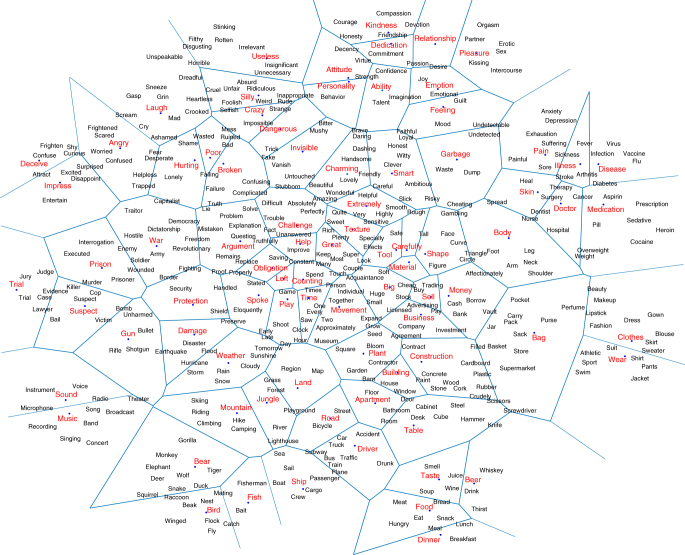
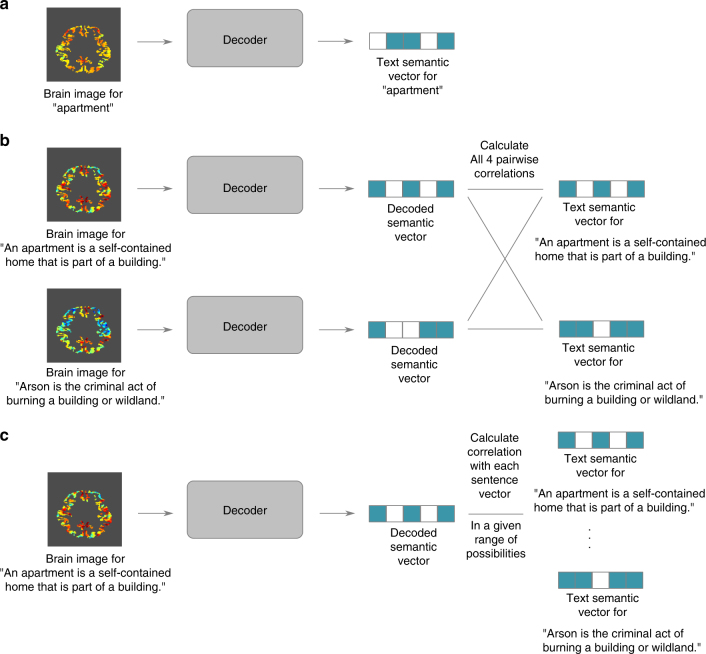
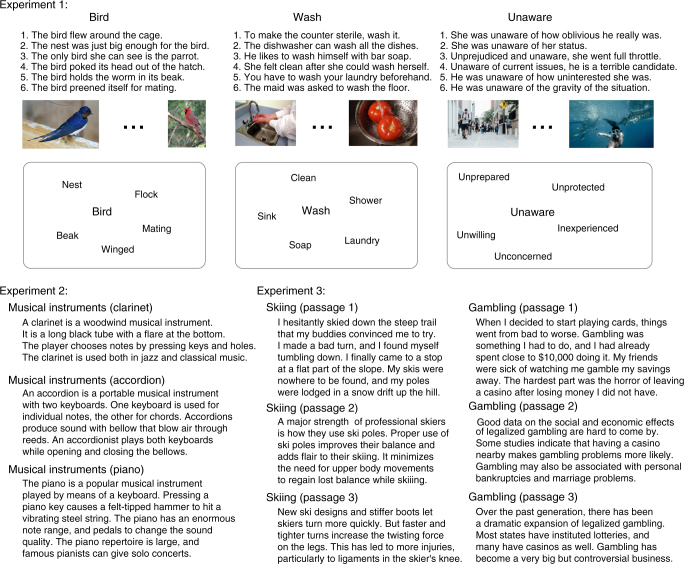
Prior work decoding linguistic meaning from imaging data has been largely limited to concrete nouns, using similar stimuli for training and testing, from a relatively small number of semantic categories. Here we present a new approach for building a brain decoding system in which words and sentences are represented as vectors in a semantic space constructed from massive text corpora. By efficiently sampling this space to select training stimuli shown to subjects, we maximize the ability to generalize to new meanings from limited imaging data. To validate this approach, we train the system on imaging data of individual concepts, and show it can decode semantic vector representations from imaging data of sentences about a wide variety of both concrete and abstract topics from two separate datasets. These decoded representations are sufficiently detailed to distinguish even semantically similar sentences, and to capture the similarity structure of meaning relationships between sentences.
Overview
The claims and statistics of this paper haven’t been checked yet.
Free: it reads the open-access text and checks the first 5 claims that cite a source we can check. Create a free account to check every claim.
Integrity signals
Registry
Cites
Statistics
Figures
Verification
Claims the paper makes
The claims and statistics of this paper haven’t been checked yet.
Free: it reads the open-access text and checks the first 5 claims that cite a source we can check. Create a free account to check every claim.
Claims other papers make about this one
Each is checked against this paper’s own text: does it say what the citing paper says it does?
The source backs part of the claim, not all of it — or backs it for a different population, condition or comparison.
In the citing paper
“Large Language Models (LLMs) have shown success in predicting neural signals associated with narrative processing”
From Incremental accumulation of linguistic context in artificial and biological neural networks (2025) · cites this paper as [1]
Experimental — accuracy not yet measuredThe source backs part of the claim, not all of it — or backs it for a different population, condition or comparison.
In the citing paper
“Previous studies in the neural encoding literature all used LLMs that were only aware of the short-term context, i.e., where the context window size was as large as several tens of words1–10.”
From Incremental accumulation of linguistic context in artificial and biological neural networks (2025) · cites this paper as [1]
Experimental — accuracy not yet measuredThe cited source says what the claim attributes to it.
In the citing paper
“This was the case even though the participants in these studies were exposed to language stimuli that encompassed hundreds and even thousands of words.”
From Incremental accumulation of linguistic context in artificial and biological neural networks (2025) · cites this paper as [1]
Self-check
Percentages, sums and reported differences re-computed from the paper’s own numbers.
The self-check needs the paper’s full text.
Citations
Cites
Glove: Global Vectors for Word Representation
Pennington, J., Socher, R., & Manning, C. (2014) · Proceedings of the 2014 Conference on Empirical Methods in Natural Language Processing (EMNLP) · doi:10.3115/v1/d14-1162 · Cited by 34,071
Distributed Representations of Words and Phrases and their Compositionality
Mikolov, T., Sutskever, I., Chen, K., Corrado, G., & Dean, J. (2013) · arXiv · doi:10.48550/arxiv.1310.4546 · Cited by 24,533
The Elements of Statistical Learning
Hastie, T., Friedman, J., & Tibshirani, R. (2001) · Springer Series in Statistics · doi:10.1007/978-0-387-21606-5 · Cited by 24,162
Indexing by latent semantic analysis
Deerwester, S., Dumais, S. T., Furnas, G. W., Landauer, T. K., & Harshman, R. (1990) · Journal of the American Society for Information Science · doi:10.1002/(sici)1097-4571(199009)41:6<391::aid-asi1>3.0.co;2-9 · Cited by 12,751
Ambrose, A., Wittgenstein, L., & Anscombe, G. E. M. (1954) · Philosophy and Phenomenological Research · doi:10.2307/2103745 · Cited by 12,192
Jenkinson, M., Beckmann, C. F., Behrens, T. E. J., Woolrich, M. W., & Smith, S. M. (2012) · NeuroImage · doi:10.1016/j.neuroimage.2011.09.015 · Cited by 11,314
A tutorial on spectral clustering
von Luxburg, U. (2007) · Statistics and Computing · doi:10.1007/s11222-007-9033-z · Cited by 10,349
The Brain's Default Network: Anatomy, Function, and Relevance to Disease
Buckner, R. L., Andrews‐Hanna, J. R., & Schacter, D. L. (2008) · Annals of the New York Academy of Sciences · doi:10.1196/annals.1440.011 · Cited by 9,761
Power, J. D., Barnes, K. A., Snyder, A. Z., Schlaggar, B. L., & Petersen, S. E. (2012) · NeuroImage · doi:10.1016/j.neuroimage.2011.10.018 · Cited by 7,429
Functional Network Organization of the Human Brain
Power, J. D., Cohen, A. L., Nelson, S. M., Wig, G. S., Barnes, K. A., Church, J. A., Vogel, A. C., Laumann, T. O., Miezin, F. M., Schlaggar, B. L., et al. (2011) · Neuron · doi:10.1016/j.neuron.2011.09.006 · Cited by 4,124
Binder, J. R., Desai, R. H., Graves, W. W., & Conant, L. L. (2009) · Cerebral Cortex · doi:10.1093/cercor/bhp055 · Cited by 4,060
Where do you know what you know? The representation of semantic knowledge in the human brain
Patterson, K., Nestor, P. J., & Rogers, T. T. (2007) · Nature Reviews Neuroscience · doi:10.1038/nrn2277 · Cited by 2,706
The neural and computational bases of semantic cognition
Ralph, M. A. L., Jefferies, E., Patterson, K., & Rogers, T. T. (2017) · Nature Reviews Neuroscience · doi:10.1038/nrn.2016.150 · Cited by 1,864
The multiple-demand (MD) system of the primate brain: mental programs for intelligent behaviour
Duncan, J. (2010) · Trends in Cognitive Sciences · doi:10.1016/j.tics.2010.01.004 · Cited by 1,846
Concreteness ratings for 40 thousand generally known English word lemmas
Brysbaert, M., Warriner, A. B., & Kuperman, V. (2014) · Behavior Research Methods · doi:10.3758/s13428-013-0403-5 · Cited by 1,821
Machine learning classifiers and fMRI: A tutorial overview
Pereira, F., Mitchell, T., & Botvinick, M. (2009) · NeuroImage · doi:10.1016/j.neuroimage.2008.11.007 · Cited by 1,624
Self-citationNatural speech reveals the semantic maps that tile human cerebral cortex
Huth, A. G., de Heer, W. A., Griffiths, T. L., Theunissen, F. E., & Gallant, J. L. (2016) · Nature · doi:10.1038/nature17637 · Cited by 1,504
Generation and evaluation of a cortical area parcellation from resting-state correlations
Gordon, E. M., Laumann, T. O., Adeyemo, B., Huckins, J. F., Kelley, W. M., & Petersen, S. E. (2016) · Cerebral Cortex · doi:10.1093/cercor/bhu239 · Cited by 1,463
Scanning the horizon: towards transparent and reproducible neuroimaging research
Poldrack, R. A., Baker, C. I., Durnez, J., Gorgolewski, K. J., Matthews, P. M., Munafò, M. R., Nichols, T. E., Poline, J.-B., Vul, E., & Yarkoni, T. (2017) · Nature Reviews Neuroscience · doi:10.1038/nrn.2016.167 · Cited by 1,410
Baroni, M., Dinu, G., & Kruszewski, G. (2014) · Proceedings of the 52nd Annual Meeting of the Association for Computational Linguistics (Volume 1: Long Papers) · doi:10.3115/v1/p14-1023 · Cited by 1,364 · cited 2×
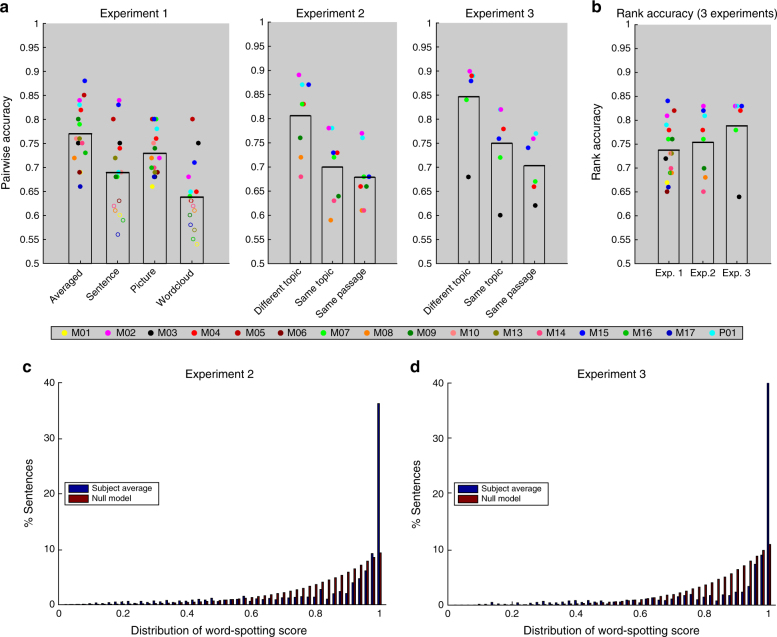
“01 using a test based on a normal approximation to the null distribution, with Bonferroni correction for the number of participants (16) and experiments (3); results are shown in Fig.”
MethodKiros, R., Zhu, Y., Salakhutdinov, R., Zemel, R. S., Torralba, A., Urtasun, R., & Fidler, S. (2015) · arXiv · doi:10.48550/arxiv.1506.06726 · Cited by 1,293
Identifying natural images from human brain activity
Kay, K. N., Naselaris, T., Prenger, R. J., & Gallant, J. L. (2008) · Nature · doi:10.1038/nature06713 · Cited by 1,286
Predicting Human Brain Activity Associated with the Meanings of Nouns
Mitchell, T. M., Shinkareva, S. V., Carlson, A., Chang, K.-M., Malave, V. L., Mason, R. A., & Just, M. A. (2008) · Science · doi:10.1126/science.1152876 · Cited by 1,180 · cited 2×
“01 using a test based on a normal approximation to the null distribution, with Bonferroni correction for the number of participants (16) and experiments (3); results are shown in Fig.”
MethodComposition in Distributional Models of Semantics
Mitchell, J., & Lapata, M. (2010) · Cognitive Science · doi:10.1111/j.1551-6709.2010.01106.x · Cited by 960 · cited 2×
“While testing for significance, we applied Bonferroni correction taking into account the number of classification tasks (3 pairwise accuracy+1 rank accuracy), networks (5), and experiments (2).”
MethodReconstructing Visual Experiences from Brain Activity Evoked by Natural Movies
Nishimoto, S., Vu, A. T., Naselaris, T., Benjamini, Y., Yu, B., & Gallant, J. L. (2011) · Current Biology · doi:10.1016/j.cub.2011.08.031 · Cited by 933
Coming of age: A review of embodiment and the neuroscience of semantics
Meteyard, L., Cuadrado, S. R., Bahrami, B., & Vigliocco, G. (2012) · Cortex · doi:10.1016/j.cortex.2010.11.002 · Cited by 862
Inferring mental states from neuroimaging data: from reverse inference to large-scale decoding
Poldrack, R. A. (2011) · Neuron · doi:10.1016/j.neuron.2011.11.001 · Cited by 821
Zero-Shot Learning with Semantic Output Codes
Palatucci, M., Pomerleau, D., Hinton, G. E., et al. (2018) · Figshare · doi:10.1184/r1/6476456.v1 · Cited by 816
Zero-Shot Learning with Semantic Output Codes
Palatucci, M., Pomerleau, D., Hinton, G. E., & Mitchell, T. M. (2018) · Figshare · doi:10.1184/r1/6476456 · Cited by 752
Functional specificity for high-level linguistic processing in the human brain
Fedorenko, E., Behr, M. K., & Kanwisher, N. (2011) · Proceedings of the National Academy of Sciences · doi:10.1073/pnas.1112937108 · Cited by 595
Self-citationProspective acquisition correction for head motion with image-based tracking for real-time fMRI
Thesen, S., Heid, O., Mueller, E., & Schad, L. R. (2000) · Magnetic Resonance in Medicine · doi:10.1002/1522-2594(200009)44:3<457::aid-mrm17>3.0.co;2-r · Cited by 572
Miyawaki, Y., Uchida, H., Yamashita, O., Sato, M.-A., Morito, Y., Tanabe, H. C., Sadato, N., & Kamitani, Y. (2008) · Neuron · doi:10.1016/j.neuron.2008.11.004 · Cited by 543
context2vec: Learning Generic Context Embedding with Bidirectional LSTM
Melamud, O., Goldberger, J., & Dagan, I. (2016) · Proceedings of The 20th SIGNLL Conference on Computational Natural Language Learning · doi:10.18653/v1/k16-1006 · Cited by 513
Bayesian Reconstruction of Natural Images from Human Brain Activity
Naselaris, T., Prenger, R. J., Kay, K. N., Oliver, M., & Gallant, J. L. (2009) · Neuron · doi:10.1016/j.neuron.2009.09.006 · Cited by 511
Efficient Non-parametric Estimation of Multiple Embeddings per Word in Vector Space
Neelakantan, A., Shankar, J., Passos, A., & McCallum, A. (2014) · Proceedings of the 2014 Conference on Empirical Methods in Natural Language Processing (EMNLP) · doi:10.3115/v1/d14-1113 · Cited by 442
A structured vector space model for word meaning in context
Erk, K., & Padó, S. (2008) · Proceedings of the Conference on Empirical Methods in Natural Language Processing - EMNLP '08 · doi:10.3115/1613715.1613831 · Cited by 366
Inverse retinotopy: Inferring the visual content of images from brain activation patterns
Thirion, B., Duchesnay, E., Hubbard, E., Dubois, J., Poline, J.-B., Lebihan, D., & Dehaene, S. (2006) · NeuroImage · doi:10.1016/j.neuroimage.2006.06.062 · Cited by 363
Risk-Sensitivity in Sensorimotor Control
Braun, D. A., Nagengast, A. J., & Wolpert, D. M. (2011) · Frontiers in Human Neuroscience · doi:10.3389/fnhum.2011.00001 · Cited by 325
Wehbe, L., Murphy, B., Talukdar, P., Fyshe, A., Ramdas, A., & Mitchell, T. (2014) · PLoS ONE · doi:10.1371/journal.pone.0112575 · Cited by 249
A Neurosemantic Theory of Concrete Noun Representation Based on the Underlying Brain Codes
Just, M. A., Cherkassky, V. L., Aryal, S., & Mitchell, T. M. (2010) · PLoS ONE · doi:10.1371/journal.pone.0008622 · Cited by 207
Pereira, F., Gershman, S. J., Ritter, S., & Botvinick, M. (2016) · Cognitive Neuropsychology · doi:10.1080/02643294.2016.1176907 · Cited by 166 · cited 2×
“The spectral clustering procedure consisted of these steps: (1) calculate a 29,805 by 29,805 matrix C with the cosine similarity for each pair of vectors; (2) normalize C from (1) to fall in a 0–1 range C Cþ1 2 , and zero out the diagonal; (3) normalize C from (2) so that each row adds up to 1; (4) compute a 100-dimen…”
MethodSelf-citationNASARI: a Novel Approach to a Semantically-Aware Representation of Items
Camacho-Collados, J., Pilehvar, M. T., & Navigli, R. (2015) · Conference of the North American Chapter of the Association for Computational Linguistics: Human Language Technologies (NAACL-HLT) · doi:10.3115/v1/n15-1059 · Cited by 127
Handjaras, G., Ricciardi, E., Leo, A., Lenci, A., Cecchetti, L., Cosottini, M., Marotta, G., & Pietrini, P. (2016) · NeuroImage · doi:10.1016/j.neuroimage.2016.04.063 · Cited by 124
Ontologically Grounded Multi-sense Representation Learning for Semantic Vector Space Models
Jauhar, S. K., Dyer, C., & Hovy, E. H. (2015) · Conference of the North American Chapter of the Association for Computational Linguistics: Human Language Technologies (NAACL-HLT) · doi:10.3115/v1/n15-1070 · Cited by 123
Wang, J., Cherkassky, V. L., & Just, M. A. (2017) · Human Brain Mapping · doi:10.1002/hbm.23692 · Cited by 109
Composition in Distributional Semantics
Baroni, M. (2013) · Language and Linguistics Compass · doi:10.1111/lnc3.12050 · Cited by 105
Anderson, A. J., Binder, J. R., Fernandino, L., Humphries, C. J., Conant, L. L., Aguilar, M., Wang, X., Doko, D., & Raizada, R. D. S. (2016) · Cerebral Cortex · doi:10.1093/cercor/bhw240 · Cited by 102
Anderson, A. J., Kiela, D., Clark, S. R. L., & Poesio, M. (2017) · Transactions of the Association for Computational Linguistics · doi:10.1162/tacl_a_00043 · Cited by 100
A Direct Demonstration of Functional Differences between Subdivisions of Human V5/MT+
Strong, S. L., Silson, E. H., Gouws, A. D., Morland, A. B., & McKeefry, D. J. (2017) · Cerebral Cortex · doi:10.1093/cercor/bhw362 · Cited by 94
Pereira, F., Botvinick, M., & Detre, G. J. (2012) · Artificial Intelligence · doi:10.1016/j.artint.2012.06.005 · Cited by 65
Self-citationGenerating Text from Functional Brain Images
Pereira, F., Detre, G., & Botvinick, M. (2011) · Frontiers in Human Neuroscience · doi:10.3389/fnhum.2011.00072 · Cited by 49
Self-citationKnowledge Authoring and Question Answering via Controlled Natural Language
Ringgaard, M., Gupta, R., & Pereira, F. C. N. (2017) · arXiv (Cornell University) · doi:10.4230/oasics.iclp.2018.21 · Cited by 37
Self-citationFirst Order vs. Higher Order Modification in Distributional Semantics
Boleda, G., Vecchi, E. M., Cornudella, M., & McNally, L. (2012) · RECERCAT (Consorci de Serveis Universitaris de Catalunya) · Cited by 24
Trimming and Improving Skip-thought VectorsPreprint
Tang, S., Jin, H., Fang, C., Wang, Z.-W., & de Sa, V. D. (2017) · arXiv.org · doi:10.48550/arxiv.1706.03148 · Cited by 7
Research works printed but not linked: 1
- Ringgaard, M., Gupta, R., and Pereira, F. C. N. SLING: a framework for frame semantic parsing. Preprint arXiv:1710.07032 (2017). · arXiv
Cited by
The neural architecture of language: Integrative modeling converges on predictive processing
Schrimpf, M., Blank, I. A., Tuckute, G., Kauf, C., Hosseini, E. A., Kanwisher, N., Tenenbaum, J. B., & Fedorenko, E. (2021) · Proceedings of the National Academy of Sciences · doi:10.1073/pnas.2105646118 · Cited by 517
Self-citationShared computational principles for language processing in humans and deep language models
Goldstein, A., Zada, Z., Buchnik, E., Schain, M., Price, A., Aubrey, B., Nastase, S. A., Feder, A., Emanuel, D., Cohen, A., et al. (2022) · Nature Neuroscience · doi:10.1038/s41593-022-01026-4 · Cited by 447
Semantic reconstruction of continuous language from non-invasive brain recordings
Tang, J., LeBel, A., Jain, S., & Huth, A. G. (2023) · Nature Neuroscience · doi:10.1038/s41593-023-01304-9 · Cited by 442
“Although previous studies have shown that the BOLD signal contains rich semantic information 5,11 , our results show that this information is captured at the granularity of individual words and phrases.”
BackgroundSemantic reconstruction of continuous language from non-invasive brain recordings
(2022) · doi:10.1101/2022.09.29.509744 · Cited by 442
The language network as a natural kind within the broader landscape of the human brain
Fedorenko, E., Ivanova, A. A., & Regev, T. I. (2024) · Nature Reviews Neuroscience · doi:10.1038/s41583-024-00802-4 · Cited by 293
“…manipulations at these different scales 19,76 (see ‘The internal structure and core computations of the language network’), and the ability of researchers to decode and encode 77 diverse linguistic features (phonological, syntactic and semantic) using the language network’s activity 78–82 .”
BackgroundSelf-citation
Metadata
- Authors
- Pereira, F., Lou, B., Pritchett, B., Ritter, S., Gershman, S. J., Kanwisher, N., Botvinick, M., & Fedorenko, E.
- Affiliations
- Siemens (United States) (US)
- Massachusetts Institute of Technology (US)
- Google DeepMind (United Kingdom) (GB)
- Harvard University (US)
- McGovern Institute for Brain Research (US)
- Corresponding author
- Pereira, Francisco
- Fedorenko, Evelina
- ORCID
- Venue
- Nature Communications
- Published
- 2018-03-06
- Volume
- 9
- Issue
- 1
- Pages
- 963-963
- ISSN
- 2041-1723 (ISSN-L)
- PMC
- PMC5840373
- OpenAlex
- W2782213998
- Cited by
- 324
- References
- 52
- Citations by year
- 2026: 23 · 2025: 49 · 2024: 45 · 2023: 46 · 2022: 38 · 2021: 39 · 2020: 39 · 2019: 37 · 2018: 8
- FWCI
- 18.28
- Type
- journal article
- Language
- en
- Open access
- gold
- doi.org
- Licence
- cc-by
- creativecommons.org/licenses/by/4.0 (tdm)
- creativecommons.org/licenses/by/4.0 (vor)
- Locations
- Nature Communications (publishedVersion, cc-by)
- PubMed Central (publishedVersion, cc-by)
- PubMed (publishedVersion)
- Digital Access to Scholarship at Harvard (DASH) (Harvard University) (submittedVersion, cc-by)
- RePEc: Research Papers in Economics (submittedVersion)
- DOAJ (DOAJ: Directory of Open Access Journals) (submittedVersion)
- DOAJ (DOAJ: Directory of Open Access Journals) (submittedVersion, cc-by-sa)
- DSpace@MIT (Massachusetts Institute of Technology) (submittedVersion, cc-by-nc)
- OSF Preprints (OSF Preprints) (submittedVersion)
- Funders
- Johns Hopkins University
- Office of the Director of National Intelligence
- National Institutes of Health (5k99hd057522-02)
- Intelligence Advanced Research Projects Activity (FA8650-14-C-7358)
- McGovern Institute for Brain Research, Massachusetts Institute of Technology
- NIH Office of the Director
- Eunice Kennedy Shriver National Institute of Child Health and Human Development (K99 HD-057522, DP1HD091947, R00HD057522)
- Air Force Research Laboratory (FA8650-14-C-7358)
- Topics
- Life Sciences › Neuroscience › Cognitive Neuroscience › Neurobiology of Language and Bilingualism
- Social Sciences › Psychology › Developmental and Educational Psychology › Reading and Literacy Development
- Physical Sciences › Computer Science › Artificial Intelligence › Topic Modeling
- Keywords
- semantic decoding, brain decoding, linguistic meaning, semantic space, semantic vectors, text corpora, sentence meaning
- MeSH terms
- Adult, Brain Mapping, Female, Humans, Magnetic Resonance Imaging, Male, Physical Stimulation, Semantics
About these checks
Registry, retraction, Cites and statistics results are computed, not judged, with one exception: a printed reference that no index lists is read once by a model before it counts as a citation error. Claims are extracted by a model and kept only when their quote appears verbatim in the text; each cited source is then checked, with a model’s help, for whether it says what the claim relies on. Those verdicts can be wrong — read the claim’s quote and the cited source before relying on one.
Statistics and arithmetic are recomputed, not judged.
Confidence bands are shown only for fields calibrated on our annotated test set. None is calibrated yet, so no band is shown.
What counts as a claim ›How we measure confidence ›How we check this ›
Are you an author, or do you see a problem with this page? Request a review
Data sources
Bibliographic data: Semantic Scholar, OpenAlex, Crossref.
Contains information from the Semantic Scholar Academic Graph Datasets, made available under the ODC Attribution License (ODC-BY 1.0).
Semantic Scholar’s data is described in: Kinney, R., et al. (2023). The Semantic Scholar Open Data Platform. arXiv:2301.10140.
