

The DOI matches its Crossref record; 47 of the 48 references it cites were found in a registry or an index.
Design and validation of a foldable and photovoltaic wide-field epiretinal prosthesis
Open accessAbstract
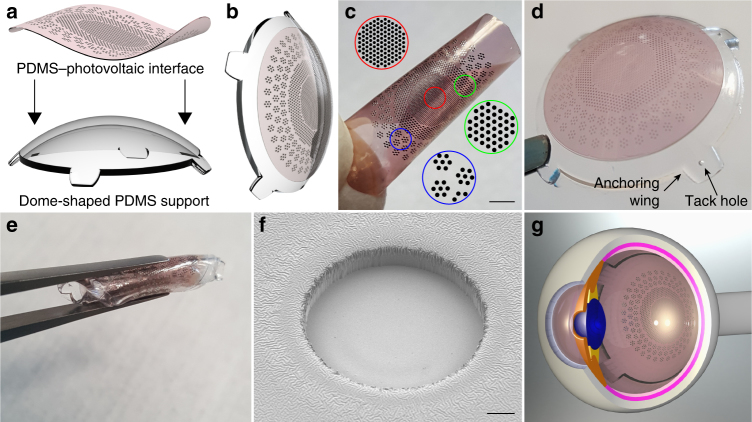
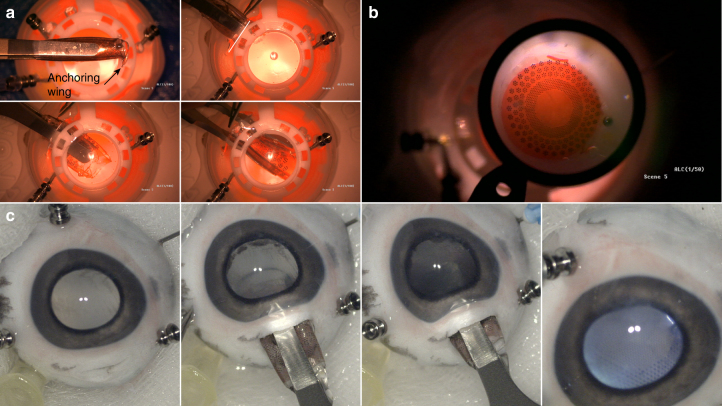
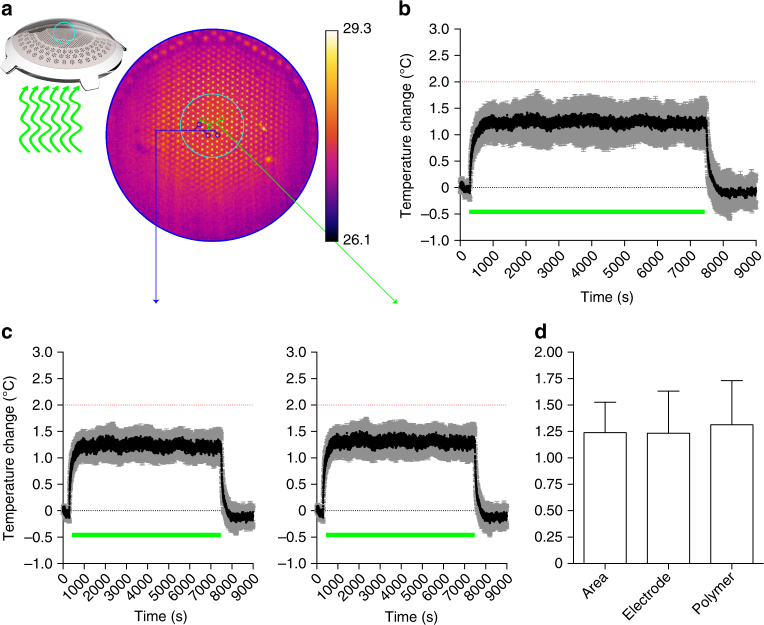
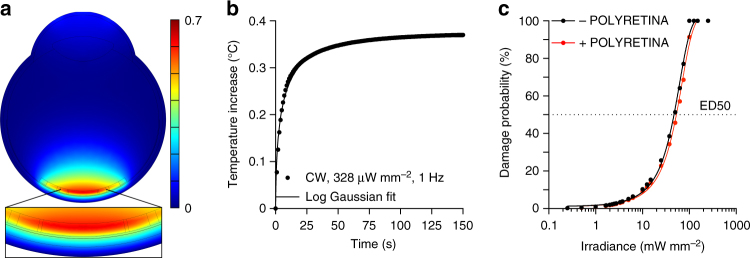
Retinal prostheses have been developed to fight blindness in people affected by outer retinal layer dystrophies. To date, few hundred patients have received a retinal implant. Inspired by intraocular lenses, we have designed a foldable and photovoltaic wide-field epiretinal prosthesis (named POLYRETINA) capable of stimulating wireless retinal ganglion cells. Here we show that within a visual angle of 46.3 degrees, POLYRETINA embeds 2215 stimulating pixels, of which 967 are in the central area of 5 mm, it is foldable to allow implantation through a small scleral incision, and it has a hemispherical shape to match the curvature of the eye. We demonstrate that it is not cytotoxic and respects optical and thermal safety standards; accelerated ageing shows a lifetime of at least 2 years. POLYRETINA represents significant progress towards the improvement of both visual acuity and visual field with the same device, a current challenging issue in the field.
Overview
The claims and statistics of this paper haven’t been checked yet.
Run the check — free, no account needed. It reads the open-access text and checks the sources it cites.
Integrity signals
Registry
Cites
Statistics
Figures
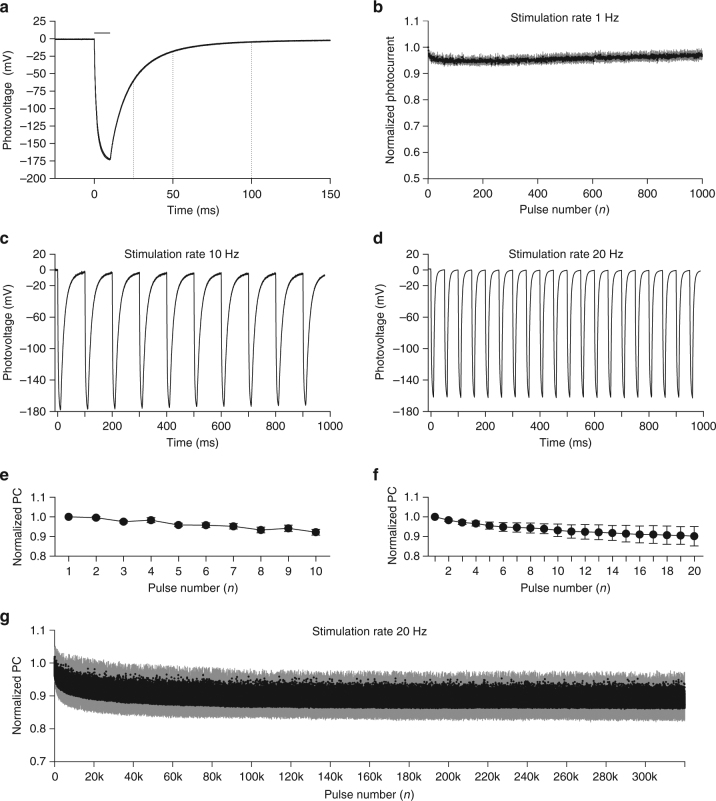
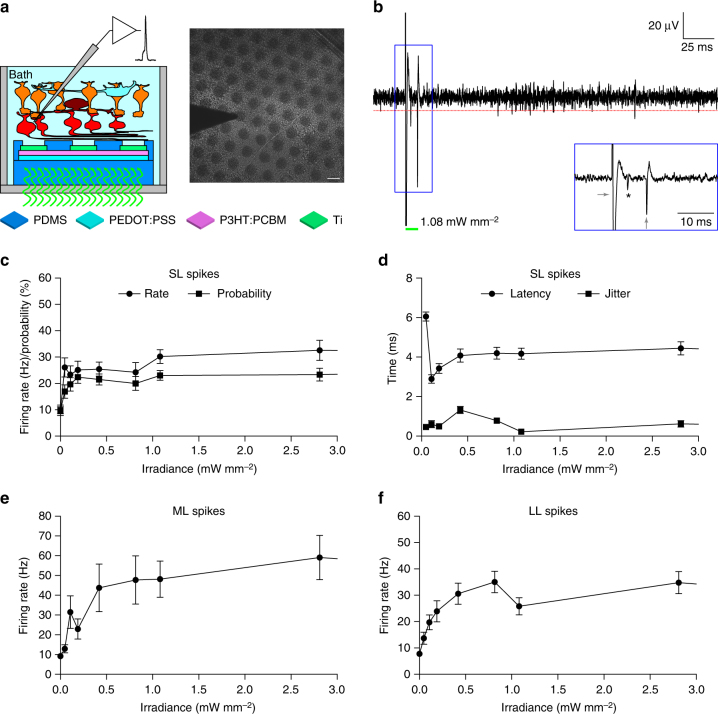
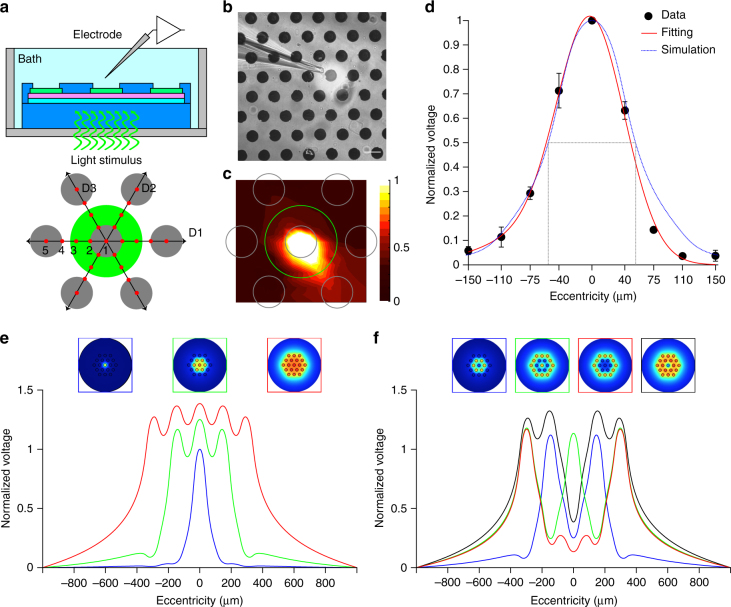
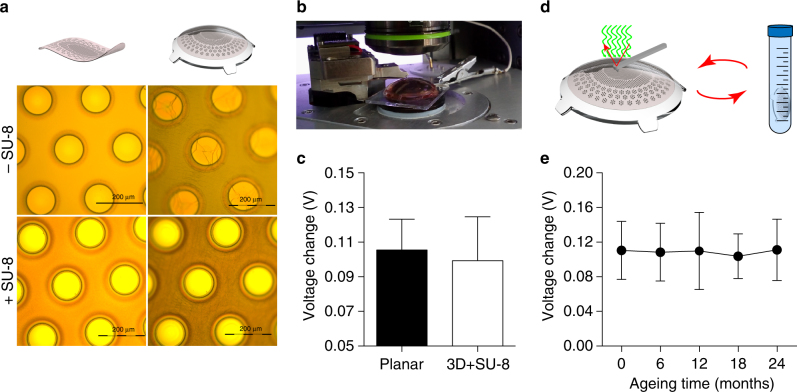
Verification
Claims the paper makes
The claims and statistics of this paper haven’t been checked yet.
Run the check — free, no account needed. It reads the open-access text and checks the sources it cites.
Claims other papers make about this one
Each is checked against this paper’s own text: does it say what the citing paper says it does?
The cited source says what the claim attributes to it.
In the citing paper
“Achieving this ambitious goal will certainly require the engineering of next-generation visual prostheses with large electrode counts (Ferlauto et al., 2018; Shah and Chichilnisky, 2020; Chen et al., 2020) and the development of sophisticated AI systems.”
From Towards a Smart Bionic Eye : AI-powered artificial vision for the treatment of incurable blindness (2022) · cites this paper as Ferlauto et al., 2018
In the citing paper
“POLYRETINA is a high-density wide-field epiretinal prosthesis containing 10 498 photovoltaic pixels distributed over an active area of approximately 43 • [38,39,131,132].”
From Advances in visual prostheses: engineering and biological challenges (2022) · cites this paper as [38]
In the citing paper
“To overcome this issue, POLYRETINA is a foldable and injectable photovoltaic epiretinal prosthesis that can be safely delivered with a 6 mm size cut through the sclera and conform better to the curvature of the eye [39,38].”
From Advances in visual prostheses: engineering and biological challenges (2022) · cites this paper as [38]
In the citing paper
“In particular, new developments in organic bioelectronics and photovoltaics showed superior features in conformability, flexibility and stretchability [38,39] compared to silicon-based technology.”
From Advances in visual prostheses: engineering and biological challenges (2022) · cites this paper as [38]
In the citing paper
“The fabricated polydimethylsiloxane (PDMS)-interface and of the dome-shaped PDMS enable to match with the curvature of the eye [Fig.1(e)].”
From From flexible electronics technology in the era of IoT and artificial intelligence toward future implanted body sensor networks (2019) · cites this paper as [33]
In the citing paper
“For instance, a foldable and photovoltaic wide-field epiretinal prosthesis is developed, capable of stimulating wireless retinal ganglion cells.33”
From From flexible electronics technology in the era of IoT and artificial intelligence toward future implanted body sensor networks (2019) · cites this paper as [33]
Self-check
Percentages, sums and reported differences re-computed from the paper’s own numbers.
The self-check needs the paper’s full text.
Citations
Cites
Neural Stimulation and Recording Electrodes
Cogan, S. F. (2008) · Annual Review of Biomedical Engineering · doi:10.1146/annurev.bioeng.10.061807.160518 · Cited by 2,243
Unsupervised spike detection and sorting with wavelets and superparamagnetic clustering
Quiroga, R. Q., Nadasdy, Z., & Ben-Shaul, Y. (2004) · Neural Computation · doi:10.1162/089976604774201631 · Cited by 2,119
Electrical stimulation of excitable tissue: design of efficacious and safe protocols
Merrill, D. R., Bikson, M., & Jefferys, J. G. R. (2005) · Journal of Neuroscience Methods · doi:10.1016/j.jneumeth.2004.10.020 · Cited by 2,078
Causes of vision loss worldwide, 1990–2010: a systematic analysis
Bourne, R., Stevens, G. A., White, R. A., Smith, J. L., Flaxman, S. R., Price, H., Jonas, J. B., Keeffe, J. E., Leasher, J. L., Naidoo, K. S., et al. (2013) · The Lancet Global Health · doi:10.1016/s2214-109x(13)70113-x · Cited by 1,882
Electronic dura mater for long-term multimodal neural interfaces
Minev, I. R., Musienko, P., Hirsch, A., Barraud, Q., Wenger, N., Moraud, E. M., Gandar, J., Capogrosso, M., Milekovic, T., Asboth, L., et al. (2015) · Science · doi:10.1126/science.1260318 · Cited by 1,082
Retinal degeneration mutants in the mouse
Chang, B., Hawes, N. L., Hurd, R. E., Davisson, M. T., Nusinowitz, S., & Heckenlively, J. R. (2002) · Vision Research · doi:10.1016/s0042-6989(01)00146-8 · Cited by 840
Subretinal electronic chips allow blind patients to read letters and combine them to words
Zrenner, E., Bartz-Schmidt, K. U., Benav, H., Besch, D., Bruckmann, A., Gabel, V.-P., Gekeler, F., Greppmaier, U., Harscher, A., Kibbel, S., et al. (2011) · Proceedings of the Royal Society B: Biological Sciences · doi:10.1098/rspb.2010.1747 · Cited by 819
Maximum permissible exposures for ocular safety (ANSI 2000), with emphasis on ophthalmic devices
Delori, F. C., Webb, R. H., & Sliney, D. H. (2007) · Journal of the Optical Society of America A · doi:10.1364/josaa.24.001250 · Cited by 484
Photovoltaic retinal prosthesis with high pixel density
Mathieson, K., Loudin, J., Goetz, G. A., Huie, P., Wang, L., Kamins, T. I., Galambos, L., Smith, R., Harris, J. S., Sher, A., et al. (2012) · Nature Photonics · doi:10.1038/nphoton.2012.104 · Cited by 460
Chang, B., Hawes, N. L., Pardue, M. T., German, A. M., Hurd, R. E., Davisson, M. T., Nusinowitz, S., Rengarajan, K., Boyd, A. P., Sidney, S. S., et al. (2007) · Vision Research · doi:10.1016/j.visres.2006.11.020 · Cited by 395
Cited by
Sorted by citations
Organic Bioelectronics: From Functional Materials to Next‐Generation Devices and Power Sources
Ohayon, D., & Inal, S. (2020) · Advanced Materials · doi:10.1002/adma.202001439 · Cited by 178
Lee, S., Shi, Q., & Lee, C. (2019) · APL Materials · doi:10.1063/1.5063498 · Cited by 164
Recent Progress in Wireless Sensors for Wearable Electronics
Park, Y., Lee, S.-I., & Park, J. (2019) · Sensors · doi:10.3390/s19204353 · Cited by 164
Ejneby, M. S., Jakešová, M., Ferrero, J. J., Migliaccio, L., Sahalianov, I. Y., Zhao, Z., Magnus Berggren, A., Khodagholy, D., Đerek, V., Gelinas, J. N., et al. (2021) · Nature Biomedical Engineering · doi:10.1038/s41551-021-00817-7 · Cited by 156
Wang, J., He, T., & Lee, C. (2019) · Nano Energy · doi:10.1016/j.nanoen.2019.104039 · Cited by 129
Metadata
- Authors
- Ferlauto, L., Airaghi Leccardi, M. J. I., Chenais, N. A. L., Gilliéron, S. C. A., Vagni, P., Bevilacqua, M., Wolfensberger, T. J., Sivula, K., & Ghezzi, D.
- Affiliations
- École Polytechnique Fédérale de Lausanne (CH)
- Hôpital Ophtalmique Jules-Gonin (CH)
- Corresponding author
- Ghezzi, Diego
- ORCID
- Venue
- Nature Communications
- Published
- 2018-03-08
- Volume
- 9
- Issue
- 1
- Pages
- 992-992
- ISSN
- 2041-1723 (ISSN-L)
- PMC
- PMC5843635
- OpenAlex
- W2791025612
- Cited by
- 183
- References
- 48
- Citations by year
- 2026: 13 · 2025: 22 · 2024: 24 · 2023: 25 · 2022: 26 · 2021: 25 · 2020: 24 · 2019: 20 · 2018: 3
- FWCI
- 8.20
- Type
- journal article
- Language
- en
- Open access
- gold
- doi.org
- Locations
- Nature Communications (publishedVersion, cc-by)
- Europe PMC (PubMed Central) (publishedVersion, other-oa)
- PubMed Central (publishedVersion, cc-by)
- PubMed (publishedVersion)
- SERVAL (Université de Lausanne) (publishedVersion, cc-by)
- IRIS (submittedVersion, cc-by)
- RePEc: Research Papers in Economics (submittedVersion)
- DOAJ (DOAJ: Directory of Open Access Journals) (submittedVersion)
- DOAJ (DOAJ: Directory of Open Access Journals) (submittedVersion, cc-by-sa)
- Infoscience (Ecole Polytechnique Fédérale de Lausanne) (submittedVersion)
- Infoscience (Ecole Polytechnique Fédérale de Lausanne) (submittedVersion, cc-by-nc-nd)
- Funders
- Velux Stiftung
- European Commission (701632)
- École Polytechnique Fédérale de Lausanne
- Fondation Pierre Mercier
- Fondation Pierre Mercier pour la Science
- Topics
- Life Sciences › Neuroscience › Cellular and Molecular Neuroscience › Neuroscience and Neural Engineering
- Health Sciences › Medicine › Ophthalmology › Retinal Development and Disorders
- Physical Sciences › Engineering › Electrical and Electronic Engineering › CCD and CMOS Imaging Sensors
- Keywords
- epiretinal prosthesis, blindness, accelerated aging, visual field restoration, visual acuity
- MeSH terms
- Humans, Prosthesis Design, Retina, Visual Acuity, Prosthesis Implantation, Visual Prosthesis
About these checks
Registry, retraction, Cites and statistics results are computed, not judged, with one exception: a printed reference that no index lists is read once by a model before it counts as a citation error. Claims are extracted by a model and kept only when their quote appears verbatim in the text; each cited source is then checked, with a model’s help, for whether it says what the claim relies on. Those verdicts can be wrong — read the claim’s quote and the cited source before relying on one.
Statistics and arithmetic are recomputed, not judged.
Confidence bands are shown only for fields calibrated on our annotated test set. None is calibrated yet, so no band is shown.
What counts as a claim ›How we measure confidence ›How we check this ›
Are you an author, or do you see a problem with this page? Request a review
