

Mimicking the surface and prebiotic chemistry of early Earth using flow chemistry
Open accessThe DOI matches its Crossref record; 50 of the 50 references it cites were found in a registry or an index.
Abstract
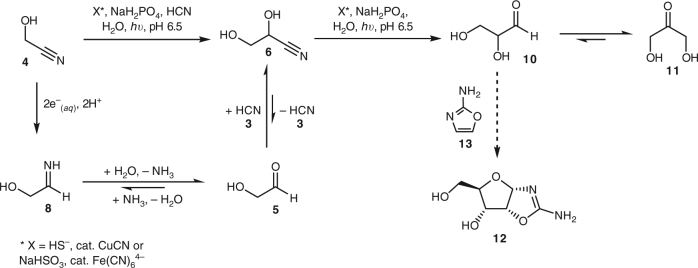
When considering life’s aetiology, the first questions that must be addressed are “how?” and “where?” were ostensibly complex molecules, considered necessary for life’s beginning, constructed from simpler, more abundant feedstock molecules on primitive Earth. Previously, we have used multiple clues from the prebiotic synthetic requirements of (proto)biomolecules to pinpoint a set of closely related geochemical scenarios that are suggestive of flow and semi-batch chemistries. We now wish to report a multistep, uninterrupted synthesis of a key heterocycle (2-aminooxazole) en route to activated nucleotides starting from highly plausible, prebiotic feedstock molecules under conditions which mimic this scenario. Further consideration of the scenario has uncovered additional pertinent and novel aspects of prebiotic chemistry, which greatly enhance the efficiency and plausibility of the synthesis.
Overview
The claims and statistics of this paper haven’t been checked yet.
Free: it reads the open-access text and checks the first 5 claims that cite a source we can check. Create a free account to check every claim.
Integrity signals
Registry
Cites
Statistics
Figures

Verification
Claims the paper makes
The claims and statistics of this paper haven’t been checked yet.
Free: it reads the open-access text and checks the first 5 claims that cite a source we can check. Create a free account to check every claim.
Claims other papers make about this one
Each is checked against this paper’s own text: does it say what the citing paper says it does?
The source backs part of the claim, not all of it — or backs it for a different population, condition or comparison.
In the citing paper
“At this point in the reaction mixture, the excess sulfite favours the reversible formation of bisulfite adducts.”
From Prebiotic Reaction Networks in Water (2020) · cites this paper as [116]
Experimental — accuracy not yet measuredThe cited source says what the claim attributes to it.
In the citing paper
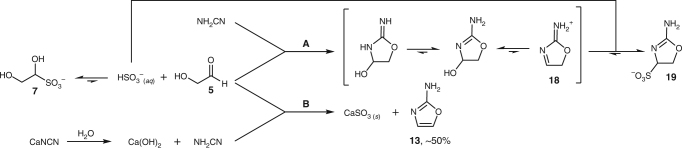
“The resulting single combined stream is made to concentrate by dry-down and then passed into a vessel containing solid calcium cyanamide (CaNCN). The calcium precipitates as CaSO3, freeing up glycolaldehyde, allowing it to react with cyanamide, which itself is produced upon addition of water, yielding 2-aminooxazole 27.”
From Prebiotic Reaction Networks in Water (2020) · cites this paper as [116]
The cited source says what the claim attributes to it.
In the citing paper
“This scenario relies on two main monomers, formaldehyde and HCN, to produce glyconitrile, plus the action of schreibersite ((Fe, Ni) 3P), hydrosulfide (HS−) as reducing agent, copper and ultraviolet light, to promote the homologation to higher cyanohydrins”
From The protometabolic nature of prebiotic chemistry (2023) · cites this paper as [99]
In the citing paper
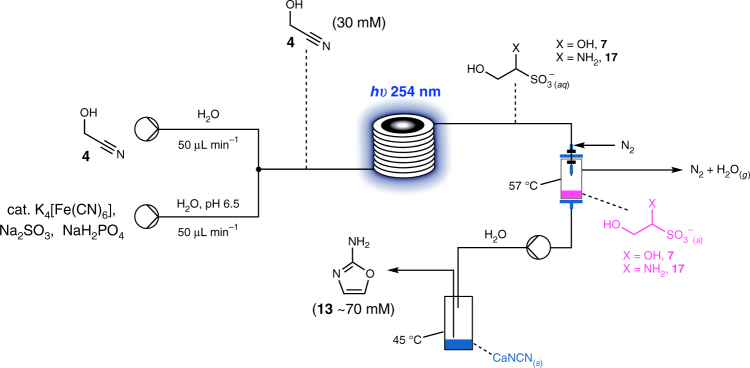
“In one variation demonstrated, the flow-chemistry reaction network begins with two separate aqueous streams of (i) glycolonitrile and (ii) catalytic potassium ferrocyanide, sodium sulfite and inorganic phosphate at pH 6.5.”
From Prebiotic Reaction Networks in Water (2020) · cites this paper as [116]
In the citing paper
“In 2018, Ritson, Sutherland and co-workers [116] used flow chemistry to help model this geochemical scenario whereby streams of different chemical composition combine and collect.”
From Prebiotic Reaction Networks in Water (2020) · cites this paper as [116]
Self-check
Percentages, sums and reported differences re-computed from the paper’s own numbers.
The self-check needs the paper’s full text.
Citations
Cites
Common origins of RNA, protein and lipid precursors in a cyanosulfidic protometabolism
Patel, B. H., Percivalle, C., Ritson, D. J., Duffy, C. D., & Sutherland, J. D. (2015) · Nature Chemistry · doi:10.1038/nchem.2202 · Cited by 949
Self-citationThe emergence of life from iron monosulphide bubbles at a submarine hydrothermal redox and pH front
RUSSELL, M. J., & HALL, A. J. (1997) · Journal of the Geological Society · doi:10.1144/gsjgs.154.3.0377 · Cited by 822
On the origin of biochemistry at an alkaline hydrothermal vent
Martin, W., & Russell, M. J. (2007) · Philosophical Transactions of the Royal Society B: Biological Sciences · doi:10.1098/rstb.2006.1881 · Cited by 771
Activated Acetic Acid by Carbon Fixation on (Fe,Ni)S Under Primordial Conditions
Huber, C., & Wächtershäuser, G. (1997) · Science · doi:10.1126/science.276.5310.245 · Cited by 714
Baross, J. A., & Hoffman, S. E. (1985) · Origins of life and evolution of the biosphere · doi:10.1007/bf01808177 · Cited by 621
The oxidation state of Hadean magmas and implications for early Earth’s atmosphere
Trail, D., Watson, E. B., & Tailby, N. D. (2011) · Nature · doi:10.1038/nature10655 · Cited by 613
The rocky roots of the acetyl-CoA pathway
Russell, M. J., & Martin, W. (2004) · Trends in Biochemical Sciences · doi:10.1016/j.tibs.2004.05.007 · Cited by 432
Mowry, D. T. (1948) · Chemical Reviews · doi:10.1021/cr60132a001 · Cited by 404
The Origin of Life—Out of the Blue
Sutherland, J. D. (2016) · Angewandte Chemie International Edition · doi:10.1002/anie.201506585 · Cited by 401
Self-citationSubmarine hot springs and the origin of life
Miller, S. L., & Bada, J. L. (1988) · Nature · doi:10.1038/334609a0 · Cited by 338
Origin of life-facing up to the physical setting
Pace, N. R. (1991) · Cell · doi:10.1016/0092-8674(91)90082-a · Cited by 325
The Drive to Life on Wet and Icy Worlds
Russell, M. J., Barge, L. M., Bhartia, R., Bocanegra, D., Bracher, P. J., Branscomb, E., Kidd, R., McGlynn, S., Meier, D. H., Nitschke, W., et al. (2014) · Astrobiology · doi:10.1089/ast.2013.1110 · Cited by 288
Asphalt, Water, and the Prebiotic Synthesis of Ribose, Ribonucleosides, and RNA
Benner, S. A., Kim, H.-J., & Carrigan, M. A. (2012) · Accounts of Chemical Research · doi:10.1021/ar200332w · Cited by 281
Prebiotic Ribose Synthesis: A Critical Analysis
Shapiro, R. (1988) · Origins of life and evolution of the biosphere · doi:10.1007/bf01808782 · Cited by 276
Organic synthesis during fluid mixing in hydrothermal systems
Shock, E. L., & Schulte, M. D. (1998) · Journal of Geophysical Research: Planets · doi:10.1029/98je02142 · Cited by 269
Synthesis of Carbohydrates in Mineral-Guided Prebiotic Cycles
Kim, H.-J., Ricardo, A., Illangkoon, H. I., Kim, M. J., Carrigan, M. A., Frye, F., & Benner, S. A. (2011) · Journal of the American Chemical Society · doi:10.1021/ja201769f · Cited by 268
Bildung einer zuckerartigen Substanz durch Synthese
Butlerow, A. (1861) · Justus Liebigs Annalen der Chemie · doi:10.1002/jlac.18611200308 · Cited by 266
A hydrothermally precipitated catalytic Iron Sulphide membrane as a first step toward life
Russell, M. J., Daniel, R. M., Hall, A. J., & Sherringham, J. A. (1994) · Journal of Molecular Evolution · doi:10.1007/bf00160147 · Cited by 257
Pasek, M. A., & Lauretta, D. S. (2005) · Astrobiology · doi:10.1089/ast.2005.5.515 · Cited by 251
Tracking Genomic Cancer Evolution for Precision Medicine: The Lung TRACERx Study
Jamal-Hanjani, M., Hackshaw, A., Ngai, Y., Shaw, J., Dive, C., Quezada, S., Middleton, G., de Bruin, E., Le Quesne, J., Shafi, S., et al. (2014) · PLoS Biology · doi:10.1371/journal.pbio.1001906 · Cited by 247
Chemistry of potentially prebiological natural products
Eschenmoser, A., & Loewenthal, E. (1992) · Chemical Society Reviews · doi:10.1039/cs9922100001 · Cited by 244
The prebiotic geochemistry of formaldehyde
Cleaves II, H. J. (2008) · Precambrian Research · doi:10.1016/j.precamres.2008.04.002 · Cited by 179
The inevitable journey to being
Russell, M. J., Nitschke, W., & Branscomb, E. (2013) · Philosophical Transactions of the Royal Society B: Biological Sciences · doi:10.1098/rstb.2012.0254 · Cited by 174
Submarine hot springs and the origin of life
RUSSELL, M. J., HALL, A. J., CAIRNS-SMITH, A. G., & BRATERMAN, P. S. (1988) · Nature · doi:10.1038/336117a0 · Cited by 161
Influence of the UV Environment on the Synthesis of Prebiotic Molecules
Ranjan, S., & Sasselov, D. D. (2016) · Astrobiology · doi:10.1089/ast.2015.1359 · Cited by 159
Paleomineralogy of the Hadean Eon: A preliminary species list
Hazen, R. M. (2013) · American Journal of Science · doi:10.2475/09.2013.01 · Cited by 158
A Bioenergetic Basis for Membrane Divergence in Archaea and Bacteria
Sojo, V., Pomiankowski, A., & Lane, N. (2014) · PLoS Biology · doi:10.1371/journal.pbio.1001926 · Cited by 154
Schlesinger, G., & Miller, S. L. (1983) · Journal of Molecular Evolution · doi:10.1007/bf02101643 · Cited by 147
Prebiotic chemistry: a new modus operandi
Powner, M. W., & Sutherland, J. D. (2011) · Philosophical Transactions of the Royal Society B: Biological Sciences · doi:10.1098/rstb.2011.0134 · Cited by 144
Self-citationBeating the acetyl coenzyme A-pathway to the origin of life
Nitschke, W., & Russell, M. J. (2013) · Philosophical Transactions of the Royal Society B: Biological Sciences · doi:10.1098/rstb.2012.0258 · Cited by 143
In vitro growth of iron sulphide chimneys: possible culture chambers for origin‐of‐life experiments
Russell, M. J., Hall, A. J., & Turner, D. (1989) · Terra Nova · doi:10.1111/j.1365-3121.1989.tb00364.x · Cited by 138
Xu, J., Tsanakopoulou, M., Magnani, C. J., Szabla, R., Šponer, J. E., Šponer, J., Góra, R. W., & Sutherland, J. D. (2017) · Nature Chemistry · doi:10.1038/nchem.2664 · Cited by 133
Self-citationPhotochemical Reductive Homologation of Hydrogen Cyanide Using Sulfite and Ferrocyanide
Xu, J., Ritson, D. J., Ranjan, S., Todd, Z. R., Sasselov, D. D., & Sutherland, J. D. (2018) · Chemical Communications · doi:10.1039/c8cc01499j · Cited by 121
Self-citationSynthesis of aldehydic ribonucleotide and amino acid precursors by photoredox chemistry
Ritson, D. J., & Sutherland, J. D. (2013) · Angewandte Chemie International Edition · doi:10.1002/anie.201300321 · Cited by 104
Self-citationBryant, D. E., & Kee, T. P. (2006) · Chemical Communications · doi:10.1039/b602651f · Cited by 102
High Energy Radical Chemistry Formation of HCN-rich Atmospheres on early Earth
Ferus, M., Kubelík, P., Knížek, A., Pastorek, A., Sutherland, J., & Civiš, S. (2017) · Scientific Reports · doi:10.1038/s41598-017-06489-1 · Cited by 98
Self-citationDETECTING PLANETARY GEOCHEMICAL CYCLES ON EXOPLANETS: ATMOSPHERIC SIGNATURES AND THE CASE OF SO2
Kaltenegger, L., & Sasselov, D. (2010) · The Astrophysical Journal · doi:10.1088/0004-637x/708/2/1162 · Cited by 97
Chapter 1 Why are hydrothermal systems proposed as plausible environments for the origin of life?
Holm, N. G. (1992) · Origins of Life and Evolution of Biospheres · doi:10.1007/bf01808015 · Cited by 94
Primordial Organic Chemistry. I. Compounds Resulting from Electron Irradiation of C14H4
Palm, C., & Calvin, M. (1962) · Journal of the American Chemical Society · doi:10.1021/ja00870a024 · Cited by 83
A prototype device for evaporation in batch and flow chemical processes
Deadman, B. J., Battilocchio, C., Śliwiński, É., & Ley, S. V. (2013) · Green Chemistry · doi:10.1039/c3gc40967h · Cited by 77
Self-citationWhy are Hydrothermal Systems Proposed as Plausible Environments for the Origin of Life?
Holm, N. G. (1992) · Springer eBooks · doi:10.1007/978-94-011-2741-7_1 · Cited by 67
Phosphorylation of Nucleotide Molecules in Hydrothermal Environments
Ozawa, K., Nemoto, A., Imai, E., Honda, H., Hatori, K., & Matsuno, K. (2004) · Origins of Life and Evolution of Biospheres · doi:10.1023/b:orig.0000043121.65714.05 · Cited by 59
Todd, Z. R., Fahrenbach, A. C., Magnani, C. J., Ranjan, S., Björkbom, A., Szostak, J. W., & Sasselov, D. D. (2018) · Chemical Communications · doi:10.1039/c7cc07748c · Cited by 29
The Future of Prebiotic Chemistry
Wagner, A. J., & Blackmond, D. G. (2016) · ACS Central Science · doi:10.1021/acscentsci.6b00336 · Cited by 26
On the Stabilization of Ribose by Silicate Minerals
Vázquez-Mayagoitia, Á., Horton, S. R., Sumpter, B. G., Šponer, J., Šponer, J. E., & Fuentes-Cabrera, M. (2011) · Astrobiology · doi:10.1089/ast.2010.0508 · Cited by 25
Sulfite–sulfide–sulfate–carbonate equilibria with applications to Mars
Marion, G. M., Kargel, J. S., Crowley, J. K., & Catling, D. C. (2013) · Icarus · doi:10.1016/j.icarus.2013.02.035 · Cited by 23
Specific Purine-Purine Base Pairing in Linear Alanyl-Peptide Nucleic Acids
Hoffmann, M. F. H., Brückner, A. M., Hupp, T., Engels, B., & Diederichsen, U. (2000) · Helvetica Chimica Acta · doi:10.1002/1522-2675(20000906)83:9<2398::aid-hlca2398>3.0.co;2-5 · Cited by 23
Primordial soup that cooks itself
Bracher, P. J. (2015) · Nature Chemistry · doi:10.1038/nchem.2219 · Cited by 19
Über die Einwirkung von Cyankalium auf Formaldehyd
Polstorff, K., & Meyer, H. (1912) · Berichte der deutschen chemischen Gesellschaft · doi:10.1002/cber.19120450263 · Cited by 15
Chance or necessity? Bioenergetics and the probability of life.
Lane, N. C. K. (2010) · Journal of Cosmology · Cited by 8
Research works printed but not linked: 1
- Pincass H Die bildung von calciumcyanamid aus ferrocyancalcium Chem. Ztg. 1922 46 661
Cited by
Nonenzymatic Metabolic Reactions and Life’s Origins
Muchowska, K. B., Varma, S. J., & Moran, J. (2020) · Chemical Reviews · doi:10.1021/acs.chemrev.0c00191 · Cited by 317
“21 Some have argued that highly unlikely sequences of events should not be ruled out because life itself might be a rare occurrence, 22 but ignoring constraints on probabilities makes it impossible to rationally discriminate between competing hypotheses.”
Chemistry of Abiotic Nucleotide Synthesis
Yadav, M., Kumar, R., & Krishnamurthy, R. (2020) · Chemical Reviews · doi:10.1021/acs.chemrev.9b00546 · Cited by 225
The origin of life as a planetary phenomenon
Sasselov, D. D., Grotzinger, J. P., & Sutherland, J. D. (2020) · Science Advances · doi:10.1126/sciadv.aax3419 · Cited by 210
Self-citationA carbonate-rich lake solution to the phosphate problem of the origin of life
Toner, J. D., & Catling, D. C. (2020) · Proceedings of the National Academy of Sciences · doi:10.1073/pnas.1916109117 · Cited by 201
“Recent attempts at “ one-pot ” syntheses have proposed closed-basin lakes as sites for the formation of amino acids, nucleotides, and lipid precursors in reaction networks involving ultraviolet light, phosphate, sulfur, and cyanide (53, 60).”
When Did Life Likely Emerge on Earth in an RNA‐First Process?
Benner, S. A., Bell, E. A., Biondi, E., Brasser, R., Carell, T., Kim, H., Mojzsis, S. J., Omran, A., Pasek, M. A., & Trail, D. (2020) · ChemSystemsChem · doi:10.1002/syst.201900035 · Cited by 162
“Adapted from Xu et al. (2018)[22] and Ritson et al. (2018).”
Method
Metadata
- Authors
- Ritson, D. J., Battilocchio, C., Ley, S. V., & Sutherland, J. D.
- Affiliations
- MRC Laboratory of Molecular Biology (GB)
- University of Cambridge (GB)
- Corresponding author
- Ritson, Dougal J.
- Sutherland, John D.
- Venue
- Nature Communications
- Published
- 2018-05-08
- Volume
- 9
- Issue
- 1
- Pages
- 1821-1821
- ISSN
- 2041-1723 (ISSN-L)
- PMC
- PMC5940729
- OpenAlex
- W2801200686
- Cited by
- 89
- References
- 50
- Citations by year
- 2026: 5 · 2025: 6 · 2024: 7 · 2023: 6 · 2022: 18 · 2021: 11 · 2020: 14 · 2019: 15 · 2018: 7
- FWCI
- 6.16
- Type
- journal article
- Language
- en
- Open access
- gold
- doi.org
- Licence
- cc-by
- creativecommons.org/licenses/by/4.0 (tdm)
- creativecommons.org/licenses/by/4.0 (vor)
- Locations
- Nature Communications (publishedVersion, cc-by)
- Europe PMC (PubMed Central) (publishedVersion, cc-by)
- PubMed Central (publishedVersion, cc-by)
- PubMed (publishedVersion)
- RePEc: Research Papers in Economics (submittedVersion)
- DOAJ (DOAJ: Directory of Open Access Journals) (submittedVersion)
- DOAJ (DOAJ: Directory of Open Access Journals) (submittedVersion, cc-by-sa)
- Apollo (University of Cambridge) (submittedVersion, cc-by)
- Apollo (cc-by)
- Funders
- Simons Foundation (290360)
- Medical Research Council (MC UP A024 1009)
- Engineering and Physical Sciences Research Council (EP/M004120/1, EP/K009494/1, EP/K039520/1, EP/K00949/1)
- Topics
- Physical Sciences › Physics and Astronomy › Astronomy and Astrophysics › Origins and Evolution of Life
- Physical Sciences › Physics and Astronomy › Astronomy and Astrophysics › Space Science and Extraterrestrial Life
- Life Sciences › Biochemistry, Genetics and Molecular Biology › Molecular Biology › RNA and protein synthesis mechanisms
- Keywords
- prebiotic chemistry, origin of life, 2-aminooxazole, heterocyclic synthesis, flow chemistry, early Earth, nucleotide precursors
- MeSH terms
- Origin of Life, Aldehydes, Oxazoles, Surface Properties, Earth, Planet, Molecular Mimicry, Physical Phenomena, Photochemical Processes
About these checks
Registry, retraction, Cites and statistics results are computed, not judged, with one exception: a printed reference that no index lists is read once by a model before it counts as a citation error. Claims are extracted by a model and kept only when their quote appears verbatim in the text; each cited source is then checked, with a model’s help, for whether it says what the claim relies on. Those verdicts can be wrong — read the claim’s quote and the cited source before relying on one.
Statistics and arithmetic are recomputed, not judged.
Confidence bands are shown only for fields calibrated on our annotated test set. None is calibrated yet, so no band is shown.
What counts as a claim ›How we measure confidence ›How we check this ›
Are you an author, or do you see a problem with this page? Request a review
Data sources
Bibliographic data: Semantic Scholar, OpenAlex, Crossref.
Contains information from the Semantic Scholar Academic Graph Datasets, made available under the ODC Attribution License (ODC-BY 1.0).
Semantic Scholar’s data is described in: Kinney, R., et al. (2023). The Semantic Scholar Open Data Platform. arXiv:2301.10140.
