

Scalable training of artificial neural networks with adaptive sparse connectivity inspired by network science
Open accessThe DOI matches its Crossref record; 53 of the 53 references it cites were found in a registry or an index.
Abstract
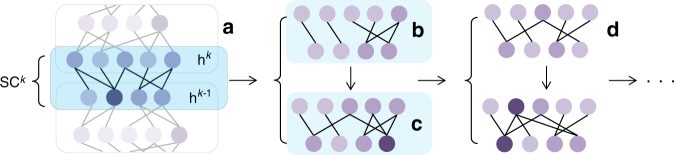
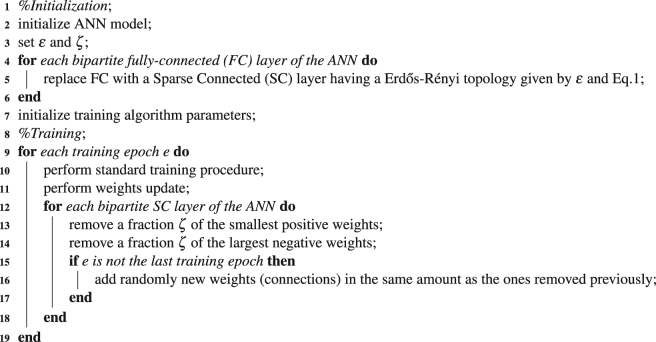
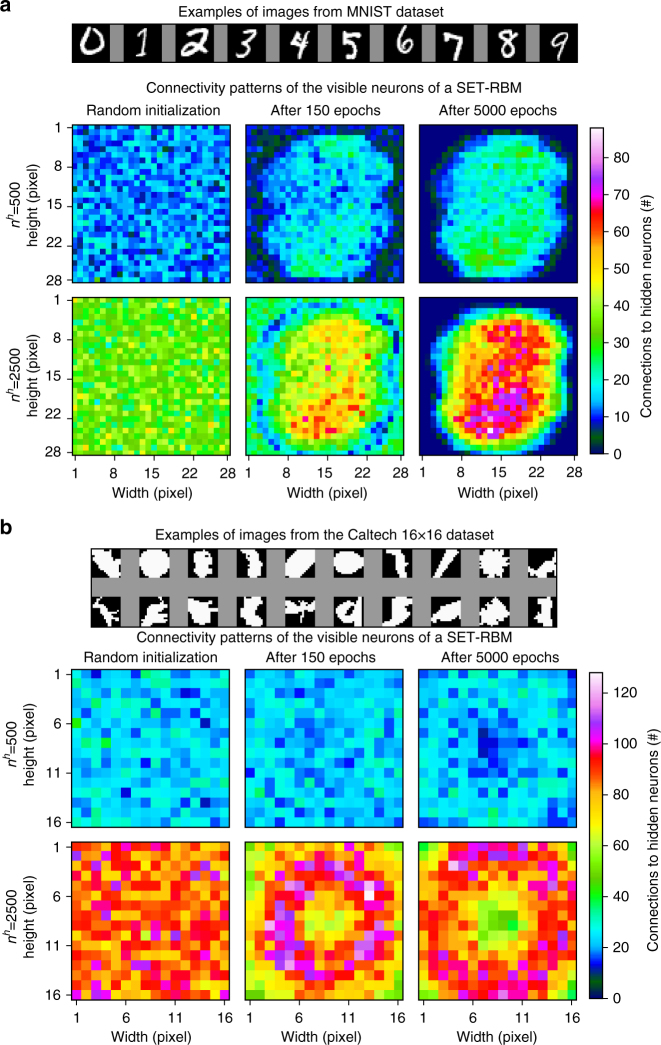
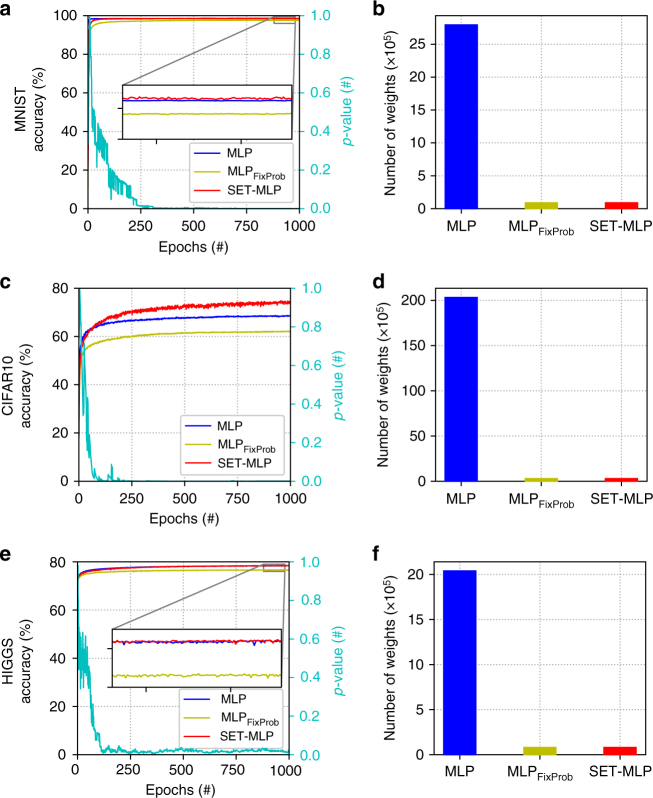
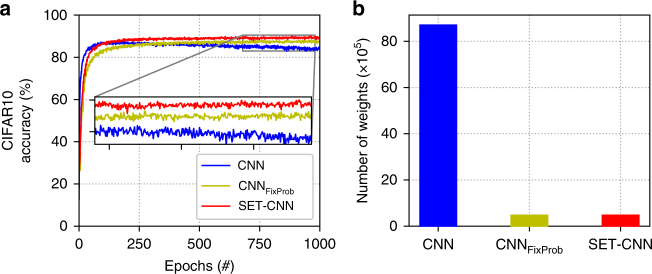
Through the success of deep learning in various domains, artificial neural networks are currently among the most used artificial intelligence methods. Taking inspiration from the network properties of biological neural networks (e.g. sparsity, scale-freeness), we argue that (contrary to general practice) artificial neural networks, too, should not have fully-connected layers. Here we propose sparse evolutionary training of artificial neural networks, an algorithm which evolves an initial sparse topology (Erdős–Rényi random graph) of two consecutive layers of neurons into a scale-free topology, during learning. Our method replaces artificial neural networks fully-connected layers with sparse ones before training, reducing quadratically the number of parameters, with no decrease in accuracy. We demonstrate our claims on restricted Boltzmann machines, multi-layer perceptrons, and convolutional neural networks for unsupervised and supervised learning on 15 datasets. Our approach has the potential to enable artificial neural networks to scale up beyond what is currently possible.
Overview
The claims and statistics of this paper haven’t been checked yet.
Free: it reads the open-access text and checks the first 5 claims that cite a source we can check. Create a free account to check every claim.
Integrity signals
Registry
Cites
Statistics
Figures
Verification
Claims the paper makes
The claims and statistics of this paper haven’t been checked yet.
Free: it reads the open-access text and checks the first 5 claims that cite a source we can check. Create a free account to check every claim.
Claims other papers make about this one
Each is checked against this paper’s own text: does it say what the citing paper says it does?
The cited source says what the claim attributes to it.
In the citing paper
“The idea of selective reinitialization is similar to the emerging idea of dynamic sparse training110–112.”
From Loss of plasticity in deep continual learning (2024) · cites this paper as [110]
Self-check
Percentages, sums and reported differences re-computed from the paper’s own numbers.
The self-check needs the paper’s full text.
Citations
Cites
LeCun, Y., Bengio, Y., & Hinton, G. (2015) · Nature · doi:10.1038/nature14539 · Cited by 84,126
Gradient-based learning applied to document recognition
Lecun, Y., Bottou, L., Bengio, Y., & Haffner, P. (1998) · Proceedings of the IEEE · doi:10.1109/5.726791 · Cited by 58,805
Collective dynamics of ‘small-world’ networks
Watts, D. J., & Strogatz, S. H. (1998) · Nature · doi:10.1038/30918 · Cited by 43,060
Emergence of Scaling in Random Networks
Barabási, A.-L., & Albert, R. (1999) · Science · doi:10.1126/science.286.5439.509 · Cited by 36,135 · cited 1×
“6 and include scale-freeness 7 (detailed in Methods section) and small-worldness 8 .”
Learning representations by back-propagating errors
Rumelhart, D. E., Hinton, G. E., & Williams, R. J. (1986) · Nature · doi:10.1038/323533a0 · Cited by 31,892
Human-level control through deep reinforcement learning
Mnih, V., Kavukcuoglu, K., Silver, D., Rusu, A. A., Veness, J., Bellemare, M. G., Graves, A., Riedmiller, M., Fidjeland, A. K., Ostrovski, G., et al. (2015) · Nature · doi:10.1038/nature14236 · Cited by 30,357
The Elements of Statistical Learning
Hastie, T., Friedman, J., & Tibshirani, R. (2001) · Springer Series in Statistics · doi:10.1007/978-0-387-21606-5 · Cited by 24,162
Reducing the dimensionality of data with neural networks
Hinton, G. E., & Salakhutdinov, R. R. (2006) · Science · doi:10.1126/science.1127647 · Cited by 20,928
Statistical mechanics of complex networks
Albert, R., & Barabási, A.-L. (2002) · Reviews of Modern Physics · doi:10.1103/revmodphys.74.47 · Cited by 20,471
A fast learning algorithm for deep belief nets
Hinton, G. E., Osindero, S., & Teh, Y.-W. (2006) · Neural Computation · doi:10.1162/neco.2006.18.7.1527 · Cited by 16,336 · cited 2×
“…being very successful in providing very good initialization weights to the supervised training of deep arti fi cial neural network architectures 42 , are also very successful as stand alone models in a variety of tasks, such as density estimation to model human choice 31 , collaborative fi…”
Influential
Research works printed but not linked: 18
- Mocanu, D. C. On the synergy of network science and artificial intelligence. In Proc. 25th International Joint Conference on Artificial Intelligence(ed. Kambhampati, S.) 4020–4021 (AAAI Press, New York, 2016).
- Dieleman, S. & Schrauwen, B. Accelerating sparse restricted boltzmann machine training using non-gaussianity measures. In Proc. Deep Learning and Unsupervised Feature Learning, Vol. 9 (eds Bengio Y., Bergstra J. & Le Q.) http://hdl.handle.net/1854/LU-3118568 (Lake Tahoe, 2012).
- Yosinski, J. & Lipson, H. Visually debugging restricted boltzmann machine training with a 3d example. In Representation Learning Workshop, 29th International Conference on Machine Learning (Edinburgh, 2012).
- Whiteson S Stone P Evolutionary function approximation for reinforcement learning J. Mach. Learn. Res. 2006 7 877 917
- Weigend, A. S., Rumelhart, D. E. & Huberman, B. A. Generalization by weight-elimination with application to forecasting. In Proc. Advances in Neural Information Processing Systems, Vol. 3, 875–882 (Morgan-Kaufmann, Colorado, 1991).
- Smolensky, P. Information processing in dynamical systems: foundations of harmony theory. In Parallel Distributed Processing: Explorations in the Microstructure of Cognition (eds Rumelhart, D. E., McClelland, J. L. & CORPORATE PDP Research Group) 194–281 (MIT Press, Cambridge, 1986).
- Osogami T Otsuka M Restricted boltzmann machines modeling human choice Proc. Adv. Neural Inf. Process. Syst. 2014 27 73 81
- Everitt B The Cambridge Dictionary of Statistics 2002 Cambridge, UK; New York Cambridge University Press
- Al-Rfou, R., et al. Theano: a Python framework for fast computation of mathematical expressions. Preprint at https://arxiv.org/abs/1605.02688 (2016). · arXiv
- Urban, G. et al. Do deep convolutional nets really need to be deep and convolutional? In Proc. 5th International Conference on Learning Representations (OpenReview.net, Toulon, 2016).
- Nair, V. & Hinton, G. E. Rectified linear units improve restricted boltzmann machines. In Proc. 27th International Conference on Machine Learning (eds Fürnkranz, J. & Joachims, T.) 807–814 (Omnipress, Haifa, 2010).
- Barabási, A.-L. Network Science (Cambridge University Press, Glasgow, 2016).
- Sutton RS Barto AG Introduction to Reinforcement Learning 1998 Cambridge, MA, USA MIT Press
- Bottou, L. & Bousquet, O. The tradeoffs of large scale learning. In Proc. Advances in Neural Information Processing Systems Vol. 20 (eds Platt, J. C., Koller, D., Singer, Y. & Roweis, S. T.) 161–168 (NIPS Foundation, Vancouver, 2008).
- Larochelle, H. & Murray, I. The neural autoregressive distribution estimator. In Proc. 14th International Conference on Artificial Intelligence and Statistics(eds Gordon, G., Dunson, D. & Dudík, M.) 29–37 (JMLR, Fort Lauderdale, 2011).
- Marlin, B. M., Swersky, K., Chen, B. & de Freitas, N. Inductive principles for restricted boltzmann machine learning. In Proc. 13th International Conference on Artificial Intelligence and Statistics (eds Teh, Y. W. & Titterington, M.) 509–516 (JMLR, Sardinia, 2010).
- LeCun Y Bottou L Bengio Y Haffner P Gradient-based learning applied to document recognition Proc. IEEE 1998 86 2278 2324 10.1109/5.726791 · DOI · Paper page
- Krizhevsky, A. Learning Multiple Layers of Features from Tiny Images. Master’s thesis (2009).
Cited by
Items 101–200 of 598
Object Detection Based on CNN and Vision‐Transformer: A Survey
Cao, J., Peng, B., Gao, M., Hao, H., Li, X., & Mou, H. (2025) · IET Computer Vision · doi:10.1049/cvi2.70028 · Cited by 45
Urban morphology impacts on urban microclimate using artificial intelligence – a review
Marey, A., Zou, J., Goubran, S., Wang, L. L., & Gaur, A. (2025) · City and Environment Interactions · doi:10.1016/j.cacint.2025.100221 · Cited by 39
Sensitivity-Informed Provable Pruning of Neural Networks
Baykal, C., Liebenwein, L., Gilitschenski, I., Feldman, D., & Rus, D. L. (2022) · SIAM Journal on Mathematics of Data Science · doi:10.1137/20m1383239 · Cited by 44
A Survey of Machine Learning Applied to Computer Architecture DesignPreprint
Penney, D. D., & Chen, L. (2019) · arXiv (Cornell University) · doi:10.48550/arxiv.1909.12373 · Cited by 45
“%) and little accuracy penalty [107].”
MethodPruneGNN: Algorithm-Architecture Pruning Framework for Graph Neural Network Acceleration
Gurevin, D., Shan, M., Huang, S., Hasan, A., Ding, C., & Khan, O. (2024) · IEEE International Symposium on High-Performance Computer Architecture (HPCA) · doi:10.1109/hpca57654.2024.00019 · Cited by 45
Assessing the future plausibility of catastrophically dangerous AI
Turchin, A. (2018) · Futures · doi:10.1016/j.futures.2018.11.007 · Cited by 40
Rethinking Weight Decay for Efficient Neural Network Pruning
Tessier, H., Gripon, V., Léonardon, M., Arzel, M., Hannagan, T., & Bertrand, D. (2022) · Journal of Imaging · doi:10.3390/jimaging8030064 · Cited by 44
“[47] and then further explored within the literature [48–50].”
LSK3DNet: Towards Effective and Efficient 3D Perception with Large Sparse Kernels
Feng, T., Wang, W., Ma, F., & Yang, Y. (2024) · IEEE Computer Society Conference on Computer Vision and Pattern Recognition/Proceedings - IEEE Computer Society Conference on Computer Vision and Pattern Recognition/Proceedings · doi:10.1109/cvpr52733.2024.01413 · Cited by 49
When edge intelligence meets cognitive buildings: The COGITO platform
Amadeo, M., Cicirelli, F., Guerrieri, A., Ruggeri, G., Spezzano, G., & Vinci, A. (2023) · Internet of Things · doi:10.1016/j.iot.2023.100908 · Cited by 35
Interpreting Neural Networks as Quantitative Argumentation Frameworks
Potyka, N. (2021) · Proceedings of the AAAI Conference on Artificial Intelligence · doi:10.1609/aaai.v35i7.16801 · Cited by 34
“From a machine learning perspective, this is interesting because there has been growing interest in learning sparse neural networks (Louizos, Welling, and Kingma 2018; Frankle and Carbin 2018; Mocanu et al. 2018), not only to improve their interpretability, but also to tame their learning complexity.”
Can Subnetwork Structure be the Key to Out-of-Distribution Generalization?Preprint
Zhang, D., Ahuja, K., Xu, Y., Wang, Y., & Courville, A. C. (2021) · arXiv (Cornell University) · doi:10.48550/arxiv.2106.02890 · Cited by 63
A comprehensive review of network pruning based on pruning granularity and pruning time perspectives
Zhu, K., Hu, F., Ding, Y., Zhou, W., & Wang, R. (2025) · Neurocomputing · doi:10.1016/j.neucom.2025.129382 · Cited by 45
A brain-inspired algorithm for training highly sparse neural networks
Atashgahi, Z., Pieterse, J., Liu, S., Mocanu, D. C., Veldhuis, R. N. J., & Pechenizkiy, M. (2022) · Machine Learning · doi:10.1007/s10994-022-06266-w · Cited by 40
“…dynamic sparse 1 https://github.com/zahraatashgahi/CTRE. training methods use magnitude as a pruning criterion, weight regrowing approaches are of different types, including random (Mocanu et al., 2018; Mostafa & Wang, 2019) and gradient-based regrowth (Evci et al., 2020; Jayakumar et al., 2020).”
BackgroundMethodInfluentialSelf-citationInterspace Pruning: Using Adaptive Filter Representations to Improve Training of Sparse CNNs
Wimmer, P., Mehnert, J., & Condurache, A. P. (2022) · IEEE Computer Society Conference on Computer Vision and Pattern Recognition/Proceedings - IEEE Computer Society Conference on Computer Vision and Pattern Recognition/Proceedings · doi:10.1109/cvpr52688.2022.01220 · Cited by 41
Dimensionality reduced training by pruning and freezing parts of a deep neural network: a survey
Wimmer, P., Mehnert, J., & Condurache, A. P. (2023) · Artificial Intelligence Review · doi:10.1007/s10462-023-10489-1 · Cited by 45
Yingli, L. V., Le, Q.-T., Bac, B. H., Bui, X.-N., Nguyen, H., Nguyen-Thoi, T., Dou, J., & Song, X. (2020) · Applied Sciences · doi:10.3390/app10020635 · Cited by 33
“However, MLP is still a popular technique due to its simplicity and efficiency [75,76].”
BackgroundEnsemble sparse supervised model for bearing fault diagnosis in smart manufacturing
Zhang, F., Yan, J., Fu, P., Wang, J., & Gao, R. X. (2020) · Robotics and Computer-Integrated Manufacturing · doi:10.1016/j.rcim.2019.101920 · Cited by 34
Liu, S., & Wang, Z. (2023) · arXiv (Cornell University) · doi:10.48550/arxiv.2302.02596 · Cited by 42
Unlocking the Potential of Two-Point Cells for Energy-Efficient and Resilient Training of Deep Nets
Adeel, A., Adetomi, A., Ahmed, K., Hussain, A., Arslan, T., & Phillips, W. A. (2023) · IEEE Transactions on Emerging Topics in Computational Intelligence · doi:10.1109/tetci.2022.3228537 · Cited by 36
Masa: Responsive Multi-DNN Inference on the Edge
Cox, B., Galjaard, J. M., Ghiassi, A., Birke, R., & Chen, L. Y. (2021) · IEEE International Conference on Pervasive Computing and Communications · doi:10.1109/percom50583.2021.9439111 · Cited by 37
“Existing solutions resort to model compression [30], [31], quantization.”
BackgroundTowards Sparsification of Graph Neural Networks
Peng, H., Gurevin, D., Huang, S., Geng, T., Jiang, W., Khan, O., & Ding, C. (2022) · IEEE International Conference on Computer Design: VLSI in Computers and Processors (ICCD) · doi:10.1109/iccd56317.2022.00048 · Cited by 52
“Sparse Evolutionary Training (SET) [60] randomly grew back the previously dropped weights.”
BackgroundLi, Z., Li, L., Chen, R., Zhang, Y., Cui, Y., & Wu, N. (2023) · Measurement · doi:10.1016/j.measurement.2023.113907 · Cited by 33
Quantum Tunneling Based Ultra-Compact and Energy Efficient Spiking Neuron Enables Hardware SNN
Singh, A. K., Saraswat, V., Baghini, M. S., & Ganguly, U. (2022) · IEEE Transactions on Circuits and Systems I Regular Papers · doi:10.1109/tcsi.2022.3172176 · Cited by 31
Plug-and-Play: An Efficient Post-training Pruning Method for Large Language ModelsPreprint
Zhang, Y., Bai, H., Lin, H., Zhao, J., Hou, L., & Cannistraci, C. V. (2024) · Preprints.org · doi:10.20944/preprints202310.1487.v2 · Cited by 140
Mashhadimoslem, H., Abdol, M. A., Zanganeh, K. E., Shafeen, A., AlHammadi, A. A., Kamkar, M., & Elkamel, A. (2024) · ACS Applied Energy Materials · doi:10.1021/acsaem.4c01465 · Cited by 30
Topological Insights into Sparse Neural Networks
Liu, S., van der Lee, T., Yaman, A., Atashgahi, Z., Ferraro, D., Sokar, G., Pechenizkiy, M., & Mocanu, D. C. (2021) · Lecture notes in computer science · doi:10.1007/978-3-030-67664-3_17 · Cited by 36
Self-citationKamada, S., Ichimura, T., Hara, A., & Mackin, K. J. (2018) · Neural Computing and Applications · doi:10.1007/s00521-018-3622-y · Cited by 30
“Sparse evolutionary training (SET) RBM [26] also makes such a sparse structure, but the network is constructed by evolutionary computation.”
BackgroundDynamic Sparse Training with Structured Sparsity
Lasby, M., Golubeva, A., Evci, U., Nica, M., & Ioannou, Y. (2024) · International Conference on Learning Representations · doi:10.48550/arxiv.2305.02299 · Cited by 42
Intelligence at the Edge of Complex Networks: The Case of Cognitive Transmission Power Control
Pace, P., Fortino, G., Zhang⋆, Y., & Liotta, A. (2019) · IEEE Wireless Communications · doi:10.1109/mwc.2019.1800354 · Cited by 30
“[8] D.”
BackgroundSelf-citationChai, Z.-Y., Yang, C.-D., & Li, Y.-L. (2022) · Evolutionary Intelligence · doi:10.1007/s12065-022-00718-x · Cited by 38
“Recently, the sparse evolutionary training (SET) [32] method is proposed, which greatly saves computing resources by reducing the search space when optimizing deep neural networks with complex network structures.”
MethodKeep the Gradients Flowing: Using Gradient Flow to Study Sparse Network OptimizationPreprint
Tessera, K.-A., Hooker, S., & Rosman, B. (2021) · arXiv (Cornell University) · doi:10.48550/arxiv.2102.01670 · Cited by 35
“Another branch of pruning is Dynamic Sparse Training, which uses information gathered during the training process, to dynamically update the sparsity pattern of these sparse networks (Mostafa & Wang, 2019; Bellec et al., 2017; Mocanu et al., 2018; Dettmers & Zettlemoyer, 2019; Evci et al., 2019).”
MethodInitialization and Regularization of Factorized Neural LayersPreprint
Khodak, M., Tenenholtz, N., Mackey, L. W., & Fusi, N. (2021) · arXiv (Cornell University) · doi:10.48550/arxiv.2105.01029 · Cited by 50
“Best of (Mostafa & Wang, 2019; Mocanu et al., 2018; Bellec et al., 2018), obtained from Wang et al. (2020).”
BackgroundMethodPre-Defined Sparse Neural Networks With Hardware Acceleration
Dey, S., Huang, K.-W., Beerel, P. A., & Chugg, K. M. (2019) · IEEE Journal on Emerging and Selected Topics in Circuits and Systems · doi:10.1109/jetcas.2019.2910864 · Cited by 37
“Finally, we note that several authors have very recently proposed pre-defined sparse NNs [17]–[19] independently of our published work [20]–[22].”
BackgroundSTRAIT: Self-Test and Self-Recovery for AI Accelerator
Lee, H., Kim, J., Park, J., & Kang, S. (2023) · IEEE Transactions on Computer-Aided Design of Integrated Circuits and Systems · doi:10.1109/tcad.2023.3236875 · Cited by 29
A Bibliometrics-Based Systematic Review of Safety Risk Assessment for IBS Hoisting Construction
Junjia, Y., Alias, A. H., Haron, N. A., & Bakar, N. A. (2023) · Buildings · doi:10.3390/buildings13071853 · Cited by 29
A Survey of Artificial Neural Network Computing Systems
Foukalas, F. T. (2024) · Cognitive Computation · doi:10.1007/s12559-024-10383-0 · Cited by 30
Pruning graph neural networks by evaluating edge properties
Wang, L., Huang, W. D., Zhang, M., Pan, S., Chang, X., & Su, S. W. (2022) · Knowledge-Based Systems · doi:10.1016/j.knosys.2022.109847 · Cited by 38
Rejoinder: “Nonparametric regression using deep neural networks with ReLU activation function”
Schmidt-Hieber, J. (2020) · The Annals of Statistics · doi:10.1214/19-aos1931 · Cited by 27
“Related to an initial choice of a sparse network topology is the evolutionary algorithm inspired by biological neural networks proposed in [17].”
Effective Model Sparsification by Scheduled Grow-and-Prune MethodsPreprint
Ma, X., Qin, M., Sun, F., Hou, Z., Yuan, K., Xu, Y. T., Wang, Y., Chen, Y.-K., Jin, R., & Xie, Y. (2021) · arXiv (Cornell University) · doi:10.48550/arxiv.2106.09857 · Cited by 38
“Additionally, SET shares similar method with RigL, thus we also implement and extend SET training by 12 × .”
BackgroundMethodInfluentialDeep learning systems as complex networks
Testolin, A., Piccolini, M., & Suweis, S. S. (2019) · Journal of Complex Networks · doi:10.1093/comnet/cnz018 · Cited by 34
Beyond multilayer perceptrons: Investigating complex topologies in neural networks
Boccato, T., Ferrante, M., Duggento, A., & Toschi, N. (2023) · Neural Networks · doi:10.1016/j.neunet.2023.12.012 · Cited by 29
FedMef: Towards Memory-Efficient Federated Dynamic Pruning
Huang, H., Zhuang, W., Chen, C., & Lyu, L. (2024) · IEEE Computer Society Conference on Computer Vision and Pattern Recognition/Proceedings - IEEE Computer Society Conference on Computer Vision and Pattern Recognition/Proceedings · doi:10.1109/cvpr52733.2024.02601 · Cited by 40
“Recent studies [3, 17, 20, 39] introduce on-device pruning via the dynamic sparse training technique [10, 11, 32].”
BackgroundA defense method against backdoor attacks on neural networks
Kaviani, S., Shamshiri, S., & Sohn, I. (2022) · Expert Systems with Applications · doi:10.1016/j.eswa.2022.118990 · Cited by 28
Jeon, I., & Kim, T. (2023) · Frontiers in Computational Neuroscience · doi:10.3389/fncom.2023.1092185 · Cited by 28
“, 2022), and as explored in Section 2, EA may be a suitable choice (Mocanu et al., 2018).”
BackgroundTwo sparsities are better than one: unlocking the performance benefits of sparse–sparse networks
Hunter, K., Spracklen, L., & Ahmad, S. (2022) · Neuromorphic Computing and Engineering · doi:10.1088/2634-4386/ac7c8a · Cited by 28
DiSparse: Disentangled Sparsification for Multitask Model Compression
Sun, X., Hassani, A., Wang, Z., Huang, G. M., & Shi, H. (2022) · IEEE Computer Society Conference on Computer Vision and Pattern Recognition/Proceedings - IEEE Computer Society Conference on Computer Vision and Pattern Recognition/Proceedings · doi:10.1109/cvpr52688.2022.01206 · Cited by 34
“Sparse Evolutionary Training (SET) [42] prunes weights according to the standard magnitude criterion then adds weights back at random.”
BackgroundMethodDeep learning architectures for nonlinear operator functions and nonlinear inverse problems
de Hoop, M. V., Lassas, M. J., & Wong, C. A. (2022) · Mathematical Statistics and Learning · doi:10.4171/msl/28 · Cited by 44
Choi, Y. I., Park, S. J., Chung, J., Kim, K. O., Cho, J. H., Kim, Y. J., Lee, K. Y., Kim, K. G., Park, D. K., & Kim, Y. J. (2020) · Journal of Clinical Medicine · doi:10.3390/jcm9113427 · Cited by 24
Quantized Sparse Training: A Unified Trainable Framework for Joint Pruning and Quantization in DNNs
Park, J.-H., Kim, K.-M., & Lee, S. (2022) · ACM Transactions on Embedded Computing Systems · doi:10.1145/3524066 · Cited by 29
Neural Network Optimization Based on Complex Network Theory: A Survey
Chung, D., & Sohn, I. (2023) · Mathematics · doi:10.3390/math11020321 · Cited by 23
Gradient sparsification for efficient wireless federated learning with differential privacy
Wei, K., Li, J., Ma, C., Ding, M., Shu, F., Zhao, H., Chen, W., & Zhu, H. (2024) · Science China Information Sciences · doi:10.1007/s11432-023-3918-9 · Cited by 25
Concept transfer of synaptic diversity from biological to artificial neural networks
Hofmann, M. R., Becker, M., Tetzlaff, C., & Mäder, P. (2025) · Nature Communications · doi:10.1038/s41467-025-60078-9 · Cited by 25
Wang, Y., Qin, Y., Liu, L., Wei, S., & Yin, S. (2022) · IEEE Transactions on Circuits and Systems I Regular Papers · doi:10.1109/tcsi.2022.3184175 · Cited by 24
“mechanism, reactivating some weights pruned in early iterations to improve the model adaptivity [13], [14].”
BackgroundDynamic Sparse Training via Balancing the Exploration-Exploitation Trade-off
Huang, S., Lei, B., Xu, D., Peng, H., Sun, Y., Xie, M., & Ding, C. (2023) · ACM/IEEE Design Automation Conference (DAC) · doi:10.1109/dac56929.2023.10247716 · Cited by 26
Exascale Deep Learning to Accelerate Cancer Research
Patton, R. M., Johnston, T., Young, S. R., Schuman, C. D., Potok, T. E., Rose, D. C., Lim, S.-H., Chae, J., Hou, L., Abousamra, S., et al. (2019) · IEEE International Conference on Big Data (BigData) · doi:10.1109/bigdata47090.2019.9006467 · Cited by 23
“[16] produced similar results showing that an evolutionary optimization approach can produce sparse networks with high classification accuracy.”
ResultTruly Sparse Neural Networks at ScalePreprint
Curci, S., Mocanu, D. C., & Pechenizkiy, M. (2021) · Research Square · doi:10.21203/rs.3.rs-133395/v1 · Cited by 25
Self-citationKaleidoscope: An Efficient, Learnable Representation For All Structured Linear Maps
Dao, T., Sohoni, N. S., Gu, A., Eichhorn, M., Blonder, A., Leszczynski, M., Rudra, A., & Ré, C. (2020) · arXiv · doi:10.48550/arxiv.2012.14966 · Cited by 21
“There is also a more nascent line of work that aims to train unstructured sparse neural networks directly (Mocanu et al., 2018; Mostafa & Wang, 2019; Dettmers & Zettlemoyer, 2019; Evci et al., 2019).”
BackgroundARNS: Adaptive Relay-Node Selection Method for Message Broadcasting in the Internet of Vehicles
Cao, D., Jiang, Y., Wang, J., Ji, B., Alfarraj, O., Tolba, A. K. R., Ma, X., & Liu, Y. (2020) · Sensors · doi:10.3390/s20051338 · Cited by 21
Dendritic normalisation improves learning in sparsely connected artificial neural networks
Bird, A. D., Jedlička, P., & Cuntz, H. (2021) · PLoS Computational Biology · doi:10.1371/journal.pcbi.1009202 · Cited by 24
“Given that sparse layers can display better scalability than fully-connected layers [29], we believe that this procedure could become standard in deep learning.”
BackgroundMethodInfluentialRethinking Full Connectivity in Recurrent Neural NetworksPreprint
Keirsbilck, M. V., Keller, A., & Yang, X. (2019) · arXiv (Cornell University) · doi:10.48550/arxiv.1905.12340 · Cited by 24
“In contrast to fully-connected RNNs, neurons in the human brain and other real-world resourceconstrained systems are not fully connected at all, with the majority of the connections being local [6, 27, 38].”
BackgroundXu, X., & Feng-hu, L. (2021) · Computational Intelligence and Neuroscience · doi:10.1155/2021/8785127 · Cited by 20
RetractedBrave the Wind and the Waves: Discovering Robust and Generalizable Graph Lottery Tickets
Wang, K., Liang, Y., Li, X., Li, G., Ghanem, B., Zimmermann, R., Zhou, Z., Yi, H., Zhang, Y., & Wang, Y. (2023) · IEEE Transactions on Pattern Analysis and Machine Intelligence · doi:10.1109/tpami.2023.3342184 · Cited by 42
“Sparse Evolutionary Training (SET) [82], involve the removal of weights with the least magnitude values and subsequently randomly growing back the same number of weights at the end of each training epoch.”
BackgroundELSA: Exploiting Layer-wise N:M Sparsity for Vision Transformer Acceleration
Huang, N.-C., Chang, C.-C., Lin, W., Taka, E., Marculescu, D., & Wu, K. H. (2024) · IEEE/CVF Conference on Computer Vision and Pattern Recognition Workshops (CVPRW) · doi:10.1109/cvprw63382.2024.00799 · Cited by 29
“10(b) and 10(c) reveal hierarchical trends in the N : M sparsity configuration for compression targets ( i.e. , weight matrices of linear layers) identified by DominoSearch [31] and ER [25].”
BackgroundMethodInfluentialA Cognitive Enabled, Edge-Computing Architecture for Future Generation IoT Environments
Cicirelli, F., Guerrieri, A., Spezzano, G., & Vinci, A. (2019) · IEEE World Forum on Internet of Things (WF-IoT) · doi:10.1109/wf-iot.2019.8767246 · Cited by 20
“This module offers services which can be based on unsupervised, semi-supervised learning techniques on data streams, time-series analysis, deep learning, and reinforcement learning techniques [29], [30].”
BackgroundVaradharajan, S. K., & Nallasamy, V. (2021) · Expert Systems · doi:10.1111/exsy.12687 · Cited by 22
Federated Pruning: Improving Neural Network Efficiency with Federated Learning
Lin, R., Xiao, Y., Yang, T.-J., Zhao, D. X., Xiong, L., Motta, G., & Beaufays, F. (2022) · Interspeech (USB) · doi:10.21437/interspeech.2022-10787 · Cited by 20
“To address this problem, [9, 10] use different pruning method time-wise and model-wise.”
MethodA generalization of regularized dual averaging and its dynamicsPreprint
Chao, S.-K., & Cheng, G. (2019) · arXiv (Cornell University) · doi:10.48550/arxiv.1909.10072 · Cited by 22
“3) is known since Orabona et al. (2015); see (gRDA-SMD).”
BackgroundEfficient Neural Network Training via Forward and Backward Propagation Sparsification
Zhou, X., Zhang, W., Chen, Z., Diao, S., & Zhang, T. (2021) · neural information processing systems · doi:10.48550/arxiv.2111.05685 · Cited by 52
“, [6, 10, 48, 29, 30], always adopt a two-stage training procedure that alternates between weight optimization and pruning.”
Shi, X., Minku, L. L., & Yao, X. (2023) · IEEE Transactions on Neural Networks and Learning Systems · doi:10.1109/tnnls.2023.3270224 · Cited by 19
“This operation is designed so that the reservoir connections can be evolved gradually, and the reservoir is kept sparsely connected [39].”
BackgroundRecent Advances in Sources of Bio‐Inspiration and Materials for Robotics and Actuators
Yang, Y., Ai, C., Chen, W., Zhen, J., Kong, X., & Jiang, Y. (2023) · Small Methods · doi:10.1002/smtd.202300338 · Cited by 20
Monkam, G. F., Lucia, M. J. D., & Bastian, N. D. (2024) · Computers & Security · doi:10.1016/j.cose.2024.103929 · Cited by 27
Hou, Y., Qi, J., Hu, J., Xiang, Y., Xin, L., & Wei, X. (2020) · Processes · doi:10.3390/pr8040488 · Cited by 21
“At present, artificial intelligence (AI) has led to enormous breakthroughs in big data, automatic driving, pattern recognition, speech recognition, human-compute games, automatic programming, comp ter visio , robots a d intelligent searches, wh ch will hav a far-reachi g impact on human society [37,38].”
BackgroundHuang, Z., Li, M., Shen, L., Yu, J., Gong, C., Han, B., & Liu, T. (2024) · International Journal of Computer Vision · doi:10.1007/s11263-024-02075-x · Cited by 25
“Recent advances based on Lottery Ticket Hypothesis (LTH) (Fran-kle & Carbin, 2019; Frankle et al., 2020; Liu et al., 2021a,b; Malach et al., 2020; Mocanu et al., 2018; Zhao et al., 2023) shows that sparse training optimized by learning task could select some critical parameters as a subnetwork…”
Effects of loss function and data sparsity on smooth manifold extraction with deep model
Qu, H., Zheng, J. D., & Tang, X. (2022) · Expert Systems with Applications · doi:10.1016/j.eswa.2022.116851 · Cited by 20
ReSprop: Reuse Sparsified Backpropagation
Goli, N., & Aamodt, T. M. (2020) · IEEE Computer Society Conference on Computer Vision and Pattern Recognition/Proceedings - IEEE Computer Society Conference on Computer Vision and Pattern Recognition/Proceedings · doi:10.1109/cvpr42600.2020.00162 · Cited by 27
“[41]; Mostafa and Wang et al .”
Efficient Variational Inference for Sparse Deep Learning with Theoretical Guarantee
Bai, J., Song, Q., & Cheng, G. (2020) · neural information processing systems · doi:10.48550/arxiv.2011.07439 · Cited by 63
“For example, Louizos et al. (2018) introduced l 0 regularized learning and Mocanu et al. (2018) proposed sparse evolutionary training.”
Srivastava, M. (2023) · OSF Preprints (OSF Preprints) · doi:10.31219/osf.io/e9p3g · Cited by 19
Perturbation of deep autoencoder weights for model compression and classification of tabular data
Abrar, S., & Samad, M. D. (2022) · Neural Networks · doi:10.1016/j.neunet.2022.09.020 · Cited by 20
Quantum computing and neuroscience for 6G/7G networks: Survey
Glisic, S., & Lorenzo, B. (2024) · Intelligent Systems with Applications · doi:10.1016/j.iswa.2024.200346 · Cited by 19
A Novel Fusion Method for Soybean Yield Prediction Using Sentinel-2 and PlanetScope Imagery
Amankulova, K., Farmonov, N., Abdelsamei, E., Szatmári, J., Khan, W., Zhran, M., Rustamov, J., Akhmedov, S. R., Sarimsakov, M., & Mucsi, L. (2024) · IEEE Journal of Selected Topics in Applied Earth Observations and Remote Sensing · doi:10.1109/jstars.2024.3402114 · Cited by 20
“ANNs can learn intricate patterns andrelationships withindata, especiallywhenthedataset is large and exhibits nonlinear characteristics [78]. licensed use limited to the terms of the applicable license agreement with IEEE.”
BackgroundEvolving Plasticity for Autonomous Learning under Changing Environmental Conditions
Yaman, A., Iacca, G., Mocanu, D. C., Coler, M., Fletcher, G., & Pechenizkiy, M. (2020) · Evolutionary Computation · doi:10.1162/evco_a_00286 · Cited by 17
“In direct encoding, the parameters of the networks (mainly weights and/or topology) are directly encoded into the genotype of the individuals and optimized to solve the task (Yaman et al., 2018; Mocanu et al., 2018).”
MethodSelf-citationSparse Training Theory for Scalable and Efficient Agents
Mocanu, D. C., Mocanu, E., Pinto, T. D. O., Curci, S., Nguyen, P. H., Gibescu, M., Ernst, D., & Vale, Z. (2021) · Adaptive Agents and Multi-Agents Systems · doi:10.65109/jkww1249 · Cited by 26
Self-citationAC/DC: Alternating Compressed/DeCompressed Training of Deep Neural Networks
Peşte, A., Iofinova, E., Vladu, A., & Alistarh, D. (2021) · neural information processing systems · doi:10.48550/arxiv.2106.12379 · Cited by 48
Bertsimas, D., Carballo, K. V., Boussioux, L., Li, M. L., Paskov, A., & Paskov, I. (2023) · Machine Learning · doi:10.1007/s10994-023-06482-y · Cited by 18
Engineering flexible machine learning systems by traversing functionally invariant paths
Raghavan, G., Tharwat, B., Hari, S. N., Satani, D., Liu, R., & Thomson, M. W. (2024) · Nature Machine Intelligence · doi:10.1038/s42256-024-00902-x · Cited by 23
“Evolutionary strategies including the sparse evolutionary training procedure 62,63 begin with sparse topologies (for example, Erdős–Rényi generated graphs) in training and optimize topology and network weights during training.”
Deep learning-enabled resolution-enhancement in mini- and regular microscopy for biomedical imaging
Dai, M., Xiao, G., Fiondella, L., Shao, M., & Zhang, Y. S. (2021) · Sensors and Actuators A Physical · doi:10.1016/j.sna.2021.112928 · Cited by 16
Yin, M., Uzkent, B., Shen, Y., Jin, H., & Yuan, B. (2023) · Proceedings of the AAAI Conference on Artificial Intelligence · doi:10.1609/aaai.v37i9.26298 · Cited by 27
Neurogenesis Dynamics-inspired Spiking Neural Network Training Acceleration
Huang, S., Fang, H., Mahmood, K., Lei, B., Xu, N., Lei, B., Sun, Y., Xu, D., Wen, W., & Ding, C. (2023) · ACM/IEEE Design Automation Conference (DAC) · doi:10.1109/dac56929.2023.10247810 · Cited by 21
Campfire: Compressible, Regularization-Free, Structured Sparse Training for Hardware AcceleratorsPreprint
Gamboa, N., Kudrolli, K., Dhoot, A., & Pedram, A. (2020) · arXiv (Cornell University) · doi:10.48550/arxiv.2001.03253 · Cited by 16
A Bregman Learning Framework for Sparse Neural NetworksPreprint
Bungert, L., Roith, T., Tenbrinck, D., & Burger, M. (2021) · arXiv · doi:10.48550/arxiv.2105.04319 · Cited by 32
“…condition of uniformly bounded stochastic gradients E (cid:107) g ( θ ; ω ) 2 ≤ C for all θ ∈ Θ. Remarkably, both assumptions have been shown to be unnecessary for proving convergence of stochastic gradient descent of convex (Nguyen et al., 2018) and non-convex functions (Lei et al., 2019).”
BackgroundZhong, J., Wu, Y., Ma, W., Deng, S., & Zhou, H. (2022) · Symmetry · doi:10.3390/sym14051070 · Cited by 18
The perils of artificial intelligence in healthcare: Disease diagnosis and treatment
Jung, C. L. (2019) · Journal of Computational Biology and Bioinformatics Research · doi:10.5897/jcbbr2019.0122 · Cited by 15
“Recently, a team of researchers published a novel scalable deep neural network training model by replacing the conventional fully-connected layers (FCLs) with quadradically fewer sparsely-connected layers (SSLs) without loss of accuracy (Mocanu et al., 2018), opening the doors to a better modeling of the original brai…”
BackgroundConnectivity Matters: Neural Network Pruning Through the Lens of Effective SparsityPreprint
Vysogorets, A., & Kempe, J. (2021) · arXiv (Cornell University) · doi:10.48550/arxiv.2107.02306 · Cited by 23
“Evci et al. [8] rely on the instantaneous gradient to revive weights but follow SET to maintain the initial layerwise sparsity distribution during training.”
BackgroundMethodInfluentialUltrasound-assisted extraction of neuroprotective antioxidants from Ganoderma lucidum
Cui, J., Wang, D., Liu, Y., Zhang, T., Liu, Y., Cheng, Y., & Liu, X. (2025) · Ultrasonics Sonochemistry · doi:10.1016/j.ultsonch.2025.107528 · Cited by 14
“ANNs have been utilized in fields such as environmental science, energy, and medicine [16].”
Wei, Y., Cao, L., Dong, Y., & Liu, T. (2024) · Digital Signal Processing · doi:10.1016/j.dsp.2024.104856 · Cited by 16
Fragkou, E., & Katsaros, D. (2024) · Future Internet · doi:10.3390/fi16110413 · Cited by 23
“For example, Mocanu et al. [101], inspired by network science, proposed a scheme of random close-to-zero weight connection removal, and in following a preferential attachment, the retrieval of the connection completes after every epoch, following a power law distribution.”
Magnitude Attention-based Dynamic Pruning
Back, J., Ahn, N., & Kim, J. (2025) · Expert Systems with Applications · doi:10.1016/j.eswa.2025.126957 · Cited by 17
Structural Analysis of Sparse Neural Networks
Stier, J., & Granitzer, M. (2019) · Procedia Computer Science · doi:10.1016/j.procs.2019.09.165 · Cited by 21
“[19], which also “argue that ANNs, too, should not have fully-connected layers”.”
BackgroundAdversarial Robust Model Compression using In-Train Pruning
Vemparala, M. R., Fasfous, N., Frickenstein, A., Sarkar, S., Zhao, Q., Kuhn, S., Frickenstein, L., Singh, A., Unger, C., Nagaraja, N.-S., et al. (2021) · IEEE/CVF Conference on Computer Vision and Pattern Recognition Workshops (CVPRW) · doi:10.1109/cvprw53098.2021.00016 · Cited by 17
“Parameters are pruned based on magnitude and grown back at random [23] or based on gradient [25] or momentum [24] information.”
BackgroundLottery Jackpots Exist in Pre-Trained Models
Zhang, Y., Lin, M., Zhong, Y., Chao, F., & Ji, R. (2023) · IEEE Transactions on Pattern Analysis and Machine Intelligence · doi:10.1109/tpami.2023.3311783 · Cited by 24
Metadata
- Authors
- Mocanu, D. C., Mocanu, E., Stone, P., Nguyen, P. H., Gibescu, M., & Liotta, A.
- Affiliations
- Eindhoven University of Technology (NL)
- The University of Texas at Austin (US)
- University of Derby (GB)
- Corresponding author
- Mocanu, Decebal Constantin
- Venue
- Nature Communications
- Published
- 2018-06-19
- Volume
- 9
- Issue
- 1
- Pages
- 2383-2383
- ISSN
- 2041-1723 (ISSN-L)
- PMC
- PMC6008460
- OpenAlex
- W2808133870
- Semantic Scholar
- 6dbb9e4b2e3b67dc4e1634989511f67d41373dd0
- Cited by
- 524
- References
- 45
- Citations by year
- 2026: 45 · 2025: 85 · 2024: 72 · 2023: 68 · 2022: 60 · 2021: 100 · 2020: 51 · 2019: 39 · 2018: 4
- FWCI
- 27.30
- Type
- journal article
- Language
- en
- Open access
- gold
- doi.org
- Licence
- cc-by
- creativecommons.org/licenses/by/4.0 (tdm)
- creativecommons.org/licenses/by/4.0 (vor)
- Locations
- Nature Communications (publishedVersion, cc-by)
- Europe PMC (PubMed Central) (publishedVersion, other-oa)
- PubMed Central (publishedVersion, cc-by)
- PubMed (publishedVersion)
- arXiv (Cornell University) (submittedVersion)
- Open Repository and Bibliography (University of Luxembourg) (submittedVersion, other-oa)
- TU/e Research Portal (submittedVersion, cc-by)
- TU/e Research Portal (submittedVersion)
- RePEc: Research Papers in Economics (submittedVersion)
- DOAJ (DOAJ: Directory of Open Access Journals) (submittedVersion, cc-by-sa)
- DOAJ (DOAJ: Directory of Open Access Journals) (submittedVersion)
- Utrecht University Repository (Utrecht University) (submittedVersion, other-oa)
- Research Output (Edinburgh Napier University) (submittedVersion, cc-by)
- Edinburgh Napier Research Repository (Edinburgh Napier University) (submittedVersion, cc-by)
- Open Research (University of Surrey) (submittedVersion, other-oa)
- arXiv (Cornell University)
- Topics
- Physical Sciences › Computer Science › Artificial Intelligence › Neural Networks and Applications
- Physical Sciences › Computer Science › Computer Vision and Pattern Recognition › Advanced Neural Network Applications
- Physical Sciences › Physics and Astronomy › Statistical and Nonlinear Physics › Complex Network Analysis Techniques
- Keywords
- sparse neural networks, scale-free topology, Erdős-Rényi random graphs, parameter reduction, restricted Boltzmann machine, multilayer perceptron, convolutional neural networks, unsupervised learning, supervised learning
About these checks
Registry, retraction, Cites and statistics results are computed, not judged, with one exception: a printed reference that no index lists is read once by a model before it counts as a citation error. Claims are extracted by a model and kept only when their quote appears verbatim in the text; each cited source is then checked, with a model’s help, for whether it says what the claim relies on. Those verdicts can be wrong — read the claim’s quote and the cited source before relying on one.
Statistics and arithmetic are recomputed, not judged.
Confidence bands are shown only for fields calibrated on our annotated test set. None is calibrated yet, so no band is shown.
What counts as a claim ›How we measure confidence ›How we check this ›
Are you an author, or do you see a problem with this page? Request a review
Data sources
Bibliographic data: Semantic Scholar, OpenAlex, Crossref.
Contains information from the Semantic Scholar Academic Graph Datasets, made available under the ODC Attribution License (ODC-BY 1.0).
Semantic Scholar’s data is described in: Kinney, R., et al. (2023). The Semantic Scholar Open Data Platform. arXiv:2301.10140.
