

Scalable training of artificial neural networks with adaptive sparse connectivity inspired by network science
Open accessThe DOI matches its Crossref record; 53 of the 53 references it cites were found in a registry or an index.
Abstract
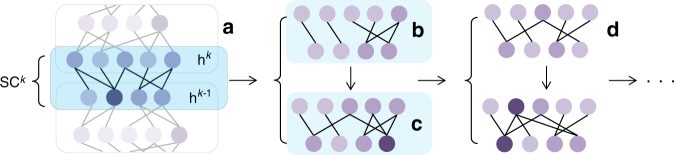
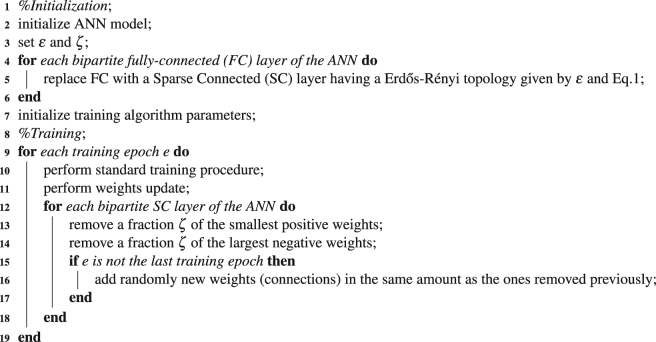
Through the success of deep learning in various domains, artificial neural networks are currently among the most used artificial intelligence methods. Taking inspiration from the network properties of biological neural networks (e.g. sparsity, scale-freeness), we argue that (contrary to general practice) artificial neural networks, too, should not have fully-connected layers. Here we propose sparse evolutionary training of artificial neural networks, an algorithm which evolves an initial sparse topology (Erdős–Rényi random graph) of two consecutive layers of neurons into a scale-free topology, during learning. Our method replaces artificial neural networks fully-connected layers with sparse ones before training, reducing quadratically the number of parameters, with no decrease in accuracy. We demonstrate our claims on restricted Boltzmann machines, multi-layer perceptrons, and convolutional neural networks for unsupervised and supervised learning on 15 datasets. Our approach has the potential to enable artificial neural networks to scale up beyond what is currently possible.
Overview
The claims and statistics of this paper haven’t been checked yet.
Free: it reads the open-access text and checks the first 5 claims that cite a source we can check. Create a free account to check every claim.
Integrity signals
Registry
Cites
Statistics
Figures
Verification
Claims the paper makes
The claims and statistics of this paper haven’t been checked yet.
Free: it reads the open-access text and checks the first 5 claims that cite a source we can check. Create a free account to check every claim.
Claims other papers make about this one
Each is checked against this paper’s own text: does it say what the citing paper says it does?
The cited source says what the claim attributes to it.
In the citing paper
“The idea of selective reinitialization is similar to the emerging idea of dynamic sparse training110–112.”
From Loss of plasticity in deep continual learning (2024) · cites this paper as [110]
Self-check
Percentages, sums and reported differences re-computed from the paper’s own numbers.
The self-check needs the paper’s full text.
Citations
Cites
LeCun, Y., Bengio, Y., & Hinton, G. (2015) · Nature · doi:10.1038/nature14539 · Cited by 84,126
Gradient-based learning applied to document recognition
Lecun, Y., Bottou, L., Bengio, Y., & Haffner, P. (1998) · Proceedings of the IEEE · doi:10.1109/5.726791 · Cited by 58,805
Collective dynamics of ‘small-world’ networks
Watts, D. J., & Strogatz, S. H. (1998) · Nature · doi:10.1038/30918 · Cited by 43,060
Emergence of Scaling in Random Networks
Barabási, A.-L., & Albert, R. (1999) · Science · doi:10.1126/science.286.5439.509 · Cited by 36,135 · cited 1×
“6 and include scale-freeness 7 (detailed in Methods section) and small-worldness 8 .”
Learning representations by back-propagating errors
Rumelhart, D. E., Hinton, G. E., & Williams, R. J. (1986) · Nature · doi:10.1038/323533a0 · Cited by 31,892
Human-level control through deep reinforcement learning
Mnih, V., Kavukcuoglu, K., Silver, D., Rusu, A. A., Veness, J., Bellemare, M. G., Graves, A., Riedmiller, M., Fidjeland, A. K., Ostrovski, G., et al. (2015) · Nature · doi:10.1038/nature14236 · Cited by 30,357
The Elements of Statistical Learning
Hastie, T., Friedman, J., & Tibshirani, R. (2001) · Springer Series in Statistics · doi:10.1007/978-0-387-21606-5 · Cited by 24,162
Reducing the dimensionality of data with neural networks
Hinton, G. E., & Salakhutdinov, R. R. (2006) · Science · doi:10.1126/science.1127647 · Cited by 20,928
Statistical mechanics of complex networks
Albert, R., & Barabási, A.-L. (2002) · Reviews of Modern Physics · doi:10.1103/revmodphys.74.47 · Cited by 20,471
A fast learning algorithm for deep belief nets
Hinton, G. E., Osindero, S., & Teh, Y.-W. (2006) · Neural Computation · doi:10.1162/neco.2006.18.7.1527 · Cited by 16,336 · cited 2×
“…being very successful in providing very good initialization weights to the supervised training of deep arti fi cial neural network architectures 42 , are also very successful as stand alone models in a variety of tasks, such as density estimation to model human choice 31 , collaborative fi…”
Influential
Research works printed but not linked: 18
- Mocanu, D. C. On the synergy of network science and artificial intelligence. In Proc. 25th International Joint Conference on Artificial Intelligence(ed. Kambhampati, S.) 4020–4021 (AAAI Press, New York, 2016).
- Dieleman, S. & Schrauwen, B. Accelerating sparse restricted boltzmann machine training using non-gaussianity measures. In Proc. Deep Learning and Unsupervised Feature Learning, Vol. 9 (eds Bengio Y., Bergstra J. & Le Q.) http://hdl.handle.net/1854/LU-3118568 (Lake Tahoe, 2012).
- Yosinski, J. & Lipson, H. Visually debugging restricted boltzmann machine training with a 3d example. In Representation Learning Workshop, 29th International Conference on Machine Learning (Edinburgh, 2012).
- Whiteson S Stone P Evolutionary function approximation for reinforcement learning J. Mach. Learn. Res. 2006 7 877 917
- Weigend, A. S., Rumelhart, D. E. & Huberman, B. A. Generalization by weight-elimination with application to forecasting. In Proc. Advances in Neural Information Processing Systems, Vol. 3, 875–882 (Morgan-Kaufmann, Colorado, 1991).
- Smolensky, P. Information processing in dynamical systems: foundations of harmony theory. In Parallel Distributed Processing: Explorations in the Microstructure of Cognition (eds Rumelhart, D. E., McClelland, J. L. & CORPORATE PDP Research Group) 194–281 (MIT Press, Cambridge, 1986).
- Osogami T Otsuka M Restricted boltzmann machines modeling human choice Proc. Adv. Neural Inf. Process. Syst. 2014 27 73 81
- Everitt B The Cambridge Dictionary of Statistics 2002 Cambridge, UK; New York Cambridge University Press
- Al-Rfou, R., et al. Theano: a Python framework for fast computation of mathematical expressions. Preprint at https://arxiv.org/abs/1605.02688 (2016). · arXiv
- Urban, G. et al. Do deep convolutional nets really need to be deep and convolutional? In Proc. 5th International Conference on Learning Representations (OpenReview.net, Toulon, 2016).
- Nair, V. & Hinton, G. E. Rectified linear units improve restricted boltzmann machines. In Proc. 27th International Conference on Machine Learning (eds Fürnkranz, J. & Joachims, T.) 807–814 (Omnipress, Haifa, 2010).
- Barabási, A.-L. Network Science (Cambridge University Press, Glasgow, 2016).
- Sutton RS Barto AG Introduction to Reinforcement Learning 1998 Cambridge, MA, USA MIT Press
- Bottou, L. & Bousquet, O. The tradeoffs of large scale learning. In Proc. Advances in Neural Information Processing Systems Vol. 20 (eds Platt, J. C., Koller, D., Singer, Y. & Roweis, S. T.) 161–168 (NIPS Foundation, Vancouver, 2008).
- Larochelle, H. & Murray, I. The neural autoregressive distribution estimator. In Proc. 14th International Conference on Artificial Intelligence and Statistics(eds Gordon, G., Dunson, D. & Dudík, M.) 29–37 (JMLR, Fort Lauderdale, 2011).
- Marlin, B. M., Swersky, K., Chen, B. & de Freitas, N. Inductive principles for restricted boltzmann machine learning. In Proc. 13th International Conference on Artificial Intelligence and Statistics (eds Teh, Y. W. & Titterington, M.) 509–516 (JMLR, Sardinia, 2010).
- LeCun Y Bottou L Bengio Y Haffner P Gradient-based learning applied to document recognition Proc. IEEE 1998 86 2278 2324 10.1109/5.726791 · DOI · Paper page
- Krizhevsky, A. Learning Multiple Layers of Features from Tiny Images. Master’s thesis (2009).
Cited by
Items 501–598 of 598
Multi-class Classification Performance Improvements Through High Sparsity Strategies
Cavallaro, L., Serafin, T., & Liotta, A. (2024) · Studies in computational intelligence · doi:10.1007/978-3-031-53468-3_28
Self-citationCDCP: A Framework for Accelerating Dynamic Channel Pruning Methods
Xiang, Z., Luo, Y., Xie, Y., She, H., Liang, W., & Zhao, L. (2023) · IEEE International Conference on Parallel and Distributed Systems (ICPADS) · doi:10.1109/icpads60453.2023.00031
“Second, we keep the feature extractor fully dense because the features of shallow layers are relatively important [24] and cooperative rather than mutually exclusive [25].”
BackgroundBoosting Robustness in Preference-Based Reinforcement Learning with Dynamic Sparsity
Muslimani, C., Grooten, B., Mamillapalli, D. R. S., Pechenizkiy, M., Mocanu, D. C., & Taylor, M. E. (2024) · TU/e Research Portal · doi:10.48550/arxiv.2406.06495
Self-citationSparsest Models Elude Pruning: An Exposé of Pruning's Current CapabilitiesPreprint
Zhang, S., & Papyan, V. (2024) · arXiv (Cornell University) · doi:10.48550/arxiv.2407.04075
“Sparse Evolutionary Training (SET) by Mocanu et al. (2018) was the pioneer algorithm in this category.”
MethodXiong, B., Zeng, H., Gan, Z., & Xu, Y. N. (2024) · International Journal of Swarm Intelligence Research · doi:10.4018/ijsir.349728
Miniaturisation of Binary Classifiers Through Sparse Neural Networks
Cavallaro, L., Serafin, T., & Liotta, A. (2024) · Lecture notes in computer science · doi:10.1007/978-3-031-81241-5_22 · Cited by 2
Self-citationKang, C., Moore, J. A., Robertson, S., Wilms, M., Towlson, E. K., & Forkert, N. D. (2025) · Neural Networks · doi:10.1016/j.neunet.2025.107308
AI4PM: Distributed and Intelligent Programmable Matter
Piranda, B., Nemer, M. A., Makhoul, A., & Bourgeois, J. (2025) · Lecture notes on data engineering and communications technologies · doi:10.1007/978-3-031-87766-7_11
A bottom-up approach for searching for sparse controllers with a budget
Reddy, V., Gümüşsoy, S., Boker, A., & Eldardiry, H. (2025) · IFAC Journal of Systems and Control · doi:10.1016/j.ifacsc.2025.100308
Chen, X., Liu, H., & Ziabari, S. S. M. (2025) · Preprints.org · doi:10.20944/preprints202506.0512.v1
Pruning of deep learning-based multi-task image analysis models via lottery ticket hypothesis
Chen, Y., Guo, S., Li, X., Yang, C., Zhang, W., & Xia, H. (2025) · Journal of Electronic Imaging · doi:10.1117/1.jei.34.3.033050
“For example, sparse evolutionary training (SET) 20 performs weight pruning based on a standard size criterion and then randomly adds some weights.”
Guo, C., Zhao, S., & Qin, S. (2025) · IEEE Congress on Evolutionary Computation (CEC) · doi:10.1109/cec65147.2025.11043007
Exploring the Neural Burden in Pruned Models: An Insight Inspired by Neuroscience
Wang, Z., Dai, W., Zhou, X., Qi, J., & Zhou, Y. (2025) · Communications in computer and information science · doi:10.1007/978-981-96-6954-7_31
Doležel, P., Štursa, D., Honc, D., Rak, J., Karamazov, S., & Kopecký, D. (2025) · International Conference on Process Control · doi:10.1109/pc65047.2025.11047318
“Recent advancements include the application of neural topology search [6], evolutionary algorithms [7], and deep reinforcement learning [2], [8] to guide the pruning process.”
Neural Network Sparsity in Brain-Body-Machine Interfaces
Petrich, L. C., Neumann, S., Pilarski, P. M., & Fyshe, A. (2025) · International Conference on Rehabilitation Robotics · doi:10.1109/icorr66766.2025.11062950
“Mocanu et al. [10] show that networks trained with SET can match the performance of densely connected networks with a fraction of the number of neurons and far less memory and computation.”
Adapt-S: Effective DNN Pruning via Unified Accuracy and Performance Tuning
Castro, R. L., Andrade, D., & Fraguela, B. B. (2025) · IEEE International Parallel and Distributed Processing Symposium (IPDPS) · doi:10.1109/ipdps64566.2025.00018
“Similarly, layers’ sensitivity studies show that not all layers of a model have the same tolerance to pruning [18], [19].”
Rethinking Green Ai for Sustainable ComputingPreprint
Zadid, T. H., Tanim, S. A., Hossen, M. R., Biswas, T., & Sattar, F. (2025) · SSRN Electronic Journal · doi:10.2139/ssrn.5367962 · Cited by 1
Geometric sparsification in recurrent neural networks
Mackey, W., Schizas, I. D., Deighton, J., Boothe, D. L., & Maroulas, V. (2025) · npj Artificial Intelligence · doi:10.1038/s44387-025-00013-x · Cited by 1
Sengupta, R. (2025) · arXiv (Cornell University) · doi:10.48550/arxiv.2502.16525
“Sparse networks can also be trained from the start, either with adaptive sparse connectivity [14] or with masks found at or near initialisation [15, 16]; it has been argued that the pruned architecture, rather than the inherited weights, often carries most of the benefit [17].”
Renormalization of interacting random graph models
Catanzaro, A., Garlaschelli, D., & Patil, S. P. (2026) · Physical review. E · doi:10.1103/34n8-pw8x · Cited by 1
Deep Differentiable Logic Gate Networks Based on Fuzzy Łukasiewicz T-norm
Nguy, C. D., & Wasilewski, P. (2025) · Annals of Computer Science and Information Systems · doi:10.15439/2025f1666
“Common strategies such as reduced-precision computation [3], [7], binary networks [22], and sparsity exploitation [8], [16] offer partial solutions but often come with trade-offs in accuracy or generality.”
Sustainable Computing Optimization in Large-Scale Machine Learning Training
Zhu, Y., Chen, H., Ma, J., & Pan, F. (2025) · International Journal of Pattern Recognition and Artificial Intelligence · doi:10.1142/s0218001425510279 · Cited by 1
Gu, W., Zhang, Y., Muscoloni, A., & Cannistraci, C. V. (2026) · Frontiers in Artificial Intelligence · doi:10.3389/frai.2026.1785867
Sparse GAIN: Imputation Methods to Handle Missing Values with Sparse Initialization
van Oers, B. P., Erez, I. B., & van Keulen, M. (2025) · Lecture notes in computer science · doi:10.1007/978-3-032-10486-1_22
Yu, Y., Lan, Y., Yang, X., Xing, Z., Zheng, H., & Yu, D. (2025) · Lecture notes in computer science · doi:10.1007/978-981-95-4384-7_18
Architectural Depth and Hyperparameter Impact on HTM Image Classification Performance
Abdelaziz, M. I., & Elgedawy, I. (2025) · Novel Intelligent and Leading Emerging Sciences Conference (NILES) · doi:10.1109/niles68063.2025.11232005
Neuro-Inspired Ensemble-to-Ensemble Communication Primitives for Sparse & Efficient ANNs
Konstantaropoulos, O., Smirnakis, S. M., & Papadopouli, M. (2025) · IEEE International Conference on Bioinformatics and Bioengineering (BIBE) · doi:10.1109/bibe66822.2025.00104 · Cited by 1
“Specifically, edges are pruned using one of the following strategies: (i) random selection, (ii) magnitude-based pruning (following the SET criterion [52]), or (iii) our proposed Hebbian-based criterion.”
InfluentialExposing Hardware Building Blocks to Machine Learning FrameworksPreprint
Akhauri, Y. (2019) · arXiv (Cornell University) · doi:10.13140/rg.2.2.31661.23527/1
NeuroTrails: Training with Dynamic Sparse Heads as the Key to Effective EnsemblingPreprint
Grooten, B., Hasanov, F., Zhang, C., Xiao, Q., Wu, B., Atashgahi, Z., Sokar, G., Liu, S., Yin, L., Mocanu, E., et al. (2025) · arXiv (Cornell University) · doi:10.48550/arxiv.2505.17909
“We use the Erd˝os–Rényi (ER) approach (Mocanu et al., 2018; Evci et al., 2020) to distribute the global sparsity S into layerwise sparsity ratios.”
InfluentialSelf-citationMohammad, Q., & Justus Liebig University Giessen (2020) · University writing server of the Justus Liebig University Giessen (Justus-Liebig-Universität Gießen) · doi:10.22029/jlupub-14829
[Re] Rigging the Lottery: Making All Tickets Winners
Sundar, V., & Dwaraknath, R. V. (2021) · Zenodo (CERN European Organization for Nuclear Research) · doi:10.5281/zenodo.4835563
AI Usage in Development, Security, and Operations
Ayidiya, M. (2023) · ScholarWorks (Walden University)
Approximating the Electrical Impedance Tomography Forward Problem with Graph Neural Networks
Mustonen, A. (2021) · Työväentutkimus Vuosikirja
Carballo, K. V. (2024) · DSpace@MIT (Massachusetts Institute of Technology)
Evaluation of Pruning Algorithms for Activity Recognition on Embedded Machine Learning
Namazi, A. (2023) · KTH Publication Database DiVA (KTH Royal Institute of Technology)
Modelling synaptic rewiring in brain-like neural networks for representation learning
Bhatnagar, K. (2023) · KTH Publication Database DiVA (KTH Royal Institute of Technology)
Ensembles of Pruned Deep Neural Networks for Accurate and Privacy Preservation in IoT Applications
Alhalabi, B. (2023) · BCU Open Access Repository (Birmingham City University) · Cited by 1
Gradual Capacity Growth for Sparse Network Discovery
Yao, Q., & Dovrolis, C. (2026) · Lecture notes in computer science · doi:10.1007/978-3-032-38401-0_1
“Typical methods alternate between pruning unimportant weights and adding new ones using random selection [17] or gradient-based criteria [5, 3].”
Neural network design options for RNG’s verification
Crespo, J., Gutierrez, J., & Valle, A. (2026) · Contemporary mathematics - American Mathematical Society · doi:10.1090/conm/835/16755
Liu, W., Deng, X., Shao, H., Wang, F., & Jiang, Y. (2026) · IEEE Transactions on Neural Networks and Learning Systems · doi:10.1109/tnnls.2026.3744093
Large Learning Agents: Towards Continually Aligned Robots with Scale in RL
Grooten, B. (2024) · Adaptive Agents and Multi-Agents Systems · doi:10.65109/xuma5017
Sparse Gradient Training for Recommender Systems
Qu, Y., Qu, L., Chen, T., Zhao, X., Li, J., & Yin, H. (2026) · Data Science and Engineering · doi:10.1007/s41019-025-00327-5
Su, Y., & Liu, H. (2025) · Conference proceedings/Conference proceedings - IEEE International Conference on Systems, Man, and Cybernetics · doi:10.1109/smc58881.2025.11342792
Sahra, S., Lehouidj, B., Moulai, H., Nacer, A., & Béroual, A. (2026) · SSRN Electronic Journal · doi:10.2139/ssrn.6222359
Naidu, C., Ashish, A., Kiran, S., Joshi, Y. C., & M.A.Jabbar (2025) · International Conference on Emerging Research in Electronics, Computer Science and Technology (ICERECT) · doi:10.1109/icerect65215.2025.11377155
“Mocanu et al. (2018) pioneered adaptive sparse connectivity-inspired network science for training large-scale artificial neural networks.”
Semenov, A., Veremyev, A., McMann, D., Pasiliao, E. L., & Boginski, V. L. (2026) · Lecture notes in computer science · doi:10.1007/978-3-032-16469-8_12
Robustness in sparse artificial neural networks trained with adaptive topology
Sulyok, B., Palla, G., Radicchi, F., & Fortunato, S. (2026) · Scientific Reports · doi:10.1038/s41598-026-68388-8
S2TE: Staged Scale-Free Topology Evolution for Sparse Spiking Neural Networks
Xie, Z., Zhu, W., Li, P., Ding, H., & Song, W. (2026) · Machine Learning · doi:10.1007/s10994-025-06982-z
“For example, Mocanu et al. (2018) found that random sparse topologies can evolve towards scale-free-like or heavy-tailed degree distributions.”
InfluentialSundaram, G. B., Ulmen, J., & Görges, D. (2026) · at - Automatisierungstechnik · doi:10.1515/auto-2025-0107
“Recent research in this area includes gradient-based meth-ods that account for second-order information [3], investigations into the lottery ticket hypothesis [7], and dynamic sparse training approaches that maintain sparsity throughout training [8].”
Hebbian-Oscillatory Co-LearningPreprint
Hays, H. (2026) · arXiv (Cornell University) · doi:10.48550/arxiv.2603.08731
“…• GCN [22] with fixed topology • RSGN [12] alone (no oscillatory coupling) • SSA [13] alone (no Hebbian plasticity) • Sparse Evolutionary Training [9] • Lottery Ticket subnetworks [8] The critical comparisons are RSGN-only and SSA-only, which isolate the contribution of the coupling mechanism…”
Distributed Resource Aggregation and Cloud-Edge Collaborative Operation Optimization Method
He, H., Wang, Q., Li, B., & Li, J. (2025) · IEEE Conference on Energy Internet and Energy System Integration (EI2) · doi:10.1109/ei268505.2025.11425286
Robust bearing fault feature extraction using adaptive TVF-FEEMD and HTSCMFE
Ren, Y., Li, X., Luan, F., Yuan, S., & Jin, N. (2026) · Measurement Science and Technology · doi:10.1088/1361-6501/ae5680
“On this basis, it verifies that structurally concise ANN [30] and standard Transformer [31] models can achieve highly effective discrimination.”
Studies on Adaptive Structural Learning of Deep Belief Networks
鎌田, 真., & Kamada, S. (2019) · Institutional Repositories DataBase (IRDB)
Fukushima, M. (2026) · Scientific Reports · doi:10.1038/s41598-026-47213-2 · Cited by 1
Inference acceleration and optimization in deep neural networks for computer vision
Keddous, F. E. (2022) · theses.fr (ABES) · doi:10.70675/b08b2f98z66c2z46d7za694z241b7296cbd2
Deep Neural Network Modeling of Electric Motors
Verma, S. (2023) · theses.fr (ABES) · doi:10.70675/9164ed61z2676z413az9e34z9fcb271dc6e1 · Cited by 3
Traitement de séries longitudinales pour l'imagerie médicale
Fakhfakh, M. (2023) · theses.fr (ABES) · doi:10.70675/8f92f252z4a35z4668z9328zda828e442113 · Cited by 1
Convolutional neural networks pruning and its application to embedded vision systems
Tessier, H. (2023) · theses.fr (ABES) · doi:10.70675/73a5734fz6c44z4d68zb238z8d30e4e00f1a · Cited by 3
Carboni, L. (2023) · theses.fr (ABES) · doi:10.70675/04aa8f1fz5ebdz4fe9zb3caz7c1377605d8f
Vers une Intelligence Artificielle Numérique Responsable
Ciocan, A. V. (2024) · theses.fr (ABES) · doi:10.70675/56c5e5d9z8984z4a72zba0bzf0e2f7041cc7 · Cited by 1
Dynamic architectural optimization of artificial neural networks
Maile, K. (2023) · theses.fr (ABES) · doi:10.70675/8a8952e2z422az4072z9397z4629b985f393
Data frugality and computational efficiency in deep learning
Zheng, L. (2024) · theses.fr (ABES) · doi:10.70675/8ed95462z1fcez4725zbc81z62196ba90ea1 · Cited by 1
Neural Network Compression and Knowledge Distillation
Ghojogh, B., & Ghodsi, A. (2026) · Springer eBooks · doi:10.1007/978-3-032-10738-1_20
Xiao, Q., Wu, B., Pechenizkiy, M., & Mocanu, D. C. (2026) · Communications in computer and information science · doi:10.1007/978-3-032-25308-8_18
Self-citationDeep learning for regression and feature selection
Wang, X. (2026) · Elsevier eBooks · doi:10.1016/b978-0-443-40541-9.00009-8
C-DPSS: Channel dual-phase sparsity pruning framework for spiking neural networks
Li, J., Li, Q., Jiang, Y., Zhang, J., Zou, H., Tao, M., Wang, L., Ran, H., Li, G., Zhang, Z., et al. (2026) · Neurocomputing · doi:10.1016/j.neucom.2026.134101
Sparse neural circuit policies for underwater vehicle trajectory tracking in complex environments
Huang, H., Dong, C., Zhang, L., & Pan, S. (2026) · Ocean Engineering · doi:10.1016/j.oceaneng.2026.129256
ScRRAMBLe: block-sparse deep learning architecture for analog in-memory computing accelerators
Jaltare, V., Mondal, R., Gibb, L., Song, J., Leugering, J., & Cauwenberghs, G. (2026) · npj Unconventional Computing · doi:10.1038/s44335-026-00071-7
“Several studies have proposed training methods for unstructured sparse neural networks with dynamic updates to network topology 26,27 .”
FGSEP: Finer-grained structured element pruning for efficient deep neural networks
Zhang, P., Tian, C., Wang, B., & Duan, Z. (2026) · Neurocomputing · doi:10.1016/j.neucom.2026.134207
Safety-aware dynamic sparse training for reinforcement learning of batch processes
Zheng, J., Ye, L., Qin, J., Xia, Y., Guan, H., & Yuan, X. (2026) · Neurocomputing · doi:10.1016/j.neucom.2026.134300
Dynamic Entropy-Guided Sparse Training for Efficient Neural Network CompressionPreprint
Vu, D. M. H., Thai, B. P. D., Duy, H. T., Quach, T.-Q., Le, H. X., & Giap, V.-T. (2026) · SSRN Electronic Journal · doi:10.2139/ssrn.7038081
Dynamic structured pruning and merging for real-time acceleration of reinforcement learning
Ishii, T., Ariizumi, R., & Matsuno, F. (2026) · Scientific Reports · doi:10.1038/s41598-026-59565-w
“Meanwhile, DST initializes a sparse network at the outset and evolves the topology during training 14–17 .”
Yu, Y., Jing, L., Liu, C., Dong, J., & Qi, J. (2026) · IEEE Internet of Things Journal · doi:10.1109/jiot.2026.3717769
“…pruning at initialization [28], [29], [30]; FPGM, MorphNet, SSS, and dynamic sparse training methods for pruning during training [31], [32], [33], [34], [35]; Lottery Ticket-style and posttraining pruning methods for pruning after training [36], [37], [38]; and dynamic routing or input-adaptive…”
Feng, Y., Zhang, P., Yang, H., Gao, B. J., & Shi, Y. (2026) · Information Sciences · doi:10.1016/j.ins.2026.123950
Zhou, X., Han, T., Yao, Q., & Chen, Y. (2026) · SSRN Electronic Journal · doi:10.2139/ssrn.7198293
Aggressive, Imperceptible, or Both: Architecture-Aware Hybrid Byzantines in Federated Learning
Özfatura, E., Özfatura, K., Buyukates, B., Coşkuner, M., Küpçü, A., & Gündüz, D. (2026) · IEEE European Symposium on Security and Privacy · doi:10.1109/eurosp68448.2026.00052
“ERK approach, introduced in [80], extends Erdos-Renyi approach to convolutional layers, including kernel dimensions.”
Zhou, X., Han, T., Yao, Q., & Chen, Y. (2026) · Physics of Fluids · doi:10.1063/5.0341732
Random Sparse Networks Training With Sharpness-Aware Regularization
Bai, Y., Zhang, M., Wang, H., Tao, Z., Li, K., Wang, Y., & Fu, Y. (2026) · IEEE Transactions on Pattern Analysis and Machine Intelligence · doi:10.1109/tpami.2026.3722118
“For example, Sparse Evolutionary Training (SET) [32] introduces connections via an evolutionary mechanism to enhance sparse training.”
Exploring compression transferability for model pruning in intelligent transportation
Guo, K., Fan, S., Chen, J., & Hu, B. (2026) · Pattern Recognition Letters · doi:10.1016/j.patrec.2026.08.009
You Only Step Once: A Single-Pass Zero-Order Sharpness-Aware Minimization for Sparse Training
Ji, J., Li, G., Deng, K., Afghah, F., & Ma, X. (2026) · Proceedings - International Conference on Image Processing · doi:10.1109/icip61757.2026.11630302
Across the Loss Landscape with Progressive Growth
Caillon, P., Cerisara, C., & Allauzen, A. (2026) · Lecture notes in computer science · doi:10.1007/978-3-032-37667-1_34
“Lottery-ticket-style results emphasize the existence of performant subnetworks within random initializations [12,34,24], while dynamic sparse training methods adapt sparsity patterns during learning [11,22].”
Optimization of Parameters and Structure of Neural Networks Using Evolutionary Algorithms
Hirianskyi, B. (2026) · Електронний архів наукових та освітніх матеріалів КПІ ім. Ігоря Сікорського (КПІ ім. Ігоря Сікорського)
Li, G., Li, J., Hu, B., Huang, Q., Yu, W., Liu, Q., & Guoliang, H. U. (2026) · Mechanics Based Design of Structures and Machines · doi:10.1080/15397734.2026.2723306
Understanding and Enhancing Dynamic Sparse Training Through the Lens of Stochasticity
Wu, B., Xiao, Q., Ding, T., Wang, S., Chen, Y., van Keulen, M., Pechenizkiy, M., Liu, S., Mocanu, D. C., & Mocanu, E. (2026) · Lecture notes in computer science · doi:10.1007/978-3-032-37670-1_7
Self-citationProgressive Magnitude-Based Pruning: Efficient Discovery of Sparse Subnetworks in One Training CyclePreprint
Qureshi, R., Benhidour, H., Kerrache, S., & Aljeraisy, N. (2026) · SSRN Electronic Journal · doi:10.2139/ssrn.7429769
Sparse Neural Network Pruning Strategies for Sustainable AI Deployment
Vaidyanathan, N., Parthasarathy, P., & Gurumurthy, G. (2024) · Journal of Intelligent Systems and Future Computing · doi:10.5281/zenodo.22843894
Soize, C. (2026) · Computer Methods in Applied Mechanics and Engineering · doi:10.1016/j.cma.2026.119437
Ma, C., Wang, X., & Zhang, H. (2026) · International Conference on Data-driven Optimization of Complex Systems (DOCS) · doi:10.1109/docs70981.2026.11698608
Super Sparse DETR: YOLO-Competitive Convergence and Acceleration
Zhu, H. (2026) · doi:10.1109/cvprf71909.2026.00641
“In terms of metrics, structured pruning is more likely to be converted into real inference acceleration; in terms of timing, pruning during training (PDT) [21] enables simultaneous learning and pruning, reducing additional fine-tuning costs.”
Bayesian Support Pursuit: A Probabilistic Framework for Dynamic Sparse Neural Network TrainingPreprint
Majumdar, A. (2026) · SSRN Electronic Journal · doi:10.2139/ssrn.7602444
SParSeFuL: Self-organizing sparse federated learning over spatially non-IID data
Domini, D., Aguzzi, G., Zenoozi, A. D., Erhan, L., Cavallaro, L., Liotta, A., & Mirko Viroli, D. (2026) · Pervasive and Mobile Computing · doi:10.1016/j.pmcj.2026.102300
Self-citationPOST: Continuous Probabilistic Optimization for Structured Dynamic Sparse Training
Wang, Z., Wang, B., Bian, H., Yang, X., & Yuan, M. (2026) · International Joint Conference on Neural Networks (IJCNN) · doi:10.1109/ijcnn69854.2026.11728542
“Early works such as SET [23] introduced a “magnitude-pruning, random-growth” cycle, demonstrating that sparse topologies could be learned adaptively during training.”
Scalable and Intelligent Computing Applications Powered by Adaptive Deep Learning Algorithms
Sharma, K., Singh, G., Bhardwaj, K., Kaur, H., Chadda, G., & Singh, O. (2026) · doi:10.1109/icoicet68875.2026.11761187
Deployment-oriented neural network state-estimation methods for battery management systems
Rzepka, F. (2026) · DepositOnce · doi:10.14279/depositonce-26876
Sabri, M. (2026) · Neural Networks · doi:10.1016/j.neunet.2026.109870
Metadata
- Authors
- Mocanu, D. C., Mocanu, E., Stone, P., Nguyen, P. H., Gibescu, M., & Liotta, A.
- Affiliations
- Eindhoven University of Technology (NL)
- The University of Texas at Austin (US)
- University of Derby (GB)
- Corresponding author
- Mocanu, Decebal Constantin
- Venue
- Nature Communications
- Published
- 2018-06-19
- Volume
- 9
- Issue
- 1
- Pages
- 2383-2383
- ISSN
- 2041-1723 (ISSN-L)
- PMC
- PMC6008460
- OpenAlex
- W2808133870
- Semantic Scholar
- 6dbb9e4b2e3b67dc4e1634989511f67d41373dd0
- Cited by
- 524
- References
- 45
- Citations by year
- 2026: 45 · 2025: 85 · 2024: 72 · 2023: 68 · 2022: 60 · 2021: 100 · 2020: 51 · 2019: 39 · 2018: 4
- FWCI
- 27.30
- Type
- journal article
- Language
- en
- Open access
- gold
- doi.org
- Licence
- cc-by
- creativecommons.org/licenses/by/4.0 (tdm)
- creativecommons.org/licenses/by/4.0 (vor)
- Locations
- Nature Communications (publishedVersion, cc-by)
- Europe PMC (PubMed Central) (publishedVersion, other-oa)
- PubMed Central (publishedVersion, cc-by)
- PubMed (publishedVersion)
- arXiv (Cornell University) (submittedVersion)
- Open Repository and Bibliography (University of Luxembourg) (submittedVersion, other-oa)
- TU/e Research Portal (submittedVersion, cc-by)
- TU/e Research Portal (submittedVersion)
- RePEc: Research Papers in Economics (submittedVersion)
- DOAJ (DOAJ: Directory of Open Access Journals) (submittedVersion, cc-by-sa)
- DOAJ (DOAJ: Directory of Open Access Journals) (submittedVersion)
- Utrecht University Repository (Utrecht University) (submittedVersion, other-oa)
- Research Output (Edinburgh Napier University) (submittedVersion, cc-by)
- Edinburgh Napier Research Repository (Edinburgh Napier University) (submittedVersion, cc-by)
- Open Research (University of Surrey) (submittedVersion, other-oa)
- arXiv (Cornell University)
- Topics
- Physical Sciences › Computer Science › Artificial Intelligence › Neural Networks and Applications
- Physical Sciences › Computer Science › Computer Vision and Pattern Recognition › Advanced Neural Network Applications
- Physical Sciences › Physics and Astronomy › Statistical and Nonlinear Physics › Complex Network Analysis Techniques
- Keywords
- sparse neural networks, scale-free topology, Erdős-Rényi random graphs, parameter reduction, restricted Boltzmann machine, multilayer perceptron, convolutional neural networks, unsupervised learning, supervised learning
About these checks
Registry, retraction, Cites and statistics results are computed, not judged, with one exception: a printed reference that no index lists is read once by a model before it counts as a citation error. Claims are extracted by a model and kept only when their quote appears verbatim in the text; each cited source is then checked, with a model’s help, for whether it says what the claim relies on. Those verdicts can be wrong — read the claim’s quote and the cited source before relying on one.
Statistics and arithmetic are recomputed, not judged.
Confidence bands are shown only for fields calibrated on our annotated test set. None is calibrated yet, so no band is shown.
What counts as a claim ›How we measure confidence ›How we check this ›
Are you an author, or do you see a problem with this page? Request a review
Data sources
Bibliographic data: Semantic Scholar, OpenAlex, Crossref.
Contains information from the Semantic Scholar Academic Graph Datasets, made available under the ODC Attribution License (ODC-BY 1.0).
Semantic Scholar’s data is described in: Kinney, R., et al. (2023). The Semantic Scholar Open Data Platform. arXiv:2301.10140.
