

Implementation of multilayer perceptron network with highly uniform passive memristive crossbar circuits
Open accessThe DOI matches its Crossref record; 42 of the 42 references it cites were found in a registry or an index.
Abstract
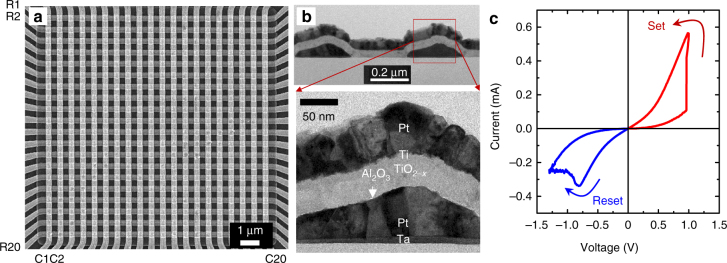
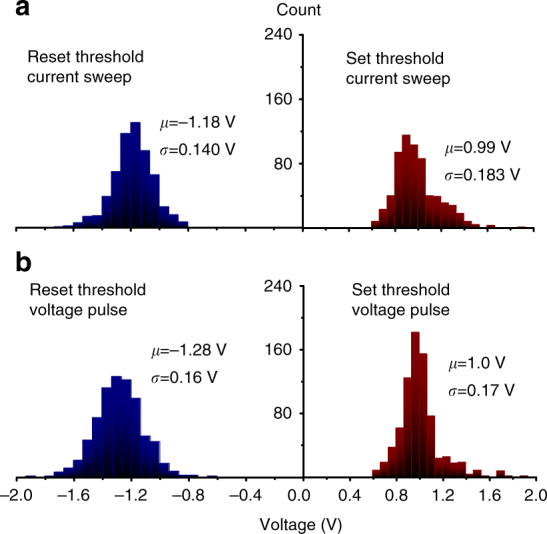
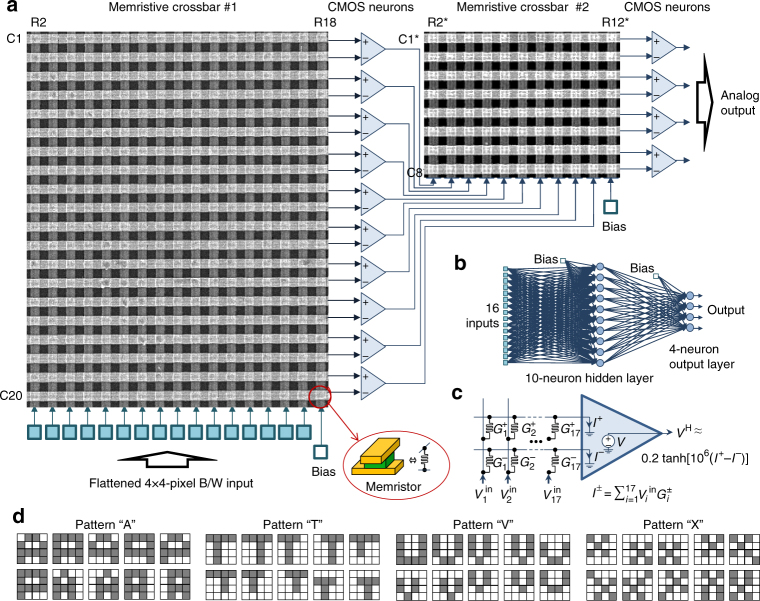
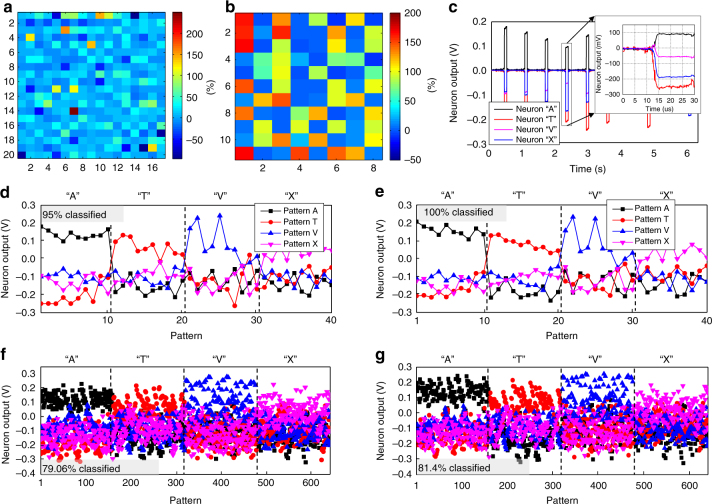
The progress in the field of neural computation hinges on the use of hardware more efficient than the conventional microprocessors. Recent works have shown that mixed-signal integrated memristive circuits, especially their passive (0T1R) variety, may increase the neuromorphic network performance dramatically, leaving far behind their digital counterparts. The major obstacle, however, is immature memristor technology so that only limited functionality has been reported. Here we demonstrate operation of one-hidden layer perceptron classifier entirely in the mixed-signal integrated hardware, comprised of two passive 20 × 20 metal-oxide memristive crossbar arrays, board-integrated with discrete conventional components. The demonstrated network, whose hardware complexity is almost 10× higher as compared to previously reported functional classifier circuits based on passive memristive crossbars, achieves classification fidelity within 3% of that obtained in simulations, when using ex-situ training. The successful demonstration was facilitated by improvements in fabrication technology of memristors, specifically by lowering variations in their I–V characteristics.
Overview
The claims and statistics of this paper haven’t been checked yet.
Free: it reads the open-access text and checks the first 5 claims that cite a source we can check. Create a free account to check every claim.
Integrity signals
Registry
Cites
Statistics
Figures
Verification
Claims the paper makes
The claims and statistics of this paper haven’t been checked yet.
Free: it reads the open-access text and checks the first 5 claims that cite a source we can check. Create a free account to check every claim.
Claims other papers make about this one
Each is checked against this paper’s own text: does it say what the citing paper says it does?
The source backs part of the claim, not all of it — or backs it for a different population, condition or comparison.
In the citing paper
“The progress in the most prospective, passive analog-grade ReRAM circuits13,17,21,22,24, however, has been much slower, mainly because of much stricter requirements for the uniformity of memory cells’ I–V characteristics (Supplementary Fig. 1).”
From 4K-memristor analog-grade passive crossbar circuit (2021) · cites this paper as [24]
Experimental — accuracy not yet measuredThe source backs part of the claim, not all of it — or backs it for a different population, condition or comparison.
In the citing paper
“The developed circuits have ten times more devices and excellent uniformity allowing for significantly better array-scale conductance tuning precision as compared to the previous work24 that reported the largest passive analog-grade memristive crossbar circuits with detailed characterization statistics.”
From 4K-memristor analog-grade passive crossbar circuit (2021) · cites this paper as [24]
Experimental — accuracy not yet measuredThe source backs part of the claim, not all of it — or backs it for a different population, condition or comparison.
In the citing paper
“the former can be achieved by reducing leakages within the device and between neighboring lines, e.g., by patterning the active switching layer and scaling down device feature sizes24, and making higher-aspect ratio electrodes”
From 4K-memristor analog-grade passive crossbar circuit (2021) · cites this paper as [24]
Experimental — accuracy not yet measuredThe cited source says what the claim attributes to it.
In the citing paper
“The developed circuits have ten times more devices and excellent uniformity allowing for significantly better array-scale conductance tuning precision as compared to the previous work24 that reported the largest passive analog-grade memristive crossbar circuits with detailed characterization statistics.”
From 4K-memristor analog-grade passive crossbar circuit (2021) · cites this paper as [24]
Self-check
Percentages, sums and reported differences re-computed from the paper’s own numbers.
The self-check needs the paper’s full text.
Citations
Cites
ImageNet classification with deep convolutional neural networks
Krizhevsky, A., Sutskever, I., & Hinton, G. E. (2017) · Communications of the ACM · doi:10.1145/3065386 · Cited by 112,155
LeCun, Y., Bengio, Y., & Hinton, G. (2015) · Nature · doi:10.1038/nature14539 · Cited by 84,126
Deep learning in neural networks: an overview
Schmidhuber, J. (2015) · Neural Networks · doi:10.1016/j.neunet.2014.09.003 · Cited by 18,570 · cited 3×
“(Similar to our previous work [1, 2], only inference stage was performed in a hardware during such in-situ training, while other operations, such as computing and storing the necessary weight updates, were assisted by an external computer.)”
BackgroundMethodResultA million spiking-neuron integrated circuit with a scalable communication network and interface
Merolla, P. A., Arthur, J. V., Alvarez-Icaza, R., Cassidy, A. S., Sawada, J., Akopyan, F., Jackson, B. L., Imam, N., Guo, C., Nakamura, Y., et al. (2014) · Science · doi:10.1126/science.1254642 · Cited by 4,147
Memristive devices for computing
Yang, J. J., Strukov, D. B., & Stewart, D. R. (2013) · Nature Nanotechnology · doi:10.1038/nnano.2012.240 · Cited by 3,885
Self-citationEyeriss: An Energy-Efficient Reconfigurable Accelerator for Deep Convolutional Neural Networks
Chen, Y.-H., Krishna, T., Emer, J. S., & Sze, V. (2017) · IEEE Journal of Solid-State Circuits · doi:10.1109/jssc.2016.2616357 · Cited by 3,247 · cited 1×
“The breakthrough 3 was enabled not by any significant algorithm advance, but rather by the use of high performance graphics processors 4 , and the further progress is being fueled now by the development of even more powerful graphics processors and custom integrated circuits 5-7 .”
MethodTraining and operation of an integrated neuromorphic network based on metal-oxide memristors
Prezioso, M., Merrikh-Bayat, F., Hoskins, B. D., Adam, G. C., Likharev, K. K., & Strukov, D. B. (2015) · Nature · doi:10.1038/nature14441 · Cited by 3,001 · cited 3×
“26,27 .”
BackgroundInfluentialSelf-citationWong, H.-S. P., Lee, H.-Y., Yu, S., Chen, Y.-S., Wu, Y., Chen, P.-S., Lee, B., Chen, F. T., & Tsai, M.-J. (2012) · Proceedings of the IEEE · doi:10.1109/jproc.2012.2190369 · Cited by 2,757
Memristors with diffusive dynamics as synaptic emulators for neuromorphic computing
Wang, Z., Joshi, S., Savel’ev, S. E., Jiang, H., Midya, R., Lin, P., Hu, M., Ge, N., Strachan, J. P., Li, Z., et al. (2017) · Nature Materials · doi:10.1038/nmat4756 · Cited by 2,358
van de Burgt, Y., Lubberman, E., Fuller, E. J., Keene, S. T., Faria, G. C., Agarwal, S., Marinella, M. J., Alec Talin, A., & Salleo, A. (2017) · Nature Materials · doi:10.1038/nmat4856 · Cited by 1,872
Research works printed but not linked: 10
- Moons, B., Uytterhoeven, R., Dehaene, W. & Verhelst, M. in IEEE International Sold-State Circuits Conference (ISSCC) 246–257 (IEEE, 2017).
- Jouppi, N. P. et al. in Proc. of the 44th Annual International Symposium on Computer Architecture 1–12 (ACM, 2017).
- Mead, C. Analog VLSI and Neural Systems (Addison-Wesley Longman Publishing Co. Inc., Boston, MA, USA, 1989).
- Suri, M. et al. in 2012 International Electron Devices Meeting 235–238 (IEEE, 2012).
- Piccolboni, G. et al. in 2015 International Electron Devices Meeting (IEDM) 447–450 (IEEE, 2015).
- Kim, S. et al. in 2015 International Electron Devices Meeting (IEDM) 443–446 (IEEE, 2015).
- Prezioso, M. et al. in 2015 International Electron Devices Meeting (IEDM) 455–458 (IEEE, 2015).
- Yu, S. et al. in 2016 International Electron Devices Meeting (IEDM) 416–419 (IEEE, 2016).
- Govoreanu, B. et al. in 2011 International Electron Devices Meeting 729–732 (IEEE, 2011).
- Ceze, L. et al. in 2016 74th Annual Device Research Conference (DRC) 1–2 (IEEE, 2016).
Cited by
Items 101–200 of 386
Chen, J., Pan, W.-Q., Li, Y., Kuang, R., He, Y., Lin, C.-Y., Duan, N., Feng, G.-R., Zheng, H.-X., Chang, T., et al. (2020) · IEEE Electron Device Letters · doi:10.1109/led.2020.2968388 · Cited by 51
“Besides, the sneak current problem raises the programming disturbance issue for large-scale networks [11]–[13].”
BackgroundOn the validity of memristor modeling in the neural network literature
Pershin, Y. V., & Di Ventra, M. (2020) · Neural Networks · doi:10.1016/j.neunet.2019.08.026 · Cited by 49
Gomes, P. A. B., Suhara, Y., Nunes‐Silva, P., Costa, L., Arruda, H., Venturieri, G. C., Imperatriz-Fonseca, V. L., Pentland, A., Júnior, P. A. D. S., & Pessin, G. (2020) · Scientific Reports · doi:10.1038/s41598-019-56352-8 · Cited by 50
Covalent Organic Frameworks for Neuromorphic Devices
Zhou, K., Jia, Z., Zhou, Y. D., Ding, G., Ma, X., Niu, W., Han, S., Zhao, J., & Zhou, Y. (2023) · The Journal of Physical Chemistry Letters · doi:10.1021/acs.jpclett.3c01711 · Cited by 48
Toward Reflective Spiking Neural Networks Exploiting Memristive Devices
Makarov, V. A., Lobov, S. A., Shchanikov, S., Mikhaylov, A. N., & Kazantsev, V. (2022) · Frontiers in Computational Neuroscience · doi:10.3389/fncom.2022.859874 · Cited by 51
“Bayat et al. (2018) described a device based on passive crossbars with 20 × 20 memristors, which implements a multilayer feed-forward perceptron capable of recognizing Latin alphabet letters with 97% accuracy.”
MethodIn situ Parallel Training of Analog Neural Network Using Electrochemical Random-Access Memory
Li, Y., Xiao, T. P., Bennett, C. H., Isele, E., Melianas, A., Tao, H., Marinella, M. J., Salleo, A., Fuller, E. J., & Talin, A. A. (2021) · Frontiers in Neuroscience · doi:10.3389/fnins.2021.636127 · Cited by 53
“Instead, in situ training utilize sequential device-by-device weight updates (Prezioso et al., 2015; Bayat et al., 2018; Li et al., 2018a; Cai et al., 2019), resulting in extra latency and energy consumption for larger array sizes between 10 3 and 10 6 devices.”
Bavandpour, M., Sahay, S., Mahmoodi, M. R., & Strukov, D. B. (2021) · Neuromorphic Computing and Engineering · doi:10.1088/2634-4386/ac0775 · Cited by 45
Self-citationMemristive Devices for Neuromorphic Applications: Comparative Analysis
Erokhin, V. V. (2020) · BioNanoScience · doi:10.1007/s12668-020-00795-1 · Cited by 46
Quantitative Evaluation of Hardware Binary Stochastic Neurons
Hassan, O., Datta, S., & Camsari, K. Y. (2021) · Physical Review Applied · doi:10.1103/physrevapplied.15.064046 · Cited by 45
Sakemi, Y., Morino, K., Morie, T., & Aihara, K. (2021) · IEEE Transactions on Neural Networks and Learning Systems · doi:10.1109/tnnls.2021.3095068 · Cited by 49
“Many research groups have already designed circuits with analog resistive memory to efficiently compute MVMs [39–43].”
BackgroundShi, J., & Zeng, Z. (2020) · IEEE Transactions on Emerging Topics in Computational Intelligence · doi:10.1109/tetci.2020.3005703 · Cited by 45
Dongale, T. D., Khot, A. C., Takaloo, A. V., Son, K. R., & Kim, T. G. (2020) · Journal of Material Science and Technology · doi:10.1016/j.jmst.2020.10.046 · Cited by 43
A Dynamical Compact Model of Diffusive and Drift Memristors for Neuromorphic Computing
Zhuo, Y., Midya, R., Song, W., Wang, Z., Asapu, S., Rao, M., Lin, P., Jiang, H., Xia, Q., Williams, R. S., et al. (2021) · Advanced Electronic Materials · doi:10.1002/aelm.202100696 · Cited by 43
Lu, Y., Li, X., Yan, B., Yan, L., Zhang, T., Song, Z., Huang, R., & Yang, Y. (2021) · Advanced Materials · doi:10.1002/adma.202107811 · Cited by 44
Mask Technique for Fast and Efficient Training of Binary Resistive Crossbar Arrays
Fouda, M. E., Lee, S., Lee, J., Eltawil, A., & Kurdahi, F. (2019) · IEEE Transactions on Nanotechnology · doi:10.1109/tnano.2019.2927493 · Cited by 41
In-memory and in-sensor reservoir computing with memristive devices
Lin, N., Chen, J., Zhao, R., He, Y., Wong, K., Qiu, Q., Wang, Z., & Yang, J. J. (2024) · APL Machine Learning · doi:10.1063/5.0174863 · Cited by 42
Wang, S., Chen, X., Huang, X., Zhang, D. W., & Zhou, P. (2020) · Advanced Intelligent Systems · doi:10.1002/aisy.202000124 · Cited by 44
High‐Resolution Programmable Metasurface Imager Based on Multilayer Perceptron Network
Gu, Z., Ma, Q., Liu, C., Xiao, Q., Gao, X., Yan, T., Miao, L., Li, L., & Cui, T. J. (2022) · Advanced Optical Materials · doi:10.1002/adom.202200619 · Cited by 41
Associative routing through neuromorphic nanowire networks
Álvarez, A. D., Higuchi, R., Li, Q., Shingaya, Y., & Nakayama, T. (2020) · AIP Advances · doi:10.1063/1.5140579 · Cited by 40
Resistive switching kinetics and second-order effects in parylene-based memristors
Matsukatova, A. N., Emelyanov, A. V., Minnekhanov, A. A., Несмелов, А. А., Vdovichenko, A. Y., Чвалун, С. Н., Rylkov, V. V., Форш, П. А., Demin, V. A., Kashkarov, P. K., et al. (2020) · Applied Physics Letters · doi:10.1063/5.0030069 · Cited by 40
Mixed-Signal Neuromorphic Inference Accelerators: Recent Results and Future Prospects
Bavandpour, M., Mahmoodi, M. R., Nili, H., Bayat, F. M., Prezioso, M., Vincent, A., Strukov, D. B., & Likharev, K. K. (2018) · 2018 IEEE International Electron Devices Meeting (IEDM) · doi:10.1109/iedm.2018.8614659 · Cited by 39
“4a), board-integrated with discrete CMOS components [6].”
BackgroundInfluentialSelf-citationTang, R., Yang, X., Wen, G., & Lu, J. (2024) · IEEE Transactions on Neural Networks and Learning Systems · doi:10.1109/tnnls.2024.3424519 · Cited by 41
“Considerable attention has been directed toward the modeling and dynamic analysis of MNNs, driven by their successful applications in communication, signal processing, and pattern classification [6], [7], [8].”
Comprehensive Compact Phenomenological Modeling of Integrated Metal-Oxide Memristors
Nili, H., Vincent, A. F., Prezesio, M., Mahmoodi, M. R., Kataeva, I., & Strukov, D. B. (2020) · IEEE Transactions on Nanotechnology · doi:10.1109/tnano.2020.2982128 · Cited by 38
“[14].”
MethodSelf-citationSong, S., Kim, M., Yoo, G., Kwon, S. M., Heo, J. S., Park, S. K., & Kim, Y. (2020) · Journal of Alloys and Compounds · doi:10.1016/j.jallcom.2020.158027 · Cited by 39
Cao, G., Gao, C., Wang, J., Lan, J., & Yan, X. (2022) · Nano Research · doi:10.1007/s12274-022-4437-9 · Cited by 38
Cristiano, G., Giordano, M., Ambrogio, S., Romero, L. P., Cheng, C., Narayanan, P., Tsai, H., Shelby, R. M., & Burr, G. W. (2018) · Journal of Applied Physics · doi:10.1063/1.5042462 · Cited by 37
Wang, J., Ren, Y., Yang, Z., Lv, Q., Zhang, Y., Zhang, M., Zhao, T., Gu, D., Liu, F., Tang, B., et al. (2024) · Advanced Science · doi:10.1002/advs.202309538 · Cited by 39
Integrated Crossbar Array With Resistive Synapses and Oscillation Neurons
Woo, J., Wang, P., & Yu, S. (2019) · IEEE Electron Device Letters · doi:10.1109/led.2019.2921656 · Cited by 37
“In this regard, a crossbar array with resistive memory that architecturally speeds up the multiplication in parallel has gain interests for neuromorphic computing [4]–[8].”
BackgroundRecent Advancements in Emerging Neuromorphic Device Technologies
Woo, J., Kim, J. H., Im, J., & Moon, S. E. (2020) · Advanced Intelligent Systems · doi:10.1002/aisy.202000111 · Cited by 37
Combinatorial optimization by weight annealing in memristive hopfield networks
Fahimi, Z., Mahmoodi, M. R., Nili, H., Polishchuk, V., & Strukov, D. B. (2021) · Scientific Reports · doi:10.1038/s41598-020-78944-5 · Cited by 39
Self-citationIliasov, A. I., Matsukatova, A. N., Emelyanov, A. V., Slepov, P. S., Nikiruy, K. E., & Rylkov, V. V. (2024) · Nanoscale Horizons · doi:10.1039/d3nh00421j · Cited by 34
Memristive Electronic Synapses Made by Anodic Oxidation
Chen, S., Noori, S., Villena, M. A., Shi, Y., Han, T., Zuo, Y., Pedeferri, M., Strukov, D. B., Lanza, M., & Diamanti, M. V. (2019) · Chemistry of Materials · doi:10.1021/acs.chemmater.9b02245 · Cited by 35
Self-citationElectroforming in Metal-Oxide Memristive Synapses
Wang, T., Shi, Y., Puglisi, F. M., Chen, S., Zhu, K., Zuo, Y., Li, X., Jing, X., Han, T., Guo, B., et al. (2020) · ACS Applied Materials & Interfaces · doi:10.1021/acsami.9b19362 · Cited by 38
Wang, J., Zhuge, X., & Zhuge, F. (2021) · Science and Technology of Advanced Materials · doi:10.1080/14686996.2021.1911277 · Cited by 35
Transverse barrier formation by electrical triggering of a metal-to-insulator transition
Salev, P., Fratino, L., Sasaki, D., Berkoun, R., del Valle, J., Kalcheim, Y., Takamura, Y., Rozenberg, M. J., & Schuller, I. K. (2021) · Nature Communications · doi:10.1038/s41467-021-25802-1 · Cited by 40
Hendy, H., & Merkel, C. E. (2022) · Journal of Electronic Imaging · doi:10.1117/1.jei.31.1.010901 · Cited by 38
Associative STDP-like learning of neuromorphic circuits based on polyaniline memristive microdevices
Prudnikov, N. V., Lapkin, D. A., Emelyanov, A. V., Minnekhanov, A. A., Malakhova, Y. N., Чвалун, С. Н., Demin, V. A., & Erokhin, V. V. (2020) · Journal of Physics D Applied Physics · doi:10.1088/1361-6463/ab9262 · Cited by 34
“…building blocks for next-generation non-volatile memory [1–7], artificial neural networks, which include single-and multi-layer perceptrons [8–12], image recognition [13, 14], sparse coding [15] and reinforcement learning [16], biological sensors [17], bio-inspired computing systems [18]…”
BackgroundThe viability of analog-based accelerators for neuromorphic computing: a survey
Musisi‐Nkambwe, M., Afshari, S., Barnaby, H., Kozicki, M. N., & Esqueda, I. S. (2021) · Neuromorphic Computing and Engineering · doi:10.1088/2634-4386/ac0242 · Cited by 36
“A forming algorithm solution is presented in [91] which allows certain devices already preformed by the anneal process to be skipped thus avoiding further device-to-device memory window variation.”
MethodSpike-driven threshold-based learning with memristive synapses and neuromorphic silicon neurons
Covi, E., George, R., Frascaroli, J., Brivio, S., Mayr, C., Mostafa, H., Indiveri, G., & Spiga, S. (2018) · Journal of Physics D Applied Physics · doi:10.1088/1361-6463/aad361 · Cited by 35
“While passive and selector free crossbars have been proposed and demonstrated for some applications [51, 52], the co-integration of selectors and memristive devices might be required for very high density systems.”
BackgroundPerspective: Uniform switching of artificial synapses for large-scale neuromorphic arrays
Tan, S. H., Lin, P., Yeon, H., Choi, S., Park, Y., & Kim, J. (2018) · APL Materials · doi:10.1063/1.5049137 · Cited by 33
On-Chip Error-Triggered Learning of Multi-Layer Memristive Spiking Neural Networks
Payvand, M., Fouda, M. E., Kurdahi, F. J., Eltawil, A. M., & Neftci, E. (2020) · IEEE Journal on Emerging and Selected Topics in Circuits and Systems · doi:10.1109/jetcas.2020.3040248 · Cited by 38
Mondal, I., Attri, R., Rao, T. S., Yadav, B., & Kulkarni, G. U. (2024) · Applied Physics Reviews · doi:10.1063/5.0220628 · Cited by 33
Deep Learning for Alzheimer’s Disease Classification using Texture Features
So, J.-H., Madusanka, N., Choi, H., Choi, B.-K., & Park, H. (2019) · Current Medical Imaging Formerly Current Medical Imaging Reviews · doi:10.2174/1573405615666190404163233 · Cited by 31
Sk, M. R., Thunder, S., Lehninger, D., Sanctis, S., Raffel, Y., Lederer, M., Jank, M. P. M., Kämpfe, T., De, S., & Chakrabarti, B. (2023) · ACS Applied Electronic Materials · doi:10.1021/acsaelm.2c01357 · Cited by 32
Self-citationArchitecture of neural processing unit for deep neural networks
Lee, K. J. (2020) · Advances in computers · doi:10.1016/bs.adcom.2020.11.001 · Cited by 43
Ding, S., Zhang, Z., Guo, L., & Sun, Y. (2022) · Information Sciences · doi:10.1016/j.ins.2022.03.060 · Cited by 30
Ferroelectric Field-Effect Transistors for Binary Neural Network With 3-D NAND Architecture
Lee, G. H., Song, M. S., Kim, S., Yim, J., Hwang, S., Yu, J., Kwon, D., & Kim, H. (2022) · IEEE Transactions on Electron Devices · doi:10.1109/ted.2022.3207130 · Cited by 30
“The activation comparator circuit receives the currents from the two paired BLs and converts the difference to voltage [53].”
BackgroundToward Simplified Physics-Based Memristor Modeling of Valence Change Mechanism Devices
Ntinas, V. G., Ascoli, A., Messaris, I., Wang, Y., Rana, V., Menzel, S., & Tetzlaff, R. (2022) · IEEE Transactions on Circuits & Systems II Express Briefs · doi:10.1109/tcsii.2022.3160304 · Cited by 31
Synapse-Mimetic Hardware-Implemented Resistive Random-Access Memory for Artificial Neural Network
Seok, H., Son, S., Jathar, S. B., Lee, J., & Kim, T. (2023) · Sensors · doi:10.3390/s23063118 · Cited by 31
“Using the dataset in the Modified National Institute of Standards and Technology (MNIST) database, handwritten using a multi-layer perceptron (MLP), simple recognition of patterned numbers by synaptic devices has been demonstrated [121,125–127].”
MethodAnalog Weight Updates with Compliance Current Modulation of Binary ReRAMs for On-Chip Learning
Payvand, M., Demirağ, Y., Dalgaty, T., Vianello, E., & Indiveri, G. (2020) · IEEE International Symposium on Circuits and Systems proceedings · doi:10.1109/iscas45731.2020.9180808 · Cited by 30
“Material Optimization: Previously, several groups re-ported TiO 2 -based [4]–[6] and HfO 2 -based [7] ReRAM devices with up to 8 bits of precision.”
MethodWoo, H. C., Kim, J., Lee, S., Kim, H. J., & Hwang, C. S. (2022) · Advanced Electronic Materials · doi:10.1002/aelm.202200656 · Cited by 30
Miniaturizing neural networks for charge state autotuning in quantum dots
Czischek, S., Yon, V., Genest, M.-A., Roux, M.-A., Rochette, S., Lemyre, J. C., Moras, M., Pioro-Ladrière, M., Drouin, D., Beilliard, Y., et al. (2021) · Machine Learning Science and Technology · doi:10.1088/2632-2153/ac34db · Cited by 42
“[31] F.”
BackgroundInvited Tutorial: Analog Matrix Computing With Crosspoint Resistive Memory Arrays
Sun, Z., & Ielmini, D. (2022) · IEEE Transactions on Circuits & Systems II Express Briefs · doi:10.1109/tcsii.2022.3174920 · Cited by 27
Picosecond Time‐Scale Resistive Switching Monitored in Real‐Time
Csontos, M., Horst, Y., Olalla, N. J., Koch, U., Shorubalko, I., Halbritter, A., & Leuthold, J. (2023) · Advanced Electronic Materials · doi:10.1002/aelm.202201104 · Cited by 30
Qu, L., Zhao, Z., Wang, L., & Wang, Y. (2020) · Neural Computing and Applications · doi:10.1007/s00521-020-04755-4 · Cited by 26
“Recently, memristor has been widely explored for the hardware implementation of artificial synapses for lowpower neuromorphic systems [26, 27] With gradually adaptive conductance with nonvolatility, only one memristor device is needed to implement STDP learning, leading to significant power and area reduction compared…”
MethodIn‐Memory Hamming Weight Calculation in a 1T1R Memristive Array
Cheng, L., Li, J., Zheng, H., Yuan, P., Yin, J., Yang, L., Luo, Q., Li, Y., Lv, H., Chang, T., et al. (2020) · Advanced Electronic Materials · doi:10.1002/aelm.202000457 · Cited by 27
Memristive System Based Image Processing Technology: A Review and Perspective
Ji, X., Dong, Z., Zhou, G., Lai, C. S., Yan, Y., & Qi, D. (2021) · Electronics · doi:10.3390/electronics10243176 · Cited by 29
“Professor Strukov’s team at the University of California, Santa Barbara [64] prepared a 20 × 20 memristor crossbar array, as depicted in Figure 16.”
MethodOh, J., Kim, S., Choi, J., Cha, J., Im, S. G., Jang, B. C., & Choi, S. (2022) · Advanced Intelligent Systems · doi:10.1002/aisy.202200177 · Cited by 26
Park, S., Jang, J. T., Hwang, Y., Lee, H., Choi, W. S., Kang, D., Kim, C., Kim, H., & Kim, D. H. (2021) · ACS Applied Electronic Materials · doi:10.1021/acsaelm.1c00517 · Cited by 25
Wan, X., Tsuruoka, T., & Terabe, K. (2021) · Nano Letters · doi:10.1021/acs.nanolett.1c01990 · Cited by 26
Memristor-Based Light-Weight Transformer Circuit Implementation for Speech Recognizing
Xiao, H., Zhou, Y., Gao, T., Duan, S., Chen, G., & Hu, X. (2023) · IEEE Journal on Emerging and Selected Topics in Circuits and Systems · doi:10.1109/jetcas.2023.3237582 · Cited by 26
“Memristor-based neuromorphic computation can produce massively parallel multi-adds while consuming little power, making memristor-based neuromorphic computation a reliable choice for implementing various neural networks and algorithms [19], [20], [21], [22], [23], [24], [25].”
BackgroundIntrinsic Bounds for Computing Precision in Memristor-Based Vector-by-Matrix Multipliers
Mahmoodi, M. R., Vincent, A. F., Nili, H., & Strukov, D. B. (2020) · IEEE Transactions on Nanotechnology · doi:10.1109/tnano.2020.2992493 · Cited by 28
Self-citationLarge-scale crossbar arrays based on three-terminal MoS2 memtransistors
Schranghamer, T. F., Pannone, A., Kumar, J. M., Baiju, D. K. T., Chen, C., Knight, T. V. M., Tadekawa, S., Haines, E., Ordoñez, R. C., Hayashi, C. K., et al. (2025) · Nature Communications · doi:10.1038/s41467-025-64536-2 · Cited by 27
“Furthermore, as shown in Supplementary Note 10, experimental testing has veri fi ed that each gate access line is suf fi ciently electrostatically isolated to prevent programming of devices in adjacent rows, thus allowing for subsets of devices to be initialized without affecting the entire array.”
InfluentialOrganic memristive devices for perceptron applications
Battistoni, S., Erokhin, V. V., & Iannotta, S. (2018) · Journal of Physics D Applied Physics · doi:10.1088/1361-6463/aac98f · Cited by 24
Towards the Development of Analog Neuromorphic Chip Prototype with 2.4M Integrated Memristors
Kataeva, I., Ohtsuka, S., Nili, H., Kim, H., Isobe, Y., Yako, K., & Strukov, D. B. (2019) · IEEE International Symposium on Circuits and Systems proceedings · doi:10.1109/iscas.2019.8702125 · Cited by 29
“…Merrikh-Bayat et al. reported experimental demonstration of a small-scale multilayer perceptron based on ∼ 1000 passively integrated memristors [22], [28], which is about four orders of magnitude below the complexity necessary to implement even a modest-size practically useful neural network.”
BackgroundMethodSelf-citationSilicon-based optoelectronic synaptic devices*
Yin, L., Pi, X., & Yang, D. (2020) · Chinese Physics B · doi:10.1088/1674-1056/ab973f · Cited by 24
Lü, J., Wu, Z., Zhang, X., Wei, J., Fang, Y., Shi, T., Liu, Q., Wu, F., & Liu, M. (2020) · IEEE Electron Device Letters · doi:10.1109/led.2020.3021593 · Cited by 25
Sk, M. R., Thunder, S., Müller, F., Laleni, N., Raffel, Y., Lederer, M., Pirro, L., Chohan, T., Hsuen, J.-H., Wu, T., et al. (2023) · IEEE Transactions on Nanotechnology · doi:10.1109/tnano.2023.3295093 · Cited by 24
“Many eNVMs such as resistive random access memory (ReRAM) [7],”
BackgroundSelf-citationSynaptic response in organic electrochemical transistor gated by a graphene electrode
Battistoni, S., Peruzzi, C., Verna, A., Marasso, S. L., Cocuzza, M., Erokhin, V. V., & Iannotta, S. (2019) · Flexible and Printed Electronics · doi:10.1088/2058-8585/ab4dce · Cited by 23
Memristors Based on Poly(p-xylylene) with Embedded Silver Nanoparticles
Matsukatova, A. N., Emelyanov, A. V., Minnekhanov, A. A., Sakharutov, D. A., Vdovichenko, A. Y., Камышинский, Р. А., Demin, V. A., Rylkov, V. V., Форш, П. А., Чвалун, С. Н., et al. (2020) · Technical Physics Letters · doi:10.1134/s1063785020010277 · Cited by 23
Electrode-dependent electrical switching characteristics of InGaZnO memristor
Choi, W. S., Kim, D., Yang, T. J., Chae, I., Kim, C., Kim, H., & Kim, D. H. (2022) · Chaos Solitons & Fractals · doi:10.1016/j.chaos.2022.112106 · Cited by 23
Emerging Memristive Devices for Brain-Inspired Computing and Artificial Perception
Wang, J., Zhu, Y., Zhu, L. Q., Chen, C., & Wan, Q. C. (2022) · Frontiers in Nanotechnology · doi:10.3389/fnano.2022.940825 · Cited by 25
“Bayat et al. designed and fabricated a 20 × 20 cross-array (Bayat et al., 2018).”
BackgroundAdvancing Neural Networks: Innovations and Impacts on Energy Consumption
Fedorova, A., Jovišić, N., Vallverdú, J., Battistoni, S., Jovičić, M., Medojević, M., Toschev, A. S., Alshanskaia, E., Talanov, M. O., & Erokhin, V. V. (2024) · Advanced Electronic Materials · doi:10.1002/aelm.202400258 · Cited by 24
Graph processing and machine learning architectures with emerging memory technologies: a survey
Qian, X. (2021) · Science China Information Sciences · doi:10.1007/s11432-020-3219-6 · Cited by 25
Minnekhanov, A. A., Shvetsov, B. S., Emelyanov, A. V., Chernoglazov, K. Y., Kukueva, E. V., Несмелов, А. А., Grishchenko, Y. V., Занавескин, М. Л., Rylkov, V. V., & Demin, V. A. (2021) · Journal of Physics D Applied Physics · doi:10.1088/1361-6463/ac203c · Cited by 22
“At present, various memristor-based NNs, such as a network with long-short-term memory [9, 10], perceptrons [11–13], spiking NNs (SNNs) [14–19], and other systems [20–24], have been implemented in hardware.”
Long Short-Term Memory Implementation Exploiting Passive RRAM Crossbar Array
Nikam, H., Satyam, S., & Sahay, S. (2021) · IEEE Transactions on Electron Devices · doi:10.1109/ted.2021.3133197 · Cited by 24
“multiplication in the analog domain if the inputs are encoded as voltages and weights are stored as conductance-states of the RRAMs using Ohm’s law and Kirchoff’s law [13]-[14] as shown in Fig.”
BackgroundMethodThe Development of Silicon for AI: Different Design Approaches
Lee, K. J., Lee, J., Choi, S., & Yoo, H. (2020) · IEEE Transactions on Circuits and Systems I Regular Papers · doi:10.1109/tcsi.2020.2996625 · Cited by 24
“Some neuromorphic processors make use of nonvolatile memory (NVM) such as ReRAM and MRAM in their analog arrays to replace floating-point MAC with parallel analog processing array [83], [85], [102] than digital processors.”
MethodConvolutional Echo‐State Network with Random Memristors for Spatiotemporal Signal Classification
Wang, S., Chen, H., Zhang, W., Li, Y., Wang, D., Shi, S., Zhao, Y., Loong, K. C., Chen, X., Dong, Y., et al. (2022) · Advanced Intelligent Systems · doi:10.1002/aisy.202200027 · Cited by 22
Kim, M., Yoo, K., Jeon, S., Park, S. K., & Kim, Y. (2020) · Micromachines · doi:10.3390/mi11020154 · Cited by 23
Effect of cycling on ultra-thin HfZrO4, ferroelectric synaptic weights
Bégon‐Lours, L., Halter, M., Sousa, M., Popoff, Y., Pineda, D. D., Falcone, D. F., Yu, Z., Reidt, S., Benatti, L., Puglisi, F. M., et al. (2022) · Neuromorphic Computing and Engineering · doi:10.1088/2634-4386/ac5b2d · Cited by 22
Unsupervised Learning Implemented by Ti3C2-MXene-Based Memristive Neuromorphic System
Wan, X., Xu, W., Zhang, M., He, N., Lian, X., Hu, E., Xu, J., & Tong, Y. (2020) · ACS Applied Electronic Materials · doi:10.1021/acsaelm.0c00705 · Cited by 21
Review of memristor based neuromorphic computation: opportunities, challenges and applications
Shekinah Archita, S., & Ravi, V. K. K. (2024) · Engineering Research Express · doi:10.1088/2631-8695/ad6662 · Cited by 25
A Survey on Architecture Advances Enabled by Emerging Beyond-CMOS Technologies
Chen, A., Datta, S., Hu, X. S., Niemier, M. T., Simunic, T., & Yang, J. J. (2019) · IEEE Design and Test · doi:10.1109/mdat.2019.2902359 · Cited by 27
Experimental Demonstrations of Security Primitives With Nonvolatile Memories
Mahmoodi, M. R., Strukov, D. B., & Kavehei, O. (2019) · IEEE Transactions on Electron Devices · doi:10.1109/ted.2019.2948950 · Cited by 22
“While such properties have been extensively studied and applied in the context of computing applications [42]–[46], recently, they have been leveraged in building novel promising security”
BackgroundSelf-citationMaas, K., Villepreux, É., Cooper, D., Jiménez, C., Roussel, H., Rapenne, L., Mescot, X., Rafhay, Q., Boudard, M., & Burriel, M. (2020) · Journal of Materials Chemistry C · doi:10.1039/c9tc03972d · Cited by 20
Kumar, S., Cárdenas-López, F. A., Hegade, N. N., Chen, X., Albarrán-Arriagada, F., Solano, E., & Barrios, G. A. (2021) · Physical Review A · doi:10.1103/physreva.104.062605 · Cited by 18
“These structures have been used in dense arrays of memristors [13, 14] for realizing brain-inspired devices [10, 13, 15].”
Mohanan, K. U., Cho, S., & Park, B. (2022) · Applied Intelligence · doi:10.1007/s10489-022-03783-y · Cited by 21
Liehr, M., Hazra, J., Beckmann, K., Rafiq, S., & Cady, N. C. (2020) · IEEE International Integrated Reliability Workshop final report · doi:10.1109/iirw49815.2020.9312855 · Cited by 18
Hassanzadeh, P. (2021) · Life Sciences · doi:10.1016/j.lfs.2021.119272 · Cited by 18
Li, Y., Tang, J., Gao, B., Li, X., Xi, Y., Zhang, W., Qian, H., & Wu, H. (2021) · Journal of Semiconductors · doi:10.1088/1674-4926/42/6/064101 · Cited by 18
A system design perspective on neuromorphic computer processors
Rose, G. S., Shawkat, M. S. A., Foshie, A. Z., Murray, J., & Adnan, M. M. (2021) · Neuromorphic Computing and Engineering · doi:10.1088/2634-4386/ac24f5 · Cited by 22
A deep learning approach for facility patient attendance prediction based on medical booking data
Piccialli, F., Cuomo, S., Crisci, D., Prezioso, E., & Mei, G. (2020) · Scientific Reports · doi:10.1038/s41598-020-71613-7 · Cited by 20
Nikiruy, K. E., Surazhevsky, I. A., Demin, V. A., & Emelyanov, A. V. (2020) · physica status solidi (a) · doi:10.1002/pssa.201900938 · Cited by 18
Yang, H., Chen, B., Song, B., Meng, D., Tiwari, S., Krishnamoorthy, A., Yan, X., Liu, Z., Wang, Y., Hu, P., et al. (2020) · ACS Applied Electronic Materials · doi:10.1021/acsaelm.0c00148 · Cited by 17
All-Passive Hardware Implementation of Multilayer Perceptron Classifiers
Ananthakrishnan, A., & Allen, M. G. (2020) · IEEE Transactions on Neural Networks and Learning Systems · doi:10.1109/tnnls.2020.3016901 · Cited by 18
“10(c)], a result that can be explained by the following key points: 1) passive SMLPs encode soft weights as conductance ratios, not absolute conductances and 2) normalized changes in resistances have been assumed to vary linearly with temperature (with a constant TCR) [27].”
BackgroundA Simulation Framework for Memristor-Based Heterogeneous Computing Architectures
Liu, H., Xu, J., Liao, X., Jin, H., Zhang, Y., & Mao, F. (2022) · IEEE Transactions on Computer-Aided Design of Integrated Circuits and Systems · doi:10.1109/tcad.2022.3152385 · Cited by 19
Kim, T., Park, K., Jang, T., Baek, M.-H., Song, Y. S., & Park, B. (2019) · Solid-State Electronics · doi:10.1016/j.sse.2019.107667 · Cited by 18
Nonvolatile Memristive Materials and Physical Modeling for In‐Memory and In‐Sensor Computing
Go, S., Lim, K.-G., Lee, T. H., & Loke, D. K. (2024) · Small Science · doi:10.1002/smsc.202300139 · Cited by 16
Energy-Accuracy Trade-Offs for Resistive In-Memory Computing Architectures
Roy, S. K., & Shanbhag, N. R. (2024) · IEEE Journal on Exploratory Solid-State Computational Devices and Circuits · doi:10.1109/jxcdc.2024.3381888 · Cited by 16
“A promising direction in IMC is the development of resistive IMCs [1], [2], [3], [4], [5], [6], [7], [8], [9], [10], [11], [12], [13], [14], [15], [16], [17], [18], [19], [20], [21], [22], [23] based on embedded nonvolatile memory (eNVM) technologies, which leverage their nonvolatility and…”
BackgroundDesign of High Performance MXene/Oxide Structure Memristors for Image Recognition Applications
Lian, X., Shi, Y., Shen, X., Wan, X., Cai, Z., & Wang, L. (2024) · Chinese Journal of Electronics · doi:10.23919/cje.2022.00.125 · Cited by 17
Metadata
- Authors
- Bayat, F. M., Prezioso, M., Chakrabarti, B., Nili, H., Kataeva, I., & Strukov, D.
- Affiliations
- University of California, Santa Barbara (US)
- Corresponding author
- Kataeva, I.
- Strukov, D.
- Venue
- Nature Communications
- Published
- 2018-06-13
- Volume
- 9
- Issue
- 1
- Pages
- 2331-2331
- ISSN
- 2041-1723 (ISSN-L)
- PMC
- PMC5998062
- OpenAlex
- W2964263004
- Cited by
- 377
- References
- 41
- Citations by year
- 2026: 9 · 2025: 24 · 2024: 38 · 2023: 46 · 2022: 53 · 2021: 54 · 2020: 88 · 2019: 50 · 2018: 14
- FWCI
- 19.71
- Type
- journal article
- Language
- en
- Open access
- gold
- doi.org
- Licence
- cc-by
- creativecommons.org/licenses/by/4.0 (tdm)
- creativecommons.org/licenses/by/4.0 (vor)
- Locations
- Nature Communications (publishedVersion, cc-by)
- Europe PMC (PubMed Central) (publishedVersion, cc-by)
- PubMed Central (publishedVersion, cc-by)
- PubMed (publishedVersion)
- arXiv (Cornell University) (submittedVersion)
- RePEc: Research Papers in Economics (submittedVersion)
- DOAJ (DOAJ: Directory of Open Access Journals) (submittedVersion)
- DOAJ (DOAJ: Directory of Open Access Journals) (submittedVersion, cc-by-sa)
- arXiv (Cornell University)
- Funders
- DOD | Defense Advanced Research Projects Agency (HR0011-13-C-0051UPSIDE)
- NSF | Directorate for Computer & Information Science and Engineering | Division of Computing and Communication Foundations (1528205)
- Topics
- Physical Sciences › Engineering › Electrical and Electronic Engineering › Advanced Memory and Neural Computing
- Physical Sciences › Computer Science › Artificial Intelligence › Neural Networks and Applications
- Physical Sciences › Computer Science › Artificial Intelligence › Neural Networks and Reservoir Computing
- Keywords
- memristor crossbar, multilayer perceptron, neuromorphic hardware, mixed-signal circuits, metal-oxide memristors, hardware implementation of neural networks
About these checks
Registry, retraction, Cites and statistics results are computed, not judged, with one exception: a printed reference that no index lists is read once by a model before it counts as a citation error. Claims are extracted by a model and kept only when their quote appears verbatim in the text; each cited source is then checked, with a model’s help, for whether it says what the claim relies on. Those verdicts can be wrong — read the claim’s quote and the cited source before relying on one.
Statistics and arithmetic are recomputed, not judged.
Confidence bands are shown only for fields calibrated on our annotated test set. None is calibrated yet, so no band is shown.
What counts as a claim ›How we measure confidence ›How we check this ›
Are you an author, or do you see a problem with this page? Request a review
Data sources
Bibliographic data: Semantic Scholar, OpenAlex, Crossref.
Contains information from the Semantic Scholar Academic Graph Datasets, made available under the ODC Attribution License (ODC-BY 1.0).
Semantic Scholar’s data is described in: Kinney, R., et al. (2023). The Semantic Scholar Open Data Platform. arXiv:2301.10140.
