

Implementation of multilayer perceptron network with highly uniform passive memristive crossbar circuits
Open accessThe DOI matches its Crossref record; 42 of the 42 references it cites were found in a registry or an index.
Abstract
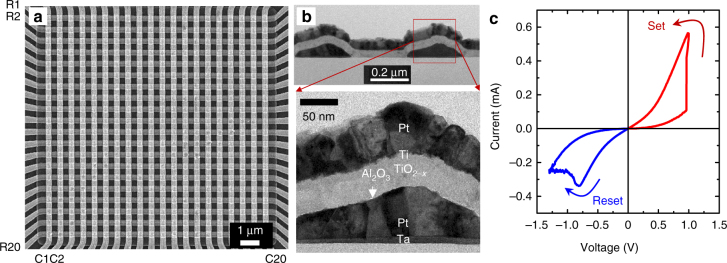
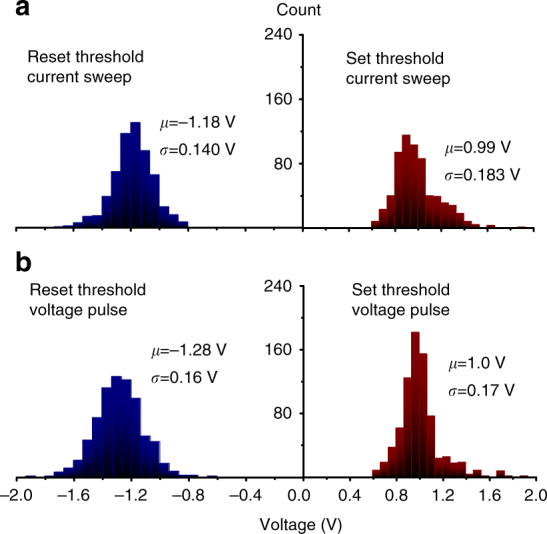
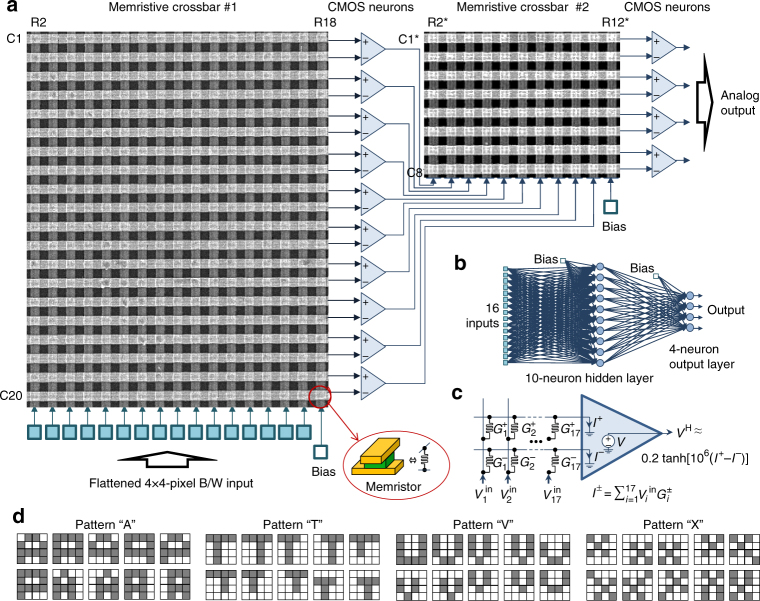
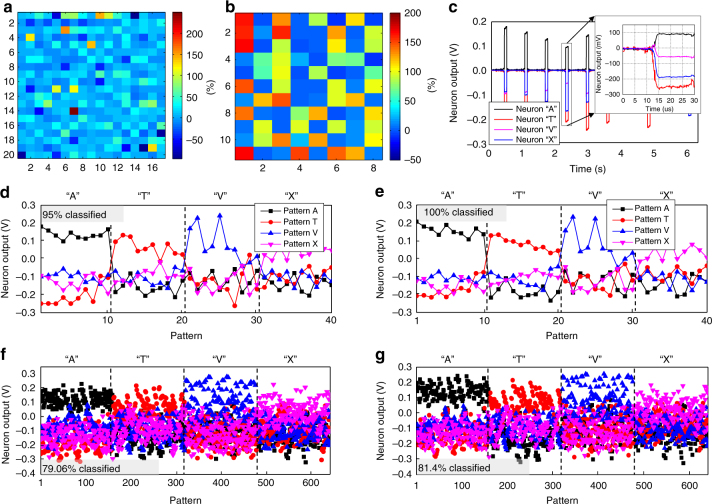
The progress in the field of neural computation hinges on the use of hardware more efficient than the conventional microprocessors. Recent works have shown that mixed-signal integrated memristive circuits, especially their passive (0T1R) variety, may increase the neuromorphic network performance dramatically, leaving far behind their digital counterparts. The major obstacle, however, is immature memristor technology so that only limited functionality has been reported. Here we demonstrate operation of one-hidden layer perceptron classifier entirely in the mixed-signal integrated hardware, comprised of two passive 20 × 20 metal-oxide memristive crossbar arrays, board-integrated with discrete conventional components. The demonstrated network, whose hardware complexity is almost 10× higher as compared to previously reported functional classifier circuits based on passive memristive crossbars, achieves classification fidelity within 3% of that obtained in simulations, when using ex-situ training. The successful demonstration was facilitated by improvements in fabrication technology of memristors, specifically by lowering variations in their I–V characteristics.
Overview
The claims and statistics of this paper haven’t been checked yet.
Free: it reads the open-access text and checks the first 5 claims that cite a source we can check. Create a free account to check every claim.
Integrity signals
Registry
Cites
Statistics
Figures
Verification
Claims the paper makes
The claims and statistics of this paper haven’t been checked yet.
Free: it reads the open-access text and checks the first 5 claims that cite a source we can check. Create a free account to check every claim.
Claims other papers make about this one
Each is checked against this paper’s own text: does it say what the citing paper says it does?
The source backs part of the claim, not all of it — or backs it for a different population, condition or comparison.
In the citing paper
“The progress in the most prospective, passive analog-grade ReRAM circuits13,17,21,22,24, however, has been much slower, mainly because of much stricter requirements for the uniformity of memory cells’ I–V characteristics (Supplementary Fig. 1).”
From 4K-memristor analog-grade passive crossbar circuit (2021) · cites this paper as [24]
Experimental — accuracy not yet measuredThe source backs part of the claim, not all of it — or backs it for a different population, condition or comparison.
In the citing paper
“The developed circuits have ten times more devices and excellent uniformity allowing for significantly better array-scale conductance tuning precision as compared to the previous work24 that reported the largest passive analog-grade memristive crossbar circuits with detailed characterization statistics.”
From 4K-memristor analog-grade passive crossbar circuit (2021) · cites this paper as [24]
Experimental — accuracy not yet measuredThe source backs part of the claim, not all of it — or backs it for a different population, condition or comparison.
In the citing paper
“the former can be achieved by reducing leakages within the device and between neighboring lines, e.g., by patterning the active switching layer and scaling down device feature sizes24, and making higher-aspect ratio electrodes”
From 4K-memristor analog-grade passive crossbar circuit (2021) · cites this paper as [24]
Experimental — accuracy not yet measuredThe cited source says what the claim attributes to it.
In the citing paper
“The developed circuits have ten times more devices and excellent uniformity allowing for significantly better array-scale conductance tuning precision as compared to the previous work24 that reported the largest passive analog-grade memristive crossbar circuits with detailed characterization statistics.”
From 4K-memristor analog-grade passive crossbar circuit (2021) · cites this paper as [24]
Self-check
Percentages, sums and reported differences re-computed from the paper’s own numbers.
The self-check needs the paper’s full text.
Citations
Cites
ImageNet classification with deep convolutional neural networks
Krizhevsky, A., Sutskever, I., & Hinton, G. E. (2017) · Communications of the ACM · doi:10.1145/3065386 · Cited by 112,155
LeCun, Y., Bengio, Y., & Hinton, G. (2015) · Nature · doi:10.1038/nature14539 · Cited by 84,126
Deep learning in neural networks: an overview
Schmidhuber, J. (2015) · Neural Networks · doi:10.1016/j.neunet.2014.09.003 · Cited by 18,570 · cited 3×
“(Similar to our previous work [1, 2], only inference stage was performed in a hardware during such in-situ training, while other operations, such as computing and storing the necessary weight updates, were assisted by an external computer.)”
BackgroundMethodResultA million spiking-neuron integrated circuit with a scalable communication network and interface
Merolla, P. A., Arthur, J. V., Alvarez-Icaza, R., Cassidy, A. S., Sawada, J., Akopyan, F., Jackson, B. L., Imam, N., Guo, C., Nakamura, Y., et al. (2014) · Science · doi:10.1126/science.1254642 · Cited by 4,147
Memristive devices for computing
Yang, J. J., Strukov, D. B., & Stewart, D. R. (2013) · Nature Nanotechnology · doi:10.1038/nnano.2012.240 · Cited by 3,885
Self-citationEyeriss: An Energy-Efficient Reconfigurable Accelerator for Deep Convolutional Neural Networks
Chen, Y.-H., Krishna, T., Emer, J. S., & Sze, V. (2017) · IEEE Journal of Solid-State Circuits · doi:10.1109/jssc.2016.2616357 · Cited by 3,247 · cited 1×
“The breakthrough 3 was enabled not by any significant algorithm advance, but rather by the use of high performance graphics processors 4 , and the further progress is being fueled now by the development of even more powerful graphics processors and custom integrated circuits 5-7 .”
MethodTraining and operation of an integrated neuromorphic network based on metal-oxide memristors
Prezioso, M., Merrikh-Bayat, F., Hoskins, B. D., Adam, G. C., Likharev, K. K., & Strukov, D. B. (2015) · Nature · doi:10.1038/nature14441 · Cited by 3,001 · cited 3×
“26,27 .”
BackgroundInfluentialSelf-citationWong, H.-S. P., Lee, H.-Y., Yu, S., Chen, Y.-S., Wu, Y., Chen, P.-S., Lee, B., Chen, F. T., & Tsai, M.-J. (2012) · Proceedings of the IEEE · doi:10.1109/jproc.2012.2190369 · Cited by 2,757
Memristors with diffusive dynamics as synaptic emulators for neuromorphic computing
Wang, Z., Joshi, S., Savel’ev, S. E., Jiang, H., Midya, R., Lin, P., Hu, M., Ge, N., Strachan, J. P., Li, Z., et al. (2017) · Nature Materials · doi:10.1038/nmat4756 · Cited by 2,358
van de Burgt, Y., Lubberman, E., Fuller, E. J., Keene, S. T., Faria, G. C., Agarwal, S., Marinella, M. J., Alec Talin, A., & Salleo, A. (2017) · Nature Materials · doi:10.1038/nmat4856 · Cited by 1,872
Research works printed but not linked: 10
- Moons, B., Uytterhoeven, R., Dehaene, W. & Verhelst, M. in IEEE International Sold-State Circuits Conference (ISSCC) 246–257 (IEEE, 2017).
- Jouppi, N. P. et al. in Proc. of the 44th Annual International Symposium on Computer Architecture 1–12 (ACM, 2017).
- Mead, C. Analog VLSI and Neural Systems (Addison-Wesley Longman Publishing Co. Inc., Boston, MA, USA, 1989).
- Suri, M. et al. in 2012 International Electron Devices Meeting 235–238 (IEEE, 2012).
- Piccolboni, G. et al. in 2015 International Electron Devices Meeting (IEDM) 447–450 (IEEE, 2015).
- Kim, S. et al. in 2015 International Electron Devices Meeting (IEDM) 443–446 (IEEE, 2015).
- Prezioso, M. et al. in 2015 International Electron Devices Meeting (IEDM) 455–458 (IEEE, 2015).
- Yu, S. et al. in 2016 International Electron Devices Meeting (IEDM) 416–419 (IEEE, 2016).
- Govoreanu, B. et al. in 2011 International Electron Devices Meeting 729–732 (IEEE, 2011).
- Ceze, L. et al. in 2016 74th Annual Device Research Conference (DRC) 1–2 (IEEE, 2016).
Cited by
Items 301–386 of 386
Features of Switching Memristor Structures to a High-Resistance State by Sawtooth Pulses
Филатов, Д. О., Карзанов, В. В., Antonov, I. N., & Gorshkov, O. N. (2018) · Technical Physics Letters · doi:10.1134/s1063785018120416 · Cited by 4
Qian, F., Gong, Y., & Wang, L. (2020) · ACM Journal on Emerging Technologies in Computing Systems · doi:10.1145/3365836 · Cited by 5
All Hardware-Based Two-Layer Perceptron Implemented in Memristor Crossbar Arrays
Kiani, F., Yin, J., Wang, Z., Yang, J. J., & Xia, Q. (2021) · IEEE International Symposium on Circuits and Systems proceedings · doi:10.1109/iscas51556.2021.9401793 · Cited by 4
State-Space Modeling and Tuning of Memristors for Neuromorphic Computing Applications
Yang, M.-J., & Strachan, J. P. (2023) · International Conference on Neuromorphic Systems (ICONS) · doi:10.1145/3589737.3605966 · Cited by 6
“inspired systems using memristor as synaptic devices with continuous conductance tuning, attracting significant attention [8, 9, 10, 11, 12].”
BackgroundInitial states and analog switching behaviors of two major tantalum oxide resistive memories
Li, Y., Tsurumaki‐Fukuchi, A., 有田正志, Morie, T., & Takahashi, Y. (2020) · Japanese Journal of Applied Physics · doi:10.35848/1347-4065/ab8022 · Cited by 4
Sarraf, J., Vaibhaw, Chakraborty, S., & Pattnaik, P. K. (2020) · Lecture notes in networks and systems · doi:10.1007/978-981-15-7990-5_28 · Cited by 4
QuickNN: Python Toolbox for Training and Optimizing ANN for Hardware Implementation
Humood, K., Serb, A., Wang, S., & Prodromakis, T. (2023) · IEEE International Midwest Symposium on Circuits and Systems (MWSCAS) · doi:10.1109/mwscas57524.2023.10405963 · Cited by 3
“In most ANN hardware accelerators, the neural network is trained offline and then the weights are mapped to the array of the ANN accelerator to perform inference operations [3], [4].”
MethodOptical Neuromorphic Computing Based on Reconfigurable Excitonic Devices
Jin, Z., Liu, H., Chen, T., Huang, T., Xu, F., Tang, C., Sun, H., Tan, C. L., Shi, Y., Wan, X., et al. (2025) · Nano Letters · doi:10.1021/acs.nanolett.5c04587 · Cited by 3
Printing polyaniline based organic memristive devices for neuromorphic computing applications
Battistoni, S., Matsukatova, A. N., Carcione, R., Ferrucci, L., Parmeggiani, M., Cocuzza, M., Marasso, S. L., Emelyanov, A. V., Demin, V. A., & Erokhin, V. V. (2026) · Materials Today Chemistry · doi:10.1016/j.mtchem.2026.103500 · Cited by 3
Yim, S. J., Park, H. B., & Kim, J. (2026) · Chemical Engineering Journal · doi:10.1016/j.cej.2026.172735 · Cited by 3
Wu, N., Vincent, A. F., & Strukov, D. B. (2019) · IEEE International Symposium on Circuits and Systems proceedings · doi:10.1109/iscas.2019.8702229 · Cited by 3
Self-citationThe Research of Fault Tolerance of Memristor-Based Artificial Neural Networks
Danilin, S. N., Shchanikov, S., Zuev, A. D., Bordanov, I., & Sakulin, A. E. (2019) · International Conference on Developments in eSystems Engineering (DeSE) · doi:10.1109/dese.2019.00104 · Cited by 3
“Leading Russian and foreign experts and scientists [1-6] state in their papers that memristors now constitute the most promising technological foundation for next-gen supercomputers.”
BackgroundResistive switching kinetics of parylene-based memristive devices with Cu active electrodes
Matsukatova, A. N., Minnekhanov, A. A., Rylkov, V. V., Demin, V. A., & Emelyanov, A. V. (2021) · Journal of Physics Conference Series · doi:10.1088/1742-6596/1758/1/012025 · Cited by 4
Ferroelectric memristor based on Li-doped BiFeO3 for information processing
Wang, L., Sun, J., Zhang, Y., Niu, J., Zhao, Z., Guo, Z., Zhang, Z., Shao, Y., Sun, S., Jia, X., et al. (2022) · Applied Physics Letters · doi:10.1063/5.0131063 · Cited by 3
Neural Information Processing and Time‐Series Prediction with Only Two Dynamical Memristors
Molnár, D., Török, T. N., Volk, J., Kövecs, R., Pósa, L., Balázs, P., Molnár, G., Olalla, N. J., Balogh, Z., Volk, J., et al. (2025) · Advanced Electronic Materials · doi:10.1002/aelm.202500353 · Cited by 5
“[11,12] 34] In general, memristive neuromorphic chips [35–38] enable a wide range of applications from real-time signal processing with field-programmable analog arrays [39] to biomedical devices.”
Shchanikov, S., Zuev, A. D., Bordanov, I., Danilin, S. N., Korolev, D. S., Belov, A. I., Pigareva, Y., Pimashkin, A. S., Mikhaylov, A. N., & Kazantsev, V. (2020) · arXiv (Cornell University) · doi:10.48550/arxiv.2004.00154 · Cited by 3
“In the work (Bayat et al., 2018), it is offered in this case to check all elements for the appropriate state after the fabrication of a chip.”
BackgroundMethodInfluentialArifin, Z., Mukti, E. Y. M., Tamamy, A. J., & Heryanto, M. A. (2020) · International Seminar on Application for Technology of Information and Communication (iSemantic) · doi:10.1109/isemantic50169.2020.9234277 · Cited by 2
Open‐source floating‐gate cell for analogue synapses
Chen, M., Sonnadara, C. S. S., & Shah, S. S. (2024) · Electronics Letters · doi:10.1049/ell2.70036 · Cited by 2
Evolution of Neural Network Models and Computing-in-Memory Architectures
Kumar, A., Devi, M., Singh, S. K., Singh, K., & Mishra, D. (2025) · Archives of Computational Methods in Engineering · doi:10.1007/s11831-025-10481-8 · Cited by 3
“Several research groups have demonstrated the implementation of fully connected CNNs using both CMOS and hybrid CMOS-memristor technologies [ 41– 43 ].”
Embracing the Unreliability of Memory Devices for Neuromorphic Computing
Bocquet, M., Hirtzlin, T., Klein, J., Nowak, E., Vianello, E., Portal, J., & Querlioz, D. (2020) · IEEE International Reliability Physics Symposium proceedings · doi:10.1109/irps45951.2020.9128346 · Cited by 2
“Strategies for reducing errors due to device variation and limited endurance involve costly materials and technology developments [3], energy-consuming special programming strategies [4], and quite universally, the reliance on advanced multiple error correcting codes (ECC) [1], [5], requiring large area and energy hun…”
BackgroundElectrical characteristics and conductive mechanisms of AlN-based memristive devices
Wen, J., Hua, W. D., Gong, Q., & Wang, B. (2022) · Journal of Ovonic Research · doi:10.15251/jor.2022.186.815 · Cited by 2
Spike-Time Dependent Plasticity in HfO₂-Based Ferroelectric FET Synapses
Sk, M. R., Roy, S., Lederer, M., Raffel, Y., Pirro, L., Chohan, T., Seidel, K., De, S., & Chakrabarti, B. (2024) · IEEE Electron Devices Technology & Manufacturing Conference (EDTM) · doi:10.1109/edtm58488.2024.10512154 · Cited by 3
“The recent emergence of advanced non-volatile memory technologies (eNVMs) offers a promising pathway to unite computing and storage within energy-efficient architectural designs [3]–[5].”
BackgroundSelf-citationEnergy-Efficient Time-Domain Computation for Edge Devices: Challenges and Prospects
Maharmeh, H. A., Ismail, M., & Alhawari, M. (2024) · Foundations and Trends® in Integrated Circuits and Systems · doi:10.1561/3500000013 · Cited by 3
Improving Self-Fault-Tolerance Capability of Memristor Crossbar Using a Weight-Sharing Approach
Yadav, D. N., Thangkhiew, P. L., Lalchhandama, F., Datta, K., Drechsler, R., & Sengupta, I. (2024) · Proceedings - Asian Test Symposium/Proceedings · doi:10.1109/ats64447.2024.10915508 · Cited by 2
“Various works are available in the literature that use memristive technology in neuromorphic applications [10], [11].”
Mixed-Signal POp/J Computing with Nonvolatile Memories
Mahmoodi, M. R., & Strukov, D. B. (2018) · ACM Great Lakes Symposium on VLSI (GLSVLSI) · doi:10.1145/3194554.3194612 · Cited by 2
Self-citationQuantitative determination of fault tolerance of memristor-based artificial neural networks
Danilin, S. N., Shchanikov, S., Bordanov, I., & Zuev, A. D. (2019) · Journal of Physics Conference Series · doi:10.1088/1742-6596/1333/6/062027 · Cited by 2
Huang, X., Li, Y., Li, H., & Miao, X. (2019) · IEEE International Conference on Integrated Circuits, Technologies and Applications (ICTA) · doi:10.1109/icta48799.2019.9012899 · Cited by 2
Neuromorphic Computing Systems with Emerging Devices
Wei, Q., Tang, J., Gao, B., Li, X., Qian, H., & Wu, H. (2021) · Wiley eBooks · doi:10.1002/9783527835317.ch6 · Cited by 2
Two‐Terminal Neuromorphic Memristors
He, H., Huang, H., & Yang, R. (2021) · Wiley eBooks · doi:10.1002/9783527835317.ch1 · Cited by 6
Drolet, P., Dawant, R., Yon, V., Mouny, P.-A., Valdenaire, M., Arias‐Zapata, J., Gliech, P., Wood, S. U. N., Ecoffey, S., Alibart, F., et al. (2023) · arXiv (Cornell University) · doi:10.48550/arxiv.2305.18495 · Cited by 2
“Typically, the fabrication yields of working devices on crossbars for state-of-the-art memristive devices are above 95% [30], with some articles reporting near perfect crossbars with yields of 99% [8] or even 100% [31].”
BackgroundAmplification of Spin Waves in the Antiferromagnet through the Spin Hall Effect
Mitrofanova, A., Safin, A. R., & Kravchenko, O. V. (2021) · Photonics & Electromagnetics Research Symposium (PIERS) · doi:10.1109/piers53385.2021.9695048 · Cited by 1
Battistoni, S. (2022) · Springer eBooks · doi:10.1007/978-3-030-90582-8_12 · Cited by 2
Neuromorphic Computing Based on Memristor Dynamics
Duan, Q., Xiao, Z., Ke, Y., & Yang, Y. (2022) · Springer eBooks · doi:10.1007/978-3-031-11506-6_1 · Cited by 1
Energy-efficient analog-domain aggregator circuit for RRAM-based neural network accelerators
Humood, K., Pan, Y., Wang, S., Serb, A., & Prodromakis, T. (2025) · Frontiers in Electronics · doi:10.3389/felec.2025.1513127 · Cited by 2
Uddin, M. H., & Baidya, S. (2025) · IEEE International Conference on Pervasive Computing and Communications Workshops (PerCom Workshops) · doi:10.1109/percomworkshops65533.2025.00111 · Cited by 1
“There were three levels (Table 1) for depression classification, and for observing the classification execution, three very well-known classification algorithms Support Vector Machine (SVM) [53], K-nearest neighbor (KNN) [54], Multilayer per-ceptrons (MLP) [55] were considered.”
IMSSA: Deploying modern state-space models on memristive in-memory compute hardware
Siegel, S., Yang, M.-J., & Strachan, J.-P. (2025) · IEEE International Symposium on Circuits and Systems proceedings · doi:10.1109/iscas56072.2025.11043527 · Cited by 2
Memristor-Based Circuit Implementation and Circuitry Optimized Algorithm for Mamba Language Network
Zhang, J. J., Sheng, Z., Sun, H., Zhu, C., Chen, L., Hu, Z., & Miao, X. (2025) · IEEE Transactions on Circuits and Systems I Regular Papers · doi:10.1109/tcsi.2025.3584247 · Cited by 1
“Consequently, memristor-based implementations have proliferated in various neural networks such as Spiking Neural Network [24], Multilayer Neural Network [25], [26], Arti-ficial Neural Network [27], Convolutional Neural Network 1549-8328 © 2025 IEEE.”
Koroleva, A. A., Kuzmichev, D. S., Rapenne, L., Roussel, H., Jiménez, C., Schlueter, C., Ternon, C., Vatajelu, E. I., & Burriel, M. (2025) · Solid State Ionics · doi:10.1016/j.ssi.2025.117039 · Cited by 1
Non-idealities in artificial synapses
Hamid, S. B., Incorvia, J. A. C., & Liu, S. (2026) · Nature Reviews Physics · doi:10.1038/s42254-026-00957-2 · Cited by 1
“Hybrid training strategies 159 , mixed-precision architectures 160 and hardware-aware learning 161 frameworks allow neural network training to adapt to nonlinearity, variability and limited precision at the device level.”
Danilin, S. N., Shchanikov, S., Bordanov, I., & Zuev, A. D. (2019) · Journal of Physics Conference Series · doi:10.1088/1742-6596/1333/3/032077 · Cited by 1
Gao, F., Chen, Y., Li, Y., Zhang, M., Wang, Y., He, N., Shen, X., Hu, E., Wan, X., Lian, X., et al. (2020) · Semiconductor Science and Technology · doi:10.1088/1361-6641/ab6baf · Cited by 1
RRAM-based coprocessors for deep learning
Zhou, Y., Gao, B., Dou, C., Chang, M., & Wu, H. (2020) · Elsevier eBooks · doi:10.1016/b978-0-08-102782-0.00014-9 · Cited by 1
Synaptic realizations based on memristive devices
Milo, V., Dalgaty, T., Ielmini, D., & Vianello, E. (2020) · Elsevier eBooks · doi:10.1016/b978-0-08-102782-0.00017-4 · Cited by 2
Jang, J., Jang, S., Choi, S., & Wang, G. (2021) · Scientific Reports · doi:10.1038/s41598-020-79452-2 · Cited by 1
MohammadiRad, M., & Sojodishijani, O. (2021) · Canadian Journal of Electrical and Computer Engineering · doi:10.1109/icjece.2020.2978403 · Cited by 1
A Survey of Memristors and Its Applications
Sumalata, G. L., & Shrivastava, A. K. (2021) · Advances in intelligent systems and computing · doi:10.1007/978-981-16-1056-1_33 · Cited by 1
Logic Elements and Neuron Networks
Erokhin, V. V. (2021) · Springer eBooks · doi:10.1007/978-3-030-79492-7_5 · Cited by 1
Neuromorphic applications using MOx-based memristors
Brivio, S., & Vianello, E. (2022) · Elsevier eBooks · doi:10.1016/b978-0-12-814629-3.00014-3 · Cited by 1
Memristive crossbar circuit for neural network and its application in digit recognition
Wan, X., He, N., Liang, D., Xu, W., Wang, L., Lian, X., Liu, X., Xu, F. Y., & Tong, Y. (2022) · Japanese Journal of Applied Physics · doi:10.35848/1347-4065/ac6b01 · Cited by 1
Memristors for Neuromorphic Circuits and Artificial Intelligence Applications
Suñé, J. (2020) · MDPI eBooks · doi:10.3390/books978-3-03928-577-8 · Cited by 1
Complex dynamics and applications of memristive devices and systems
Mikhaylov, A. N. (2022) · Scientific School Dynamics of Complex Networks and their Applications (DCNA) · doi:10.1109/dcna56428.2022.9923186 · Cited by 1
“On an appropriate analog-digital platform, where analog operations are performed in memristive crossbars and digital circuits are used for learning (mapping synaptic weights to the crossbar), various ANN algorithms have been demonstrated in hardware [15-18].”
MethodState Estimation of Memristor Neural Networks with Model Uncertainties
Ma, L., & Wang, M. (2022) · Machines · doi:10.3390/machines10121228 · Cited by 1
Straightforward data transfer in a blockwise dataflow for an analog RRAM-based CIM system
Liu, Y., Gao, B., Yao, P., Liu, Q., Zhang, Q., Wu, D. M., Tang, J., Qian, H., & Wu, H. (2023) · Frontiers in Electronics · doi:10.3389/felec.2023.1129675 · Cited by 1
“Other works have proposed applying analog CMOS components between RRAM arrays to reduce the ADC/DAC overhead (Bayat et al., 2018; Kiani et al., 2021; Zhou et al., 2021).”
MethodFault Pruning: Robust Training of Neural Networks with Memristive Weights
Kraišniković, C., Stathopoulos, S., Prodromakis, T., & Legenstein, R. A. (2023) · Lecture notes in computer science · doi:10.1007/978-3-031-34034-5_9 · Cited by 1
Devices and Architectures for Efficient Computing In-Memory (CIM) Design
Bengel, C., Gebregiorgis, A., Menzel, S., Waser, R. M., Gaydadjiev, G. N., & Hamdioui, S. (2023) · Lecture notes in computer science · doi:10.1007/978-3-031-46077-7_29 · Cited by 1
Stochastic Computing Applications to Artificial Neural Networks
Rosselló, J. L., Font-Rosselló, J., Frasser, C. F., Morán, A., Canals, V., & Roca, M. (2023) · Springer eBooks · doi:10.1007/978-3-031-42478-6_12 · Cited by 1
A New Three-Dimensional Map Based Discrete Memristor and Its Hardware Implementation
Han, X., Li, P., Sun, B., & Ren, L. (2024) · Mobile Networks and Applications · doi:10.1007/s11036-023-02154-2 · Cited by 1
Modeling the Functional Features of a Memristive Crossbar Array in Neuromorphic Electronic Modules
Dudkin, A. P., Ryndin, E. A., & Andreeva, N. V. (2024) · Russian Microelectronics · doi:10.1134/s1063739724600675 · Cited by 1
River: Sneak Path Aware READ-based In-Memory Computing for 1T1M Memristive Crossbars
Schnittka, T., Jha, C. K., Ahmadi-Pour, S., & Drechsler, R. (2025) · IEEE International Symposium on Design and Diagnostics of Electronic Circuits & Systems (DDECS) · doi:10.1109/ddecs63720.2025.11006811 · Cited by 1
“The passive crossbar is a crossbar of wires, where each word line W = { w 0 , . . . , w n } and bit line B = { b 0 , . . . , b m } is connected via a memristor M = { m n,m } (n = row and m = column) [17].”
Energy-Efficient Implementation of Generative Adversarial Networks on Passive RRAM Crossbar ArraysPreprint
Sahay, S., Nikam, H., & Satyam, S. (2022) · doi:10.36227/techrxiv.19590667.v1 · Cited by 1
Design of Variation-Tolerant 1F-1T Memory Array for Neuromorphic ComputingPreprint
Rana, M. S. K., Thunder, S., Müller, F., Laleni, N., Raffel, Y., Lederer, M., Pirro, L., Chohan, T., Hsuen, J.-H., Wu, T., et al. (2023) · doi:10.36227/techrxiv.22178192.v1 · Cited by 2
Self-citationAssessing the Performance of Reinforcement Learning on Passive RRAM Crossbar ArrayPreprint
Tyagi, A., & Sahay, S. (2023) · doi:10.36227/techrxiv.22347277 · Cited by 1
Neuromorphic Computing with Memristors: From Devices to Integrated Systems
Cai, F. (2019) · Deep Blue (University of Michigan)
Тихов, С. В., Геннадьевич, Ш. В., Денисов, С. А., Антонов, И. Н., Kruglov, A. V., Белов, А. И., Филатов, Д. О., Горшков, О. Н., & Михайлов, А. Н. (2020) · Журнал технической физики · doi:10.21883/jtf.2020.10.49808.300-19
Embracing the Unreliability of Memory Devices for Neuromorphic ComputingPreprint
Bocquet, M., Hirtzlin, T., Klein, J., Nowak, E., Vianello, E., Portal, J., & Querlioz, D. (2020) · arXiv (Cornell University) · doi:10.48550/arxiv.2007.06238
“Strategies for reducing errors due to device variation and limited endurance involve costly materials and technology developments [3], energy-consuming special programming strategies [4], and quite universally, the reliance on advanced multiple error correcting codes (ECC) [1], [5], requiring large area and energy hun…”
BackgroundTikhov, S. V., Геннадьевич, Ш. В., Denisov, S. A., Antonov, I. N., Kruglov, A. V., Белов, А. И., Филатов, Д. О., Gorshkov, O. N., & Михайлов, А. Н. (2020) · Technical Physics · doi:10.1134/s1063784220100229
Shchanikov, S., Зуев, А., Bordanov, I., Danilin, S. N., Lukoyanov, V., Королев, Д. С., Белов, А., Пигарева, Я. И., Гладков, А. А., Pimashkin, A. S., et al. (2020) · ELECTRONICS Science Technology Business · doi:10.22184/1992-4178.2020.200.9.86.95
Active Traffic Signal Decisions Using Vector‐Matrix Multiplication
Jang, J., Jeon, T., & Wang, G. (2023) · Advanced Intelligent Systems · doi:10.1002/aisy.202200228
Assessing the Performance of Reinforcement Learning on Passive RRAM Crossbar ArrayPreprint
Tyagi, A., & Sahay, S. (2023) · doi:10.36227/techrxiv.22347277.v1
Energy-Efficient Implementation of Generative Adversarial Networks on Passive RRAM Crossbar ArraysPreprint
Sahay, S., Nikam, H., & Satyam, S. (2022) · doi:10.36227/techrxiv.19590667 · Cited by 1
Organic Resistive Memories for Neuromorphic Electronics
Zhuang, Y., Liu, S., & Zhao, Q. (2023) · Royal Society of Chemistry eBooks · doi:10.1039/bk9781839169946-00060
Erokhin, V. V. (2023) · Elsevier eBooks · doi:10.1016/b978-0-323-96027-4.00004-8
Wani, I. H., & Singh, A. (2023) · IEEE Silchar Subsection Conference (SILCON) · doi:10.1109/silcon59133.2023.10405237
“These arrays allow for the implementation of a singlelayer perceptron, and subsequent improvements in fabrication techniques enabled the realization of highly dense RRAM arrays, facilitating the implementation of MLP [13].”
MethodJoint Structural Balance Feature Representation on Graph Convolution Networks for Link Prediction
He, M., Chen, J., Wang, Z., & Shao, Z. (2025) · Cognitive Computation · doi:10.1007/s12559-025-10454-w
Interconnection Tensor Rank and the Neural Network Storage Capacity
Kryzhanovsky, B. (2025) · Optical Memory and Neural Networks · doi:10.3103/s1060992x25600272
Oh, S. (2023) · eScholarship (California Digital Library) · Cited by 1
Frantz Segovia, C. G. (2024) · Constellation (Université du Québec à Chicoutimi)
Bio-inspired continual learning and credit assignment for neuromorphic computing
Laborieux, A. (2021) · theses.fr (ABES) · doi:10.70675/800314bdz09a6z46fdz87f5z3a5795d98157 · Cited by 1
Artificial neural networks with radio-frequency spintronic nano-devices
Leroux, N. (2022) · theses.fr (ABES) · doi:10.70675/acc48b6dzf6c5z436dzbb4az611c0b52d106 · Cited by 1
Modeling and simulations of skyrmionic neuromorphic applications
Chen, X. (2022) · theses.fr (ABES) · doi:10.70675/652af953z1771z4795zb4cbz5598fdc45e86
Convolutional and dynamical spintronic neural networks
Plouet, E. (2024) · theses.fr (ABES) · doi:10.70675/2bb4a111z543cz414fz820bz399226e583c6
Exploring Heteroatomic Layer Structures to Enhance Switching Dynamics of Sub-2 nm Memristors
Goul, R. W., Marshall, A. D., Dodson, B., Adetoye, B. O., Tabassum, A., Sakidja, R., Peelaers, H., & Wu, J. Z. (2026) · ACS Applied Electronic Materials · doi:10.1021/acsaelm.6c00507
Hierarchical Temporal Memory Implementation on Passive RRAM Crossbar Arrays
Mehra, S., Sateesh, & Sahay, S. (2026) · International Conference on Machine Learning and Autonomous Systems (ICMLAS) · doi:10.1109/icmlas67792.2026.11483998
Unified matrix-parallel outer-product updates for pretrained deployment and on-device adaptationPreprint
Lee, J., Lee, I.-S., Lee, K. H., Koo, R., Im, J., Park, S., Ko, J., Hwang, J., Ryu, S., & Lee, K. H. (2026) · Research Square · doi:10.21203/rs.3.rs-9144413/v1
Fault Resilience in Memristor Crossbar: Sensitivity-Driven Mapping for Neural Accelerators
Sahil, Rathor, K. K., Raj, U., Sethi, B., Thangkhiew, P. L., & Yadav, D. N. (2026) · Communications in computer and information science · doi:10.1007/978-3-032-27120-4_3
Dong, C., Xie, X., Chen, J., Tan, G., Huang, Y., & Cao, S. (2026) · Electronics · doi:10.3390/electronics15194512
Metadata
- Authors
- Bayat, F. M., Prezioso, M., Chakrabarti, B., Nili, H., Kataeva, I., & Strukov, D.
- Affiliations
- University of California, Santa Barbara (US)
- Corresponding author
- Kataeva, I.
- Strukov, D.
- Venue
- Nature Communications
- Published
- 2018-06-13
- Volume
- 9
- Issue
- 1
- Pages
- 2331-2331
- ISSN
- 2041-1723 (ISSN-L)
- PMC
- PMC5998062
- OpenAlex
- W2964263004
- Cited by
- 377
- References
- 41
- Citations by year
- 2026: 9 · 2025: 24 · 2024: 38 · 2023: 46 · 2022: 53 · 2021: 54 · 2020: 88 · 2019: 50 · 2018: 14
- FWCI
- 19.71
- Type
- journal article
- Language
- en
- Open access
- gold
- doi.org
- Licence
- cc-by
- creativecommons.org/licenses/by/4.0 (tdm)
- creativecommons.org/licenses/by/4.0 (vor)
- Locations
- Nature Communications (publishedVersion, cc-by)
- Europe PMC (PubMed Central) (publishedVersion, cc-by)
- PubMed Central (publishedVersion, cc-by)
- PubMed (publishedVersion)
- arXiv (Cornell University) (submittedVersion)
- RePEc: Research Papers in Economics (submittedVersion)
- DOAJ (DOAJ: Directory of Open Access Journals) (submittedVersion)
- DOAJ (DOAJ: Directory of Open Access Journals) (submittedVersion, cc-by-sa)
- arXiv (Cornell University)
- Funders
- DOD | Defense Advanced Research Projects Agency (HR0011-13-C-0051UPSIDE)
- NSF | Directorate for Computer & Information Science and Engineering | Division of Computing and Communication Foundations (1528205)
- Topics
- Physical Sciences › Engineering › Electrical and Electronic Engineering › Advanced Memory and Neural Computing
- Physical Sciences › Computer Science › Artificial Intelligence › Neural Networks and Applications
- Physical Sciences › Computer Science › Artificial Intelligence › Neural Networks and Reservoir Computing
- Keywords
- memristor crossbar, multilayer perceptron, neuromorphic hardware, mixed-signal circuits, metal-oxide memristors, hardware implementation of neural networks
About these checks
Registry, retraction, Cites and statistics results are computed, not judged, with one exception: a printed reference that no index lists is read once by a model before it counts as a citation error. Claims are extracted by a model and kept only when their quote appears verbatim in the text; each cited source is then checked, with a model’s help, for whether it says what the claim relies on. Those verdicts can be wrong — read the claim’s quote and the cited source before relying on one.
Statistics and arithmetic are recomputed, not judged.
Confidence bands are shown only for fields calibrated on our annotated test set. None is calibrated yet, so no band is shown.
What counts as a claim ›How we measure confidence ›How we check this ›
Are you an author, or do you see a problem with this page? Request a review
Data sources
Bibliographic data: Semantic Scholar, OpenAlex, Crossref.
Contains information from the Semantic Scholar Academic Graph Datasets, made available under the ODC Attribution License (ODC-BY 1.0).
Semantic Scholar’s data is described in: Kinney, R., et al. (2023). The Semantic Scholar Open Data Platform. arXiv:2301.10140.
