

Nicotine aversion is mediated by GABAergic interpeduncular nucleus inputs to laterodorsal tegmentum
Open accessThe DOI matches its Crossref record; 70 of the 70 references it cites were found in a registry or an index.
Abstract
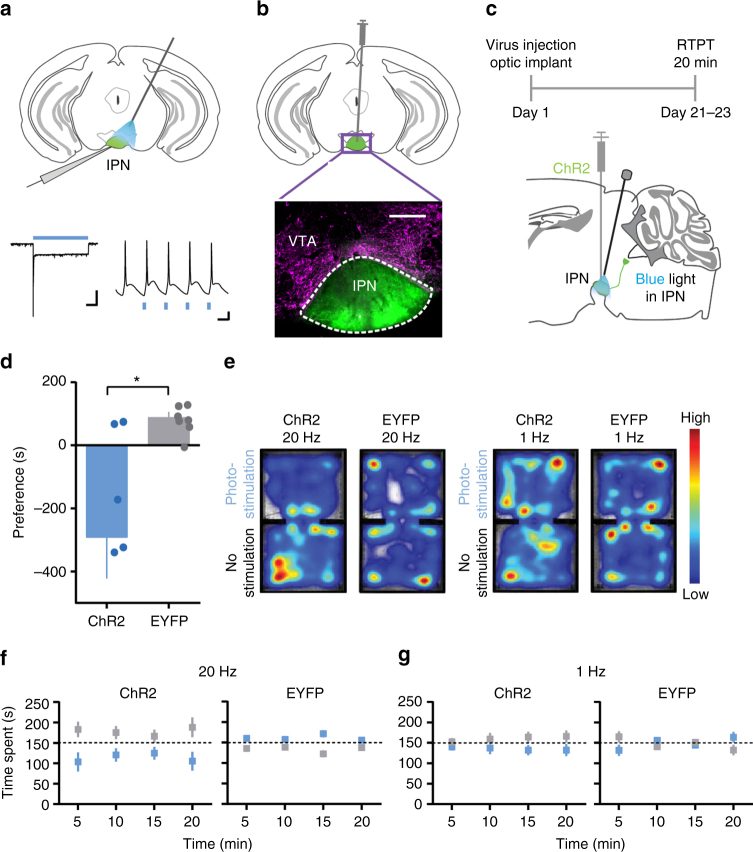
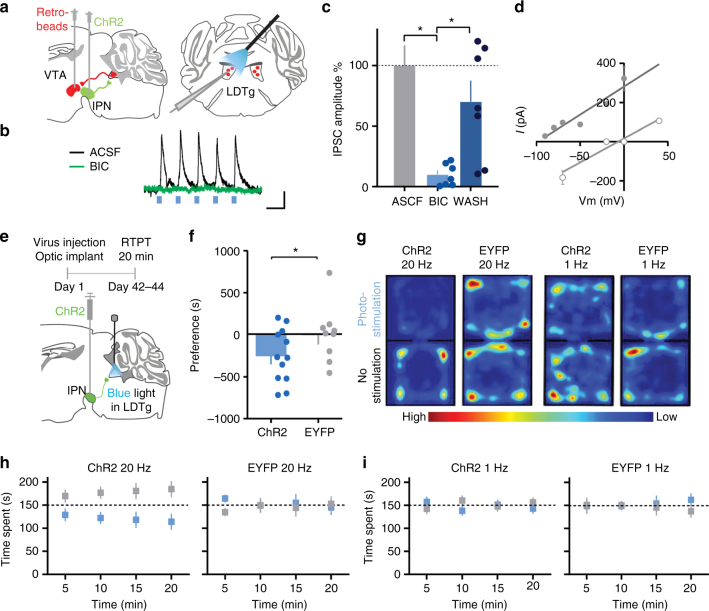
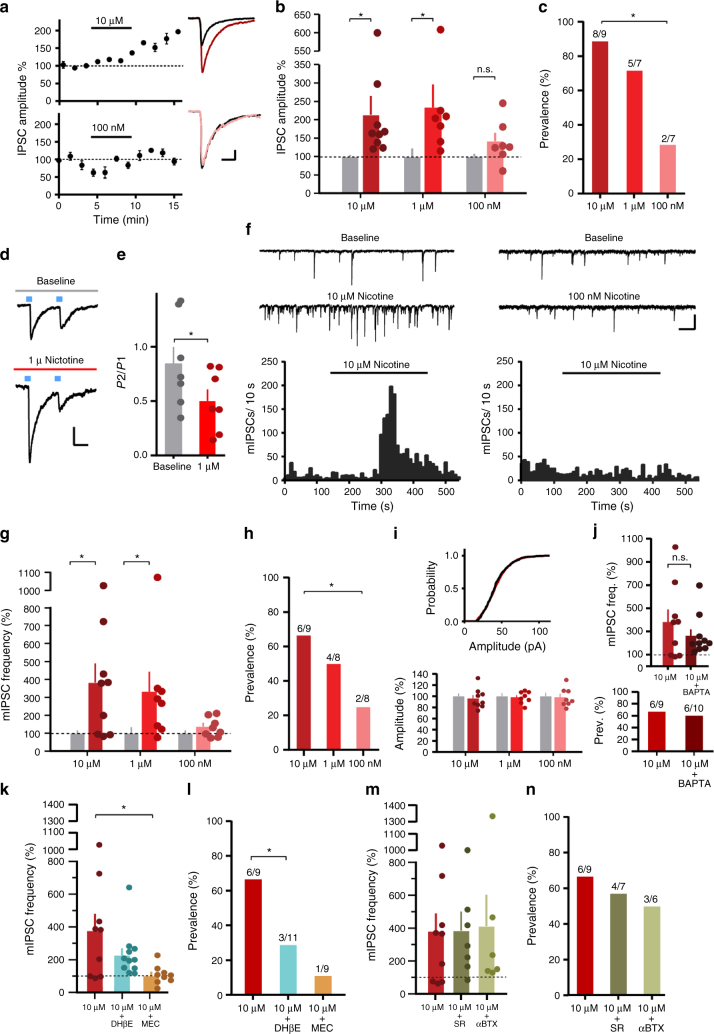
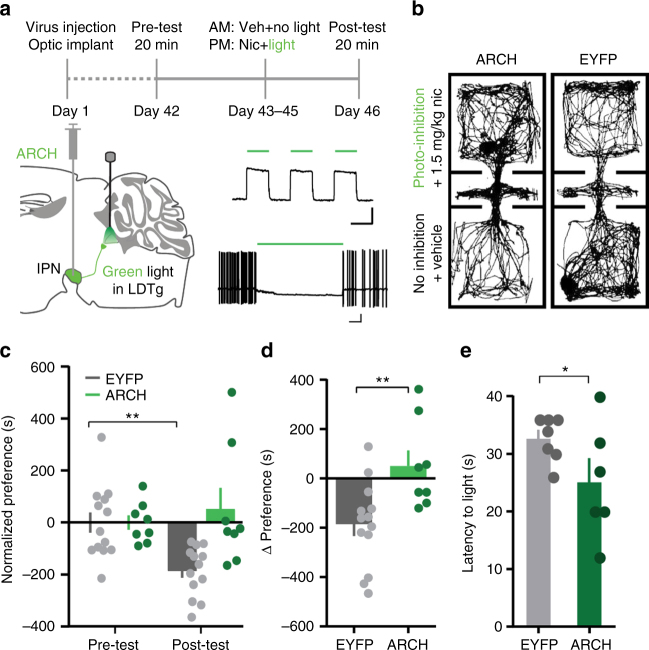
Nicotine use can lead to dependence through complex processes that are regulated by both its rewarding and aversive effects. Recent studies show that aversive nicotine doses activate excitatory inputs to the interpeduncular nucleus (IPN) from the medial habenula (MHb), but the downstream targets of the IPN that mediate aversion are unknown. Here we show that IPN projections to the laterodorsal tegmentum (LDTg) are GABAergic using optogenetics in tissue slices from mouse brain. Selective stimulation of these IPN axon terminals in LDTg in vivo elicits avoidance behavior, suggesting that these projections contribute to aversion. Nicotine modulates these synapses in a concentration-dependent manner, with strong enhancement only seen at higher concentrations that elicit aversive responses in behavioral tests. Optogenetic inhibition of the IPN–LDTg connection blocks nicotine conditioned place aversion, suggesting that the IPN–LDTg connection is a critical part of the circuitry that mediates the aversive effects of nicotine.
Overview
The claims and statistics of this paper haven’t been checked yet.
Free: it reads the open-access text and checks the first 5 claims that cite a source we can check. Create a free account to check every claim.
Integrity signals
Registry
Cites
Statistics
Figures
Verification
Claims the paper makes
The claims and statistics of this paper haven’t been checked yet.
Free: it reads the open-access text and checks the first 5 claims that cite a source we can check. Create a free account to check every claim.
Claims other papers make about this one
Each is checked against this paper’s own text: does it say what the citing paper says it does?
The cited source says what the claim attributes to it.
In the citing paper
“This may reflect late maturation of the medial habenula to lateral dorsal tegmental pathway that underlies nicotine aversion (Wolfman et al., 2018).”
From Unique, long-term effects of nicotine on adolescent brain. (2020) · cites this paper as Wolfman et al., 2018
Self-check
Percentages, sums and reported differences re-computed from the paper’s own numbers.
The self-check needs the paper’s full text.
Citations
Cites
Mammalian nicotinic acetylcholine receptors: from structure to function
Albuquerque, E. X., Pereira, E. F. R., Alkondon, M., & Rogers, S. W. (2009) · Physiological Reviews · doi:10.1152/physrev.00015.2008 · Cited by 1,724
Motulsky, H. J., & Brown, R. E. (2006) · BMC Bioinformatics · doi:10.1186/1471-2105-7-123 · Cited by 1,616
Input-specific control of reward and aversion in the ventral tegmental area
Lammel, S., Lim, B. K., Ran, C., Huang, K. W., Betley, M. J., Tye, K. M., Deisseroth, K., & Malenka, R. C. (2012) · Nature · doi:10.1038/nature11527 · Cited by 1,300
Guidelines on nicotine dose selection for in vivo research
Matta, S. G., Balfour, D. J., Benowitz, N. L., Boyd, R. T., Buccafusco, J. J., Caggiula, A. R., Craig, C. R., Collins, A. C., Damaj, M. I., Donny, E. C., et al. (2007) · Psychopharmacology · doi:10.1007/s00213-006-0441-0 · Cited by 824
Projection-specific modulation of dopamine neuron synapses by aversive and rewarding stimuli
Lammel, S., Ion, D. I., Roeper, J., & Malenka, R. C. (2011) · Neuron · doi:10.1016/j.neuron.2011.03.025 · Cited by 766
Long-term potentiation of excitatory inputs to brain reward areas by nicotine
Mansvelder, H. D., & McGehee, D. S. (2000) · Neuron · doi:10.1016/s0896-6273(00)00042-8 · Cited by 720
Self-citationSynaptic mechanisms underlie nicotine-induced excitability of brain reward areas
Mansvelder, H. D., Keath, J. R., & McGehee, D. S. (2002) · Neuron · doi:10.1016/s0896-6273(02)00625-6 · Cited by 701
Self-citationCRH Engagement of the Locus Coeruleus Noradrenergic System Mediates Stress-Induced Anxiety
McCall, J. G., Al-Hasani, R., Siuda, E. R., Hong, D. Y., Norris, A. J., Ford, C. P., & Bruchas, M. R. (2015) · Neuron · doi:10.1016/j.neuron.2015.07.002 · Cited by 666
Self-citationHabenular α5 nicotinic receptor subunit signalling controls nicotine intake
Fowler, C. D., Lu, Q., Johnson, P. M., Marks, M. J., & Kenny, P. J. (2011) · Nature · doi:10.1038/nature09797 · Cited by 663
Zhao, S., Ting, J. T., Atallah, H. E., Qiu, L., Tan, J., Gloss, B., Augustine, G. J., Deisseroth, K., Luo, M., Graybiel, A. M., et al. (2011) · Nature Methods · doi:10.1038/nmeth.1668 · Cited by 653
Activation of lateral habenula inputs to the ventral midbrain promotes behavioral avoidance
Stamatakis, A. M., & Stuber, G. D. (2012) · Nature Neuroscience · doi:10.1038/nn.3145 · Cited by 564
Nicotine binding and nicotinic receptor subunit RNA after chronic nicotine treatment
Marks, M., Pauly, Jr., Gross, S., Deneris, E., Hermans-Borgmeyer, I., Heinemann, S., & Collins, A. (1992) · The Journal of Neuroscience · doi:10.1523/jneurosci.12-07-02765.1992 · Cited by 551
Cellular and synaptic mechanisms of nicotine addiction
Mansvelder, H. D., & McGehee, D. S. (2002) · Journal of Neurobiology · doi:10.1002/neu.10148 · Cited by 440
Self-citationConstruction of implantable optical fibers for long-term optogenetic manipulation of neural circuits
Sparta, D. R., Stamatakis, A. M., Phillips, J. L., Hovelsø, N., van Zessen, R., & Stuber, G. D. (2012) · Nature Protocols · doi:10.1038/nprot.2011.413 · Cited by 394
Villella, V. R., Esposito, S., Bruscia, E. M., Maiuri, M. C., Raia, V., Kroemer, G., & Maiuri, L. (2013) · Frontiers in Pharmacology · doi:10.3389/fphar.2013.00001 · Cited by 389
Reward, addiction, withdrawal to nicotine
De Biasi, M., & Dani, J. A. (2011) · Annual Review of Neuroscience · doi:10.1146/annurev-neuro-061010-113734 · Cited by 366
Biophysical constraints of optogenetic inhibition at presynaptic terminals
Mahn, M., Prigge, M., Ron, S., Levy, R., & Yizhar, O. (2016) · Nature Neuroscience · doi:10.1038/nn.4266 · Cited by 360
The laterodorsal tegmentum is essential for burst firing of ventral tegmental area dopamine neurons
Lodge, D. J., & Grace, A. A. (2006) · Proceedings of the National Academy of Sciences · doi:10.1073/pnas.0510715103 · Cited by 347
Hu, M.-C., Davies, M., & Kandel, D. B. (2006) · American Journal of Public Health · doi:10.2105/ajph.2004.057232 · Cited by 321
Frahm, S., Ślimak, M. A., Ferrarese, L., Santos-Torres, J., Antolin-Fontes, B., Auer, S., Filkin, S., Pons, S., Fontaine, J.-F., Tsetlin, V., et al. (2011) · Neuron · doi:10.1016/j.neuron.2011.04.013 · Cited by 283
Bruchas, M. R., Schindler, A. G., Shankar, H., Messinger, D. I., Miyatake, M., Land, B. B., Lemos, J. C., Hagan, C. E., Neumaier, J. F., Quintana, A., et al. (2011) · Neuron · doi:10.1016/j.neuron.2011.06.011 · Cited by 267
Self-citationNicotine self-administration in animals and humans: similarities and differences
Rose, J. E., & Corrigall, W. A. (1997) · Psychopharmacology · doi:10.1007/s002130050209 · Cited by 261
Laterodorsal tegmental projections to identified cell populations in the rat ventral tegmental area
Omelchenko, N., & Sesack, S. R. (2005) · The Journal of Comparative Neurology · doi:10.1002/cne.20417 · Cited by 252
Grady, S. R., Moretti, M., Zoli, M., Marks, M. J., Zanardi, A., Pucci, L., Clementi, F., & Gotti, C. (2009) · The Journal of Neuroscience · doi:10.1523/jneurosci.5121-08.2009 · Cited by 222
McLaughlin, I., Dani, J. A., & De Biasi, M. (2017) · Journal of Neurochemistry · doi:10.1111/jnc.14008 · Cited by 218
Nicotine as a reinforcer in human subjects and laboratory animals
Henningfield, J. E., & Goldberg, S. R. (1983) · Pharmacology Biochemistry and Behavior · doi:10.1016/0091-3057(83)90405-7 · Cited by 212
On the development of nicotine dependence in adolescence
Kandel, D. B., Hu, M.-C., Griesler, P. C., & Schaffran, C. (2007) · Drug and Alcohol Dependence · doi:10.1016/j.drugalcdep.2007.04.011 · Cited by 204
GLP-1 acts on habenular avoidance circuits to control nicotine intake
Tuesta, L. M., Chen, Z., Duncan, A., Fowler, C. D., Ishikawa, M., Lee, B. R., Liu, X.-A., Lu, Q., Cameron, M., Hayes, M. R., et al. (2017) · Nature Neuroscience · doi:10.1038/nn.4540 · Cited by 200
Nicotinic Receptor Gene Variants Influence Susceptibility to Heavy Smoking
Stevens, V. L., Bierut, L. J., Talbot, J. T., Wang, J. C., Sun, J., Hinrichs, A. L., Thun, M. J., Goate, A., & Calle, E. E. (2008) · Cancer Epidemiology, Biomarkers & Prevention · doi:10.1158/1055-9965.epi-08-0585 · Cited by 190
Do initial responses to drugs predict future use or abuse?
de Wit, H., & Phillips, T. J. (2012) · Neuroscience & Biobehavioral Reviews · doi:10.1016/j.neubiorev.2012.04.005 · Cited by 176
Zhao-Shea, R., DeGroot, S. R., Liu, L., Vallaster, M., Pang, X., Su, Q., Gao, G., Rando, O. J., Martin, G. E., George, O., et al. (2015) · Nature Communications · doi:10.1038/ncomms7770 · Cited by 165
Nicotine-induced conditioned place preference and conditioned place aversion in mice
Risinger, F. O., & Oakes, R. A. (1995) · Pharmacology Biochemistry and Behavior · doi:10.1016/0091-3057(95)00007-j · Cited by 158
Jackson, K. J., Marks, M. J., Vann, R. E., Chen, X., Gamage, T. F., Warner, J. A., & Damaj, M. I. (2010) · The Journal of Pharmacology and Experimental Therapeutics · doi:10.1124/jpet.110.165738 · Cited by 156
The habenulo-interpeduncular pathway in nicotine aversion and withdrawal
Antolin-Fontes, B., Ables, J. L., Görlich, A., & Ibañez-Tallon, I. (2015) · Neuropharmacology · doi:10.1016/j.neuropharm.2014.11.019 · Cited by 154
Spatiotemporal Control of Opioid Signaling and Behavior
Siuda, E. R., Copits, B. A., Schmidt, M. J., Baird, M. A., Al-Hasani, R., Planer, W. J., Funderburk, S. C., McCall, J. G., Gereau, R. W., & Bruchas, M. R. (2015) · Neuron · doi:10.1016/j.neuron.2015.03.066 · Cited by 146
Self-citationSherva, R., Wilhelmsen, K., Pomerleau, C. S., Chasse, S. A., Rice, J. P., Snedecor, S. M., Bierut, L. J., Neuman, R. J., & Pomerleau, O. F. (2008) · Addiction · doi:10.1111/j.1360-0443.2008.02279.x · Cited by 143
Habenular CB1 Receptors Control the Expression of Aversive Memories
Gómez, E. S., Busquets-García, A., Hu, F., Mehidi, A., Cannich, A., Roux, L., Louit, I., Alonso, L., Wiesner, T., Georges, F. E., et al. (2015) · Neuron · doi:10.1016/j.neuron.2015.08.035 · Cited by 140
Shih, P.-Y., Engle, S. E., Oh, G., Deshpande, P., Puskar, N. L., Lester, H. A., & Drenan, R. M. (2014) · The Journal of Neuroscience · doi:10.1523/jneurosci.0476-14.2014 · Cited by 136
Liu, L., Zhao-Shea, R., McIntosh, J. M., Gardner, P. D., & Tapper, A. R. (2012) · Molecular Pharmacology · doi:10.1124/mol.111.076661 · Cited by 133
VTA CRF neurons mediate the aversive effects of nicotine withdrawal and promote intake escalation
Grieder, T. E., Herman, M. A., Contet, C., Tan, L. A., Vargas-Perez, H., Cohen, A., Chwalek, M., Maal-Bared, G., Freiling, J., Schlosburg, J. E., et al. (2014) · Nature Neuroscience · doi:10.1038/nn.3872 · Cited by 132
Zhao-Shea, R., Liu, L., Pang, X., Gardner, P. D., & Tapper, A. R. (2013) · Current Biology · doi:10.1016/j.cub.2013.09.041 · Cited by 129
Stefanik, M. T., Kupchik, Y. M., Brown, R. M., & Kalivas, P. W. (2013) · The Journal of Neuroscience · doi:10.1523/jneurosci.1570-13.2013 · Cited by 116
Pistillo, F., Clementi, F., Zoli, M., & Gotti, C. (2015) · Progress in Neurobiology · doi:10.1016/j.pneurobio.2014.10.002 · Cited by 114
Lima, L. B., Bueno, D., Leite, F., Souza, S., Gonçalves, L., Furigo, I. C., Donato, J., & Metzger, M. (2017) · The Journal of Comparative Neurology · doi:10.1002/cne.24217 · Cited by 107
Individual differences in nicotine intake per cigarette.
Patterson, F., Benowitz, N. L., Shields, P. G., Kaufmann, V., Jepson, C., Wileyto, P., Kucharski, S., & Lerman, C. E. (2003) · PubMed · Cited by 104
Grady, S. R., Drenan, R. M., Breining, S. R., Yohannes, D., Wageman, C. R., Fedorov, N. B., McKinney, S., Whiteaker, P., Bencherif, M., Lester, H. A., et al. (2010) · Neuropharmacology · doi:10.1016/j.neuropharm.2010.01.013 · Cited by 98
Hsu, Y.-W. A., Tempest, L., Quina, L. A., Wei, A. D., Zeng, H., & Turner, E. E. (2013) · The Journal of Neuroscience · doi:10.1523/jneurosci.2927-13.2013 · Cited by 95
Sartor, C. E., Lessov-Schlaggar, C. N., Scherrer, J. F., Bucholz, K. K., Madden, P. A. F., Pergadia, M. L., Grant, J. D., Jacob, T., & Xian, H. (2010) · Addictive Behaviors · doi:10.1016/j.addbeh.2010.03.004 · Cited by 93
Quina, L. A., Harris, J. A., Zeng, H., & Turner, E. E. (2017) · The Journal of Comparative Neurology · doi:10.1002/cne.24221 · Cited by 93
Chen, L., Hung, R. J., Baker, T. B., Horton, A. C., Culverhouse, R., Saccone, N. L., Cheng, I. C., Deng, B., Han, Y., Hansen, H. M., et al. (2015) · JNCI Journal of the National Cancer Institute · doi:10.1093/jnci/djv100 · Cited by 92
MicroRNA Profiling Reveals Marker of Motor Neuron Disease in ALS Models
Hoye, M. L., Koval, E. D., Wegener, A. J., Hyman, T. S., Yang, C., O'Brien, D. R., Miller, R. L., Cole, T., Schoch, K. M., Shen, T., et al. (2017) · The Journal of Neuroscience · doi:10.1523/jneurosci.3582-16.2017 · Cited by 82
A circuit-based mechanism underlying familiarity signaling and the preference for novelty
Molas, S., Zhao-Shea, R., Liu, L., DeGroot, S. R., Gardner, P. D., & Tapper, A. R. (2017) · Nature Neuroscience · doi:10.1038/nn.4607 · Cited by 73
McCallum, S. E., Cowe, M. A., Lewis, S. W., & Glick, S. D. (2012) · Neuropharmacology · doi:10.1016/j.neuropharm.2012.04.015 · Cited by 71
Lotfipour, S., Byun, J. S., Leach, P., Fowler, C. D., Murphy, N. P., Kenny, P. J., Gould, T. J., & Boulter, J. (2013) · The Journal of Neuroscience · doi:10.1523/jneurosci.4731-12.2013 · Cited by 68
Steidl, S., Wang, H., Ordonez, M., Zhang, S., & Morales, M. (2017) · European Journal of Neuroscience · doi:10.1111/ejn.13436 · Cited by 61
Ables, J. L., Görlich, A., Antolin-Fontes, B., Wang, C., Lipford, S. M., Riad, M. H., Ren, J., Hu, F., Luo, M., Kenny, P. J., et al. (2017) · Proceedings of the National Academy of Sciences · doi:10.1073/pnas.1717506114 · Cited by 61
Sastry, B. R. (1978) · Brain Research · doi:10.1016/0006-8993(78)90168-3 · Cited by 55
Al-Hasani, R., McCall, J. G., & Bruchas, M. R. (2013) · Frontiers in Pharmacology · doi:10.3389/fphar.2013.00096 · Cited by 49
Self-citationGallego, X., Molas, S., Amador‐Arjona, A., Marks, M. J., Robles, N., Murtra, P., Armengol, L., Fernández-Montes, R. D., Gratacòs, M., Pumarola, M. B., et al. (2011) · Amino Acids · doi:10.1007/s00726-011-1149-y · Cited by 48
Ślimak, M. A., Ables, J. L., Frahm, S., Antolin-Fontes, B., Santos-Torres, J., Moretti, M., Gotti, C., & Ibañez-Tallon, I. (2014) · Frontiers in Human Neuroscience · doi:10.3389/fnhum.2014.00012 · Cited by 41
Koppensteiner, P., Melani, R., & Ninan, I. (2017) · Cell Reports · doi:10.1016/j.celrep.2017.07.013 · Cited by 41
Development of Novel Pharmacotherapeutics for Tobacco Dependence: Progress and Future Directions
Harmey, D., Griffin, P. R., & Kenny, P. J. (2012) · Nicotine & Tobacco Research · doi:10.1093/ntr/nts201 · Cited by 37
Hedrick, T. P., Danskin, B. P., Larsen, R. S., Ollerenshaw, D. R., Groblewski, P. A., Valley, M. T., Olsen, S. R., & Waters, J. (2016) · PLoS ONE · doi:10.1371/journal.pone.0156596 · Cited by 31
Regulation of intravenously self-administered nicotine in rats.
Lynch, W. J., & Carroll, M. E. (1999) · Experimental and Clinical Psychopharmacology · doi:10.1037/1064-1297.7.3.198 · Cited by 30
Nicotine reinforcement in never-smokers
Duke, A. N., Johnson, M. W., Reissig, C. J., & Griffiths, R. R. (2015) · Psychopharmacology · doi:10.1007/s00213-015-4053-4 · Cited by 28
Depboylu, C., Rösler, T. W., de Andrade, A., Oertel, W. H., & Höglinger, G. U. (2015) · Journal of Neurochemistry · doi:10.1111/jnc.13026 · Cited by 28
Smolinski, T. G., Buchanan, R., Boratyn, G. M., Milanova, M. G., & Prinz, A. A. (2006) · BMC Bioinformatics · doi:10.1186/1471-2105-7-s2-s8 · Cited by 22
Urbán, R., & Sutfin, E. L. (2010) · Nicotine & Tobacco Research · doi:10.1093/ntr/ntq178 · Cited by 17
Grieder, T. E., George, O., Yee, M., Bergamini, M., Chwalek, M., Maal‐Bared, G., Vargas-Pérez, H., & van der Kooy, D. (2017) · European Journal of Neuroscience · doi:10.1111/ejn.13605 · Cited by 15
Regulation of intravenously self-administered nicotine in rats.
Lynch, W. J., & Carroll, M. E. (1999) · Experimental and Clinical Psychopharmacology · doi:10.1037//1064-1297.7.3.198 · Cited by 14
Research works printed but not linked: 2
- 53. Antolin-Fontes, B., Ables, J. L., Görlich, A. & Ibañez-Tallon, I. The habenulo- interpeduncular pathway in nicotine aversion and withdrawal. Neuropharmacology 96, 213-222 (2014). · DOI · Paper page
- 63. Paxinos, G. & Franklin, K. B. J. The Mouse Brain in Stereotaxic Coordinates (Academic Press, Amsterdam, London, 2008).
Cited by
Nicotinic acetylcholine receptors and nicotine addiction: A brief introduction
Wittenberg, R. E., Wolfman, S. L., De Biasi, M., & Dani, J. A. (2020) · Neuropharmacology · doi:10.1016/j.neuropharm.2020.108256 · Cited by 193
“Furthermore, many of the nAChR subtypes that are important for withdrawal-related behaviors are also expressed in the mesolimbic circuit, and a variety of studies have shown direct and indirect anatomical connections between these aversive and rewarding pathways (Quina et al., 2017; Wolfman et al., 2018; Zhao-Shea et…”
BackgroundSelf-citationUnique, long-term effects of nicotine on adolescent brain.
Leslie, F. M. (2020) · Pharmacology, Biochemistry, and Behavior · doi:10.1016/j.pbb.2020.173010 · Cited by 178
Neurobiological Mechanisms of Nicotine Reward and Aversion
Wills, L., Ables, J. L., Braunscheidel, K. M., Caligiuri, S. P. B., Elayouby, K. S., Fillinger, C., Ishikawa, M., Moen, J. K., & Kenny, P. J. (2022) · Pharmacological Reviews · doi:10.1124/pharmrev.121.000299 · Cited by 121
“…circuit may influence mesoaccumbens dopamine transmission through an indirect mechanism that involves IPn projections to the LDTg. Consistent with this possibility, nicotine stimulates b2* nAChRs on IPn neurons to increase inhibitory GABAergic transmission in LDTg neurons (Wolfman et al., 2018).”
BackgroundNicotine inhibits the VTA-to-amygdala dopamine pathway to promote anxiety
Nguyen, C., Mondoloni, S., Le Borgne, T., Centeno, I., Come, M., Jehl, J., Solié, C., Reynolds, L. M., Durand-de Cuttoli, R., Tolu, S., et al. (2021) · Neuron · doi:10.1016/j.neuron.2021.06.013 · Cited by 136
DeGroot, S. R., Zhao-Shea, R., Chung, L., Klenowski, P. M., Sun, F., Molas, S., Gardner, P. D., Li, Y., & Tapper, A. R. (2020) · Biological Psychiatry · doi:10.1016/j.biopsych.2020.06.018 · Cited by 87
Metadata
- Authors
- Wolfman, S. L., Gill, D. F., Bogdanic, F., Long, K., Al-Hasani, R., McCall, J. G., Bruchas, M. R., & McGehee, D. S.
- Affiliations
- University of Chicago (US)
- University of Health Sciences and Pharmacy (US)
- Washington University in St. Louis (US)
- Corresponding author
- McGehee, Daniel S.
- ORCID
- Venue
- Nature Communications
- Published
- 2018-07-13
- Volume
- 9
- Issue
- 1
- Pages
- 2710-2710
- ISSN
- 2041-1723 (ISSN-L)
- PMC
- PMC6045623
- OpenAlex
- W2831267268
- Cited by
- 81
- References
- 70
- Citations by year
- 2026: 7 · 2025: 17 · 2024: 10 · 2023: 6 · 2022: 8 · 2021: 9 · 2020: 15 · 2019: 8
- FWCI
- 2.84
- Type
- journal article
- Language
- en
- Open access
- gold
- doi.org
- Licence
- cc-by
- creativecommons.org/licenses/by/4.0 (tdm)
- creativecommons.org/licenses/by/4.0 (vor)
- Locations
- Nature Communications (publishedVersion, cc-by)
- Europe PMC (PubMed Central) (publishedVersion, other-oa)
- PubMed Central (publishedVersion, cc-by)
- PubMed (publishedVersion)
- Digital Commons@Becker (Washington University School of Medicine) (submittedVersion, cc-by)
- RePEc: Research Papers in Economics (submittedVersion)
- DOAJ (DOAJ: Directory of Open Access Journals) (submittedVersion)
- DOAJ (DOAJ: Directory of Open Access Journals) (submittedVersion, cc-by-sa)
- Funders
- National Institutes of Health (DA033396)
- National Institute on Drug Abuse (R01DA036978, R01DA033396, K99DA038725, R00DA038725, R37DA033396)
- Topics
- Life Sciences › Biochemistry, Genetics and Molecular Biology › Molecular Biology › Nicotinic Acetylcholine Receptors Study
- Life Sciences › Neuroscience › Cellular and Molecular Neuroscience › Neurotransmitter Receptor Influence on Behavior
- Life Sciences › Neuroscience › Cellular and Molecular Neuroscience › Neuroscience and Neuropharmacology Research
- Keywords
- nicotine aversion, interpeduncular nucleus, laterodorsal tegmentum, GABAergic projections, nicotine dependence, conditioned place aversion, avoidance behavior, medial habenula
- MeSH terms
- Channelrhodopsins, Animals, Avoidance Learning, Electrodes, Implanted, Male, Mice, Inbred C57BL, Neural Pathways, Nicotine, Reward, Stereotaxic Techniques, Synapses, Tegmentum Mesencephali, Gene Expression, Transgenes, Habenula, Mice, GABAergic Neurons, Optogenetics, Interpeduncular Nucleus
About these checks
Registry, retraction, Cites and statistics results are computed, not judged, with one exception: a printed reference that no index lists is read once by a model before it counts as a citation error. Claims are extracted by a model and kept only when their quote appears verbatim in the text; each cited source is then checked, with a model’s help, for whether it says what the claim relies on. Those verdicts can be wrong — read the claim’s quote and the cited source before relying on one.
Statistics and arithmetic are recomputed, not judged.
Confidence bands are shown only for fields calibrated on our annotated test set. None is calibrated yet, so no band is shown.
What counts as a claim ›How we measure confidence ›How we check this ›
Are you an author, or do you see a problem with this page? Request a review
Data sources
Bibliographic data: Semantic Scholar, OpenAlex, Crossref.
Contains information from the Semantic Scholar Academic Graph Datasets, made available under the ODC Attribution License (ODC-BY 1.0).
Semantic Scholar’s data is described in: Kinney, R., et al. (2023). The Semantic Scholar Open Data Platform. arXiv:2301.10140.
