

Neuromorphic computing with multi-memristive synapses
Open accessThe DOI matches its Crossref record; 66 of the 67 references it cites were found in a registry or an index; 8 of the 30 sources its claims cite were checked for support.
Abstract
Neuromorphic computing has emerged as a promising avenue towards building the next generation of intelligent computing systems. It has been proposed that memristive devices, which exhibit history-dependent conductivity modulation, could efficiently represent the synaptic weights in artificial neural networks. However, precise modulation of the device conductance over a wide dynamic range, necessary to maintain high network accuracy, is proving to be challenging. To address this, we present a multi-memristive synaptic architecture with an efficient global counter-based arbitration scheme. We focus on phase change memory devices, develop a comprehensive model and demonstrate via simulations the effectiveness of the concept for both spiking and non-spiking neural networks. Moreover, we present experimental results involving over a million phase change memory devices for unsupervised learning of temporal correlations using a spiking neural network. The work presents a significant step towards the realization of large-scale and energy-efficient neuromorphic computing systems.
Overview
CoChat Summary
TL;DR
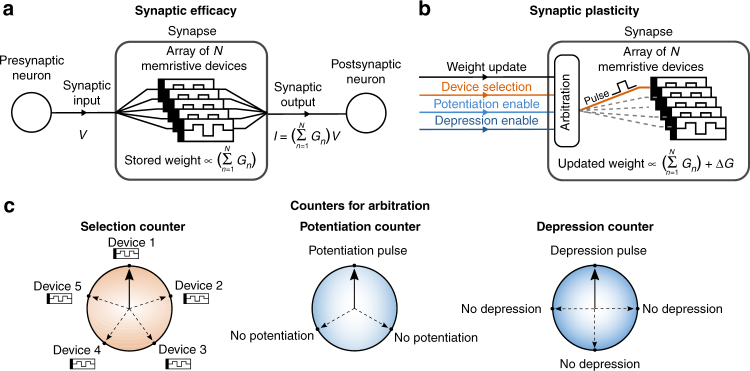
The paper proposes a multi-memristive synapse architecture that uses multiple memristive devices per synapse plus a counter-based arbitration scheme to improve dynamic range, resolution, and robustness for neuromorphic learning. It demonstrates the idea with PCM devices in simulations and in experiments on more than one million devices, including unsupervised temporal-correlation detection.
Key findings
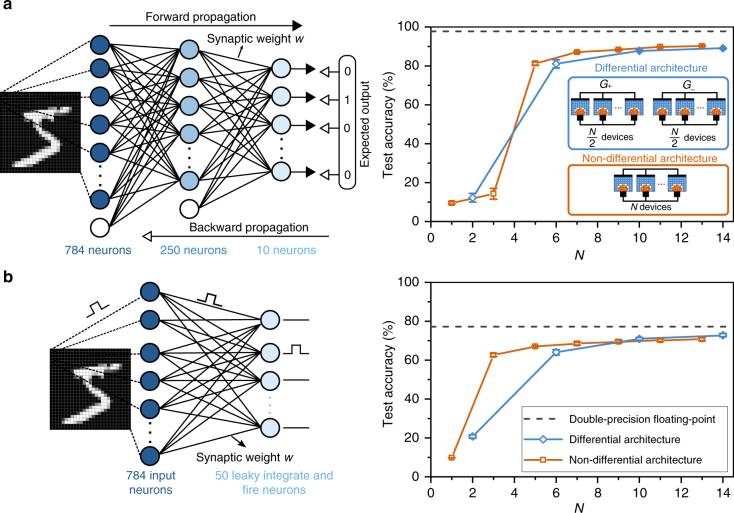
- In MNIST simulations for an ANN, the ideal floating-point classifier achieved 97.8% accuracy, while multi-memristive synapses reached >88.9% in the differential architecture and >90% in the non-differential architecture; the conventional 2-device differential architecture stayed below 15%.
- In MNIST simulations for an SNN with unsupervised learning, the floating-point baseline achieved 77.2% accuracy; the network with multi-memristive synapses achieved >70% correct classification for N > 9, while the conventional 2-device differential architecture was below 21%.
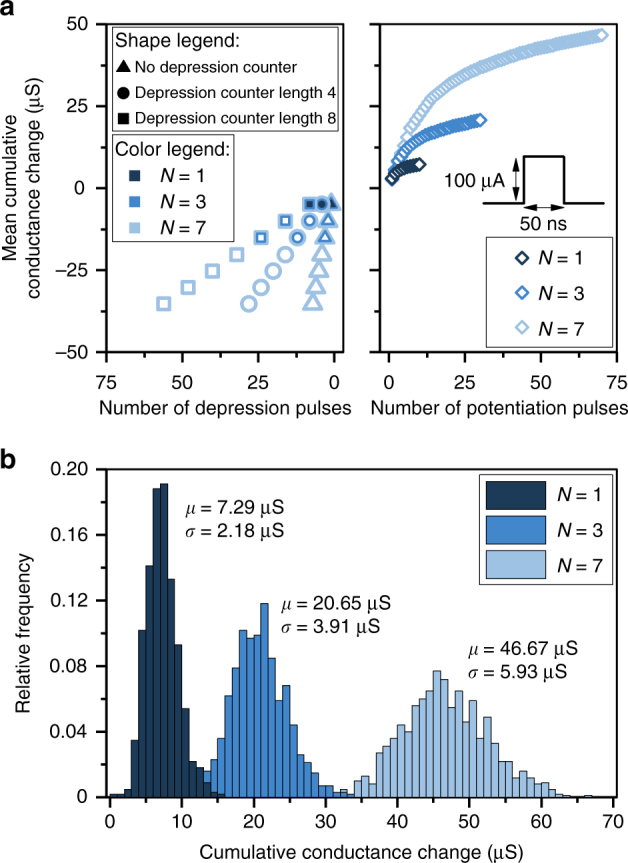
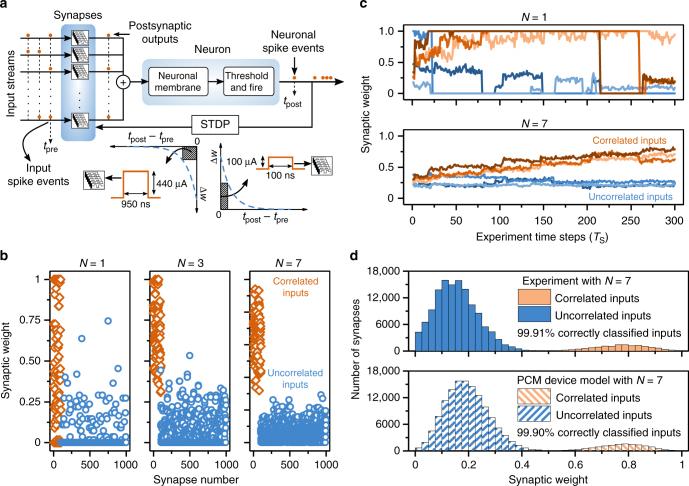
- In the small-scale temporal-correlation experiment, the number of misclassified inputs was 49 for N = 1, 8 for N = 3, and 0 for N = 7.
- In the large-scale temporal-correlation experiment, 144,000 synapses with 7 PCM devices per synapse used 1,008,000 PCM devices total, and the experiment and simulation each reported about 0.1% misclassified inputs after training.
Methods
- The paper combines device characterization, analytical modeling, simulations, and hardware experiments using a prototype PCM chip with 3 million devices in a four-bank inter-leaved architecture fabricated in 90 nm CMOS.
- For simulation, the authors trained an ANN on 60,000 MNIST training images and tested on 10,000 MNIST test images; they also simulated an SNN for MNIST and an SNN for temporal-correlation detection using STDP-based learning rules.
- The hardware correlation-detection experiment trained an SNN on 1000 synapses in the small-scale case and 144,000 synapses in the large-scale case, with some synapses receiving correlated inputs at correlation coefficient 0.75.
Limitations
- The paper states that PCM devices have limiting characteristics including limited conductance range, asymmetric conductance response, nonlinear conductance response, stochasticity, and device-to-device variability.
- The text makes evident that the scheme still relies on counter-based arbitration and may produce weight-dependent plasticity because device selection does not use exact conductance knowledge; the paper notes this could negatively affect ANN accuracy, though it may stabilize some SNNs.
- The paper also states that its experimental data are available upon request only, which may limit immediate reproducibility from the text alone.
Model-written summary. Check it against the paper before relying on it.
Integrity signals
Registry
Cites
Statistics
Figures
Verification
Claims the paper makes
6 Valid · 1 Not valid · 15 Not checked · 68 Own results and interpretations
Every source the paper cites for this claim was checked and supports it.
In the paper
“Such a strongly asymmetric conductance response is undesirable in memristive-device-based implementations of neural networks44”
§ Neuromorphic computing with multi-memristive synapses > Results > Multi-memristive synapses based on PCM devices
What the sources say
- Supportedcites [44] Gokmen T Vlasov Y Acceleration of deep neural network training with resistive cross-point devices: design considerations Front. Neurosci. 2016 10 333 10.3389/fnins.2016.00333 27493624 PMC4954855 source
The Introduction identifies asymmetrical set and reset operations as a limitation for accelerating neural-network training. The Results (“Derivation of RPU device specifications”) find that upward and downward conductance changes must be closely balanced to keep the training error penalty acceptable. The paper notes that global asymmetry can be compensated by adjusting pulses. (LLM, conf=0.90)
boosted- Asserted: passes — The authors put it forward as true.
- Checkable: passes — It can be checked against evidence.
- Load-bearing: passes — The paper’s conclusions depend on it.
- Based: passes — The paper gives a reason why it holds.
- Supported
The cited sources support only part of this claim — read each source’s verdict below.
In the paper
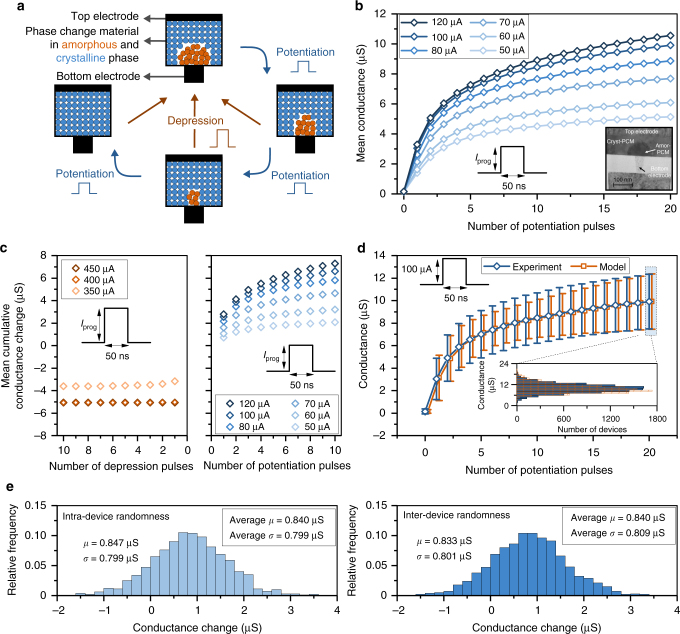
“Large conductance change granularities, as well as nonlinear conductance responses, both observed in the PCM characterization performed here, have been shown to degrade the performance of neural networks trained with memristive synapses34,43.”
§ Neuromorphic computing with multi-memristive synapses > Results > Multi-memristive synapses based on PCM devices
What the sources say
- Not checked — no full text of the sourcecites [34] Burr GW Experimental demonstration and tolerancing of a large-scale neural network (165 000 synapses) using phase-change memory as the synaptic weight element IEEE Trans. Electron Dev. 2015 62 3498 3507 10.1109/TED.2015.2439635 source
- Partly supportedcites [43] Boybat, I. et al. Stochastic weight updates in phase-change memory-based synapses and their influence on artificial neural networks. In Proc. Ph.D. Research in Microelectronics and Electronics (PRIME), 13–16 (IEEE, Giardini Naxos, Italy, 2017). sourceExperimental — accuracy not yet measured
Our copy supports the granularity half: Section II.C states that 'the minimal mean conductance change that can be induced can be quite large especially for low values of device conductance... implies a granularity of possible weight updates in a PCM synapse', and the abstract/introduction (Section I) frame the paper as quantifying the effect of experimentally observed conductance-change granularity (and stochasticity) on classification accuracies, noting that 'non-ideal device characteristics pose challenges to reach competitive classification accuracies'. The nonlinear-conductance-response half is not in this paper at all: our copy's stated scope is explicitly limited to 'two aspects: the granularity of weight updates and the update randomness', and searches for nonlinearity, asymmetry or potentiation/depression returned no passage. The attributed claim that nonlinear responses degrade network performance therefore rests on the other citation(s), not on Boybat et al. (2017). (LLM, conf=0.75)
boostedstates a cause- Asserted: passes — The authors put it forward as true.
- Checkable: passes — It can be checked against evidence.
- Load-bearing: passes — The paper’s conclusions depend on it.
- Based: passes — The paper gives a reason why it holds.
Every source the paper cites for this claim was checked and supports it.
In the paper
“Memristive crossbars can also be fabricated with very small areal footprint27,29,60.”
§ Neuromorphic computing with multi-memristive synapses > Discussion
What the sources say
- Supportedcites [27] Alibart F Zamanidoost E Strukov DB Pattern classification by memristive crossbar circuits using ex situ and in situ training Nat. Commun. 2013 4 2072 10.1038/ncomms3072 23797631 source
The Abstract says memristors’ simple structure allows crossbar integration and aggressive size scaling. It also reports sub-10-nm devices, supporting the claim that memristive crossbars can have a very small areal footprint. Page numbers are not provided in our copy. (LLM, conf=0.91)
- Supportedcites [29] Prezioso M Training and operation of an integrated neuromorphic network based on metal-oxide memristors Nature 2015 521 61 64 10.1038/nature14441 25951284 source
The paper reports fabricating an integrated 12×12 memristive crossbar (Memristor Fabrication, Forming and Characterization, p. 3). It also describes the crossbar topology as capable of extremely high areal density and gives a 30-nm-pitch example (main text, p. 2), supporting the general claim of a small areal footprint. (LLM, conf=0.87)
- Supportedcites [60] Eryilmaz SB Brain-like associative learning using a nanoscale non-volatile phase change synaptic device array Front. Neurosci. 2014 8 205 10.3389/fnins.2014.00205 25100936 PMC4106403 source
The Introduction says nanoscale non-volatile memory devices can be scaled to nanometer dimensions, enabling dense synaptic arrays because of their small feature sizes. The paper also describes its PCM cells as connected in a crossbar fashion (Phase change memory cell array for synaptic operation). Together, these passages support the general claim that such crossbar arrays can have a small areal footprint; the paper does not quantify the footprint of its array. (LLM, conf=0.86)
plain- Asserted: passes — The authors put it forward as true.
- Checkable: passes — It can be checked against evidence.
- Load-bearing: unclear — It is unclear whether the paper’s conclusions depend on it.
- Based: passes — The paper gives a reason why it holds.
- Supported
A result the paper reports from its own data — it cites no other source for it, so there is none to check. The quote shows it is in the paper.
In the paper
“These experiments show that the standard deviation of the conductance change due to intra-device variability is almost as large as that due to the inter-device variability.”
§ Neuromorphic computing with multi-memristive synapses > Results > Multi-memristive synapses based on PCM devices
plain- Asserted: passes — The authors put it forward as true.
- Checkable: passes — It can be checked against evidence.
- Load-bearing: passes — The paper’s conclusions depend on it.
- Based: passes — The paper gives a reason why it holds.
A result the paper reports from its own data — it cites no other source for it, so there is none to check. The quote shows it is in the paper.
In the paper
“Moreover, the fact that the non-differential architecture achieves a comparable performance to that of the differential architecture is promising for synaptic realizations using highly asymmetric devices.”
§ Neuromorphic computing with multi-memristive synapses > Results > Simulation results on handwritten digit classification
plain- Asserted: passes — The authors put it forward as true.
- Checkable: passes — It can be checked against evidence.
- Load-bearing: passes — The paper’s conclusions depend on it.
- Based: passes — The paper gives a reason why it holds.
- Rests on an assumption not shown here.
55 more claims
Create a free account to see all 90 claims and to verify the 2 references still open.
- It may state two separate claims as one. 18
- Borderline: one of the tests for a substantial claim is unclear. 1
- The quote only partly states this claim. 1
- Probably not a substantial claim. 13
Claims other papers make about this one
Each is checked against this paper’s own text: does it say what the citing paper says it does?
The cited source says what the claim attributes to it.
In the citing paper
“Multibit weights are composed of low-bit weights 33 through the cooperation of peripheral circuits.”
From A computing-in-memory macro based on three-dimensional resistive random-access memory (2022) · cites this paper as [33]
Citations
Cites
LeCun, Y., Bengio, Y., & Hinton, G. (2015) · Nature · doi:10.1038/nature14539 · Cited by 84,126
Gradient-based learning applied to document recognition
Lecun, Y., Bottou, L., Bengio, Y., & Haffner, P. (1998) · Proceedings of the IEEE · doi:10.1109/5.726791 · Cited by 58,805
Learning representations by back-propagating errors
Rumelhart, D. E., Hinton, G. E., & Williams, R. J. (1986) · Nature · doi:10.1038/323533a0 · Cited by 31,892
Parallel Distributed Processing: Explorations in the Microstructure of Cognition: Foundations
Rumelhart, D. E., McClelland, J. L., & AU (1986) · doi:10.7551/mitpress/5236.001.0001 · Cited by 15,686
Strukov, D. B., Snider, G. S., Stewart, D. R., & Williams, R. S. (2008) · Nature · doi:10.1038/nature06932 · Cited by 11,828
A million spiking-neuron integrated circuit with a scalable communication network and interface
Merolla, P. A., Arthur, J. V., Alvarez-Icaza, R., Cassidy, A. S., Sawada, J., Akopyan, F., Jackson, B. L., Imam, N., Guo, C., Nakamura, Y., et al. (2014) · Science · doi:10.1126/science.1254642 · Cited by 4,147
Malenka, R. C., & Bear, M. F. (2004) · Neuron · doi:10.1016/j.neuron.2004.09.012 · Cited by 3,968
Regulation of Synaptic Efficacy by Coincidence of Postsynaptic APs and EPSPs
Markram, H., Lübke, J., Frotscher, M., & Sakmann, B. (1997) · Science · doi:10.1126/science.275.5297.213 · Cited by 3,832
Training and operation of an integrated neuromorphic network based on metal-oxide memristors
Prezioso, M., Merrikh-Bayat, F., Hoskins, B. D., Adam, G. C., Likharev, K. K., & Strukov, D. B. (2015) · Nature · doi:10.1038/nature14441 · Cited by 3,001
Competitive Hebbian learning through spike-timing-dependent synaptic plasticity
Song, S., Miller, K. D., & Abbott, L. F. (2000) · Nature Neuroscience · doi:10.1038/78829 · Cited by 2,729
Research works printed but not linked: 1
- Indiveri G Linares-Barranco B Legenstein R Deligeorgis G Prodromakis T Integration of nanoscale memristor synapses in neuromorphic computing architectures Nanotechnology 2013 24 384010 10.1088/0957-4484/24/38/384010 23999381 · DOI · Paper page
Cited by
Items 401–500 of 896
Device‐System End‐to‐End Design of Photonic Neuromorphic Processor Using Reinforcement Learning
Tang, Y., Zamani, P. T., Chen, R., Ma, J., Qi, M., Yu, C., & Gao, W. (2022) · Laser & Photonics Review · doi:10.1002/lpor.202200381 · Cited by 16
An, Y.-J., Yan, H., Yeom, C.-M., Jeong, J.-K., Eadi, S. B., Lee, H., & Kwon, H.-M. (2024) · Nanoscale · doi:10.1039/d3nr04917e · Cited by 15
Lim, E., Ju, D., Lee, J. W., Park, Y., Kim, M.-H., & Kim, S. (2024) · ACS Materials Letters · doi:10.1021/acsmaterialslett.3c01587 · Cited by 16
Implementing the analogous neural network using chaotic strange attractors
Kesgin, B. U., & Teğin, U. (2024) · Communications Engineering · doi:10.1038/s44172-024-00242-z · Cited by 24
“Optical computing methods 6 – 8 and electronic memristive devices 9 – 11 were introduced as powerful reservoir computing platforms.”
BackgroundNitrogen-doped carbon quantum dot-decorated In2O3 synaptic transistors for neuromorphic computing
Zahid, M., Sadiq, M. I., Jin, C., Wang, J., Shi, X., Liu, W., Aslam, F., Xu, Y., Tahir, M., Yang, J., et al. (2024) · Applied Physics Letters · doi:10.1063/5.0231655 · Cited by 15
Photoexcitation Induced Ultrafast Nonthermal Amorphization in Sb2Te3
Tiwari, S., Kalia, R. K., Nakano, A., Shimojo, F., Vashishta, P. D., & Branicio, P. S. (2020) · The Journal of Physical Chemistry Letters · doi:10.1021/acs.jpclett.0c02521 · Cited by 15
Mah, W. L. W., Kumar, D., Jin, T., & Piramanayagam, S. N. (2021) · Journal of Magnetism and Magnetic Materials · doi:10.1016/j.jmmm.2021.168131 · Cited by 16
Kabir, S., Nirantar, S., Monshipouri, M., et al. (2021) · Advanced Electronic Materials · doi:10.1002/aelm.202100428 · Cited by 15
4K-Memristor Analog-Grade Passive Crossbar CircuitPreprint
Kim, H., Nili, H., Mahmoodi, M., et al. (2019) · arXiv (Cornell University) · doi:10.48550/arxiv.1906.12045 · Cited by 15
“Analog-grade nonvoltaile memories, such as those based on floating-gate transistor [13], and phase-change [4-6], ferroelectric [7, 8], magnetic [9], solid-state electrolyte [10, 11], organic [12], and metal-oxide [13-21] materials, are enabling components for mixed-signal circuits implementing vector-by-martix multipl…”
BackgroundShooshtari, M., Kim, S., Pahlavan, S., Serrano‐Gotarredona, T., Bisquert, J., & Linares-Barranco, B. (2026) · ACS Applied Materials & Interfaces · doi:10.1021/acsami.5c21545 · Cited by 17
A dynamic AES cryptosystem based on memristive neural network
Liu, Y. A., Chen, L., Liu, Y., Liu, Y. L., Hu, S. G., Yu, Q., Chen, T. P., & Liu, Y. (2022) · Scientific Reports · doi:10.1038/s41598-022-13286-y · Cited by 19
1S1R Optimization for High‐Frequency Inference on Binarized Spiking Neural Networks
Lopez, J. M., Rafhay, Q., Dampfhoffer, M., Reganaz, L., Castellani, N., Meli, V., Martin, S., Grenouillet, L., Navarro, G., Magis, T., et al. (2022) · Advanced Electronic Materials · doi:10.1002/aelm.202200323 · Cited by 16
Choi, H.-S., Lee, Y.-J., Park, H., & Cho, W.-J. (2022) · International Journal of Molecular Sciences · doi:10.3390/ijms232415901 · Cited by 17
Graphene-based RRAM devices for neural computing
Rajalekshmi, T. R., Das, R. R., Reghuvaran, C., & James, A. P. (2023) · Frontiers in Neuroscience · doi:10.3389/fnins.2023.1253075 · Cited by 16
“When memristive devices are used as synapses in a neural network, their resistance values change over time in response to the input signals that they receive [21].”
BackgroundCao, Z., Sun, B. T., Mao, S., Zhou, G., Duan, X., Yan, W., Sun, S., Chen, X., & Shao, J. (2023) · Materials Today Physics · doi:10.1016/j.mtphys.2023.101264 · Cited by 14
Bakhshi, T., & Zafar, S. (2023) · Sensors · doi:10.3390/s23218972 · Cited by 16
Quantized Magnetic Domain Wall Synapse for Efficient Deep Neural Networks
Dhull, S., Misba, W. A., Nisar, A., Atulasimha, J., & Kaushik, B. K. (2024) · IEEE Transactions on Neural Networks and Learning Systems · doi:10.1109/tnnls.2024.3369969 · Cited by 19
“Multiple devices per synapse have been used to increase the precision and address the nonlinearity of the conductance response [43], [44], [45].”
High-performance artificial synapses based on two-dimensional MoSe 2 powder with Se vacancies
Chen, X., Li, D., Luo, F., Wu, Y., Tian, F., & Zhang, X. (2024) · Journal of Materials Chemistry C · doi:10.1039/d4tc00396a · Cited by 13
Reducible-dimension discrete memristive chaotic map
Li, K., Wang, Q., Zheng, Q., Yu, X., Liang, B., & Tian, Z. (2024) · Nonlinear Dynamics · doi:10.1007/s11071-024-10226-5 · Cited by 15
“Memristors hold significant research significance in the development of artificial neural networks [4, 5] and neuromorphic computing [6, 7].”
Electroforming-free resistive switching in yttrium manganite thin films by cationic substitution
Rayapati, V. R., Bürger, D., Du, N., Patra, R., Skorupa, I., Blaschke, D., Stöcker, H., Matthes, P., Schulz, S. E., & Schmidt, H. (2019) · Journal of Applied Physics · doi:10.1063/1.5094748 · Cited by 14
Bio-mimetic synaptic plasticity and learning in a sub-500 mV Cu/SiO2/W memristor
Nandakumar, S. R., & Rajendran, B. (2020) · Microelectronic Engineering · doi:10.1016/j.mee.2020.111290 · Cited by 13
Self-citationHan, C., Li, Y., Zhang, Z. X., Liu, W., Li, X., Guo, X., Wan, J., Zhang, G. H., Wang, X. L., & Lin, Q. (2021) · Organic Electronics · doi:10.1016/j.orgel.2021.106118 · Cited by 14
Fully Unsupervised Spike-Rate-Dependent Plasticity Learning With Oxide- Based Memory Devices
Kumar, M., Bezugam, S. S., Khan, S., & Suri, M. (2021) · IEEE Transactions on Electron Devices · doi:10.1109/ted.2021.3077346 · Cited by 17
“Table I benchmarks the current work with other RRAM/memristor-based SRDP [7], [20]–[23] and STDP [31], [37]–[40] works presented in the literature.”
MethodDNA Memristors and Their Application to Reservoir Computing
Liu, X., & Parhi, K. K. (2022) · ACS Synthetic Biology · doi:10.1021/acssynbio.2c00184 · Cited by 16
Zayer, F., Dghais, W., & Hamdi, B. (2019) · Journal of Physics D Applied Physics · doi:10.1088/1361-6463/ab24a7 · Cited by 16
“…for resistive switching layers in memory devices, such as TiO 2 , HfO 2 , Ta 2 O 5 , WO 3 [17 – 26] for metal oxides ReRAM devices; GaSbGe, GST, GeTe/SbTe, graphene [27 – 33] for phase change memory devices; and SiO 2 , Zr, ZnO:Cr doped HfO 2 , and perovskites [34 – 39] for ferroelectric memories.”
BackgroundWang, Z., Hong, Q., & Wang, X. (2020) · IEEE Transactions on Computational Biology and Bioinformatics · doi:10.1109/tcbb.2020.2974944 · Cited by 15
On-Chip Photonic Synapses Based on Slot-Ridge Waveguides With PCMs For In-Memory Computing
Zhang, H., Huang, B., Zhang, Z., Cheng, C., Zhang, Z., Zhang, H., Chen, R., & Chen, H. (2021) · IEEE photonics journal · doi:10.1109/jphot.2021.3066500 · Cited by 17
Kang, H., Kim, H. W., Hong, E. R., & Woo, J. (2022) · Applied Physics Letters · doi:10.1063/5.0086164 · Cited by 14
Solution-based manufacturing of 2D materials for memristive device applications
Nam, K., Kim, G. Y., Rhee, D., Park, H., Jariwala, D., & Kang, J. (2025) · International Journal of Extreme Manufacturing · doi:10.1088/2631-7990/add634 · Cited by 22
“These analog resistive switching characteristics facilitate the mimicking of synaptic plasticity in biological neural networks, thereby supporting the hardware implementation of artificial neural networks [19, 20, 28, 29] .”
Modeling of a memristor-coupled neural circuit with piezoelectric channel
Zhao, L., Guo, Y., Ma, J., & Wang, C. (2025) · Chaos Solitons & Fractals · doi:10.1016/j.chaos.2025.117384 · Cited by 16
Technology Roadmap of Bioinspired Computing Hardware
Wang, S., Li, Z., Pei, M., Ren, Q., Deng, M., Kah-Wee, A., Ascoli, A., Banerjee, S., Bonnin, M., van de Burgt, Y., et al. (2026) · ACS Nano · doi:10.1021/acsnano.5c17087 · Cited by 20
Shin, U., Ishii, M., Okazaki, A., Ito, M., Rasch, M. J., Kim, W., Nomura, A., Choi, W., Koh, D., Hosokawa, K., et al. (2022) · Advanced Intelligent Systems · doi:10.1002/aisy.202200034 · Cited by 13
Multistate Compound Magnetic Tunnel Junction Synapses for Digital Recognition
Kumar, A., Lin, D. J. X., Das, D., Huang, L., Yap, S. L. K., Tan, H. R., Tan, H. K., Lim, R. J. J., Toh, Y. T., Chen, S., et al. (2024) · ACS Applied Materials & Interfaces · doi:10.1021/acsami.3c17195 · Cited by 20
ADS-CNN: Adaptive Dataflow Scheduling for lightweight CNN accelerator on FPGAs
Wan, Y., Xie, X., Chen, J., Xie, K., Yi, D., Lu, Y., & Gai, K. (2024) · Future Generation Computer Systems · doi:10.1016/j.future.2024.04.038 · Cited by 16
Metallopolymeric Memristor Based Artificial Optoelectronic Synapse for Neuromorphic Computing
Cheng, X., Qin, Z., Guo, H., Dou, Z., Lian, H., Fan, J., Qu, Y., & Dong, Q. (2024) · ACS Applied Electronic Materials · doi:10.1021/acsaelm.4c00427 · Cited by 14
Exploring the potential of 2D PtTe2-based memristors for neuromorphic computing
Lian, X., Zhang, X., Li, S., Ding, B., Jiang, J., Zhang, Y., Guo, Y., Cai, Z., & Wang, L. (2025) · Applied Physics Letters · doi:10.1063/5.0244591 · Cited by 13
Xie, X., Wen, S., Yan, Z., Huang, T., & Chen, Y. (2020) · Neural Computing and Applications · doi:10.1007/s00521-020-04752-7 · Cited by 12
“As an important component of neuromorphic computing system, one of the most ideal applications of memristor is to combine with spiking neural network (SNN) [4].”
BackgroundPhase synchronization of memristive systems by using saturation gain method
Ma, S., Zhou, P., Ma, J., & Wang, C. (2020) · International Journal of Modern Physics B · doi:10.1142/s0217979220500745 · Cited by 13
Beom, K., Han, J., Kim, H.-M., & Yoon, T. (2021) · Nanoscale · doi:10.1039/d1nr02911h · Cited by 13
Nikam, R. D., Lee, J., Choi, W., Kim, D., & Hwang, H. (2022) · ACS Nano · doi:10.1021/acsnano.2c02913 · Cited by 14
Non-volatile memory characteristics of a Ti/HfO2/Pt synaptic device with a crossbar array structure
Kwon, O., Kim, S., Викторович, А. Н., Krichigin, A. V., Mikhaylov, A. N., Grimaudo, R., Valenti, D., & Spagnolo, B. (2022) · Chaos Solitons & Fractals · doi:10.1016/j.chaos.2022.112480 · Cited by 13
Tailor-made synaptic dynamics based on memristive devices
Bengel, C., Zhang, K., Mohr, J., Ziegler, T., Wiefels, S., Waser, R. M., Wouters, D. J., & Menzel, S. (2023) · Frontiers in Electronic Materials · doi:10.3389/femat.2023.1061269 · Cited by 15
“Generally speaking, for single devices VCM and PCM devices enable a more gradual tuning of the resistance states, while STT-MRAM and ECM switch more abruptly (Burr et al. (2017)).”
BackgroundInfluentialOptimization of Projected Phase Change Memory for Analog In‐Memory Computing Inference
Li, N., Mackin, C., Chen, A., Brew, K. W., Philip, T. M., Simon, A. H., Saraf, I., Han, J., Sarwat, S. G., Burr, G. W., et al. (2023) · Advanced Electronic Materials · doi:10.1002/aelm.202201190 · Cited by 16
Self-citationMishra, A. B., & Thamankar, R. (2023) · APL Materials · doi:10.1063/5.0143219 · Cited by 13
Miniaturized DNA Sequencers for Personal Use: Unreachable Dreams or Achievable Goals
Huo, W., Ling, W., Wang, Z., Ya, L., Zhou, M., Ren, M., Li, X., Li, J., Xia, Z., Liu, X., et al. (2021) · Frontiers in Nanotechnology · doi:10.3389/fnano.2021.628861 · Cited by 18
“Unlike conventional von Neumann-based computers, the human brain exhibits excellent performance on solving certain problems such as face identification, speech recognition, and pattern recognition at a low power consumption (Boybat et al., 2018).”
BackgroundFundamental Limits on the Computational Accuracy of Resistive Crossbar-based In-memory Architectures
Roy, S. K., Patil, A. D., & Shanbhag, N. R. (2022) · IEEE International Symposium on Circuits and Systems proceedings · doi:10.1109/iscas48785.2022.9937336 · Cited by 17
Zendrikov, D., Solinas, S. M. G., & Indiveri, G. (2022) · bioRxiv (Cold Spring Harbor Laboratory) · doi:10.1101/2022.10.26.513846 · Cited by 13
Progress and challenges of phase change memory for in-memory computing
Su, X., Guo, Z., Zhang, G., Tsai, H.-Y. S., & Li, N. (2025) · Current Opinion in Solid State and Materials Science · doi:10.1016/j.cossms.2025.101225 · Cited by 15
Multisensory Neuromorphic Devices: From Physics to Integration
Gui, A., Mu, H., Yang, R., Zhang, G., & Lin, S. (2026) · Nano-Micro Letters · doi:10.1007/s40820-025-01940-9 · Cited by 20
Gallo, M. L., & Sebastian, A. (2020) · Elsevier eBooks · doi:10.1016/b978-0-08-102782-0.00003-4 · Cited by 15
Self-citationA high linearity and multilevel polymer-based conductive-bridging memristor for artificial synapses
Zhou, J., Wang, Z., Fu, Y., Xie, Z., Xiao, W., Wen, Z., Wang, Q., Liu, Q., Zhang, J., & He, D. (2023) · Nanoscale · doi:10.1039/d3nr01726e · Cited by 13
Majumdar, S., & Zeimpekis, I. (2023) · Advanced Intelligent Systems · doi:10.1002/aisy.202300391 · Cited by 17
Energy-Accuracy Trade-Offs for Resistive In-Memory Computing Architectures
Roy, S. K., & Shanbhag, N. R. (2024) · IEEE Journal on Exploratory Solid-State Computational Devices and Circuits · doi:10.1109/jxcdc.2024.3381888 · Cited by 16
“…in IMC is the development of resistive IMCs [1], [2], [3], [4], [5], [6], [7], [8], [9], [10], [11], [12], [13], [14], [15], [16], [17], [18], [19], [20], [21], [22], [23] based on embedded nonvolatile memory (eNVM) technologies, which leverage their nonvolatility and high-storage density…”
Moitra, A., Bhattacharjee, A., Li, Y., Kim, Y., & Panda, P. (2024) · Applied Physics Reviews · doi:10.1063/5.0211040 · Cited by 19
“Device innovations have been system agnostic: Over the years, comprehensive research efforts have introduced numerous synaptic NVM devices showcasing plasticity akin to neurons in the brain 102–105 .”
BackgroundDynamical mechanism of a memristor and its phase transition
Yao, Z., Sun, K., & Wang, H. (2025) · Communications in Theoretical Physics · doi:10.1088/1572-9494/ad9b1b · Cited by 15
“…fabrications made great progress based on the different metal oxides, and the mechanisms are divided into several types, including electrical metallization, valence change memory effect, thermochemical memory effect, electrostatic effect [ 33 – 35 ] and phase change memory effect [ 36, 37 ] .”
A droplet memristor with ionic liquid-electrolyte meniscus
Liu, W. K., Shang, J., Zheng, F., Fan, Q., Yuan, X., Chen, Y., & Sha, J. (2024) · Chemical Engineering Journal · doi:10.1016/j.cej.2024.158948 · Cited by 13
Yu, Z., Wang, Q., Zeng, T., Ye, K., Zhou, H., Han, Z., Zeng, Y., Fang, B., Lv, W., Geng, L., et al. (2025) · Small · doi:10.1002/smll.202502676 · Cited by 14
A SPICE Model of Phase Change Memory for Neuromorphic Circuits
Chen, X., Hu, H., Huang, X., Cai, W., Liu, M., Lam, C. H., Lin, X., Zhang, L., & Chan, M. (2020) · IEEE Access · doi:10.1109/access.2020.2995907 · Cited by 13
Spiking neuromorphic chip learns entangled quantum states
Czischek, S., Baumbach, A., Billaudelle, S., Cramer, B., Kades, L., Pawlowski, J. M., Oberthaler, M. K., Schemmel, J., Petrovici, M. A., Gasenzer, T., et al. (2022) · SciPost Physics · doi:10.21468/scipostphys.12.1.039 · Cited by 18
Power-Aware Neuromorphic Architecture With Partial Voltage Scaling 3-D Stacking Synaptic Memory
Nguyen, N.-D., Ahmed, A. B., Abdallah, A. B., & Dang, K. N. (2023) · IEEE Transactions on Very Large Scale Integration (VLSI) Systems · doi:10.1109/tvlsi.2023.3318231 · Cited by 12
“The first solution is to perform the computations near the memory [8], [9], [10], or better, to merge PEs and memory, which is so-called in-memory computing (IMC) [11], [12], [13], [14], [15], in order to reduce data movements and terminate delivery power.”
MethodWu, C., Zhang, Y., Zhou, X., Li, D., Park, J. H., An, H., Sung, S., Lin, J., Guo, T., Li, F., et al. (2020) · ACS Applied Materials & Interfaces · doi:10.1021/acsami.0c02145 · Cited by 12
Role of resistive memory devices in brain-inspired computing
Spiga, S., Sebastian, A., Querlioz, D., & Rajendran, B. (2020) · Elsevier eBooks · doi:10.1016/b978-0-08-102782-0.00001-0 · Cited by 14
Self-citationResistive switching on individual V 2 O 5 nanoparticles encapsulated in fluorinated graphene films
Ivanov, A. I., Prinz, V. Y., Antonova, I. V., & Gutakovskii, A. K. (2021) · Physical Chemistry Chemical Physics · doi:10.1039/d1cp02930d · Cited by 12
Sasikumar, R., Ajoy, A., & Padmanabhan, R. (2021) · IEEE Transactions on Nanotechnology · doi:10.1109/tnano.2021.3133356 · Cited by 12
Multi-ReRAM Synapses for Artificial Neural Network Training
Boybat, I., Giovinazzo, C., Shahrabi, E., Krawczuk, I., Giannopoulos, I., Piveteau, C., Gallo, M. L., Ricciardi, C., Sebastian, A., Eleftheriou, E. S., et al. (2019) · IEEE International Symposium on Circuits and Systems proceedings · doi:10.1109/iscas.2019.8702714 · Cited by 12
“Hence, we investigate a multi-ReRAM-based synaptic architecture motivated by a recent work [22].”
MethodSelf-citationOnline Training of Spiking Recurrent Neural Networks with Phase-Change Memory SynapsesPreprint
Demirağ, Y., Frenkel, C., Payvand, M., & Indiveri, G. (2021) · arXiv (Cornell University) · doi:10.48550/arxiv.2108.01804 · Cited by 19
“The updates are applied to the devices sequentially, which in turn decreases the smallest mean weight change by a factor of 2N and reduces the variance due to WRITE noise by a factor of √ 2N [55] (see Supplementary Note 3).”
BackgroundMethodInfluentialvan der Waals Ferroelectric Halide Perovskite Artificial Synapse
Cai, Y., Hu, Y., Chen, Z., Jiang, J., Zhang, L., Guo, Y., Pendse, S., Jia, R., Zhang, J., Ma, X., et al. (2022) · Physical Review Applied · doi:10.1103/physrevapplied.18.014014 · Cited by 13
Liu, C., Shen, X., Fan, S., et al. (2023) · ACS Applied Electronic Materials · doi:10.1021/acsaelm.3c00810 · Cited by 11
28 nm FDSOI embedded PCM exhibiting near zero drift at 12 K for cryogenic SNNs
Palhares, J. H. Q., Garg, N., Mouny, P.-A., Beilliard, Y., Sandrini, J., Arnaud, F., Anghel, L., Alibart, F., Drouin, D., & Galy, P. (2024) · npj Unconventional Computing · doi:10.1038/s44335-024-00008-y · Cited by 14
“The MNIST classi fi cation performance is in complete agreement with the literature for similar PCM based SNN architectures 60,61 .”
Lee, J. W., Cai, L., Nam, J., Kim, D., Kim, T., Kim, S., Lee, J. H., Jang, C., Baek, S., Han, J., et al. (2025) · Advanced Science · doi:10.1002/advs.202511489 · Cited by 15
Neural oscillation of single silicon nanowire neuron device with no external bias voltage
Woo, S., & Kim, S. (2022) · Scientific Reports · doi:10.1038/s41598-022-07374-2 · Cited by 11
Back-End, CMOS-Compatible Ferroelectric FinFET for Synaptic Weights
Falcone, D. F., Halter, M., Bégon‐Lours, L., & Offrein, B. J. (2022) · Frontiers in Electronic Materials · doi:10.3389/femat.2022.849879 · Cited by 12
Short-Term Memory Characteristics of IGZO-Based Three-Terminal Devices
Pyo, J., Bae, J., Kim, S., & Cho, S. (2023) · Materials · doi:10.3390/ma16031249 · Cited by 11
“Further, if the conductance is enhanced continuously by multiple pulses, it is considered as potentiation, and the opposite as depression [51].”
BackgroundConversion of a single-layer ANN to photonic SNN for pattern recognition
Han, Y., Xiang, S., Zhang, T., Zhang, Y., Guo, X., & Shi, Y. (2023) · Science China Information Sciences · doi:10.1007/s11432-022-3699-2 · Cited by 13
Abunahla, H., Abbas, Y., Gebregiorgis, A., Waheed, W., Mohammad, B. S., Hamdioui, S., Alazzam, A., & Rezeq, M. (2023) · Scientific Reports · doi:10.1038/s41598-023-48529-z · Cited by 12
On the design and analysis of a compact array with 1T1R RRAM memory element
Mbarek, K., Rziga, F. O., Ghédira, S., et al. (2019) · Analog Integrated Circuits and Signal Processing · doi:10.1007/s10470-019-01488-w · Cited by 11
Pedretti, G., Mannocci, P., Li, C., Sun, Z., Strachan, J. P., & Ielmini, D. (2021) · IEEE Transactions on Electron Devices · doi:10.1109/ted.2021.3095430 · Cited by 12
Photovoltaic sensing of a memristor based in LSMO/BTO/ITO ferroionic tunnel junctions
Tenreiro, I., Rouco, V., Sánchez‐Santolino, G., et al. (2022) · Applied Physics Letters · doi:10.1063/5.0071748 · Cited by 11
Dayal, G., & Jinesh, K. B. (2022) · ACS Applied Electronic Materials · doi:10.1021/acsaelm.1c00958 · Cited by 13
A Van Der Waals Photo‐Ferroelectric Synapse
Cai, Y., Zhang, L., Jiang, J., Hu, Y., Chen, Z., Jia, R., Sun, C., & Shi, J. Z. (2022) · Advanced Electronic Materials · doi:10.1002/aelm.202200326 · Cited by 11
Spiking Hyperdimensional Network: Neuromorphic Models Integrated with Memory-Inspired FrameworkPreprint
Zou, Z., Alimohamadi, H., Imani, F., et al. (2021) · arXiv (Cornell University) · doi:10.48550/arxiv.2110.00214 · Cited by 11
Memcapacitors in neuromorphic architectures: the mechanisms, challenges, and applications
Chen, K., Shih, L., Chen, Y.-C., Lin, K., & Chen, J. (2025) · Journal of Materials Chemistry C · doi:10.1039/d5tc00993f · Cited by 16
Hydrogel-Gated FETs in Neuromorphic Computing to Mimic Biological Signal: A Review
Bag, S. P., Lee, S., Song, J., & Kim, J. (2024) · Biosensors · doi:10.3390/bios14030150 · Cited by 10
“To solve this issue of complex and unstructured information competently, a new type of computing design and fabrication is required [4,6,7].”
BackgroundZhong, Y., Yin, J., Li, M., He, Y., Lei, P., Zhong, L., Liao, K., Wu, H.-J., Wang, Z.-G., & Jie, W. (2024) · Journal of Alloys and Compounds · doi:10.1016/j.jallcom.2024.174533 · Cited by 14
Synapse Neurotransmitter Channel‐Inspired AlO x Memristor with “V” Type Oxygen Vacancy Distribution
Yue, J., Zou, L., Bai, N., Zhu, C., Yi, Y., Fan, X., Sun, H., Hu, S., Cheng, W., He, Q., et al. (2024) · Small Methods · doi:10.1002/smtd.202301657 · Cited by 10
The Investigation of Neuromimetic Dynamics in Ferroelectrics via In Situ TEM
Wu, Y., Yang, H., He, Q., et al. (2024) · Nano Letters · doi:10.1021/acs.nanolett.4c01626 · Cited by 10
Kuate, P. D. K., Ito, H., Fossi, J. T., Zhao, M., Fozin, T. F., Fotsin, H. B., Valdes-Sosa, P. A., Boccaletti, S., & Minati, L. (2025) · Nonlinear Dynamics · doi:10.1007/s11071-025-11198-w · Cited by 12
“One promising future solution is the integration of memristive devices with CMOS circuits [109,140,141].”
Ion beam-assisted solid phase epitaxy of SiGe and its application for analog memristors
Kim, K.-H., Kang, D. C., Jeong, Y., Kim, J., Lee, S., Kwak, J. Y., Park, J., Hwang, G. W., Lee, K.-S., Ju, B., et al. (2021) · Journal of Alloys and Compounds · doi:10.1016/j.jallcom.2021.161086 · Cited by 10
Machine Learning and Fuzzy Logic in Electronics: Applying Intelligence in Practice
Ivanova, M., Petkova, P., & Petkov, N. (2021) · Electronics · doi:10.3390/electronics10222878 · Cited by 11
“An architecture of multi-resistive synapses typical for neuromorphic computing is presented by Boybat et al. as it is designed to operate in a wide dynamic range and with high accuracy [59].”
BackgroundBridge Memristor Super-Resolution Crossbars
Radhakrishnan, A., Pallathuvalappil, S., Choubey, B., et al. (2022) · IEEE Journal on Emerging and Selected Topics in Circuits and Systems · doi:10.1109/jetcas.2022.3221539 · Cited by 10
“This is particularly useful for applications in-memory and neuromorphic computing [3].”
BackgroundUnsupervised character recognition with graphene memristive synapses
Walters, B., Lammie, C., Yang, S., Jacob, M. V., & Azghadi, M. R. (2023) · Neural Computing and Applications · doi:10.1007/s00521-023-09135-2 · Cited by 10
“Furthermore, most of the STDP-based MNIST classifi-cation studies in the literature [34–38] have used up to 100 neurons, which has resulted in classification accuracies lower than 80%, which is not significant.”
Impact of conductance drift on multi-PCM synaptic architectures
Boybat, I., Nandakumar, S. R., Gallo, M. L., Rajendran, B., Leblebici, Y., Sebastian, A., & Eleftheriou, E. S. (2018) · Non-Volatile Memory Technology Symposium · doi:10.1109/nvmts.2018.8603100 · Cited by 13
“Multi-PCM synapses have been shown to improve the conductance change granularity, nonlinearity, asymmetry and stochasticity [14].”
BackgroundSelf-citationAn On-Chip Learning Accelerator for Spiking Neural Networks using STT-RAM Crossbar Arrays
Kulkarni, S., Yin, S., Seo, J.-S., & Rajendran, B. (2020) · Design, Automation, and Test in Europe · doi:10.23919/date48585.2020.9116226 · Cited by 10
Self-citationField-driven modulating of In-Sn-O synaptic transistors with a precisely controlled weight update
Liu, W., Huang, Y., Jin, C., Zhou, B., Yu, J., Liang, Y., Sun, Q., Sun, J., & Yang, J. (2021) · Applied Materials Today · doi:10.1016/j.apmt.2021.101024 · Cited by 9
Modeling and Synaptic Behaviors of a WOx‐Based Memristor with Oxygen Vacancy Conductive Mechanism
Sun, Q., & Dai, Y. (2022) · physica status solidi (b) · doi:10.1002/pssb.202100647 · Cited by 10
Flexible Nanocellulose Gated Pseudo-Diode for Neuromorphic Electronic Applications
Wang, W. S., Ren, Z. Y., Shi, Z. W., Xiao, H., Zeng, Y. H., & Zhu, L. Q. (2022) · IEEE Electron Device Letters · doi:10.1109/led.2022.3160494 · Cited by 10
“Interestingly, ionic/electronic hybrid provides promising strategy to construct devices with new functions, including neuromorphic computation [14], novel interfacial phenomena for condensed matters [15], ionotronic rectification behaviors [16], etc.”
BackgroundRole of the electrolyte layer in CMOS-compatible and oxide-based vertical three-terminal ECRAM
Han, G., Seo, J., Kim, H.-J., & Lee, D. (2023) · Journal of Materials Chemistry C · doi:10.1039/d2tc05552j · Cited by 10
A Monolithic Ferroelectric‐Ionic Duality for Stochastic‐Neuromorphic Core Integration
Han, C., Koo, R., Song, M. K., Cho, Y., Kang, M. W., Kim, J., Lee, J., Shin, W., & Kwon, D. (2026) · Advanced Materials · doi:10.1002/adma.202517440 · Cited by 11
Reservoir Computing With Dynamic Reservoir using Cascaded DNA Memristors
Liu, X., & Parhi, K. K. (2023) · IEEE Transactions on Biomedical Circuits and Systems · doi:10.1109/tbcas.2023.3312300 · Cited by 10
“…the training process, only the weights between the dynamic reservoir and the output layer need to be updated based on the difference (e) between the current output (y) and the desired output (d). systems, including in-memory computing systems [4], [5], [6] and reservoir computing (RC) system [7].”
BackgroundEfficient Hybrid Training Method for Neuromorphic Hardware Using Analog Nonvolatile Memory
Kwon, D., Woo, S. Y., Hwang, J., Kim, H., Bae, J., Shin, W., Park, B., & Lee, J. (2023) · IEEE Transactions on Neural Networks and Learning Systems · doi:10.1109/tnnls.2023.3327906 · Cited by 10
“…devices such as two-terminal resistive random-access memory (RRAM) [23], [24], [25], [26], [27], [28], [29], [30], [31], phase-change RAM (PCRAM) [32], [33], [34], [35], three-terminal ferroelectric field-effect transistors (FeFETs) [36], [37], charge-trap flash [21], [38], [39], [40], [41], and…”
Metadata
- Authors
- Boybat, I., Le Gallo, M., Nandakumar, S. R., Moraitis, T., Parnell, T., Tuma, T., Rajendran, B., Leblebici, Y., Sebastian, A., & Eleftheriou, E.
- Affiliations
- IBM Research - Zurich (CH)
- New Jersey Institute of Technology (US)
- École Polytechnique Fédérale de Lausanne (CH)
- Corresponding author
- Boybat, Irem
- Sebastian, Abu
- ORCID
- Venue
- Nature Communications
- Published
- 2018-06-28
- Volume
- 9
- Issue
- 1
- Pages
- 2514-2514
- ISSN
- 2041-1723 (ISSN-L)
- PMC
- PMC6023896
- OpenAlex
- W2769049661
- Semantic Scholar
- 677743cfbe8a71c65b6b3af31040d98aa55fb9b2
- Cited by
- 899
- References
- 67
- Citations by year
- 2026: 95 · 2025: 107 · 2024: 99 · 2023: 128 · 2022: 127 · 2021: 140 · 2020: 122 · 2019: 63 · 2018: 18
- FWCI
- 32.77
- Type
- journal article
- Language
- en
- Open access
- gold
- doi.org
- Licence
- cc-by
- creativecommons.org/licenses/by/4.0 (tdm)
- creativecommons.org/licenses/by/4.0 (vor)
- Locations
- Nature Communications (publishedVersion, cc-by)
- Europe PMC (PubMed Central) (publishedVersion, cc-by)
- PubMed Central (publishedVersion, cc-by)
- PubMed (publishedVersion)
- arXiv (Cornell University) (submittedVersion)
- Research Portal (King's College London) (submittedVersion, cc-by)
- RePEc: Research Papers in Economics (submittedVersion)
- DOAJ (DOAJ: Directory of Open Access Journals) (submittedVersion)
- DOAJ (DOAJ: Directory of Open Access Journals) (submittedVersion, cc-by-sa)
- Infoscience (Ecole Polytechnique Fédérale de Lausanne) (submittedVersion, cc-by-nc-nd)
- arXiv (Cornell University)
- Funders
- National Science Foundation
- European Commission (HORIZON2020, 682675)
- Schweizerischer Nationalfonds zur Förderung der Wissenschaftlichen Forschung
- Topics
- Physical Sciences › Engineering › Electrical and Electronic Engineering › Advanced Memory and Neural Computing
- Physical Sciences › Computer Science › Artificial Intelligence › Neural Networks and Reservoir Computing
- Physical Sciences › Mathematics › Theoretical Computer Science › DNA and Biological Computing
- Keywords
- neuromorphic computing, memristors, phase-change memory, spiking neural networks, unsupervised learning, energy-efficient hardware, artificial neural networks
- MeSH terms
- Unsupervised Machine Learning, Action Potentials, Animals, Electric Conductivity, Electronics, Humans, Models, Neurological, Synapses, Neural Networks, Computer, Biomimetic Materials
About these checks
Registry, retraction, Cites and statistics results are computed, not judged, with one exception: a printed reference that no index lists is read once by a model before it counts as a citation error. Claims are extracted by a model and kept only when their quote appears verbatim in the text; each cited source is then checked, with a model’s help, for whether it says what the claim relies on. Those verdicts can be wrong — read the claim’s quote and the cited source before relying on one.
The claim verdicts this report counts are experimental: their accuracy is not yet measured.
A language model drew the claims from the paper on 2026-10-10, under version 3 of the claim definition (model deepseek-v4.1-flash, prompt extract-v3).
A second model labelled each claim on 2026-10-10 (model jev-1.13-20260917, definition revision gold-guideline-v0.2).
Cited sources are checked with a language model’s help (gpt-6-sol and qwen3.8-omni-flash).
Statistics and arithmetic are recomputed, not judged.
Confidence bands are shown only for fields calibrated on our annotated test set. None is calibrated yet, so no band is shown.
What counts as a claim ›How we measure confidence ›How we check this ›
Are you an author, or do you see a problem with this page? Request a review
Data sources
Bibliographic data: Semantic Scholar, OpenAlex, Crossref.
Contains information from the Semantic Scholar Academic Graph Datasets, made available under the ODC Attribution License (ODC-BY 1.0).
Semantic Scholar’s data is described in: Kinney, R., et al. (2023). The Semantic Scholar Open Data Platform. arXiv:2301.10140.
