

Neuromorphic computing with multi-memristive synapses
Open accessThe DOI matches its Crossref record; 66 of the 67 references it cites were found in a registry or an index; 8 of the 30 sources its claims cite were checked for support.
Abstract
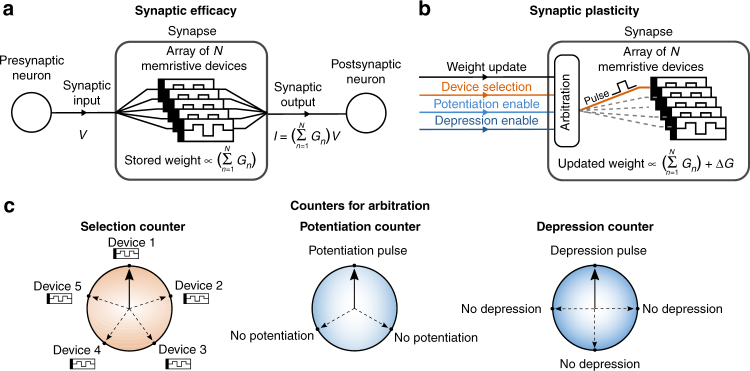
Neuromorphic computing has emerged as a promising avenue towards building the next generation of intelligent computing systems. It has been proposed that memristive devices, which exhibit history-dependent conductivity modulation, could efficiently represent the synaptic weights in artificial neural networks. However, precise modulation of the device conductance over a wide dynamic range, necessary to maintain high network accuracy, is proving to be challenging. To address this, we present a multi-memristive synaptic architecture with an efficient global counter-based arbitration scheme. We focus on phase change memory devices, develop a comprehensive model and demonstrate via simulations the effectiveness of the concept for both spiking and non-spiking neural networks. Moreover, we present experimental results involving over a million phase change memory devices for unsupervised learning of temporal correlations using a spiking neural network. The work presents a significant step towards the realization of large-scale and energy-efficient neuromorphic computing systems.
Overview
CoChat Summary
TL;DR
The paper proposes a multi-memristive synapse architecture that uses multiple memristive devices per synapse plus a counter-based arbitration scheme to improve dynamic range, resolution, and robustness for neuromorphic learning. It demonstrates the idea with PCM devices in simulations and in experiments on more than one million devices, including unsupervised temporal-correlation detection.
Key findings
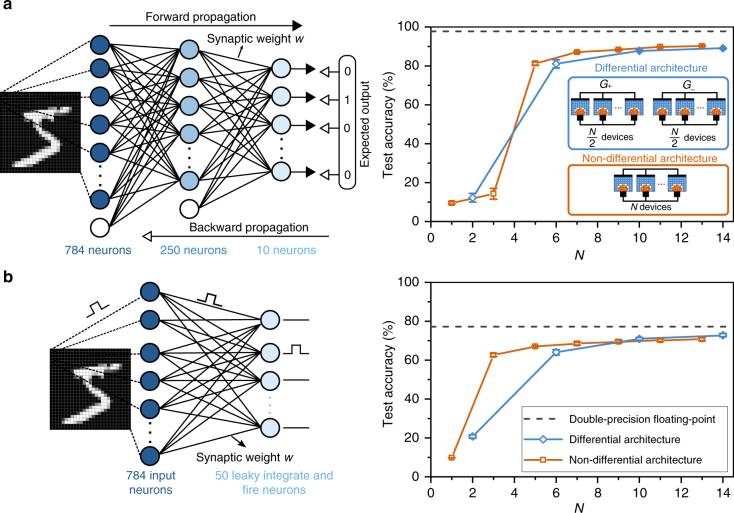
- In MNIST simulations for an ANN, the ideal floating-point classifier achieved 97.8% accuracy, while multi-memristive synapses reached >88.9% in the differential architecture and >90% in the non-differential architecture; the conventional 2-device differential architecture stayed below 15%.
- In MNIST simulations for an SNN with unsupervised learning, the floating-point baseline achieved 77.2% accuracy; the network with multi-memristive synapses achieved >70% correct classification for N > 9, while the conventional 2-device differential architecture was below 21%.
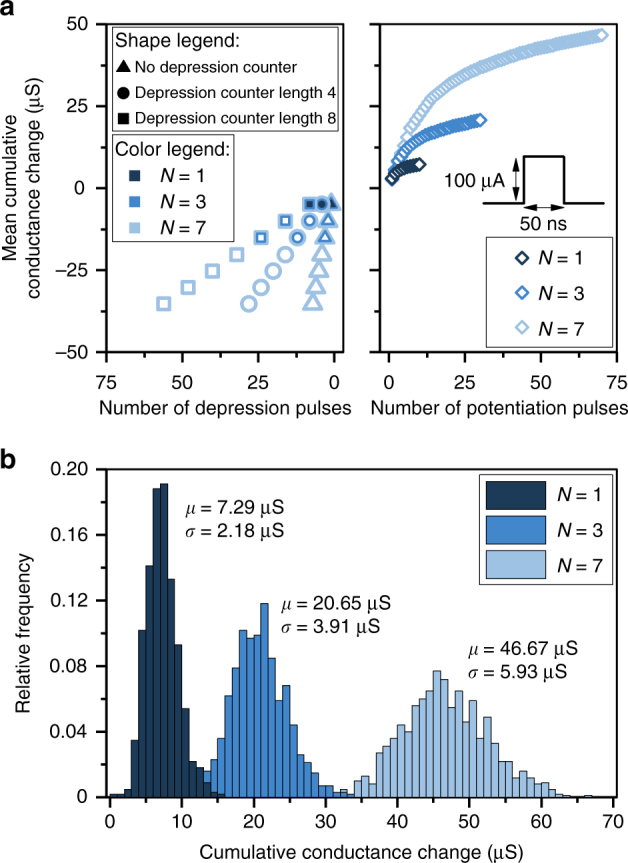
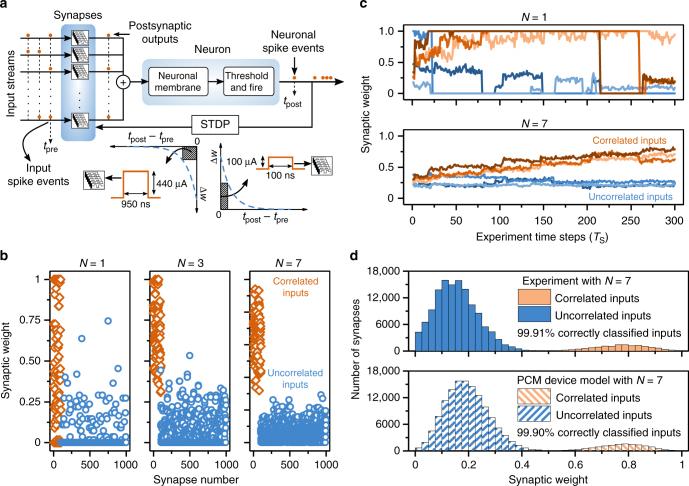
- In the small-scale temporal-correlation experiment, the number of misclassified inputs was 49 for N = 1, 8 for N = 3, and 0 for N = 7.
- In the large-scale temporal-correlation experiment, 144,000 synapses with 7 PCM devices per synapse used 1,008,000 PCM devices total, and the experiment and simulation each reported about 0.1% misclassified inputs after training.
Methods
- The paper combines device characterization, analytical modeling, simulations, and hardware experiments using a prototype PCM chip with 3 million devices in a four-bank inter-leaved architecture fabricated in 90 nm CMOS.
- For simulation, the authors trained an ANN on 60,000 MNIST training images and tested on 10,000 MNIST test images; they also simulated an SNN for MNIST and an SNN for temporal-correlation detection using STDP-based learning rules.
- The hardware correlation-detection experiment trained an SNN on 1000 synapses in the small-scale case and 144,000 synapses in the large-scale case, with some synapses receiving correlated inputs at correlation coefficient 0.75.
Limitations
- The paper states that PCM devices have limiting characteristics including limited conductance range, asymmetric conductance response, nonlinear conductance response, stochasticity, and device-to-device variability.
- The text makes evident that the scheme still relies on counter-based arbitration and may produce weight-dependent plasticity because device selection does not use exact conductance knowledge; the paper notes this could negatively affect ANN accuracy, though it may stabilize some SNNs.
- The paper also states that its experimental data are available upon request only, which may limit immediate reproducibility from the text alone.
Model-written summary. Check it against the paper before relying on it.
Integrity signals
Registry
Cites
Statistics
Figures
Verification
Claims the paper makes
6 Valid · 1 Not valid · 15 Not checked · 68 Own results and interpretations
Every source the paper cites for this claim was checked and supports it.
In the paper
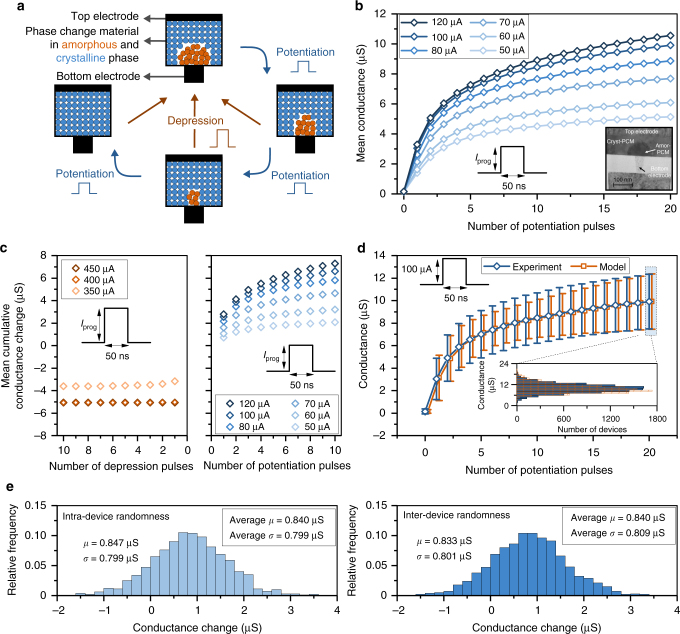
“Such a strongly asymmetric conductance response is undesirable in memristive-device-based implementations of neural networks44”
§ Neuromorphic computing with multi-memristive synapses > Results > Multi-memristive synapses based on PCM devices
What the sources say
- Supportedcites [44] Gokmen T Vlasov Y Acceleration of deep neural network training with resistive cross-point devices: design considerations Front. Neurosci. 2016 10 333 10.3389/fnins.2016.00333 27493624 PMC4954855 source
The Introduction identifies asymmetrical set and reset operations as a limitation for accelerating neural-network training. The Results (“Derivation of RPU device specifications”) find that upward and downward conductance changes must be closely balanced to keep the training error penalty acceptable. The paper notes that global asymmetry can be compensated by adjusting pulses. (LLM, conf=0.90)
boosted- Asserted: passes — The authors put it forward as true.
- Checkable: passes — It can be checked against evidence.
- Load-bearing: passes — The paper’s conclusions depend on it.
- Based: passes — The paper gives a reason why it holds.
- Supported
The cited sources support only part of this claim — read each source’s verdict below.
In the paper
“Large conductance change granularities, as well as nonlinear conductance responses, both observed in the PCM characterization performed here, have been shown to degrade the performance of neural networks trained with memristive synapses34,43.”
§ Neuromorphic computing with multi-memristive synapses > Results > Multi-memristive synapses based on PCM devices
What the sources say
- Not checked — no full text of the sourcecites [34] Burr GW Experimental demonstration and tolerancing of a large-scale neural network (165 000 synapses) using phase-change memory as the synaptic weight element IEEE Trans. Electron Dev. 2015 62 3498 3507 10.1109/TED.2015.2439635 source
- Partly supportedcites [43] Boybat, I. et al. Stochastic weight updates in phase-change memory-based synapses and their influence on artificial neural networks. In Proc. Ph.D. Research in Microelectronics and Electronics (PRIME), 13–16 (IEEE, Giardini Naxos, Italy, 2017). sourceExperimental — accuracy not yet measured
Our copy supports the granularity half: Section II.C states that 'the minimal mean conductance change that can be induced can be quite large especially for low values of device conductance... implies a granularity of possible weight updates in a PCM synapse', and the abstract/introduction (Section I) frame the paper as quantifying the effect of experimentally observed conductance-change granularity (and stochasticity) on classification accuracies, noting that 'non-ideal device characteristics pose challenges to reach competitive classification accuracies'. The nonlinear-conductance-response half is not in this paper at all: our copy's stated scope is explicitly limited to 'two aspects: the granularity of weight updates and the update randomness', and searches for nonlinearity, asymmetry or potentiation/depression returned no passage. The attributed claim that nonlinear responses degrade network performance therefore rests on the other citation(s), not on Boybat et al. (2017). (LLM, conf=0.75)
boostedstates a cause- Asserted: passes — The authors put it forward as true.
- Checkable: passes — It can be checked against evidence.
- Load-bearing: passes — The paper’s conclusions depend on it.
- Based: passes — The paper gives a reason why it holds.
Every source the paper cites for this claim was checked and supports it.
In the paper
“Memristive crossbars can also be fabricated with very small areal footprint27,29,60.”
§ Neuromorphic computing with multi-memristive synapses > Discussion
What the sources say
- Supportedcites [27] Alibart F Zamanidoost E Strukov DB Pattern classification by memristive crossbar circuits using ex situ and in situ training Nat. Commun. 2013 4 2072 10.1038/ncomms3072 23797631 source
The Abstract says memristors’ simple structure allows crossbar integration and aggressive size scaling. It also reports sub-10-nm devices, supporting the claim that memristive crossbars can have a very small areal footprint. Page numbers are not provided in our copy. (LLM, conf=0.91)
- Supportedcites [29] Prezioso M Training and operation of an integrated neuromorphic network based on metal-oxide memristors Nature 2015 521 61 64 10.1038/nature14441 25951284 source
The paper reports fabricating an integrated 12×12 memristive crossbar (Memristor Fabrication, Forming and Characterization, p. 3). It also describes the crossbar topology as capable of extremely high areal density and gives a 30-nm-pitch example (main text, p. 2), supporting the general claim of a small areal footprint. (LLM, conf=0.87)
- Supportedcites [60] Eryilmaz SB Brain-like associative learning using a nanoscale non-volatile phase change synaptic device array Front. Neurosci. 2014 8 205 10.3389/fnins.2014.00205 25100936 PMC4106403 source
The Introduction says nanoscale non-volatile memory devices can be scaled to nanometer dimensions, enabling dense synaptic arrays because of their small feature sizes. The paper also describes its PCM cells as connected in a crossbar fashion (Phase change memory cell array for synaptic operation). Together, these passages support the general claim that such crossbar arrays can have a small areal footprint; the paper does not quantify the footprint of its array. (LLM, conf=0.86)
plain- Asserted: passes — The authors put it forward as true.
- Checkable: passes — It can be checked against evidence.
- Load-bearing: unclear — It is unclear whether the paper’s conclusions depend on it.
- Based: passes — The paper gives a reason why it holds.
- Supported
A result the paper reports from its own data — it cites no other source for it, so there is none to check. The quote shows it is in the paper.
In the paper
“These experiments show that the standard deviation of the conductance change due to intra-device variability is almost as large as that due to the inter-device variability.”
§ Neuromorphic computing with multi-memristive synapses > Results > Multi-memristive synapses based on PCM devices
plain- Asserted: passes — The authors put it forward as true.
- Checkable: passes — It can be checked against evidence.
- Load-bearing: passes — The paper’s conclusions depend on it.
- Based: passes — The paper gives a reason why it holds.
A result the paper reports from its own data — it cites no other source for it, so there is none to check. The quote shows it is in the paper.
In the paper
“Moreover, the fact that the non-differential architecture achieves a comparable performance to that of the differential architecture is promising for synaptic realizations using highly asymmetric devices.”
§ Neuromorphic computing with multi-memristive synapses > Results > Simulation results on handwritten digit classification
plain- Asserted: passes — The authors put it forward as true.
- Checkable: passes — It can be checked against evidence.
- Load-bearing: passes — The paper’s conclusions depend on it.
- Based: passes — The paper gives a reason why it holds.
- Rests on an assumption not shown here.
55 more claims
Create a free account to see all 90 claims and to verify the 2 references still open.
- It may state two separate claims as one. 18
- Borderline: one of the tests for a substantial claim is unclear. 1
- The quote only partly states this claim. 1
- Probably not a substantial claim. 13
Claims other papers make about this one
Each is checked against this paper’s own text: does it say what the citing paper says it does?
The cited source says what the claim attributes to it.
In the citing paper
“Multibit weights are composed of low-bit weights 33 through the cooperation of peripheral circuits.”
From A computing-in-memory macro based on three-dimensional resistive random-access memory (2022) · cites this paper as [33]
Citations
Cites
LeCun, Y., Bengio, Y., & Hinton, G. (2015) · Nature · doi:10.1038/nature14539 · Cited by 84,126
Gradient-based learning applied to document recognition
Lecun, Y., Bottou, L., Bengio, Y., & Haffner, P. (1998) · Proceedings of the IEEE · doi:10.1109/5.726791 · Cited by 58,805
Learning representations by back-propagating errors
Rumelhart, D. E., Hinton, G. E., & Williams, R. J. (1986) · Nature · doi:10.1038/323533a0 · Cited by 31,892
Parallel Distributed Processing: Explorations in the Microstructure of Cognition: Foundations
Rumelhart, D. E., McClelland, J. L., & AU (1986) · doi:10.7551/mitpress/5236.001.0001 · Cited by 15,686
Strukov, D. B., Snider, G. S., Stewart, D. R., & Williams, R. S. (2008) · Nature · doi:10.1038/nature06932 · Cited by 11,828
A million spiking-neuron integrated circuit with a scalable communication network and interface
Merolla, P. A., Arthur, J. V., Alvarez-Icaza, R., Cassidy, A. S., Sawada, J., Akopyan, F., Jackson, B. L., Imam, N., Guo, C., Nakamura, Y., et al. (2014) · Science · doi:10.1126/science.1254642 · Cited by 4,147
Malenka, R. C., & Bear, M. F. (2004) · Neuron · doi:10.1016/j.neuron.2004.09.012 · Cited by 3,968
Regulation of Synaptic Efficacy by Coincidence of Postsynaptic APs and EPSPs
Markram, H., Lübke, J., Frotscher, M., & Sakmann, B. (1997) · Science · doi:10.1126/science.275.5297.213 · Cited by 3,832
Training and operation of an integrated neuromorphic network based on metal-oxide memristors
Prezioso, M., Merrikh-Bayat, F., Hoskins, B. D., Adam, G. C., Likharev, K. K., & Strukov, D. B. (2015) · Nature · doi:10.1038/nature14441 · Cited by 3,001
Competitive Hebbian learning through spike-timing-dependent synaptic plasticity
Song, S., Miller, K. D., & Abbott, L. F. (2000) · Nature Neuroscience · doi:10.1038/78829 · Cited by 2,729
Research works printed but not linked: 1
- Indiveri G Linares-Barranco B Legenstein R Deligeorgis G Prodromakis T Integration of nanoscale memristor synapses in neuromorphic computing architectures Nanotechnology 2013 24 384010 10.1088/0957-4484/24/38/384010 23999381 · DOI · Paper page
Cited by
Items 201–300 of 896
Neuromorphic devices for electronic skin applications
Patil, C. S., Ghode, S. B., Kim, J., Kamble, G. U., Kundale, S. S., Mannan, A., Ko, Y., Noman, M. A., Saqib, Q. M., Patil, S. R., et al. (2025) · Materials Horizons · doi:10.1039/d4mh01848f · Cited by 58
Shen, P., Lin, C., Wang, H., Teo, K. H., & Kong, J. (2020) · Applied Physics Letters · doi:10.1063/1.5129963 · Cited by 52
Khan, A. I., Yu, H., Zhang, H. R., Goggin, J. R., Kwon, H., Wu, X., Perez, C., Neilson, K. M., Asheghi, M., Goodson, K. E., et al. (2023) · Advanced Materials · doi:10.1002/adma.202300107 · Cited by 52
Bavandpour, M., Sahay, S., Mahmoodi, M. R., & Strukov, D. B. (2021) · Neuromorphic Computing and Engineering · doi:10.1088/2634-4386/ac0775 · Cited by 45
Retinomorphic optoelectronic devices for intelligent machine vision
Chen, W., Zhang, Z., & Liu, G. (2022) · iScience · doi:10.1016/j.isci.2021.103729 · Cited by 52
Liu, L., Cheng, Y., Han, F., Fan, S., & Zhang, Y. (2023) · Chemical Engineering Journal · doi:10.1016/j.cej.2023.144678 · Cited by 44
Chen, J., Zhu, Y.-Q., Zhao, X.-C., Wang, Z., Zhang, K., Zhang, Z., Sun, M. Y., Wang, S., Zhang, Y., Han, L. G., et al. (2023) · Nano Letters · doi:10.1021/acs.nanolett.3c02721 · Cited by 48
Noise-Resilient DNN: Tolerating Noise in PCM-Based AI Accelerators via Noise-Aware Training
Kariyappa, S., Tsai, H., Spoon, K., Ambrogio, S., Narayanan, P., Mackin, C., Chen, A., Qureshi, M., & Burr, G. W. (2021) · IEEE Transactions on Electron Devices · doi:10.1109/ted.2021.3089987 · Cited by 45
Jang, J. T., Min, J., Hwang, Y., Choi, S., Kim, D. M., Kim, H., & Kim, D. H. (2020) · IEEE Access · doi:10.1109/access.2020.3032188 · Cited by 46
On-Chip Trainable 1.4M 6T2R PCM Synaptic Array with 1.6K Stochastic LIF Neurons for Spiking RBM
Ishii, M., Shin, U., Hosokawa, K., BrightSky, M., Haensch, W., Kim, S., Lewis, S., Okazaki, A., Okazawa, J., Ito, M., et al. (2019) · 2019 IEEE International Electron Devices Meeting (IEDM) · doi:10.1109/iedm19573.2019.8993466 · Cited by 43
Precision of bit slicing with in-memory computing based on analog phase-change memory crossbars
Le Gallo, M., Nandakumar, S. R., Ciric, L., Boybat, I., Khaddam-Aljameh, R., Mackin, C., & Sebastian, A. (2022) · Neuromorphic Computing and Engineering · doi:10.1088/2634-4386/ac4fb7 · Cited by 42
“Previous works devised various strategies to program a matrix element to multiple device conductance values and applied them to inference [20] and training [18, 24] of deep neural networks (DNNs).”
BackgroundMethodSelf-citationChromatic Plasmonic Polarizer-Based Synapse for All-Optical Convolutional Neural Network
Guo, J., Liu, Y., Lin, L., Li, S., Cai, J., Chen, J., Huang, W., Lin, Y., & Xu, J. (2023) · Nano Letters · doi:10.1021/acs.nanolett.3c02194 · Cited by 54
Coupling synchronization between photoelectric neurons by using memristive synapse
Guo, Y., Zhu, Z., Wang, C., & Ren, G. (2020) · Optik · doi:10.1016/j.ijleo.2020.164993 · Cited by 43
Nanoscale Room-Temperature Multilayer Skyrmionic Synapse for Deep Spiking Neural Networks
Chen, R., Li, C., Li, Y., Miles, J. J., Indiveri, G., Furber, S. B., Pavlidis, V. F., & Moutafis, C. (2020) · Physical Review Applied · doi:10.1103/physrevapplied.14.014096 · Cited by 46
“Moreover, skyrmionic synapses have advantages of shorter update times and relatively smaller cycle-to-cycle and device-to-device variability compared to existing transistor-free phase change memory (PCM) devices [63] and resistive random access memory (RRAM) [64].”
BackgroundKim, T., Lee, J., Kim, S., Park, J., Park, B., & Kim, H. (2021) · Nanotechnology · doi:10.1088/1361-6528/abf0cc · Cited by 46
“…devices store weight information and perform parallel operation with various memory devices: fl ash memories [ 17 – 21 ] and two-terminal memristors based on resistive random access memory ( RRAM ) [ 22 – 28 ] , phase change memory ( PCM ) [ 10, 29 – 33 ] , and ferroelectric memory [ 34 – 39 ] .”
Spike‐Enabled Audio Learning in Multilevel Synaptic Memristor Array‐Based Spiking Neural Network
Wu, X., Dang, B., Wang, H., Wu, X., & Yang, Y. (2021) · Advanced Intelligent Systems · doi:10.1002/aisy.202100151 · Cited by 43
Scalable Deep Learning on Distributed Infrastructures: Challenges, Techniques and ToolsPreprint
Mayer, R., & Jacobsen, H. (2019) · arXiv (Cornell University) · doi:10.48550/arxiv.1903.11314 · Cited by 42
“3.1.1 Hardware Components for DL. novel in-memory computing architectures (also called neuromorphic hardware [20]).”
BackgroundInfluentialNbOx based memristor as artificial synapse emulating short term plasticity
Deswal, S., Kumar, A., & Kumar, A. (2019) · AIP Advances · doi:10.1063/1.5118980 · Cited by 42
Kaushik, D., Singh, U., Sahu, U., Indu, S., & Bhowmik, D. (2020) · AIP Advances · doi:10.1063/1.5128344 · Cited by 41
Xiang, S., Ren, Z., Zhang, Y., Song, Z., Guo, X., Han, G., & Hao, Y. (2020) · IEEE Journal of Selected Topics in Quantum Electronics · doi:10.1109/jstqe.2020.3005589 · Cited by 46
Analog Neural Computing With Super-Resolution Memristor Crossbars
James, A. P., & Chua, L. O. (2021) · IEEE Transactions on Circuits and Systems I Regular Papers · doi:10.1109/tcsi.2021.3079980 · Cited by 49
Unsupervised Learning to Overcome Catastrophic Forgetting in Neural Networks
Muñoz-Martín, I., Bianchi, S., Pedretti, G., Melnic, O., Ambrogio, S., & Ielmini, D. (2019) · IEEE Journal on Exploratory Solid-State Computational Devices and Circuits · doi:10.1109/jxcdc.2019.2911135 · Cited by 40
“STDP can also be easily implemented with emerging memory devices, where the change of conductance can be controlled by the timing of the spikes at either the pre-synaptic or postsynaptic ends of the synapse [14], [15].”
BackgroundWeight Programming in DNN Analog Hardware Accelerators in the Presence of NVM Variability
Mackin, C., Tsai, H., Ambrogio, S., Narayanan, P., Chen, A., & Burr, G. W. (2019) · Advanced Electronic Materials · doi:10.1002/aelm.201900026 · Cited by 41
Deep learning acceleration based on in-memory computing
Eleftheriou, E., Gallo, M. L., Nandakumar, S. R., Piveteau, C., Boybat, I., Joshi, V., Khaddam-Aljameh, R., Dazzi, M., Giannopoulos, I., Karunaratne, G., et al. (2019) · IBM Journal of Research and Development · doi:10.1147/jrd.2019.2947008 · Cited by 40
Self-citationSong, Z., Xiang, S., Ren, Z., Han, G., & Hao, Y. (2020) · IEEE Journal of Selected Topics in Quantum Electronics · doi:10.1109/jstqe.2020.2975564 · Cited by 40
An Overview of Ferroelectric Hafnia and Epitaxial Growth
Cao, J. X., Shi, S., Zhu, Y. H., & Chen, J. (2021) · physica status solidi (RRL) - Rapid Research Letters · doi:10.1002/pssr.202100025 · Cited by 43
Logical stochastic resonance and energy consumption in stochastic Hodgkin–Huxley neuron system
Yu, D., Yang, L., Zhan, X., Fu, Z., & Jia, Y. (2022) · Nonlinear Dynamics · doi:10.1007/s11071-022-08187-8 · Cited by 42
Memristor Based Binary Convolutional Neural Network Architecture With Configurable Neurons
Huang, L., Diao, J., Nie, H., Wang, W., Li, Z., Li, Q., & Liu, H. (2021) · Frontiers in Neuroscience · doi:10.3389/fnins.2021.639526 · Cited by 45
“…be noticed that the network is trained with 1-bit precision in the forward computation but 32-bit floating point precision in back propagation (Courbariaux and Bengio, 2016), to be more specific, the gradient of tanh function is used to approximate the gradient of binary activation…”
MethodLu, Y., Li, X., Yan, B., Yan, L., Zhang, T., Song, Z., Huang, R., & Yang, Y. (2021) · Advanced Materials · doi:10.1002/adma.202107811 · Cited by 44
Qian, C., Choi, Y., Kim, S., Kim, S., Choi, Y. J., Roe, D. G., Lee, J. H., Kang, M. S., Lee, W. H., & Cho, J. H. (2022) · Advanced Functional Materials · doi:10.1002/adfm.202112490 · Cited by 41
Photonic spiking neural network based on excitable VCSELs-SA for sound azimuth detection
Song, Z. W., Xiang, S., Ren, Z. X., Wang, S. H., Wen, A. J., & Hao, Y. (2020) · Optics Express · doi:10.1364/oe.381229 · Cited by 44
Wang, S., Chen, X., Huang, X., Zhang, D. W., & Zhou, P. (2020) · Advanced Intelligent Systems · doi:10.1002/aisy.202000124 · Cited by 44
Pedretti, G., Ambrosi, E., & Ielmini, D. (2021) · 2021 IEEE International Reliability Physics Symposium (IRPS) · doi:10.1109/irps46558.2021.9405130 · Cited by 39
“I, namely (a) multilevel [19], [20], (b) binary [26], (c) unary [27], (d) multilevel with redundancy [28] and (e) slicing [29].”
BackgroundRoe, D. G., Ho, D. H., Choi, Y. Y., Choi, Y. J., Kim, S., Jo, S. B., Kang, M. S., Ahn, J., & Cho, J. H. (2023) · Nature Communications · doi:10.1038/s41467-022-34324-3 · Cited by 43
Bio-inspired artificial synapses: Neuromorphic computing chip engineering with soft biomaterials
Ahmed, T. (2023) · Memories - Materials Devices Circuits and Systems · doi:10.1016/j.memori.2023.100088 · Cited by 54
Emerging Optoelectronic Devices for Brain‐Inspired Computing
Hu, L., Zhuge, X., Wang, J., Wei, X., Zhang, L., Chai, Y., Xue, X., Ye, Z., & Zhuge, F. (2024) · Advanced Electronic Materials · doi:10.1002/aelm.202400482 · Cited by 46
An efficient Verilog-A memristor model implementation: simulation and application
Rziga, F. O., Mbarek, K., Ghédira, S., & Besbes, K. (2019) · Journal of Computational Electronics · doi:10.1007/s10825-019-01357-9 · Cited by 39
“The cited models apply different mathematical meth-ods suitable for implementation in the SPICE or Verilog-A language for applications such as RRAM [12], or artificial synapses in neuromorphic systems [13].”
MethodSong, S., Kim, M., Yoo, G., Kwon, S. M., Heo, J. S., Park, S. K., & Kim, Y. (2020) · Journal of Alloys and Compounds · doi:10.1016/j.jallcom.2020.158027 · Cited by 39
Recent advances in solid electrolytes for synaptic transistors
Li, J., Fu, W., Li, L., Jiang, D., He, L.-C., Zhu, W., & Zhang, J. (2021) · Organic Electronics · doi:10.1016/j.orgel.2021.106196 · Cited by 39
Logical chaotic resonance in the FitzHugh–Nagumo neuron
Yao, Y. (2022) · Nonlinear Dynamics · doi:10.1007/s11071-021-07155-y · Cited by 37
“…computer which is based on the von Neumann architecture with separate memory and processing units operates mostly sequentially, while the brain with less than 20 W of power consumption operates in a massively parallel fashion via a densely interconnected complex network of neurons [59, 60].”
MethodChen, B., Sun, S., Fan, S., Liu, X., Li, Q., & Su, J. (2022) · Advanced Electronic Materials · doi:10.1002/aelm.202200864 · Cited by 36
Nikam, R. D., Lee, J., Lee, K., & Hwang, H. (2023) · Small · doi:10.1002/smll.202302593 · Cited by 41
Ex Situ Transfer of Bayesian Neural Networks to Resistive Memory‐Based Inference Hardware
Dalgaty, T., Esmanhotto, E., Castellani, N., Querlioz, D., & Vianello, E. (2021) · Advanced Intelligent Systems · doi:10.1002/aisy.202000103 · Cited by 41
Yan, X., Ma, J., Wu, T., Zhang, A., Wu, J., Chin, M. L., Zhang, Z., Dubey, M., Wu, W., Chen, M. S., et al. (2021) · Nature Communications · doi:10.1038/s41467-021-26012-5 · Cited by 38
Recent developments in phase‐change memory
Ehrmann, A., Błachowicz, T., Ehrmann, G., & Grethe, T. (2022) · Applied Research · doi:10.1002/appl.202200024 · Cited by 39
Photocurrent Imaging of Multi-Memristive Charge Density Wave Switching in Two-Dimensional 1T-TaS 2
Patel, T., Okamoto, J., Dekker, T., et al. (2020) · Nano Letters · doi:10.1021/acs.nanolett.0c02537 · Cited by 35
Delay-weight plasticity-based supervised learning in optical spiking neural networks
Han, Y., Xiang, S., Ren, Z., Fu, C., Wen, A., & Hao, Y. (2021) · Photonics Research · doi:10.1364/prj.413742 · Cited by 42
Bengel, C., Cüppers, F., Payvand, M., Dittmann, R., Waser, R. M., Hoffmann‐Eifert, S., & Menzel, S. (2021) · Frontiers in Neuroscience · doi:10.3389/fnins.2021.661856 · Cited by 37
“Examples for experimental realizations of this concept were done for Electro-Chemical Metallization (ECM) cells (Gaba et al., 2013) and Phase Change Mechanism (PCM) cells (Boybat et al., 2018), as well as other VCM systems.”
BackgroundMethodNbOx based memristor as artificial synapse emulating short term plasticity
Deswal, S., Kumar, A., & Kumar, A. (2019) · IR@NPL (CSIR-The National Physical Laboratory(NPL)) · Cited by 34
12-state multi-level cell storage implemented in a 128 Mb phase change memory chip
Song, Z., Cai, D., Cheng, Y. M., et al. (2021) · Nanoscale · doi:10.1039/d1nr00100k · Cited by 34
Plasma processing for advanced microelectronics beyond CMOS
Marchack, N., Buzi, L., Farmer, D. B., Miyazoe, H., Papalia, J. M., Yan, H., Totir, G. G., & Engelmann, S. U. (2021) · Journal of Applied Physics · doi:10.1063/5.0053666 · Cited by 36
Wang, Z., Wang, X., & Zeng, Z. (2021) · IEEE Transactions on Biomedical Circuits and Systems · doi:10.1109/tbcas.2021.3127573 · Cited by 35
Resistive Memory Devices Based on Reticular Materials for Electrical Information Storage
Oh, J., & Yoon, S. M. (2021) · ACS Applied Materials & Interfaces · doi:10.1021/acsami.1c16332 · Cited by 33
Minimizing the Programming Power of Phase Change Memory by Using Graphene Nanoribbon Edge‐Contact
Wang, X., Song, S., Wang, H., Guo, T., Xue, Y., Wang, R., Wang, H., Chen, L., Jiang, C., Chen, C., et al. (2022) · Advanced Science · doi:10.1002/advs.202202222 · Cited by 34
Yang, Y., Li, Y., Chen, D., et al. (2024) · Materials Horizons · doi:10.1039/d3mh02154h · Cited by 33
High Amplitude Spike Generator in Au Nanodot-Incorporated NbOx Mott Memristor
Park, W., Kim, G., In, J. H., Rhee, H., Song, H., Park, J., Martinez, A., & Kim, K. M. (2023) · Nano Letters · doi:10.1021/acs.nanolett.2c04599 · Cited by 34
Ferroelectric artificial synapse for neuromorphic computing and flexible applications
Li, Q., Liu, Y., Cao, Y., Wang, T.-Y., Zhu, H., Li, J., Liu, W.-J., Sun, Q., Zhang, D. W., & Chen, L. (2022) · Fundamental Research · doi:10.1016/j.fmre.2022.02.004 · Cited by 32
“…effectively studied, following the development of artificial synaptic devices, such as excitatory or inhibitory postsynaptic currents (EPSC/IPSC), paired pulse facilitation/depression (PPF/PPD), short-term and long-term potentiation (STP/LTP), and spike-timing-dependent plasticity (STDP) [8–10] .”
BackgroundInfluentialWang, Z., Wang, W., Liu, P., Liu, G., Li, J., Zhao, J., Zhou, Z., Wang, J., Pei, Y., Zhao, Z., et al. (2022) · Research · doi:10.34133/2022/9754876 · Cited by 34
Chaudhary, M., Yang, T., Chen, C., Lai, P., Hsu, Y., Peng, Y., Kumar, A., Lee, C., & Chueh, Y. (2023) · Advanced Functional Materials · doi:10.1002/adfm.202303697 · Cited by 32
Xiao, Y., Li, W., Lin, X., Ji, Y. Y., Chen, Z., Jiang, Y., Liu, Q., Tang, X., & Liang, Q. (2023) · Advanced Electronic Materials · doi:10.1002/aelm.202300388 · Cited by 33
Temperature‐Resilient Polymeric Memristors for Effective Deblurring in Static and Dynamic Imaging
Lv, Z., Jiang, M., Liu, H., Li, Q., Xie, T., Yang, J., Wang, Y., Zhai, Y., Ding, G., Zhu, S., et al. (2025) · Advanced Functional Materials · doi:10.1002/adfm.202424382 · Cited by 34
Wang, J., Zhuge, X., & Zhuge, F. (2021) · Science and Technology of Advanced Materials · doi:10.1080/14686996.2021.1911277 · Cited by 35
“The resistance of a memristor can be electrically tuned via various mechanisms, such as field-driven ion [33–39] or electron [40,41] behaviour or current-induced phase change [42,43], depending on the film and electrode materials used.”
BackgroundProgressive amorphization of GeSbTe phase-change material under electron beam irradiation
Jiang, T.-T., Wang, J.-J., Lu, L., Ma, C.-S., Zhang, D.-L., Rao, F., Jia, C.-L., & Zhang, W. (2019) · APL Materials · doi:10.1063/1.5102075 · Cited by 32
Liu, Z., & Wang, L. (2020) · IEEE Access · doi:10.1109/access.2020.2990536 · Cited by 34
“This is because human brain is well known as the most efficient computational entity due to its ability to provide ultra-low power consumption, super-fast processing speed, and most importantly, in-memory computing that computation and storage are simultaneously processed in the same location [137].”
BackgroundAnalog Weight Updates with Compliance Current Modulation of Binary ReRAMs for On-Chip Learning
Payvand, M., Demirağ, Y., Dalgaty, T., Vianello, E., & Indiveri, G. (2020) · IEEE International Symposium on Circuits and Systems proceedings · doi:10.1109/iscas45731.2020.9180808 · Cited by 30
“An example of this approach involves using n binary switches to emulate an n-bit synapse as is reported in [9].”
MethodParit, A. K., Yadav, M. S., Gupta, A. K., Mikhaylov, A. N., & Rawat, B. (2021) · Chaos Solitons & Fractals · doi:10.1016/j.chaos.2021.110818 · Cited by 31
High performance of Er-doped Sb2Te material used in phase change memory
Zhao, J., Yuan, Z., Song, W., et al. (2021) · Journal of Alloys and Compounds · doi:10.1016/j.jallcom.2021.161701 · Cited by 31
An All-in-One Bioinspired Neural Network
Radhakrishnan, S. S., Dodda, A., & Das, S. (2022) · ACS Nano · doi:10.1021/acsnano.2c02172 · Cited by 31
Freestanding Membranes for Unique Functionality in Electronics
Han, S., Meng, Y., Xu, Z., Kim, J. S., Li, Y., Roh, I., Ahn, H., Kim, D., & Bae, S. (2023) · ACS Applied Electronic Materials · doi:10.1021/acsaelm.2c01411 · Cited by 33
Li, W., Li, J., Mu, T., Li, J., Sun, P., Dai, M., Chen, Y., Yang, R., Chen, Z., Wang, Y., et al. (2024) · Small · doi:10.1002/smll.202311630 · Cited by 43
Is artificial consciousness achievable? Lessons from the human brain
Farisco, M., Evers, K., & Changeux, J. (2024) · Neural Networks · doi:10.1016/j.neunet.2024.106714 · Cited by 61
Mondal, I., Attri, R., Rao, T. S., Yadav, B., & Kulkarni, G. U. (2024) · Applied Physics Reviews · doi:10.1063/5.0220628 · Cited by 33
A binary classifier based on a reconfigurable dense network of metallic nanojunctions
Mirigliano, M., Paroli, B., Martini, G., Fedrizzi, M., Falqui, A., Casu, A., & Milani, P. (2021) · Neuromorphic Computing and Engineering · doi:10.1088/2634-4386/ac29c9 · Cited by 40
“Memristors have been proposed for the physical realization of the perceptron as synaptic weights [15, 20, 23].”
BackgroundCheng, S., Zhong, L., Yin, J., Duan, H., Xie, Q., Luo, W., & Jie, W. (2023) · Nanoscale · doi:10.1039/d2nr06580k · Cited by 30
Ionotronic Neuromorphic Devices for Bionic Neural Network Applications
Yu, F., & Zhu, L. Q. (2019) · physica status solidi (RRL) - Rapid Research Letters · doi:10.1002/pssr.201800674 · Cited by 35
Noise Tailoring in Memristive Filaments
Sánta, B., Balogh, Z., Pósa, L., Krisztián, D., Török, T. N., Molnár, D., Sinkó, C., Hauert, R., Csontos, M., & Halbritter, A. (2021) · ACS Applied Materials & Interfaces · doi:10.1021/acsami.0c21156 · Cited by 33
Koryazhkina, M. N., Филатов, Д. О., Shishmakova, V. A., Шенина, М. Е., Belov, A. I., Antonov, I. N., Kotomina, V. E., Mikhaylov, A. N., Gorshkov, O. N., Викторович, А. Н., et al. (2022) · Chaos Solitons & Fractals · doi:10.1016/j.chaos.2022.112459 · Cited by 29
Tian, F., Zhang, L., Zhu, L., Zhao, M., Liu, J., Dong, Q., & Zhao, Q. (2024) · IEEE Transactions on Computational Social Systems · doi:10.1109/tcss.2024.3420445 · Cited by 33
Multi-Level Neuromorphic Devices Built on Emerging Ferroic Materials: A Review
Wang, C., Agrawal, A., Yu, E., & Roy, K. (2021) · Frontiers in Neuroscience · doi:10.3389/fnins.2021.661667 · Cited by 31
“Among the emerging NVMs, resistive random-access memory (ReRAM) (Hu et al., 2014) and phase change memory (PCM) (Boybat et al., 2018) can provide high memory density as well as multi-level cells.”
BackgroundInfluentialHendy, H., & Merkel, C. E. (2022) · Journal of Electronic Imaging · doi:10.1117/1.jei.31.1.010901 · Cited by 38
Misba, W. A., Lozano, M., Querlioz, D., & Atulasimha, J. (2022) · IEEE Access · doi:10.1109/access.2022.3196688 · Cited by 31
Padilla, R. I. S., Chen, P.-C., Yang, C., & Lai, C. (2022) · Materials Research Letters · doi:10.1080/21663831.2022.2147803 · Cited by 30
“Recently, a great effort has been devoted to studying how to mimic a neural network since the first memristor-based functional array was demonstrated, as conceptually depicted in Figure 4 [27,28].”
BackgroundNath, S. K., Sun, X., Nandi, S. K., Chen, X., Wang, Z., Das, S. K., Lei, W., Faraone, L., Rickard, W. D. A., & Elliman, R. G. (2023) · Advanced Functional Materials · doi:10.1002/adfm.202306428 · Cited by 27
Chen, J., Zhao, X., Zhu, Y.-Q., Wang, Z., Zhang, Z., Sun, M. Y., Wang, S., Zhang, Y., Han, L. G., Wu, X., et al. (2023) · ACS Nano · doi:10.1021/acsnano.3c08632 · Cited by 27
Xiong, X., Kang, J., Liu, S., Tong, A., Fu, T., Li, X., Huang, R., & Wu, Y. (2021) · Advanced Materials · doi:10.1002/adma.202106321 · Cited by 31
Text classification in memristor-based spiking neural networks
Huang, J., Serb, A., Stathopoulos, S., & Prodromakis, T. (2023) · Neuromorphic Computing and Engineering · doi:10.1088/2634-4386/acb2f0 · Cited by 30
“[25, 27, 28, 51] demonstrated pattern recognition and image classification in memristor-based SNNs.”
BackgroundDiverse synaptic weight adjustment of bio-inspired ZrOx-based memristors for neuromorphic system
Kim, C., Lee, Y., Kim, S., Kang, M., & Kim, S. (2023) · Materials Science in Semiconductor Processing · doi:10.1016/j.mssp.2023.107314 · Cited by 27
Vohra, S. K., Thomas, S. A., Sakare, M., & Das, D. M. (2023) · Integration · doi:10.1016/j.vlsi.2023.102122 · Cited by 30
Zhou, C., Kadambi, P., Mattina, M., & Whatmough, P. N. (2020) · arXiv · doi:10.48550/arxiv.2001.04974 · Cited by 27
“Similarly, the authors in Joshi et al. (2019) also model analog computation noise as additive Gaussian noise on the parameters, where the variance is proportional to the range of values that their PCM device can represent.”
BackgroundCIM-SIM: Computation In Memory SIMuIator
BanaGozar, A., Vadivel, K., Stuijk, S., Corporaal, H., Wong, S., Lebdeh, M. A., Yu, J., & Hamdioui, S. (2019) · International Workshop on Software and Compilers for Embedded Systems (SCOPES) · doi:10.1145/3323439.3323989 · Cited by 30
Recent progress on 2D materials-based artificial synapses
Zhang, C., Zhou, H., Chen, S., Zhang, G., Yu, Z. G., Chi, D., Zhang, Y., & Ang, K. (2021) · Critical reviews in solid state and materials sciences/CRC critical reviews in solid state and materials sciences · doi:10.1080/10408436.2021.1935212 · Cited by 27
Differentiable Content Addressable Memory with Memristors
Pedretti, G., Graves, C. E., Vaerenbergh, T. V., Serebryakov, S., Foltín, M., Sheng, X., Mao, R., Li, C., & Strachan, J. P. (2022) · Advanced Electronic Materials · doi:10.1002/aelm.202101198 · Cited by 31
Katkar, P. K., Padalkar, N. S., Kumbhar, D. D., Patil, A. H., Sutar, S. S., Kadam, S. J., Kamat, R. K., Chun, S., & Dongale, T. D. (2022) · ACS Applied Electronic Materials · doi:10.1021/acsaelm.2c00085 · Cited by 26
Chougale, M. Y., Khan, M. U., Kim, J., Shaukat, R. A., Saqib, Q. M., Patil, S. R., Dongale, T. D., Bermak, A., Mohammad, B. S., & Bae, J. (2022) · Advanced Engineering Materials · doi:10.1002/adem.202200314 · Cited by 27
An overview of brain-like computing: Architecture, applications, and future trends
Ou, W., Xiao, S., Zhu, C., Han, W., & Zhang, Q. (2022) · Frontiers in Neurorobotics · doi:10.3389/fnbot.2022.1041108 · Cited by 30
“A summary of the evolution of brain-like computing (Mead, 1989; Gu and Pan, 2015; Andreopoulos et al., 2018; Boybat et al., 2018; Gleeson et al., 2019) is shown in Figure 2.”
MethodThe g-C3N4-TiO2 nanocomposite for non-volatile memory and artificial synaptic device applications
Patil, V. B., Pawar, O., Patil, H. S., et al. (2023) · Journal of Alloys and Compounds · doi:10.1016/j.jallcom.2023.171024 · Cited by 26
Multiscale Modeling for Application-Oriented Optimization of Resistive Random-Access Memory
Torraca, P. L., Puglisi, F. M., Padovani, A., & Larcher, L. (2019) · Materials · doi:10.3390/ma12213461 · Cited by 29
“Memristor-based SNNs thus have a huge potential, providing a new architectural and computational paradigm approaching a brain-like computation and circumventing the von Neumann bottleneck at once.”
BackgroundInfluentialLi, Z. Y., Zhu, L. Q., Guo, L. Q., Ren, Z. Y., Xiao, H., & Cai, J. C. (2021) · ACS Applied Materials & Interfaces · doi:10.1021/acsami.0c22047 · Cited by 24
Zhang, W., Gao, B., Yao, P., Tang, J., Qian, H., & Wu, H. (2021) · Science China Information Sciences · doi:10.1007/s11432-020-3198-9 · Cited by 26
Redundancy and Analog Slicing for Precise In-Memory Machine Learning—Part I: Programming Techniques
Pedretti, G., Mannocci, P., Li, C., Sun, Z., Strachan, J. P., & Ielmini, D. (2021) · IEEE Transactions on Electron Devices · doi:10.1109/ted.2021.3095433 · Cited by 28
Metadata
- Authors
- Boybat, I., Le Gallo, M., Nandakumar, S. R., Moraitis, T., Parnell, T., Tuma, T., Rajendran, B., Leblebici, Y., Sebastian, A., & Eleftheriou, E.
- Affiliations
- IBM Research - Zurich (CH)
- New Jersey Institute of Technology (US)
- École Polytechnique Fédérale de Lausanne (CH)
- Corresponding author
- Boybat, Irem
- Sebastian, Abu
- ORCID
- Venue
- Nature Communications
- Published
- 2018-06-28
- Volume
- 9
- Issue
- 1
- Pages
- 2514-2514
- ISSN
- 2041-1723 (ISSN-L)
- PMC
- PMC6023896
- OpenAlex
- W2769049661
- Semantic Scholar
- 677743cfbe8a71c65b6b3af31040d98aa55fb9b2
- Cited by
- 899
- References
- 67
- Citations by year
- 2026: 95 · 2025: 107 · 2024: 99 · 2023: 128 · 2022: 127 · 2021: 140 · 2020: 122 · 2019: 63 · 2018: 18
- FWCI
- 32.77
- Type
- journal article
- Language
- en
- Open access
- gold
- doi.org
- Licence
- cc-by
- creativecommons.org/licenses/by/4.0 (tdm)
- creativecommons.org/licenses/by/4.0 (vor)
- Locations
- Nature Communications (publishedVersion, cc-by)
- Europe PMC (PubMed Central) (publishedVersion, cc-by)
- PubMed Central (publishedVersion, cc-by)
- PubMed (publishedVersion)
- arXiv (Cornell University) (submittedVersion)
- Research Portal (King's College London) (submittedVersion, cc-by)
- RePEc: Research Papers in Economics (submittedVersion)
- DOAJ (DOAJ: Directory of Open Access Journals) (submittedVersion)
- DOAJ (DOAJ: Directory of Open Access Journals) (submittedVersion, cc-by-sa)
- Infoscience (Ecole Polytechnique Fédérale de Lausanne) (submittedVersion, cc-by-nc-nd)
- arXiv (Cornell University)
- Funders
- National Science Foundation
- European Commission (HORIZON2020, 682675)
- Schweizerischer Nationalfonds zur Förderung der Wissenschaftlichen Forschung
- Topics
- Physical Sciences › Engineering › Electrical and Electronic Engineering › Advanced Memory and Neural Computing
- Physical Sciences › Computer Science › Artificial Intelligence › Neural Networks and Reservoir Computing
- Physical Sciences › Mathematics › Theoretical Computer Science › DNA and Biological Computing
- Keywords
- neuromorphic computing, memristors, phase-change memory, spiking neural networks, unsupervised learning, energy-efficient hardware, artificial neural networks
- MeSH terms
- Unsupervised Machine Learning, Action Potentials, Animals, Electric Conductivity, Electronics, Humans, Models, Neurological, Synapses, Neural Networks, Computer, Biomimetic Materials
About these checks
Registry, retraction, Cites and statistics results are computed, not judged, with one exception: a printed reference that no index lists is read once by a model before it counts as a citation error. Claims are extracted by a model and kept only when their quote appears verbatim in the text; each cited source is then checked, with a model’s help, for whether it says what the claim relies on. Those verdicts can be wrong — read the claim’s quote and the cited source before relying on one.
The claim verdicts this report counts are experimental: their accuracy is not yet measured.
A language model drew the claims from the paper on 2026-10-10, under version 3 of the claim definition (model deepseek-v4.1-flash, prompt extract-v3).
A second model labelled each claim on 2026-10-10 (model jev-1.13-20260917, definition revision gold-guideline-v0.2).
Cited sources are checked with a language model’s help (gpt-6-sol and qwen3.8-omni-flash).
Statistics and arithmetic are recomputed, not judged.
Confidence bands are shown only for fields calibrated on our annotated test set. None is calibrated yet, so no band is shown.
What counts as a claim ›How we measure confidence ›How we check this ›
Are you an author, or do you see a problem with this page? Request a review
Data sources
Bibliographic data: Semantic Scholar, OpenAlex, Crossref.
Contains information from the Semantic Scholar Academic Graph Datasets, made available under the ODC Attribution License (ODC-BY 1.0).
Semantic Scholar’s data is described in: Kinney, R., et al. (2023). The Semantic Scholar Open Data Platform. arXiv:2301.10140.
