

Neuromorphic computing with multi-memristive synapses
Open accessThe DOI matches its Crossref record; 66 of the 67 references it cites were found in a registry or an index; 8 of the 30 sources its claims cite were checked for support.
Abstract
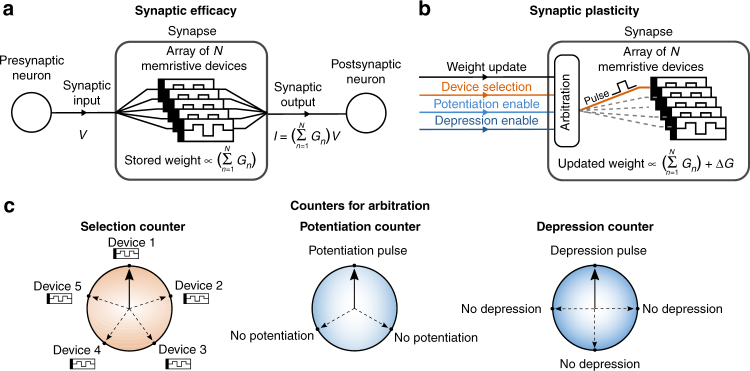
Neuromorphic computing has emerged as a promising avenue towards building the next generation of intelligent computing systems. It has been proposed that memristive devices, which exhibit history-dependent conductivity modulation, could efficiently represent the synaptic weights in artificial neural networks. However, precise modulation of the device conductance over a wide dynamic range, necessary to maintain high network accuracy, is proving to be challenging. To address this, we present a multi-memristive synaptic architecture with an efficient global counter-based arbitration scheme. We focus on phase change memory devices, develop a comprehensive model and demonstrate via simulations the effectiveness of the concept for both spiking and non-spiking neural networks. Moreover, we present experimental results involving over a million phase change memory devices for unsupervised learning of temporal correlations using a spiking neural network. The work presents a significant step towards the realization of large-scale and energy-efficient neuromorphic computing systems.
Overview
CoChat Summary
TL;DR
The paper proposes a multi-memristive synapse architecture that uses multiple memristive devices per synapse plus a counter-based arbitration scheme to improve dynamic range, resolution, and robustness for neuromorphic learning. It demonstrates the idea with PCM devices in simulations and in experiments on more than one million devices, including unsupervised temporal-correlation detection.
Key findings
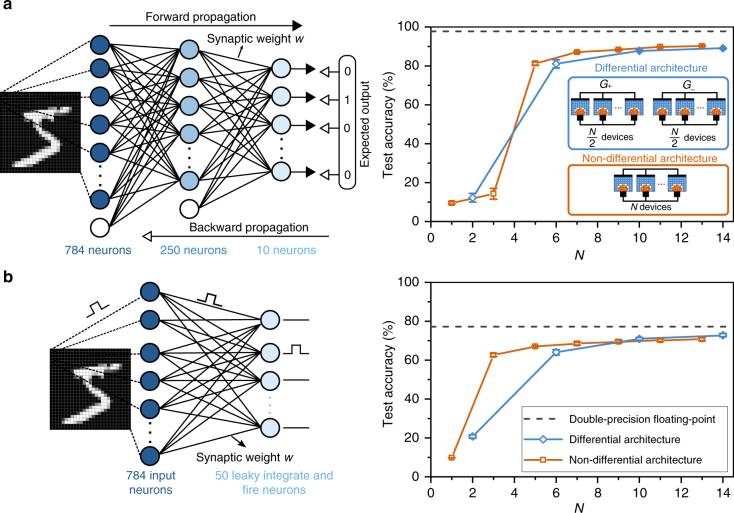
- In MNIST simulations for an ANN, the ideal floating-point classifier achieved 97.8% accuracy, while multi-memristive synapses reached >88.9% in the differential architecture and >90% in the non-differential architecture; the conventional 2-device differential architecture stayed below 15%.
- In MNIST simulations for an SNN with unsupervised learning, the floating-point baseline achieved 77.2% accuracy; the network with multi-memristive synapses achieved >70% correct classification for N > 9, while the conventional 2-device differential architecture was below 21%.
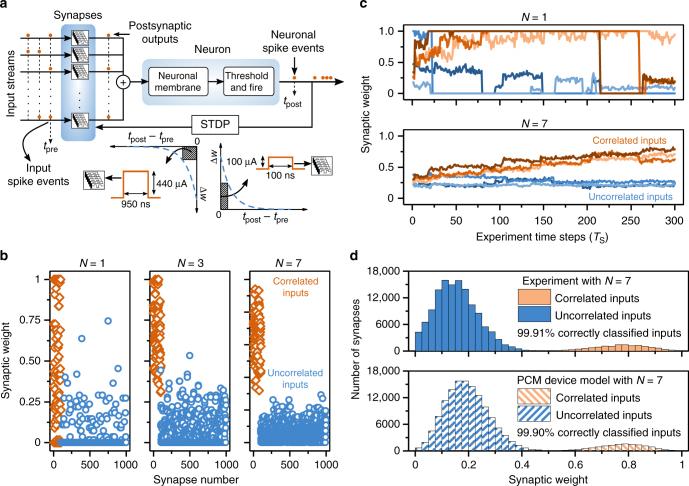
- In the small-scale temporal-correlation experiment, the number of misclassified inputs was 49 for N = 1, 8 for N = 3, and 0 for N = 7.
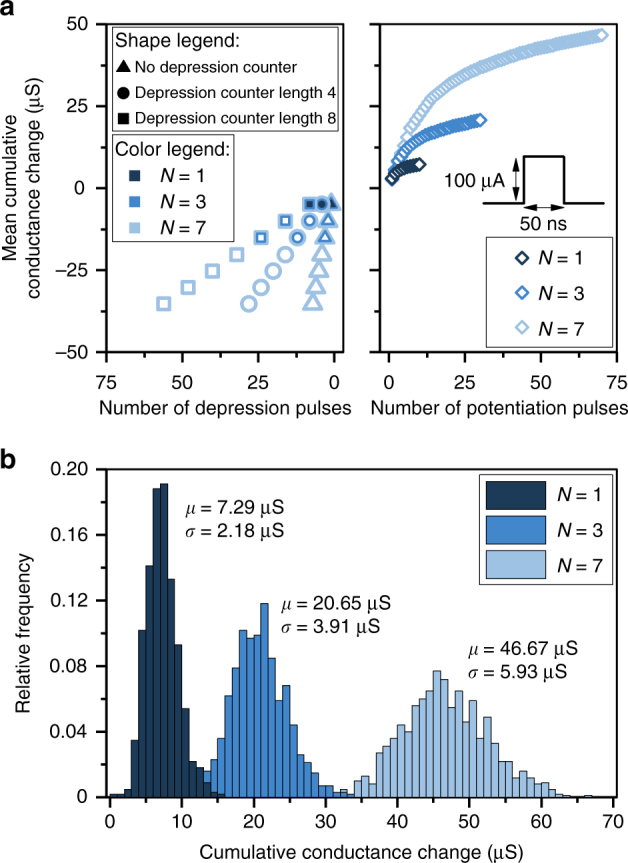
- In the large-scale temporal-correlation experiment, 144,000 synapses with 7 PCM devices per synapse used 1,008,000 PCM devices total, and the experiment and simulation each reported about 0.1% misclassified inputs after training.
Methods
- The paper combines device characterization, analytical modeling, simulations, and hardware experiments using a prototype PCM chip with 3 million devices in a four-bank inter-leaved architecture fabricated in 90 nm CMOS.
- For simulation, the authors trained an ANN on 60,000 MNIST training images and tested on 10,000 MNIST test images; they also simulated an SNN for MNIST and an SNN for temporal-correlation detection using STDP-based learning rules.
- The hardware correlation-detection experiment trained an SNN on 1000 synapses in the small-scale case and 144,000 synapses in the large-scale case, with some synapses receiving correlated inputs at correlation coefficient 0.75.
Limitations
- The paper states that PCM devices have limiting characteristics including limited conductance range, asymmetric conductance response, nonlinear conductance response, stochasticity, and device-to-device variability.
- The text makes evident that the scheme still relies on counter-based arbitration and may produce weight-dependent plasticity because device selection does not use exact conductance knowledge; the paper notes this could negatively affect ANN accuracy, though it may stabilize some SNNs.
- The paper also states that its experimental data are available upon request only, which may limit immediate reproducibility from the text alone.
Model-written summary. Check it against the paper before relying on it.
Integrity signals
Registry
Cites
Statistics
Figures
Verification
Claims the paper makes
6 Valid · 1 Not valid · 15 Not checked · 68 Own results and interpretations
Every source the paper cites for this claim was checked and supports it.
In the paper
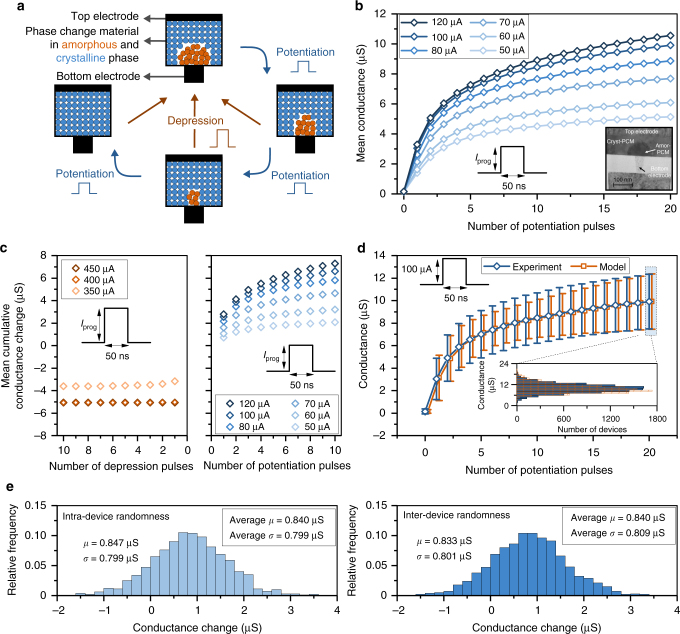
“Such a strongly asymmetric conductance response is undesirable in memristive-device-based implementations of neural networks44”
§ Neuromorphic computing with multi-memristive synapses > Results > Multi-memristive synapses based on PCM devices
What the sources say
- Supportedcites [44] Gokmen T Vlasov Y Acceleration of deep neural network training with resistive cross-point devices: design considerations Front. Neurosci. 2016 10 333 10.3389/fnins.2016.00333 27493624 PMC4954855 source
The Introduction identifies asymmetrical set and reset operations as a limitation for accelerating neural-network training. The Results (“Derivation of RPU device specifications”) find that upward and downward conductance changes must be closely balanced to keep the training error penalty acceptable. The paper notes that global asymmetry can be compensated by adjusting pulses. (LLM, conf=0.90)
boosted- Asserted: passes — The authors put it forward as true.
- Checkable: passes — It can be checked against evidence.
- Load-bearing: passes — The paper’s conclusions depend on it.
- Based: passes — The paper gives a reason why it holds.
- Supported
The cited sources support only part of this claim — read each source’s verdict below.
In the paper
“Large conductance change granularities, as well as nonlinear conductance responses, both observed in the PCM characterization performed here, have been shown to degrade the performance of neural networks trained with memristive synapses34,43.”
§ Neuromorphic computing with multi-memristive synapses > Results > Multi-memristive synapses based on PCM devices
What the sources say
- Not checked — no full text of the sourcecites [34] Burr GW Experimental demonstration and tolerancing of a large-scale neural network (165 000 synapses) using phase-change memory as the synaptic weight element IEEE Trans. Electron Dev. 2015 62 3498 3507 10.1109/TED.2015.2439635 source
- Partly supportedcites [43] Boybat, I. et al. Stochastic weight updates in phase-change memory-based synapses and their influence on artificial neural networks. In Proc. Ph.D. Research in Microelectronics and Electronics (PRIME), 13–16 (IEEE, Giardini Naxos, Italy, 2017). sourceExperimental — accuracy not yet measured
Our copy supports the granularity half: Section II.C states that 'the minimal mean conductance change that can be induced can be quite large especially for low values of device conductance... implies a granularity of possible weight updates in a PCM synapse', and the abstract/introduction (Section I) frame the paper as quantifying the effect of experimentally observed conductance-change granularity (and stochasticity) on classification accuracies, noting that 'non-ideal device characteristics pose challenges to reach competitive classification accuracies'. The nonlinear-conductance-response half is not in this paper at all: our copy's stated scope is explicitly limited to 'two aspects: the granularity of weight updates and the update randomness', and searches for nonlinearity, asymmetry or potentiation/depression returned no passage. The attributed claim that nonlinear responses degrade network performance therefore rests on the other citation(s), not on Boybat et al. (2017). (LLM, conf=0.75)
boostedstates a cause- Asserted: passes — The authors put it forward as true.
- Checkable: passes — It can be checked against evidence.
- Load-bearing: passes — The paper’s conclusions depend on it.
- Based: passes — The paper gives a reason why it holds.
Every source the paper cites for this claim was checked and supports it.
In the paper
“Memristive crossbars can also be fabricated with very small areal footprint27,29,60.”
§ Neuromorphic computing with multi-memristive synapses > Discussion
What the sources say
- Supportedcites [27] Alibart F Zamanidoost E Strukov DB Pattern classification by memristive crossbar circuits using ex situ and in situ training Nat. Commun. 2013 4 2072 10.1038/ncomms3072 23797631 source
The Abstract says memristors’ simple structure allows crossbar integration and aggressive size scaling. It also reports sub-10-nm devices, supporting the claim that memristive crossbars can have a very small areal footprint. Page numbers are not provided in our copy. (LLM, conf=0.91)
- Supportedcites [29] Prezioso M Training and operation of an integrated neuromorphic network based on metal-oxide memristors Nature 2015 521 61 64 10.1038/nature14441 25951284 source
The paper reports fabricating an integrated 12×12 memristive crossbar (Memristor Fabrication, Forming and Characterization, p. 3). It also describes the crossbar topology as capable of extremely high areal density and gives a 30-nm-pitch example (main text, p. 2), supporting the general claim of a small areal footprint. (LLM, conf=0.87)
- Supportedcites [60] Eryilmaz SB Brain-like associative learning using a nanoscale non-volatile phase change synaptic device array Front. Neurosci. 2014 8 205 10.3389/fnins.2014.00205 25100936 PMC4106403 source
The Introduction says nanoscale non-volatile memory devices can be scaled to nanometer dimensions, enabling dense synaptic arrays because of their small feature sizes. The paper also describes its PCM cells as connected in a crossbar fashion (Phase change memory cell array for synaptic operation). Together, these passages support the general claim that such crossbar arrays can have a small areal footprint; the paper does not quantify the footprint of its array. (LLM, conf=0.86)
plain- Asserted: passes — The authors put it forward as true.
- Checkable: passes — It can be checked against evidence.
- Load-bearing: unclear — It is unclear whether the paper’s conclusions depend on it.
- Based: passes — The paper gives a reason why it holds.
- Supported
A result the paper reports from its own data — it cites no other source for it, so there is none to check. The quote shows it is in the paper.
In the paper
“These experiments show that the standard deviation of the conductance change due to intra-device variability is almost as large as that due to the inter-device variability.”
§ Neuromorphic computing with multi-memristive synapses > Results > Multi-memristive synapses based on PCM devices
plain- Asserted: passes — The authors put it forward as true.
- Checkable: passes — It can be checked against evidence.
- Load-bearing: passes — The paper’s conclusions depend on it.
- Based: passes — The paper gives a reason why it holds.
A result the paper reports from its own data — it cites no other source for it, so there is none to check. The quote shows it is in the paper.
In the paper
“Moreover, the fact that the non-differential architecture achieves a comparable performance to that of the differential architecture is promising for synaptic realizations using highly asymmetric devices.”
§ Neuromorphic computing with multi-memristive synapses > Results > Simulation results on handwritten digit classification
plain- Asserted: passes — The authors put it forward as true.
- Checkable: passes — It can be checked against evidence.
- Load-bearing: passes — The paper’s conclusions depend on it.
- Based: passes — The paper gives a reason why it holds.
- Rests on an assumption not shown here.
55 more claims
Create a free account to see all 90 claims and to verify the 2 references still open.
- It may state two separate claims as one. 18
- Borderline: one of the tests for a substantial claim is unclear. 1
- The quote only partly states this claim. 1
- Probably not a substantial claim. 13
Claims other papers make about this one
Each is checked against this paper’s own text: does it say what the citing paper says it does?
The cited source says what the claim attributes to it.
In the citing paper
“Multibit weights are composed of low-bit weights 33 through the cooperation of peripheral circuits.”
From A computing-in-memory macro based on three-dimensional resistive random-access memory (2022) · cites this paper as [33]
Citations
Cites
LeCun, Y., Bengio, Y., & Hinton, G. (2015) · Nature · doi:10.1038/nature14539 · Cited by 84,126
Gradient-based learning applied to document recognition
Lecun, Y., Bottou, L., Bengio, Y., & Haffner, P. (1998) · Proceedings of the IEEE · doi:10.1109/5.726791 · Cited by 58,805
Learning representations by back-propagating errors
Rumelhart, D. E., Hinton, G. E., & Williams, R. J. (1986) · Nature · doi:10.1038/323533a0 · Cited by 31,892
Parallel Distributed Processing: Explorations in the Microstructure of Cognition: Foundations
Rumelhart, D. E., McClelland, J. L., & AU (1986) · doi:10.7551/mitpress/5236.001.0001 · Cited by 15,686
Strukov, D. B., Snider, G. S., Stewart, D. R., & Williams, R. S. (2008) · Nature · doi:10.1038/nature06932 · Cited by 11,828
A million spiking-neuron integrated circuit with a scalable communication network and interface
Merolla, P. A., Arthur, J. V., Alvarez-Icaza, R., Cassidy, A. S., Sawada, J., Akopyan, F., Jackson, B. L., Imam, N., Guo, C., Nakamura, Y., et al. (2014) · Science · doi:10.1126/science.1254642 · Cited by 4,147
Malenka, R. C., & Bear, M. F. (2004) · Neuron · doi:10.1016/j.neuron.2004.09.012 · Cited by 3,968
Regulation of Synaptic Efficacy by Coincidence of Postsynaptic APs and EPSPs
Markram, H., Lübke, J., Frotscher, M., & Sakmann, B. (1997) · Science · doi:10.1126/science.275.5297.213 · Cited by 3,832
Training and operation of an integrated neuromorphic network based on metal-oxide memristors
Prezioso, M., Merrikh-Bayat, F., Hoskins, B. D., Adam, G. C., Likharev, K. K., & Strukov, D. B. (2015) · Nature · doi:10.1038/nature14441 · Cited by 3,001
Competitive Hebbian learning through spike-timing-dependent synaptic plasticity
Song, S., Miller, K. D., & Abbott, L. F. (2000) · Nature Neuroscience · doi:10.1038/78829 · Cited by 2,729
Research works printed but not linked: 1
- Indiveri G Linares-Barranco B Legenstein R Deligeorgis G Prodromakis T Integration of nanoscale memristor synapses in neuromorphic computing architectures Nanotechnology 2013 24 384010 10.1088/0957-4484/24/38/384010 23999381 · DOI · Paper page
Cited by
Items 801–896 of 896
Brāzma, A. (2023) · Oxford University Press eBooks · doi:10.1093/oso/9780192871947.003.0004
Evolution as a Ratchet of Information
Brāzma, A. (2023) · Oxford University Press eBooks · doi:10.1093/oso/9780192871947.003.0008
(2023) · Oxford University Press eBooks · doi:10.1093/oso/9780192871947.002.0003
Brāzma, A. (2023) · Oxford University Press eBooks · doi:10.1093/oso/9780192871947.003.0003
Statistical Study on Data Dependency of Memristor Crossbar Architectures for Neuromorphic Computing
Le, M., & Truong, S. N. (2023) · International Conference on Applying New Technology in Green Buildings (ATiGB) · doi:10.1109/atigb59969.2023.10364403
“More interestingly, memristors is capable of learning and memorizing information by updating the memristance values using an appropriate voltage applied to the two terminals of the device [11, 12].”
MethodWiśniewski, P., Stonio, B., Jasiński, J., et al. (2023) · IEEE International Meeting for Future of Electron Devices, Kansai (IMFEDK) · doi:10.1109/imfedk60983.2023.10366347
“Moreover, their conduction (resistance) modulation feature enables their implementation for in-memory and brain-inspired computing applications [2].”
BackgroundCelebrating 1 year of Frontiers in Electronic Materials
(2024) · Frontiers research topics · doi:10.3389/978-2-8325-4263-7
Vasques, X. (2024) · Wiley eBooks · doi:10.1002/9781394220649.oth
Emerging Technologies for Memory-Centric Computing
Matrangolo, P.-A., Marchand, C., Navarro, D., O’Connor, I., & Bosio, A. (2024) · Springer eBooks · doi:10.1007/978-3-031-42478-6_1 · Cited by 1
Oxygen Gas Modulable Artificial Optoelectronic Synapse Based on Srtio3 SurfacePreprint
Yao, L., Wang, F., He, Z., Li, J., Guo, W., Qiao, Y., Wang, Y., & Wang, F. (2024) · SSRN Electronic Journal · doi:10.2139/ssrn.4789600
Reprogrammable Time-Domain RRAM Based Vector Matrix Multiplier for In-Memory Computing
Boro, B., Parmar, R., Dongre, A., & Trivedi, G. (2024) · International Symposium on Quality Electronic Design (ISQED) · doi:10.1109/isqed60706.2024.10528699 · Cited by 1
“Constant transconductance bias circuit has been employed to reduce process variation and mismatch effects [26].”
MethodThe Integration of Neuromorphic Computing in Autonomous Robotic Systems
Siddique, M. A. B. (2024) · Digital Commons - Michigan Tech (Michigan Technological University) · doi:10.37099/mtu.dc.etdr/1743 · Cited by 1
Electrical switching properties of Ag2S/Cu3P under light and heat excitation
Guo, X., Lv, Y., Chen, M., Xi, J., Fu, L., & Zhao, S. (2024) · Heliyon · doi:10.1016/j.heliyon.2024.e33569
Improving model robustness to weight noise via consistency regularization
Hou, Y., Zhang, Q., Wang, N., & Wu, H. (2024) · Machine Learning Science and Technology · doi:10.1088/2632-2153/ad734a
“In recent years, computing-in-memory (CIM) has garnered significant attention as a groundbreaking technology [1–4], with its associated advancements in technologies and applications progressing rapidly [5, 6].”
Zhang, L., Liu, Z., Zeng, K., Luo, Y., Zeng, J., Fang, B., & Zeng, Z. (2024) · Japanese Journal of Applied Physics · doi:10.35848/1347-4065/ad8418
Nanoscale Sliding Modulated Srcoox-Based Neuromorphic Memory DevicePreprint
Ren, L., Jia, M., Tian, S., et al. (2024) · SSRN Electronic Journal · doi:10.2139/ssrn.5002629
Huang, G., Zhou, S., Zhu, R., Huang, S., & Chai, Y. (2024) · SSRN Electronic Journal · doi:10.2139/ssrn.5049463
Gaurav, R., Uttarwar, U., Deshmukh, S., Sakhuja, J., Randad, K., Agarwal, S., Koshti, A., Biswas, A., & Ganguly, U. (2024) · Non-Volatile Memory Technology Symposium · doi:10.1109/ieeeconf63530.2024.10830795
Rate Coding With 3D Memristor Crossbar
Pallathuvalappil, S., & James, A. P. (2025) · IEEE transactions on circuits and systems for artificial intelligence. · doi:10.1109/tcasai.2025.3532406
“Memristor [15], [16], [17] nodes can be used for counting applications in which each count is encoded as the conductance state.”
Partial Melting and Structural Disorder in Models of Irradiated Amorphous Ge2Sb2Te5
Mocanu, F. C., Elliott, S. R., & Konstantinou, K. (2025) · physica status solidi (RRL) - Rapid Research Letters · doi:10.1002/pssr.202500037
Ultrathin Tio2-Interfaced Hafnia Ferroelectric Transistor for Large-Scale Neuromorphic ComputingPreprint
Han, C., Koo, R., Shin, W., et al. (2025) · SSRN Electronic Journal · doi:10.2139/ssrn.5217557
A review on footsteps of a revolution in electronics: Spin memristors
AL-EDRESI, A., Aydın, G., Abboubi, M. E., Kazan, S., Candan, İ., & San, S. E. (2025) · Materials Today Physics · doi:10.1016/j.mtphys.2025.101760 · Cited by 1
5-Bit High-Linearity UV-Stimulated Synaptic Device Based on MoS2/GaN Heterostructure
Su, Z.-J., Yan, Y. M., Sun, H., et al. (2025) · IEEE Electron Devices Technology & Manufacturing Conference (EDTM) · doi:10.1109/edtm61175.2025.11041542
Interconnection Tensor Rank and the Neural Network Storage Capacity
Kryzhanovsky, B. (2025) · Optical Memory and Neural Networks · doi:10.3103/s1060992x25600272
“These nonvolatile cells usually use ferroelectric [8, 9], magnetic [10], organic [11, 12] and metal-oxide [13–18] materials, floating-gate transistors [19– 21], phase-change memory [22–24].”
The Council on Electronic Design Automation: Creation, Growth, and Future
Micheli, G. D. (2025) · IEEE Design and Test · doi:10.1109/mdat.2025.3596020
“Prototypes already show the embedding of new materials, from phase-change [5] to monolayer [6] devices, for this objective.”
Li, L., Huang, Q., Osada, M., Zhao, J., & Li, Y. (2025) · Journal of Physics D Applied Physics · doi:10.1088/1361-6463/adfbfa
Noh, M., & Kim, S. (2025) · Journal of Materials Chemistry C · doi:10.1039/d5tc02402a · Cited by 1
Colored noise-induced logical stochastic resonance in a low-power-consumption spintronics neuron
Liao, Z., Tang, S., Sarker, M. S., Yamahara, H., Seki, M., & Tabata, H. (2025) · Nonlinear Dynamics · doi:10.1007/s11071-025-11823-8 · Cited by 1
“Neuromorphic systems seek to replicate functionalities such as synaptic plasticity [2], associative learning [3], and Boolean logic operations [4].”
Mazzucca, N., Zhao, J., Xu, Z., et al. (2025) · Applied Physics Letters · doi:10.1063/5.0288908
Gupta, S. S., Vadde, V., Muralidharan, B., et al. (2025) · Journal of Applied Physics · doi:10.1063/5.0282158
Retinomorphic devices beyond silicon for dynamic machine vision
Xia, Y., Babu, R. S., Vishwanath, S. K., & Georgiadou, D. G. (2025) · Neuromorphic Computing and Engineering · doi:10.1088/2634-4386/ae2156 · Cited by 1
Effects of Total Ionizing Dose on HfO 2 ‐Based Ferroelectric Tunnel Junction Artificial Synapses
Xie, S., Zhong, X., Yao, L., Long, J., Ma, C., Wang, J., Fu, Z., & Song, H. (2025) · physica status solidi (a) · doi:10.1002/pssa.202500465
“In general, the positive pulse voltage leads to an increase in conductance value, corresponding to the LTP process, while the negative pulse voltage leads to a decrease in conductance value, corresponding to the LTD process [8, 9].”
Interactions Enhance Ramp Reversal Memory in Locally Phase Separated Materials
Sun, Y., Banguero, M. A., Salev, P., et al. (2025) · Advanced Electronic Materials · doi:10.1002/aelm.202500489
Park, S., Koo, M., & Kim, S. (2025) · Journal of Physics D Applied Physics · doi:10.1088/1361-6463/ae2edd
“PRAM-OTS systems are particularly well-suited for MLNN applications due to their ability to store and update synaptic weights in a non-volatile manner [119].”
Gebregiorgis, A., Yousefzadeh, A., Eissa, S., Siddiqi, M. A., Frenkel, C., Zenke, F., Bohté, S. M., Mahmoud, A. N., Das, A. K., Hamdioui, S., et al. (2025) · Microprocessors and Microsystems · doi:10.1016/j.micpro.2025.105240 · Cited by 11
Surface group-governed charge storage in carbon dots for a visual memristor
Zheng, D., Zhang, T., Yu, H., et al. (2026) · Materials Horizons · doi:10.1039/d5mh02204e
Haidar, A., Abdelsamad, A., Yang, H., Ntinas, V. G., & Tetzlaff, R. (2025) · International Congress of Mathematicans · doi:10.1109/icm66518.2025.11322501
“PCM-based crossbar arrays execute energy-efficient analog matrix-vector multiplications (MVMs) by encoding neural network weights into programmable conductance states, significantly improving computational speed and energy efficiency compared to conventional von Neumann architectures [3].”
Integrated Photonics for Neuromorphic Computing
Meyer, L., Xu, R., & Pernice, W. H. P. (2026) · Machine intelligence for materials science · doi:10.1007/978-3-032-04129-6_17
Yoo, D.-G., Kim, G.-B., Park, S. W., & Baek, M.-H. (2026) · ACS Applied Electronic Materials · doi:10.1021/acsaelm.5c02162 · Cited by 1
Lee, J., Hwang, E., Kim, H., Baek, M.-H., Myeong, I., & Kim, G. (2026) · Semiconductor Science and Technology · doi:10.1088/1361-6641/ae46d2
“To connect device behavior with algorithmic performance, we establish a device-to-system methodology that links physical switching mechanisms to neural-network learning accuracy and energy consumption [43, 44].”
NeoHebbian synapses to accelerate online training of neuromorphic hardware
Pande, S. R., Bezugam, S. S., Bhattacharya, T., Wlaźlak, E., Chakravorty, A., Chakrabarti, B., & Strukov, D. B. (2026) · Scientific Reports · doi:10.1038/s41598-026-35641-z
“The net conductance G can be increased (decreased) by potentiating (depressing) G + or depressing (potentiating) G − 51,52 .”
Filipoiu, F. M., Tătaru, C.-I., Dobrin, N., Șerban, M., Covache-Busuioc, R.-A., Toader, C., Rădoi, M. P., Munteanu, O., & Enyedi, M. (2026) · International Journal of Molecular Sciences · doi:10.3390/ijms27042074
“…coupled networks may be viewed as a controlled, simple version of multiphysical computing and therefore provide additional direction for translation towards the experimental validation of the implications of state-variable-constrained attractor models of neural stability and degeneration [119].”
Advance design for brain-inspired flexible computing: Materials, structures, models to applications
Cao, Y., Chung, K. Y., Guan, X., Chen, Y., Tian, X., Fan, X., Fu, H., & Xu, B. (2026) · Materials Today · doi:10.1016/j.mattod.2026.103262 · Cited by 1
Biomimetic Performance Evaluation of Funnel Geometries in Nanofluidic Artificial Synaptic Memristors
Liu, Y., Li, P., Liu, J., et al. (2026) · Proceedings, IEEE micro electro mechanical systems · doi:10.1109/mems64181.2026.11419503
Gong, Y., Fan, S., Xing, X., Wang, X., & Kang, T. B. (2026) · International Journal of Extreme Manufacturing · doi:10.1088/2631-7990/ae51d1 · Cited by 3
Liu, L., Huang, W., Zhu, F., Cai, Y., Li, X., Yang, Y., Ma, X., Wei, Z., Chen, W., & Chen, H. (2026) · InfoMat · doi:10.1002/inf2.70133 · Cited by 2
Nonlinear spatiotemporal dynamics in magnetic dipole systems for physical reservoir computing
He, L., Jin, Y., Edelstein, S., García, P. D., Rabczuk, T., Zhuang, X., & Torrent, D. (2026) · Nonlinear Dynamics · doi:10.1007/s11071-026-12291-4
Bayesian neuromorphic computing based on resistive memory
Dalgaty, T. (2020) · theses.fr (ABES) · doi:10.70675/e5b4f3e2z44a5z4c41zbac6z4c933e86b101 · Cited by 1
Pammi, V. A. (2021) · theses.fr (ABES) · doi:10.70675/2083af6bz82aaz4797zb43fz9defff39ca20 · Cited by 3
RRAM co-integration with OTS-based back-end selector : from devices to applications
Lopez, J. M. (2022) · theses.fr (ABES) · doi:10.70675/197a0071z4b82z48fdzad97zce487a71c1af
Accelerating optimisation algorithms via optical propagation in complex media
Delloye, L. (2024) · theses.fr (ABES) · doi:10.70675/4b413b60z53e5z41bdzb56ezd58ede1ef04d
Palhares, J. H. Q. (2024) · theses.fr (ABES) · doi:10.70675/48a36fbcze95ez430dzbd4bz985b904d48d3
Reganaz, L. (2024) · theses.fr (ABES) · doi:10.70675/8a8c196ez95d7z468czabf2z768bdddceef5 · Cited by 1
Neuromorphic in-memory learning with analog integrated circuits and nanoscale memristive devices
Garg, N. (2024) · theses.fr (ABES) · doi:10.70675/a5f34c0ezcc3bz42c8z8a52z529a545221ca · Cited by 2
Miyata, N. (2026) · Neuromorphic Computing and Engineering · doi:10.1088/2634-4386/ae5fc6
“For practical implementation in hardware including synaptic memory device technology, however, non-ideal device behaviors and their impact on learning performance must be carefully considered [33–37].”
Ha, H., Kim, D., Kwon, O., Seo, Y., & Hwang, H. (2026) · IEEE Electron Device Letters · doi:10.1109/led.2026.3691110
“Such architectures are particularly suitable for inference-only operation, where the weight matrix is determined o ffl ine and reused during operation [15], [16].”
Opportunities of Lead Free Perovskites Materials for Memristive Applications
Khrolia, Y., Anamika, & Rana, A. (2026) · Topics in applied physics · doi:10.1007/978-3-032-24873-2_10
O2-plasma interface engineering activates WSe2/MoSe2 synaptic memristors for neuromorphic computing
Cai, Z., Tang, M., Wang, G., Liu, Y., Zheng, K., Xiao, M. W., & Tang, H. (2026) · Applied Surface Science · doi:10.1016/j.apsusc.2026.167324
Wang, Y., Lyu, Z., Liu, Y., Wang, L., Chen, Y., Jia, X., & Wang, S. (2026) · SSRN Electronic Journal · doi:10.2139/ssrn.6838696
Jang, S., Lee, D. K., Shin, U., Kang, Y. G., Choi, Y., Han, D., Kwak, J. Y., & Kim, S. (2026) · Nanoscale Horizons · doi:10.1039/d6nh00158k · Cited by 1
HILAL: Hessian-Informed Layer Allocation for Heterogeneous Analog–Digital Inference
Bessalah, A., Abdelmoumen, H., Benatchba, K., & Benmeziane, H. (2026) · Design, Automation, and Test in Europe · doi:10.23919/date69613.2026.11539316
“Analog in-memory computing (AIMC) has recently emerged as a promising alternative that directly performs matrix–vector multiplications in memory arrays, offering orders-of-magnitude improvements in throughput and energy efficiency [2], [3].”
Ye, Z., He, T., Lv, J., Jiang, Q., Sun, M., (157186), H. Y., & Zhang, L. (2026) · Journal of Materials Science Materials in Electronics · doi:10.1007/s10854-026-17711-0
Differential magneto-ionic artificial synapse
Mohanty, H. N., Bernard, G., Syskaki, M., Cottart, K., Durnez, A., Langer, J., Querlioz, D., & Diez, L. H. (2026) · Applied Physics Letters · doi:10.1063/5.0334517
Memristor-driven spike encoding for fully implantable cochlear implants
Török, T. N., Kövecs, R., Braun, F., Pollner, Z., Zeffer, T., Khánh, N. Q., Pósa, L., Revesz, P. Z., Kim, H., Piqué, A., et al. (2026) · Biomedical Signal Processing and Control · doi:10.1016/j.bspc.2026.110761
Hybrid Approximate-Accurate Neural Network Using Vertical NAND Flash MemoryPreprint
Park, S., Koo, R., Yang, Y., et al. (2026) · SSRN Electronic Journal · doi:10.2139/ssrn.7022206
Programming arbitrary analog conductance states of memristors in one step
Li, Y., Wang, S., Luo, Y., & Sun, Z. X. (2026) · Frontiers in Nanotechnology · doi:10.3389/fnano.2026.1866642 · Cited by 1
Spikes as perturbations of resonant neural circuits: an RLC framework with testable predictions
Sender, J., & Chen, Y. P. (2026) · Frontiers in Computational Neuroscience · doi:10.3389/fncom.2026.1846697
“…inductance [implementable as a gyrator circuit or voltage-controlled transconductor pair (Ziegler et al., 2018)]; (ii) a memristive synapse (Boybat et al., 2018; Indiveri et al., 2013; Rao, 2021; Wang et al., 2017; Weilenmann et al., 2024) providing the history-dependent, adaptive coupling…”
Non-idealities in artificial synapses
Hamid, S. B., Incorvia, J. A. C., & Liu, S. (2026) · Nature Reviews Physics · doi:10.1038/s42254-026-00957-2 · Cited by 1
“This results in a sudden decrease in conductance and asymmetry between the potentiation and depression cycles 13,69,70 .”
Visco-Bits: temporal-coding-inspired viscoelastic metamaterial for mechanical memory expansion
Thakkar, A., Rivas-Padilla, J. R., & Arrieta, A. F. (2026) · Materials Horizons · doi:10.1039/d6mh00721j
CMOS-Compatible AlScN Memristor on Silicon Exhibiting Short-Term Memory for Reservoir Computing
Park, W., Chae, H., Rasheed, M., & Kim, S. (2026) · Biomimetics · doi:10.3390/biomimetics11080519
“Synaptic behaviors were further analyzed through conductance modulation experiments, focusing on potentiation (conductance increase) and depression (conductance decrease) [25,26].”
Bhatnagar, V., & Kumar, A. (2026) · Next Materials · doi:10.1016/j.nxmate.2026.102865 · Cited by 1
A double perovskite Cs 2 KBiI 6 memristor for simulating biological synaptic functions
Wang, Y., Li, H., Meng, L., Tong, J., & Zhang, X. (2026) · Journal of Materials Chemistry C · doi:10.1039/d6tc02010k
CMOS Electronic Synaptic Circuit Based on an Active Substrate Charge Injection Mechanism
Song, Z., Zhang, Y., Liu, C., & Xu, J. (2026) · IEEE Transactions on Circuits & Systems II Express Briefs · doi:10.1109/tcsii.2026.3720490
“A reduced conductance ratio not only compresses the available conductance range, but also weakens the distinction between adjacent conductance states during learning, thereby lowering the weight resolution and reducing the accuracy of feature extraction [17], [18].”
Mixed potential for RLC circuits with memristors
Marco, M. D., Forti, M., Pancioni, L., Innocenti, G., & Tesi, A. (2026) · Nonlinear Dynamics · doi:10.1007/s11071-026-12925-7 · Cited by 1
Wang, J., Zhao, S., Wang, Z., Li, Y., Li, Y., Yue, Z., Tang, L., & Tao, J. (2026) · The Journal of Physical Chemistry Letters · doi:10.1021/acs.jpclett.6c02194
Zhao, R., Chen, X., Chen, H., Shu, H., Xu, W., Zhang, S., Li, X., Wang, T., Tong, H., & Miao, X. (2026) · IEEE Electron Device Letters · doi:10.1109/led.2026.3722897
“Meanwhile, PCM-based artificial neurons have mainly been explored in the third generation spiking neural networks (SNNs) [16] to realize leaky integrate-and-fire (LIF) behaviors [17], [18].”
Machine learning modeling reveals unconventional nucleation mechanism in phase‐change material GeTe
Tang, S., Xu, Q., Yuan, S., Chen, R., Hu, H., Xu, M. K., Xue, K., Chen, N., Mazzarello, R., Li, X., et al. (2026) · InfoScience. · doi:10.1002/inc2.70021
“By 8–12 With the continued development of PCM‐ based technologies, research interest has increasingly shifted from demonstrating phase‐switching functionality to controlling the crystallization pathways that determine switching speed, stability, and device variability.”
Wang, Z. M., Li, C., Ren, R., Li, Y., Xu, H., & Liu, Y. X. (2026) · ACS Materials Letters · doi:10.1021/acsmaterialslett.6c00532
Bhatnagar, V., & Kumar, A. (2026) · Next Materials · doi:10.1016/j.nxmate.2026.103165
Analysis and Applications of Neuromorphic Memristors in Artificial Intelligence Computing
Wang, J., Chen, Q., Zhang, J., Meng, J., & Wang, T. (2026) · Nano-Micro Letters · doi:10.1007/s40820-026-02322-5
“Then, key performance metrics, including energy efficiency, reliability, flexibility, and system-level considerations, are discussed [20, 21].”
AI-Enabled Neuromorphic Hardware for Secure and Trusted Semiconductor Systems
Kumar, G., Kumar, R., & Sharma, S. (2026) · Advances in computational intelligence and robotics book series · doi:10.4018/979-8-2600-0021-2.ch007
Zhang, Y., Yu, L., Zhu, X., Wu, K., Zhang, Y., & Pan, J. (2026) · Journal of Russian Laser Research · doi:10.1007/s10946-026-10322-4
“Among the various optical computing solutions, optical neural networks (ONNs) are attracting attention, since they can provide a scalable approach to accelerate AI workloads by employing integrated photonic circuits for matrix-vector multiplications (MVMs) [23].”
Ren, J., Liang, L., & Cao, H. (2026) · Materials · doi:10.3390/ma19173626
“The conductance modulation range, update linearity, and symmetry of potentiation and depression processes affect weight mapping accuracy and system recognition performance, so the quality of a device cannot be judged solely based on the magnitude of a single photoresponse [99].”
An Optoelectronic MXene/HfO 2 Memristor for In-Sensor Neuromorphic Visual Computing
Liu, X., Wu, J., Chen, J., Mao, Y., Di, G., Zhou, P., Chen, J., He, N., Gu, Y., Wang, Z., et al. (2026) · IEEE Transactions on Electron Devices · doi:10.1109/ted.2026.3717691
“Among various hardware candidates for neuromorphic systems, memristors are particularly attractive due to their simple structure, fast switching, and capability to emulate synaptic plasticity [2], [3].”
LAM-coupled bi-cell CNN: firing activities and synchronous patterns
Wu, H., Shao, W., Wang, Z., et al. (2026) · The European Physical Journal Plus · doi:10.1140/epjp/s13360-026-08144-z
Wang, M., Yang, S., Lin, Y., Gao, Y., Zhang, X., Gao, X., Niu, M., Liu, H., Wang, Y., Peng, W., et al. (2026) · Chip · doi:10.1016/j.chip.2026.100220
Beyond Learning: STDP as a Computational Primitive for Boolean Logic in Memristive Devices
Khwairakpam, D. S., & Wangkheirakpam, V. D. (2026) · IEEE North-East India International Energy Conversion Conference and Exhibition (NE-IECCE) · doi:10.1109/ne-iecce69680.2026.11666068
“In neuromorphic systems, this behaviour has been widely used to drive synaptic weight adaptation for effective learning algorithms [5].”
Etémé, A. S., Mvogo, A., Nadarajah, S., Fouda, H. P. E., Kofané, T. C., & Tabi, C. B. (2026) · Chaos An Interdisciplinary Journal of Nonlinear Science · doi:10.1063/5.0336997 · Cited by 1
Kong, M., Kim, S. E., Kim, K., Yu, S., Park, N., & Lee, S. (2026) · ACS Photonics · doi:10.1021/acsphotonics.6c01155
Mukherjee, S., Ganaie, M. M., Chatterjee, A., Auti, C. B., Adamu, J., Das, C., Kumar, P., Tyagi, L., Saliba, M., & Kumar, M. (2026) · Materials Horizons · doi:10.1039/d6mh00879h · Cited by 1
Nonlinear Dynamics and Invariants of Motion in ReRAM Cells
Marco, M. D., Forti, M., Pancioni, L., et al. (2026) · Advanced Electronic Materials · doi:10.1002/aelm.70553
Krishna, V. R., Choudhury, M., Reddy, M. B. S. S., Raghuram, K. S., & Padhi, S. N. (2026) · Journal of Computational Electronics · doi:10.1007/s10825-026-02637-x
“Multi-memristive synapses and integrated memristor–CMOS architectures have demonstrated their potential for neuromorphic and in-memory computing [44, 45].”
Hybrid approximate-accurate neural network using vertical NAND flash memory
Park, S.-H., Koo, R., Yang, Y., et al. (2026) · Nano Energy · doi:10.1016/j.nanoen.2026.112454
Leveraging Local Magnetic Modifications for Spin-Based Neuromorphic Computing
Rahaman, H., Kumar, D., Maddu, R., et al. (2026) · ACS Applied Materials & Interfaces · doi:10.1021/acsami.6c12598
Elamaran, D., Sakai, M., Huiqin, L., Naoi, R., Kobayashi, T., Qi, K., Tung, V., Sakota, S., Yoshimura, T., Fujimura, N., et al. (2026) · ACS Nano · doi:10.1021/acsnano.6c10356
Metadata
- Authors
- Boybat, I., Le Gallo, M., Nandakumar, S. R., Moraitis, T., Parnell, T., Tuma, T., Rajendran, B., Leblebici, Y., Sebastian, A., & Eleftheriou, E.
- Affiliations
- IBM Research - Zurich (CH)
- New Jersey Institute of Technology (US)
- École Polytechnique Fédérale de Lausanne (CH)
- Corresponding author
- Boybat, Irem
- Sebastian, Abu
- ORCID
- Venue
- Nature Communications
- Published
- 2018-06-28
- Volume
- 9
- Issue
- 1
- Pages
- 2514-2514
- ISSN
- 2041-1723 (ISSN-L)
- PMC
- PMC6023896
- OpenAlex
- W2769049661
- Semantic Scholar
- 677743cfbe8a71c65b6b3af31040d98aa55fb9b2
- Cited by
- 899
- References
- 67
- Citations by year
- 2026: 95 · 2025: 107 · 2024: 99 · 2023: 128 · 2022: 127 · 2021: 140 · 2020: 122 · 2019: 63 · 2018: 18
- FWCI
- 32.77
- Type
- journal article
- Language
- en
- Open access
- gold
- doi.org
- Licence
- cc-by
- creativecommons.org/licenses/by/4.0 (tdm)
- creativecommons.org/licenses/by/4.0 (vor)
- Locations
- Nature Communications (publishedVersion, cc-by)
- Europe PMC (PubMed Central) (publishedVersion, cc-by)
- PubMed Central (publishedVersion, cc-by)
- PubMed (publishedVersion)
- arXiv (Cornell University) (submittedVersion)
- Research Portal (King's College London) (submittedVersion, cc-by)
- RePEc: Research Papers in Economics (submittedVersion)
- DOAJ (DOAJ: Directory of Open Access Journals) (submittedVersion)
- DOAJ (DOAJ: Directory of Open Access Journals) (submittedVersion, cc-by-sa)
- Infoscience (Ecole Polytechnique Fédérale de Lausanne) (submittedVersion, cc-by-nc-nd)
- arXiv (Cornell University)
- Funders
- National Science Foundation
- European Commission (HORIZON2020, 682675)
- Schweizerischer Nationalfonds zur Förderung der Wissenschaftlichen Forschung
- Topics
- Physical Sciences › Engineering › Electrical and Electronic Engineering › Advanced Memory and Neural Computing
- Physical Sciences › Computer Science › Artificial Intelligence › Neural Networks and Reservoir Computing
- Physical Sciences › Mathematics › Theoretical Computer Science › DNA and Biological Computing
- Keywords
- neuromorphic computing, memristors, phase-change memory, spiking neural networks, unsupervised learning, energy-efficient hardware, artificial neural networks
- MeSH terms
- Unsupervised Machine Learning, Action Potentials, Animals, Electric Conductivity, Electronics, Humans, Models, Neurological, Synapses, Neural Networks, Computer, Biomimetic Materials
About these checks
Registry, retraction, Cites and statistics results are computed, not judged, with one exception: a printed reference that no index lists is read once by a model before it counts as a citation error. Claims are extracted by a model and kept only when their quote appears verbatim in the text; each cited source is then checked, with a model’s help, for whether it says what the claim relies on. Those verdicts can be wrong — read the claim’s quote and the cited source before relying on one.
The claim verdicts this report counts are experimental: their accuracy is not yet measured.
A language model drew the claims from the paper on 2026-10-10, under version 3 of the claim definition (model deepseek-v4.1-flash, prompt extract-v3).
A second model labelled each claim on 2026-10-10 (model jev-1.13-20260917, definition revision gold-guideline-v0.2).
Cited sources are checked with a language model’s help (gpt-6-sol and qwen3.8-omni-flash).
Statistics and arithmetic are recomputed, not judged.
Confidence bands are shown only for fields calibrated on our annotated test set. None is calibrated yet, so no band is shown.
What counts as a claim ›How we measure confidence ›How we check this ›
Are you an author, or do you see a problem with this page? Request a review
Data sources
Bibliographic data: Semantic Scholar, OpenAlex, Crossref.
Contains information from the Semantic Scholar Academic Graph Datasets, made available under the ODC Attribution License (ODC-BY 1.0).
Semantic Scholar’s data is described in: Kinney, R., et al. (2023). The Semantic Scholar Open Data Platform. arXiv:2301.10140.
