

Neuromorphic computing with multi-memristive synapses
Open accessThe DOI matches its Crossref record; 66 of the 67 references it cites were found in a registry or an index; 8 of the 30 sources its claims cite were checked for support.
Abstract
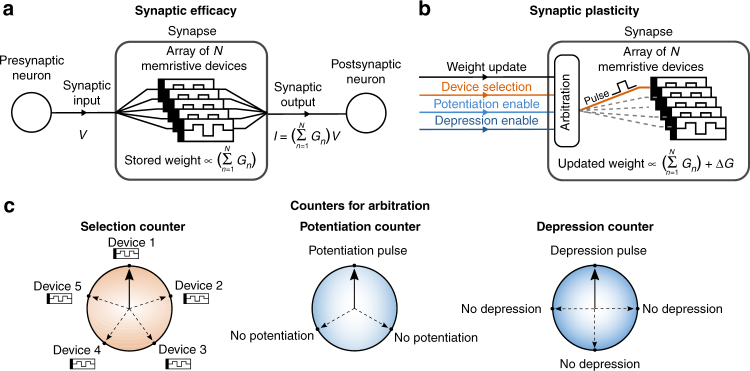
Neuromorphic computing has emerged as a promising avenue towards building the next generation of intelligent computing systems. It has been proposed that memristive devices, which exhibit history-dependent conductivity modulation, could efficiently represent the synaptic weights in artificial neural networks. However, precise modulation of the device conductance over a wide dynamic range, necessary to maintain high network accuracy, is proving to be challenging. To address this, we present a multi-memristive synaptic architecture with an efficient global counter-based arbitration scheme. We focus on phase change memory devices, develop a comprehensive model and demonstrate via simulations the effectiveness of the concept for both spiking and non-spiking neural networks. Moreover, we present experimental results involving over a million phase change memory devices for unsupervised learning of temporal correlations using a spiking neural network. The work presents a significant step towards the realization of large-scale and energy-efficient neuromorphic computing systems.
Overview
CoChat Summary
TL;DR
The paper proposes a multi-memristive synapse architecture that uses multiple memristive devices per synapse plus a counter-based arbitration scheme to improve dynamic range, resolution, and robustness for neuromorphic learning. It demonstrates the idea with PCM devices in simulations and in experiments on more than one million devices, including unsupervised temporal-correlation detection.
Key findings
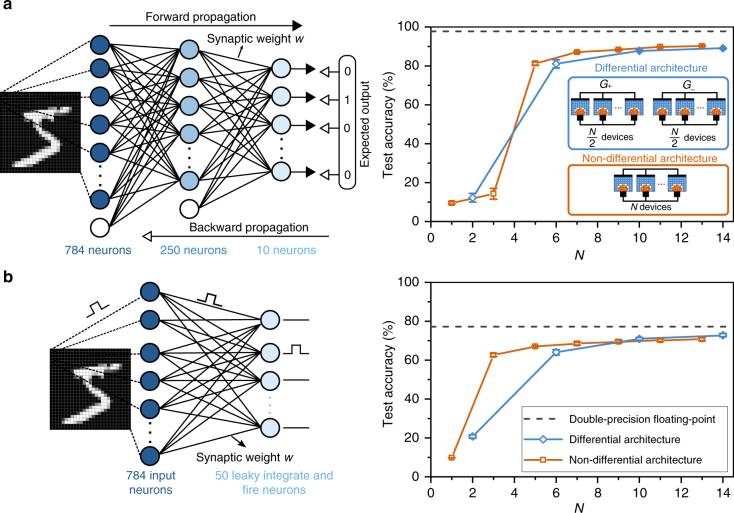
- In MNIST simulations for an ANN, the ideal floating-point classifier achieved 97.8% accuracy, while multi-memristive synapses reached >88.9% in the differential architecture and >90% in the non-differential architecture; the conventional 2-device differential architecture stayed below 15%.
- In MNIST simulations for an SNN with unsupervised learning, the floating-point baseline achieved 77.2% accuracy; the network with multi-memristive synapses achieved >70% correct classification for N > 9, while the conventional 2-device differential architecture was below 21%.
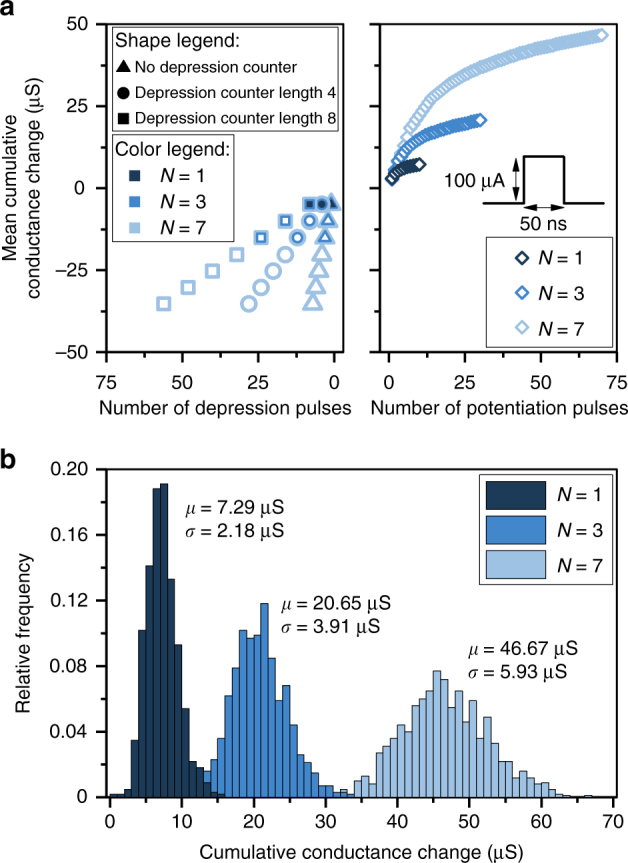
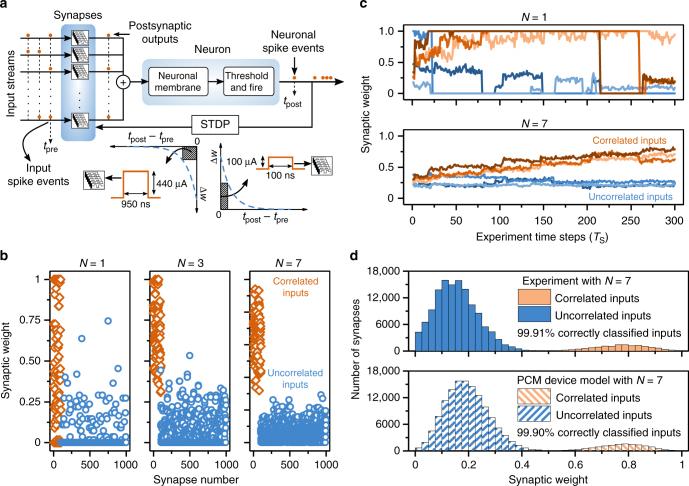
- In the small-scale temporal-correlation experiment, the number of misclassified inputs was 49 for N = 1, 8 for N = 3, and 0 for N = 7.
- In the large-scale temporal-correlation experiment, 144,000 synapses with 7 PCM devices per synapse used 1,008,000 PCM devices total, and the experiment and simulation each reported about 0.1% misclassified inputs after training.
Methods
- The paper combines device characterization, analytical modeling, simulations, and hardware experiments using a prototype PCM chip with 3 million devices in a four-bank inter-leaved architecture fabricated in 90 nm CMOS.
- For simulation, the authors trained an ANN on 60,000 MNIST training images and tested on 10,000 MNIST test images; they also simulated an SNN for MNIST and an SNN for temporal-correlation detection using STDP-based learning rules.
- The hardware correlation-detection experiment trained an SNN on 1000 synapses in the small-scale case and 144,000 synapses in the large-scale case, with some synapses receiving correlated inputs at correlation coefficient 0.75.
Limitations
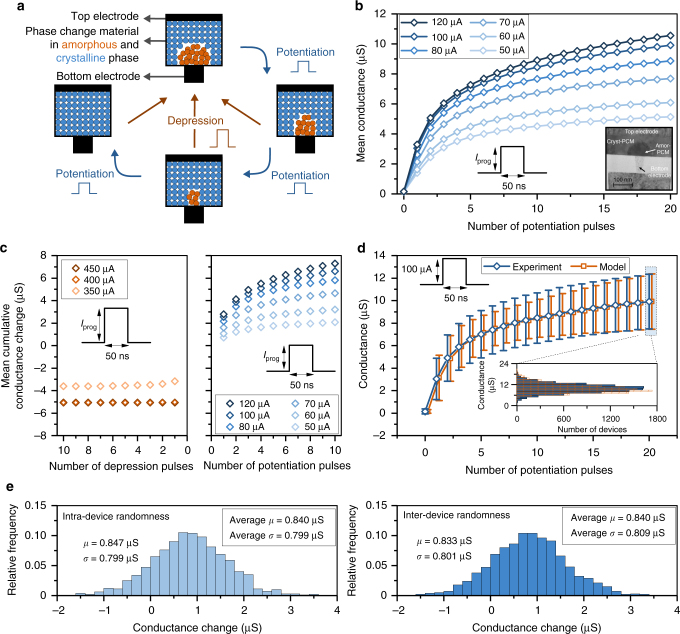
- The paper states that PCM devices have limiting characteristics including limited conductance range, asymmetric conductance response, nonlinear conductance response, stochasticity, and device-to-device variability.
- The text makes evident that the scheme still relies on counter-based arbitration and may produce weight-dependent plasticity because device selection does not use exact conductance knowledge; the paper notes this could negatively affect ANN accuracy, though it may stabilize some SNNs.
- The paper also states that its experimental data are available upon request only, which may limit immediate reproducibility from the text alone.
Model-written summary. Check it against the paper before relying on it.
Integrity signals
Registry
Cites
Statistics
Figures
Verification
Claims the paper makes
6 Valid · 1 Not valid · 15 Not checked · 68 Own results and interpretations
Every source the paper cites for this claim was checked and supports it.
In the paper
“Such a strongly asymmetric conductance response is undesirable in memristive-device-based implementations of neural networks44”
§ Neuromorphic computing with multi-memristive synapses > Results > Multi-memristive synapses based on PCM devices
What the sources say
- Supportedcites [44] Gokmen, T. & Vlasov, Y. Acceleration of deep neural network training with resistive cross-point devices: design considerations. Front. Neurosci. 10, 333 (2016). source
The Introduction identifies asymmetrical set and reset operations as a limitation for accelerating neural-network training. The Results (“Derivation of RPU device specifications”) find that upward and downward conductance changes must be closely balanced to keep the training error penalty acceptable. The paper notes that global asymmetry can be compensated by adjusting pulses. (LLM, conf=0.90)
boosted- Asserted: passes — The authors put it forward as true.
- Checkable: passes — It can be checked against evidence.
- Load-bearing: passes — The paper’s conclusions depend on it.
- Based: passes — The paper gives a reason why it holds.
- Supported
The cited sources support only part of this claim — read each source’s verdict below.
In the paper
“Large conductance change granularities, as well as nonlinear conductance responses, both observed in the PCM characterization performed here, have been shown to degrade the performance of neural networks trained with memristive synapses34,43.”
§ Neuromorphic computing with multi-memristive synapses > Results > Multi-memristive synapses based on PCM devices
What the sources say
- Not checked — no full text of the sourcecites [34] Burr, G. W. et al. Experimental demonstration and tolerancing of a large-scale neural network (165 000 synapses) using phase-change memory as the synaptic weight element. IEEE Trans. Electron Dev. 62, 3498–3507 (2015). source
- Partly supportedcites [43] Boybat, I. et al. Stochastic weight updates in phase-change memory-based synapses and their influence on artificial neural networks. In Proc. Ph.D. Research in Microelectronics and Electronics (PRIME), 13–16 (IEEE, Giardini Naxos, Italy, 2017). sourceExperimental — accuracy not yet measured
Our copy supports the granularity half: Section II.C states that 'the minimal mean conductance change that can be induced can be quite large especially for low values of device conductance... implies a granularity of possible weight updates in a PCM synapse', and the abstract/introduction (Section I) frame the paper as quantifying the effect of experimentally observed conductance-change granularity (and stochasticity) on classification accuracies, noting that 'non-ideal device characteristics pose challenges to reach competitive classification accuracies'. The nonlinear-conductance-response half is not in this paper at all: our copy's stated scope is explicitly limited to 'two aspects: the granularity of weight updates and the update randomness', and searches for nonlinearity, asymmetry or potentiation/depression returned no passage. The attributed claim that nonlinear responses degrade network performance therefore rests on the other citation(s), not on Boybat et al. (2017). (LLM, conf=0.75)
boostedstates a cause- Asserted: passes — The authors put it forward as true.
- Checkable: passes — It can be checked against evidence.
- Load-bearing: passes — The paper’s conclusions depend on it.
- Based: passes — The paper gives a reason why it holds.
Every source the paper cites for this claim was checked and supports it.
In the paper
“Memristive crossbars can also be fabricated with very small areal footprint27,29,60.”
§ Neuromorphic computing with multi-memristive synapses > Discussion
What the sources say
- Supportedcites [27] Alibart, F., Zamanidoost, E. & Strukov, D. B. Pattern classification by memristive crossbar circuits using ex situ and in situ training. Nat. Commun. 4, 2072 (2013). source
The Abstract says memristors’ simple structure allows crossbar integration and aggressive size scaling. It also reports sub-10-nm devices, supporting the claim that memristive crossbars can have a very small areal footprint. Page numbers are not provided in our copy. (LLM, conf=0.91)
- Supportedcites [29] Prezioso, M. et al. Training and operation of an integrated neuromorphic network based on metal-oxide memristors. Nature 521, 61–64 (2015). source
The paper reports fabricating an integrated 12×12 memristive crossbar (Memristor Fabrication, Forming and Characterization, p. 3). It also describes the crossbar topology as capable of extremely high areal density and gives a 30-nm-pitch example (main text, p. 2), supporting the general claim of a small areal footprint. (LLM, conf=0.87)
- Supportedcites [60] Eryilmaz, S. B. et al. Brain-like associative learning using a nanoscale non-volatile phase change synaptic device array. Front. Neurosci. 8, 205 (2014). source
The Introduction says nanoscale non-volatile memory devices can be scaled to nanometer dimensions, enabling dense synaptic arrays because of their small feature sizes. The paper also describes its PCM cells as connected in a crossbar fashion (Phase change memory cell array for synaptic operation). Together, these passages support the general claim that such crossbar arrays can have a small areal footprint; the paper does not quantify the footprint of its array. (LLM, conf=0.86)
plain- Asserted: passes — The authors put it forward as true.
- Checkable: passes — It can be checked against evidence.
- Load-bearing: unclear — It is unclear whether the paper’s conclusions depend on it.
- Based: passes — The paper gives a reason why it holds.
- Supported
A result the paper reports from its own data — it cites no other source for it, so there is none to check. The quote shows it is in the paper.
In the paper
“These experiments show that the standard deviation of the conductance change due to intra-device variability is almost as large as that due to the inter-device variability.”
§ Neuromorphic computing with multi-memristive synapses > Results > Multi-memristive synapses based on PCM devices
plain- Asserted: passes — The authors put it forward as true.
- Checkable: passes — It can be checked against evidence.
- Load-bearing: passes — The paper’s conclusions depend on it.
- Based: passes — The paper gives a reason why it holds.
A result the paper reports from its own data — it cites no other source for it, so there is none to check. The quote shows it is in the paper.
In the paper
“Moreover, the fact that the non-differential architecture achieves a comparable performance to that of the differential architecture is promising for synaptic realizations using highly asymmetric devices.”
§ Neuromorphic computing with multi-memristive synapses > Results > Simulation results on handwritten digit classification
plain- Asserted: passes — The authors put it forward as true.
- Checkable: passes — It can be checked against evidence.
- Load-bearing: passes — The paper’s conclusions depend on it.
- Based: passes — The paper gives a reason why it holds.
- Rests on an assumption not shown here.
55 more claims
Create a free account to see all 90 claims and to verify the 2 references still open.
- It may state two separate claims as one. 18
- Borderline: one of the tests for a substantial claim is unclear. 1
- The quote only partly states this claim. 1
- Probably not a substantial claim. 13
Claims other papers make about this one
Each is checked against this paper’s own text: does it say what the citing paper says it does?
The cited source says what the claim attributes to it.
In the citing paper
“Multibit weights are composed of low-bit weights 33 through the cooperation of peripheral circuits.”
From A computing-in-memory macro based on three-dimensional resistive random-access memory (2022) · cites this paper as [33]
Citations
Cites
LeCun, Y., Bengio, Y., & Hinton, G. (2015) · Nature · doi:10.1038/nature14539 · Cited by 84,126
Gradient-based learning applied to document recognition
Lecun, Y., Bottou, L., Bengio, Y., & Haffner, P. (1998) · Proceedings of the IEEE · doi:10.1109/5.726791 · Cited by 58,805
Learning representations by back-propagating errors
Rumelhart, D. E., Hinton, G. E., & Williams, R. J. (1986) · Nature · doi:10.1038/323533a0 · Cited by 31,892
Parallel Distributed Processing: Explorations in the Microstructure of Cognition: Foundations
Rumelhart, D. E., McClelland, J. L., & AU (1986) · doi:10.7551/mitpress/5236.001.0001 · Cited by 15,686
Strukov, D. B., Snider, G. S., Stewart, D. R., & Williams, R. S. (2008) · Nature · doi:10.1038/nature06932 · Cited by 11,828
A million spiking-neuron integrated circuit with a scalable communication network and interface
Merolla, P. A., Arthur, J. V., Alvarez-Icaza, R., Cassidy, A. S., Sawada, J., Akopyan, F., Jackson, B. L., Imam, N., Guo, C., Nakamura, Y., et al. (2014) · Science · doi:10.1126/science.1254642 · Cited by 4,147
Malenka, R. C., & Bear, M. F. (2004) · Neuron · doi:10.1016/j.neuron.2004.09.012 · Cited by 3,968
Regulation of Synaptic Efficacy by Coincidence of Postsynaptic APs and EPSPs
Markram, H., Lübke, J., Frotscher, M., & Sakmann, B. (1997) · Science · doi:10.1126/science.275.5297.213 · Cited by 3,832
Training and operation of an integrated neuromorphic network based on metal-oxide memristors
Prezioso, M., Merrikh-Bayat, F., Hoskins, B. D., Adam, G. C., Likharev, K. K., & Strukov, D. B. (2015) · Nature · doi:10.1038/nature14441 · Cited by 3,001
Competitive Hebbian learning through spike-timing-dependent synaptic plasticity
Song, S., Miller, K. D., & Abbott, L. F. (2000) · Nature Neuroscience · doi:10.1038/78829 · Cited by 2,729
Research works printed but not linked: 1
- Burr, G. W. et al. Integration of nanoscale memristor synapses in neuromorphic computing architectures. Adv. Phys. X 2, 89–124 (2016).
Cited by
Items 701–800 of 896
Reliable Brain-inspired AI Accelerators using Classical and Emerging Memories
Yayla, M., Thomann, S., Islam, M. M., Wei, M., Ho, S.-Y., Aziz, A., Yang, C.-L., Chen, J.-J., & Amrouch, H. (2023) · IEEE VLSI Test Symposium (VTS) · doi:10.1109/vts56346.2023.10140068 · Cited by 2
“This limitation can be addressed by using memristors with fewer levels and employing multiple memristors for a single weight [72].”
BackgroundLiving Computers: Replicators, Information Processing, and the Evolution of Life
Brāzma, A. (2023) · doi:10.1093/oso/9780192871947.001.0001 · Cited by 2
Sinha, J., Nyns, L., & Delabie, A. (2024) · Journal of Vacuum Science & Technology A Vacuum Surfaces and Films · doi:10.1116/6.0003890 · Cited by 1
Spin–Charge Conversion-Based Artificial Synaptic Device for Neuromorphic Computing
Kim, S. B., Lee, J., Choi, D., Kim, S., Ahn, J. U., Han, K. H., Park, T., Lee, O., Lee, K., Hong, S., et al. (2024) · ACS Applied Electronic Materials · doi:10.1021/acsaelm.4c02048 · Cited by 1
Mao, L., Ke, Y., Su, H., Zhang, X., Sun, B., Ma, K., & Li, T. (2025) · IEEE Electron Device Letters · doi:10.1109/led.2025.3558375 · Cited by 1
“[5], [6], [7] However, the inevitable mechanical coupling noise inherent to flexible components complicates accurate benchmarking of synaptic plasticity in flexible SNN systems, introducing uncertainty challenges that affect both the prediction accuracy and confidence in real-world flexible…”
Reliable Analog In-Memory Computing with Crossbars: Memristors for Analog Neural Computing
James, A. P. (2025) · Foundations and Trends® in Integrated Circuits and Systems · doi:10.1561/3500000018 · Cited by 1
Tibetan Syllable Component Recognization with Memristor
Liu, Y., Shen, J., Yu, Y., Ma-bao, B., Tsering, T., Wang, X., Huang, C., & Tashi, N. (2024) · International Conference on Neuromorphic Computing (ICNC) · doi:10.1109/icnc64304.2024.10987743 · Cited by 1
“The memristor crossbar array, one of fundamental memristor architectures, is widely used in parallel operation task, such as neural network[10], signal processing[11], and neuromorphic computing [12].”
A SPICE Model of Electrolyte Synaptic Transistors
Wu, Z., Hao, Y., Ruan, H., Wang, H., Lin, Z., Zou, J., Feng, Z., Guo, W., Zhu, Y., Xu, Z., et al. (2025) · IEEE Transactions on Electron Devices · doi:10.1109/ted.2025.3591092 · Cited by 1
“T HE human brain efficiently processes vast amounts of information with low energy consumption, with synaptic connections playing a fundamental role in learning, memory, and information processing [1].”
Yan, Z., Zhang, S., & Teng, J. (2025) · The European Physical Journal Special Topics · doi:10.1140/epjs/s11734-025-01926-z · Cited by 1
Samardžić, N., & Dautović, S. (2025) · International Journal of Circuit Theory and Applications · doi:10.1002/cta.70150 · Cited by 2
“The synaptic weight update during the training of SNN can be achieved by the modulation of memristance [27, 28] in various architectures of mem-ristive synapses [29–31], including multimemristive synapses [32].”
Xu, W., & Zhu, S. (2025) · Neural Networks · doi:10.1016/j.neunet.2025.108266 · Cited by 2
Faizan, M., Loan, S. A., Afzal, N., & Alkhammash, H. I. (2025) · IEEE Transactions on Nanotechnology · doi:10.1109/tnano.2025.3632531 · Cited by 2
“Non-CMOS neuron technologies like memristive, spintronic, and PCM-based neurons offer energy-efficient, compact, and in-memory computing capabilities [11], [12].”
Fast-Converging Hybrid Pulse for High Precision Multilevel Phase Change Memory
Hong, T., Chen, X., Song, S., Jiao, Z., Li, X., Li, S., Dai, W., & Song, Z. (2025) · IEEE Electron Device Letters · doi:10.1109/led.2025.3633772 · Cited by 1
“To address these drawbacks, cumulative SET pulse methods [8] have been introduced to incrementally increase conductance in a single direction, avoiding iteration but su ff ering from conductance saturation [9], which limit precision.”
An, S., Shen, L., Liu, T., Wang, Y., Han, Q., & Liu, M. (2025) · ACS Applied Materials & Interfaces · doi:10.1021/acsami.5c20352 · Cited by 1
Zhenhao, J. I. A. O., Chen, X., Tao, H. O. N. G., Li, S., Li, X., Dai, W., Chengcai, T. U., & Song, Z. (2026) · Journal of Systems Architecture · doi:10.1016/j.sysarc.2026.103683 · Cited by 1
Garg, N., Balafrej, I., Palhares, J. H. Q., Bégon‐Lours, L., Florini, D., Falcone, D. F., Stecconi, T., Bragaglia, V., Offrein, B. J., Portal, J., et al. (2026) · Communications Materials · doi:10.1038/s43246-025-01033-5 · Cited by 7
Reachable set bounding for delayed memristive neural networks via adaptive control
Zhao, J., Wu, N., & Zhou, X. (2026) · Networks and Heterogeneous Media · doi:10.3934/nhm.2026009 · Cited by 1
Towards efficient and reliable artificial intelligence through neuromorphic principles
Rajendran, B., Simeone, O., & Al‐Hashimi, B. M. (2026) · Philosophical Transactions of the Royal Society A Mathematical Physical and Engineering Sciences · doi:10.1098/rsta.2024.0522 · Cited by 17
Self-citationChanda, S., Kumar, D., Biswas, I., Sharma, M., Lee, Y., Lee, S., Sharma, S. K., & Mondal, A. (2026) · InfoMat · doi:10.1002/inf2.70131 · Cited by 3
Tong, B., Du, T., Du, J., Yu, X., Tong, J., Xu, J., Li, W., Liu, Z., Li, C., & Ren, W. (2026) · Nature Communications · doi:10.1038/s41467-026-70587-w · Cited by 4
“These neurotransmitters can activate various types of receptors, which in fl uence the excitatory or inhibitory nature of neurons, thereby establishing distinct synaptic weights-a fundamental principle of parallel processing 27,38,39 .”
Orchestrating the post‑silicon revolution of electronics through material-enabled intelligence
Wang, B., Li, X., Yu, L., & Lu, Y. (2026) · Chemical Engineering Journal · doi:10.1016/j.cej.2026.175242 · Cited by 1
Takaki, K., Furuichi, S., Kosugi, M., et al. (2026) · APL Electronic Devices · doi:10.1063/5.0311764 · Cited by 1
Thermal memory driven compact electro-thermal modelling of phase-change memristors
Bhatnagar, V., & Kumar, A. (2026) · Next Materials · doi:10.1016/j.nxmate.2026.102138 · Cited by 1
Analog Weight Update Rule in Ferroelectric Hafnia, Using picoJoule Programming Pulses
Baigol, A., Garg, N., Mazza, M., Zhang, Y., Zaccaria, E., Choi, W., Offrein, B. J., & Bégon‐Lours, L. (2026) · Advanced Electronic Materials · doi:10.1002/aelm.202500823 · Cited by 3
“Comparable performance levels have also been reported for STDP-trained memristive spiking neural networks [46, 47].”
Material‐Intrinsic Circularly Polarized Light Encryption via Neuromorphic Transistors
Liu, L., Li, X., Yang, Y., et al. (2026) · Advanced Functional Materials · doi:10.1002/adfm.76738 · Cited by 1
“In parallel, neuromorphic engineering has emerged as a promising hardware platform for energy-efficient information processing by co-integrating sensing, memory, and computation [26, 27].”
Dang, R., Bian, Y., Bao, R., Rao, J., Chen, M., & Pan, C. (2026) · Journal of Semiconductors · doi:10.1088/1674-4926/26050023 · Cited by 1
Performance Analysis of Spiking RBM with Measurement-Based Phase Change Memory Model
Ishii, M., Ito, M., Kim, W., Kim, S., Nomura, A., Okazaki, A., Okazawa, J., Hosokawa, K., BrightSky, M. J., & Hänsch, W. (2019) · Communications in computer and information science · doi:10.1007/978-3-030-36802-9_63 · Cited by 1
Two-terminal optoelectronic memory device
Zhao, X., Wang, Z., Xu, H., & Liu, Y. (2020) · Elsevier eBooks · doi:10.1016/b978-0-12-819717-2.00004-7 · Cited by 3
Manufacturing heterojunction based on 2D materials for artificial neural network construction
Zhao, E. L., Li, B., Chen, L., et al. (2021) · World Conference on Mechanical Engineering and Intelligent Manufacturing (WCMEIM) · doi:10.1109/wcmeim54377.2021.00133 · Cited by 1
STEM-EELS Analysis of Niobium Oxide Multilayer Films for High Temperature Memristor Devices
Gregorio, B. T. D., Lock, E. H., Knipling, K. E., et al. (2022) · Microscopy and Microanalysis · doi:10.1017/s1431927622007954 · Cited by 1
2D materials for neuromorphic devices
Jiang, J., & Su, J. (2023) · Elsevier eBooks · doi:10.1016/b978-0-12-821505-0.00007-1 · Cited by 1
Hybrid Devices for Neuromorphic Applications
Shanbogh, S. M., Kumari, R. A., & Anjaneyulu, P. (2023) · Royal Society of Chemistry eBooks · doi:10.1039/bk9781839169946-00622 · Cited by 2
Yadav, A., Lim, D., & Jeong, H. (2023) · physica status solidi (RRL) - Rapid Research Letters · doi:10.1002/pssr.202300374 · Cited by 1
Chien, W.-C., Sung, C. L., Bruce, R. L., Yeh, C. W., Cheng, H., Liu, Z. L., Lai, E.-K., Cheng, C., Zheng, J., Grun, A., et al. (2024) · IEEE International Memory Workshop (IMW) · doi:10.1109/imw59701.2024.10536964 · Cited by 1
Artificial afferent neurons based on the metal-insulator transition of VO2
Chen, J., Yin, L., Wang, Y., Wang, H., Li, D., Yang, D., & Pi, X. (2024) · Science China Information Sciences · doi:10.1007/s11432-023-3959-6 · Cited by 2
Implementation of chaining in operant conditioning by a neural network circuit
Chen, B., Liu, F., Wang, N., Bao, H., & Xu, Q. (2025) · AEU - International Journal of Electronics and Communications · doi:10.1016/j.aeue.2025.155760 · Cited by 1
O-doped GeTe/Sb2Te3 multilayer chalcogenide for multi-level phase-change device
Miuchi, M., Matsuda, K., Yoshimoto, S., Sawai, E., & Yin, Y. (2025) · Japanese Journal of Applied Physics · doi:10.35848/1347-4065/adc465 · Cited by 1
Hou, Z., Niu, G., Wang, Y., Meng, H., Yang, J., Zhang, B., Zhao, Y. Z., Li, J., & Wu, S. (2025) · Journal of Materials Chemistry C · doi:10.1039/d5tc00252d · Cited by 1
CMOS compatible SiN-based memristive synapses for edge computing applications
Park, H., Noh, M., Cho, S., & Kim, S. (2025) · Journal of Alloys and Compounds · doi:10.1016/j.jallcom.2025.181398 · Cited by 2
Liu, Y., Wang, Y., Wang, X., Yang, C., Li, L., Tang, W., & Guo, Y. (2025) · IEEE Transactions on Electron Devices · doi:10.1109/ted.2025.3599823 · Cited by 1
“Recent research has explored alternative approaches using emerging devices, such as memristors [19], [20], spintronic devices [21], and phase change materials [22], [23], to implement stochastic computing more efficiently.”
Lv, H.-L., & Zhang, Y. (2025) · The Physics of Fluids · doi:10.1063/5.0281901 · Cited by 1
Haidar, A., Ntinas, V. G., & Tetzlaff, R. (2025) · IEEE International Conference on Artificial Intelligence Circuits and Systems (AICAS) · doi:10.1109/aicas64808.2025.11173140 · Cited by 2
“This efficiency is achieved by storing ANN weights to the tunable conductance states of PCM devices [5].”
Ascoli, A., Gemo, E., Corinto, F., Bonnin, M., Gilli, M., Civalleri, P. P., Demirkol, A. Ş., Messaris, I., Ntinas, V., Prousalis, D. A., et al. (2025) · International Joint Conference on Neural Networks (IJCNN) · doi:10.1109/ijcnn64981.2025.11228286 · Cited by 2
“…classes of memristor physical realizations, one including non-volatile devices, which may be operated as finely-tuneable electronic synapses [5]-[6], and the other grouping two-terminal components, unable to store data under power-off conditions, but exhibiting a non-monotonic DC current versus…”
Lin, Y., Lee, D.-Y., Wang, C., et al. (2020) · Japanese Journal of Applied Physics · doi:10.35848/1347-4065/ab769a · Cited by 1
System-level integration in neuromorphic co-processors
Indiveri, G., Linares-Barranco, B., & Payvand, M. (2020) · Elsevier eBooks · doi:10.1016/b978-0-08-102782-0.00018-6 · Cited by 1
Synaptic realizations based on memristive devices
Milo, V., Dalgaty, T., Ielmini, D., & Vianello, E. (2020) · Elsevier eBooks · doi:10.1016/b978-0-08-102782-0.00017-4 · Cited by 2
Optimization of Analog Accelerators for Deep Neural Networks Inference
Fasoli, A., Ambrogio, S., Narayanan, P., Tsai, H.-Y. S., Mackin, C., Spoon, K., Friz, A. M., Chen, A., & Burr, G. W. (2020) · IEEE International Symposium on Circuits and Systems proceedings · doi:10.1109/iscas45731.2020.9180799 · Cited by 3
Electrochemical reaction in memristor devices in a set state
Guo, H., Liu, X., Gao, X., Yin, K., Yin, J., Xia, Y., Liu, Z. G., & Sun, L. (2021) · AIP Advances · doi:10.1063/5.0033613 · Cited by 1
Le, M., Pham, T. K. H., & Truong, S. N. (2021) · Micromachines · doi:10.3390/mi12060690 · Cited by 1
“Furthermore, the conductance of memristors could be modified and saved by applying programming pulse [4,6], which is the key characteristic of memristors for supporting neuromorphic system implementation.”
BackgroundWagner, M., Bartol, T. M., B, T. J. S. A., & Cauwenberghs, G. (2021) · Frontiers in Neuroscience · doi:10.3389/fnins.2021.698635 · Cited by 2
Neuromorphic applications using MOx-based memristors
Brivio, S., & Vianello, E. (2022) · Elsevier eBooks · doi:10.1016/b978-0-12-814629-3.00014-3 · Cited by 1
Improved thermal stability and ultralow resistance drift of pseudo-binary Sb2Se3–Bi2S3 material
Chen, Y., Wu, T., Wang, G., Zhu, J., Meng, F., & Jiao, Y. (2022) · Vacuum · doi:10.1016/j.vacuum.2022.111466 · Cited by 1
Dual sampling neural network: Learning without explicit optimization
Teramae, J.-N., & Tsubo, Y. (2022) · Physical Review Research · doi:10.1103/physrevresearch.4.043051 · Cited by 2
Dalgaty, T., Castellani, N., Querlioz, D., & Vianello, E. (2020) · arXiv (Cornell University) · doi:10.48550/arxiv.2001.11426 · Cited by 1
Artificial Synapses Based On Two-Dimensional Materials
Jiang, J., & Gu, L. (2023) · Elsevier eBooks · doi:10.1016/b978-0-12-819728-8.00136-4 · Cited by 1
Ernoult, M. (2020) · theses.fr (ABES) · doi:10.70675/1ec5c554z9a7fz4244zaf72z8a780cac9faa · Cited by 2
2022 roadmap on neuromorphic computing and engineering
Christensen, D. V., Dittmann, R., Linares-Barranco, B., Sebastian, A., Le Gallo, M., Redaelli, A., Slesazeck, S., Mikolajick, T., Spiga, S., Menzel, S., et al. (2022) · Neuromorphic Computing and Engineering · doi:10.1088/2634-4386/ac4a83
Self-citationMisba, W. A., Kaisar, T., Bhattacharya, D., & Atulasimha, J. (2021) · IEEE Transactions on Electron Devices · doi:10.1109/ted.2021.3111846 · Cited by 22
Alyushin, A. V., Arkhangelsky, V. G., & Alyushin, S. A. (2019) · IEEE Conference of Russian Young Researchers in Electrical and Electronic Engineering · doi:10.1109/eiconrus.2019.8657127
“A similar homogeneous approach uses the parallel connection of P identical PCM elements (P/2 + P/2 in the case of the differential scheme) with the sequential reconfiguration of each element to extend the dynamic range of PCM synaptic structure [23].”
MethodRobust Unsupervised Two Layered Network with RRAM Synapses for Image Recognition
Lele, A. S., Kumbhare, P., & Ganguly, U. (2018) · IEEE International Conference on Emerging Electronics (ICEE) · doi:10.1109/icee44586.2018.8937982
“SNNs require gradual and symmetric weight change for accurate learning [6].”
BackgroundArima, C., Naitoh, Y., Shima, H., Akinaga, H., & Hasegawa, T. (2020) · Japanese Journal of Applied Physics · doi:10.35848/1347-4065/ab80a1
The data center of tomorrow is made up of heterogeneous acceleratorsPreprint
Vasques, X. (2020) · arXiv (Cornell University) · doi:10.48550/arxiv.2003.10950
Large-scale neuromorphic computing hardware for analog AI enabled by epitaxial random access memory
Choi, C. (2019) · DSpace@MIT (Massachusetts Institute of Technology) · Cited by 1
Memristive devices as computational memory
Sebastian, A., Querlioz, D., Rajendran, B., & Spiga, S. (2020) · Elsevier eBooks · doi:10.1016/b978-0-08-102782-0.00006-x
Self-citationAnalog acceleration of deep learning using phase-change memory
Narayanan, P., Ambrogio, S., Tsai, H.-Y. S., Mackin, C., Shelby, R. M., & Burr, G. W. (2020) · Elsevier eBooks · doi:10.1016/b978-0-08-102782-0.00013-7
A Novel On-chip Photonic Synapse Based on Slot-ridge Waveguides with PCMs
Zhang, H., Huang, B., Cheng, C., & Chen, H. (2020) · IEEE Photonics Conference · doi:10.1109/ipc47351.2020.9252447
“many electronic devices have recently been developed, such as memory[2], memristor[3, 4], and the field-effect transistor[5].”
Artificial Intelligence Accelerators based on Graphene Optoelectronic DevicesPreprint
Gao, W., Yu, C., & Chen, R. (2020) · arXiv (Cornell University) · doi:10.48550/arxiv.2012.01979
Dao, T. D., & Chung, J. (2020) · Journal of Low Power Electronics and Applications · doi:10.3390/jlpea10040040
Štukelj, G. (2020) · Elektronische Hochschulschriften der LMU München (Ludwig-Maximilians-Universität München) · doi:10.5282/edoc.27075 · Cited by 2
An All-in-One Biomimetic 2D Spiking Neural NetworkPreprint
Radhakrishnan, S. S., Dodda, A., & Das, S. (2021) · Research Square · doi:10.21203/rs.3.rs-249741/v1
“This demonstration highlights the fully integrated nature of our MoS2 based hardware SNN and distinguishes it from other hardware SNN architectures based on CMOS or emerging technologies such as RRAM, PCM, memristor, all-optic, as well as hybrid approaches.”
MethodInfluentialDesign and implementation of memristive neuron leakage integrator, and learning feedback
Masaev, D., Talanov, M. O., Zykov, E. Y., Suleimanova, A., Toschev, A. S., & Erokhin, V. V. (2021) · International Siberian Conference on Control and Communications · doi:10.1109/sibcon50419.2021.9438877
“We have found several works on electronic implementation of a part of a mammalian nervous system [15]–[20], however lacking bio-plausibility.”
BackgroundUne nouvelle étape pour l'informatique : Binaire, Biologique, Quantique
Vasques, X. (2021) · HAL
A new step for computingPreprint
Vasques, X. (2021) · arXiv (Cornell University) · doi:10.48550/arxiv.2108.03997
Sahu, P. (2021) · University of Minnesota Digital Conservancy (University of Minnesota)
A Dynamic AES Encryption Based on Memristive Chaos Neural NetworkPreprint
Liu, Y. A., Chen, L., Li, X. W., Liu, Y., Hu, S., Yu, Q., Chen, T. P., & Liu, Y. (2021) · Research Square · doi:10.21203/rs.3.rs-950992/v1
An All-in-One Bio-inspired Neural NetworkPreprint
Radhakrishnan, S. S., Dodda, A., & Das, S. (2021) · Research Square · doi:10.21203/rs.3.rs-969671/v1
“Acknowledging the energy gap, field programmable gate arrays (FPGAs) [3] and crossbar architectures utilizing memristors [4, 5], resistive random-access memory (RRAM) [6], phase change memory (PCM) [7-9], etc.”
InfluentialNeuromorphic Computing Systems with Emerging Devices
Wei, Q., Tang, J., Gao, B., Li, X., Qian, H., & Wu, H. (2021) · Wiley eBooks · doi:10.1002/9783527835317.ch6 · Cited by 2
Czischek, S., Baumbach, A., Billaudelle, S., et al. (2021) · SciPost Physics · doi:10.21468/scipost.report.3185
Czischek, S., Baumbach, A., Billaudelle, S., et al. (2021) · SciPost Physics · doi:10.21468/scipost.report.2718
Czischek, S., Baumbach, A., Billaudelle, S., et al. (2021) · SciPost Physics · doi:10.21468/scipost.report.3718
In-Memory Computation Based Mapping of Keccak-f Hash Function
Kingra, S. K., Parmar, V., & Suri, M. (2022) · Frontiers in Nanotechnology · doi:10.3389/fnano.2022.841756
Memristive/CMOS Devices for Neuromorphic Applications
Milo, V., Malavena, G., Compagnoni, C. M., & Ielmini, D. (2022) · Springer handbooks · doi:10.1007/978-3-030-79827-7_32 · Cited by 1
Yu, Y., & Skowroński, M. (2023) · Journal of Materials Chemistry C · doi:10.1039/d2tc04754c
Binary Synaptic Array for Inference and Training with Built-in RRAM Electroforming Circuit
Dongre, A., & Trivedi, G. (2023) · International Symposium on Quality Electronic Design (ISQED) · doi:10.1109/isqed57927.2023.10129360
“With massive technology scaling, CPUs have become more powerful, but memories did not achieve the same efficiency [1].”
BackgroundTiotto, T. F., Mkhitaryan, D., Borst, J. P., & Taatgen, N. (2023) · SSRN Electronic Journal · doi:10.2139/ssrn.4495227
Wintersteller, S., Yarema, O., Kumaar, D., et al. (2023) · Research Square · doi:10.21203/rs.3.rs-3382076/v1
Ads-Cnn: Adaptive Dataflow Scheduling for Lightweight Cnn Accelerator on FpgasPreprint
Wan, Y., Xie, X., Chen, J., et al. (2023) · SSRN Electronic Journal · doi:10.2139/ssrn.4587719
Organic Resistive Memories for Neuromorphic Electronics
Zhuang, Y., Liu, S., & Zhao, Q. (2023) · Royal Society of Chemistry eBooks · doi:10.1039/bk9781839169946-00060
Memristive Devices for Neuromorphic and Deep Learning Applications
Walters, B., Lammie, C., Eshraghian, J. K., Yakopcic, C., Taha, T. M., Genov, R., Jacob, M. V., Amirsoleimani, A., & Azghadi, M. R. (2023) · Royal Society of Chemistry eBooks · doi:10.1039/bk9781839169946-00680 · Cited by 1
Long, Y., Chen, X., Pan, X., Duan, J., Li, X., Wu, Y., Tang, J., Ma, G., Shen, L., Zhang, J., et al. (2023) · physica status solidi (RRL) - Rapid Research Letters · doi:10.1002/pssr.202300342
Brāzma, A. (2023) · Oxford University Press eBooks · doi:10.1093/oso/9780192871947.003.0006
(2023) · Oxford University Press eBooks · doi:10.1093/oso/9780192871947.002.0004
Brāzma, A. (2023) · Oxford University Press eBooks · doi:10.1093/oso/9780192871947.003.0001
Brāzma, A. (2023) · Oxford University Press eBooks · doi:10.1093/oso/9780192871947.003.0007
Brāzma, A. (2023) · Oxford University Press eBooks · doi:10.1093/oso/9780192871947.003.0010
Brāzma, A. (2023) · Oxford University Press eBooks · doi:10.1093/oso/9780192871947.003.0005
Brāzma, A. (2023) · Oxford University Press eBooks · doi:10.1093/oso/9780192871947.003.0002
Brāzma, A. (2023) · Oxford University Press eBooks · doi:10.1093/oso/9780192871947.003.0009
(2023) · Oxford University Press eBooks · doi:10.1093/oso/9780192871947.002.0005
(2023) · Oxford University Press eBooks · doi:10.1093/oso/9780192871947.002.0008
Metadata
- Authors
- Boybat, I., Le Gallo, M., Nandakumar, S. R., Moraitis, T., Parnell, T., Tuma, T., Rajendran, B., Leblebici, Y., Sebastian, A., & Eleftheriou, E.
- Affiliations
- IBM Research - Zurich (CH)
- New Jersey Institute of Technology (US)
- École Polytechnique Fédérale de Lausanne (CH)
- Corresponding author
- Boybat, Irem
- Sebastian, Abu
- ORCID
- Venue
- Nature Communications
- Published
- 2018-06-28
- Volume
- 9
- Issue
- 1
- Pages
- 2514-2514
- ISSN
- 2041-1723 (ISSN-L)
- PMC
- PMC6023896
- OpenAlex
- W2769049661
- Cited by
- 899
- References
- 67
- Citations by year
- 2026: 95 · 2025: 107 · 2024: 99 · 2023: 128 · 2022: 127 · 2021: 140 · 2020: 122 · 2019: 63 · 2018: 18
- FWCI
- 32.77
- Type
- journal article
- Language
- en
- Open access
- gold
- doi.org
- Licence
- cc-by
- creativecommons.org/licenses/by/4.0 (tdm)
- creativecommons.org/licenses/by/4.0 (vor)
- Locations
- Nature Communications (publishedVersion, cc-by)
- Europe PMC (PubMed Central) (publishedVersion, cc-by)
- PubMed Central (publishedVersion, cc-by)
- PubMed (publishedVersion)
- arXiv (Cornell University) (submittedVersion)
- Research Portal (King's College London) (submittedVersion, cc-by)
- RePEc: Research Papers in Economics (submittedVersion)
- DOAJ (DOAJ: Directory of Open Access Journals) (submittedVersion)
- DOAJ (DOAJ: Directory of Open Access Journals) (submittedVersion, cc-by-sa)
- Infoscience (Ecole Polytechnique Fédérale de Lausanne) (submittedVersion, cc-by-nc-nd)
- arXiv (Cornell University)
- Funders
- National Science Foundation
- European Commission (HORIZON2020, 682675)
- Schweizerischer Nationalfonds zur Förderung der Wissenschaftlichen Forschung
- Topics
- Physical Sciences › Engineering › Electrical and Electronic Engineering › Advanced Memory and Neural Computing
- Physical Sciences › Computer Science › Artificial Intelligence › Neural Networks and Reservoir Computing
- Physical Sciences › Mathematics › Theoretical Computer Science › DNA and Biological Computing
- Keywords
- neuromorphic computing, memristors, phase-change memory, spiking neural networks, unsupervised learning, energy-efficient hardware, artificial neural networks
- MeSH terms
- Unsupervised Machine Learning, Action Potentials, Animals, Electric Conductivity, Electronics, Humans, Models, Neurological, Synapses, Neural Networks, Computer, Biomimetic Materials
About these checks
Registry, retraction, Cites and statistics results are computed, not judged, with one exception: a printed reference that no index lists is read once by a model before it counts as a citation error. Claims are extracted by a model and kept only when their quote appears verbatim in the text; each cited source is then checked, with a model’s help, for whether it says what the claim relies on. Those verdicts can be wrong — read the claim’s quote and the cited source before relying on one.
The claim verdicts this report counts are experimental: their accuracy is not yet measured.
A language model drew the claims from the paper on 2026-10-10, under version 3 of the claim definition (model deepseek-v4.1-flash, prompt extract-v3).
A second model labelled each claim on 2026-10-10 (model jev-1.13-20260917, definition revision gold-guideline-v0.2).
Cited sources are checked with a language model’s help (gpt-6-sol and qwen3.8-omni-flash).
Statistics and arithmetic are recomputed, not judged.
Confidence bands are shown only for fields calibrated on our annotated test set. None is calibrated yet, so no band is shown.
What counts as a claim ›How we measure confidence ›How we check this ›
Are you an author, or do you see a problem with this page? Request a review
Data sources
Bibliographic data: Semantic Scholar, OpenAlex, Crossref.
Contains information from the Semantic Scholar Academic Graph Datasets, made available under the ODC Attribution License (ODC-BY 1.0).
Semantic Scholar’s data is described in: Kinney, R., et al. (2023). The Semantic Scholar Open Data Platform. arXiv:2301.10140.
