

Mechanically tunable conductive interpenetrating network hydrogels that mimic the elastic moduli of biological tissue
Open accessThe DOI matches its Crossref record; 47 of the 48 references it cites were found in a registry or an index.
Abstract
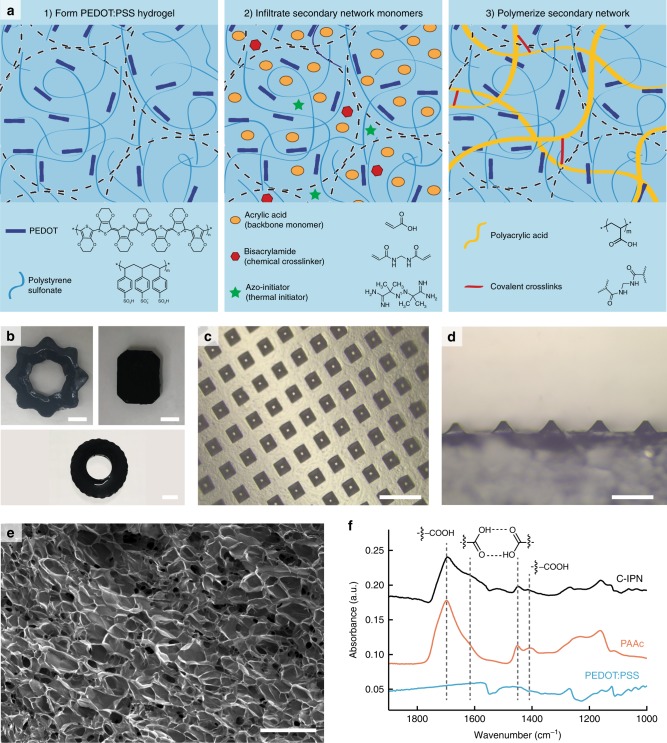
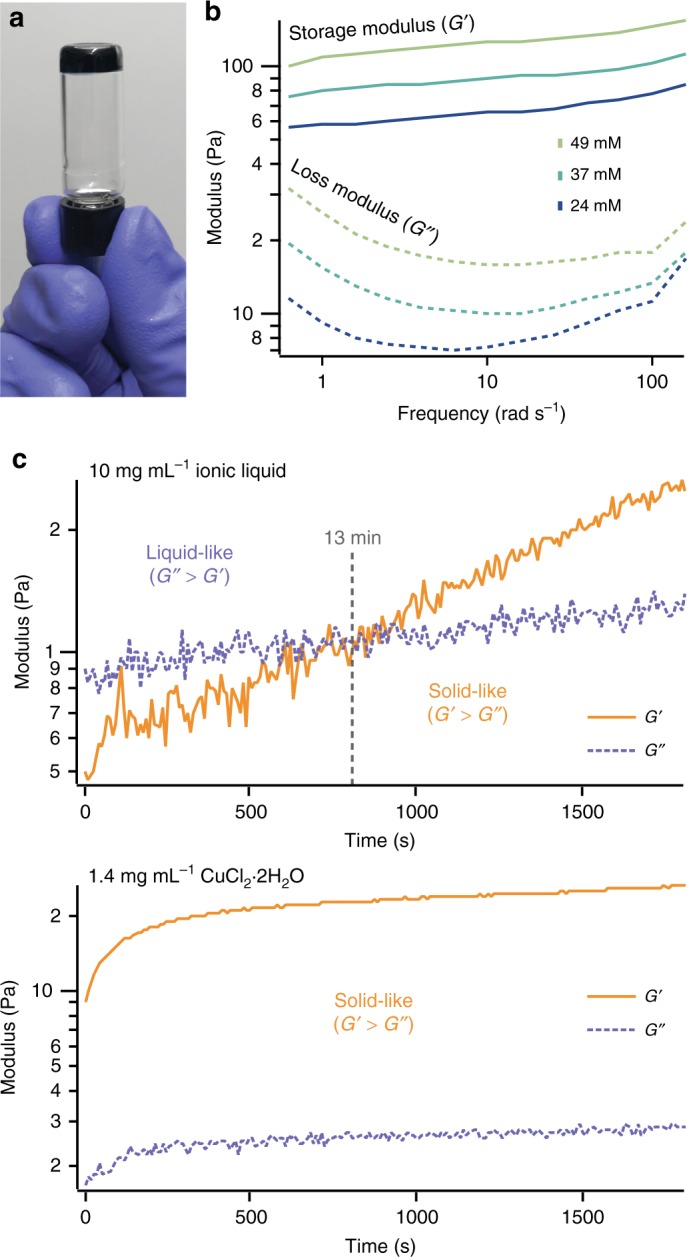
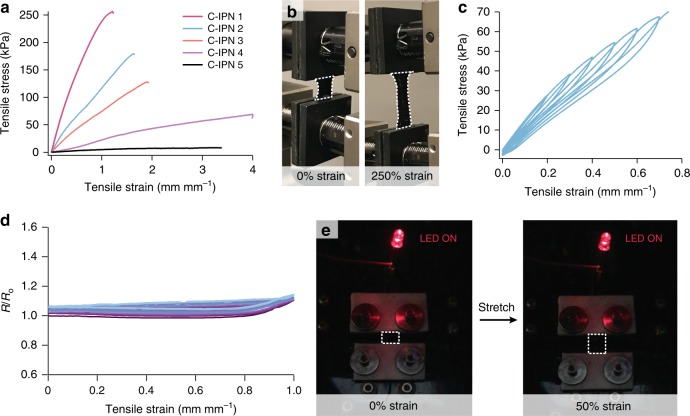
Conductive and stretchable materials that match the elastic moduli of biological tissue (0.5–500 kPa) are desired for enhanced interfacial and mechanical stability. Compared with inorganic and dry polymeric conductors, hydrogels made with conducting polymers are promising soft electrode materials due to their high water content. Nevertheless, most conducting polymer-based hydrogels sacrifice electronic performance to obtain useful mechanical properties. Here we report a method that overcomes this limitation using two interpenetrating hydrogel networks, one of which is formed by the gelation of the conducting polymer PEDOT:PSS. Due to the connectivity of the PEDOT:PSS network, conductivities up to 23 S m −1 are achieved, a record for stretchable PEDOT:PSS-based hydrogels. Meanwhile, the low concentration of PEDOT:PSS enables orthogonal control over the composite mechanical properties using a secondary polymer network. We demonstrate tunability of the elastic modulus over three biologically relevant orders of magnitude without compromising stretchability ( > 100%) or conductivity ( > 10 S m − 1 ).
Overview
The claims and statistics of this paper haven’t been checked yet.
Free: it reads the open-access text and checks the first 5 claims that cite a source we can check. Create a free account to check every claim.
Integrity signals
Registry
Cites
Statistics
Figures
Verification
Claims the paper makes
The claims and statistics of this paper haven’t been checked yet.
Free: it reads the open-access text and checks the first 5 claims that cite a source we can check. Create a free account to check every claim.
Claims other papers make about this one
Each is checked against this paper’s own text: does it say what the citing paper says it does?
The source backs part of the claim, not all of it — or backs it for a different population, condition or comparison.
In the citing paper
“In addition, the combination of hydrogels and conductive polymers is a hot area of research since the former has mechanical properties similar to those of nerves and can provide a hydrophilic interface that reduces the adhesion of non-specific proteins.[58,539–542]”
From Flexible Electronics and Devices as Human–Machine Interfaces for Medical Robotics (2022) · cites this paper as [540]
Experimental — accuracy not yet measured
Self-check
Percentages, sums and reported differences re-computed from the paper’s own numbers.
The self-check needs the paper’s full text.
Citations
Cites
Tissue Cells Feel and Respond to the Stiffness of Their Substrate
Discher, D. E., Janmey, P., & Wang, Y.-L. (2005) · Science · doi:10.1126/science.1116995 · Cited by 6,382
Highly stretchable and tough hydrogels
Sun, J.-Y., Zhao, X., Illeperuma, W. R. K., Chaudhuri, O., Oh, K. H., Mooney, D. J., Vlassak, J. J., & Suo, Z. (2012) · Nature · doi:10.1038/nature11409 · Cited by 5,481
A general relationship between disorder, aggregation and charge transport in conjugated polymers
Noriega, R., Rivnay, J., Vandewal, K., Koch, F. P. V., Stingelin, N., Smith, P., Toney, M. F., & Salleo, A. (2013) · Nature Materials · doi:10.1038/nmat3722 · Cited by 2,206
A highly stretchable, transparent, and conductive polymer
Wang, Y., Zhu, C., Pfattner, R., Yan, H., Jin, L., Chen, S., Molina-Lopez, F., Lissel, F., Liu, J., Rabiah, N. I., et al. (2017) · Science Advances · doi:10.1126/sciadv.1602076 · Cited by 1,442
Self-citationMulti-scale multi-mechanism design of tough hydrogels: building dissipation into stretchy networks
Zhao, X. (2014) · Soft Matter · doi:10.1039/c3sm52272e · Cited by 1,252
The role of matrix stiffness in regulating cell behavior†
Wells, R. G. (2008) · Hepatology · doi:10.1002/hep.22193 · Cited by 1,059
Yang, T., Gregori, G., Pellet, N., Grätzel, M., & Maier, J. (2015) · Angewandte Chemie International Edition · doi:10.1002/anie.201500014 · Cited by 553
Deep-Brain Stimulation for Parkinson's Disease
Okun, M. S. (2012) · New England Journal of Medicine · doi:10.1056/nejmct1208070 · Cited by 541
Chen, Q.-Z., Bismarck, A., Hansen, U., Junaid, S., Tran, M. Q., Harding, S. E., Ali, N. N., & Boccaccini, A. R. (2008) · Biomaterials · doi:10.1016/j.biomaterials.2007.09.010 · Cited by 530
Biomechanical Properties of In Vivo Human Skin From Dynamic Optical Coherence Elastography
Liang, X., & Boppart, S. A. (2010) · IEEE Transactions on Biomedical Engineering · doi:10.1109/tbme.2009.2033464 · Cited by 470
Percolation-dominated conductivity in a conjugated-polymer-carbon-nanotube composite
Coleman, J. N., Curran, S., Dalton, A. B., Davey, A. P., McCarthy, B., Blau, W., & Barklie, R. C. (1998) · Physical Review B · doi:10.1103/physrevb.58.r7492 · Cited by 442
Huggins, R. A. (2002) · Ionics · doi:10.1007/bf02376083 · Cited by 430
Greczynski, G., Kugler, T., & Salaneck, W. R. (1999) · Thin Solid Films · doi:10.1016/s0040-6090(99)00422-8 · Cited by 423
Ultrahigh‐Conductivity Polymer Hydrogels with Arbitrary Structures
Yao, B., Wang, H., Zhou, Q., Wu, M., Zhang, M., Li, C., & Shi, G. (2017) · Advanced Materials · doi:10.1002/adma.201700974 · Cited by 423
Electrochemical Impedance Spectroscopy in PEM Fuel Cells
Yuan, X.-Z., Song, C., Wang, H., & Zhang, J. (2010) · Springer eBooks · doi:10.1007/978-1-84882-846-9 · Cited by 403
Silent hippocampal seizures and spikes identified by foramen ovale electrodes in Alzheimer's disease
Lam, A. D., Deck, G., Goldman, A., Eskandar, E. N., Noebels, J., & Cole, A. J. (2017) · Nature Medicine · doi:10.1038/nm.4330 · Cited by 374
Jamnik, J., & Maier, J. (1999) · Journal of The Electrochemical Society · doi:10.1149/1.1392611 · Cited by 364
Luo, S.-C., Mohamed Ali, E., Tansil, N. C., Yu, H.-H., Gao, S., Kantchev, E. A. B., & Ying, J. Y. (2008) · Langmuir · doi:10.1021/la800333g · Cited by 323
Polypyrrole/Agarose-Based Electronically Conductive and Reversibly Restorable Hydrogel
Hur, J., Im, K., Kim, S. W., Kim, J., Chung, D.-Y., Kim, T.-H., Jo, K. H., Hahn, J. H., Bao, Z., Hwang, S., et al. (2014) · ACS Nano · doi:10.1021/nn502704g · Cited by 299
Self-citationAllagui, A., Freeborn, T. J., Elwakil, A. S., & Maundy, B. J. (2016) · Scientific Reports · doi:10.1038/srep38568 · Cited by 230
Conductive PANi/PEGDA Macroporous Hydrogels For Nerve Regeneration
Guarino, V., Alvarez‐Perez, M. A., Borriello, A., Napolitano, T., & Ambrosio, L. (2013) · Advanced Healthcare Materials · doi:10.1002/adhm.201200152 · Cited by 217
Young’s modulus and volume porosity relationships for additive manufacturing applications
Choren, J. A., Heinrich, S. M., & Silver-Thorn, M. B. (2013) · Journal of Materials Science · doi:10.1007/s10853-013-7237-5 · Cited by 208
Ultra-thin conductive free-standing PEDOT/PSS nanofilms
Greco, F., Zucca, A., Taccola, S., Menciassi, A., Fujie, T., Haniuda, H., Takeoka, S., Dario, P., & Mattoli, V. (2011) · Soft Matter · doi:10.1039/c1sm06174g · Cited by 198
Electrochemical polymerization of conducting polymers in living neural tissue
Richardson-Burns, S. M., Hendricks, J. L., & Martin, D. C. (2007) · Journal of Neural Engineering · doi:10.1088/1741-2560/4/2/l02 · Cited by 195
Wu, Q., Wei, J., Xu, B., Liu, X., Wang, H., Wang, W., Wang, Q., & Liu, W. (2017) · Scientific Reports · doi:10.1038/srep41566 · Cited by 192
Ma, Y.-H., Wu, S.-Y., Wu, T., Chang, Y.-J., Hua, M.-Y., & Chen, J.-P. (2009) · Biomaterials · doi:10.1016/j.biomaterials.2009.02.034 · Cited by 181
Leuchter, A. F. (1987) · Archives of General Psychiatry · doi:10.1001/archpsyc.1987.01800230073012 · Cited by 177
Polymeric Hydrogels as Smart Biomaterials
(2016) · Springer Series on Polymer and Composite Materials · doi:10.1007/978-3-319-25322-0 · Cited by 165
Biocompatibility of intracortical microelectrodes: current status and future prospects
Marin, C. (2010) · Frontier in Neuroengineering · doi:10.3389/fneng.2010.00008 · Cited by 160
Conducting hydrogels with enhanced mechanical strength
Dai, T., Qing, X., Lu, Y., & Xia, Y. (2009) · Polymer · doi:10.1016/j.polymer.2009.09.025 · Cited by 139
Chitosan-graft-Polyaniline-Based Hydrogels: Elaboration and Properties
Marcasuzaa, P., Reynaud, S., Ehrenfeld, F., Khoukh, A., & Desbrières, J. (2010) · Biomacromolecules · doi:10.1021/bm100379z · Cited by 137
Biomaterials for Brain Tissue Engineering
Pettikiriarachchi, J. T. S., Parish, C. L., Shoichet, M. S., Forsythe, J. S., & Nisbet, D. R. (2010) · Australian Journal of Chemistry · doi:10.1071/ch10159 · Cited by 132
Mechanical Properties of Composites
Chou, T., & Kelly, A. (1980) · Annual Review of Materials Science · doi:10.1146/annurev.ms.10.080180.001305 · Cited by 125
Electroconductive Hydrogel Based on Functional Poly(Ethylenedioxy Thiophene)
Mawad, D., Artzy‐Schnirman, A., Tonkin, J. N., Ramos, J., Inal, S., Mahat, M. M., Darwish, N. A., Zwi‐Dantsis, L., Malliaras, G. G., Gooding, J. J., et al. (2016) · Chemistry of Materials · doi:10.1021/acs.chemmater.6b01298 · Cited by 116
Runge, M. B., Dadsetan, M., Baltrusaitis, J., Ruesink, T., Lu, L., Windebank, A. J., & Yaszemski, M. J. (2010) · Biomacromolecules · doi:10.1021/bm100526a · Cited by 113
Interpenetrating Conducting Hydrogel Materials for Neural Interfacing Electrodes
Goding, J., Gilmour, A., Martens, P., Poole‐Warren, L., & Green, R. (2017) · Advanced Healthcare Materials · doi:10.1002/adhm.201601177 · Cited by 110
Demystifying rotors and their place in clinical translation of atrial fibrillation mechanisms
Nattel, S., Xiong, F., & Aguilar, M. (2017) · Nature Reviews Cardiology · doi:10.1038/nrcardio.2017.37 · Cited by 97
Electrostatic Effect on the Solution Structure and Dynamics of PEDOT:PSS
Leaf, M. A., & Muthukumar, M. (2016) · Macromolecules · doi:10.1021/acs.macromol.6b00740 · Cited by 92
Mechanically strong conducting hydrogels with special double-network structure
Dai, T., Qing, X., Zhou, H., Shen, C., Wang, J., & Lu, Y. (2010) · Synthetic Metals · doi:10.1016/j.synthmet.2010.01.024 · Cited by 83
Smaller, softer, lower-impedance electrodes for human neuroprosthesis: a pragmatic approach
Castagnola, E., Ansaldo, A., Maggiolini, E., Ius, T., Skrap, M., Ricci, D., & Fadiga, L. (2014) · Frontiers in Neuroengineering · doi:10.3389/fneng.2014.00008 · Cited by 78
Self-assembly of polypyrrole/chitosan composite hydrogels
Huang, H., Wu, J., Lin, X., Li, L., Shang, S., Yuen, M. C., & Yan, G. (2013) · Carbohydrate Polymers · doi:10.1016/j.carbpol.2013.02.071 · Cited by 77
Preparation of hydrogel/conducting polymer composites
Gilmore, K. J., Hodgson, A. J., Luan, B., Small, C. J., & Wallace, G. G. (1994) · Polymer Gels and Networks · doi:10.1016/0966-7822(94)90032-9 · Cited by 70
Engineering the Next Generation of Clinical Deep Brain Stimulation Technology
McIntyre, C. C., Chaturvedi, A., Shamir, R. R., & Lempka, S. F. (2015) · Brain Stimulation · doi:10.1016/j.brs.2014.07.039 · Cited by 64
Transition from ionic to electronic conduction in silver–vanadate–phosphate glasses
Garbarczyk, J. E., Wasiucionek, M., Machowski, P., & Jakubowski, W. (1999) · Solid State Ionics · doi:10.1016/s0167-2738(98)00475-5 · Cited by 54
Seldon, H. L., Dahm, M. C., Clark, G. M., & Crowe, S. M. (1994) · Biomaterials · doi:10.1016/0142-9612(94)90237-2 · Cited by 36
A percolation model for insulator-metal transition in polymer-conductor composites
Yang, Q., & Liang, J. (2008) · Applied Physics Letters · doi:10.1063/1.2995992 · Cited by 21
Novel biosensing platform based on self-assembled supramolecular hydrogel
Ma, D., & Zhang, L. (2013) · Materials Science and Engineering C · doi:10.1016/j.msec.2013.02.023 · Cited by 20
Research works printed but not linked: 1
- Grill, W. M. in Indwelling Neural Implants: Strategies for Contending with the In Vivo Environment (ed. WM, R.) (CRC Press/Taylor & Francis, 2008). 21204399
Cited by
Yang, J. C., Mun, J., Kwon, S. Y., Park, S., Bao, Z., & Park, S. (2019) · Advanced Materials · doi:10.1002/adma.201904765 · Cited by 1,641
Self-citationHydrogels and Hydrogel-Derived Materials for Energy and Water Sustainability
Guo, Y., Bae, J., Fang, Z., Li, P., Zhao, F., & Yu, G. (2020) · Chemical Reviews · doi:10.1021/acs.chemrev.0c00345 · Cited by 1,395
Stretchable Conductive Polymers and Composites Based on PEDOT and PEDOT:PSS
Kayser, L. V., & Lipomi, D. J. (2019) · Advanced Materials · doi:10.1002/adma.201806133 · Cited by 1,186
Soft Materials by Design: Unconventional Polymer Networks Give Extreme Properties
Zhao, X., Chen, X., Yuk, H., Lin, S., Liu, X., & Parada, G. (2021) · Chemical Reviews · doi:10.1021/acs.chemrev.0c01088 · Cited by 1,161
Lu, B., Yuk, H., Lin, S., Jian, N., Qu, K., Xu, J., & Zhao, X. (2019) · Nature Communications · doi:10.1038/s41467-019-09003-5 · Cited by 1,035
Metadata
- Authors
- Feig, V. R., Tran, H., Lee, M., & Bao, Z.
- Affiliations
- Stanford University (US)
- Corresponding author
- Bao, Zhenan
- Venue
- Nature Communications
- Published
- 2018-07-16
- Volume
- 9
- Issue
- 1
- Pages
- 2740-2740
- ISSN
- 2041-1723 (ISSN-L)
- PMC
- PMC6048132
- OpenAlex
- W2816607594
- Cited by
- 585
- References
- 48
- Citations by year
- 2026: 35 · 2025: 98 · 2024: 102 · 2023: 85 · 2022: 86 · 2021: 78 · 2020: 55 · 2019: 41 · 2018: 5
- FWCI
- 22.34
- Type
- journal article
- Language
- en
- Update notices
- correction (2018-11-23)
- Open access
- gold
- doi.org
- Licence
- cc-by
- creativecommons.org/licenses/by/4.0 (tdm)
- creativecommons.org/licenses/by/4.0 (vor)
- Locations
- Nature Communications (publishedVersion, cc-by)
- Europe PMC (PubMed Central) (publishedVersion, other-oa)
- PubMed Central (publishedVersion, cc-by)
- PubMed (publishedVersion)
- RePEc: Research Papers in Economics (submittedVersion)
- DOAJ (DOAJ: Directory of Open Access Journals) (submittedVersion)
- DOAJ (DOAJ: Directory of Open Access Journals) (submittedVersion, cc-by-sa)
- OSTI OAI (U.S. Department of Energy Office of Scientific and Technical Information) (submittedVersion)
- Funders
- National Science Foundation (1542152)
- U.S. Department of Defense
- U.S. Department of Energy (ECCS-1542152)
- Office of the Director of National Intelligence
- National Research Foundation
- Schweizerischer Nationalfonds zur Förderung der Wissenschaftlichen Forschung (ECCS-1542152)
- National Research Foundation of Korea (NRF-2017R1A6A3A03007053)
- Oak Ridge Institute for Science and Education
- Stanford Precourt Institute for Energy
- Intelligence Community Postdoctoral Research Fellowship Program
- National Defense Science and Engineering Graduate
- NIH Office of the Director
- Division of Electrical, Communications and Cyber Systems (ECCS-1542152, 1542152)
- Topics
- Physical Sciences › Materials Science › Polymers and Plastics › Conducting polymers and applications
- Physical Sciences › Materials Science › Biomaterials › Hydrogels: synthesis, properties, applications
- Physical Sciences › Materials Science › Electronic, Optical and Magnetic Materials › Dielectric materials and actuators
- Keywords
- interpenetrating polymer network hydrogels, conductive hydrogels, PEDOT:PSS, stretchable conductors, soft electrodes, electrical conductivity, stretchability
- MeSH terms
- Electric Conductivity, Electrodes, Electrons, Humans, Materials Testing, Polystyrenes, Thiophenes, Hydrogels, Biomimetic Materials, Elastic Modulus
About these checks
Registry, retraction, Cites and statistics results are computed, not judged, with one exception: a printed reference that no index lists is read once by a model before it counts as a citation error. Claims are extracted by a model and kept only when their quote appears verbatim in the text; each cited source is then checked, with a model’s help, for whether it says what the claim relies on. Those verdicts can be wrong — read the claim’s quote and the cited source before relying on one.
Statistics and arithmetic are recomputed, not judged.
Confidence bands are shown only for fields calibrated on our annotated test set. None is calibrated yet, so no band is shown.
What counts as a claim ›How we measure confidence ›How we check this ›
Are you an author, or do you see a problem with this page? Request a review
Data sources
Bibliographic data: Semantic Scholar, OpenAlex, Crossref.
Contains information from the Semantic Scholar Academic Graph Datasets, made available under the ODC Attribution License (ODC-BY 1.0).
Semantic Scholar’s data is described in: Kinney, R., et al. (2023). The Semantic Scholar Open Data Platform. arXiv:2301.10140.
