

Mechanically tunable conductive interpenetrating network hydrogels that mimic the elastic moduli of biological tissue
Open accessThe DOI matches its Crossref record; 47 of the 48 references it cites were found in a registry or an index.
Abstract
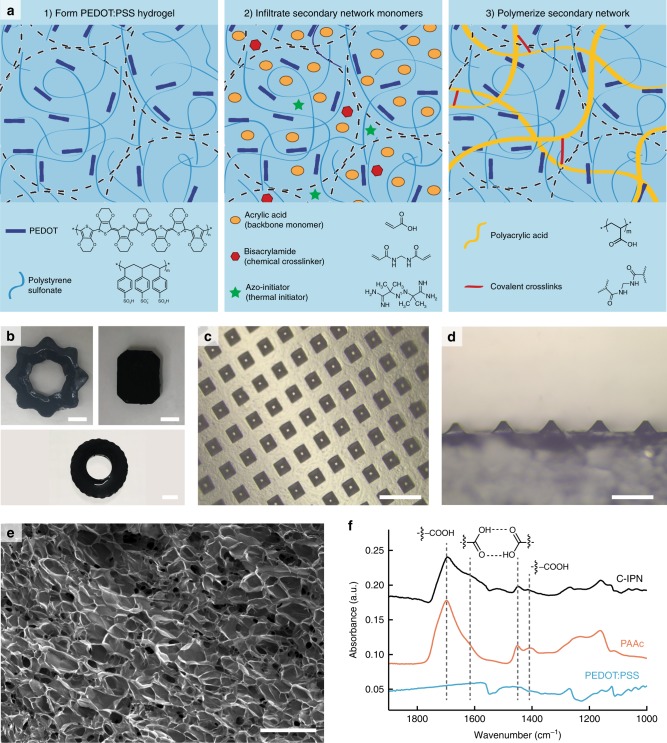
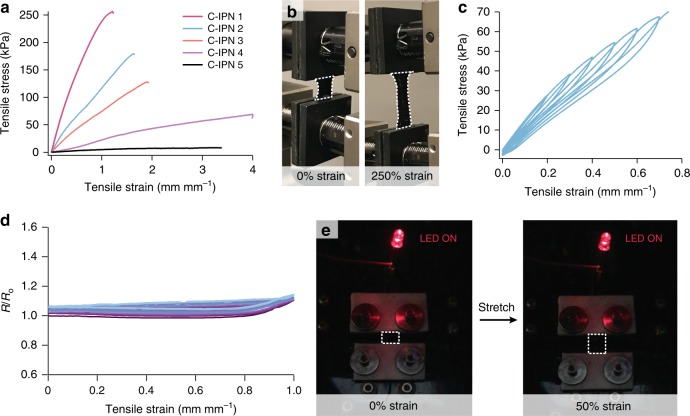
Conductive and stretchable materials that match the elastic moduli of biological tissue (0.5–500 kPa) are desired for enhanced interfacial and mechanical stability. Compared with inorganic and dry polymeric conductors, hydrogels made with conducting polymers are promising soft electrode materials due to their high water content. Nevertheless, most conducting polymer-based hydrogels sacrifice electronic performance to obtain useful mechanical properties. Here we report a method that overcomes this limitation using two interpenetrating hydrogel networks, one of which is formed by the gelation of the conducting polymer PEDOT:PSS. Due to the connectivity of the PEDOT:PSS network, conductivities up to 23 S m −1 are achieved, a record for stretchable PEDOT:PSS-based hydrogels. Meanwhile, the low concentration of PEDOT:PSS enables orthogonal control over the composite mechanical properties using a secondary polymer network. We demonstrate tunability of the elastic modulus over three biologically relevant orders of magnitude without compromising stretchability ( > 100%) or conductivity ( > 10 S m − 1 ).
Overview
The claims and statistics of this paper haven’t been checked yet.
Free: it reads the open-access text and checks the first 5 claims that cite a source we can check. Create a free account to check every claim.
Integrity signals
Registry
Cites
Statistics
Figures
Verification
Claims the paper makes
The claims and statistics of this paper haven’t been checked yet.
Free: it reads the open-access text and checks the first 5 claims that cite a source we can check. Create a free account to check every claim.
Claims other papers make about this one
Each is checked against this paper’s own text: does it say what the citing paper says it does?
The source backs part of the claim, not all of it — or backs it for a different population, condition or comparison.
In the citing paper
“In addition, the combination of hydrogels and conductive polymers is a hot area of research since the former has mechanical properties similar to those of nerves and can provide a hydrophilic interface that reduces the adhesion of non-specific proteins.[58,539–542]”
From Flexible Electronics and Devices as Human–Machine Interfaces for Medical Robotics (2022) · cites this paper as [540]
Experimental — accuracy not yet measured
Self-check
Percentages, sums and reported differences re-computed from the paper’s own numbers.
The self-check needs the paper’s full text.
Citations
Cites
Tissue Cells Feel and Respond to the Stiffness of Their Substrate
Discher, D. E., Janmey, P., & Wang, Y.-L. (2005) · Science · doi:10.1126/science.1116995 · Cited by 6,382
Highly stretchable and tough hydrogels
Sun, J.-Y., Zhao, X., Illeperuma, W. R. K., Chaudhuri, O., Oh, K. H., Mooney, D. J., Vlassak, J. J., & Suo, Z. (2012) · Nature · doi:10.1038/nature11409 · Cited by 5,481
A general relationship between disorder, aggregation and charge transport in conjugated polymers
Noriega, R., Rivnay, J., Vandewal, K., Koch, F. P. V., Stingelin, N., Smith, P., Toney, M. F., & Salleo, A. (2013) · Nature Materials · doi:10.1038/nmat3722 · Cited by 2,206
A highly stretchable, transparent, and conductive polymer
Wang, Y., Zhu, C., Pfattner, R., Yan, H., Jin, L., Chen, S., Molina-Lopez, F., Lissel, F., Liu, J., Rabiah, N. I., et al. (2017) · Science Advances · doi:10.1126/sciadv.1602076 · Cited by 1,442
Self-citationMulti-scale multi-mechanism design of tough hydrogels: building dissipation into stretchy networks
Zhao, X. (2014) · Soft Matter · doi:10.1039/c3sm52272e · Cited by 1,252
The role of matrix stiffness in regulating cell behavior†
Wells, R. G. (2008) · Hepatology · doi:10.1002/hep.22193 · Cited by 1,059
Yang, T., Gregori, G., Pellet, N., Grätzel, M., & Maier, J. (2015) · Angewandte Chemie International Edition · doi:10.1002/anie.201500014 · Cited by 553
Deep-Brain Stimulation for Parkinson's Disease
Okun, M. S. (2012) · New England Journal of Medicine · doi:10.1056/nejmct1208070 · Cited by 541
Chen, Q.-Z., Bismarck, A., Hansen, U., Junaid, S., Tran, M. Q., Harding, S. E., Ali, N. N., & Boccaccini, A. R. (2008) · Biomaterials · doi:10.1016/j.biomaterials.2007.09.010 · Cited by 530
Biomechanical Properties of In Vivo Human Skin From Dynamic Optical Coherence Elastography
Liang, X., & Boppart, S. A. (2010) · IEEE Transactions on Biomedical Engineering · doi:10.1109/tbme.2009.2033464 · Cited by 470
Research works printed but not linked: 1
- Grill, W. M. in Indwelling Neural Implants: Strategies for Contending with the In Vivo Environment (ed. WM, R.) (CRC Press/Taylor & Francis, 2008). 21204399
Cited by
Yang, J. C., Mun, J., Kwon, S. Y., Park, S., Bao, Z., & Park, S. (2019) · Advanced Materials · doi:10.1002/adma.201904765 · Cited by 1,641
Self-citationHydrogels and Hydrogel-Derived Materials for Energy and Water Sustainability
Guo, Y., Bae, J., Fang, Z., Li, P., Zhao, F., & Yu, G. (2020) · Chemical Reviews · doi:10.1021/acs.chemrev.0c00345 · Cited by 1,395
Stretchable Conductive Polymers and Composites Based on PEDOT and PEDOT:PSS
Kayser, L. V., & Lipomi, D. J. (2019) · Advanced Materials · doi:10.1002/adma.201806133 · Cited by 1,186
Soft Materials by Design: Unconventional Polymer Networks Give Extreme Properties
Zhao, X., Chen, X., Yuk, H., Lin, S., Liu, X., & Parada, G. (2021) · Chemical Reviews · doi:10.1021/acs.chemrev.0c01088 · Cited by 1,161
Lu, B., Yuk, H., Lin, S., Jian, N., Qu, K., Xu, J., & Zhao, X. (2019) · Nature Communications · doi:10.1038/s41467-019-09003-5 · Cited by 1,035
Liu, X., Liu, J., Lin, S., & Zhao, X. (2020) · Materials Today · doi:10.1016/j.mattod.2019.12.026 · Cited by 1,023
3D printing of conducting polymers
Yuk, H., Lu, B., Lin, S., Qu, K., Xu, J., Luo, J., & Zhao, X. (2020) · Nature Communications · doi:10.1038/s41467-020-15316-7 · Cited by 1,001
Highly Stretchable, Elastic, and Ionic Conductive Hydrogel for Artificial Soft Electronics
Zhou, Y., Wan, C., Yang, Y., Yang, H., Wang, S., Dai, Z., Ji, K., Jiang, H., Chen, X., & Long, Y. (2019) · Advanced Functional Materials · doi:10.1002/adfm.201806220 · Cited by 933
Soft and elastic hydrogel-based microelectronics for localized low-voltage neuromodulation
Liu, Y., Liu, J., Chen, S., Lei, T., Kim, Y., Niu, S., Wang, H., Wang, X., Foudeh, A. M., Tok, J. B.-H., et al. (2019) · Nature Biomedical Engineering · doi:10.1038/s41551-018-0335-6 · Cited by 811
Self-citationRecent advances in conductive hydrogels: classifications, properties, and applications
Zhu, T., Ni, Y., Biesold, G. M., Cheng, Y., Ge, M., Li, H., Huang, J., Lin, Z., & Lai, Y. (2023) · Chemical Society Reviews · doi:10.1039/d2cs00173j · Cited by 738
Relationship between Structure and Rheology of Hydrogels for Various Applications
Stojkov, G., Niyazov, Z., Picchioni, F., & Bose, R. K. (2021) · Gels · doi:10.3390/gels7040255 · Cited by 654
Flexible Electronics and Devices as Human–Machine Interfaces for Medical Robotics
Heng, W., Solomon, S., & Gao, W. (2022) · Advanced Materials · doi:10.1002/adma.202107902 · Cited by 609
3D printable high-performance conducting polymer hydrogel for all-hydrogel bioelectronic interfaces
Zhou, T., Yuk, H., Hu, F., Wu, J., Tian, F., Roh, H., Shen, Z., Gu, G., Xu, J., Lu, B., et al. (2023) · Nature Materials · doi:10.1038/s41563-023-01569-2 · Cited by 587
Materials and structural designs of stretchable conductors
Matsuhisa, N., Chen, X., Bao, Z., & Someya, T. (2019) · Chemical Society Reviews · doi:10.1039/c8cs00814k · Cited by 566
Self-citationJiang, Y., Trotsyuk, A. A., Niu, S., Henn, D., Chen, K., Shih, C.-C., Larson, M. R., Mermin-Bunnell, A. M., Mittal, S., Lai, J.-C., et al. (2023) · Nature Biotechnology · doi:10.1038/s41587-022-01528-3 · Cited by 559
Self-citationAn electrically conductive silver–polyacrylamide–alginate hydrogel composite for soft electronics
Ohm, Y., Pan, C., Ford, M. J., Huang, X., Liao, J., & Majidi, C. (2021) · Nature Electronics · doi:10.1038/s41928-021-00545-5 · Cited by 546
Zhao, Y., Li, Z., Song, S., Yang, K., Liu, H., Yang, Z., Wang, J., Yang, B., & Lin, Q. (2019) · Advanced Functional Materials · doi:10.1002/adfm.201901474 · Cited by 528
Highly Conducting and Stretchable Double‐Network Hydrogel for Soft Bioelectronics
Li, G., Huang, K., Deng, J., Guo, M., Cai, M., Zhang, Y., & Guo, C. F. (2022) · Advanced Materials · doi:10.1002/adma.202200261 · Cited by 443
Material‐Based Approaches for the Fabrication of Stretchable Electronics
Kim, D. C., Shim, H. J., Lee, W., Koo, J. H., & Kim, D. (2020) · Advanced Materials · doi:10.1002/adma.201902743 · Cited by 438
He, F., You, X., Gong, H., Yang, Y., Bai, T., Wang, W., Guo, W., Liu, X., & Ye, M. (2020) · ACS Applied Materials & Interfaces · doi:10.1021/acsami.9b19721 · Cited by 421
Natural Biopolymer-Based Biocompatible Conductors for Stretchable Bioelectronics
Wang, C., Yokota, T., & Someya, T. (2021) · Chemical Reviews · doi:10.1021/acs.chemrev.0c00897 · Cited by 412
Solution-processable, soft, self-adhesive, and conductive polymer composites for soft electronics
Tan, P., Wang, H., Xiao, F., Lu, X., Shang, W., Deng, X., Song, H., Xu, Z., Cao, J., Gan, T., et al. (2022) · Nature Communications · doi:10.1038/s41467-022-28027-y · Cited by 403
Self-healing conductive hydrogels: preparation, properties and applications
Deng, Z., Wang, H., Ma, P. X., & Guo, B. (2020) · Nanoscale · doi:10.1039/c9nr09283h · Cited by 385
Lim, C., Hong, Y. J., Jung, J., Shin, Y., Sunwoo, S.-H., Baik, S., Park, O. K., Choi, S. H., Hyeon, T., Kim, J. H., et al. (2021) · Science Advances · doi:10.1126/sciadv.abd3716 · Cited by 365
“PEDOT:PSS increases electrical conductivity (43, 44), decreases impedance (45), and improves charge injection capability (44), making it useful for fabricating conductive hydrogels (33, 46).”
BackgroundZhu, Y., Liu, J., Guo, T., Wang, J. J., Tang, X., & Nicolosi, V. (2021) · ACS Nano · doi:10.1021/acsnano.0c08830 · Cited by 356
Transparent Electronics for Wearable Electronics Application
Won, D., Bang, J., Choi, S. H., Pyun, K. R., Jeong, S., Lee, Y., & Ko, S. H. (2023) · Chemical Reviews · doi:10.1021/acs.chemrev.3c00139 · Cited by 339
Jia, Z., Zeng, Y., Tang, P., Gan, D., Xing, W., Hou, Y., Wang, K., Xie, C., & Lu, X. (2019) · Chemistry of Materials · doi:10.1021/acs.chemmater.9b01498 · Cited by 330
Li, M., Zhang, Y., Lian, L., Liu, K., Lu, M., Chen, Y., Zhang, L., Zhang, X., & Wan, P. (2022) · Advanced Functional Materials · doi:10.1002/adfm.202208141 · Cited by 329
Viscoelastic surface electrode arrays to interface with viscoelastic tissues
Tringides, C. M., Vachicouras, N., de Lázaro, I., Wang, H., Trouillet, A., Seo, B. R., Elosegui-Artola, A., Fallegger, F., Shin, Y., Casiraghi, C., et al. (2021) · Nature Nanotechnology · doi:10.1038/s41565-021-00926-z · Cited by 309
Cheng, T., Zhang, Y., Wang, S., Chen, Y., Gao, S., Wang, F., Lai, W., & Huang, W. (2021) · Advanced Functional Materials · doi:10.1002/adfm.202101303 · Cited by 308
Zhang, S., Chen, Y., Liu, H., Wang, Z., Ling, H., Wang, C., Ni, J., Çelebi‐Saltik, B., Wang, X., Meng, X., et al. (2020) · Advanced Materials · doi:10.1002/adma.201904752 · Cited by 298
Su, G., Yin, S., Guo, Y., Zhao, F., Guo, Q., Zhang, X., Zhou, T., & Yu, G. (2021) · Materials Horizons · doi:10.1039/d1mh00085c · Cited by 293
Hydrogels for Flexible Electronics
Zhang, Y., Tan, Y., Lao, J., Gao, H., & Yu, J. (2023) · ACS Nano · doi:10.1021/acsnano.3c02897 · Cited by 291
Won, D., Kim, J., Choi, J., Kim, H., Han, S., Ha, I., Bang, J., Kim, K. K., Lee, Y., Kim, T.-S., et al. (2022) · Science Advances · doi:10.1126/sciadv.abo3209 · Cited by 288
Highly conductive tissue-like hydrogel interface through template-directed assembly
Chong, J., Sung, C., Nam, K. S., Kang, T., Kim, H., Lee, H., Park, H., Park, S., & Kang, J. (2023) · Nature Communications · doi:10.1038/s41467-023-37948-1 · Cited by 286
Ionic Hydrogel for Efficient and Scalable Moisture‐Electric Generation
Yang, S., Tao, X., Chen, W., Mao, J., Luo, H., Lin, S., Zhang, L., & Hao, J. (2022) · Advanced Materials · doi:10.1002/adma.202200693 · Cited by 277
Polymer nanocomposite meshes for flexible electronic devices
Gong, M., Zhang, L., & Wan, P. (2020) · Progress in Polymer Science · doi:10.1016/j.progpolymsci.2020.101279 · Cited by 270
Ultra-stretchable hydrogels with reactive liquid metals as asymmetric force-sensors
Peng, H., Xin, Y., Xu, J., Liu, H., & Zhang, J. (2019) · Materials Horizons · doi:10.1039/c8mh01561a · Cited by 261
Strong adhesion of wet conducting polymers on diverse substrates
Inoue, A., Yuk, H., Lu, B., & Zhao, X. (2020) · Science Advances · doi:10.1126/sciadv.aay5394 · Cited by 260
Wang, J., Li, Q., Li, K., Sun, X., Wang, Y., Zhuang, T., Yan, J., & Wang, H. (2022) · Advanced Materials · doi:10.1002/adma.202109904 · Cited by 253
Wang, W., Zhou, H., Xu, Z., Li, Z., Zhang, L., & Wan, P. (2024) · Advanced Materials · doi:10.1002/adma.202401035 · Cited by 251
Zhang, H., Tang, N., Yu, X., Li, M., & Hu, J. (2022) · Advanced Functional Materials · doi:10.1002/adfm.202206305 · Cited by 248
Wang, S., Nie, Y., Zhu, H., Xu, Y., Cao, S., Zhang, J., Li, Y., Wang, J., Ning, X., & Kong, D. (2022) · Science Advances · doi:10.1126/sciadv.abl5511 · Cited by 246
Liang, Y., Offenhäusser, A., Ingebrandt, S., & Mayer, D. (2021) · Advanced Healthcare Materials · doi:10.1002/adhm.202100061 · Cited by 239
Biocompatible Conductive Polymers with High Conductivity and High Stretchability
He, H., Zhang, L., Guan, X., Cheng, H., Liu, X., Yu, S., Wei, J., & Ouyang, J. (2019) · ACS Applied Materials & Interfaces · doi:10.1021/acsami.9b07325 · Cited by 238
Hybrid assembly of polymeric nanofiber network for robust and electronically conductive hydrogels
He, H., Li, H., Pu, A., Li, W., Ban, K., & Xu, L. (2023) · Nature Communications · doi:10.1038/s41467-023-36438-8 · Cited by 236
Enabling Deformable and Stretchable Batteries
Mackanic, D. G., Kao, M., & Bao, Z. (2020) · Advanced Energy Materials · doi:10.1002/aenm.202001424 · Cited by 232
Self-citationCellulose-Based Ionic Conductor: An Emerging Material toward Sustainable Devices
Ye, Y., Yu, L., Lizundia, E., Zhu, Y., Chen, C., & Jiang, F. (2023) · Chemical Reviews · doi:10.1021/acs.chemrev.2c00618 · Cited by 232
Skin-like hydrogel devices for wearable sensing, soft robotics and beyond
Ying, B., & Liu, X. (2021) · iScience · doi:10.1016/j.isci.2021.103174 · Cited by 230
“, polyacrylic acid (PAAc)] (Figures 3A and 3B) (Feig et al., 2018).”
BackgroundMethodInfluentialYan, X., Fang, W.-W., Xue, J., Sun, T.-C., Dong, L., Zha, Z., Qian, H., Song, Y.-H., Zhang, M., Gong, X., et al. (2019) · ACS Nano · doi:10.1021/acsnano.9b02845 · Cited by 228
An Electrochemical Gelation Method for Patterning Conductive PEDOT:PSS Hydrogels
Feig, V. R., Tran, H., Lee, M., Liu, K., Huang, Z., Beker, L., Mackanic, D. G., & Bao, Z. (2019) · Advanced Materials · doi:10.1002/adma.201902869 · Cited by 221
Self-citationHigh-strength hydrogels: Fabrication, reinforcement mechanisms, and applications
Huang, H., Dong, Z., Ren, X., Jia, B., Li, G., Zhou, S., Zhao, X., & Wang, W. (2023) · Nano Research · doi:10.1007/s12274-022-5129-1 · Cited by 219
Architectural Code for Rubber Elasticity: From Supersoft to Superfirm Materials
Sheiko, S. S., & Dobrynin, A. V. (2019) · Macromolecules · doi:10.1021/acs.macromol.9b01127 · Cited by 215
Conjugated Polymers for Assessing and Controlling Biological Functions
Zeglio, E., Rutz, A. L., Winkler, T. E., Malliaras, G. G., & Herland, A. (2019) · Advanced Materials · doi:10.1002/adma.201806712 · Cited by 210
Wearable Bioelectronics for Chronic Wound Management
Wang, C., Shirzaei Sani, E., & Gao, W. (2022) · Advanced Functional Materials · doi:10.1002/adfm.202111022 · Cited by 208
Flexible, all-hydrogel supercapacitor with self-healing ability
Zou, Y., Chen, C., Sun, Y., Gan, S., Dong, L., Zhao, J., & Rong, J. (2021) · Chemical Engineering Journal · doi:10.1016/j.cej.2021.128616 · Cited by 205
Stimuli‐Responsive Biomaterials: Scaffolds for Stem Cell Control
Gelmi, A., & Schutt, C. E. (2021) · Advanced Healthcare Materials · doi:10.1002/adhm.202001125 · Cited by 204
Flexible and Stretchable Light-Emitting Diodes and Photodetectors for Human-Centric Optoelectronics
Chang, S., Koo, J. H., Yoo, J., Kim, M. S., Choi, M. K., Kim, D.-H., & Song, Y. M. (2024) · Chemical Reviews · doi:10.1021/acs.chemrev.3c00548 · Cited by 202
Gan, D., Shuai, T., Wang, X., Huang, Z., Ren, F., Fang, L., Wang, K., Xie, C., & Lu, X. (2020) · Nano-Micro Letters · doi:10.1007/s40820-020-00507-0 · Cited by 199
Designing organic mixed conductors for electrochemical transistor applications
Wang, Y., Wustoni, S., Surgailis, J., Zhong, Y., Koklu, A., & Inal, S. (2024) · Nature Reviews Materials · doi:10.1038/s41578-024-00652-7 · Cited by 188
“The OMIEC film soft-ness can be increased by the addition of softer components into the polymer casting solution 15 , by formulating conductive hydrogels 121,122 , or by decreasing the glass transition temperature and/or the degree of crystalline order through molecular design 123 .”
Boosting the Performance of PEDOT:PSS Based Electronics Via Ionic Liquids
Li, Y., Pang, Y., Wang, L., Li, Q., Liu, B., Li, J., Liu, S., & Zhao, Q. (2024) · Advanced Materials · doi:10.1002/adma.202310973 · Cited by 187
Laser-induced wet stability and adhesion of pure conducting polymer hydrogels
Won, D., Kim, H., Kim, J., Kim, H., Kim, M. W., Ahn, J., Min, K., Lee, Y., Hong, S., Choi, J., et al. (2024) · Nature Electronics · doi:10.1038/s41928-024-01161-9 · Cited by 186
“Most conductive hydrogels are fabricated by incorporating conductive fillers (such as metal nanomaterials 7 , graphene 8 or conducting polymers 9 ) in crosslinked non-conductive hydrogel backbones.”
Antibacterial Dual Network Hydrogels for Sensing and Human Health Monitoring
Lei, H., Zhao, J., Ma, X., Li, H., & Fan, D. (2021) · Advanced Healthcare Materials · doi:10.1002/adhm.202101089 · Cited by 182
Xue, Y., Chen, X., Wang, F., Lin, J., & Liu, J. (2023) · Advanced Materials · doi:10.1002/adma.202304095 · Cited by 185
Han, Q., Zhang, C., Guo, T., Tian, Y., Song, W., Lei, J., Li, Q., Wang, A., Zhang, M., Bai, S., et al. (2023) · Advanced Materials · doi:10.1002/adma.202209606 · Cited by 181
Precisely manipulating polymer chain interactions for multifunctional hydrogels
Guo, S., Zhang, S., Li, H., Liu, S., Koh, J. J., Zhou, M., Sun, Z., Liu, Y., Qu, H., Yu, Z., et al. (2025) · Matter · doi:10.1016/j.matt.2024.06.024 · Cited by 179
Huang, X., Chen, C., Ma, X., Zhu, T., Ma, W., Jin, Q., Du, R., Cai, Y., Zhang, M., Kong, D., et al. (2023) · Advanced Functional Materials · doi:10.1002/adfm.202302846 · Cited by 177
Conductive and elastic bottlebrush elastomers for ultrasoft electronics
Xu, P., Wang, S., Lin, A., Min, H.-K., Zhou, Z., Dou, W., Sun, Y., Huang, X., Tran, H., & Liu, X. (2023) · Nature Communications · doi:10.1038/s41467-023-36214-8 · Cited by 177
Self-citationFree-standing PEDOT/polyaniline conductive polymer hydrogel for flexible solid-state supercapacitors
Yang, Z., Ma, J., Bai, B., Qiu, A., Losic, D., Shi, D., & Chen, M. (2019) · Electrochimica Acta · doi:10.1016/j.electacta.2019.134769 · Cited by 175
Zhou, H., Wang, Z., Zhao, W., Tong, X., Jin, X., Zhang, X., Yu, Y., Liu, H., Ma, Y., Li, S., et al. (2021) · Chemical Engineering Journal · doi:10.1016/j.cej.2020.126307 · Cited by 174
Orthogonal photochemistry-assisted printing of 3D tough and stretchable conductive hydrogels
Wei, H., Lei, M., Zhang, P., Leng, J., Zheng, Z., & Yu, Y. (2021) · Nature Communications · doi:10.1038/s41467-021-21869-y · Cited by 174
Strategies for Designing Stretchable Strain Sensors and Conductors
Wu, S., Peng, S., Yu, Y., & Wang, C. (2020) · Advanced Materials Technologies · doi:10.1002/admt.201900908 · Cited by 173
Skin-Inspired Gels with Toughness, Antifreezing, Conductivity, and Remoldability
Chen, H., Ren, X., & Gao, G. (2019) · ACS Applied Materials & Interfaces · doi:10.1021/acsami.9b11032 · Cited by 170
Active Materials for Functional Origami
Leanza, S., Wu, S., Sun, X., Qi, H. J., & Zhao, R. R. (2024) · Advanced Materials · doi:10.1002/adma.202302066 · Cited by 169
Liquid-in-liquid printing of 3D and mechanically tunable conductive hydrogels
Xie, X., Xu, Z., Xin, Y., Jiang, H., Li, H., & Feng, W. (2023) · Nature Communications · doi:10.1038/s41467-023-40004-7 · Cited by 171
“Therobust conductivitycanbeattributedtotherearrangementofPEDOTdomains that stay connected with others during the stress deformation, rather than disrupting or insulating the conductive regimes 34 .”
InfluentialPEDOTs‐Based Conductive Hydrogels: Design, Fabrications, and Applications
Li, H., Cao, J., Wan, R., Feig, V. R., Tringides, C. M., Xu, J., Yuk, H., & Lu, B. (2025) · Advanced Materials · doi:10.1002/adma.202415151 · Cited by 168
Self-citationLi, Y., Li, N., Liu, W., Prominski, A., Kang, S., Dai, Y., Liu, Y., Hu, H., Wai, S., Dai, S., et al. (2023) · Nature Communications · doi:10.1038/s41467-023-40191-3 · Cited by 165
Ye, Y., & Jiang, F. (2022) · Nano Energy · doi:10.1016/j.nanoen.2022.107374 · Cited by 164
Conjugated polymers and composites for stretchable organic electronics
Wang, M., Baek, P., Akbarinejad, A., Barker, D. L. A., & Travaš‐Sejdić, J. (2019) · Journal of Materials Chemistry C · doi:10.1039/c9tc00709a · Cited by 165
PEDOT:PSS: From conductive polymers to sensors
Zhang, X., Yang, W., Zhang, H., Xie, M., & Duan, X. (2021) · Nanotechnology and Precision Engineering · doi:10.1063/10.0006866 · Cited by 163
Lim, C., Shin, Y., Jung, J., Kim, J. H., Lee, S., & Kim, D. (2018) · APL Materials · doi:10.1063/1.5063657 · Cited by 163
Shin, Y., Lee, H. S., Hong, Y. J., Sunwoo, S.-H., Park, O. K., Choi, S. H., Kim, D.-H., & Lee, S. (2024) · Science Advances · doi:10.1126/sciadv.adi7724 · Cited by 161
Recent Progress on Self‐Healable Conducting Polymers
Li, Y., Zhou, X., Sarkar, B., Gagnon‐Lafrenais, N., & Cicoira, F. (2022) · Advanced Materials · doi:10.1002/adma.202108932 · Cited by 161
Wang, F., Xue, Y., Chen, X., Zhang, P., Shan, L., Duan, Q., Xing, J., Lan, Y., Lu, B., & Liu, J. (2024) · Advanced Functional Materials · doi:10.1002/adfm.202314471 · Cited by 159
Engineering Electrodes with Robust Conducting Hydrogel Coating for Neural Recording and Modulation
Zhang, J., Wang, L., Xue, Y., Lei, I. M., Chen, X., Zhang, P., Cai, C., Liang, X., Lu, Y., & Liu, J. (2022) · Advanced Materials · doi:10.1002/adma.202209324 · Cited by 158
Flexible and Stretchable Electrically Conductive Polymer Materials for Physical Sensing Applications
Lin, J.-C., Liatsis, P., & Alexandridis, P. (2022) · Journal of macromolecular science. Part C, Reviews in macromolecular chemistry and physics/Journal of macromolecular science. Reviews in macromolecular chemistry and physics · doi:10.1080/15583724.2022.2059673 · Cited by 157
“to human tissue, which can reduce any mismatches with the human body surface when fabricated into stretchable electronics.([215]) Aside from common synthetic polymers such as polyvinyl alcohol (PVA)([216,217]) and polyacrylamide (PAAm),([218]) biopolymers (polysaccharides such as cellulose,([219,220]) silk fibroin,([2…”
BackgroundPresent and future thermoelectric materials toward wearable energy harvesting
Li, C., Jiang, F., Liu, C., Liu, P., & Xu, J. (2019) · Applied Materials Today · doi:10.1016/j.apmt.2019.04.007 · Cited by 153
Zhang, P., Zhu, B., Du, P., & Travaš‐Sejdić, J. (2023) · Chemical Reviews · doi:10.1021/acs.chemrev.3c00392 · Cited by 157
Su, X., Wu, X., Chen, S., Nedumaran, A. M., Stephen, M., Hou, K., Czarny, B., & Leong, W. L. (2022) · Advanced Materials · doi:10.1002/adma.202200682 · Cited by 152
Review on applications of PEDOTs and PEDOT:PSS in perovskite solar cells
Xia, Y., & Dai, S. (2020) · Journal of Materials Science Materials in Electronics · doi:10.1007/s10854-020-03473-w · Cited by 149
Injectable bottlebrush hydrogels with tissue-mimetic mechanical properties
Vashahi, F., Martinez, M. R., Dashtimoghadam, E., Fahimipour, F., Keith, A. N., Bersenev, E. A., Ivanov, D. A., Zhulina, E. B., Popryadukhin, P. V., Matyjaszewski, K. A., et al. (2022) · Science Advances · doi:10.1126/sciadv.abm2469 · Cited by 147
Conducting polymer hydrogels for electrically responsive drug delivery
Bansal, M., Dravid, A., Aqrawe, Z., Montgomery, J. M., Wu, Z., & Svirskis, D. M. (2020) · Journal of Controlled Release · doi:10.1016/j.jconrel.2020.08.051 · Cited by 147
Wang, K., Wang, H., Li, J., Liang, Y., Xie, X., Liu, J., Gu, C., Zhang, Y., Zhang, G., & Liu, C. (2021) · Materials Horizons · doi:10.1039/d1mh00725d · Cited by 145
Wang, L., & Daoud, W. A. (2019) · Nano Energy · doi:10.1016/j.nanoen.2019.104080 · Cited by 143
Self-healing, stretchable, and highly adhesive hydrogels for epidermal patch electrodes
Zhou, X., Rajeev, A., Subramanian, A., Li, Y., Rossetti, N., Natale, G., Lodygensky, G. A., & Cicoira, F. (2021) · Acta Biomaterialia · doi:10.1016/j.actbio.2021.07.069 · Cited by 142
Wang, J., Wang, L., Wu, C., Pei, X., Cong, Y., Zhang, R., & Fu, J. (2020) · ACS Applied Materials & Interfaces · doi:10.1021/acsami.0c14959 · Cited by 144
He, P., Guo, R., Hu, K., Liu, K., Lin, S., Wu, H., Huang, L., Chen, L., & Ni, Y. (2021) · Chemical Engineering Journal · doi:10.1016/j.cej.2021.128726 · Cited by 140
Ding, M., Li, S., Guo, L., Jing, L., Gao, S., Yang, H., Little, J. M., Dissanayake, T. U., Li, K., Yang, J., et al. (2021) · Advanced Energy Materials · doi:10.1002/aenm.202101494 · Cited by 140
Ren, X., Yang, M., Yang, T., Xu, C., Ye, Y., Wu, X., Zheng, X., Wang, B., Wan, Y., & Luo, Z. (2021) · ACS Applied Materials & Interfaces · doi:10.1021/acsami.1c04432 · Cited by 142
Topoarchitected polymer networks expand the space of material properties
Liu, X., Wu, J., Qiao, K., Liu, G., Wang, Z., Lu, T., Suo, Z., & Hu, J. Q. (2022) · Nature Communications · doi:10.1038/s41467-022-29245-0 · Cited by 139
Metadata
- Authors
- Feig, V. R., Tran, H., Lee, M., & Bao, Z.
- Affiliations
- Stanford University (US)
- Corresponding author
- Bao, Zhenan
- Venue
- Nature Communications
- Published
- 2018-07-16
- Volume
- 9
- Issue
- 1
- Pages
- 2740-2740
- ISSN
- 2041-1723 (ISSN-L)
- PMC
- PMC6048132
- OpenAlex
- W2816607594
- Semantic Scholar
- a51e52d8a500521cf9b9f2960a9749fdb5fa0dfd
- Cited by
- 585
- References
- 48
- Citations by year
- 2026: 35 · 2025: 98 · 2024: 102 · 2023: 85 · 2022: 86 · 2021: 78 · 2020: 55 · 2019: 41 · 2018: 5
- FWCI
- 22.34
- Type
- journal article
- Language
- en
- Update notices
- correction (2018-11-23)
- Open access
- gold
- doi.org
- Licence
- cc-by
- creativecommons.org/licenses/by/4.0 (tdm)
- creativecommons.org/licenses/by/4.0 (vor)
- Locations
- Nature Communications (publishedVersion, cc-by)
- Europe PMC (PubMed Central) (publishedVersion, other-oa)
- PubMed Central (publishedVersion, cc-by)
- PubMed (publishedVersion)
- RePEc: Research Papers in Economics (submittedVersion)
- DOAJ (DOAJ: Directory of Open Access Journals) (submittedVersion)
- DOAJ (DOAJ: Directory of Open Access Journals) (submittedVersion, cc-by-sa)
- OSTI OAI (U.S. Department of Energy Office of Scientific and Technical Information) (submittedVersion)
- Funders
- National Science Foundation (1542152)
- U.S. Department of Defense
- U.S. Department of Energy (ECCS-1542152)
- Office of the Director of National Intelligence
- National Research Foundation
- Schweizerischer Nationalfonds zur Förderung der Wissenschaftlichen Forschung (ECCS-1542152)
- National Research Foundation of Korea (NRF-2017R1A6A3A03007053)
- Oak Ridge Institute for Science and Education
- Stanford Precourt Institute for Energy
- Intelligence Community Postdoctoral Research Fellowship Program
- National Defense Science and Engineering Graduate
- NIH Office of the Director
- Division of Electrical, Communications and Cyber Systems (ECCS-1542152, 1542152)
- Topics
- Physical Sciences › Materials Science › Polymers and Plastics › Conducting polymers and applications
- Physical Sciences › Materials Science › Biomaterials › Hydrogels: synthesis, properties, applications
- Physical Sciences › Materials Science › Electronic, Optical and Magnetic Materials › Dielectric materials and actuators
- Keywords
- interpenetrating polymer network hydrogels, conductive hydrogels, PEDOT:PSS, stretchable conductors, soft electrodes, electrical conductivity, stretchability
- MeSH terms
- Electric Conductivity, Electrodes, Electrons, Humans, Materials Testing, Polystyrenes, Thiophenes, Hydrogels, Biomimetic Materials, Elastic Modulus
About these checks
Registry, retraction, Cites and statistics results are computed, not judged, with one exception: a printed reference that no index lists is read once by a model before it counts as a citation error. Claims are extracted by a model and kept only when their quote appears verbatim in the text; each cited source is then checked, with a model’s help, for whether it says what the claim relies on. Those verdicts can be wrong — read the claim’s quote and the cited source before relying on one.
Statistics and arithmetic are recomputed, not judged.
Confidence bands are shown only for fields calibrated on our annotated test set. None is calibrated yet, so no band is shown.
What counts as a claim ›How we measure confidence ›How we check this ›
Are you an author, or do you see a problem with this page? Request a review
Data sources
Bibliographic data: Semantic Scholar, OpenAlex, Crossref.
Contains information from the Semantic Scholar Academic Graph Datasets, made available under the ODC Attribution License (ODC-BY 1.0).
Semantic Scholar’s data is described in: Kinney, R., et al. (2023). The Semantic Scholar Open Data Platform. arXiv:2301.10140.
