

Cortical population activity within a preserved neural manifold underlies multiple motor behaviors
Open accessPublished version of a preprint
The DOI matches its Crossref record; 94 of the 95 references it cites were found in a registry or an index, and 1 are not checked yet.
Abstract
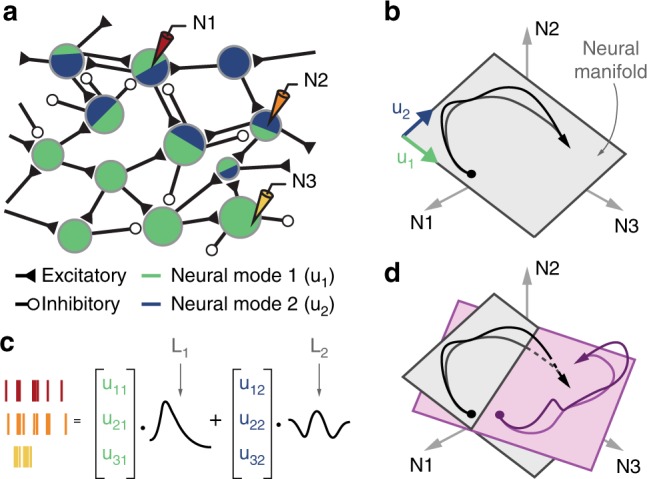
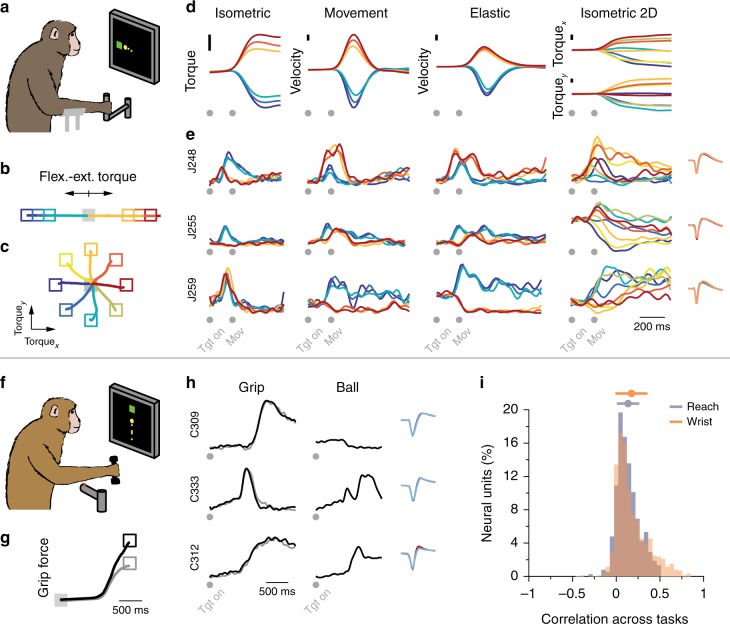
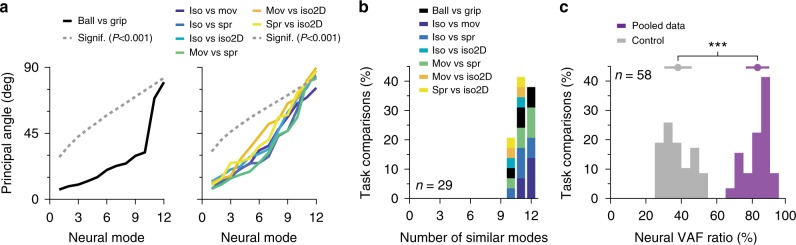
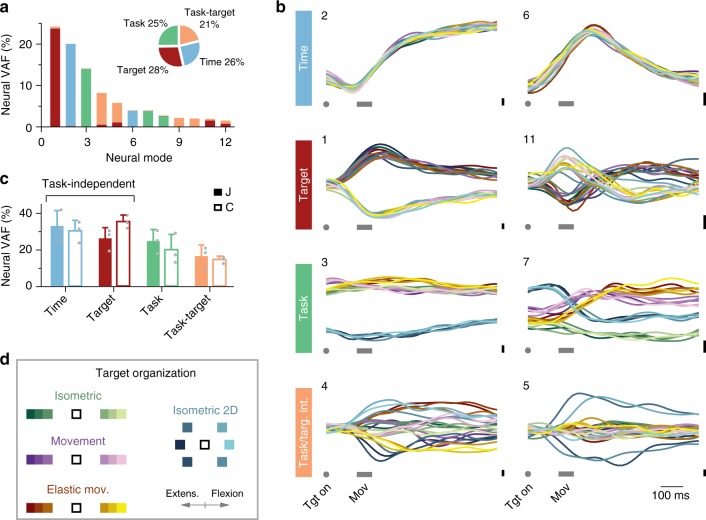
Populations of cortical neurons flexibly perform different functions; for the primary motor cortex (M1) this means a rich repertoire of motor behaviors. We investigate the flexibility of M1 movement control by analyzing neural population activity during a variety of skilled wrist and reach-to-grasp tasks. We compare across tasks the neural modes that capture dominant neural covariance patterns during each task. While each task requires different patterns of muscle and single unit activity, we find unexpected similarities at the neural population level: the structure and activity of the neural modes is largely preserved across tasks. Furthermore, we find two sets of neural modes with task-independent activity that capture, respectively, generic temporal features of the set of tasks and a task-independent mapping onto muscle activity. This system of flexibly combined, well-preserved neural modes may underlie the ability of M1 to learn and generate a wide-ranging behavioral repertoire.
Overview
The claims and statistics of this paper haven’t been checked yet.
Free: it reads the open-access text and checks the first 5 claims that cite a source we can check. Create a free account to check every claim.
Integrity signals
Registry
Cites
Statistics
Figures
Verification
Claims the paper makes
The claims and statistics of this paper haven’t been checked yet.
Free: it reads the open-access text and checks the first 5 claims that cite a source we can check. Create a free account to check every claim.
Self-check
Percentages, sums and reported differences re-computed from the paper’s own numbers.
The self-check needs the paper’s full text.
Citations
Cites
1 retracted
RETRACTED: A mathematical model explains saturating axon guidance responses to molecular gradients
Nguyen, H., Dayan, P., Pujic, Z., Cooper-White, J., & Goodhill, G. J. (2016) · eLife · doi:10.7554/elife.12248 · Cited by 1,221
RetractedGeorgopoulos, A., Kalaska, J., Caminiti, R., & Massey, J. (1982) · The Journal of Neuroscience · doi:10.1523/jneurosci.02-11-01527.1982 · Cited by 2,130
Context-dependent computation by recurrent dynamics in prefrontal cortex
Mante, V., Sussillo, D., Shenoy, K. V., & Newsome, W. T. (2013) · Nature · doi:10.1038/nature12742 · Cited by 1,847
Neural population dynamics during reaching
Churchland, M. M., Cunningham, J. P., Kaufman, M. T., Foster, J. D., Nuyujukian, P., Ryu, S. I., & Shenoy, K. V. (2012) · Nature · doi:10.1038/nature11129 · Cited by 1,626
Descending Pathways in Motor Control
Lemon, R. N. (2008) · Annual Review of Neuroscience · doi:10.1146/annurev.neuro.31.060407.125547 · Cited by 1,599
A century of trends in adult human height
NCD Risk Factor Collaboration (NCD-RisC) (2016) · eLife · doi:10.7554/elife.13410 · Cited by 1,558
Control of Locomotion in Bipeds, Tetrapods, and Fish
Grillner, S. (1981) · Comprehensive Physiology · doi:10.1002/cphy.cp010226 · Cited by 1,365
Neuroscience Needs Behavior: Correcting a Reductionist Bias
Krakauer, J. W., Ghazanfar, A. A., Gomez-Marin, A., MacIver, M. A., & Poeppel, D. (2017) · Neuron · doi:10.1016/j.neuron.2016.12.041 · Cited by 1,358
LAWRENCE, D. G., & KUYPERS, H. G. J. M. (1968) · Brain · doi:10.1093/brain/91.1.1 · Cited by 1,285
Relation of pyramidal tract activity to force exerted during voluntary movement.
Evarts, E. V. (1968) · Journal of Neurophysiology · doi:10.1152/jn.1968.31.1.14 · Cited by 1,249
Research works printed but not linked: 1
- Elsayed G Cunningham JP Structure in neural population recordings: significant or epiphenomenal? Nat. Neurosci. 2017 25 1 14 PMC5577566 28783140
Cited by
Items 101–200 of 412
Conjoint specification of action by neocortex and striatum
Park, J., Polidoro, P., Fortunato, C., Arnold, J., Mensh, B. D., Gallego, J. Á., & Dudman, J. T. (2025) · Neuron · doi:10.1016/j.neuron.2024.12.024 · Cited by 28
Self-citationAreshenkoff, C. N., Gale, D. J., Nashed, J. Y., Standage, D., Flanagan, J. R., & Gallivan, J. P. (2022) · eLife · doi:10.7554/elife.74591 · Cited by 28
De novo motor learning creates structure in neural activity that shapes adaptation
Chang, J. C., Perich, M. G., Miller, L. E., Gallego, J. Á., & Clopath, C. (2024) · Nature Communications · doi:10.1038/s41467-024-48008-7 · Cited by 27
“Similar behaviors (e.g., various wrist manipulations or grasping tasks) may share similarly oriented task-speci fi c neural manifolds 13 , while dissimilar behaviors (e.g., reaching and walking in mice) may have almostorthogonalmanifolds even if they sharesimilar movements 15 .”
Self-citationWeber, J., Solbakk, A., Blenkmann, A. O., Llorens, A., Funderud, I., Leske, S. L., Larsson, P. G., Ivanović, J., Knight, R. T., Endestad, T., et al. (2024) · Nature Communications · doi:10.1038/s41467-023-44571-7 · Cited by 28
Wang, Y., Wu, Z., Li, C., & Wu, A. (2023) · neural information processing systems · doi:10.52202/075280-1694 · Cited by 28
Rapid context inference in a thalamocortical model using recurrent neural networks
Zheng, W., Wu, Z., Hummos, A., Yang, G. R., & Halassa, M. M. (2024) · Nature Communications · doi:10.1038/s41467-024-52289-3 · Cited by 27
“57 Task variables are distributed randomly across neurons.”
BackgroundMelbaum, S., Russo, E., Eriksson, D., Schneider, A., Durstewitz, D., Brox, T., & Diester, I. (2022) · Nature Communications · doi:10.1038/s41467-022-35115-6 · Cited by 26
“In contrast to the 278 global principal component analysis (PCA) used by most studies (12,20,15,16,4,17,18,35), we 279 rather assume the preservation of local neighborhood relations in the data.”
BackgroundMethodFew-shot Algorithms for Consistent Neural Decoding (FALCON) Benchmark
Karpowicz, B. M., Ye, J., Fan, C., Tostado-Marcos, P., Rizzoglio, F., Washington, C., Scodeler, T., de Lucena, D., Nason, S. R., Mender, M. J., et al. (2024) · neural information processing systems · doi:10.52202/079017-2439 · Cited by 26
Self-citationSpeech-related dorsal motor cortex activity does not interfere with iBCI cursor control
Stavisky, S. D., Willett, F. R., Avansino, D. T., Hochberg, L. R., Shenoy, K. V., & Henderson, J. M. (2020) · Journal of Neural Engineering · doi:10.1088/1741-2552/ab5b72 · Cited by 25
Latent Characteristics and Neural Manifold of Brain Functional Network Under Acupuncture
Li, K., Wang, J., Li, S., Deng, B., & Yu, H. (2022) · IEEE Transactions on Neural Systems and Rehabilitation Engineering · doi:10.1109/tnsre.2022.3157380 · Cited by 25
Clinical neuroscience and neurotechnology: An amazing symbiosis
Cometa, A., Falasconi, A., Biasizzo, M., Carpaneto, J., Horn, A., Mazzoni, A., & Micera, S. (2022) · iScience · doi:10.1016/j.isci.2022.105124 · Cited by 24
A neural signature of social support mitigates negative emotion
Pei, R., Courtney, A. L., Ferguson, I., Brennan, C. M., & Zaki, J. (2023) · Scientific Reports · doi:10.1038/s41598-023-43273-w · Cited by 23
Motor-like neural dynamics in two parietal areas during arm reaching
Diomedi, S., Vaccari, F. E., Galletti, C., Hadjidimitrakis, K., & Fattori, P. (2021) · Progress in Neurobiology · doi:10.1016/j.pneurobio.2021.102116 · Cited by 23
Linking fast and slow: The case for generative models
Medrano, J., Friston, K. J., & Zeidman, P. (2024) · Network Neuroscience · doi:10.1162/netn_a_00343 · Cited by 23
“…by stable low-dimensional dynamics of neuronal populations in the motor cortex (Chaudhuri, Gerçek, Pandey, Peyrache, & Fiete, 2019; Churchland et al., 2012; Gallego et al., 2018; Langdon, Genkin, & Engel, 2023; Lara, Cunningham, & Churchland, 2018; Saxena, Russo, Cunningham, & Churchland, 2022).”
Invariant neural dynamics drive commands to control different movements
Athalye, V. R., Khanna, P., Gowda, S., Orsborn, A. L., Costa, R. M., & Carmena, J. M. (2023) · Current Biology · doi:10.1016/j.cub.2023.06.027 · Cited by 23
Motor cortex flexibly deploys a high-dimensional repertoire of subskillsPreprint
Amematsro, E. A., Trautmann, E. M., Marshall, N. J., Abbott, L. F., Shadlen, M. N., Wolpert, D. M., & Churchland, M. M. (2025) · bioRxiv (Cold Spring Harbor Laboratory) · doi:10.1101/2025.09.07.674717 · Cited by 22
“Like most prevailing conceptions of M1 2–4, 18 , the flexible-repertoire hypothesis posits dynamics within a state-space state-space 8, state-space, with different subskills engaging different regions and dimensions (Fig.”
InfluentialAligned and oblique dynamics in recurrent neural networks
Schuessler, F., Mastrogiuseppe, F., Ostojic, S., & Barak, O. (2024) · eLife · doi:10.7554/elife.93060.3 · Cited by 22
Sotskov, V. P., Pospelov, N., Plusnin, V. V., & Anokhin, K. V. (2022) · International Journal of Molecular Sciences · doi:10.3390/ijms23020638 · Cited by 22
Borno, M. A., Hicks, J. L., & Delp, S. L. (2020) · Journal of The Royal Society Interface · doi:10.1098/rsif.2020.0011 · Cited by 22
“, in the spinal circuitry [14] or in cortex [20]), which is unknown.”
BackgroundCerebellar output shapes cortical preparatory activity during motor adaptation
Israely, S., Ninou, H., Rajchert, O., Elmaleh, L., Harel, R., Mawase, F., Kadmon, J., & Prut, Y. (2025) · Nature Communications · doi:10.1038/s41467-025-57832-4 · Cited by 21
Mohammadi, Z., Ashwood, Z. C., & Pillow, J. W. (2025) · Nature Communications · doi:10.1038/s41467-025-66738-0 · Cited by 20
“Analyzing and comparing neural modes across different tasks while considering a wide-ranging behavioral repertoire 63 can provide valuable insights into the animals decision-making strategies.”
Xing, D., Truccolo, W., & Borton, D. A. (2022) · Journal of Neuroscience · doi:10.1523/jneurosci.0746-22.2022 · Cited by 20
Regional specialization of movement encoding across the primate sensorimotor cortex
Borgognon, S., Macellari, N., Hickey, A. M., Perich, M. G., Javaheri, H., Ornelas-Kobayashi, R., Delacombaz, M., Hitz, C., Fallegger, F., Lacour, S. P., et al. (2025) · Nature Communications · doi:10.1038/s41467-025-61172-8 · Cited by 20
“We computed principal angles between the communication subspace and either the task-dependent or the task-independent subspaces 14 .”
InfluentialSelf-citationAbstract Value Encoding in Neural Populations But Not Single Neurons
Fine, J. M., Maisson, D. J.-N., Yoo, S. B. M., Cash-Padgett, T. V., Wang, M. Z., Zimmermann, J., & Hayden, B. Y. (2023) · Journal of Neuroscience · doi:10.1523/jneurosci.1954-22.2023 · Cited by 20
Xing, D., Aghagolzadeh, M., Truccolo, W., Bézard, E., Courtine, G., & Borton, D. A. (2019) · Frontiers in Neuroscience · doi:10.3389/fnins.2019.01046 · Cited by 20
“Additionally, a common low-dimensional neural manifold underlying various wrist movements have be found using demixed principle component analysis, or dPCA (Gallego et al., 2018).”
MethodRecurrent neural network models of multi-area computation underlying decision-makingPreprint
Kleinman, M., Chandrasekaran, C., & Kao, J. C. (2019) · bioRxiv (Cold Spring Harbor Laboratory) · doi:10.1101/798553 · Cited by 19
Learning to select actions shapes recurrent dynamics in the corticostriatal system
Márton, C. D., Schultz, S. R., & Averbeck, B. B. (2020) · Neural Networks · doi:10.1016/j.neunet.2020.09.008 · Cited by 19
Active dissociation of intracortical spiking and high gamma activity
Lei, T., Scheid, M. R., Flint, R. D., Glaser, J. I., & Slutzky, M. W. (2026) · Nature · doi:10.1038/s41586-026-10331-y · Cited by 19
“To assess whether the subspace angles between pairs of subspaces were significantly small, we compared them to the subspace angles between column-shuffled W A and W B , which preserved the key statistics of the individual subspace 64 .”
Jiang, X., Saggar, H., Ryu, S. I., Shenoy, K. V., & Kao, J. C. (2020) · Cell Reports · doi:10.1016/j.celrep.2020.108148 · Cited by 19
“, 2014), and shared computation between multiple motor tasks (Gallego et al., 2018).”
BackgroundPrivileged representational axes in biological and artificial neural networks
Khosla, M., Williams, A. H., McDermott, J. H., & Kanwisher, N. (2023) · Conference on Cognitive Computational Neuroscience (CCN) · doi:10.32470/ccn.2023.1664-0 · Cited by 18
Exploiting correlations across trials and behavioral sessions to improve neural decoding
Zhang, Y., Lyu, H., Hurwitz, C., Wang, S., Findling, C., Wang, Y., Hubert, F., Pouget, A., Varol, E., & Paninski, L. (2025) · Neuron · doi:10.1016/j.neuron.2025.10.026 · Cited by 18
Motor Cortex Latent Dynamics Encode Spatial and Temporal Arm Movement Parameters Independently
Rodriguez, A. C., Perich, M. G., Miller, L. E., & Humphries, M. D. (2024) · Journal of Neuroscience · doi:10.1523/jneurosci.1777-23.2024 · Cited by 18
“…single neuron activity encodes movement parameters to posit that much of the activity in motor cortex re fl ects the ongoing evolution of a dynamical system, which results in a descending movement execution signal (Shenoy et al., 2013; Kaufman et al., 2014; Gallego et al., 2018; Russo et al., 2018).”
Self-citationControl Principles of Neural Dynamics Revealed by the Neurobiology of Timing
Stine, G. M., & Jazayeri, M. (2025) · Annual Review of Neuroscience · doi:10.1146/annurev-neuro-091724-015512 · Cited by 17
“In such a system, the permissible population activity patterns reside in a small subregion of the space of all possible population activity patterns (Cunningham & Yu 2014, Gallego et al. 2018, Jazayeri & Ostojic 2021, Nieh et al. 2021).”
Aligned and oblique dynamics in recurrent neural networksPreprint
Schuessler, F., Mastrogiuseppe, F., Ostojic, S., & Barak, O. (2024) · eLife · doi:10.7554/elife.93060 · Cited by 17
“Note that this is more restricted than canonical correlation analysis (CCA), which is also commonly used [16, 17].”
Spatial reasoning via recurrent neural dynamics in mouse retrosplenial cortex
Voigts, J., Kanitscheider, I., Miller, N. J., Toloza, E. H. S., Newman, J. P., Fiete, I., & Harnett, M. T. (2025) · Nature Neuroscience · doi:10.1038/s41593-025-01944-z · Cited by 17
“…emergence of conjunctive encoding, explicit hypothesis codes and similar roles for dynamics across RSC and the ANN suggests that spatial computations and, by extension, cognitive processing in neocortex may be constrained by simple cost functions 36 , similar to sensory 37 or motor 38 computations.”
Meta-Dynamical State Space Models for Integrative Neural Data Analysis
Vermani, A., Nassar, J., Jeon, H., Dowling, M., & Park, I. M. (2025) · International Conference on Learning Representations · doi:10.48550/arxiv.2410.05454 · Cited by 17
“We used single and multi-unit neural population recordings from the motor and premotor cortex during two behavioral tasks–the Centre-Out (CO) and Maze reaching tasks (Perich et al., 2018; Gallego et al., 2020; Churchland et al., 2012).”
An emerging view of neural geometry in motor cortex supports high-performance decoding
Perkins, S. M., Amematsro, E. A., Cunningham, J. P., Wang, Q., & Churchland, M. M. (2025) · eLife · doi:10.1101/2023.04.05.535396 · Cited by 16
Katic, N., Balaguer, J.-M., Gorskii, O., Pavlova, N., Liang, L., Ho, J. C., Grigsby, E. M., Gerszten, P. C., Карал-оглы, Д. Д., Bulgin, D. V., et al. (2024) · Cell Reports · doi:10.1016/j.celrep.2024.113695 · Cited by 16
“31 Analysis of population neural dynamics using neural manifolds is commonly employed to study computational objects that process information in the cortex 32–35 and, more recently, in the spinal cord.”
Ahmadipour, P., Sani, O. G., Pesaran, B., & Shanechi, M. M. (2024) · Journal of Neural Engineering · doi:10.1088/1741-2552/ad1053 · Cited by 16
Exploring Behavior-Relevant and Disentangled Neural Dynamics with Generative Diffusion Models
Wang, Y., Li, C., Li, W., & Wu, A. (2024) · neural information processing systems · doi:10.52202/079017-1095 · Cited by 16
Efficient and robust multi-task learning in the brain with modular latent primitivesPreprint
Márton, C. D., Gagnon, L., Lajoie, G., & Rajan, K. (2021) · arXiv (Cornell University) · doi:10.48550/arxiv.2105.14108 · Cited by 16
Towards NeuroAI: introducing neuronal diversity into artificial neural networks
Fan, F., Li, Y., Zeng, T., Wang, F., & Peng, H. (2025) · Med-X · doi:10.1007/s44258-024-00042-2 · Cited by 15
Yin, L., Tang, T., Lin, Y., Yang, M., Liu, W., & Liang, S. (2022) · Journal of Integrative Neuroscience · doi:10.31083/j.jin2106162 · Cited by 15
Sparse Ensemble Machine Learning to Improve Robustness of Long-Term Decoding in iBMIs
Shaikh, S., So, R. Q., Sibindi, T. M., Libedinsky, C., & Basu, A. (2019) · IEEE Transactions on Neural Systems and Rehabilitation Engineering · doi:10.1109/tnsre.2019.2962708 · Cited by 14
“Figures (a), (b) are adapted from [7] (CC-BY license) and Figure (c) is adapted from [19] (CC-BY license).”
Li, Y., Zhu, X., Qi, Y., & Wang, Y. (2024) · eLife · doi:10.7554/elife.87881 · Cited by 14
Varley, T. F., Mediano, P. A. M., Patania, A., & Bongard, J. (2025) · PLoS Computational Biology · doi:10.1371/journal.pcbi.1013649 · Cited by 14
“A very common approach in modern neuroscience is to use manifold learning to extract a low-dimensional representation of highly multivariate data [43–46].”
Rizzoglio, F., Altan, E., Ma, X., Bodkin, K. L., Dekleva, B. M., Solla, S. A., Kennedy, A., & Miller, L. E. (2023) · Journal of Neural Engineering · doi:10.1088/1741-2552/ad038e · Cited by 13
Self-citationTracking the topology of neural manifolds across populations
Yoon, I. H. R., Henselman‐Petrusek, G., Yu, Y., Ghrist, R., Smith, S. L., & Giusti, C. (2024) · Proceedings of the National Academy of Sciences · doi:10.1073/pnas.2407997121 · Cited by 13
The cortical critical power law balances energy and information in an optimal fashion
Tatsukawa, T., & Teramae, J.-N. (2025) · Proceedings of the National Academy of Sciences · doi:10.1073/pnas.2418218122 · Cited by 13
“Panels of the middle row show examples of receptive fields of neurons (different colors corresponding to different neurons) where the input stimulus 𝜃 is a one-dimensional periodic signal, and neural responses obey a power law each.”
New insights on single-neuron selectivity in the era of population-level approaches
Vaccari, F., Diomedi, S., Filippini, M., Hadjidimitrakis, K., & Fattori, P. (2022) · Frontiers in Integrative Neuroscience · doi:10.3389/fnint.2022.929052 · Cited by 13
“This new approach has made significant advances so much so that the motor cortical areas are now viewed as “dynamical systems” that exhibit low-dimensional, rhythmic activity optimized to generate the proper behavior, disregarding correlations between single cell activity and movement parameters (Churchland et al., 20…”
BackgroundFrom sensory to perceptual manifolds: The twist of neural geometry
Ma, H., Jiang, L., Liu, T., & Liu, J. (2025) · Science Advances · doi:10.1126/sciadv.adv0431 · Cited by 13
EEG spectral attractors identify a geometric core of brain dynamics
Pourdavood, P., & Jacob, M. (2024) · Patterns · doi:10.1016/j.patter.2024.101025 · Cited by 13
Dynamics of motor cortical activity during naturalistic feeding behavior
Liu, S., Iriarte-Díaz, J., Hatsopoulos, N. G., Ross, C. F., Takahashi, K., & Chen, Z. S. (2019) · Journal of Neural Engineering · doi:10.1088/1741-2552/ab0474 · Cited by 13
Assistive algorithms influence neural representations in motor brain-computer interfaces
Rajeswaran, P., Payeur, A., Lajoie, G., & Orsborn, A. L. (2026) · Nature Communications · doi:10.1038/s41467-026-76109-y · Cited by 10
“Many studies represent coordinated neural activity with principal components (PCs) capturing the most prominent directions of variability 53 – 55 .”
Ottenhoff, M. C., Verwoert, M., Goulis, S., Wagner, L., van Dijk, J. P., Kubben, P., & Herff, C. (2024) · Journal of Neural Engineering · doi:10.1088/1741-2552/ad851c · Cited by 12
“Manifolds have been demonstrated to capture robust representations of latent dynamics [22] and to be predictive for multiple types of behaviors [23, 24] and subjects [25].”
Fieseler, C., Lev, I., Rey, U., Hille, L., Brenner, H., & Zimmer, M. (2025) · bioRxiv (Cold Spring Harbor Laboratory) · doi:10.1101/2025.03.09.642241 · Cited by 12
A hippocampal population code for rapid generalizationPreprint
Tang, W., Chang, H., Liu, C., Perez-Hernandez, S., Zheng, W. Y., Park, J., Oliva, A., & Fernández‐Ruiz, A. (2025) · bioRxiv (Cold Spring Harbor Laboratory) · doi:10.1101/2025.03.15.643456 · Cited by 11
“To capture the functional connectivity between CA3 and CA1, we identified their communication subspaces using Canonical Correlation Analysis (CCA) 57,71 and Reduced Rank Regression (RRR) 58,72 .”
InfluentialDixon, T. C., Merrick, C. M., Wallis, J. D., Ivry, R. B., & Carmena, J. M. (2021) · PLoS Computational Biology · doi:10.1371/journal.pcbi.1009615 · Cited by 11
“Other studies have reported greater dimensionality estimates in PMd and M1, with values ranging from 4 to 16 [78,79].”
BackgroundFacial gestures are enacted through a cortical hierarchy of dynamic and stable codes
Ianni, G. R., Vázquez, Y., Rouse, A. G., Schieber, M. H., Prut, Y., & Freiwald, W. A. (2026) · Science · doi:10.1126/science.aea0890 · Cited by 11
Ottenhoff, M. C., Verwoert, M., Goulis, S., Colon, A., Wagner, L., Tousseyn, S., van Dijk, J. P., Kubben, P., & Herff, C. (2023) · Frontiers in Neuroscience · doi:10.3389/fnins.2023.1283491 · Cited by 11
Weng, G., Clark, K., Akbarian, A., Noudoost, B., & Nategh, N. (2024) · Frontiers in Computational Neuroscience · doi:10.3389/fncom.2024.1273053 · Cited by 11
“Typical state-space models assume that behavioral measurements such as movement kinematics, or decision choices at each point in time are directly represented in the neural activity at that time (Churchland et al., 2012; Kao et al., 2014; Gallego et al., 2018; Wallis, 2018).”
BackgroundThe impact of task context on predicting finger movements in a brain-machine interface
Mender, M. J., Nason, S. R., Temmar, H., Costello, J. T., Wallace, D. M., Willsey, M. S., Kumar, N. G., Kung, T. A., Patil, P. G., & Chestek, C. A. (2023) · eLife · doi:10.7554/elife.82598 · Cited by 11
Calabro, F. J., LeCroy, D., Foran, W., Sydnor, V. J., Parr, A. C., Constantinidis, C., & Luna, B. (2025) · Developmental Cognitive Neuroscience · doi:10.1016/j.dcn.2025.101541 · Cited by 11
“Low dimensional activity is highly robust to noise (Gallego et al., 2018; Tavares et al., 2015), which may make it an ideal coding strategy at younger ages when spontaneous neural activity is high and can interfere with task-related signals (Sydnor et al., 2023).”
Orthogonal neural representations support perceptual judgments of natural stimuli
Srinath, R., Ni, A. M., Marucci, C., Cohen, M. R., & Brainard, D. H. (2025) · Scientific Reports · doi:10.1038/s41598-025-88910-8 · Cited by 11
Modeling of hyper-adaptability: from motor coordination to rehabilitation
Eberle, H., Hayashi, Y., Kurazume, R., Takei, T., & An, Q. (2021) · Advanced Robotics · doi:10.1080/01691864.2021.1943710 · Cited by 11
“Accumulating evidence showed that the low-dimensional subspace of motor cortex dynamics was consistent across multiple behaviors [52], over a long period of time [53,54], and during motor learning [54].”
BackgroundInputDSA: Demixing then Comparing Recurrent and Externally Driven DynamicsPreprint
Huang, A., Ostrow, M., Singh, S. H., Kozachkov, L., Fiete, I., & Rajan, K. (2025) · PubMed Central · doi:10.48550/arxiv.2510.25943 · Cited by 11
“…to do so are Representa-tional Similarity Analysis, Centered Kernel Alignment, Procrustes Analysis, Canonical Correlation Analysis, and Pearson Correlation (Kriegeskorte et al., 2008; Kornblith et al., 2019; Williams et al., 2022; Gallego et al., 2018; Raghu et al., 2017; Schrimpf et al., 2018).”
Human learning of noninvasive brain–computer interfaces via manifold geometry
Busch, E. L., Fincke, E. C., Lajoie, G., Krishnaswamy, S., & Turk‐Browne, N. B. (2026) · Nature Neuroscience · doi:10.1038/s41593-026-02311-2 · Cited by 10
Contextual neural dynamics during time perception in the primate ventral premotor cortex
Díaz, H., Bayones, L., Álvarez, M., Andrade-Ortega, B., Valero, S., Zainos, A., Romo, R., & Rossi-Pool, R. (2025) · Proceedings of the National Academy of Sciences · doi:10.1073/pnas.2420356122 · Cited by 10
“Although further experiments and geometric analyses are needed to fully unravel these transitions in biological networks ( 72 – 74 ), RNNs provide a powerful framework for exploring the flexibility of neural circuits across various contexts ( 71 ).”
Liu, Z., & Schieber, M. H. (2020) · eNeuro · doi:10.1523/eneuro.0376-20.2020 · Cited by 10
Low-dimensional neural manifolds for the control of constrained and unconstrained movementsPreprint
Altan, E., Ma, X., Miller, L. E., Perreault, E. J., & Solla, S. A. (2023) · bioRxiv (Cold Spring Harbor Laboratory) · doi:10.1101/2023.05.25.542264 · Cited by 10
Self-citationLinking task structure and neural network dynamics
Márton, C. D., Zhou, S., & Rajan, K. (2022) · Nature Neuroscience · doi:10.1038/s41593-022-01090-w · Cited by 10
Spike Train Coactivity Encodes Learned Natural Stimulus Invariances in Songbird Auditory Cortex
Theilman, B. H., Perks, K. E., & Gentner, T. Q. (2020) · Journal of Neuroscience · doi:10.1523/jneurosci.0248-20.2020 · Cited by 10
Multiple regions of sensorimotor cortex encode bite force and gape
Arce‐McShane, F. I., Sessle, B. J., Ram, Y., Balcer, C., Ross, C. F., & Hatsopoulos, N. G. (2023) · Frontiers in Systems Neuroscience · doi:10.3389/fnsys.2023.1213279 · Cited by 10
“Here we showed that the latent activity of populations of neurons in MIo, SIo, and CMA discriminated between task parameters, consistent with previous findings in other brain regions (Kobak et al., 2016; Gallego et al., 2018).”
ResultDavis, F., & Altmann, G. T. M. (2021) · Cognition · doi:10.1016/j.cognition.2021.104651 · Cited by 9
“…evolves through time, distributed across the entire representational substrate both in network space (hidden unit activation space) and time (c.f. “neural manifolds”, although these are generally associated with subsets of the entire neural substrate; e.g. Gallego, Perich, Naufel, et al., 2018).”
BackgroundMultitasking Recurrent Networks Utilize Compositional Strategies for Control of MovementPreprint
Lazzari, J., & Saxena, S. (2025) · bioRxiv (Cold Spring Harbor Laboratory) · doi:10.1101/2025.09.10.675375 · Cited by 8
“To test whether or not a shared low dimensional manifold exists across tasks, we utilize the methods presented in [20, 58] to compute the principal angles between network modes across tasks.”
InfluentialActive learning of neural population dynamics using two-photon holographic optogenetics
Wagenmaker, A., Mi, L., Rózsa, M., Bull, M. S., Svoboda, K., Daie, K., Golub, M. D., & Jamieson, K. (2024) · neural information processing systems · doi:10.52202/079017-0994 · Cited by 8
A brain machine interface framework for exploring proactive control of smart environments
Braun, J.-M., Fauth, M. J., Berger, M., Huang, N.-S., Simeoni, E., Gaeta, E., do Carmo, R. R., García-Betances, R. I., Arredondo, M. T., Gail, A., et al. (2024) · Scientific Reports · doi:10.1038/s41598-024-60280-7 · Cited by 8
Awasthi, P., Lin, T.-H., Bae, J., Miller, L. E., & Danziger, Z. C. (2022) · Journal of Neural Engineering · doi:10.1088/1741-2552/ac97c3 · Cited by 7
“We trained the neural emulator to output firing rates, not spike times, using data collected from two rhesus monkeys performing center-out reaches to eight targets during recording sessions on 22 different days spanning two years (Gallego et al 2018, Perich et al 2018).”
MethodSelf-citationAligned and oblique dynamics in recurrent neural networksPreprint
Schuessler, F., Mastrogiuseppe, F., Ostojic, S., & Barak, O. (2024) · eLife · doi:10.7554/elife.93060.2 · Cited by 7
Embodied Sensorimotor Control: Computational Modeling of the Neural Control of Movement
Almani, M. N., Lazzari, J., Walker, J. D., & Saxena, S. (2026) · Annual Review of Biomedical Engineering · doi:10.1146/annurev-bioeng-102723-020454 · Cited by 7
Kirchherr, S., Moraga, S. M., Coudé, G., Bimbi, M., Ferrari, P. F., Aarts, E., & Bonaiuto, J. J. (2023) · European Journal of Neuroscience · doi:10.1111/ejn.16065 · Cited by 7
“…recent evidence suggests that neural population activity in low dimensional subspaces, or manifolds, may be more important in neural computation than the firing of particular single neurons (Barack & Krakauer, 2021; Gallego et al., 2017, Gallego, 2018; Humphries, 2021; Saxena & Cunningham, 2019).”
BackgroundMethodSimilar neural states, but dissimilar decoding patterns for motor control in parietal cortex
Vaccari, F. E., Diomedi, S., Vitis, M. D., Filippini, M., & Fattori, P. (2024) · Network Neuroscience · doi:10.1162/netn_a_00364 · Cited by 7
“All these terms hint at common activation patterns shared between neurons (Churchland et al., 2012; Gallego et al., 2017, 2018; Kadmon Harpaz et al., 2019; Okun et al., 2015; Wärnberg & Kumar, 2019), considered to be the simplest coding strategy to finally produce muscle activation and relaxation…”
BackgroundZheng, S., Li, W., Qian, L., He, C., & Li, X. (2022) · Lecture notes in computer science · doi:10.1007/978-3-031-15934-3_43 · Cited by 7
Hidden connectivity structures control collective network dynamicsPreprint
Tiberi, L., Dahmen, D., & Helias, M. (2023) · arXiv (Cornell University) · doi:10.48550/arxiv.2303.02476 · Cited by 7
Probing Human Visual Robustness with Neurally-Guided Deep Neural NetworksPreprint
Shao, Z., Ma, L., Zhou, Y., Zhang, Y. J., Koyejo, S., Li, B., & Beck, D. M. (2024) · arXiv (Cornell University) · doi:10.48550/arxiv.2405.02564 · Cited by 7
“…the neural one where Z b,c = f n ( f s ( X b,c )) and f RMS denotes the root-mean-squared error, 2. a subspace constraint, analogous to the Variance Accounted For (VAF) [18, 21], that encourages orientation alignment between the DNN and neural manifolds: where ∥ · ∥ F denotes Frobenius norm.”
Dynamic control of neural manifoldsPreprint
Lehr, A. B., Kumar, A., & Tetzlaff, C. (2024) · bioRxiv (Cold Spring Harbor Laboratory) · doi:10.1101/2024.07.08.602452 · Cited by 6
“For different behaviors, neural activity occupies different subspaces making fast and dynamic subspace reori-entation a key facet of neural computation (Saba-tini and Kaufman, 2023; Gallego et al., 2018; Elsayed et al., 2016; Tang et al., 2020).”
BackgroundSimultaneous speech and gesture decoding for multimodal communication in paralysis
Brosler, S., Liu, J. R., Silva, A. B., Hallinan, I. P., Kurtz-Miott, C. M., Wilker, J. D., Tu-Chan, A., Ganguly, K., & Chang, E. F. (2026) · Nature Neuroscience · doi:10.1038/s41593-026-02446-2 · Cited by 6
“…frameworks similarly suggest that overlap at the level of individual ECoG electrodes or single neurons does not preclude separable population-level representations, as single low-dimensional neural manifolds within a single cortical area can support multiple distinct motor behaviors 46 .”
Population Dynamics in Songbird RA and HVC During Learned Motor-Vocal Behavior
Tostado-Marcos, P., Arneodo, E. M., Ostrowski, L. M., Brown, D. E., Perez, X. A., Kadwory, A., Stanwicks, L. L., Alothman, A., Gentner, T. Q., & Gilja, V. (2026) · Journal of Neuroscience · doi:10.1523/jneurosci.0580-25.2026 · Cited by 6
Ma, X., Rizzoglio, F., Bodkin, K. L., & Miller, L. E. (2025) · Journal of Neural Engineering · doi:10.1088/1741-2552/adab93 · Cited by 6
“Our group previously examined the neural activity recorded from monkeys in the lab during several types of constrained wrist and grasp tasks and found the underlying (linear) neural manifolds all had similar orientation [54].”
Self-citationA computational mechanism of cue-stimulus integration for pain in the brain
Kim, J., Gim, S., Yoo, S. B. M., & Woo, C. (2024) · Science Advances · doi:10.1126/sciadv.ado8230 · Cited by 6
“Conversely, studies that directly measured neuronal responses have identified behaviorally relevant neural subspaces ( 32 , 34 , 44 – 50 ) and population dynamics underlying behaviors ( 18 , 51 – 54 ), but their scope was limited to a few brain regions due to measurement constraints.”
Pretel, J., Buendía, V., Torres, J. J., & Muñoz, M. A. (2024) · Physical Review Research · doi:10.1103/physrevresearch.6.023018 · Cited by 6
“These correlation patterns manifest mainly in the form of so-called neural modes , i.e., specific activation patterns that capture the bulk of activity variability in cortical populations, which are robustly observed and have been proven to be crucial for brain functioning [10, 27–29].”
BackgroundIwama, S., Zhang, Y., & Ushiba, J. (2022) · eNeuro · doi:10.1523/eneuro.0145-22.2022 · Cited by 6
Liu, R., Azabou, M., Dabagia, M., Xiao, J., & Dyer, E. L. (2022) · bioRxiv (Cold Spring Harbor Laboratory) · doi:10.1101/2022.06.10.495595 · Cited by 6
Conserved neural population geometry supports behavioral generalizationPreprint
Solla, S. A., Disterhoft, J. F., & Wirtshafter, H. S. (2024) · bioRxiv (Cold Spring Harbor Laboratory) · doi:10.1101/2024.10.24.620127 · Cited by 6
Self-citationEnsemble perspective for understanding temporal credit assignment
Zou, W., Li, C., & Huang, H. (2023) · Physical review. E · doi:10.1103/physreve.107.024307 · Cited by 6
What does the mean mean? A simple test for neuroscience
Tlaie, A., Shapcott, K. A., van der Plas, T. L., Rowland, J. M., Lees, R. M., Keeling, J., Packer, A. M., Tiesinga, P. H. E., Schölvinck, M. L., & Havenith, M. N. (2024) · PLoS Computational Biology · doi:10.1371/journal.pcbi.1012000 · Cited by 6
Liu, Y., Caracoglia, J., Sen, S., Freud, E., & Striem-Amit, E. (2022) · Experimental Brain Research · doi:10.1007/s00221-022-06359-x · Cited by 6
“…that reflect covariations among kinematics and muscle activity) during hand movements were found to be encoded by population neural response in primary motor cortex (Gallego, Perich, Miller, & Solla, 2017; Gallego et al., 2018; Leo et al., 2016; Overduin, D’Avella, Roh, Carmena, & Bizzi, 2015).”
BackgroundHuang, N.-S., Chen, Y.-C., Larsen, J. C., & Manoonpong, P. (2020) · Energies · doi:10.3390/en13092180 · Cited by 6
Spatially heterogeneous inhibition projects sequential activity onto unique neural subspacesPreprint
Lehr, A. B., Kumar, A., & Tetzlaff, C. (2023) · bioRxiv (Cold Spring Harbor Laboratory) · doi:10.1101/2023.09.15.557865 · Cited by 5
Population Activity in Motor Cortex is Influenced by the Contexts of the Motor Behavior
Ma, X., Bodkin, K. L., & Miller, L. E. (2021) · International IEEE/EMBS Conference on Neural Engineering · doi:10.1109/ner49283.2021.9441430 · Cited by 5
“This would be consistent with an earlier experiment in our lab that found well preserved neural manifolds across a range of wrist and hand tasks in the lab [3].”
BackgroundResultSelf-citation
Metadata
- Authors
- Gallego, J. A., Perich, M. G., Naufel, S. N., Ethier, C., Solla, S. A., & Miller, L. E.
- Affiliations
- Northwestern University (US)
- Corresponding author
- Miller, Lee E.
- ORCID
- Venue
- Nature Communications
- Published
- 2018-10-12
- Volume
- 9
- Issue
- 1
- Pages
- 4233-4233
- ISSN
- 2041-1723 (ISSN-L)
- PMC
- PMC6185944
- OpenAlex
- W2896846197
- Cited by
- 413
- References
- 91
- Citations by year
- 2026: 88 · 2025: 75 · 2024: 70 · 2023: 43 · 2022: 50 · 2021: 29 · 2020: 31 · 2019: 17 · 2018: 8
- FWCI
- 9.90
- Type
- journal article
- Language
- en
- Open access
- gold
- doi.org
- Licence
- cc-by
- creativecommons.org/licenses/by/4.0 (tdm)
- creativecommons.org/licenses/by/4.0 (vor)
- Locations
- Nature Communications (publishedVersion, cc-by)
- bioRxiv (Cold Spring Harbor Laboratory) (submittedVersion, cc-by-nd)
- Europe PMC (PubMed Central) (publishedVersion, cc-by)
- PubMed Central (publishedVersion, cc-by)
- PubMed (publishedVersion)
- RePEc: Research Papers in Economics (submittedVersion)
- DOAJ (DOAJ: Directory of Open Access Journals) (submittedVersion)
- Funders
- EC | Seventh Framework Programme (FP7-PEOPLE-2013-IOF-627384)
- U.S. Department of Health & Human Services | NIH | National Institute of Neurological Disorders and Stroke (F31-NS092356, NS053603)
- U.S. Department of Health & Human Services | NIH | NICHD | National Center for Medical Rehabilitation Research (T32-HD07418)
- Center for Selective C-H Functionalization, National Science Foundation (DGE-1324585)
- Fonds de Recherche du Québec - Santé (22343)
- Topics
- Life Sciences › Neuroscience › Cognitive Neuroscience › Motor Control and Adaptation
- Life Sciences › Neuroscience › Cognitive Neuroscience › Neural dynamics and brain function
- Life Sciences › Neuroscience › Cognitive Neuroscience › Memory and Neural Mechanisms
- Keywords
- primary motor cortex, neural population activity, neural manifolds, wrist kinematics, reach-to-grasp
- MeSH terms
- Animals, Macaca mulatta, Male, Motor Cortex, Neurons, Psychomotor Performance, Wrist, Hand Strength
About these checks
Registry, retraction, Cites and statistics results are computed, not judged, with one exception: a printed reference that no index lists is read once by a model before it counts as a citation error. Claims are extracted by a model and kept only when their quote appears verbatim in the text; each cited source is then checked, with a model’s help, for whether it says what the claim relies on. Those verdicts can be wrong — read the claim’s quote and the cited source before relying on one.
Statistics and arithmetic are recomputed, not judged.
Confidence bands are shown only for fields calibrated on our annotated test set. None is calibrated yet, so no band is shown.
What counts as a claim ›How we measure confidence ›How we check this ›
Are you an author, or do you see a problem with this page? Request a review
Data sources
Bibliographic data: Semantic Scholar, OpenAlex, Crossref.
Contains information from the Semantic Scholar Academic Graph Datasets, made available under the ODC Attribution License (ODC-BY 1.0).
Semantic Scholar’s data is described in: Kinney, R., et al. (2023). The Semantic Scholar Open Data Platform. arXiv:2301.10140.
