

Cortical population activity within a preserved neural manifold underlies multiple motor behaviors
Open accessPublished version of a preprint
The DOI matches its Crossref record; 94 of the 95 references it cites were found in a registry or an index, and 1 are not checked yet.
Abstract
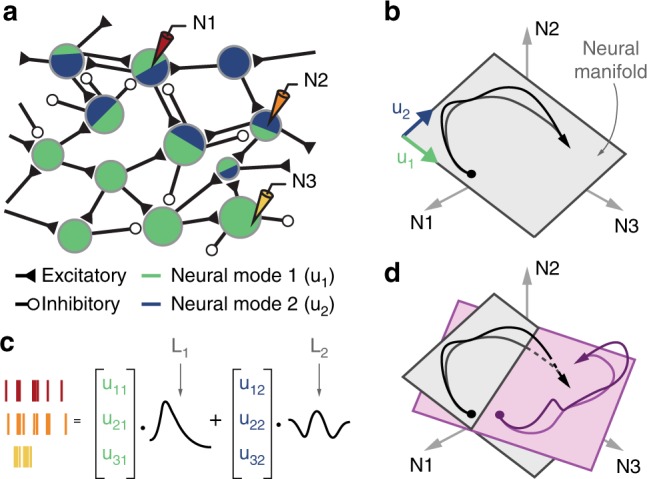
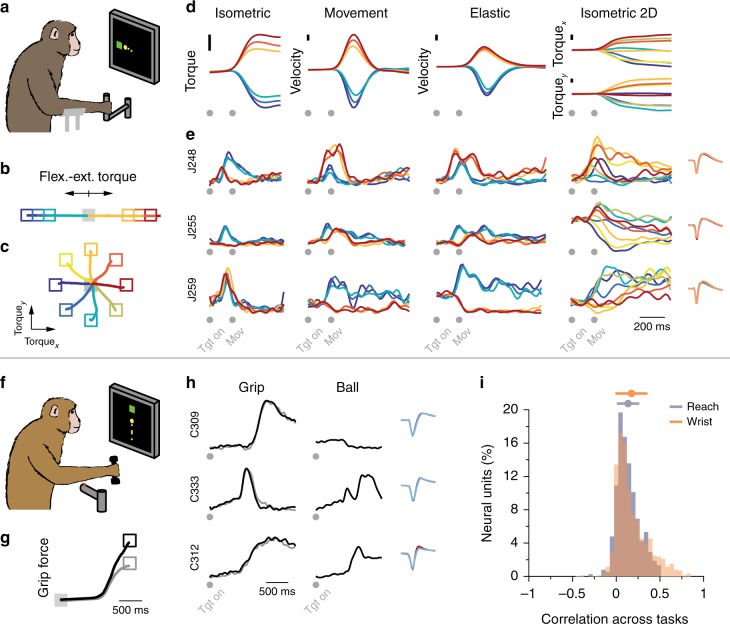
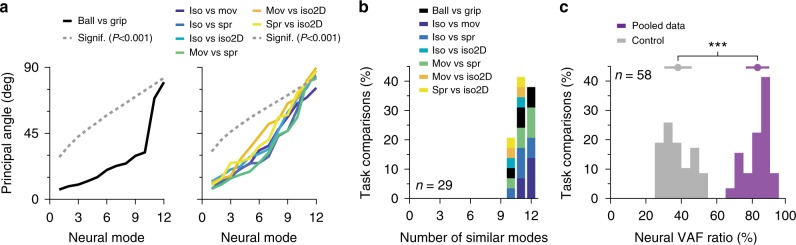
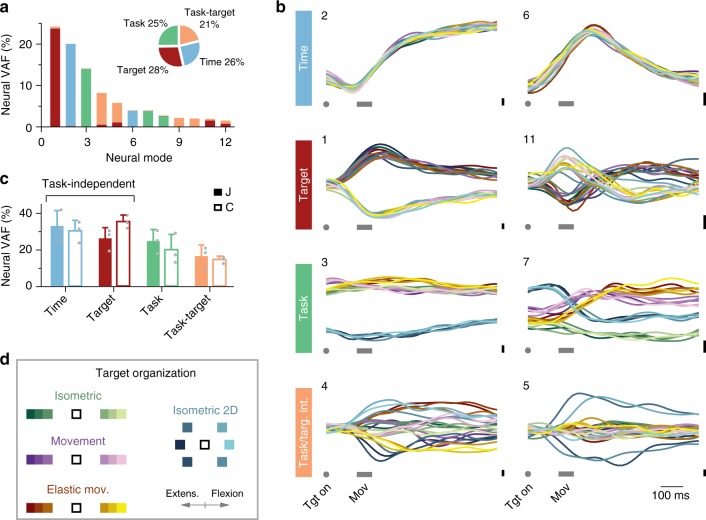
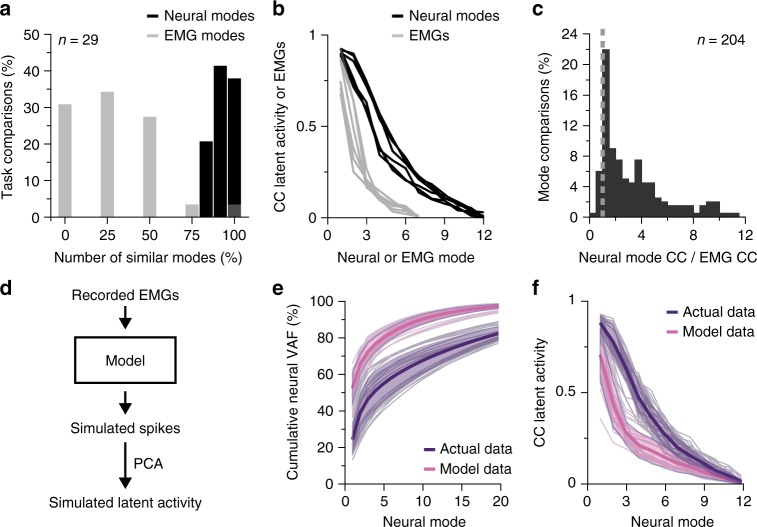
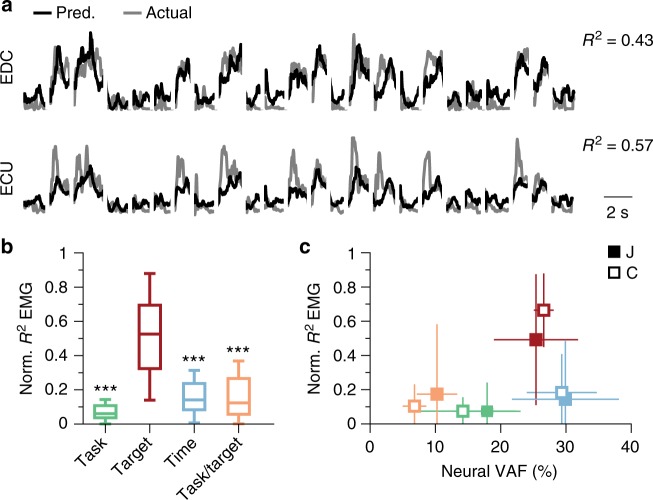
Populations of cortical neurons flexibly perform different functions; for the primary motor cortex (M1) this means a rich repertoire of motor behaviors. We investigate the flexibility of M1 movement control by analyzing neural population activity during a variety of skilled wrist and reach-to-grasp tasks. We compare across tasks the neural modes that capture dominant neural covariance patterns during each task. While each task requires different patterns of muscle and single unit activity, we find unexpected similarities at the neural population level: the structure and activity of the neural modes is largely preserved across tasks. Furthermore, we find two sets of neural modes with task-independent activity that capture, respectively, generic temporal features of the set of tasks and a task-independent mapping onto muscle activity. This system of flexibly combined, well-preserved neural modes may underlie the ability of M1 to learn and generate a wide-ranging behavioral repertoire.
Overview
The claims and statistics of this paper haven’t been checked yet.
Free: it reads the open-access text and checks the first 5 claims that cite a source we can check. Create a free account to check every claim.
Integrity signals
Registry
Cites
Statistics
Figures
Verification
Claims the paper makes
The claims and statistics of this paper haven’t been checked yet.
Free: it reads the open-access text and checks the first 5 claims that cite a source we can check. Create a free account to check every claim.
Self-check
Percentages, sums and reported differences re-computed from the paper’s own numbers.
The self-check needs the paper’s full text.
Citations
Cites
1 retracted
RETRACTED: A mathematical model explains saturating axon guidance responses to molecular gradients
Nguyen, H., Dayan, P., Pujic, Z., Cooper-White, J., & Goodhill, G. J. (2016) · eLife · doi:10.7554/elife.12248 · Cited by 1,221
RetractedGeorgopoulos, A., Kalaska, J., Caminiti, R., & Massey, J. (1982) · The Journal of Neuroscience · doi:10.1523/jneurosci.02-11-01527.1982 · Cited by 2,130
Context-dependent computation by recurrent dynamics in prefrontal cortex
Mante, V., Sussillo, D., Shenoy, K. V., & Newsome, W. T. (2013) · Nature · doi:10.1038/nature12742 · Cited by 1,847
Neural population dynamics during reaching
Churchland, M. M., Cunningham, J. P., Kaufman, M. T., Foster, J. D., Nuyujukian, P., Ryu, S. I., & Shenoy, K. V. (2012) · Nature · doi:10.1038/nature11129 · Cited by 1,626
Descending Pathways in Motor Control
Lemon, R. N. (2008) · Annual Review of Neuroscience · doi:10.1146/annurev.neuro.31.060407.125547 · Cited by 1,599
A century of trends in adult human height
NCD Risk Factor Collaboration (NCD-RisC) (2016) · eLife · doi:10.7554/elife.13410 · Cited by 1,558
Control of Locomotion in Bipeds, Tetrapods, and Fish
Grillner, S. (1981) · Comprehensive Physiology · doi:10.1002/cphy.cp010226 · Cited by 1,365
Neuroscience Needs Behavior: Correcting a Reductionist Bias
Krakauer, J. W., Ghazanfar, A. A., Gomez-Marin, A., MacIver, M. A., & Poeppel, D. (2017) · Neuron · doi:10.1016/j.neuron.2016.12.041 · Cited by 1,358
LAWRENCE, D. G., & KUYPERS, H. G. J. M. (1968) · Brain · doi:10.1093/brain/91.1.1 · Cited by 1,285
Relation of pyramidal tract activity to force exerted during voluntary movement.
Evarts, E. V. (1968) · Journal of Neurophysiology · doi:10.1152/jn.1968.31.1.14 · Cited by 1,249
Research works printed but not linked: 1
- Elsayed G Cunningham JP Structure in neural population recordings: significant or epiphenomenal? Nat. Neurosci. 2017 25 1 14 PMC5577566 28783140
Cited by
Items 301–400 of 412
The VEP Booster: A Closed-Loop AI System for Visual EEG Biomarker Auto-generationPreprint
Luo, J., Jiang, C., Chen, Q., Han, D., Wang, Y., Yan, B., Li, D., & Zhang, J. (2024) · arXiv (Cornell University) · doi:10.48550/arxiv.2407.15167 · Cited by 1
“Second, the EEG decoder should be designed to extract a broad range of features from the EEG signals, including capturing dynamic neural patterns [23, 24] and various nonlinear features [25] that are indicative of subtle neural activities.”
BackgroundCircuit mechanisms for disentangled representations and generalization in the hippocampus
Tang, W., Chang, H., Liu, C., Perez-Hernandez, S., Zheng, W. Y., Park, J., Karaba, L. A., Oliva, A., & Fernandez-Ruiz, A. (2026) · Nature Neuroscience · doi:10.1038/s41593-026-02491-x
Wasserman, T. H., & Wasserman, L. D. (2024) · Springer eBooks · doi:10.1007/978-3-031-78732-4_10
Spatially heterogeneous inhibition projects sequential activity onto unique neural subspacesPreprint
Lehr, A. B., Kumar, A., & Tetzlaff, C. (2025) · eLife · doi:10.7554/elife.108375.1
Conscious simultaneity with continuous motion: a measure-theoretic resolution of the hard problem
Sanfey, J. (2026) · Frontiers in Human Neuroscience · doi:10.3389/fnhum.2026.1809939
Stimulus-Driven Thermodynamic Shifts and Geometric Reorganization in Mouse Primary Visual CortexPreprint
Liu, J., Jiang, L., Li, X., Wu, J., & Liu, J. (2026) · bioRxiv (Cold Spring Harbor Laboratory) · doi:10.64898/2026.02.12.705646
Li, Y., Xinyun, Z., Yu, Q., et al. (2023) · eLife · doi:10.7554/elife.87881.1.sa1
Flexible Corticospinal Control of Muscles
Marshall, N. J. (2021) · doi:10.7916/d8-3xfh-fd51
Exploring Synergies in Brain-Machine Interfaces: Compression vs. Performance
Cubillos, L. H., Kelberman, M. M., Mender, M. J., Hite, A., Temmar, H., Willsey, M. S., Kumar, N. G., Kung, T. A., Patil, P. G., Chestek, C. A., et al. (2026) · Restorative Neurology and Neuroscience · doi:10.1177/09226028261457824
“…the original signal to 2000 Hz using an 800 Hz anti-aliasing fi lter, followed by a band-pass fi lter (100 to 500 Hz), signal recti fi cation, and a fi nal low-pass fi lter at 6 Hz to extract the envelopes ( “ Envelope Extraction ” in Figure 1B, left) (Gallego et al., 2018; Mender et al., 2023).”
InfluentialExploring Synergies in Brain-Machine Interfaces: Compression vs. PerformancePreprint
Cubillos, L. H., Kelberman, M. M., Mender, M. J., Hite, A., Temmar, H., Willsey, M. S., Kumar, N. G., Kung, T. A., Patil, P. G., Chestek, C. A., et al. (2025) · SSRN Electronic Journal · doi:10.2139/ssrn.5414881
Exploring Synergies in Brain-Machine Interfaces: Compression vs. PerformancePreprint
Cubillos, L. H., Kelberman, M. M., Mender, M. J., Hite, A., Temmar, H., Willsey, M. S., Kumar, N. G., Kung, T. A., Patil, P. G., Chestek, C. A., et al. (2025) · SSRN Electronic Journal · doi:10.2139/ssrn.5414880
3D directional tuning in the orofacial sensorimotor cortex during natural feeding and drinkingPreprint
Hosack, V. B., & Arce‐McShane, F. I. (2025) · eLife · doi:10.7554/elife.101325.2
Preserved Embedding of Neural Population Activity for Brain Computer InterfacesPreprint
Jiang, H., Liu, Z., Bu, X., Liu, A., Ji, X., & Yao, C. (2026) · bioRxiv (Cold Spring Harbor Laboratory) · doi:10.64898/2026.02.05.704020
“Studies have shown the existence of a low-dimensional neural manifold that remains consistent across time when aligning latent dynamics, suggesting that the embeddings of motor command within this manifold exhibits long stability [13, 26].”
Bilodeau, G., Miao, A., Gagnon-Turcotte, G., Éthier, C., & Gosselin, B. J. (2026) · bioRxiv (Cold Spring Harbor Laboratory) · doi:10.64898/2026.03.25.714179
“Performance was evaluated using data recorded from a rhesus macaque performing a center-out isometric wrist force task, previously reported in [37].”
InfluentialThe neural code of perceptual inference
Shin, H. (2026) · Molecular Brain · doi:10.1186/s13041-026-01299-x
“In a firing rate code, the integration time window is on the order of tens to hundreds of milliseconds consistency of representations between distinct sets of neurons [25, 32].”
Temporal computations in recurrent neural networks
Beirán, M. (2020) · theses.fr (ABES) · doi:10.70675/808e8f9fz7127z4bacza4b9z1ccea046cec1
On the interpretation of higher-order principal components
Mancoo, A. (2021) · theses.fr (ABES) · doi:10.70675/8753410dze43dz4436z95a8z3797457c62a8
Liao, Y., Zhang, J., Zhao, X., Zhang, G., & Yang, Z. (2026) · Nonlinear Dynamics · doi:10.1007/s11071-026-12939-1
Neurodatascience: Past, Present, and Future
Cooper, K. W., Shahbaba, B., & Fortin, N. J. (2026) · Data Science in Science · doi:10.1080/26941899.2026.2619222
Bar-Or, K. L., Krishnan, V. S., & Gauthier, D. W. (2026) · Brain and Environment · doi:10.1016/j.braen.2026.100032
Yu, H., Lin, Z., & Zhi, H. (2026) · Neuroscience · doi:10.1016/j.neuroscience.2026.08.020
Low-power machine learners for implantable decoding
Shaikh, S. D. (2021) · DR-NTU (Nanyang Technological University) · doi:10.32657/10356/146463
Computation embodied in population geometry
Zhang, Y., & Ventra, M. D. (2026) · Nature Communications · doi:10.1038/s41467-026-76139-6
Gong, Z., Ge, N., Cao, S., 田开熙, & Yu, S. P. (2026) · IEEE Transactions on Neural Systems and Rehabilitation Engineering · doi:10.1109/tnsre.2026.3720921
“These issues of cross-session and cross-subject variability hinder progress in using spike data to model shared neural manifolds [4], [5].”
Chirimuuta, M. (2024) · The MIT Press eBooks · doi:10.7551/mitpress/13804.003.0019
Wasserman, T. H., & Wasserman, L. D. (2024) · Springer eBooks · doi:10.1007/978-3-031-78732-4_5
Yue, Y., Zhang, S., Tian, Y., Du, K., & Huang, T. (2026) · arXiv (Cornell University) · doi:10.48550/arxiv.2604.14200
“For example, as electrical synapses, retina gap junctions allow bi-directional and unattenuated currents to pass through between adjacent cells in order to smooth visual signals and perform blind denoising [12-14].”
Terapêutica no cancro do cólon e recto: contribuição da via de sinalização APC/β-catenina/TCF7L2
Gonçalves, N. C. R. (2010) · Portuguese National Funding Agency for Science, Research and Technology (RCAAP Project by FCT)
Schoenbaum, G. M., & Zhou, J. (2020) · Faculty Opinions – Post-Publication Peer Review of the Biomedical Literature · doi:10.3410/f.737164238.793571683
Neural signatures of motor memories emerge in neural network modelsPreprint
Chang, J. C., Clopath, C., & Gallego, J. Á. (2025) · bioRxiv (Cold Spring Harbor Laboratory) · doi:10.1101/2025.04.02.646788
“For ex-409 ample, a comparison of different but related upper limb tasks indicated that their underlying patterns were shifted with respect to each other but these tasks still shared dynamical and ge-411 ometric features 49 .”
Self-citationNeural signatures of motor memories emerge in neural network modelsPreprint
Chang, J. C., Clopath, C., & Gallego, J. Á. (2025) · eLife · doi:10.7554/elife.106871
Self-citationNeural signatures of motor memories emerge in neural network modelsPreprint
Chang, J. C., Clopath, C., & Gallego, J. Á. (2025) · eLife · doi:10.7554/elife.106871.1
Self-citationPham, M., Odutola, S., Pable, H., Chhabra, R., & D’Angiulli, A. (2026) · Journal of Integrative Neuroscience · doi:10.31083/jin52511
Simulation of fronto-parietal neural population activity to probe dimensionality reduction methods.
Filippow, A. (2022) · eDiss (Georg-August-Universität Göttingen) · doi:10.53846/goediss-9450
Understanding Apraxia Going Forward
Wasserman, T. H., & Wasserman, L. D. (2023) · Springer eBooks · doi:10.1007/978-3-031-24105-5_11
Treatment for Apraxia: Plasticity and Regeneration
Wasserman, T. H., & Wasserman, L. D. (2023) · Springer eBooks · doi:10.1007/978-3-031-24105-5_10
Neuropsychological Assessment of Apraxia: Where Network Reality and Domain Assessment Collide
Wasserman, T. H., & Wasserman, L. D. (2023) · Springer eBooks · doi:10.1007/978-3-031-24105-5_9
Light-Controlled Modulation and Analysis of Neuronal Functions
Bregestovski, P. D., & Matera, C. (2023) · MDPI eBooks · doi:10.3390/books978-3-0365-6562-0
Neural and behavioural manifold dynamics align across interacting individualsPreprint
Koul, A., Corsini, A., Torricelli, F., Bigand, F., Abalde, S., Novembre, G., Tomassini, A., & D’Ausilio, A. (2026) · bioRxiv (Cold Spring Harbor Laboratory) · doi:10.64898/2026.08.19.745562
State-Dependent Dissociation of Shared Input and Directed Information Flow in the Visual CortexPreprint
Xue, Y., Morton, M. P., Nandy, A. S., & Jadi, M. P. (2026) · bioRxiv (Cold Spring Harbor Laboratory) · doi:10.64898/2026.01.22.701042
“This distinction is important because the low-dimensional nature of single-population neural activity is well established [15, 17, 19], whereas investigations into the nature of the low dimensionality of inter-laminar predictive subspaces are at a nascent stage.”
Uncertainty Shapes Neural Dynamics in Motor Cortex During ReachingPreprint
Arakeri, T. J., Dill, J. M., Gothard, K. M., & Fuglevand, A. J. (2025) · bioRxiv (Cold Spring Harbor Laboratory) · doi:10.1101/2025.10.14.682390
Madrid-Carvajal, J., Derakhshan, S., & König, P. (2026) · bioRxiv (Cold Spring Harbor Laboratory) · doi:10.64898/2026.02.28.707665
Interaction of hand orientations during familiarization of a goal-directed aiming task
Amini, E., Yusof, A., Riek, S. P., & Selvanayagam, V. S. (2022) · Human Movement Science · doi:10.1016/j.humov.2022.102955
Constraints on population dynamics across cortical and subcortical sensorimotor circuits
Gallego-Carracedo, C. (2026) · Spiral (Imperial College London) · doi:10.25560/131474
Associative memory formation reshapes the learning trajectory of a novel cognitive mapPreprint
Immerzeel, N., Gallego-Carracedo, C., Mauro, L., Mitelut, C., & Donato, F. (2026) · bioRxiv (Cold Spring Harbor Laboratory) · doi:10.64898/2026.09.07.749796
Cortex-wide voltage imaging in a sensory cued reaching task reveals fast subnetwork dynamicsPreprint
Wang, Y., Kim, S. H., He, E. J., Chatelier, B. L., Choi, H., & Jaeger, D. (2025) · bioRxiv (Cold Spring Harbor Laboratory) · doi:10.1101/2025.04.24.650533
“…success of dimensionality reduction methods in extracting low-dimensional cortical activity manifolds related to motor control from single unit data 45, 46 and calcium imaging 47, 48, 49 , we set out to examine how dimensionality reduction can be applied to widefield voltage imaging to assess…”
Flexible reorientation of conserved neural dynamics underlies grasp controlPreprint
Ghulam‐Jelani, Z., & Kaufman, M. T. (2026) · bioRxiv (Cold Spring Harbor Laboratory) · doi:10.64898/2026.09.04.749537
Neural circuit mechanisms for multi-taskingPreprint
Beirán, M., Marschall, O., Zemlianova, K. O., Bernardo, A. D., Ostojic, S., & Litwin-Kumar, A. (2026) · bioRxiv (Cold Spring Harbor Laboratory) · doi:10.64898/2026.10.01.755960
Retinotopy constrains the topology of neural manifolds in macaque visual cortexPreprint
Ardalani, R., Kurth, A. C., & Morales-Gregorio, A. (2025) · bioRxiv (Cold Spring Harbor Laboratory) · doi:10.64898/2025.12.22.695909
Condruz, N., Bulygin, I., Chintaluri, C., & Vogels, T. P. (2026) · bioRxiv (Cold Spring Harbor Laboratory) · doi:10.64898/2026.09.14.751508
“Experimentally, it has been observed that motor cortical activity unfolds along low-dimensional manifolds, 16,40,41,53,54 and recent findings suggest that different tasks may recruit distinct, low-dimensional subspaces that together tile a higher-dimensional space.”
Xiaojun, W., Lin, Z., Deng, B., Liu, X., & Yu, H. (2026) · Neuroscience · doi:10.1016/j.neuroscience.2026.10.016
Neuromotor modules revealed by direct electrical stimulation of the human primary motor cortex
Xie, J. J., Huang, S., Lau, K. Y. S., Kong, A. H. S., Chan, R. H. M., Woo, P. Y. M., & Cheung, V. C. K. (2026) · Proceedings of the National Academy of Sciences · doi:10.1073/pnas.2604933123
“To assess the similarity between two muscle synergy vectors or the centroids of two synergy clusters, the scalar product (SP) was calculated after the vectors were L2 - normalized (109).”
Memory encoding reprograms neuronal transcriptional responses via durable chromatin remodelingPreprint
Ke, Y., Sun, X., Greenleaf, W. J., & Schnitzer, M. J. (2026) · bioRxiv (Cold Spring Harbor Laboratory) · doi:10.64898/2026.07.29.741555
Gallego, J. Á. (2024) · eLife · doi:10.7554/elife.87881.3.sa4
Self-citationLi, Y., Zhu, X., Qi, Y., & Wang, Y. (2024) · eLife · doi:10.7554/elife.87881.3.sa0
Comparative Evaluation of Neural Manifolds for Force Decoding from Intracortical Neural Activity
Ganjali, M., Mehridehnavi, A., & Khorasani, A. (2024) · National and International Iranian Conference on Biomedical Engineering (ICBME) · doi:10.1109/icbme64381.2024.10895258
“The neural manifolds capture the main patterns and relationships in the neural data and enhance the stability and generalization of decoding algorithms[9].”
Comparison of BMI decoders based on neural population activity and local field potentials
Gallego-Carracedo, C. (2019) · e-Archivo (Carlos III University of Madrid)
Using Riemannian Processing to Represent Manifolds in EEG
Yamauti, S. Y., Soares, A. K. A., Filho, G. O. S., Costa, A. B., de Albuquerque, T. S., & Vasiljevic, G. A. M. (2025) · World Congress on Medical Physics and Biomedical Engineering, September 7 - 12, 2009, Munich, Germany · doi:10.1007/978-3-031-93646-3_96
Coordinated yet asymmetric striatal neuromodulatory dynamics encode associative learningPreprint
Kim, M. J., Yang, Y., Gamage, P. L., Haun, T., Wu, Y., Navarro, D., & Li, N. (2026) · bioRxiv (Cold Spring Harbor Laboratory) · doi:10.64898/2026.03.17.712528
Coordinated yet asymmetric striatal neuromodulatory dynamics encode associative learningPreprint
Li, N., Kim, M. J., Yang, Y., Gamage, P. L., Haun, T., Wu, Y., & Navarro, D. (2026) · Research Square · doi:10.21203/rs.3.rs-9931881/v1
Electrode pooling preserves movement decoding by retaining neural population dynamicsPreprint
Yang, S., Lin, Y., Hsieh, W.-Y., Chen, Y., Chung, W.-J., Liu, Y.-S., Chen, Y.-K., Chiu, Y.-T., Shen, S.-S., & Wu, Y. (2026) · bioRxiv (Cold Spring Harbor Laboratory) · doi:10.64898/2026.05.13.724949
Zhao, Z., & Schieber, M. H. (2025) · eLife · doi:10.7554/elife.94165.2
Borno, M. A., Hicks, J. L., & Delp, S. L. (2019) · bioRxiv (Cold Spring Harbor Laboratory) · doi:10.1101/804096
“, in the spinal circuitry [15] or in cortex [21]), which is unknown.”
BackgroundAuthor response: Aligned and oblique dynamics in recurrent neural networks
Schuessler, F., Mastrogiuseppe, F., Ostojic, S., & Barak, O. (2024) · eLife · doi:10.7554/elife.93060.3.sa3
Generalized phase locking analysis of electrophysiology data
Safavi, S., Panagiotaropoulos, T. I., Kapoor, K., Logothetis, N. K., & Besserve, M. (2017) · Max Planck Digital Library
Yang, M., Logothetis, N. K., & Eschenko, O. (2018) · Max Planck Digital Library
Totah, N., van Keulen, S., Logothetis, N. K., & Eschenko, O. (2018) · Max Planck Digital Library
Cubillos, L. H. (2025) · Deep Blue (University of Michigan) · doi:10.7302/25565
Papadopoulos, S. (2025) · theses.fr (ABES) · doi:10.70675/c6f083bbz71c6z432az91cazd96d58d053df
Cortex-wide representational drift of different layersPreprint
Pollak, Y. E., Sachdev, R. N. S., Larkum, M. E., & Gilad, A. (2026) · bioRxiv (Cold Spring Harbor Laboratory) · doi:10.64898/2026.07.15.738614
Why behavior lasts while neurons drift
Kim, K. (2026) · Current Opinion in Neurobiology · doi:10.1016/j.conb.2026.103272
Hosack, V. B., & Arce‐McShane, F. I. (2025) · eLife · doi:10.7554/elife.101325.3.sa4
The Influences of Posture and Motivation on Neural Population Activity in Motor Cortex
Marino, P. J. (2023) · D-Scholarship@Pitt (University of Pittsburgh)
Machine learning decoding of reach and grasp intentions from premotor cortex activity in primates
Pizzinga, M. (2023) · Electronic Theses and Dissertations Repository (University of Pisa)
Herrera, A. J. (2023) · D-Scholarship@Pitt (University of Pittsburgh)
Yang, B., & Yu, S. (2025) · Journal of Neuroscience · doi:10.1523/jneurosci.2220-24.2025
Madrid-Carvajal, J., Derakhshan, S., & König, P. (2026) · PLoS Computational Biology · doi:10.1371/journal.pcbi.1014056
“Moreover, such low-dimensional structural organization is consistently observed in non-human primates [50,51], mice [29,52,53], Caenorhabditis elegans [22], zebrafish [54], and birds [55].”
From Signals to Trajectories: A Primer on Low-Dimensional Dynamics in Human EEG and MEGPreprint
Hadid, V., Abdelhedi, H., Pascarella, A., Solla, S. A., Cisek, P., & Jerbi, K. (2026) · arXiv (Cornell University) · doi:10.48550/arxiv.2609.32315
“…through neural state space (Churchland et al., 2012; Shenoy et al., 2013; Mante et al., 2013; Kaufman et al., 2014; Elsayed et al., 2016; Kobak et al., 2016; Gallego et al., 2017, 2018, 2020; Russo et al., 2020; Vyas et al., 2020; Thura et al., 2022; Langdon et al., 2023; Oby et al., 2025).”
Self-citationKirchherr, S. (2023) · theses.fr (ABES) · doi:10.70675/7c99423fza964z47d7zbb5bz9cac2a832a80
A shared manifold for scalable temporal representations in self-paced timingPreprint
Serrano, M., Castelli, M., Peng, Y., Sharott, A., & Dupret, D. (2026) · bioRxiv (Cold Spring Harbor Laboratory) · doi:10.64898/2026.09.03.749079
Parkinsonism disrupts the population-level organization of cortical dynamicsPreprint
Ning, Y., Johnson, L. A., Wang, J., Sheheitli, H., Mohanty, B., & Vitek, J. L. (2026) · bioRxiv (Cold Spring Harbor Laboratory) · doi:10.64898/2026.04.21.719912
“This low dimensionality is thought to simplify downstream readout by consolidating high-dimensional neuronal activity into a compact set of latent variables that encode movement-relevant information, thereby enabling robust and efficient control of movement 17,18,22 – 24 .”
InfluentialThe primate hippocampus constructs a dynamic internal model of rhythmic events
Salgado-Ménez, M., Malagón, A. M., Mercado, K., & de Lafuente, V. (2026) · Scientific Reports · doi:10.1038/s41598-026-58985-y
Development of a peripheral neuroprosthesis to elicit fine hand movements in primates
Badi-Dubois, M. A. G. (2021) · Infoscience (Ecole Polytechnique Fédérale de Lausanne) · doi:10.5075/epfl-thesis-8436
Identifying Invariant Representations underlying Neural Computation
Vermani, A. (2025) · Portuguese National Funding Agency for Science, Research and Technology (RCAAP Project by FCT)
Why neural foundation models work, and what they might—and might not—teach us about the brain
Gallego, J. Á. (2026) · The Transmitter · doi:10.53053/hohz7647
Self-citationStructured Representation Learning with Locally Linear Embeddings and Adaptive Feature Fusion
Nath, S., Cone, J. J., Nowrouzezahrai, D., & Kahou, S. E. (2026) · Transactions on machine learning research · doi:10.48550/arxiv.2606.18469
Walker, J. D., Aparicio, P. L., Saxena, S., Hatsopoulos, N. G., & MacLean, J. N. (2026) · bioRxiv (Cold Spring Harbor Laboratory) · doi:10.64898/2026.09.01.748436
Peer review history of Integrated neural dynamics of sensorimotor decisions and actions (part 2)
Thura, D., Cabana, J.-F., Feghaly, A., & Cisek, P. (2022) · doi:10.1371/journal.pbio.3001861.r002
Peer review history of De novo sensorimotor learning through reuse of movement components (part 4)
Gabriel, G., Mushtaq, F., & Morehead, J. R. (2024) · doi:10.1371/journal.pcbi.1012492.r004
Reorganization of neural dynamics during motor recovery after stroke
Guo, L. T. (2020) · eScholarship (California Digital Library)
Li, Y., Zhu, X., Qi, Y., & Wang, Y. (2024) · eLife · doi:10.7554/elife.87881.2.sa4
Doughnut or Mickey Mouse? Detecting Toroidal Structure in Data through Persistent Cup-LengthPreprint
Ivshina, E. S., Anikeeva, G., & Zhou, L. (2025) · arXiv (Cornell University) · doi:10.48550/arxiv.2507.11151
“It is clear that the cup-length function is independent of the choice of representative cocycles, whereas the cup-length diagram generally depends on this choice, as explained in [8, Example 18].”
Peer review history of What does the mean mean? A simple test for neuroscience (part 2)
Tlaie, A., Shapcott, K., van der Plas, T. L., Rowland, J., Lees, R., Keeling, J., Packer, A., Tiesinga, P., Schölvinck, M. L., & Havenith, M. N. (2024) · doi:10.1371/journal.pcbi.1012000.r002
Distributed cortical dynamics organize behavior across timescalesPreprint
Wei, P., Han, Y., Liu, Q., Liu, S., & Cheng, H. (2026) · Research Square · doi:10.21203/rs.3.rs-11376554/v1
Metadata
- Authors
- Gallego, J. A., Perich, M. G., Naufel, S. N., Ethier, C., Solla, S. A., & Miller, L. E.
- Affiliations
- Northwestern University (US)
- Corresponding author
- Miller, Lee E.
- ORCID
- Venue
- Nature Communications
- Published
- 2018-10-12
- Volume
- 9
- Issue
- 1
- Pages
- 4233-4233
- ISSN
- 2041-1723 (ISSN-L)
- PMC
- PMC6185944
- OpenAlex
- W2896846197
- Cited by
- 413
- References
- 91
- Citations by year
- 2026: 88 · 2025: 75 · 2024: 70 · 2023: 43 · 2022: 50 · 2021: 29 · 2020: 31 · 2019: 17 · 2018: 8
- FWCI
- 9.90
- Type
- journal article
- Language
- en
- Open access
- gold
- doi.org
- Licence
- cc-by
- creativecommons.org/licenses/by/4.0 (tdm)
- creativecommons.org/licenses/by/4.0 (vor)
- Locations
- Nature Communications (publishedVersion, cc-by)
- bioRxiv (Cold Spring Harbor Laboratory) (submittedVersion, cc-by-nd)
- Europe PMC (PubMed Central) (publishedVersion, cc-by)
- PubMed Central (publishedVersion, cc-by)
- PubMed (publishedVersion)
- RePEc: Research Papers in Economics (submittedVersion)
- DOAJ (DOAJ: Directory of Open Access Journals) (submittedVersion)
- Funders
- EC | Seventh Framework Programme (FP7-PEOPLE-2013-IOF-627384)
- U.S. Department of Health & Human Services | NIH | National Institute of Neurological Disorders and Stroke (F31-NS092356, NS053603)
- U.S. Department of Health & Human Services | NIH | NICHD | National Center for Medical Rehabilitation Research (T32-HD07418)
- Center for Selective C-H Functionalization, National Science Foundation (DGE-1324585)
- Fonds de Recherche du Québec - Santé (22343)
- Topics
- Life Sciences › Neuroscience › Cognitive Neuroscience › Motor Control and Adaptation
- Life Sciences › Neuroscience › Cognitive Neuroscience › Neural dynamics and brain function
- Life Sciences › Neuroscience › Cognitive Neuroscience › Memory and Neural Mechanisms
- Keywords
- primary motor cortex, neural population activity, neural manifolds, wrist kinematics, reach-to-grasp
- MeSH terms
- Animals, Macaca mulatta, Male, Motor Cortex, Neurons, Psychomotor Performance, Wrist, Hand Strength
About these checks
Registry, retraction, Cites and statistics results are computed, not judged, with one exception: a printed reference that no index lists is read once by a model before it counts as a citation error. Claims are extracted by a model and kept only when their quote appears verbatim in the text; each cited source is then checked, with a model’s help, for whether it says what the claim relies on. Those verdicts can be wrong — read the claim’s quote and the cited source before relying on one.
Statistics and arithmetic are recomputed, not judged.
Confidence bands are shown only for fields calibrated on our annotated test set. None is calibrated yet, so no band is shown.
What counts as a claim ›How we measure confidence ›How we check this ›
Are you an author, or do you see a problem with this page? Request a review
Data sources
Bibliographic data: Semantic Scholar, OpenAlex, Crossref.
Contains information from the Semantic Scholar Academic Graph Datasets, made available under the ODC Attribution License (ODC-BY 1.0).
Semantic Scholar’s data is described in: Kinney, R., et al. (2023). The Semantic Scholar Open Data Platform. arXiv:2301.10140.
