

Cortical population activity within a preserved neural manifold underlies multiple motor behaviors
Open accessPublished version of a preprint
The DOI matches its Crossref record; 94 of the 95 references it cites were found in a registry or an index, and 1 are not checked yet.
Abstract
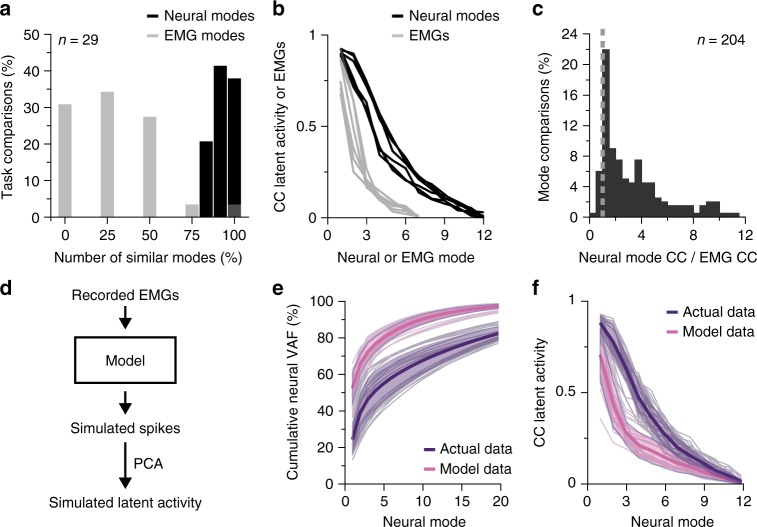
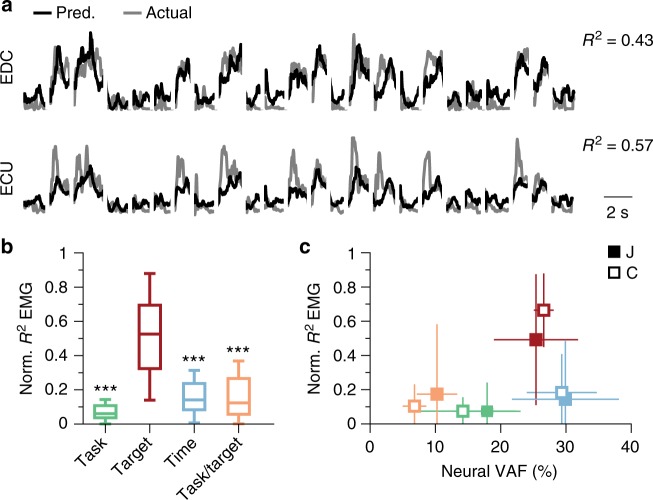
Populations of cortical neurons flexibly perform different functions; for the primary motor cortex (M1) this means a rich repertoire of motor behaviors. We investigate the flexibility of M1 movement control by analyzing neural population activity during a variety of skilled wrist and reach-to-grasp tasks. We compare across tasks the neural modes that capture dominant neural covariance patterns during each task. While each task requires different patterns of muscle and single unit activity, we find unexpected similarities at the neural population level: the structure and activity of the neural modes is largely preserved across tasks. Furthermore, we find two sets of neural modes with task-independent activity that capture, respectively, generic temporal features of the set of tasks and a task-independent mapping onto muscle activity. This system of flexibly combined, well-preserved neural modes may underlie the ability of M1 to learn and generate a wide-ranging behavioral repertoire.
Overview
The claims and statistics of this paper haven’t been checked yet.
Free: it reads the open-access text and checks the first 5 claims that cite a source we can check. Create a free account to check every claim.
Integrity signals
Registry
Cites
Statistics
Figures
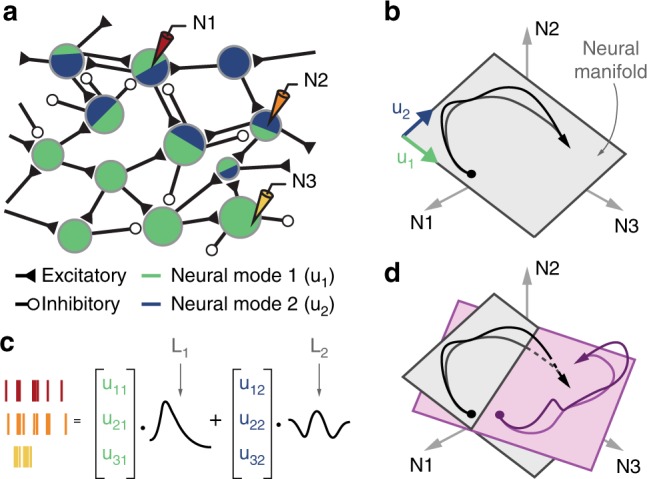
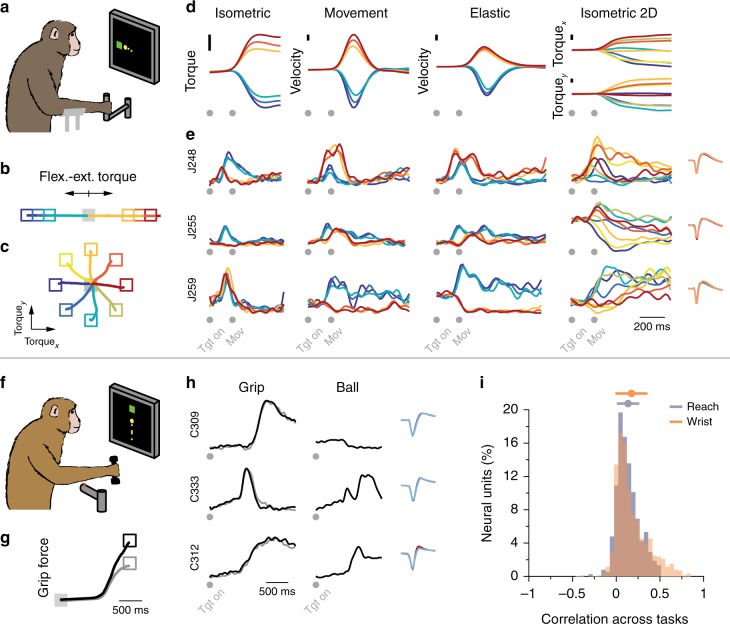
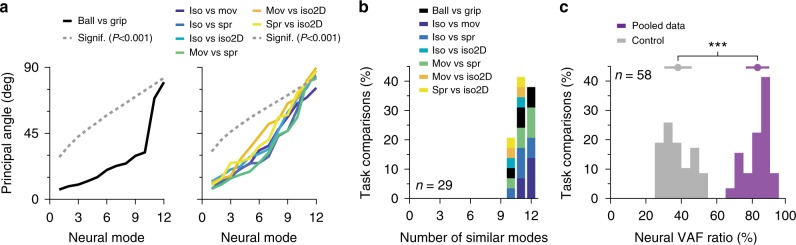
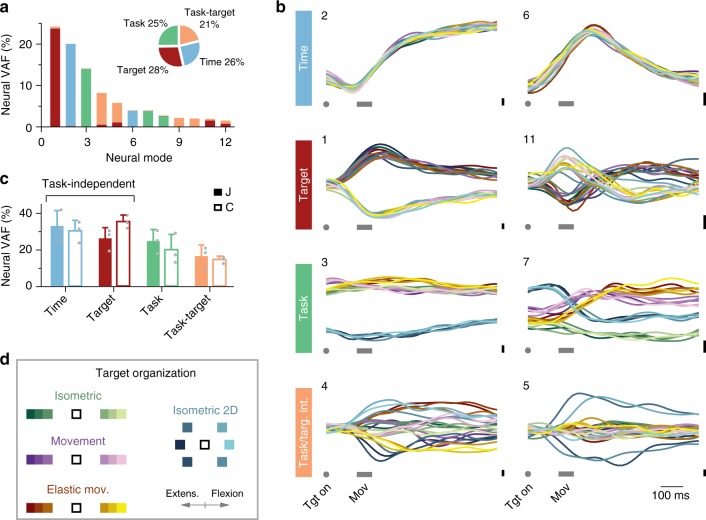
Verification
Claims the paper makes
The claims and statistics of this paper haven’t been checked yet.
Free: it reads the open-access text and checks the first 5 claims that cite a source we can check. Create a free account to check every claim.
Self-check
Percentages, sums and reported differences re-computed from the paper’s own numbers.
The self-check needs the paper’s full text.
Citations
Cites
1 retracted
RETRACTED: A mathematical model explains saturating axon guidance responses to molecular gradients
Nguyen, H., Dayan, P., Pujic, Z., Cooper-White, J., & Goodhill, G. J. (2016) · eLife · doi:10.7554/elife.12248 · Cited by 1,221
RetractedGeorgopoulos, A., Kalaska, J., Caminiti, R., & Massey, J. (1982) · The Journal of Neuroscience · doi:10.1523/jneurosci.02-11-01527.1982 · Cited by 2,130
Context-dependent computation by recurrent dynamics in prefrontal cortex
Mante, V., Sussillo, D., Shenoy, K. V., & Newsome, W. T. (2013) · Nature · doi:10.1038/nature12742 · Cited by 1,847
Neural population dynamics during reaching
Churchland, M. M., Cunningham, J. P., Kaufman, M. T., Foster, J. D., Nuyujukian, P., Ryu, S. I., & Shenoy, K. V. (2012) · Nature · doi:10.1038/nature11129 · Cited by 1,626
Descending Pathways in Motor Control
Lemon, R. N. (2008) · Annual Review of Neuroscience · doi:10.1146/annurev.neuro.31.060407.125547 · Cited by 1,599
A century of trends in adult human height
NCD Risk Factor Collaboration (NCD-RisC) (2016) · eLife · doi:10.7554/elife.13410 · Cited by 1,558
Control of Locomotion in Bipeds, Tetrapods, and Fish
Grillner, S. (1981) · Comprehensive Physiology · doi:10.1002/cphy.cp010226 · Cited by 1,365
Neuroscience Needs Behavior: Correcting a Reductionist Bias
Krakauer, J. W., Ghazanfar, A. A., Gomez-Marin, A., MacIver, M. A., & Poeppel, D. (2017) · Neuron · doi:10.1016/j.neuron.2016.12.041 · Cited by 1,358
LAWRENCE, D. G., & KUYPERS, H. G. J. M. (1968) · Brain · doi:10.1093/brain/91.1.1 · Cited by 1,285
Relation of pyramidal tract activity to force exerted during voluntary movement.
Evarts, E. V. (1968) · Journal of Neurophysiology · doi:10.1152/jn.1968.31.1.14 · Cited by 1,249
Research works printed but not linked: 1
- Elsayed G Cunningham JP Structure in neural population recordings: significant or epiphenomenal? Nat. Neurosci. 2017 25 1 14 PMC5577566 28783140
Cited by
Items 201–300 of 412
Yu, H., Zhao, Q., Li, S., Li, K., Liu, C., & Wang, J. (2022) · Frontiers in Computational Neuroscience · doi:10.3389/fncom.2022.852281 · Cited by 5
“Gallego et al. (2018) confirmed the existence of a neural manifold in the motor cortex of monkeys by PCA.”
BackgroundNeural Manifold Constraint for Spike Prediction Models Under Behavioral Reinforcement
Wu, S., Zhang, X., & Wang, Y. (2024) · IEEE Transactions on Neural Systems and Rehabilitation Engineering · doi:10.1109/tnsre.2024.3435568 · Cited by 5
“Then, we extract the latent neural manifold by PCA [20], [21] on the firing probabilities during the freely moving period.”
MethodGranule cells reorient cortical trajectories to separate contexts
Garcia-Garcia, M. G., Wójcik, M. J., Thota, S., Drake, L., Otchere, A., Akinwale, O., Ramos, L., Costa, R. P., & Wagner, M. J. (2026) · Nature · doi:10.1038/s41586-026-10946-1 · Cited by 5
Neurobiologically realistic neural network enables cross-scale modeling of neural dynamics
Chang, Y.-J., Chen, Y., Yeh, H., Carmena, J. M., & Santacruz, S. R. (2024) · Scientific Reports · doi:10.1038/s41598-024-54593-w · Cited by 5
“To understand the information encoded within neural populations, decoding cortical activity is of particular interest 45 .”
BackgroundProbing latent brain dynamics in Alzheimer’s disease via recurrent neural network
Li, T., Wang, J., Li, S., & Li, K. (2023) · Cognitive Neurodynamics · doi:10.1007/s11571-023-09981-9 · Cited by 5
“Neural manifold is a low-dimensional mapping space of neural activity, and dynamic characteristics can be found by analyzing the trajectory changes in manifold space (Ebitz and Hayden 2021; Gallego et al. 2018).”
Liu, T., Wang, Z., Shakil, S., & Tong, R. K. (2025) · IEEE Transactions on Neural Systems and Rehabilitation Engineering · doi:10.1109/tnsre.2025.3600824 · Cited by 5
“Recent studies have shown that movement-related neural population dynamics can be represented as specific low-dimensional neural manifolds in the neural mode space, which remain stable across tasks, time, and subjects [16], [17], [18].”
InputDSA : Demixing then comparing recurrent and externally driven dynamics.
Huang, A., Ostrow, M., Singh, S. H., Kozachkov, L., Fiete, I., & Rajan, K. (2026) · International Conference on Learning Representations · Cited by 5
The Spatiotemporal Structure of Neural Activity in Motor Cortex during Reaching
Canfield, R. A., Ouchi, T., Fang, H., Macagno, B., Smith, L. I., Scholl, L. R., & Orsborn, A. L. (2026) · Journal of Neuroscience · doi:10.1523/jneurosci.1965-25.2026 · Cited by 4
“𝐴𝐴 𝐵𝐵 𝐴𝐴 𝐵𝐵 CCA was applied to Z-scored and smoothed firing rates (See Firing Rate Estimation for details) following procedures based on previous work (Gallego et al., 2018).”
Feedback control of random networks as a model of flexible motor cortical dynamics across tasks
Kalidindi, H. T., & Crevecoeur, F. (2026) · Cell Reports · doi:10.1016/j.celrep.2026.116991 · Cited by 4
Gharesi, N., Luneau, L., Kalaska, J. F., & Baillet, S. (2023) · bioRxiv (Cold Spring Harbor Laboratory) · doi:10.1101/2023.06.06.543581 · Cited by 4
“…underlying neural circuits (Churchland et al., 2010, 2012; Shenoy et al., 2013; Kaufman et al., 2014; Cunningham and Yu, 2014; Elsayed et al., 2016; Gallego et al., 2017, 2018; Kalaska, 2019; Vyas et al., 2020; Duncker and Sahani, 2021; Thura et al., 2022; Meirhaeghe et al., 2023), which are…”
BackgroundGuo, H., Kuang, S., & Gail, A. (2025) · Nature Communications · doi:10.1038/s41467-025-56360-5 · Cited by 4
Experience-driven development of decision-related representations in the auditory cortex
Kazanovich, I., Itzhak, S., & Resnik, J. (2024) · EMBO Reports · doi:10.1038/s44319-024-00309-0 · Cited by 4
“Before calculating the Euclidian distances, we used canonical correlation analysis (CCA) to “ align ” the latent dynamics across the different Bins (Dabagia et al, 2023; Veuthey et al, 2020; Gallego et al, 2020, 2018).”
Highlights from the 32nd Annual Meeting of the Society for the Neural Control of Movement
Love, K., Cao, D., Chang, J. C., Dal’Bello, L. R., Ma, X., O’Shea, D. J., Schone, H. R., Shahbazi, M., & Smoulder, A. L. (2023) · Journal of Neurophysiology · doi:10.1152/jn.00428.2023 · Cited by 4
Short-term memory by distributed neural network oscillators in a simple nervous system
Dunn, R. L., Costello, C. M., Borchardt, J., Sprague, D., Chiu, G. C., Miller, J. M., L’Étoile, N. D., & Kato, S. (2025) · Current Biology · doi:10.1016/j.cub.2025.10.018 · Cited by 4
A high-dimensional population code in the bat motor cortex during natural dexterous flight
Styr, B., Qi, K. K., Chen, X., Liberti, W. A., & Yartsev, M. M. (2026) · Cell · doi:10.1016/j.cell.2026.09.029 · Cited by 4
Flexible Use of Limited Resources for Sequence Working Memory in Macaque Prefrontal Cortex
Li, S., Chen, J., Zhang, C., Tang, S., Xie, Y., & Wang, L. (2025) · Nature Communications · doi:10.1038/s41467-025-65380-0 · Cited by 4
Neural dynamics hierarchy in motor cortex and striatum across naturalistic behaviorsPreprint
Xing, D., Glaser, J. I., & Miri, A. (2024) · bioRxiv (Cold Spring Harbor Laboratory) · doi:10.1101/2024.12.17.629049 · Cited by 4
Treviño, M., Arias-Carrión, Ó., de la Torre-Valdovinos, B., Osuna-Carrasco, L. P., & Márquez, I. (2025) · NeuroSci · doi:10.3390/neurosci6040108 · Cited by 4
“This organization separates null spaces, which support preparatory activity without influencing motor output, from potent spaces that project to effectors and directly drive movement [17,23].”
InfluentialFukunishi, A., Kutsuzawa, K., Owaki, D., & Hayashibe, M. (2024) · Frontiers in Computational Neuroscience · doi:10.3389/fncom.2024.1355855 · Cited by 4
Spatially heterogeneous inhibition projects sequential activity onto unique neural subspacesPreprint
Lehr, A. B., Kumar, A., & Tetzlaff, C. (2025) · eLife · doi:10.7554/elife.108375 · Cited by 3
O’Reilly-Shah, V. N., & Selvitella, A. (2026) · Journal of Computational Neuroscience · doi:10.1007/s10827-026-00951-8 · Cited by 3
“The question is: how do the low-dimensional manifolds observed in sensory cortex (Chaudhuri et al., 2019; Cunningham and Yu, 2014; Gallego et al., 2017, 2018, 2020; Gardner et al., 2022; Kim et al., 2017) arise?”
Lv, X., Liu, H., Chen, L., Dai, C., Wei, P., Hao, J., & Zhao, G. (2023) · Journal of Neural Engineering · doi:10.1088/1741-2552/acd603 · Cited by 3
“The joint motion of animals can be mapped with the electrical activity generated from the cerebral cortex [5, 6], and can be used to evaluate the recovery state induced by nerve injury [1, 2].”
BackgroundThe geometry of neural representation: From neural tuning to manifold geometry
Zhu, J., Zhu, M., Wu, P., He, Q. L., Wang, J., Niu, X., & Wang, Z. (2026) · Chaos Solitons & Fractals · doi:10.1016/j.chaos.2026.118193 · Cited by 3
A model for cortical activity sequencesPreprint
Lehr, A. B., Erzmann, F., Michaelis, C., Nowak, J., Gail, A., Kumar, A., & Tetzlaff, C. (2024) · bioRxiv (Cold Spring Harbor Laboratory) · doi:10.1101/2024.02.25.581959 · Cited by 2
Xu, X., Morton, M. P., Denagamage, S., Hudson, N. V., Nandy, A. S., & Jadi, M. P. (2024) · Neuron · doi:10.1016/j.neuron.2024.09.021 · Cited by 3
Huang, Y., & Yu, Z. (2022) · Entropy · doi:10.3390/e24020152 · Cited by 3
Ventral CA1 Population Codes for AnxietyPreprint
Lim, S. C., Fusi, S., & Hen, R. (2023) · bioRxiv (Cold Spring Harbor Laboratory) · doi:10.1101/2023.09.25.559358 · Cited by 3
Thivierge, J., & Pilzak, A. (2022) · Scientific Reports · doi:10.1038/s41598-021-04684-9 · Cited by 3
Benchmarking criteria to determine latent linear dimensionality in neural data
Vaccari, F. E., Diomedi, S., Bettazzi, E., Filippini, M., Vitis, M. D., Hadjidimitrakis, K., & Fattori, P. (2026) · Scientific Reports · doi:10.1038/s41598-026-55225-1 · Cited by 3
Emergence of Universal Computations Through Neural Manifold Dynamics
Gort, J. (2024) · Neural Computation · doi:10.1162/neco_a_01631 · Cited by 3
“This has indeed been reported by experimental studies [7].”
BackgroundResultInfluentialBifurcations of a Neural Network Model with Symmetry
Parker, R., & Barreiro, A. K. (2022) · SIAM Journal on Applied Dynamical Systems · doi:10.1137/22m1470451 · Cited by 3
Li, Y., Zhu, X., Qi, Y., & Wang, Y. (2024) · eLife · doi:10.7554/elife.87881.3 · Cited by 3
Zhao, Z., & Schieber, M. H. (2025) · eLife · doi:10.7554/elife.94165 · Cited by 3
He, B., Salmas, P., Zhang, J., Duan, X., & Cheung, V. C. K. (2025) · The Journal of Physiology · doi:10.1113/jp288073 · Cited by 3
“Future studies that aim to relate neural manifolds (Gallego et al., 2020, 2018; Safaie et al., 2023) in spinal neural populations and muscle synergy activities may eventually shed light on the neuronal origin of the synergies’ activation coefficients.”
Loriette, C. (2022) · theses.fr (ABES) · doi:10.70675/202352e0z857fz4171z8953zf43f1d44da96 · Cited by 3
Neural-vocal phase coupling reveals structured timing in birdsong productionPreprint
Leites, F. L., Boaretto, B. R. R., Masoller, C., & Amador, A. (2026) · bioRxiv (Cold Spring Harbor Laboratory) · doi:10.64898/2026.07.21.739824 · Cited by 3
Zheng, Z. S., Zutshi, I., Huszár, R., Zhang, Y., Karadas, M., Buzsáki, G., & Williams, A. H. (2025) · bioRxiv (Cold Spring Harbor Laboratory) · doi:10.64898/2025.12.14.694183 · Cited by 3
Locomotion engages context-dependent motor strategies for head stabilization in primates
Wei, R.-H., Stanley, O. R., Charles, A., & Cullen, K. E. (2026) · Communications Biology · doi:10.1038/s42003-026-09512-2 · Cited by 3
“Prior work has demonstrated that dimensionality reduction techni-quescanuncovertemporalpatternsofmusclecoactivationduringbehaviorssuchaslocomotion(factoranalysis 21 – 23 ; non-negative matrix factorization, NNMF 47 – 49 ) and wrist or arm movements (principal component analysis, PCA 37,39,50 ).”
Experience Reorganizes Coordinated Population Dynamics Across Hippocampal CircuitsPreprint
Khanzada, S., Hu, X., Klütsch, D., Kempermann, G., Boi, F., & Amin, H. (2026) · bioRxiv (Cold Spring Harbor Laboratory) · doi:10.64898/2026.01.15.698118 · Cited by 2
“Rather than reflecting a loss of complexity, such population ‐ level compression indicates structured coordination, consistent with models in which effective computation arises within constrained subspaces shaped by circuit history and connectivity 64 .”
Distinct tasks engage a shared neural subspace in human hippocampus and anterior cingulate cortexPreprint
Lu, H., Chericoni, A., Franch, M. C., Katlowitz, K. A., Mickiewicz, E. A., Paulo, D. L., Watrous, A. J., Bartoli, E., Provenza, N. R., Sheth, S. A., et al. (2026) · bioRxiv (Cold Spring Harbor Laboratory) · doi:10.64898/2026.04.24.720703 · Cited by 2
An emerging view of neural geometry in motor cortex supports high-performance decodingPreprint
Perkins, S. M., Amematsro, E. A., Cunningham, J. P., Wang, Q., & Churchland, M. M. (2024) · eLife · doi:10.7554/elife.89421.2 · Cited by 2
Aligned and oblique dynamics in recurrent neural networksPreprint
Schuessler, F., Mastrogiuseppe, F., Ostojic, S., & Barak, O. (2024) · eLife · doi:10.7554/elife.93060.1 · Cited by 2
Precision multidimensional neural population code recovered from single intracellular recordings
Johnson, J. K., Geng, S., Hoffman, M. W., Adesnik, H., & Weßel, R. (2020) · Scientific Reports · doi:10.1038/s41598-020-72936-1 · Cited by 2
Stability of neural manifolds at minimal dimensionality despite motor representational driftPreprint
Abdulla, M. U., Clarke, S. E., Jun, E. J., & Nuyujukian, P. (2026) · bioRxiv (Cold Spring Harbor Laboratory) · doi:10.64898/2026.01.30.702162 · Cited by 2
“It has been argued that the behaviorally relevant neural manifold in motor regions is roughly 10-dimensional (with various estimates for dimensionality ranging from 5 to 20 25,28,36,39,42,43 .)”
InfluentialLearning sculpts orthogonal task manifolds for continual skill learning in recurrent networksPreprint
Liu, Z., Kurth, A. C., Osako, Y., & Asabuki, T. (2026) · bioRxiv (Cold Spring Harbor Laboratory) · doi:10.64898/2026.02.15.705283 · Cited by 2
“…have been identified across diverse brain regions and behaviors, including motor cortex during movement generation (Churchland et al., 2012; Gallego et al., 2018), prefrontal cortex during context-54 dependent decision making (Mante et al., 2013), and navigation-related circuits (Harvey et…”
De novo sensorimotor learning through reuse of movement components
Gabriel, G., Mushtaq, F., & Morehead, J. R. (2024) · PLoS Computational Biology · doi:10.1371/journal.pcbi.1012492 · Cited by 2
Peng, Y., Okur, O., Lindersson, C., Tinelli, S., Stedehouder, J., Shah, R. S., Lak, A., Stagg, C. J., & Sharott, A. (2024) · bioRxiv (Cold Spring Harbor Laboratory) · doi:10.1101/2024.11.04.621878 · Cited by 2
“Previous studies have observed movement-related latent dynamics outside of motor cortex 4,8,27,28 , and that they can be preserved across tasks 54 , time 48 , subjects and shared between motor cortex and striatum 49 .”
A metric for comparing complex systems by their dynamicsPreprint
Ostrow, M., Eisen, A. J., Kozachkov, L., Redman, W. T., & Fiete, I. (2026) · bioRxiv (Cold Spring Harbor Laboratory) · doi:10.64898/2026.07.16.738953 · Cited by 2
Hierarchy in Neuronal Representations of Multiple Tasks in Prefrontal CortexPreprint
Sheng, Q., Luo, S., Li, D., Jia, J., Fan, Z., He, Z., Wang, F., Chen, Y., Yuan, S., Cheng, Z., et al. (2026) · bioRxiv (Cold Spring Harbor Laboratory) · doi:10.64898/2026.02.10.705211 · Cited by 2
A Biologically Inspired Attention Model for Neural Signal AnalysisPreprint
Skatchkovsky, N., Glazman, N., Egea-Weiss, A., Sadeh, S., & Iacaruso, M. F. (2024) · bioRxiv (Cold Spring Harbor Laboratory) · doi:10.1101/2024.08.13.607787 · Cited by 2
“To circumvent this issue, previous studies often relied on single-neuron or average population analysis, and averaged spike trains to consider firing rates [7], [8].”
Rule, M. E., & O’Leary, T. (2021) · German Neuroinformatics Node · doi:10.12751/nncn.bc2021.p170 · Cited by 2
Neural subspace reorganization reflects value-based decision-making
Li, H., Eisen, A. J., Brincat, S. L., Rose, J., & Miller, E. K. (2026) · iScience · doi:10.1016/j.isci.2026.117492 · Cited by 2
“45 We estimated a 2D sub-space for each target representation by applying principal component analysis (PCA) to the condition-mean population activity and finding the first two principal components.”
InfluentialControlling Spatio-Temporal Sequences of Neural Activity by Local Synaptic Changes
Wernecke, H. O., Lehr, A. B., & Kumar, A. (2026) · Journal of Neuroscience · doi:10.1523/jneurosci.1506-25.2026 · Cited by 2
“Consistent with this idea, sequential activity has been observed in a variety of tasks such as motor con-trol (Gallego et al., 2018; Eichenlaub et al., 2020; Lindén et al., 2022), decision-making (Harvey et al., 2012), episodic memory (O ’ Keefe, 1976; Dragoi and Buzsáki, 2006; Foster and Wilson,…”
Characterizing neural manifolds’ properties and curvatures using normalizing flows
Bouss, P., Nestler, S., Fischer, K., Merger, C., René, A., & Helias, M. (2025) · PRX Life · doi:10.1103/rmfp-b7b5 · Cited by 1
“A number of studies on neural manifolds have been carried out for different brain areas, such as motor cortex [13, 14], prefrontal cortex [17, 34, 35], hippocampus [36, 37], visual cortex [9, 18], and basal ganglia [24, 25].”
Embodied sensorimotor control: computational modeling of the neural control of movementPreprint
Almani, M. N., Lazzari, J., Walker, J., & Saxena, S. (2025) · PubMed Central · doi:10.48550/arxiv.2509.14360 · Cited by 2
“The use of shared manifolds across distinct tasks with similar elements has also been discovered in primate M1 (30).”
Population coding of distinct categories of behavior in the frontal eye field
Cain, M., & Joshua, M. (2025) · Journal of Neurophysiology · doi:10.1152/jn.00147.2024 · Cited by 2
Zhao, Z., & Schieber, M. H. (2025) · eLife · doi:10.7554/elife.94165.3 · Cited by 2
Extracting task-relevant preserved dynamics from contrastive aligned neural recordings
Jiang, Y., Sheng, K., Gao, Y., Buchanan, E. K., Shikano, Y., Kim, T. H., Zhao, Y., Woo, S. J., Dinç, F., Linderman, S. W., et al. (2025) · neural information processing systems · doi:10.52202/085713-5376 · Cited by 2
Zhao, Z., Pasek, M., & Nemenman, I. M. (2026) · arXiv (Cornell University) · doi:10.48550/arxiv.2605.26551 · Cited by 2
“There are ample experiments where dimensionality has been reported with the duration of behavior serving as the measurement time T [18–21, 23–25, 27, 28, 31].”
Mixed Selectivity of Subthalamic Nucleus Neurons in Encoding Motor and Reward BehaviorsPreprint
Wu, B.-S., Min, M., & Wu, Y. (2025) · bioRxiv (Cold Spring Harbor Laboratory) · doi:10.1101/2025.02.12.637797 · Cited by 2
Langevin Flows for Modeling Neural Latent DynamicsPreprint
Song, Y., Keller, T. A., Yue, Y., Perona, P., & Welling, M. (2025) · arXiv · doi:10.48550/arxiv.2507.11531 · Cited by 2
“…2010), shed light on network-wide interactions (Cohen & Kohn, 2011; Saxena & Cunningham, 2019), and relate neural activity to behavior in real time (Gallego et al., 2018, 2020; Dabagia et al., 2023) — all of which are central goals for both fundamental neuroscience research and applied domains…”
A number simplex in the human medial temporal lobePreprint
Zhu, H., Chericoni, A., Ismail, T., Mickiewicz, E. A., Franch, M. C., Nigam, T., Yan, X., Belanger, J. L., Chavez, A. G., Nair, J., et al. (2026) · bioRxiv (Cold Spring Harbor Laboratory) · doi:10.64898/2026.06.25.734462 · Cited by 1
Wang, R., Liu, G., Wang, S., Zeng, T., Yang, X., Sun, J., Ma, X., Zhu, B., Qiu, M., Wang, H., et al. (2026) · Nature Communications · doi:10.1038/s41467-026-75979-6 · Cited by 1
“The brain performs functions such as perception, decision-making, memory, planning, and navigation thanks to the coordinated activity of groups of neurons 1,2 .”
Sequential learning in neural decoders reveals interpretable neural representations
Klawitter, J., & Michmizos, K. P. (2026) · Neurocomputing · doi:10.1016/j.neucom.2026.132742 · Cited by 1
Music's manifold emotions for mental well-being: a topological approachPreprint
Darcourt, J. (2023) · Research Square · doi:10.21203/rs.3.rs-3602878/v1 · Cited by 1
Decoupling simultaneous motor imagination and execution via orthogonal ECoG neural representations
Pollina, L., Struber, L., de Seta, V., Russo, E., Karakas, S., Chabardès, S., Aksenova, T., Charvet, G., Shokur, S., & Micera, S. (2026) · Nature Communications · doi:10.1038/s41467-026-71234-0 · Cited by 1
“This shift has led to the concept of neural manifolds or neural spaces, lower-dimensional representations of neural activity that capture the coordinated dynamics of neural populations 7,8 .”
3D directional tuning in the orofacial sensorimotor cortex during natural feeding and drinking
Hosack, V. B., & Arce‐McShane, F. I. (2025) · eLife · doi:10.7554/elife.101325.3 · Cited by 1
Rethink the motor cortical control via the experiment-analysis-model flywheel: an overview
Jiang, H., Bu, X., Shi, Q., Zheng, Z., Zhu, D., Tang, H., & Chen, Y. (2025) · Med-X · doi:10.1007/s44258-025-00059-1 · Cited by 1
“Gallego et al. [101] revealed that motor cortical activity lies within a neural manifold across different tasks, including arm and hand tasks.”
3D directional tuning in the orofacial sensorimotor cortex during natural feeding and drinkingPreprint
Hosack, V. B., & Arce‐McShane, F. I. (2025) · eLife · doi:10.7554/elife.101325 · Cited by 1
“A high degree of similarity in neural modes has been reported across different wrist tasks in 1D and 2D ( Gallego et al., 2018 ).”
Zou, Y., Liu, K., Zhang, C., Ling, Y., Wang, F., Li, M., Chen, Y., Li, M., Guan, S., He, Z., et al. (2025) · bioRxiv (Cold Spring Harbor Laboratory) · doi:10.1101/2025.04.20.649482 · Cited by 1
“Specifically, similar to the calculation process in (Gallego et al., 2018), the matrices L i are first decomposed into orthonormal basis via QR factorization, B } ), where the first m columns of Q A and Q B span the column spaces of L TA and L TB , respectively.”
InfluentialExplaining Social Behaviors Via Cognitive Map
Hu, Y., & Guan, Z. (2022) · Advances in Social Science, Education and Humanities Research/Advances in social science, education and humanities research · doi:10.2991/assehr.k.220504.505 · Cited by 1
Representation of fear memory features in the ventral hippocampus
Milentijevic, A., Cerquetella, C., Nevian, T., Ciocchi, S., & Forro, T. (2026) · Current Biology · doi:10.1016/j.cub.2026.09.034 · Cited by 1
Landau, I. D., Mel, G. C., O’Shea, D. J., Schnitzer, M. J., & Ganguli, S. (2026) · bioRxiv (Cold Spring Harbor Laboratory) · doi:10.64898/2026.07.19.739385 · Cited by 1
Song, Z., Wu, S., Zhou, T., & Wang, Y. (2025) · Annual International Conference of the IEEE Engineering in Medicine and Biology Society (EMBC) · doi:10.1109/embc58623.2025.11251780 · Cited by 1
“When new tasks share eewangyw@ust.hk elements with previously learned actions, existing neural circuits can be reused, thereby facilitating faster learning [3].”
Silvernagel, M. P., Tor, A., Jun, E. J., Clarke, S. E., Sutherland, R., Marshall, K., Wu, Y., Abdulla, M. U., Even-Chen, N., & Nuyujukian, P. (2026) · bioRxiv (Cold Spring Harbor Laboratory) · doi:10.64898/2026.01.26.701668 · Cited by 1
Neuronal Populations, Neural Nodes, and Apraxia
Wasserman, T. H., & Wasserman, L. D. (2023) · Springer eBooks · doi:10.1007/978-3-031-24105-5_4 · Cited by 1
V1 interlaminar coherence decreases with interocular conflictPreprint
Carlson, B. M., Mitchell, B., Westerberg, J. A., Poggi, P. G., Woodman, G., & Maier, A. (2025) · bioRxiv (Cold Spring Harbor Laboratory) · doi:10.1101/2025.10.04.680461 · Cited by 1
“Certain aspects of neuronal population responses are invisible to the study of one neuron at a time, or even pairs of neurons at a time (34–36 , Evaluating magnitude-squared coherence for V1 LFPs can serve as a heuristic for the laminar structure of coherence within single cortical columns (25, 42).”
Fast timescale reparameterization of stable neural manifoldsPreprint
Clarke, S. E., & Nuyujukian, P. (2026) · bioRxiv (Cold Spring Harbor Laboratory) · doi:10.64898/2026.01.26.701671 · Cited by 1
Subcortical control of reaching in humansPreprint
Contemori, S., Loeb, G. E., Corneil, B. D., Wallis, G. M., & Carroll, T. J. (2025) · bioRxiv (Cold Spring Harbor Laboratory) · doi:10.1101/2025.11.26.690644 · Cited by 1
Li, Y., Zhu, X., Qi, Y., & Wang, Y. (2024) · eLife · doi:10.7554/elife.87881.2 · Cited by 1
Ling, A. S., Silvernagel, M. P., Clarke, S. E., Jun, E. J., Abdulla, M. U., & Nuyujukian, P. (2025) · bioRxiv (Cold Spring Harbor Laboratory) · doi:10.64898/2025.12.19.695640 · Cited by 1
“These findings have revealed rich, low-dimensional neural dynamics that lie within a preserved neural manifold underlying multiple reaching behaviors Gallego et al (2018); Perich et al (2025); Pandarinath et al (2015).”
Simeoni, E. (2022) · UPM Digital Archive (Technical University of Madrid) · doi:10.20868/upm.thesis.70833 · Cited by 1
Global and local origins of trial-to-trial spike count variability in visual cortexPreprint
Li, A. J., Lu, Z., Ladd, A., Matveev, P., Shea‐Brown, E., & Steinmetz, N. A. (2025) · bioRxiv (Cold Spring Harbor Laboratory) · doi:10.1101/2025.08.08.669442 · Cited by 1
“To identify the manifold for each model, we applied principal component analysis (PCA) to the model prediction, and defined its manifold as the r -dimensional subspace spanned by the top r PCs capturing over 99% variance (Gallego et al., 2018).”
Privileged representational axes in biological and artificial neural networks
Khosla, M., Srivastava, S., Williams, A. H., McDermott, J. H., & Kanwisher, N. (2026) · Nature Human Behaviour · doi:10.1038/s41562-026-02515-3 · Cited by 1
Cortical control of innate behavior from subcortical demonstrationPreprint
Keller, J. A., Kwak, I. S., Stark, A. K., Pachitariu, M., Branson, K. M., & Dudman, J. T. (2025) · bioRxiv (Cold Spring Harbor Laboratory) · doi:10.1101/2025.02.12.637930 · Cited by 1
Applying Neural Manifold Constraint on Point Process Model for Neural Spike Prediction *
Wu, S., & Wang, Y. (2023) · Annual International Conference of the IEEE Engineering in Medicine and Biology Society (EMBC) · doi:10.1109/embc40787.2023.10340489 · Cited by 1
“An intuitive way to estimate the neural manifold is dimension reduction methods such as the principal component analysis (PCA) to find the latent dynamics [14, 15].”
MethodExploring neural manifolds across a wide range of intrinsic dimensions
Fadanni, J., Pacelli, R., Zucchetta, A., Rotondo, P., & Allegra, M. (2026) · PLoS Computational Biology · doi:10.1371/journal.pcbi.1014162 · Cited by 1
A tradeoff between reliability and dimensionality in the neural code for music
Mouawad, P., Sabesan, S., Greasley, A., & Lesica, N. A. (2026) · Hearing Research · doi:10.1016/j.heares.2026.109815 · Cited by 1
Dwarakanath, A., Kapoor, K., Safavi, S., Logothetis, N. K., & Eschenko, O. (2018) · Max Planck Digital Library · Cited by 1
Attention modulates the neural geometry of auditory representationsPreprint
Pedersini, C. A., Muukkonen, I., & Wikman, P. A. (2025) · bioRxiv (Cold Spring Harbor Laboratory) · doi:10.1101/2025.10.09.681368 · Cited by 1
“Principal Angle was extracted to quantify how attention affects the orientation and the alignment of neural manifolds 32,34,100 .”
Data-driven reduced modeling of neural dynamics
Marraffa, A., Krause, R., Mante, V., & Haller, G. (2026) · Nature Communications · doi:10.1038/s41467-026-75924-7 · Cited by 1
Seneque, G., Ho, L.-H., Saeedi, N. E., Molendijk, J., & Elson, T. (2026) · arXiv (Cornell University) · doi:10.48550/arxiv.2604.17663 · Cited by 1
Developmental tuning of functional manifold dimensionality across the human brainPreprint
Busch, E. L., & Turk‐Browne, N. B. (2026) · bioRxiv (Cold Spring Harbor Laboratory) · doi:10.64898/2026.07.24.740635 · Cited by 1
“…complexity of neural activity comes from electrophysiological recordings of individual brain regions during constrained laboratory tasks in animals [14–17], or from neuroimaging studies focused on specific brain networks and static, controlled paradigms in adult humans [10, 12, 18–20].”
Flexible neuronal participation within a reliable motor sequencePreprint
Peng, J., Duffy, A., Dippenaar, I., Liu, L., Wu, J., Tu, X., Fairhall, A. L., & Lois, C. (2026) · bioRxiv (Cold Spring Harbor Laboratory) · doi:10.64898/2026.07.10.737866 · Cited by 1
Spinal rotational dynamics orchestrate locomotor recoveryPreprint
Colard, J., Harnie, J., Berg, R. W., & Frigon, A. (2026) · bioRxiv (Cold Spring Harbor Laboratory) · doi:10.64898/2026.07.21.739844 · Cited by 1
“Each smoothed signal 𝑋 ’ was normalised by its standard deviation plus a 5 constant to prevent noise amplification from low-activity units 49,50 : The manifold structure was identified using Principal Component Analysis (PCA).”
Dynamics and dimensionality of information representation for higher cognitive function
Wasmuht, D. (2019) · Oxford University Research Archive (ORA) (University of Oxford) · doi:10.5287/ora-9gvzn1qkv · Cited by 1
Predicting Spatio-Temporal Human Brain Response Using fMRI
Zhao, C., Zhan, L., Thompson, P. M., & Huang, H. (2022) · Lecture notes in computer science · doi:10.1007/978-3-031-16431-6_32 · Cited by 1
Reliable and Context-Dependent Computation in the Brain
Johnston, W. J. (2020) · Knowledge@UChicago (University of Chicago) · doi:10.6082/9p0ma-kg670 · Cited by 1
Symbols, Dynamics, and Maps: A Neurosymbolic Approach to Spatial Cognition
Dumont, N. S.-Y. (2025) · UWSpace (University of Waterloo) · Cited by 1
Metadata
- Authors
- Gallego, J. A., Perich, M. G., Naufel, S. N., Ethier, C., Solla, S. A., & Miller, L. E.
- Affiliations
- Northwestern University (US)
- Corresponding author
- Miller, Lee E.
- ORCID
- Venue
- Nature Communications
- Published
- 2018-10-12
- Volume
- 9
- Issue
- 1
- Pages
- 4233-4233
- ISSN
- 2041-1723 (ISSN-L)
- PMC
- PMC6185944
- OpenAlex
- W2896846197
- Cited by
- 413
- References
- 91
- Citations by year
- 2026: 88 · 2025: 75 · 2024: 70 · 2023: 43 · 2022: 50 · 2021: 29 · 2020: 31 · 2019: 17 · 2018: 8
- FWCI
- 9.90
- Type
- journal article
- Language
- en
- Open access
- gold
- doi.org
- Licence
- cc-by
- creativecommons.org/licenses/by/4.0 (tdm)
- creativecommons.org/licenses/by/4.0 (vor)
- Locations
- Nature Communications (publishedVersion, cc-by)
- bioRxiv (Cold Spring Harbor Laboratory) (submittedVersion, cc-by-nd)
- Europe PMC (PubMed Central) (publishedVersion, cc-by)
- PubMed Central (publishedVersion, cc-by)
- PubMed (publishedVersion)
- RePEc: Research Papers in Economics (submittedVersion)
- DOAJ (DOAJ: Directory of Open Access Journals) (submittedVersion)
- Funders
- EC | Seventh Framework Programme (FP7-PEOPLE-2013-IOF-627384)
- U.S. Department of Health & Human Services | NIH | National Institute of Neurological Disorders and Stroke (F31-NS092356, NS053603)
- U.S. Department of Health & Human Services | NIH | NICHD | National Center for Medical Rehabilitation Research (T32-HD07418)
- Center for Selective C-H Functionalization, National Science Foundation (DGE-1324585)
- Fonds de Recherche du Québec - Santé (22343)
- Topics
- Life Sciences › Neuroscience › Cognitive Neuroscience › Motor Control and Adaptation
- Life Sciences › Neuroscience › Cognitive Neuroscience › Neural dynamics and brain function
- Life Sciences › Neuroscience › Cognitive Neuroscience › Memory and Neural Mechanisms
- Keywords
- primary motor cortex, neural population activity, neural manifolds, wrist kinematics, reach-to-grasp
- MeSH terms
- Animals, Macaca mulatta, Male, Motor Cortex, Neurons, Psychomotor Performance, Wrist, Hand Strength
About these checks
Registry, retraction, Cites and statistics results are computed, not judged, with one exception: a printed reference that no index lists is read once by a model before it counts as a citation error. Claims are extracted by a model and kept only when their quote appears verbatim in the text; each cited source is then checked, with a model’s help, for whether it says what the claim relies on. Those verdicts can be wrong — read the claim’s quote and the cited source before relying on one.
Statistics and arithmetic are recomputed, not judged.
Confidence bands are shown only for fields calibrated on our annotated test set. None is calibrated yet, so no band is shown.
What counts as a claim ›How we measure confidence ›How we check this ›
Are you an author, or do you see a problem with this page? Request a review
Data sources
Bibliographic data: Semantic Scholar, OpenAlex, Crossref.
Contains information from the Semantic Scholar Academic Graph Datasets, made available under the ODC Attribution License (ODC-BY 1.0).
Semantic Scholar’s data is described in: Kinney, R., et al. (2023). The Semantic Scholar Open Data Platform. arXiv:2301.10140.
