

VDAC2 enables BAX to mediate apoptosis and limit tumor development
Open accessThe DOI matches its Crossref record; 66 of the 66 references it cites were found in a registry or an index.
Abstract
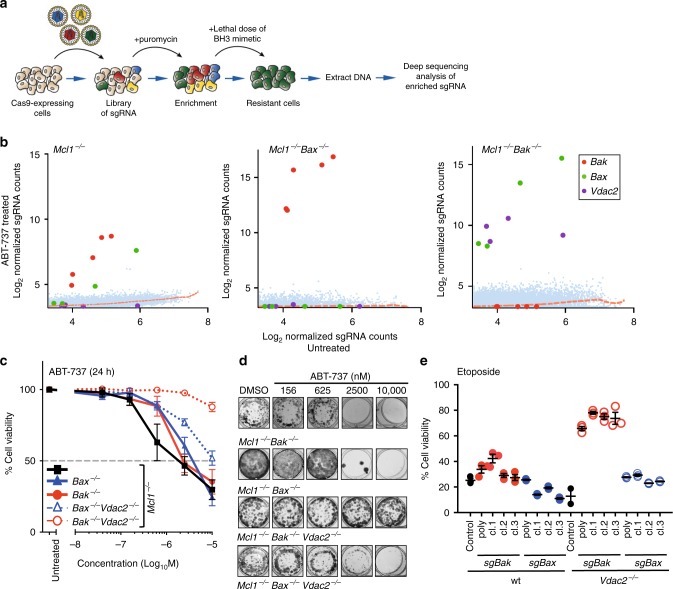
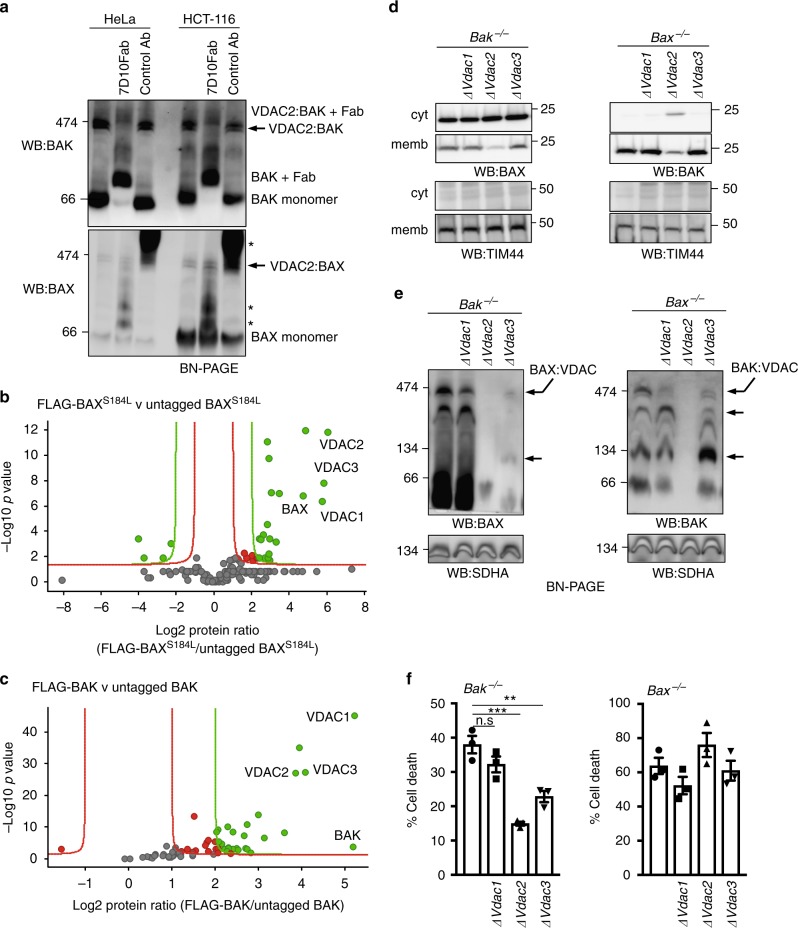
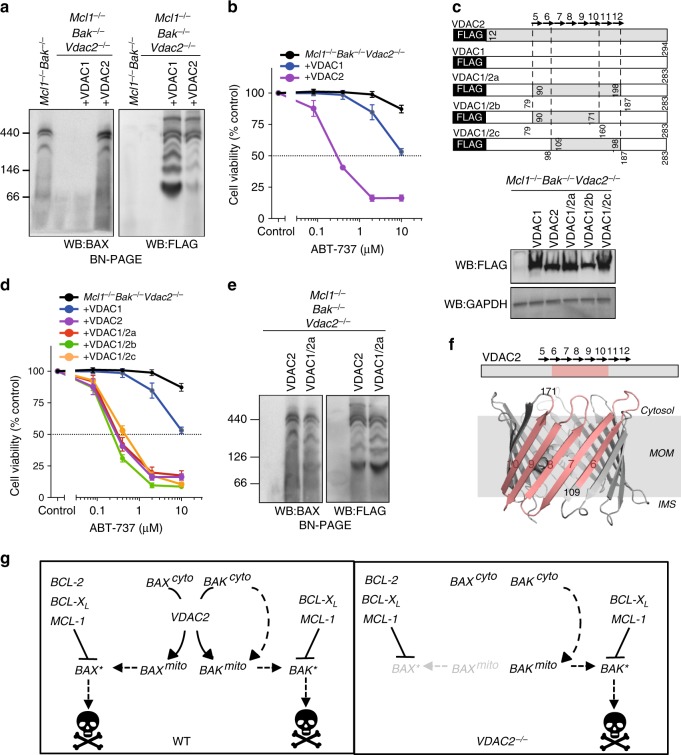
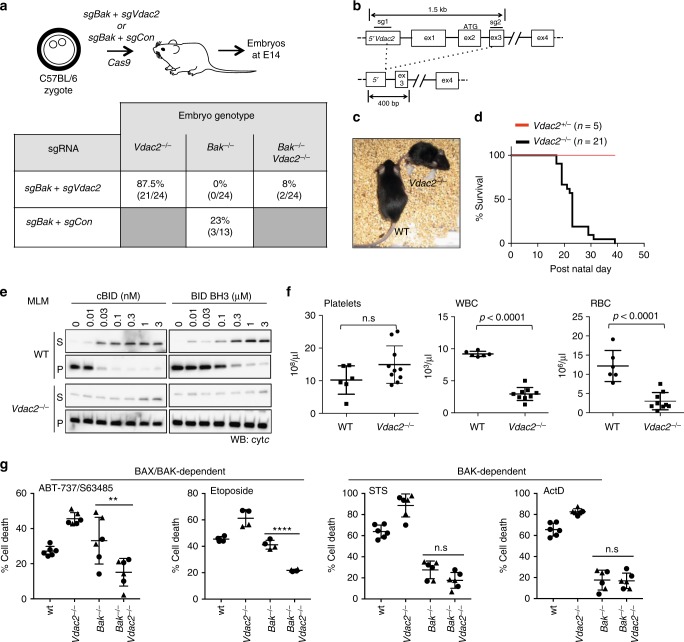
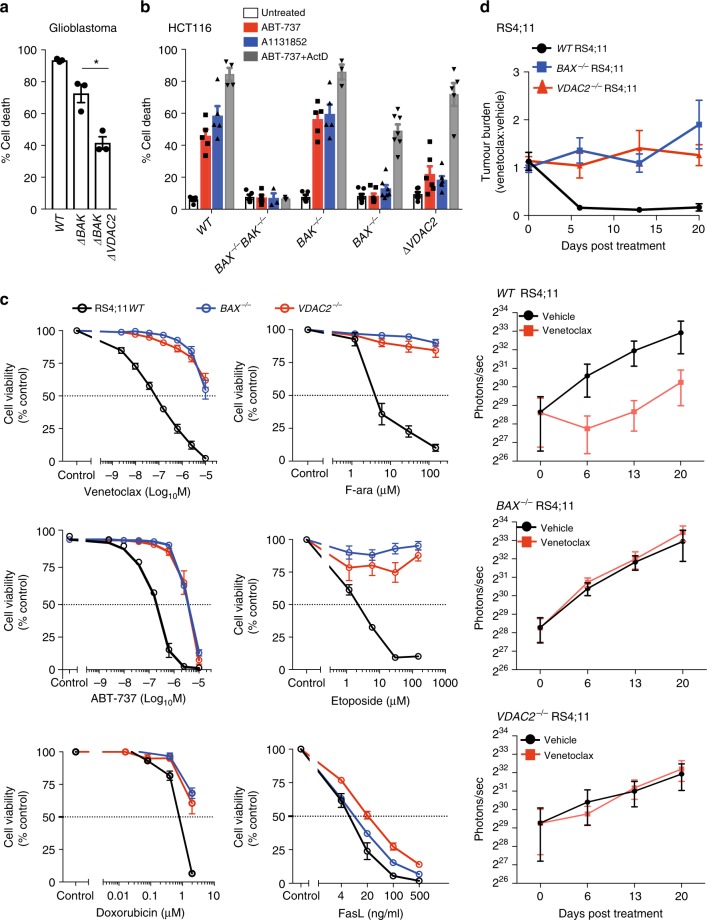
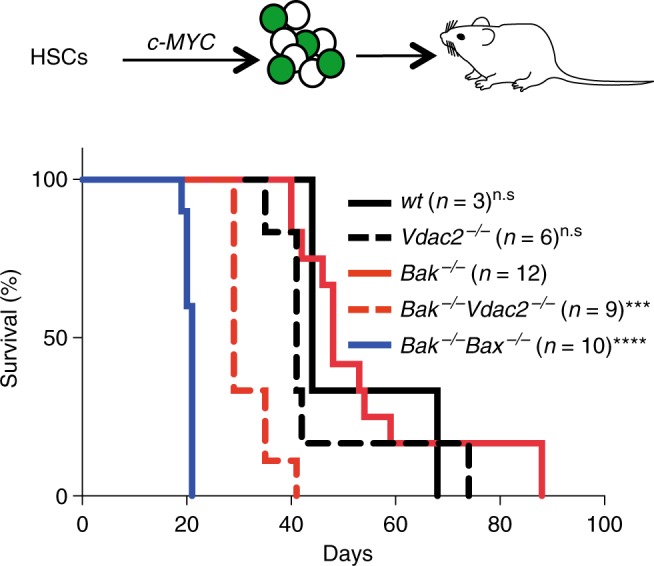
Intrinsic apoptosis is critical to prevent tumor formation and is engaged by many anti-cancer agents to eliminate tumor cells. BAX and BAK, the two essential mediators of apoptosis, are thought to be regulated through similar mechanisms and act redundantly to drive apoptotic cell death. From an unbiased genome-wide CRISPR/Cas9 screen, we identified VDAC2 (voltage-dependent anion channel 2) as important for BAX, but not BAK, to function. Genetic deletion of VDAC2 abrogated the association of BAX and BAK with mitochondrial complexes containing VDAC1, VDAC2, and VDAC3, but only inhibited BAX apoptotic function. Deleting VDAC2 phenocopied the loss of BAX in impairing both the killing of tumor cells by anti-cancer agents and the ability to suppress tumor formation. Together, our studies show that efficient BAX-mediated apoptosis depends on VDAC2, and reveal a striking difference in how BAX and BAK are functionally impacted by their interactions with VDAC2.
Overview
The claims and statistics of this paper haven’t been checked yet.
Free: it reads the open-access text and checks the first 5 claims that cite a source we can check. Create a free account to check every claim.
Integrity signals
Registry
Cites
Statistics
Figures
Verification
Claims the paper makes
The claims and statistics of this paper haven’t been checked yet.
Free: it reads the open-access text and checks the first 5 claims that cite a source we can check. Create a free account to check every claim.
Claims other papers make about this one
Each is checked against this paper’s own text: does it say what the citing paper says it does?
The source backs part of the claim, not all of it — or backs it for a different population, condition or comparison.
In the citing paper
“Pilot experiments were performed to determine the virus input required to achieve MOI = 0.3–0.5, corresponding to around 70% and 50% cell death upon puromycin selection, respectively, as previously described [14].”
From Rapid and Robust Generation of Homozygous Fluorescent Reporter Knock-In Cell Pools by CRISPR-Cas9 (2025) · cites this paper as [14]
Experimental — accuracy not yet measured
Self-check
Percentages, sums and reported differences re-computed from the paper’s own numbers.
The self-check needs the paper’s full text.
Citations
Cites
Cox, J., & Mann, M. (2008) · Nature Biotechnology · doi:10.1038/nbt.1511 · Cited by 14,855
Genome engineering using the CRISPR-Cas9 system
Ran, F. A., Hsu, P. D., Wright, J., Agarwala, V., Scott, D. A., & Zhang, F. (2013) · Nature Protocols · doi:10.1038/nprot.2013.143 · Cited by 11,133
Universal sample preparation method for proteome analysis
Wiśniewski, J. R., Zougman, A., Nagaraj, N., & Mann, M. (2009) · Nature Methods · doi:10.1038/nmeth.1322 · Cited by 8,352
Andromeda: A Peptide Search Engine Integrated into the MaxQuant Environment
Cox, J., Neuhauser, N., Michalski, A., Scheltema, R. A., Olsen, J. V., & Mann, M. (2011) · Journal of Proteome Research · doi:10.1021/pr101065j · Cited by 5,500
Proapoptotic BAX and BAK: A Requisite Gateway to Mitochondrial Dysfunction and Death
Wei, M. C., Zong, W.-X., Cheng, E. H.-Y., Lindsten, T., Panoutsakopoulou, V., Ross, A. J., Roth, K. A., MacGregor, G. R., Thompson, C. B., & Korsmeyer, S. J. (2001) · Science · doi:10.1126/science.1059108 · Cited by 3,988
2016 update of the PRIDE database and its related tools
Vizcaíno, J. A., Csordas, A., del-Toro, N., Dianes, J. A., Griss, J., Lavidas, I., Mayer, G., Perez-Riverol, Y., Reisinger, F., Ternent, T., et al. (2016) · Nucleic Acids Research · doi:10.1093/nar/gkv1145 · Cited by 3,451
An inhibitor of Bcl-2 family proteins induces regression of solid tumours
Oltersdorf, T., Elmore, S. W., Shoemaker, A. R., Armstrong, R. C., Augeri, D. J., Belli, B. A., Bruncko, M., Deckwerth, T. L., Dinges, J., Hajduk, P. J., et al. (2005) · Nature · doi:10.1038/nature03579 · Cited by 3,416
Control of apoptosis by the BCL-2 protein family: implications for physiology and therapy
Czabotar, P. E., Lessene, G., Strasser, A., & Adams, J. M. (2014) · Nature Reviews Molecular Cell Biology · doi:10.1038/nrm3722 · Cited by 3,219
ABT-199, a potent and selective BCL-2 inhibitor, achieves antitumor activity while sparing platelets
Souers, A. J., Leverson, J. D., Boghaert, E. R., Ackler, S. L., Catron, N. D., Chen, J., Dayton, B. D., Ding, H., Enschede, S. H., Fairbrother, W. J., et al. (2013) · Nature Medicine · doi:10.1038/nm.3048 · Cited by 3,058
Self-citationShimizu, S., Narita, M., Tsujimoto, Y., & Tsujimoto, Y. (1999) · Nature · doi:10.1038/20959 · Cited by 2,178
ABT-263: A Potent and Orally Bioavailable Bcl-2 Family Inhibitor
Tse, C., Shoemaker, A. R., Adickes, J., Anderson, M. G., Chen, J., Jin, S., Johnson, E. F., Marsh, K. C., Mitten, M. J., Nimmer, P., et al. (2008) · Cancer Research · doi:10.1158/0008-5472.can-07-5836 · Cited by 1,992
Targeting BCL2 with Venetoclax in Relapsed Chronic Lymphocytic Leukemia
Roberts, A. W., Davids, M. S., Pagel, J. M., Kahl, B. S., Puvvada, S. D., Gerecitano, J. F., Kipps, T. J., Anderson, M. A., Brown, J. R., Gressick, L., et al. (2016) · New England Journal of Medicine · doi:10.1056/nejmoa1513257 · Cited by 1,900
Yang, H., Wang, H., Shivalila, C. S., Cheng, A. W., Shi, L., & Jaenisch, R. (2013) · Cell · doi:10.1016/j.cell.2013.08.022 · Cited by 1,596
Bax-Deficient Mice with Lymphoid Hyperplasia and Male Germ Cell Death
Knudson, C. M., Tung, K. S. K., Tourtellotte, W. G., Brown, G. A. J., & Korsmeyer, S. J. (1995) · Science · doi:10.1126/science.270.5233.96 · Cited by 1,493
Lindsten, T., Ross, A. J., King, A., Zong, W.-X., Rathmell, J. C., Shiels, H. A., Ulrich, E., Waymire, K. G., Mahar, P., Frauwirth, K., et al. (2000) · Molecular Cell · doi:10.1016/s1097-2765(00)00136-2 · Cited by 1,489
van Delft, M. F., Wei, A. H., Mason, K. D., Vandenberg, C. J., Chen, L., Czabotar, P. E., Willis, S. N., Scott, C. L., Day, C. L., Cory, S., et al. (2006) · Cancer Cell · doi:10.1016/j.ccr.2006.08.027 · Cited by 1,240
Self-citationWillis, S. N., Chen, L., Dewson, G., Wei, A., Naik, E., Fletcher, J. I., Adams, J. M., & Huang, D. C. S. (2005) · Genes & Development · doi:10.1101/gad.1304105 · Cited by 1,233
Self-citationApoptosis Initiated When BH3 Ligands Engage Multiple Bcl-2 Homologs, Not Bax or Bak
Willis, S. N., Fletcher, J. I., Kaufmann, T., van Delft, M. F., Chen, L., Czabotar, P. E., Ierino, H., Lee, E. F., Fairlie, W. D., Bouillet, P., et al. (2007) · Science · doi:10.1126/science.1133289 · Cited by 1,125
Self-citationKoike-Yusa, H., Li, Y., Tan, E.-P., Velasco-Herrera, M. D. C., & Yusa, K. (2014) · Nature Biotechnology · doi:10.1038/nbt.2800 · Cited by 1,064
The MCL1 inhibitor S63845 is tolerable and effective in diverse cancer models
Kotschy, A., Szlavik, Z., Murray, J., Davidson, J., Maragno, A. L., Le Toumelin-Braizat, G., Chanrion, M., Kelly, G. L., Gong, J.-N., Moujalled, D. M., et al. (2016) · Nature · doi:10.1038/nature19830 · Cited by 1,047
Self-citationProgrammed Anuclear Cell Death Delimits Platelet Life Span
Mason, K. D., Carpinelli, M. R., Fletcher, J. I., Collinge, J. E., Hilton, A. A., Ellis, S., Kelly, P. N., Ekert, P. G., Metcalf, D., Roberts, A. W., et al. (2007) · Cell · doi:10.1016/j.cell.2007.01.037 · Cited by 1,031
Self-citationVoltage-dependent anion channels are dispensable for mitochondrial-dependent cell death
Baines, C. P., Kaiser, R. A., Sheiko, T., Craigen, W. J., & Molkentin, J. D. (2007) · Nature Cell Biology · doi:10.1038/ncb1575 · Cited by 971
From basic apoptosis discoveries to advanced selective BCL-2 family inhibitors
Ashkenazi, A., Fairbrother, W. J., Leverson, J. D., & Souers, A. J. (2017) · Nature Reviews Drug Discovery · doi:10.1038/nrd.2016.253 · Cited by 903
VDAC2 Inhibits BAK Activation and Mitochondrial Apoptosis
Cheng, E. H.-Y., Sheiko, T. V., Fisher, J. K., Craigen, W. J., & Korsmeyer, S. J. (2003) · Science · doi:10.1126/science.1083995 · Cited by 852
2016 update of the PRIDE database and its related tools
Vizcaíno, J. A., Csordas, A., del-Toro, N., Dianes, J. A., Griss, J., Lavidas, I., Mayer, G., Perez-Riverol, Y., Reisinger, F., Ternent, T., et al. (2016) · Nucleic Acids Research · doi:10.1093/nar/gkw880 · Cited by 807
Bcl‐2 and Fas/APO‐1 regulate distinct pathways to lymphocyte apoptosis.
Strasser, A., Harris, A. W., Huang, D. C., Krammer, P. H., & Cory, S. (1995) · The EMBO Journal · doi:10.1002/j.1460-2075.1995.tb00304.x · Cited by 784
Self-citationDiscovering motifs in ranked lists of DNA sequences
Eden, E., Lipson, D., Yogev, S., & Yakhini, Z. (2007) · PLoS Computational Biology · doi:10.1371/journal.pcbi.0030039 · Cited by 696
Bcl-xL Retrotranslocates Bax from the Mitochondria into the Cytosol
Edlich, F., Banerjee, S., Suzuki, M., Cleland, M. M., Arnoult, D., Wang, C., Neutzner, A., Tjandra, N., & Youle, R. J. (2011) · Cell · doi:10.1016/j.cell.2011.02.034 · Cited by 630
Hildebrand, J. M., Tanzer, M. C., Lucet, I. S., Young, S. N., Spall, S. K., Sharma, P., Pierotti, C., Garnier, J.-M., Dobson, R. C. J., Webb, A. I., et al. (2014) · Proceedings of the National Academy of Sciences · doi:10.1073/pnas.1408987111 · Cited by 598
Self-citationLeverson, J. D., Phillips, D. C., Mitten, M. J., Boghaert, E. R., Diaz, D., Tahir, S. K., Belmont, L. D., Nimmer, P., Xiao, Y., Ma, X. M., et al. (2015) · Science Translational Medicine · doi:10.1126/scitranslmed.aaa4642 · Cited by 541
Self-citationAubrey, B. J., Kelly, G. L., Kueh, A. J., Brennan, M. S., O’Connor, L., Milla, L., Wilcox, S., Tai, L., Strasser, A., & Herold, M. J. (2015) · Cell Reports · doi:10.1016/j.celrep.2015.02.002 · Cited by 399
Self-citationCytotoxic edema: mechanisms of pathological cell swelling
Liang, D., Bhatta, S., Gerzanich, V., & Simard, J. M. (2007) · Neurosurgical Focus · doi:10.3171/foc.2007.22.5.3 · Cited by 398
To Trigger Apoptosis, Bak Exposes Its BH3 Domain and Homodimerizes via BH3:Groove Interactions
Dewson, G., Kratina, T., Sim, H. W., Puthalakath, H., Adams, J. M., Colman, P. M., & Kluck, R. M. (2008) · Molecular Cell · doi:10.1016/j.molcel.2008.04.005 · Cited by 348
Self-citationKluck, R. M., Esposti, M. D., Perkins, G., Renken, C., Kuwana, T., Bossy-Wetzel, E., Goldberg, M., Allen, T., Barber, M. J., Green, D. R., et al. (1999) · The Journal of Cell Biology · doi:10.1083/jcb.147.4.809 · Cited by 319
Self-citationAnderson, M. A., Deng, J., Seymour, J. F., Tam, C., Kim, S. Y., Fein, J., Yu, L., Brown, J. R., Westerman, D., Si, E. G., et al. (2016) · Blood · doi:10.1182/blood-2016-01-688796 · Cited by 316
Self-citationDeficiency in Bak and Bax perturbs thymic selection and lymphoid homeostasis
Rathmell, J. C., Lindsten, T., Zong, W.-X., Cinalli, R. M., & Thompson, C. B. (2002) · Nature Immunology · doi:10.1038/ni834 · Cited by 297
Keilhauer, E. C., Hein, M. Y., & Mann, M. (2015) · Molecular & Cellular Proteomics · doi:10.1074/mcp.m114.041012 · Cited by 256
Sarosiek, K. A., Chi, X., Bachman, J. A., Sims, J. J., Montero, J., Patel, L., Flanagan, A., Andrews, D. W., Sorger, P., & Letai, A. (2013) · Molecular Cell · doi:10.1016/j.molcel.2013.08.048 · Cited by 247
Immotile Sperm and Infertility in Mice Lacking Mitochondrial Voltage-dependent Anion Channel Type 3
Sampson, M. J., Decker, W. K., Beaudet, A. L., Ruitenbeek, W., Armstrong, D., Hicks, M. J., & Craigen, W. J. (2001) · Journal of Biological Chemistry · doi:10.1074/jbc.m104724200 · Cited by 240
Schellenberg, B., Wang, P., Keeble, J. A., Rodriguez-Enriquez, R., Walker, S., Owens, T. W., Foster, F., Tanianis-Hughes, J., Brennan, K., Streuli, C. H., et al. (2013) · Molecular Cell · doi:10.1016/j.molcel.2012.12.022 · Cited by 237
Bak Activation for Apoptosis Involves Oligomerization of Dimers via Their α6 Helices
Dewson, G., Kratina, T., Czabotar, P., Day, C. L., Adams, J. M., & Kluck, R. M. (2009) · Molecular Cell · doi:10.1016/j.molcel.2009.11.008 · Cited by 220
Self-citationPotential mechanisms of resistance to venetoclax and strategies to circumvent it
Tahir, S. K., Smith, M. L., Hessler, P., Rapp, L. R., Idler, K. B., Park, C. H., Leverson, J. D., & Lam, L. T. (2017) · BMC Cancer · doi:10.1186/s12885-017-3383-5 · Cited by 195
Josefsson, E. C., James, C., Henley, K. J., Debrincat, M. A., Rogers, K. L., Dowling, M. R., White, M. J., Kruse, E. A., Lane, R. M., Ellis, S., et al. (2011) · Journal of Experimental Medicine · doi:10.1084/jem.20110750 · Cited by 187
Self-citationOkada, S. F., O'Neal, W. K., Huang, P., Nicholas, R. A., Ostrowski, L. E., Craigen, W. J., Lazarowski, E. R., & Boucher, R. C. (2004) · The Journal of General Physiology · doi:10.1085/jgp.200409154 · Cited by 179
Differential retrotranslocation of mitochondrial Bax and Bak
Todt, F., Cakir, Z., Reichenbach, F., Emschermann, F., Lauterwasser, J., Kaiser, A., Ichim, G., Tait, S. W., Frank, S., Langer, H. F., et al. (2015) · The EMBO Journal · doi:10.15252/embj.201488806 · Cited by 172
Schredelseker, J., Paz, A., López, C. J., Altenbach, C., Leung, C. S., Drexler, M. K., Chen, J.-N., Hubbell, W. L., & Abramson, J. (2014) · Journal of Biological Chemistry · doi:10.1074/jbc.m113.497438 · Cited by 152
Gallenne, T., Gautier, F., Oliver, L., Hervouet, E., Noël, B., Hickman, J. A., Geneste, O., Cartron, P.-F., Vallette, F. M., Manon, S., et al. (2009) · Journal of Cell Biology · doi:10.1083/jcb.200809153 · Cited by 148
Huang, H., Hu, X., Eno, C. O., Zhao, G., Li, C., & White, C. (2013) · Journal of Biological Chemistry · doi:10.1074/jbc.m112.448290 · Cited by 147
Roy, S. S., Ehrlich, A. M., Craigen, W. J., & Hajnóczky, G. (2009) · EMBO reports · doi:10.1038/embor.2009.219 · Cited by 146
Ma, S. B., Nguyen, T. N., Tan, I., Ninnis, R., Iyer, S., Stroud, D. A., Menard, M., Kluck, R. M., Ryan, M. T., & Dewson, G. (2014) · Cell Death & Differentiation · doi:10.1038/cdd.2014.119 · Cited by 138
Self-citationAnflous, K., Armstrong, D. D., & Craigen, W. J. (2001) · Journal of Biological Chemistry · doi:10.1074/jbc.m006587200 · Cited by 132
Uren, R. T., Dewson, G., Chen, L., Coyne, S. C., Huang, D. C. S., Adams, J. M., & Kluck, R. M. (2007) · The Journal of Cell Biology · doi:10.1083/jcb.200606065 · Cited by 123
Self-citationWang, C., & Youle, R. J. (2012) · Oncogene · doi:10.1038/onc.2011.497 · Cited by 113
Inhibition of Bak Activation by VDAC2 Is Dependent on the Bak Transmembrane Anchor
Lazarou, M., Stojanovski, D., Frazier, A. E., Kotevski, A., Dewson, G., Craigen, W. J., Kluck, R. M., Vaux, D. L., & Ryan, M. T. (2010) · Journal of Biological Chemistry · doi:10.1074/jbc.m110.159301 · Cited by 111
Self-citationThe porin VDAC2 is the mitochondrial platform for Bax retrotranslocation
Lauterwasser, J., Todt, F., Zerbes, R. M., Nguyen, T. N., Craigen, W. J., Lazarou, M., van der Laan, M., & Edlich, F. (2016) · Scientific Reports · doi:10.1038/srep32994 · Cited by 101
Motifs of VDAC2 required for mitochondrial Bak import and tBid-induced apoptosis
Naghdi, S., Várnai, P., & Hajnóczky, G. (2015) · Proceedings of the National Academy of Sciences · doi:10.1073/pnas.1510574112 · Cited by 96
Hockings, C., Anwari, K., Ninnis, R. L., Brouwer, J., O'Hely, M., Evangelista, M., Hinds, M. G., Czabotar, P. E., Lee, E. F., Fairlie, W. D., et al. (2015) · Cell Death & Disease · doi:10.1038/cddis.2015.105 · Cited by 94
Self-citationActivation Kinetics and Off-Target Effects of Thymus-Initiated Cre Transgenes
Shi, J., & Petrie, H. T. (2012) · PLoS ONE · doi:10.1371/journal.pone.0046590 · Cited by 93
Neurons Exclusively Express N-Bak, a BH3 Domain-only Bak Isoform That Promotes Neuronal Apoptosis
Uo, T., Kinoshita, Y., & Morrison, R. S. (2004) · Journal of Biological Chemistry · doi:10.1074/jbc.m413030200 · Cited by 74
Patel, A. J., Lauritzen, I., Lazdunski, M., & Honoré, E. (1998) · The Journal of Neuroscience · doi:10.1523/jneurosci.18-09-03117.1998 · Cited by 73
Assembly of the Bak Apoptotic Pore
Ma, S., Hockings, C., Anwari, K., Kratina, T., Fennell, S., Lazarou, M., Ryan, M. T., Kluck, R. M., & Dewson, G. (2013) · Journal of Biological Chemistry · doi:10.1074/jbc.m113.490094 · Cited by 71
Self-citationRequirement of voltage-dependent anion channel 2 for pro-apoptotic activity of Bax
Yamagata, H., Shimizu, S., Nishida, Y., Watanabe, Y., Craigen, W. J., & Tsujimoto, Y. (2009) · Oncogene · doi:10.1038/onc.2009.213 · Cited by 63
The VDAC2-BAK Rheostat Controls Thymocyte Survival
Ren, D., Kim, H., Tu, H.-C., Westergard, T. D., Fisher, J. K., Rubens, J. A., Korsmeyer, S. J., Hsieh, J. J.-D., & Cheng, E. H.-Y. (2009) · Science Signaling · doi:10.1126/scisignal.2000274 · Cited by 60
Identification of an activation site in Bak and mitochondrial Bax triggered by antibodies
Iyer, S., Anwari, K., Alsop, A. E., Yuen, W. S., Huang, D. C. S., Carroll, J., Smith, N. A., Smith, B. J., Dewson, G., & Kluck, R. M. (2016) · Nature Communications · doi:10.1038/ncomms11734 · Cited by 58
Self-citationOkamoto, T., Coultas, L., Metcalf, D., van Delft, M. F., Glaser, S. P., Takiguchi, M., Strasser, A., Bouillet, P., Adams, J. M., & Huang, D. C. S. (2013) · Proceedings of the National Academy of Sciences · doi:10.1073/pnas.1321259110 · Cited by 53
Self-citationKueh, A. J., Pál, M., Tai, L., Liao, Y., Smyth, G. K., Shi, W., & Herold, M. J. (2017) · Cell Death and Differentiation · doi:10.1038/cdd.2017.122 · Cited by 43
Self-citation
Cited by
Mitochondria as multifaceted regulators of cell death
Bock, F. J., & Tait, S. W. G. (2020) · Nature Reviews Molecular Cell Biology · doi:10.1038/s41580-019-0173-8 · Cited by 2,450
TDP-43 Triggers Mitochondrial DNA Release via mPTP to Activate cGAS/STING in ALS
Yu, C.-H., Davidson, S., Harapas, C. R., Hilton, J. B., Mlodzianoski, M. J., Laohamonthonkul, P., Louis, C., Low, R. R. J., Moecking, J., De Nardo, D., et al. (2020) · Cell · doi:10.1016/j.cell.2020.09.020 · Cited by 1,019
Self-citationMechanisms of BCL-2 family proteins in mitochondrial apoptosis
Czabotar, P. E., & Garcia-Saez, A. J. (2023) · Nature Reviews Molecular Cell Biology · doi:10.1038/s41580-023-00629-4 · Cited by 680
Glover, H. L., Schreiner, A., Dewson, G., & Tait, S. W. G. (2024) · Nature Cell Biology · doi:10.1038/s41556-024-01429-4 · Cited by 461
Self-citationCosentino, K., Hertlein, V., Jenner, A., Dellmann, T., Gojkovic, M., Peña-Blanco, A., Dadsena, S., Wajngarten, N., Danial, J. S. H., Thevathasan, J. V., et al. (2022) · Molecular Cell · doi:10.1016/j.molcel.2022.01.008 · Cited by 247
Metadata
- Authors
- Chin, H. S., Li, M. X., Tan, I. K. L., Ninnis, R. L., Reljic, B., Scicluna, K., Dagley, L. F., Sandow, J. J., Kelly, G. L., Samson, A. L., Chappaz, S., Khaw, S. L., Chang, C., Morokoff, A., Brinkmann, K., Webb, A., Hockings, C., Hall, C. M., Kueh, A. J., Ryan, M. T., Kluck, R. M., Bouillet, P., Herold, M. J., Gray, D. H. D., Huang, D. C. S., van Delft, M. F., & Dewson, G.
- Affiliations
- The University of Melbourne (AU)
- Walter and Eliza Hall Institute of Medical Research (AU)
- The Royal Melbourne Hospital (AU)
- Monash University (AU)
- Corresponding author
- Dewson, Grant
- ORCID
- Chin, Hui San
- Dagley, Laura F.
- Sandow, Jarrod J.
- Kelly, Gemma L.
- Samson, Andre L.
- Chappaz, Stephane
- Khaw, Seong L.
- Chang, Catherine
- Morokoff, Andrew
- Brinkmann, Kerstin
- Webb, Andrew
- Hockings, Colin
- Hall, Cathrine M.
- Kueh, Andrew J.
- Ryan, Michael T.
- Kluck, Ruth M.
- Bouillet, Philippe
- Herold, Marco J.
- Gray, Daniel H. D.
- Huang, David C. S.
- van Delft, Mark F.
- Dewson, Grant
- Venue
- Nature Communications
- Published
- 2018-11-26
- Volume
- 9
- Issue
- 1
- Pages
- 4976-4976
- ISSN
- 2041-1723 (ISSN-L)
- PMC
- PMC6255874
- OpenAlex
- W2901323432
- Cited by
- 196
- References
- 65
- Citations by year
- 2026: 24 · 2025: 25 · 2024: 34 · 2023: 24 · 2022: 22 · 2021: 27 · 2020: 23 · 2019: 14 · 2018: 3
- FWCI
- 5.95
- Type
- journal article
- Language
- en
- Open access
- gold
- doi.org
- Licence
- cc-by
- creativecommons.org/licenses/by/4.0 (tdm)
- creativecommons.org/licenses/by/4.0 (vor)
- Locations
- Nature Communications (publishedVersion, cc-by)
- Europe PMC (PubMed Central) (publishedVersion, other-oa)
- PubMed Central (publishedVersion, cc-by)
- PubMed (publishedVersion)
- Monash University Research Portal (Monash University) (submittedVersion, other-oa)
- Minerva Access (University of Melbourne) (submittedVersion, cc-by)
- RePEc: Research Papers in Economics (submittedVersion)
- DOAJ (DOAJ: Directory of Open Access Journals) (submittedVersion)
- DOAJ (DOAJ: Directory of Open Access Journals) (submittedVersion, cc-by-sa)
- Funders
- Australian Government
- Australian Cancer Research Foundation
- University of Melbourne
- Stanford Institute for Research in the Social Sciences
- Medical Research Council (1016701)
- Australian Research Council (FT100100791)
- National Health and Medical Research Council (1057742, 1016701, 1124737, 1078924, 1059290, 1113133, 9000220, 1078763, 1083077, 1090236, 1043149)
- Cancer Council Victoria
- Topics
- Life Sciences › Biochemistry, Genetics and Molecular Biology › Molecular Biology › Cell death mechanisms and regulation
- Life Sciences › Biochemistry, Genetics and Molecular Biology › Molecular Biology › Mitochondrial Function and Pathology
- Health Sciences › Medicine › Oncology › Cancer-related Molecular Pathways
- Keywords
- VDAC2, Bax, Bak, mitochondrial apoptosis, mitochondrial permeability transition pore, VDAC1, VDAC3, tumor suppression, CRISPR-Cas9 screen
- MeSH terms
- Animals, HeLa Cells, Humans, Mice, Inbred C57BL, Mitochondria, Promoter Regions, Genetic, Apoptosis, HCT116 Cells, Embryonic Development, Voltage-Dependent Anion Channel 2, bcl-2 Homologous Antagonist-Killer Protein, bcl-2-Associated X Protein, Carcinogenesis, CRISPR-Cas Systems
About these checks
Registry, retraction, Cites and statistics results are computed, not judged, with one exception: a printed reference that no index lists is read once by a model before it counts as a citation error. Claims are extracted by a model and kept only when their quote appears verbatim in the text; each cited source is then checked, with a model’s help, for whether it says what the claim relies on. Those verdicts can be wrong — read the claim’s quote and the cited source before relying on one.
Statistics and arithmetic are recomputed, not judged.
Confidence bands are shown only for fields calibrated on our annotated test set. None is calibrated yet, so no band is shown.
What counts as a claim ›How we measure confidence ›How we check this ›
Are you an author, or do you see a problem with this page? Request a review
Data sources
Bibliographic data: Semantic Scholar, OpenAlex, Crossref.
Contains information from the Semantic Scholar Academic Graph Datasets, made available under the ODC Attribution License (ODC-BY 1.0).
Semantic Scholar’s data is described in: Kinney, R., et al. (2023). The Semantic Scholar Open Data Platform. arXiv:2301.10140.
