

Transcriptomic landscape of the blastema niche in regenerating adult axolotl limbs at single-cell resolution
Open accessThe DOI matches its Crossref record; 72 of the 72 references it cites were found in a registry or an index.
Abstract
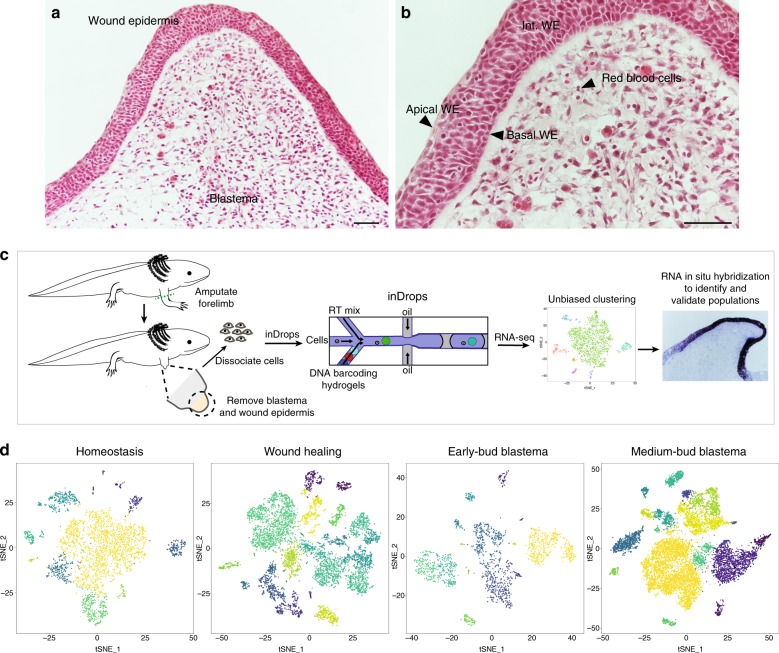
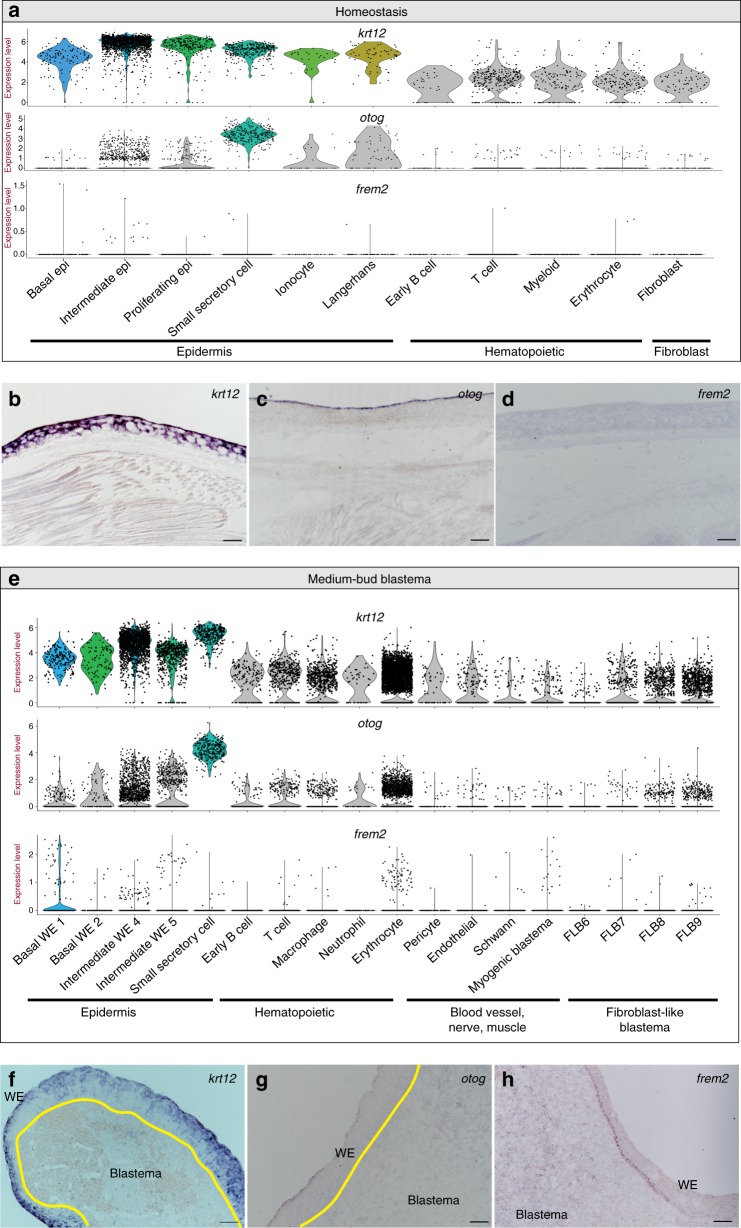
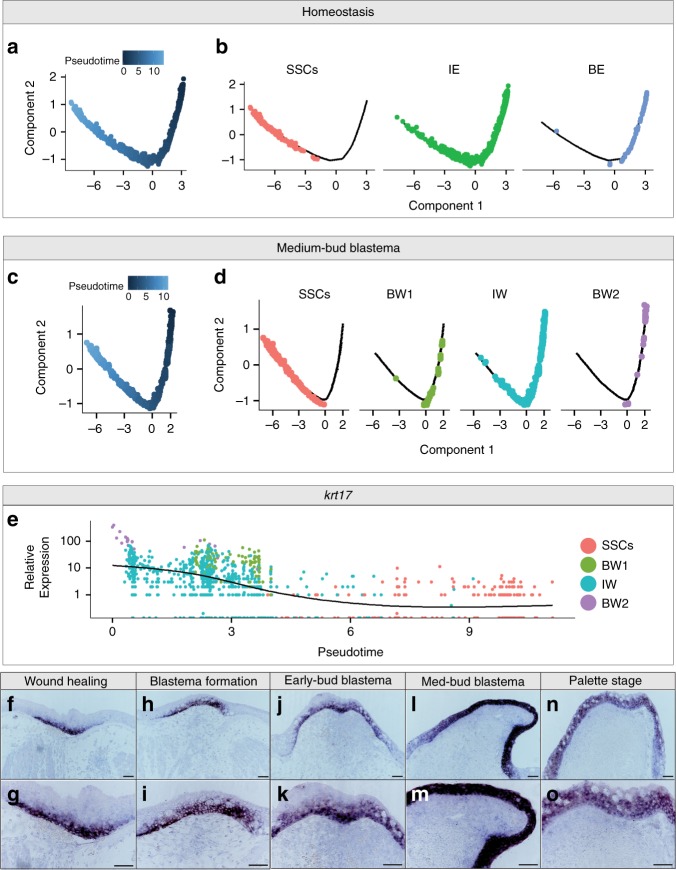
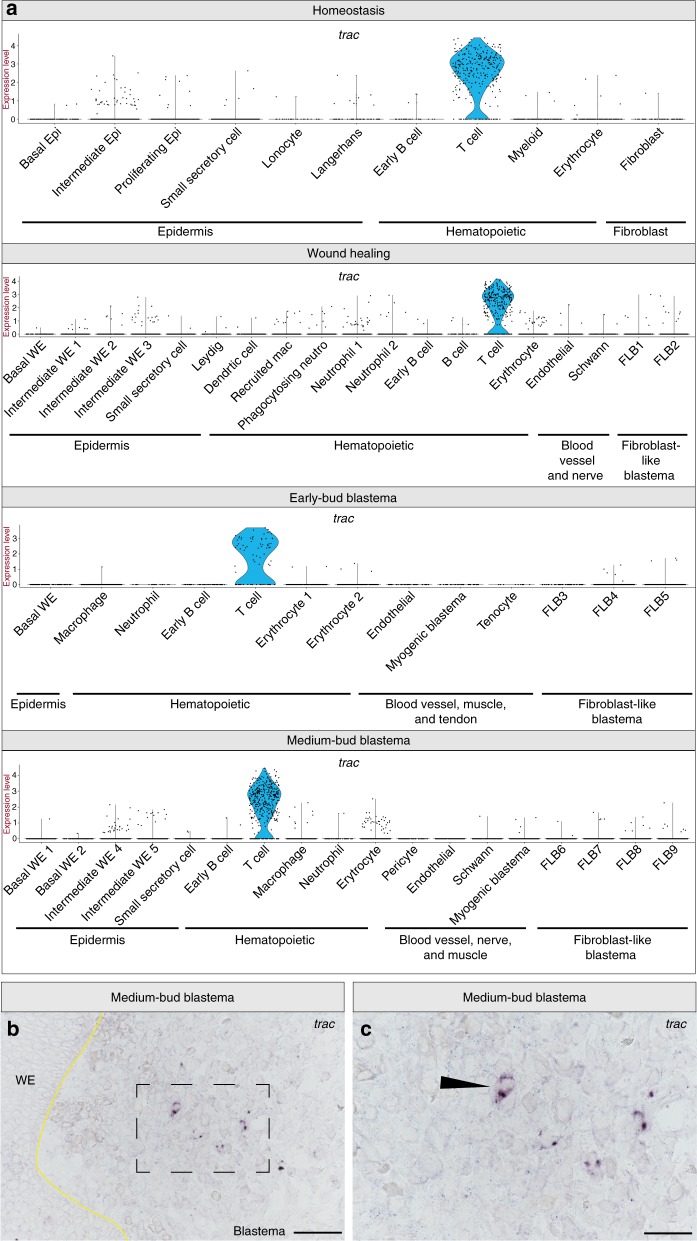
Regeneration of complex multi-tissue structures, such as limbs, requires the coordinated effort of multiple cell types. In axolotl limb regeneration, the wound epidermis and blastema have been extensively studied via histology, grafting, and bulk-tissue RNA-sequencing. However, defining the contributions of these tissues is hindered due to limited information regarding the molecular identity of the cell types in regenerating limbs. Here we report unbiased single-cell RNA-sequencing on over 25,000 cells from axolotl limbs and identify a plethora of cellular diversity within epidermal, mesenchymal, and hematopoietic lineages in homeostatic and regenerating limbs. We identify regeneration-induced genes, develop putative trajectories for blastema cell differentiation, and propose the molecular identity of fibroblast-like blastema progenitor cells. This work will enable application of molecular techniques to assess the contribution of these populations to limb regeneration. Overall, these data allow for establishment of a putative framework for adult axolotl limb regeneration.
Overview
The claims and statistics of this paper haven’t been checked yet.
Free: it reads the open-access text and checks the first 5 claims that cite a source we can check. Create a free account to check every claim.
Integrity signals
Registry
Cites
Statistics
Figures
Verification
Claims the paper makes
The claims and statistics of this paper haven’t been checked yet.
Free: it reads the open-access text and checks the first 5 claims that cite a source we can check. Create a free account to check every claim.
Claims other papers make about this one
Each is checked against this paper’s own text: does it say what the citing paper says it does?
The cited source says what the claim attributes to it.
In the citing paper
“The axolotl is an example of the type of organism for which scRNA-seq has enabled cell level study of regeneration and immunology for the first time (Gerber et al, 2018; Leigh et al, 2018; Rodgers et al, 2020; Lin et al, 2021; Lust et al, 2022; Ye et al, 2022).”
From Evaluation of genetic demultiplexing of single-cell sequencing data from model species (2023) · cites this paper as Leigh et al, 2018
Self-check
Percentages, sums and reported differences re-computed from the paper’s own numbers.
The self-check needs the paper’s full text.
Citations
Cites
Integrating single-cell transcriptomic data across different conditions, technologies, and species
Butler, A., Hoffman, P., Smibert, P., Papalexi, E., & Satija, R. (2018) · Nature Biotechnology · doi:10.1038/nbt.4096 · Cited by 13,174
Trapnell, C., Cacchiarelli, D., Grimsby, J., Pokharel, P., Li, S., Morse, M., Lennon, N. J., Livak, K. J., Mikkelsen, T. S., & Rinn, J. L. (2014) · Nature Biotechnology · doi:10.1038/nbt.2859 · Cited by 7,314
Highly parallel genome-wide expression profiling of individual cells using nanoliter droplets.
Macosko, E. Z., Basu, A., Satija, R., Nemesh, J., Shekhar, K., Goldman, M., Tirosh, I., Bialas, A. R., Kamitaki, N., Martersteck, E. M., et al. (2015) · Cell · doi:10.1016/j.cell.2015.05.002 · Cited by 7,110
Droplet barcoding for single-cell transcriptomics applied to embryonic stem cells
Klein, A. M., Mazutis, L., Akartuna, I., Tallapragada, N., Veres, A., Li, V., Peshkin, L., Weitz, D. A., & Kirschner, M. W. (2015) · Cell · doi:10.1016/j.cell.2015.04.044 · Cited by 3,356
Development of Monocytes, Macrophages, and Dendritic Cells
Geissmann, F., Manz, M. G., Jung, S., Sieweke, M. H., Merad, M., & Ley, K. (2010) · Science · doi:10.1126/science.1178331 · Cited by 3,049
Single-cell RNA-seq reveals new types of human blood dendritic cells, monocytes, and progenitors
Villani, A.-C., Satija, R., Reynolds, G., Sarkizova, S., Shekhar, K., Fletcher, J., Griesbeck, M., Butler, A., Zheng, S., Lazo, S., et al. (2017) · Science · doi:10.1126/science.aah4573 · Cited by 2,413
Mapping the Mouse Cell Atlas by Microwell-Seq
Han, X., Wang, R., Zhou, Y., Fei, L., Sun, H., Lai, S., Saadatpour, A., Zhou, Z., Chen, H., Ye, F., et al. (2018) · Cell · doi:10.1016/j.cell.2018.02.001 · Cited by 1,597
Bi, Y., Ehirchiou, D., Kilts, T. M., Inkson, C. A., Embree, M. C., Sonoyama, W., Li, L., Leet, A. I., Seo, B.-M., Zhang, L., et al. (2007) · Nature Medicine · doi:10.1038/nm1630 · Cited by 1,486
Yang, D., Chen, Q., Schmidt, A. P., Anderson, G. M., Wang, J. M., Wooters, J., Oppenheim, J. J., & Chertov, O. (2000) · The Journal of Experimental Medicine · doi:10.1084/jem.192.7.1069 · Cited by 1,240
A Special Population of Regulatory T Cells Potentiates Muscle Repair
Burzyn, D., Kuswanto, W., Kolodin, D., Shadrach, J. L., Cerletti, M., Jang, Y., Sefik, E., Tan, T. G., Wagers, A. J., Benoist, C., et al. (2013) · Cell · doi:10.1016/j.cell.2013.10.054 · Cited by 1,234
Cited by
Items 101–188 of 188
Safian, D., Wiegertjes, G. F., & Pollux, B. J. A. (2021) · Frontiers in Ecology and Evolution · doi:10.3389/fevo.2021.613157 · Cited by 7
Stem Cells, Cell Therapies, and Bioengineering in Lung Biology and Disease 2019
Wagner, D. E., Ikonomou, L., Gilpin, S. E., Magin, C. M., Cruz, F. F., Greaney, A. M., Magnusson, M., Chen, Y., Davis, B. R., Vanuytsel, K., et al. (2020) · ERJ Open Research · doi:10.1183/23120541.00123-2020 · Cited by 7
“L EIGH and co-workers [23] (Harvard University, USA) leveraged this technology to study the dynamic cellular landscape during axolotl (Salamander) limb regeneration and homeostasis. scRNA-seq on various stages of this process were used to create computational predictions for the progression of limb…”
Rebuilding limbs, one cell at a time
Leigh, N. D., & Currie, J. D. (2022) · Developmental Dynamics · doi:10.1002/dvdy.463 · Cited by 7
“Recent work using transcriptomic approaches has now shed light on the gene expression profiles that define this unique structure and will help contextualize the more historic studies of this tissue.(6,90) This paints an already complicated picture of multiple tissue types that would not be considered blastema progenit…”
BackgroundSelf-citationde Lima, F. M. R., Abrahão, I., Pentagna, N., & Carneiro, K. (2022) · Developmental Dynamics · doi:10.1002/dvdy.543 · Cited by 7
“Moreover, macrophages build up in the first 72 hours post-tissue injury and are enriched with triggering receptor expressed on myeloid cells 2 (TREM2), a marker for tissue-resident and/or regenerative PACs (macrophages).(143) Amphibians may provide us with insights, in the context of regenerative tissue repair, on how…”
BackgroundThe Genetic Odyssey of Axolotl Regeneration: Insights and Innovations
Faisal, M., Mehreen, A., Hays, D., Yaseen, F., & Liang, Y. (2024) · The International Journal of Developmental Biology · doi:10.1387/ijdb.240111yl · Cited by 6
“Furthermore, rna sequencing at single-cell resolution (leigh et al ., 2018) and cellular reprogramming (atsuta et al ., 2024) will help us to understand cellular diversity, cellular dynamics, and A review on Regenerative Potential of Axolotl 105 cell lineage and mark the donor tissues. genomic…”
Aires, R., Keeley, S. D., & Sandoval‐Guzmán, T. (2020) · Springer eBooks · doi:10.1007/978-3-319-08831-0_66 · Cited by 6
The essential role of connective-tissue cells during axolotl limb regenerationPreprint
García-García, D., Knapp, D., Jamwal, K., Grindle, R. A., Fuqua, J. H., Seaman, R. P., Sujansky, M., Kim, M., Nowoshilow, S., Novatchkova, M., et al. (2025) · bioRxiv (Cold Spring Harbor Laboratory) · doi:10.1101/2025.03.30.645595 · Cited by 6
Wang, M., Kuan, C., Ma, H., & Cheng, N. (2025) · Materials Today Bio · doi:10.1016/j.mtbio.2025.102443 · Cited by 6
“Single-cell transcriptomics of axolotl limb regeneration revealed profound differences between homeostatic and regenerating states, with blastema fibroblast-like progenitors and wound epidermis expressing regeneration-specific genes that likely shape a pro-regenerative niche [45].”
Ependymoglial cells are critical for cortex regeneration in axolotls
Fu, S., Zeng, Y.-Y., Peng, C., Wang, L., Feng, Y., Wang, K., Liu, Y., & Fei, J. (2026) · Nature Communications · doi:10.1038/s41467-026-68538-6 · Cited by 5
Farhadi, A., Xue, L., Zhao, Q., & Tan, K. (2024) · International Journal of Biological Macromolecules · doi:10.1016/j.ijbiomac.2024.139354 · Cited by 6
DIscBIO: A User-Friendly Pipeline for Biomarker Discovery in Single-Cell Transcriptomics
Ghannoum, S., Netto, W. L., Fantini, D., Ragan-Kelley, B., Parizadeh, A., Jonasson, E., Ståhlberg, A., Farhan, H., & Köhn‐Luque, A. (2021) · International Journal of Molecular Sciences · doi:10.3390/ijms22031399 · Cited by 5
Reddien, P. W. (2019) · Science · doi:10.1126/science.aay3660 · Cited by 5
Sousa, J. F., Lima, G., Perez, L., Schof, H., & Schneider, I. (2026) · Nature Communications · doi:10.1038/s41467-026-68801-w · Cited by 4
“Prior studies identi fi ed Frem2 as a wound epidermis marker during axolotl limb regeneration 24,26 .”
InfluentialPancreatic injury induces β‐cell regeneration in axolotl
Powell, C. J., Singer, H. D., Juarez, A. R., Kim, R. T., Kim, E. M., Payzin‐Dogru, D., Savage, A. M., Lopez, N. J., Thornton, K. N., Blair, S. J., et al. (2025) · Developmental Dynamics · doi:10.1002/dvdy.70060 · Cited by 4
“22 24 – 26 Confirmation of these hypotheses could lead to a mechanistic understanding of the pancreatic response to injury and whether it shares characteristics with other regenerative organs in the axolotl.”
Self-citationBaddar, N. W. A. H., Timoshevskaya, N. Y., Smith, J. J., Guo, H., & Voss, S. R. (2021) · Frontiers in Ecology and Evolution · doi:10.3389/fevo.2021.786263 · Cited by 4
Inflammation and Limb Regeneration: The Role of the Chemokines
Xu, M., Su, J., Yue, Z., Yu, Y., Zhao, X., & Xie, X. (2022) · Russian Journal of Developmental Biology · doi:10.1134/s1062360422030055 · Cited by 4
“However, whether these T cells in the blastema play a role in axolotl limb regeneration remains to be determined (Leigh et al., 2018).”
BackgroundInfluentialTail and Spinal Cord Regeneration in Urodelean Amphibians
Grigoryan, E. N., & Markitantova, Y. V. (2024) · Life · doi:10.3390/life14050594 · Cited by 4
“With the progress of regeneration, these cells also differentiate to acquire a chondrotypic phenotype [73,131].”
BackgroundSingle cell biology—a Keystone Symposia report
Cable, J., Elowitz, M. B., Domingos, A. I., Habib, N., Itzkovitz, S., Hamidzada, H., Balzer, M. S., Yanai, I., Liberali, P., Whited, J. L., et al. (2021) · Annals of the New York Academy of Sciences · doi:10.1111/nyas.14692 · Cited by 4
Self-citationSavage, A. M., Wagner, A. C., Kim, R. T., Gilbert, P., Singer, H. D., Chen, E., Kim, E. M., Lopez, N., Dooling, K. E., Paoli, J. C., et al. (2024) · Developmental Biology · doi:10.1016/j.ydbio.2025.05.030 · Cited by 3
Self-citationMammalian Blastema: Possibility and Potentials
Nam, J., Min, B., Baek, A., Lee, S.-Y., Ha, J., Cho, M. J., & Kim, J. (2025) · International Journal of Stem Cells · doi:10.15283/ijsc24121 · Cited by 3
“In vertebrate organisms with high regenerative capacity, such as fishes and amphibians, blaste-mas contain a mixture of lineage-restricted progenitors (26-28).”
Ruiz‐Pérez, S., Alcaraz, N., Torres‐Arciga, K., Ocampo‐Cervantes, J. A., Cervera, A., Hernández, C. C., Sámano, C., Soto‐Reyes, E., & González‐Barrios, R. (2025) · Advanced Biology · doi:10.1002/adbi.202400502 · Cited by 3
Genomic characterization of the T-cell receptor loci in Ambystoma mexicanum
Pacheco-Olvera, D. L., Remy-Hernández, S. S., Godoy-Lozano, E. E., Téllez‐Sosa, J., Valdovinos-Torres, H., Curiel‐Quesada, E., López-Macías, C. I. R., & Martínez-Barnetche, J. (2025) · Frontiers in Immunology · doi:10.3389/fimmu.2025.1656386 · Cited by 3
Kim, R. T., & Whited, J. L. (2024) · Annals of the New York Academy of Sciences · doi:10.1111/nyas.15210 · Cited by 3
“91 Kragl et al. found via lineage tracing that epidermal cells of the limb stump contribute solely to the epidermis of the regener-atedlimb;however,atransitionalcontributionofselectepidermalcells to the blastema, with these cells ultimately rejoining the epidermis or perhaps being eliminated,…”
Self-citationDevelopment: How Tadpoles ROC Tail Regeneration
Dunlap, G. S., & Whited, J. L. (2019) · Current Biology · doi:10.1016/j.cub.2019.06.026 · Cited by 3
Self-citationAires, R., Keeley, S. D., & Sandoval‐Guzmán, T. (2020) · Reference series in biomedical engineering · doi:10.1007/978-3-319-37076-7_66-1 · Cited by 3
The hipotises of the immune system's role in carcinogenesis
Slepov, Y. K., Laushkin, M. A., & Deev, R. V. (2021) · Genes and Cells · doi:10.23868/202104013 · Cited by 3
Qin, T., Han, J., Fan, C., Sun, H., Rauf, N., Wang, T., Yin, Z., & Chen, X. (2024) · Computational and Structural Biotechnology Journal · doi:10.1016/j.csbj.2024.08.014 · Cited by 3
“…sequencing (scRNA-Seq) as well as single-nuclei RNA sequencing (snRNA-Seq) technologies further explore and resolve the cellular heterogeneity and provide comprehensive information about cell subtype-specific gene expression within multiple lineages in homeostatic and regenerating limbs [3 – 6].”
BackgroundAdult Drosophila legs do not regenerate after amputationPreprint
Sustar, A., & Tuthill, J. C. (2022) · bioRxiv (Cold Spring Harbor Laboratory) · doi:10.1101/2022.10.25.513553 · Cited by 3
“In some animals that do regenerate amputated limbs, such as newts and axolotls, blastema cells in an amputated leg de-differentiate, undergoing morphological and transcriptional changes to become more like younger cells (Leigh et al., 2018; Tanaka et al., 2016).”
BackgroundSustar, A., & Tuthill, J. C. (2023) · eLife · doi:10.7554/elife.84435 · Cited by 3
Adaptive immunity is dispensable for appendage regeneration in highly regenerative vertebratesPreprint
Castro, L. A. B., Valappil, Y. O., Petzold, A., Knopf, F., & Yun, M. H. (2026) · bioRxiv (Cold Spring Harbor Laboratory) · doi:10.64898/2026.04.13.718128 · Cited by 3
“While T and B lymphocytes have been identified within regenerating axolotl limbs (Leigh et al, 2018; Rodgers et al, 2020), a detailed, quantitative assessment of adaptive cell recruitment dynamics during appendage regeneration is lacking.”
Hawkins, M. R., Cervera, D., Tang, T. M., & Wingert, R. A. (2025) · Frontiers in Cell and Developmental Biology · doi:10.3389/fcell.2025.1653967 · Cited by 2
Yin, B., Cui, X., Liu, Y., & Fei, J. (2024) · Medicine Advances · doi:10.1002/med4.49 · Cited by 2
Limb regeneration in salamanders: the plethodontid tale
Gómez, C. M. A., & Delgado, J.-P. (2020) · The International Journal of Developmental Biology · doi:10.1387/ijdb.200228jd · Cited by 2
Hu, Y., Feng, W., He, Z., Zeng, J., Tang, J., Li, S., Yu, T., Fu, S., X, H., Lu, B., et al. (2026) · Advanced Science · doi:10.1002/advs.202524339 · Cited by 2
The use of single-cell sequencing to reveal stem/progenitor cells in animal organ regeneration
Lu, S., Schneider, I., Zeng, H., & He, S. (2022) · Water Biology and Security · doi:10.1016/j.watbs.2022.100081 · Cited by 2
Evi5 is required for Xenopus limb and tail regeneration
Li, Y., Chen, Y., Liu, H., Liu, Y., Yuan, F., Li, Q., & Lin, G. (2022) · Frontiers in Cell and Developmental Biology · doi:10.3389/fcell.2022.1027666 · Cited by 2
“, 2020), with single-cell resolution (Gerber et al., 2018; Leigh et al., 2018).”
Transcribing the Heart: Faithfully Interpreting Cardiac Transcriptional Insights
Echeagaray, O., & Sussman, M. A. (2019) · Regenerative Medicine · doi:10.2217/rme-2019-0063 · Cited by 2
“Gene expression data can yield information on frequency distribution [32], gene set enrichment [32], intercellular communication analysis [13,15], differential gene expression, gene ontology, pathway enrichment analysis [13], cell surface signature analysis [3], gene correlation and network analysis [12], cellspecific…”
BackgroundMusser, D. R., & Vargun, A. (2005) · Cited by 2
Yan, S., Xu, W., Fan, Y., Liu, P., Wang, W., Dong, B., & Yang, X. (2025) · The FASEB Journal · doi:10.1096/fj.202501104r · Cited by 1
Modelling discrete states and long-term dynamics in functional brain networks
Cho, S., Huang, R., Gohil, C., Jones, Ō. P., & Woolrich, M. W. (2026) · Imaging Neuroscience · doi:10.1162/imag.a.1237 · Cited by 1
Toward human lung regeneration: gaining insights from the axolotl salamander Ambystoma mexicanum
Dobie, A. C., Win, W., Kotton, D. N., & Monaghan, J. R. (2025) · American Journal of Respiratory Cell and Molecular Biology · doi:10.1165/rcmb.2025-0097ps · Cited by 1
Single-cell transcriptome analysis reveals elongation and ossification characteristics of antlers
Han, R., Wang, Q., & Li, H. (2025) · Frontiers in Veterinary Science · doi:10.3389/fvets.2025.1658210 · Cited by 1
Griffiths, J. R., Miller, M., Duerr, T. J., Owen, A. E., & Monaghan, J. R. (2026) · npj Regenerative Medicine · doi:10.1038/s41536-026-00461-2 · Cited by 1
“…signaling domains known to play critical roles in the regeneration of more proximal limb regions, multiplexed HCR FISH was performed for selected targetsintissuesectionsof10,20,and30 dpadigitblastemasgeneratedfrom amputations through the proximal (DI, DII, DIV) or intermediate (DIII) phalanges.”
Advances in deer antler research based on single-cell multi-omics approaches
Ba, H., & Li, C. (2026) · Frontiers in Cell and Developmental Biology · doi:10.3389/fcell.2026.1873515 · Cited by 1
“Although these mammalian developmental programs show limited overlap with other regenerative systems, including axolotl limb (Gerber et al., 2018; Leigh et al., 2018) and zebrafish fin regeneration (Jiang et al., 2021; Hou et al., 2020), the extent of their molecular and functional conservation…”
Editorial: Emerging research organisms in regenerative biology
Tiozzo, S., & Schneider, I. (2023) · Frontiers in Ecology and Evolution · doi:10.3389/fevo.2022.1127607 · Cited by 1
“More recent literature endorsed Waddington’s theory and highlighted striking similarities between wound healing, regenerative phenomena and the progression of some tumors (Flier et al., 2010; Leigh et al., 2018).”
BackgroundMedina-Feliciano, J. G., Valentín‐Tirado, G., Luna-Martínez, K., Miranda-Negrón, Y., & García‐Arrarás, J. E. (2024) · eLife · doi:10.7554/elife.100796.1 · Cited by 1
Medina-Feliciano, J. G., Valentín‐Tirado, G., Luna-Martínez, K., Beltrán-Rivera, A., Miranda-Negrón, Y., & García‐Arrarás, J. E. (2025) · eLife · doi:10.7554/elife.100796.2 · Cited by 1
Cellular and molecular characterization of the corneal epithelium in Xenopus frogs
Sonam, S. (2021) · Illinois Digital Environment for Access to Learning and Scholarship (University of Illinois at Urbana-Champaign) · Cited by 1
Adaptive immunity is dispensable for salamander appendage regenerationPreprint
Umeano, C. H., Oesterle, M. J., Ghaffarinia, A., Okeke, U., Larsson, N., Meena, S., Bolech, E., Consiglio, C. R., Eroğlu, E., Simon, A., et al. (2026) · bioRxiv (Cold Spring Harbor Laboratory) · doi:10.64898/2026.04.13.718117 · Cited by 1
Self-citationCytokine Signaling Plays Central Roles in the Initiation of Limb Regeneration
Tsai, S. L. (2019) · Digital Access to Scholarship at Harvard (DASH) (Harvard University)
Lovely, A. M. (2021) · Digital Repository Service (Northeastern University) · doi:10.17760/d20405622
Goodwin, A. T., Karadoğan, D., Santis, M. M. D., Alsafadi, H. N., Hawthorne, I. J., Bradicich, M., Siciliano, M., Duyar, S. Ş., Targa, A., Mészáros, M., et al. (2021) · Breathe · doi:10.1183/20734735.0080-2021
“The blastema is rich in a pool of restricted progenitor cells and was found to contain epithelial, mesenchymal and haematopoietic cell populations and a massive influx of immune cells across all stages of regeneration [24].”
BackgroundLeigh, N. D., & Pereira, C. (2022) · Cellular Reprogramming · doi:10.1089/cell.2022.29055.nl
Self-citationMacrophage-mediated epimorphosis in pig heart with right ventricular failurePreprint
Lambert, V., Deleris, A., Tibourtine, F., Fouilloux, V., Martin, A., Bridge, P., Jagla, B., Arguel, M., Gaigeard, L., Barbry, P., et al. (2022) · bioRxiv (Cold Spring Harbor Laboratory) · doi:10.1101/2022.07.04.498652
“All these genes are highly expressed in blastema cells of axolotl ( 24 ) as well as in mammalian ear-hole in the course of epimorphosis ( 25 ).”
Now that We Got There, What Next?
Tanaka, E. M. (2022) · Methods in molecular biology · doi:10.1007/978-1-0716-2659-7_31
Best Practices to Promote Data Utility and Reuse by the Non-Traditional Model Organism Community
Dunlap, G. S., & Leigh, N. D. (2022) · Methods in molecular biology · doi:10.1007/978-1-0716-2659-7_30
Self-citationCheung, S. (2022) · Utrecht University Repository (Utrecht University) · doi:10.33540/1452
In preprints: cellular memory – the tension between old and new identities in the blastema
Tajer, B. J., & Whited, J. L. (2024) · Development · doi:10.1242/dev.202605
Self-citationZhang, B., & Zhang, H. (2024) · 中国科学通报:英文版 · doi:10.1016/j.scib.2024.07.031
Specific cell states underlie complex tissue regeneration in spiny micePreprint
Rivadeneira, E. O., Allen, R. S., Adam, M., & Seifert, A. W. (2025) · bioRxiv (Cold Spring Harbor Laboratory) · doi:10.1101/2025.02.10.637521
Optimized toolkit for the manipulation of immortalized axolotl fibroblasts
Tajer, B. J., Kalu, G., Jay, S., Wynn, E., Decaux, A., Gilbert, P., Singer, H. D., Kidd, M. D., Nelson, J. A., Harake, N., et al. (2025) · Methods · doi:10.1016/j.ymeth.2025.03.019 · Cited by 1
Self-citationTRPV4 Inhibition Reduces Cartilage Growth During Axolotl Limb RegenerationPreprint
Kondiboyina, V., Miller, M., Ritterbuck, M., Owen, A., Duerr, T. J., Monaghan, J. R., & Shefelbine, S. J. (2025) · bioRxiv (Cold Spring Harbor Laboratory) · doi:10.1101/2025.06.10.658903
Mahapatra, C., Naik, P., Swain, S. K., & Mohapatra, P. P. (2024) · Figshare · doi:10.6084/m9.figshare.26575538
Mahapatra, C., Naik, P., Swain, S. K., & Mohapatra, P. P. (2024) · Figshare · doi:10.6084/m9.figshare.26575541
Mahapatra, C., Naik, P., Swain, S. K., & Mohapatra, P. P. (2024) · Figshare · doi:10.6084/m9.figshare.26575544
Mahapatra, C., Naik, P., Swain, S. K., & Mohapatra, P. P. (2024) · Figshare · doi:10.6084/m9.figshare.26575532
Mahapatra, C., Naik, P., Swain, S. K., & Mohapatra, P. P. (2024) · Figshare · doi:10.6084/m9.figshare.26575550
Mahapatra, C., Naik, P., Swain, S. K., & Mohapatra, P. P. (2024) · Figshare · doi:10.6084/m9.figshare.26575535
Mahapatra, C., Naik, P., Swain, S. K., & Mohapatra, P. P. (2024) · Figshare · doi:10.6084/m9.figshare.26575547
Exploring the role of four Kazald paralogs in Axolotl limb regeneration
Shrestha, M. (2024) · Digital Access to Scholarship at Harvard (DASH) (Harvard University)
Singer, H. D. (2024) · Digital Access to Scholarship at Harvard (DASH) (Harvard University)
Sun, D., Hu, J., Wen, H., Qi, X., Li, C., Wang, L., Sun, C., Zhang, X., & Li, Y. (2026) · Aquaculture · doi:10.1016/j.aquaculture.2026.743698
Role of the nail and dorsoventral patterning in regeneration
Castilla‐Ibeas, A. (2023) · UCrea (University of Cantabria)
Dynamics of macrophage polarization in zebrafish during the tissue injury and infection
Sipka, T. (2020) · theses.fr (ABES) · doi:10.70675/fe270cfcz6d95z4dfaz86a6z01efaf8a5ef7
Almazán, A. (2022) · theses.fr (ABES) · doi:10.70675/16c4a6f1z6fa5z4443za73azacfdf9be258a
Tendon Regeneration Ability in Axolotl Limbs
Amada, R., Yamamoto, S., Ohashi, A., Nakayama, H., Furukawa, S., & Satoh, A. (2026) · ZOOLOGICAL SCIENCE · doi:10.2108/zs250104
Axolotl regeneration reveals a dormant cis-regulatory grammar conserved across vertebrate genomesPreprint
Fujiwara, T., Nakanishi, K., Suzuki, T., & Shimizu, H. (2026) · bioRxiv (Cold Spring Harbor Laboratory) · doi:10.64898/2026.07.13.738357
Lopez, N., Zhang, B., Shuken, S. R., Zhou, Y., Payzin‐Dogru, D., Paoli, J. C., Striker, A. E., Wu, S. Y. C., Patel, T. S., Chan, K., et al. (2026) · bioRxiv (Cold Spring Harbor Laboratory) · doi:10.64898/2026.08.27.747356
Self-citationRawson, C. D., Hutchinson, H. J., Haghighi, M., Melvin, T., Lucke-Wold, B. P., Karsy, M. J., & Pahlevani, M. (2026) · Cells Tissues Organs · doi:10.1159/cto/acbag005
Andrade, J. L., Wolff, A., Rios, L., Fergatova, A., & Hinman, V. F. (2026) · bioRxiv (Cold Spring Harbor Laboratory) · doi:10.64898/2026.09.20.752982
Single-cell and spatial transcriptomics inform mechanistic physiology in non-model animals
Amin, A., & Zaman, W. (2026) · Functional & Integrative Genomics · doi:10.1007/s10142-026-02054-0
“In axo-lotl limb regeneration, scRNA-seq identified convergence of connective-tissue identities and resolved the blastema niche across time (Gerber et al. 2018; Leigh et al. 2018).”
Barrett, J. E., Ailuri, R., Amos, Z., Curtis, T., Rock, S., & Currie, J. R. (2026) · bioRxiv (Cold Spring Harbor Laboratory) · doi:10.64898/2026.09.18.752769
“Previous scRNA-seq characterizations of axolotl regeneration have been complicated by over-214 representation of erythrocytes (Rodgers et al., 2020) and of epithelial cells, the latter requiring a selective removal of epithelia from harvested tissue (Leigh et al., 2018).”
A regenerative fibroblast competence field supports multiple cell fates in adult skin regenerationPreprint
Huang, C.-H., Chen, C.-K., Kam, C. Y., Handel, B. V., Sarkar, A., Ho, Y., Evseenko, D. A., Chuong, C., & Harn, H. I. (2026) · bioRxiv (Cold Spring Harbor Laboratory) · doi:10.64898/2026.10.01.756129
A conserved pituitary response to tissue loss controls regeneration across vertebratesPreprint
Lopez, N., Paoli, J. C., Payzin‐Dogru, D., Singer, H. D., Froitzheim, T., Landivar-Uriona, L., Zgouro, A., de Rezende, E., Moss, A. R., Wu, S. Y. C., et al. (2026) · bioRxiv (Cold Spring Harbor Laboratory) · doi:10.64898/2026.10.31.762810
Self-citationHu, Y., Pan, X., Shi, Y., Qiu, Y., Wang, L., Murawala, P., Liu, Y., Xing, W., Tanaka, E. M., & Fei, J.-F. (2022) · doi:10.3389/fgene.2022.1036641.s001
Metadata
- Authors
- Leigh, N. D., Dunlap, G. S., Johnson, K., Mariano, R., Oshiro, R., Wong, A. Y., Bryant, D. M., Miller, B. M., Ratner, A., Chen, A., Ye, W. W., Haas, B. J., & Whited, J. L.
- Affiliations
- Broad Institute (US)
- Brigham and Women's Hospital (US)
- Harvard University (US)
- Corresponding author
- Whited, Jessica L.
- ORCID
- Venue
- Nature Communications
- Published
- 2018-12-04
- Volume
- 9
- Issue
- 1
- Pages
- 5153-5153
- ISSN
- 2041-1723 (ISSN-L)
- PMC
- PMC6279788
- OpenAlex
- W2902071445
- Semantic Scholar
- 3fa97538ba3315787f50908e641c5dfbd6d2e76a
- Cited by
- 174
- References
- 72
- Citations by year
- 2026: 12 · 2025: 19 · 2024: 19 · 2023: 21 · 2022: 29 · 2021: 30 · 2020: 30 · 2019: 13
- FWCI
- 6.49
- Type
- journal article
- Language
- en
- Open access
- gold
- doi.org
- Licence
- cc-by
- creativecommons.org/licenses/by/4.0 (tdm)
- creativecommons.org/licenses/by/4.0 (vor)
- Locations
- Nature Communications (publishedVersion, cc-by)
- Europe PMC (PubMed Central) (publishedVersion, other-oa)
- PubMed Central (publishedVersion, cc-by)
- PubMed (publishedVersion)
- RePEc: Research Papers in Economics (submittedVersion)
- DOAJ (DOAJ: Directory of Open Access Journals) (submittedVersion, cc-by-sa)
- Lund University Publications (Lund University) (submittedVersion)
- Funders
- National Science Foundation (1144152)
- Howard Hughes Medical Institute
- Richard and Susan Smith Family Foundation
- Harvard University
- National Institutes of Health (DGE1144152)
- Harvard Stem Cell Institute
- National Institute of Arthritis and Musculoskeletal and Skin Diseases (R03AR068126)
- Eunice Kennedy Shriver National Institute of Child Health and Human Development (F32HD092120, DP2HD087953)
- Topics
- Life Sciences › Biochemistry, Genetics and Molecular Biology › Molecular Biology › Planarian Biology and Electrostimulation
- Life Sciences › Biochemistry, Genetics and Molecular Biology › Molecular Biology › Developmental Biology and Gene Regulation
- Life Sciences › Biochemistry, Genetics and Molecular Biology › Molecular Biology › Single-cell and spatial transcriptomics
- Keywords
- axolotl, limb regeneration, blastema, single-cell transcriptomics, cellular diversity, wound epidermis, mesenchymal lineage, hematopoietic lineage
- MeSH terms
- Epidermal Cells, Ambystoma mexicanum, Animals, Cell Differentiation, Epidermis, Extremities, Fibroblasts, Immune System, Macrophages, Nerve Regeneration, Neurons, Regeneration, Stem Cells, In Situ Hybridization, Sequence Analysis, RNA, Gene Expression Regulation, Developmental, Cell Lineage, Gene Expression Profiling, Myeloid Cells, Animal Experimentation, Transcriptome, Mesenchymal Stem Cells
About these checks
Registry, retraction, Cites and statistics results are computed, not judged, with one exception: a printed reference that no index lists is read once by a model before it counts as a citation error. Claims are extracted by a model and kept only when their quote appears verbatim in the text; each cited source is then checked, with a model’s help, for whether it says what the claim relies on. Those verdicts can be wrong — read the claim’s quote and the cited source before relying on one.
Statistics and arithmetic are recomputed, not judged.
Confidence bands are shown only for fields calibrated on our annotated test set. None is calibrated yet, so no band is shown.
What counts as a claim ›How we measure confidence ›How we check this ›
Are you an author, or do you see a problem with this page? Request a review
Data sources
Bibliographic data: Semantic Scholar, OpenAlex, Crossref.
Contains information from the Semantic Scholar Academic Graph Datasets, made available under the ODC Attribution License (ODC-BY 1.0).
Semantic Scholar’s data is described in: Kinney, R., et al. (2023). The Semantic Scholar Open Data Platform. arXiv:2301.10140.
