

Structure of the plastic-degrading Ideonella sakaiensis MHETase bound to a substrate
Open accessThe DOI matches its Crossref record; 39 of the 40 references it cites were found in a registry or an index.
Abstract
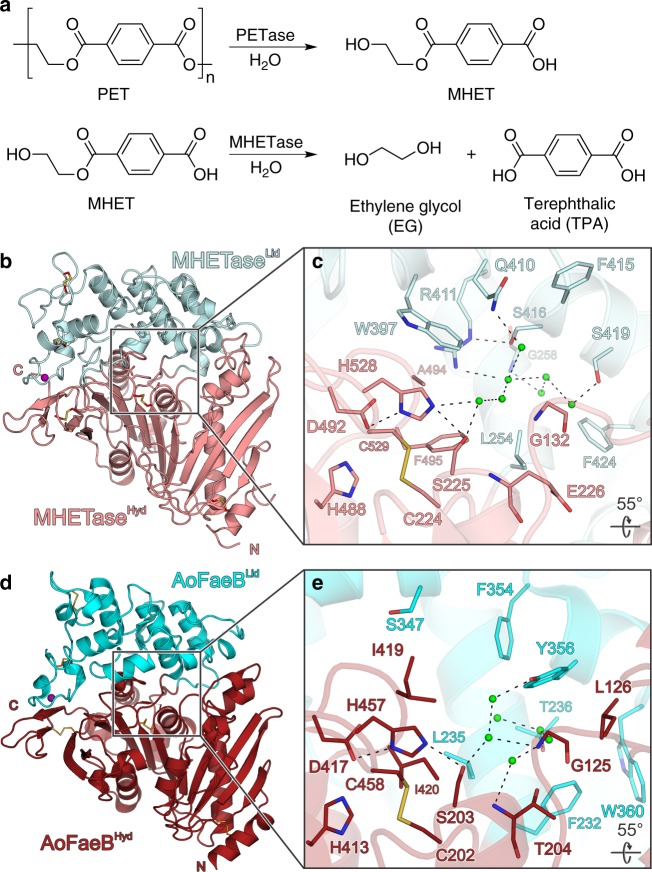
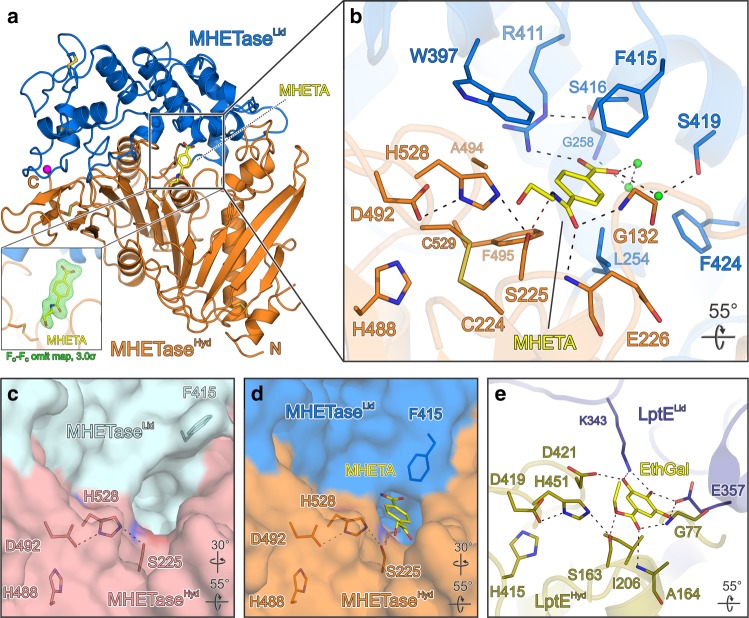
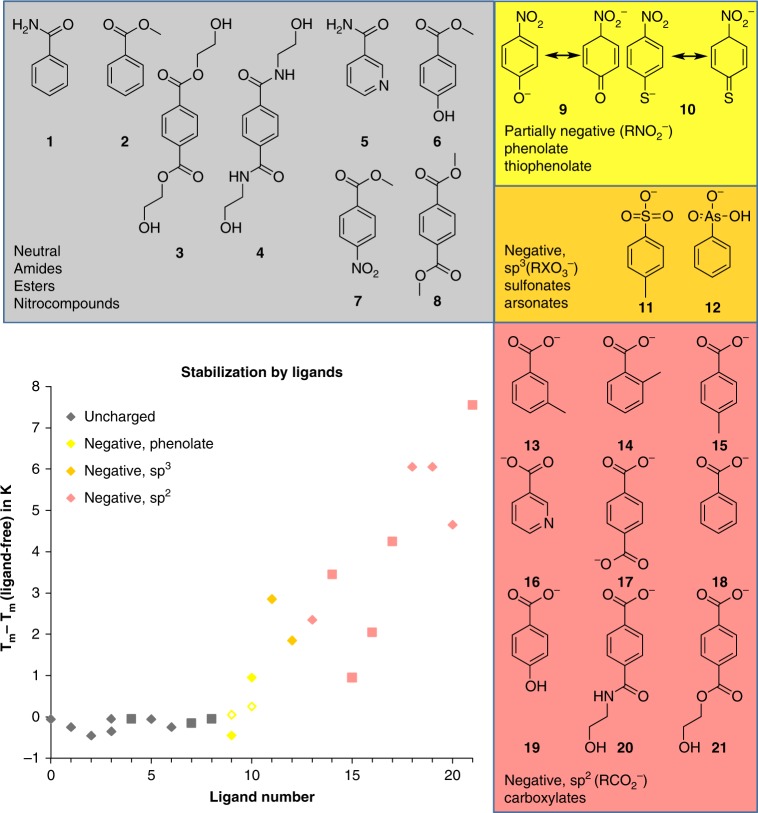
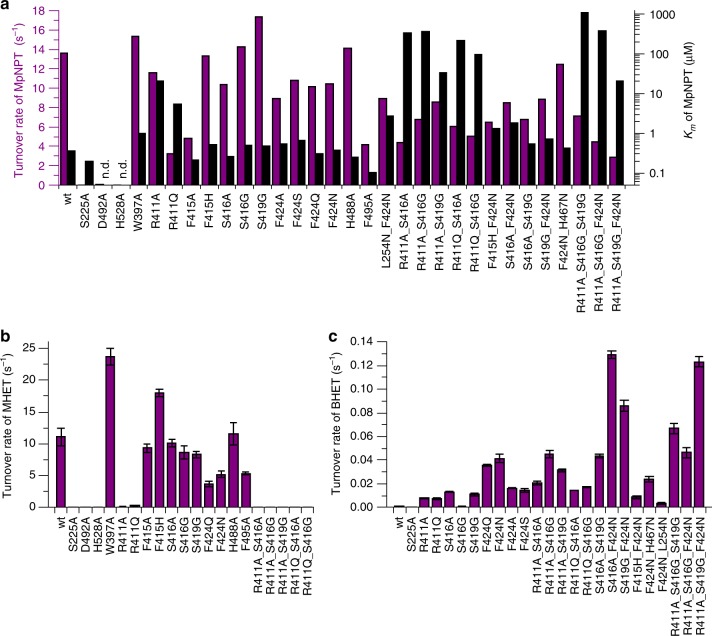
The extreme durability of polyethylene terephthalate (PET) debris has rendered it a long-term environmental burden. At the same time, current recycling efforts still lack sustainability. Two recently discovered bacterial enzymes that specifically degrade PET represent a promising solution. First, Ideonella sakaiensis PETase, a structurally well-characterized consensus α/β-hydrolase fold enzyme, converts PET to mono-(2-hydroxyethyl) terephthalate (MHET). MHETase, the second key enzyme, hydrolyzes MHET to the PET educts terephthalate and ethylene glycol. Here, we report the crystal structures of active ligand-free MHETase and MHETase bound to a nonhydrolyzable MHET analog. MHETase, which is reminiscent of feruloyl esterases, possesses a classic α/β-hydrolase domain and a lid domain conferring substrate specificity. In the light of structure-based mapping of the active site, activity assays, mutagenesis studies and a first structure-guided alteration of substrate specificity towards bis-(2-hydroxyethyl) terephthalate (BHET) reported here, we anticipate MHETase to be a valuable resource to further advance enzymatic plastic degradation.
Overview
The claims and statistics of this paper haven’t been checked yet.
Free: it reads the open-access text and checks the first 5 claims that cite a source we can check. Create a free account to check every claim.
Integrity signals
Registry
Cites
Statistics
Figures
Verification
Claims the paper makes
The claims and statistics of this paper haven’t been checked yet.
Free: it reads the open-access text and checks the first 5 claims that cite a source we can check. Create a free account to check every claim.
Self-check
Percentages, sums and reported differences re-computed from the paper’s own numbers.
The self-check needs the paper’s full text.
Citations
Cites
Basic local alignment search tool
Altschul, S. F., Gish, W., Miller, W., Myers, E. W., & Lipman, D. J. (1990) · Journal of Molecular Biology · doi:10.1006/jmbi.1990.9999 · Cited by 98,669
MEGA7: Molecular Evolutionary Genetics Analysis Version 7.0 for Bigger Datasets
Kumar, S., Stecher, G., & Tamura, K. (2016) · Molecular Biology and Evolution · doi:10.1093/molbev/msw054 · Cited by 44,059
Features and development of Coot
Emsley, P., Lohkamp, B., Scott, W. G., & Cowtan, K. (2010) · Acta Crystallographica Section D Biological Crystallography · doi:10.1107/s0907444910007493 · Cited by 29,915
Production, use, and fate of all plastics ever made
Geyer, R., Jambeck, J. R., & Law, K. L. (2017) · Science Advances · doi:10.1126/sciadv.1700782 · Cited by 18,606
Kabsch, W. (2010) · Acta Crystallographica Section D Biological Crystallography · doi:10.1107/s0907444909047337 · Cited by 16,463
Overview of the CCP 4 suite and current developments
Winn, M. D., Ballard, C. C., Cowtan, K. D., Dodson, E. J., Emsley, P., Evans, P. R., Keegan, R. M., Krissinel, E. B., Leslie, A. G. W., McCoy, A., et al. (2011) · Acta Crystallographica Section D Biological Crystallography · doi:10.1107/s0907444910045749 · Cited by 12,353
Lost at sea: where is all the plastic?
Thompson, R. C., Olsen, Y., Mitchell, R. P., Davis, A., Rowland, S. J., John, A. W. G., McGonigle, D., & Russell, A. E. (2004) · Science · doi:10.1126/science.1094559 · Cited by 7,765
The rapid generation of mutation data matrices from protein sequences
Jones, D. T., Taylor, W. R., & Thornton, J. M. (1992) · Bioinformatics · doi:10.1093/bioinformatics/8.3.275 · Cited by 6,947
Towards automated crystallographic structure refinement with phenix.refine
Afonine, P. V., Grosse-Kunstleve, R. W., Echols, N., Headd, J. J., Moriarty, N. W., Mustyakimov, M., Terwilliger, T. C., Urzhumtsev, A., Zwart, P. H., & Adams, P. D. (2012) · Acta Crystallographica Section D Biological Crystallography · doi:10.1107/s0907444912001308 · Cited by 5,511
Eriksen, M., Lebreton, L. C. M., Carson, H. S., Thiel, M., Moore, C. J., Borerro, J. C., Galgani, F., Ryan, P. G., & Reisser, J. (2014) · PLoS ONE · doi:10.1371/journal.pone.0111913 · Cited by 4,710
Cited by
Items 301–400 of 514
A Bird’s Eye View on Sustainable Management Solutions for Non-degradable Plastic Wastes
Jeya, G., Rajalakshmi, S., Gayathri, K. V., Priya, P., Sakthivel, P., & Sivamurugan, V. (2021) · Emerging contaminants and associated treatment technologies · doi:10.1007/978-3-030-72441-2_20 · Cited by 12
Gao, Y., Zheng, Y., Qi, Z., Pan, Y., Zhou, Y. J., You, S., Su, R., Qi, W. D., & Wang, M. (2024) · Journal of Chemical Technology & Biotechnology · doi:10.1002/jctb.7688 · Cited by 8
Dahmer, B. R., de Lima, J. C., Bachega, J. F. R., Wymore, T., & Timmers, L. F. S. M. (2025) · ACS Omega · doi:10.1021/acsomega.5c02068 · Cited by 8
Foster, M. J., Becker, C., Madden, D. J., Wasson, P. A., Sichert, A., Hayden, M. G., Subhas, A. V., Gross, S., McRose, D. L., Cordero, O. X., et al. (2026) · Environmental Science & Technology · doi:10.1021/acs.est.5c14910 · Cited by 8
Dong, X., Zhu, L., He, Y., Li, C., Wu, R., & Li, D. (2026) · Journal of Environmental Management · doi:10.1016/j.jenvman.2026.129422 · Cited by 8
Plastics: Toward a Circular Bioeconomy
Amanna, R., Mahal, Z., Vieira, E. C. S., Samavi, M., & Rakshit, S. K. (2021) · Elsevier eBooks · doi:10.1016/b978-0-12-821878-5.00027-1 · Cited by 12
Enzymatic Degradation of Polyethylene and Polyethylene Terephthalate: A Mini Review
Raoufi, H., Taqwa, S., & Fagiryaar, F. (2023) · American Journal of Environment and Climate · doi:10.54536/ajec.v2i3.1937 · Cited by 8
Ercolano, C., Iacono, R., Cafaro, V., Pizzo, E., Giovannelli, D., Feuerriegel, G., Streit, W. R., Strazzulli, A., & Moracci, M. (2024) · International Journal of Molecular Sciences · doi:10.3390/ijms25158120 · Cited by 8
“As shown in Figure 1b, the Sis model overlays with Is PETase (PDB 6QGC) [26], with an overall RMSD of Moreover, Sis also does not cluster with the p -nitrobenzylesterase from Bacillus subtilis BsEstB [24] and the esterase from Clostridium botulinum Cbotu_EstA [25], which, to date, have not been…”
MethodAnuar, N. F. S. K., Wahab, R. A., Huyop, F., Normi, Y. M., Oyewusi, H. A., & Susanti, E. (2024) · Journal of Biomolecular Structure and Dynamics · doi:10.1080/07391102.2024.2431655 · Cited by 9
“…al., 2010; Herrero Acero et al., 2011; Ribitsch et al., 2011; Baker et al., 2012; Sulaiman et al., 2012; Yoshida et al., 2016; Kitadokoro et al., 2019; Palm et al., 2019), the alkaline-stable LipKV1 might have practical applications in the plastic recycling industry, which has yet to be reported.”
Dharmasiddhi, I. P. W., chen, J., Arab, B., Lan, C., Euler, C., Chou, C.-H. P., & Liu, Y. (2025) · Processes · doi:10.3390/pr13020375 · Cited by 8
Kamal, S., Carew, K., Qin, J., Hatinoglu, D., Apul, O. G., & Xiong, B. (2025) · ACS Sustainable Chemistry & Engineering · doi:10.1021/acssuschemeng.4c08256 · Cited by 8
Rani, K., Singh, P., Agarwal, R., & Kushagra, A. (2022) · Elsevier eBooks · doi:10.1016/b978-0-323-85884-7.00013-8 · Cited by 12
Flexible Candlelight Organic LED on Mica
Chen, T.-H., Chen, H.-J., Weng, C.-Y., Chen, F., Liou, D., Chen, S., Chu, Y., & Jou, J. (2022) · ACS Applied Electronic Materials · doi:10.1021/acsaelm.2c00123 · Cited by 8
Biological degradation of microplastics and nanoplastics in water and wastewater
Amanna, R., Samavi, M., & Rakshit, S. K. (2022) · Elsevier eBooks · doi:10.1016/b978-0-323-99908-3.00002-6 · Cited by 10
Romero-Orejón, K. L., Karbalaei‐Heidari, H. R., Budiša, N., & Levin, D. B. (2024) · bioRxiv (Cold Spring Harbor Laboratory) · doi:10.1101/2024.11.20.624590 · Cited by 9
Song, Y., Li, A., Cui, H., Wu, L., Zhou, B. F., & Li, X. (2025) · ChemSusChem · doi:10.1002/cssc.202402614 · Cited by 12
Damayanti, D., Marpaung, D. S. S., Kodarif, A. R., Sanjaya, A., Saputri, D. R., Fahni, Y., Rahmiyati, L., Silvia, P. Z., A’yuni, D. Q., Imalia, C. L., et al. (2025) · Resources · doi:10.3390/resources14110176 · Cited by 7
“Two α / β -hydrolase fold enzymes, PETase and MHETase, collaborate to degrade PET in a two-step process through MHET, resulting in TPA and MEG, which are the essential precursors for a new cycle of PET production [119], as seen in Figure 3.”
A programmable microbial assembly line for plastic upcycling
Qian, Y., Collins, J. J., & Lu, T. (2026) · Nature Sustainability · doi:10.1038/s41893-025-01765-9 · Cited by 8
Côrrea, T. L. R., Román, E. K. B., Costa, C. A. R., Wolf, L. D., Landers, R., Biely, P., Murakami, M. T., & Walton, P. H. (2024) · ChemSusChem · doi:10.1002/cssc.202401350 · Cited by 7
Gunawardana, D., Abeysiri, S., & Manage, P. M. (2023) · Phycology · doi:10.3390/phycology3010007 · Cited by 7
“Plastic pollution can be tackled by applied science endeavors that have the potential to unveil newer microorganisms such as Idionella sakiensis that degrades Polyethylene Terephthalate plastics [74], to be used in global bioremediation.”
BackgroundKoh, D. W., Ang, B. Y.-X., Yeo, J. Y., Xing, Z., & Gan, S. K. (2020) · doi:10.14324/111.444/000048.v1 · Cited by 8
Makryniotis, K., Papi, M., Nikolaivits, E., & Topakas, E. (2025) · International Journal of Biological Macromolecules · doi:10.1016/j.ijbiomac.2025.148892 · Cited by 9
Engineered bacteria for PET and polyethylene degradation: A review
Riaz, A., Abid, J., Shaheen, R., Nadeem, S., & Ghumman, Z. (2025) · Journal of environmental chemical engineering · doi:10.1016/j.jece.2025.119368 · Cited by 7
Faszczewska, A., Piotrowska‐Niczyporuk, A., & Karpińska, J. (2026) · Journal of Environmental Sciences · doi:10.1016/j.jes.2026.01.087 · Cited by 7
Batista, V. S., Świderek, K., & Moliner, V. (2026) · Journal of the American Chemical Society · doi:10.1021/jacs.5c21421 · Cited by 6
Fortaleza, J. A. G., Asemoloye, M. D., Tekere, M., Chigwada, A. D., Zhou, X., Sabeeh, M., Cabuhat, K. S. P., & Jesus, R. S. D. (2026) · Waste Management Bulletin · doi:10.1016/j.wmb.2026.100304 · Cited by 8
Wu, S., Hooks, D. O., & Brightwell, G. (2025) · Bioengineering · doi:10.3390/bioengineering12010068 · Cited by 6
Improvement in the Thermal Stability of IsMHETase by Sequence and Structure-Guided Calculation
Duan, S., Chao, T., Wu, Y., Wei, Z., & Cao, S. (2025) · Molecules · doi:10.3390/molecules30050988 · Cited by 6
In-silico and biochemical insights into MHET biodegradation by Arctic Pseudomonas MHET hydrolase
Thapa, G., Gurung, S., Han, S., & Oh, T. (2025) · International Journal of Biological Macromolecules · doi:10.1016/j.ijbiomac.2025.146195 · Cited by 6
Brambley, C. A., Yared, T. J., Gonzalez, M., Jansch, A. L., Wallen, J. R., Weiland, M. H., & Miller, J. M. (2021) · The Journal of Physical Chemistry B · doi:10.1021/acs.jpcb.1c01216 · Cited by 6
Song, P., Li, M., Wang, H., Cheng, Y., & Wei, Z. (2024) · Polymers · doi:10.3390/polym16182588 · Cited by 6
“Aliphatic–aromatic copolyesters are biodegradable materials with better mechanical and thermal properties than aliphatic polyesters [16–18].”
BackgroundZhang, Z., Cai, D., Shao, C., Chen, C., & Chen, B. (2022) · Process Biochemistry · doi:10.1016/j.procbio.2022.01.011 · Cited by 6
Urbelienė, N., Meškienė, R., Tiškus, M., Stanislauskienė, R., Aučynaitė, A., Laurynėnas, A., & Meškys, R. (2020) · Catalysts · doi:10.3390/catal10040445 · Cited by 6
“This family includes fungal tannase and feruloyl esterase [42,43], several bacterial homologues of unknown function, and polyethylene terephthalate (PET) hydrolysing enzymes, e.g., the mono(2-hydroxyethyl) terephthalate hydrolase from the bacterium Ideonella sakaiensis [44,45].”
BackgroundInfluentialMarine microplastic pollution in Peninsular Malaysia: A meta-analysis
Gao, P., Huang, D. M., Hu, W., Chen, W., Fadhullah, W., & John, A. (2025) · Regional Studies in Marine Science · doi:10.1016/j.rsma.2025.104228 · Cited by 8
Biotechnological innovations for microplastic degradation: A synthetic biology perspective
Yadav, P., Yadav, C., Joshi, A., Meena, M., & Arora, J. (2025) · Next research. · doi:10.1016/j.nexres.2025.100878 · Cited by 6
Valuable Compounds from Pollutants: Converting PET into Enantiopure Alanine
Rosini, E., Battaglia, C., Miani, D., Molinari, F., Arrigoni, F., Piarulli, U., Molla, G., & Pollegioni, L. (2025) · ACS Catalysis · doi:10.1021/acscatal.5c06530 · Cited by 5
Liu, X., Chen, Z., Liu, X., Zhu, T., Sun, J., Li, C., Cui, Y., & Wu, B. (2025) · CHINESE JOURNAL OF CATALYSIS (CHINESE VERSION) · doi:10.1016/s1872-2067(25)64802-9 · Cited by 5
Performance of PET hydrolases with tethered binding modules in large-scale applications
Wei, R., & Weber, G. (2022) · Chem Catalysis · doi:10.1016/j.checat.2022.09.027 · Cited by 5
Self-citationDíaz-García, L., Chuvochina, M. S., Feuerriegel, G., Bunk, B., Spröer, C., Streit, W. R., Rodriguez‐R, L. M., Overmann, J., & Jiménez, D. J. (2023) · Systematic and Applied Microbiology · doi:10.1016/j.syapm.2023.126485 · Cited by 5
Molecular docking analysis of PET with MHET
Uday, J. (2023) · Bioinformation · doi:10.6026/97320630019255 · Cited by 5
Tinjauan Potensi Pemanfaatan Botol Bekas Berbahan Polyethylene Terephthalate (PET) di Indonesia
Fitriyano, G. (2019) · Eksergi · doi:10.31315/e.v16i1.2747 · Cited by 10
Demirel, B., Kılıç, E., Yaraş, A., Akkurt, F., Daver, F., & Gezer, D. U. (2022) · Journal of Plastic Film & Sheeting · doi:10.1177/87560879221097640 · Cited by 5
“Although PET requires many years to biodegrade, it is suggested that PET can be hydrolyzed by certain isolated enzymes.(22,23) Critical changes can be observed in the PET’s mechanical and thermal (Tg and Tm) properties when it is exposed to the above-mentioned degradation mechanisms.”
BackgroundMalūnavičius, V., Padaiga, A., Stankevičiūtė, J., Pakalniškis, A., & Gudiukaitė, R. (2023) · International Journal of Biological Macromolecules · doi:10.1016/j.ijbiomac.2023.127656 · Cited by 6
Biodegradation of Microplastic Using Bacterial Cultures
Mohan, L., Manoj, S. E., Sunil, L. G., Raju, A. V., & Krishnan, K. S. A. (2024) · Springer eBooks · doi:10.1007/978-981-99-8357-5_26 · Cited by 5
Wang, D., Yang, M., Zhang, Z., Zhao, Y., Lyu, C., Qiu, S., Mei, L., Fan, F., & Huang, J. (2025) · Physical Chemistry Chemical Physics · doi:10.1039/d5cp03204k · Cited by 4
Priestia megaterium Jou-S14 degrades highly crystalline polyethylene terephthalate microplastics
Yang, G., Huang, X., Yu, G., Tao, T., Guo, K., Hou, X., Qi, C., Gao, S., & Fang, Y. (2026) · Journal of Hazardous Materials · doi:10.1016/j.jhazmat.2026.141843 · Cited by 4
Achnafani, D., Nurhayati, N., Aji, N. A., Ulfah, M., Sabbathini, G. C., Wulandari, S. R., & Helianti, I. (2023) · AIP conference proceedings · doi:10.1063/5.0183747 · Cited by 4
Singh, S., Subramanian, S., Gupta, N., Bajaj, A., & Manickam, N. (2024) · Current Research in Biotechnology · doi:10.1016/j.crbiot.2024.100258 · Cited by 5
Degradación del polietilentereftalato por medio de microorganismos
Herrera, J. A. S., & Bermúdez-Morera, D. (2021) · Informador Técnico · doi:10.23850/22565035.3592 · Cited by 4
Ideonella sakaiensis Can Metabolize Bisphenol A as a Carbon Source
Pop, C.-E., Deák, G., Maria, C., Ghiță, G., Ivanov, A. A., Fendrihan, S., Mihailescu, D. F., & Mernea, M. (2023) · Microorganisms · doi:10.3390/microorganisms11122891 · Cited by 4
“The three ligands were docked to PETase and MHETase active sites [30,31] (Figure 6a,b).”
BackgroundMethodInfluentialYadav, R., Rajput, V., & Dharne, M. S. (2024) · Environmental Science and Pollution Research · doi:10.1007/s11356-024-35187-5 · Cited by 4
“…, Ideonella , Rubrivivax , Dechloromonas , Thauera , Pseudomonas , and several others that are already reported for degradation of xenobiotic compounds such as aromatic hydrocarbons and plastic degradation (Online Resource 13) (Palm et al. 2019; Dubbels et al. 2009; and Fan et al. 2019).”
Biodegradation of microplastics and synthetic polymers in agricultural soils
Rajagopalan, K., Christyraj, J. R. S. S., Chelladurai, K. S., Jeevanandam, M., Ganesan, H., Mathews, M. G. R., & Christyraj, J. D. S. (2022) · Elsevier eBooks · doi:10.1016/b978-0-323-90452-0.00017-7 · Cited by 5
Microbial strategies to address environmental nanopollutants
Guha, N., Walke, S., & Thiagarajan, P. (2022) · Elsevier eBooks · doi:10.1016/b978-0-323-89937-6.00004-8 · Cited by 4
Preventing Petrochemical Plastics Pollution: Sustainable Material AlternativesPreprint
Singh, N. P., Ogunseitan, O. A., Tang, Y., & Wong, M. H. (2021) · Engineering Archive (engrXiv) · doi:10.31224/osf.io/xemny · Cited by 5
New Biocatalytic Approaches for Plastic Depolymerization
Wei, R., & Bornscheuer, U. T. (2025) · Engineering · doi:10.1016/j.eng.2025.11.017 · Cited by 3
Self-citationWang, H., Ren, W., Xu, Y., Sun, Y., Hu, W., Li, Y., Huang, Y., Chen, T., & Teng, Y. (2025) · Agriculture Ecosystems & Environment · doi:10.1016/j.agee.2025.110160 · Cited by 3
Granja‐Travez, R. S., Dale, T., & Jha, R. K. (2026) · Protein Engineering Design and Selection · doi:10.1093/protein/gzag009 · Cited by 3
Lu, Q., Zhou, H., Chen, W., Li, X., Yang, H., Lian, Y., Lu, L., & Wang, W. (2026) · International Journal of Biological Macromolecules · doi:10.1016/j.ijbiomac.2026.152041 · Cited by 3
Plastic-Degrading Microorganisms: Biodegradation Pathways and Habitat Origins
Żarska, M. J., Jasiak, M. D., Mierzejewski, P. A., Tomczyk, K., Małecki, J., Gudz, R., Urbanek, A. K., Kosiorowska, K. E., & Dybka, J. A. (2026) · Molecules · doi:10.3390/molecules31101638 · Cited by 4
“This strain produces two enzymes: PETase (PET hydrolase, an enzyme that breaks the ester bonds in the PET chain) and MHETase (MHET hydrolase, an enzyme that converts the intermediate degradation product into monomers: terephthalic acid and ethylene glycol) [53,80,81].”
Bioaugmentation with bacterial consortia for sustainable plastic waste treatment
Ningthoujam, R., Mistry, A. N., Rachmani, L. D., Krainara, S., Pinyakong, O., Assavalapsakul, W., Jitpraphai, S. M., Angsujinda, K., & Luepromchai, E. (2026) · npj Materials Sustainability · doi:10.1038/s44296-026-00113-y · Cited by 4
Metabolic adaptations of extremophiles and their applications in environmental biotechnology
Krempaská, V., Murgašová, M., & Vesteg, M. (2026) · World Journal of Microbiology and Biotechnology · doi:10.1007/s11274-026-05124-4 · Cited by 3
“…PET-degrading microorganisms, genes encoding PET hydrolases (PETase) and mono(2-hydroxyethyl) terephthal-ate hydrolases (MHETase) catalyze sequential hydrolysis of PET into terephthalic acid (TPA) and ethylene glycol (EG), which can subsequently enter central metabolic pathways (Palm et al. 2019).”
Kumari, S., & Amaresan, N. (2026) · Journal of environmental chemical engineering · doi:10.1016/j.jece.2026.124251 · Cited by 4
Swarna, S. K., Muntasir, M. A., Mahbub, M. M., Nusrin, S., & Jesmin, J. (2024) · Environment and Natural Resources Journal · doi:10.32526/ennrj/22/20230124 · Cited by 4
Numoto, N., Kamiya, N., Kawai, F., & Oda, M. (2020) · ACS symposium series · doi:10.1021/bk-2020-1373.ch004 · Cited by 3
Iterated local search with partition crossover for computational protein design
Beuvin, F., de Givry, S., Schiex, T., Vérel, S., & Simoncini, D. (2021) · Proteins Structure Function and Bioinformatics · doi:10.1002/prot.26174 · Cited by 6
Plastic glut down a microbial gut
Dileep, D., Forrester, M. J., & Cochran, E. W. (2022) · Polymer International · doi:10.1002/pi.6369 · Cited by 3
Sustainable chemical recycling of plastic waste
Teo, J. Y. Q., & Lim, J. Y. C. (2023) · Elsevier eBooks · doi:10.1016/b978-0-323-91198-6.00004-8 · Cited by 3
Varshney, A. (2024) · Springer eBooks · doi:10.1007/978-3-031-51967-3_15 · Cited by 3
Buhari, S. B., Nezhad, N. G., Normi, Y. M., Shariff, F. M., & Leow, T. C. (2025) · Journal of Biomolecular Structure and Dynamics · doi:10.1080/07391102.2024.2440646 · Cited by 3
“…activity (Skariyachan et al., 2022); activity is also increased when Cys224-Cys529 are swapped out for C224W-C529S (Knott et al., 2020), along with many other reported substitutions (Magalh ~ aes et al., 2021; Palm et al., 2019; Sagong et al., 2020; Son et al., 2019; Zhong-Johnson et al., 2021).”
Brambley, C. A., Bolay, A. L., Salvo, H., Jansch, A. L., Yared, T. J., Miller, J. M., Wallen, J. R., & Weiland, M. H. (2020) · ACS Sustainable Chemistry & Engineering · doi:10.1021/acssuschemeng.0c01158 · Cited by 3
Microplastics Contamination in the Environment: An Ecotoxicological Concern
Sreelakshmi, T., & C, C. K. (2021) · International Journal of Zoological Investigations · doi:10.33745/ijzi.2021.v07i01.019 · Cited by 5
“The unique properties of PET prevent the attack of microorganisms, however, Ideonella sakaiensis, a bacterium, is known to possess the ability to biodegrade PET as it contains the enzyme PETase that breakdown PET into its monomers (Palm et al., 2019).”
BackgroundEmerging Techniques for the Mitigation of Micro and Nanoplastics in Soil
Pavan, C. S., Kumar, P. S., Sree, N. R. S., & Munawar, T. M. (2023) · Springer eBooks · doi:10.1007/978-3-031-21195-9_16 · Cited by 3
Current Progress and Potential Microbial Cornucopia for Plastic Degradation
Puranik, S., Shylla, A., Manoj, M., & Vijaysri, D. (2024) · Springer eBooks · doi:10.1007/978-3-031-55661-6_3 · Cited by 5
Olalemi, A. O., Ola, H. O., Ogundiran, B. A., & Obileye, E. A. (2024) · Water Practice & Technology · doi:10.2166/wpt.2024.249 · Cited by 2
Biochemical Upcycling of PET via Glycolysis and Engineered Microbial Consortia
Molpeceres-García, F. J., García-Miró, A., Prieto, A., Sanz, D., & Barriuso, J. (2026) · Microbial Biotechnology · doi:10.1111/1751-7915.70340 · Cited by 3
“This may be explained by the higher copy number associated with the RSF1010 origin of replication and the larger molecular weight of Is MHETase (65 kDa) compared to FAST-PETase (29 kDa) (Palm et al. 2019; Seo et al. 2019), which may represent a metabolic burden for P. putida JM37.”
Yu, J., Huang, L., Wang, Y., Liu, J., Wei, Y., Li, Q., Jiang, J., Wang, S., Shen, Y., & Zhang, L. (2025) · Journal of Water Process Engineering · doi:10.1016/j.jwpe.2025.108903 · Cited by 2
Qiao, J., Wu, L., Ma, X., Li, A., Tian, Y., Lin, H., Guo, D., & Li, X. (2025) · Engineering Microbiology · doi:10.1016/j.engmic.2025.100255 · Cited by 2
“Although the biodegradation of PET plastics via PET hydrolases (PETase [ 54 , 154 , 155 ], BHETase [ 156 , 157 ], and MHETase [ 158 , 159 ]) has been extensively studied, research into the enzymes involved in PE degradation is still in its early stages [ 160 ].”
Wang, S., Cao, S., Zhang, G., Gao, R., Liu, F., Duan, Y., & Du, H. (2026) · Chemical Engineering Journal · doi:10.1016/j.cej.2026.172963 · Cited by 3
Liu, F., Li, N., Liu, X., Xu, N., & Wang, T. (2026) · Journal of environmental chemical engineering · doi:10.1016/j.jece.2026.121518 · Cited by 2
Ma, R., Liu, B., Wang, R., Wu, Z., & Guo, L. (2026) · Reaction Chemistry & Engineering · doi:10.1039/d5re00388a · Cited by 2
Biological Degradation of Phthalates: From Bioremediation to Plastic Waste Valorization
Pereyra‐Camacho, M. A., & Pardo, I. (2026) · ChemSusChem · doi:10.1002/cssc.202501955 · Cited by 2
“In contrast to PETase, which shows a shallow, solvent exposed cleft that allows it to bind the PET polymer chain, MHETase possesses a lid domain to specifically and efficiently position MHET for hydrolysis (Figure 3) [43].”
Li, J., Li, P., Guo, X., Yu, K., Dou, F., Zhang, X., & He, Y. Y. (2026) · Sustainability · doi:10.3390/su18084134 · Cited by 2
Engineering and Application of a Thermostable MHETase for PET Depolymerization
Murphy, N. P., Gado, J. E., Neumann, T., Pérez-García, P., Komp, E., Avilán, L., Mathews, I. I., Bell, E. L., Norton‐Baker, B., Clark, M., et al. (2026) · ACS Sustainable Chemistry & Engineering · doi:10.1021/acssuschemeng.6c01404 · Cited by 2
Rajan, H., Devipriya, S. P., & Bhat, S. G. (2026) · Biodegradation · doi:10.1007/s10532-026-10316-8 · Cited by 2
“While coordinated enzyme systems have improved efficiency in PET degradation, extending this approach to polyolefins requires inclusion of oxidative as well as hydrolytic activities (Barth et al. 2016; Hachisuka et al. 2021; Palm et al. 2019).”
Enzymes, DNAzymes and nanozymes for environmental remediation
Panferov, V. G., Lee, J. H., & Liu, J. (2026) · Nanoscale · doi:10.1039/d6nr01540a · Cited by 2
Ohta, Y., Katsumata, M., Kurosawa, K., Takaki, Y., Nishimura, H., Watanabe, T., & Kasuya, K. (2021) · Environmental Microbiology · doi:10.1111/1462-2920.15551 · Cited by 2
Toward the Middle of the Century: A European Synchrotron Perspective
Vollmer, A. (2021) · Synchrotron Radiation News · doi:10.1080/08940886.2021.1968237 · Cited by 2
Genetically modified microbes as an effective tool for sustainable solid waste management
Nayak, A., Kisku, K., Dhara, M., & Naik, U. C. (2022) · Elsevier eBooks · doi:10.1016/b978-0-323-89937-6.00008-5 · Cited by 2
Kumar, A., Kukreti, B., Bundela, V., Rani, P., & Singh, A. V. (2024) · Springer eBooks · doi:10.1007/978-3-031-55661-6_4 · Cited by 2
Joseph, A., Nithin, B., & Goel, S. (2024) · Springer eBooks · doi:10.1007/978-3-031-49144-3_13 · Cited by 2
Plastic Recycling for Energy Production
Faisal, S., Naveed, M. H., Kifayatullah, S., & Muhammad, M. (2022) · Springer eBooks · doi:10.1007/978-3-030-91570-4_14 · Cited by 2
Belov, D. V., & Belyaev, S. N. (2022) · Proceedings of universities Applied chemistry and biotechnology · doi:10.21285/2227-2925-2022-12-2-238-253 · Cited by 2
Structural Characterization of Multienzyme Assemblies: An Overview
Papageorgiou, A. C. (2022) · Methods in molecular biology · doi:10.1007/978-1-0716-2269-8_4 · Cited by 2
Microbial degradation, recycling and upcycling of PET wastes: A Mini-Review
Ningthoujam, D. S. (2022) · Microbial Bioactives · doi:10.25163/microbbioacts.526329 · Cited by 2
Plastic degradation—contemporary enzymes versus nanozymes-based technologies
Samal, S., Dey, P., Baral, S. S., & Rangarajan, V. (2023) · Elsevier eBooks · doi:10.1016/b978-0-323-95253-8.00006-1 · Cited by 3
Microbial Enzymes for Wastewater Treatment
Çaloğlu, B., Laçın, K., Binay, B., & Hung, Y. (2023) · Handbook of environmental engineering · doi:10.1007/978-3-031-44768-6_3 · Cited by 2
Biodegradação e biorremediação de plásticos
da Silva, C. P., Chibite, E. E. A., Chibite, A., & Motoyama, M. H. (2022) · Mérida Publishers eBooks · doi:10.4322/mp.978-65-84548-03-9.c8 · Cited by 1
Quantitative Risk Assessment for Synthetic Biology
Ulanova, A., Gong, P., Trump, B. D., Cummings, C. L., & Linkov, I. (2024) · Wiley eBooks · doi:10.1002/9781119742975.ch8 · Cited by 1
Ahuja, N., & Markowitz, E. S. (2024) · Journal of Emerging Investigators · doi:10.59720/23-167 · Cited by 1
Parray, J. A., & Li, W.-J. (2025) · Synthesis lectures on chemical engineering and biochemical engineering · doi:10.1007/978-3-031-84437-9_2 · Cited by 1
Metadata
- Authors
- Palm, G. J., Reisky, L., Böttcher, D., Müller, H., Michels, E. A. P., Walczak, M. C., Berndt, L., Weiss, M. S., Bornscheuer, U. T., & Weber, G.
- Affiliations
- Universität Greifswald (DE)
- Helmholtz-Zentrum Berlin für Materialien und Energie (DE)
- Corresponding author
- Bornscheuer, Uwe T.
- Weber, Gert
- ORCID
- Venue
- Nature Communications
- Published
- 2019-04-12
- Volume
- 10
- Issue
- 1
- Pages
- 1717-1717
- ISSN
- 2041-1723 (ISSN-L)
- PMC
- PMC6461665
- OpenAlex
- W2935008047
- Semantic Scholar
- 42b9fbfede7afc036ca1302efa65d810541f4d76
- Cited by
- 491
- References
- 40
- Citations by year
- 2026: 69 · 2025: 55 · 2024: 93 · 2023: 75 · 2022: 72 · 2021: 83 · 2020: 34 · 2019: 10
- FWCI
- 17.96
- Type
- journal article
- Language
- en
- Open access
- gold
- doi.org
- Licence
- cc-by
- creativecommons.org/licenses/by/4.0 (tdm)
- creativecommons.org/licenses/by/4.0 (vor)
- Locations
- Nature Communications (publishedVersion, cc-by)
- PubMed Central (publishedVersion, cc-by)
- PubMed (publishedVersion)
- HZB Repository (Helmholtz-Zentrum Berlin für Materialien und Energie GmbH (HZB)) (submittedVersion, other-oa)
- RePEc: Research Papers in Economics (submittedVersion)
- DESY Publication Database (PUBDB) (Deutsches Elektronen-Synchrotron) (submittedVersion, cc-by)
- DOAJ (DOAJ: Directory of Open Access Journals) (submittedVersion)
- DOAJ (DOAJ: Directory of Open Access Journals) (submittedVersion, cc-by-sa)
- Funders
- Humboldt-Universität zu Berlin
- Freie Universität Berlin
- Helmholtz-Zentrum Berlin für Materialien und Energie
- Deutsches Elektronen-Synchrotron
- Leibniz-Gemeinschaft
- Topics
- Life Sciences › Biochemistry, Genetics and Molecular Biology › Structural Biology › Enzyme Structure and Function
- Life Sciences › Biochemistry, Genetics and Molecular Biology › Biotechnology › Enzyme Production and Characterization
- Physical Sciences › Materials Science › Biomaterials › biodegradable polymer synthesis and properties
- Keywords
- Ideonella sakaiensis, MHETase, polyethylene terephthalate degradation, plastic biodegradation, alpha/beta hydrolase fold, feruloyl esterase, lid domain, substrate specificity, active site mapping, bis(2-hydroxyethyl) terephthalate, crystal structure
- MeSH terms
- Protein Domains, Burkholderiales, Biodegradation, Environmental, Enzymes, Fluorometry, Hydrolases, Hydrolysis, Ligands, Phthalic Acids, Phylogeny, Plastics, Polyethylene Terephthalates, Substrate Specificity, Mutagenesis, Mutagenesis, Site-Directed, Protein Structure, Secondary, Protein Folding, Ethylene Glycol, Catalytic Domain
About these checks
Registry, retraction, Cites and statistics results are computed, not judged, with one exception: a printed reference that no index lists is read once by a model before it counts as a citation error. Claims are extracted by a model and kept only when their quote appears verbatim in the text; each cited source is then checked, with a model’s help, for whether it says what the claim relies on. Those verdicts can be wrong — read the claim’s quote and the cited source before relying on one.
Statistics and arithmetic are recomputed, not judged.
Confidence bands are shown only for fields calibrated on our annotated test set. None is calibrated yet, so no band is shown.
What counts as a claim ›How we measure confidence ›How we check this ›
Are you an author, or do you see a problem with this page? Request a review
Data sources
Bibliographic data: Semantic Scholar, OpenAlex, Crossref.
Contains information from the Semantic Scholar Academic Graph Datasets, made available under the ODC Attribution License (ODC-BY 1.0).
Semantic Scholar’s data is described in: Kinney, R., et al. (2023). The Semantic Scholar Open Data Platform. arXiv:2301.10140.
