

Structure of the plastic-degrading Ideonella sakaiensis MHETase bound to a substrate
Open accessThe DOI matches its Crossref record; 39 of the 40 references it cites were found in a registry or an index.
Abstract
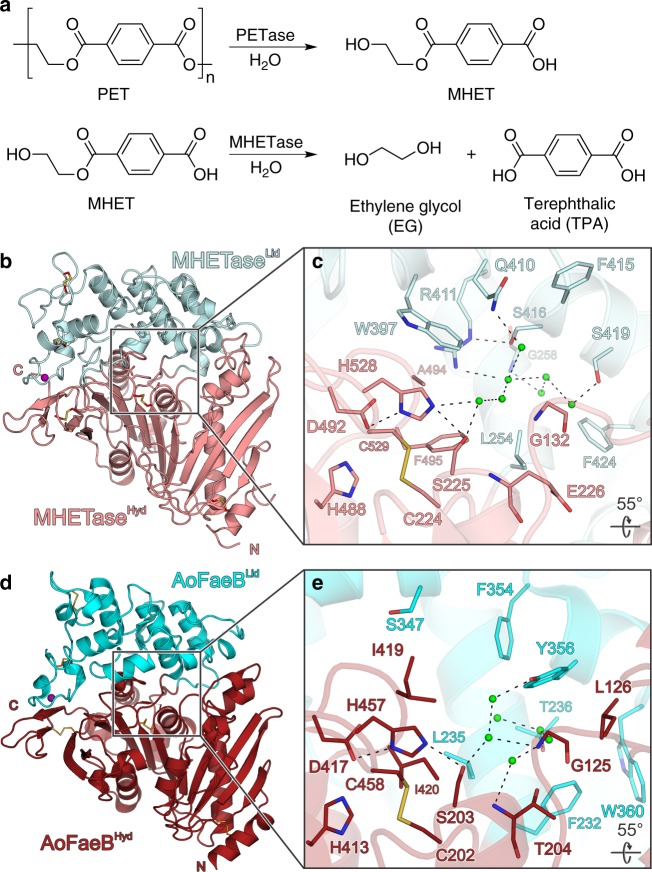
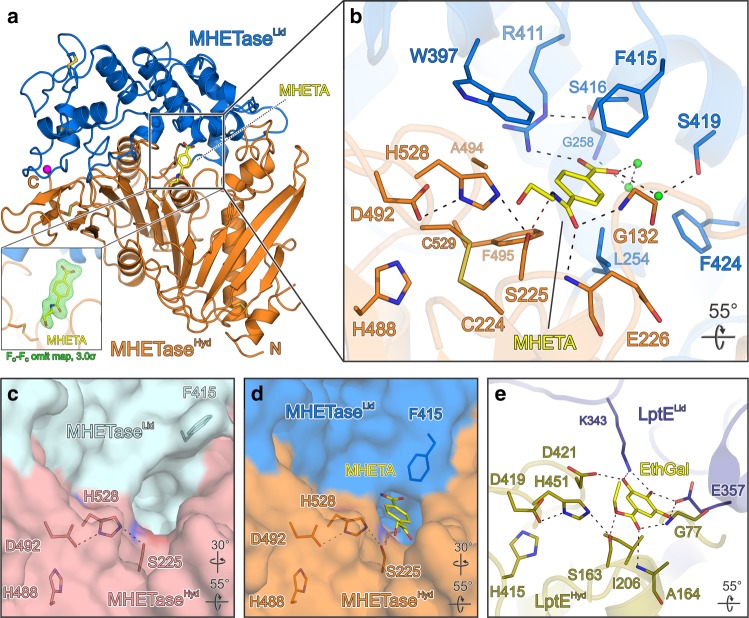
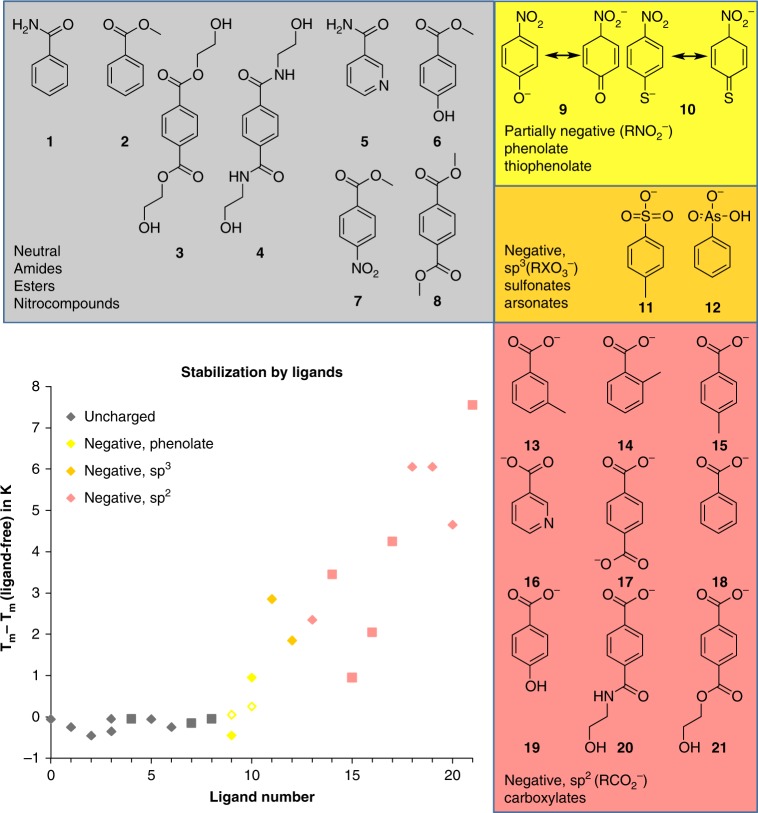
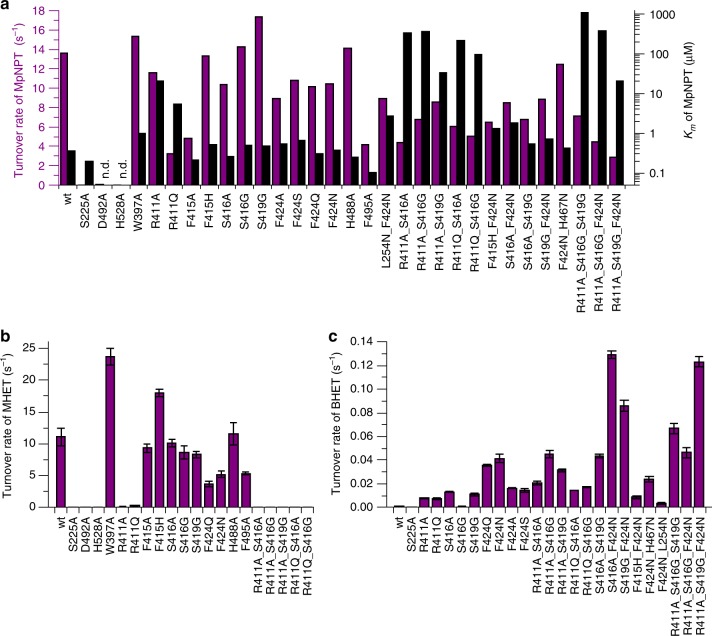
The extreme durability of polyethylene terephthalate (PET) debris has rendered it a long-term environmental burden. At the same time, current recycling efforts still lack sustainability. Two recently discovered bacterial enzymes that specifically degrade PET represent a promising solution. First, Ideonella sakaiensis PETase, a structurally well-characterized consensus α/β-hydrolase fold enzyme, converts PET to mono-(2-hydroxyethyl) terephthalate (MHET). MHETase, the second key enzyme, hydrolyzes MHET to the PET educts terephthalate and ethylene glycol. Here, we report the crystal structures of active ligand-free MHETase and MHETase bound to a nonhydrolyzable MHET analog. MHETase, which is reminiscent of feruloyl esterases, possesses a classic α/β-hydrolase domain and a lid domain conferring substrate specificity. In the light of structure-based mapping of the active site, activity assays, mutagenesis studies and a first structure-guided alteration of substrate specificity towards bis-(2-hydroxyethyl) terephthalate (BHET) reported here, we anticipate MHETase to be a valuable resource to further advance enzymatic plastic degradation.
Overview
The claims and statistics of this paper haven’t been checked yet.
Free: it reads the open-access text and checks the first 5 claims that cite a source we can check. Create a free account to check every claim.
Integrity signals
Registry
Cites
Statistics
Figures
Verification
Claims the paper makes
The claims and statistics of this paper haven’t been checked yet.
Free: it reads the open-access text and checks the first 5 claims that cite a source we can check. Create a free account to check every claim.
Self-check
Percentages, sums and reported differences re-computed from the paper’s own numbers.
The self-check needs the paper’s full text.
Citations
Cites
Basic local alignment search tool
Altschul, S. F., Gish, W., Miller, W., Myers, E. W., & Lipman, D. J. (1990) · Journal of Molecular Biology · doi:10.1006/jmbi.1990.9999 · Cited by 98,669
MEGA7: Molecular Evolutionary Genetics Analysis Version 7.0 for Bigger Datasets
Kumar, S., Stecher, G., & Tamura, K. (2016) · Molecular Biology and Evolution · doi:10.1093/molbev/msw054 · Cited by 44,059
Features and development of Coot
Emsley, P., Lohkamp, B., Scott, W. G., & Cowtan, K. (2010) · Acta Crystallographica Section D Biological Crystallography · doi:10.1107/s0907444910007493 · Cited by 29,915
Production, use, and fate of all plastics ever made
Geyer, R., Jambeck, J. R., & Law, K. L. (2017) · Science Advances · doi:10.1126/sciadv.1700782 · Cited by 18,606
Kabsch, W. (2010) · Acta Crystallographica Section D Biological Crystallography · doi:10.1107/s0907444909047337 · Cited by 16,463
Overview of the CCP 4 suite and current developments
Winn, M. D., Ballard, C. C., Cowtan, K. D., Dodson, E. J., Emsley, P., Evans, P. R., Keegan, R. M., Krissinel, E. B., Leslie, A. G. W., McCoy, A., et al. (2011) · Acta Crystallographica Section D Biological Crystallography · doi:10.1107/s0907444910045749 · Cited by 12,353
Lost at sea: where is all the plastic?
Thompson, R. C., Olsen, Y., Mitchell, R. P., Davis, A., Rowland, S. J., John, A. W. G., McGonigle, D., & Russell, A. E. (2004) · Science · doi:10.1126/science.1094559 · Cited by 7,765
The rapid generation of mutation data matrices from protein sequences
Jones, D. T., Taylor, W. R., & Thornton, J. M. (1992) · Bioinformatics · doi:10.1093/bioinformatics/8.3.275 · Cited by 6,947
Towards automated crystallographic structure refinement with phenix.refine
Afonine, P. V., Grosse-Kunstleve, R. W., Echols, N., Headd, J. J., Moriarty, N. W., Mustyakimov, M., Terwilliger, T. C., Urzhumtsev, A., Zwart, P. H., & Adams, P. D. (2012) · Acta Crystallographica Section D Biological Crystallography · doi:10.1107/s0907444912001308 · Cited by 5,511
Eriksen, M., Lebreton, L. C. M., Carson, H. S., Thiel, M., Moore, C. J., Borerro, J. C., Galgani, F., Ryan, P. G., & Reisser, J. (2014) · PLoS ONE · doi:10.1371/journal.pone.0111913 · Cited by 4,710
A bacterium that degrades and assimilates poly(ethylene terephthalate)
Yoshida, S., Hiraga, K., Takehana, T., Taniguchi, I., Yamaji, H., Maeda, Y., Toyohara, K., Miyamoto, K., Kimura, Y., & Oda, K. (2016) · Science · doi:10.1126/science.aad6359 · Cited by 3,367
Plastics Recycling: Challenges and Opportunities
Hopewell, J., Dvorak, R., & Kosior, E. (2009) · Philosophical Transactions of the Royal Society B: Biological Sciences · doi:10.1098/rstb.2008.0311 · Cited by 3,201
Plastics, the environment and human health: current consensus and future trends
Thompson, R. C., Moore, C. J., vom Saal, F. S., & Swan, S. H. (2009) · Philosophical Transactions of the Royal Society B: Biological Sciences · doi:10.1098/rstb.2009.0053 · Cited by 3,032
Classify plastic waste as hazardous
Rochman, C. M., Browne, M. A., Halpern, B. S., Hentschel, B. T., Hoh, E., Karapanagioti, H. K., Rios-Mendoza, L. M., Takada, H., Teh, S., & Thompson, R. C. (2013) · Nature · doi:10.1038/494169a · Cited by 1,752
Characterization and engineering of a plastic-degrading aromatic polyesterase
Austin, H. P., Allen, M. D., Donohoe, B. S., Rorrer, N. A., Kearns, F. L., Silveira, R. L., Pollard, B. C., Dominick, G., Duman, R., El Omari, K., et al. (2018) · Proceedings of the National Academy of Sciences · doi:10.1073/pnas.1718804115 · Cited by 1,079
Structural insight into molecular mechanism of poly(ethylene terephthalate) degradation
Joo, S., Cho, I. J., Seo, H., Son, H. F., Sagong, H.-Y., Shin, T. J., Choi, S. Y., Lee, S. Y., & Kim, K.-J. (2018) · Nature Communications · doi:10.1038/s41467-018-02881-1 · Cited by 802
Cutinase-Catalyzed Hydrolysis of Poly(ethylene terephthalate)
Ronkvist, Å. M., Xie, W., Lu, W., & Gross, R. A. (2009) · Macromolecules · doi:10.1021/ma9005318 · Cited by 708
Müller, R., Schrader, H., Profe, J., Dresler, K., & Deckwer, W. (2005) · Macromolecular Rapid Communications · doi:10.1002/marc.200500410 · Cited by 670
Automated Structure Solution with the PHENIX Suite
Zwart, P. H., Afonine, P. V., Grosse-Kunstleve, R. W., Hung, L.-W., Ioerger, T. R., McCoy, A. J., McKee, E., Moriarty, N. W., Read, R. J., Sacchettini, J. C., et al. (2008) · Methods in Molecular Biology · doi:10.1007/978-1-60327-058-8_28 · Cited by 553
Structural insight into catalytic mechanism of PET hydrolase
Han, X., Liu, W., Huang, J.-W., Ma, J., Zheng, Y., Ko, T.-P., Xu, L., Cheng, Y.-S., Chen, C.-C., & Guo, R.-T. (2017) · Nature Communications · doi:10.1038/s41467-017-02255-z · Cited by 544
Li, C., Wen, A., Shen, B., Lu, J., Huang, Y., & Chang, Y. (2011) · BMC Biotechnology · doi:10.1186/1472-6750-11-92 · Cited by 484
Facilities for macromolecular crystallography at the Helmholtz-Zentrum Berlin
Mueller, U., Darowski, N., Fuchs, M. R., Förster, R., Hellmig, M., Paithankar, K. S., Pühringer, S., Steffien, M., Zocher, G., & Weiss, M. S. (2012) · Journal of Synchrotron Radiation · doi:10.1107/s0909049512006395 · Cited by 396
Self-citationLenfant, N., Hotelier, T., Velluet, E., Bourne, Y., Marchot, P., & Chatonnet, A. (2012) · Nucleic Acids Research · doi:10.1093/nar/gks1154 · Cited by 317
XDSAPP: a graphical user interface for the convenient processing of diffraction data using XDS
Krug, M., Weiss, M. S., Heinemann, U., & Mueller, U. (2012) · Journal of Applied Crystallography · doi:10.1107/s0021889812011715 · Cited by 306
Self-citationActive Site Flexibility as a Hallmark for Efficient PET Degradation by I. sakaiensis PETase
Fecker, T., Galaz-Davison, P., Engelberger, F., Narui, Y., Sotomayor, M., Parra, L. P., & Ramírez-Sarmiento, C. A. (2018) · Biophysical Journal · doi:10.1016/j.bpj.2018.02.005 · Cited by 290
Roth, C., Wei, R., Oeser, T., Then, J., Föllner, C., Zimmermann, W., & Sträter, N. (2014) · Applied Microbiology and Biotechnology · doi:10.1007/s00253-014-5672-0 · Cited by 260
Wei, R., Oeser, T., Schmidt, J., Meier, R., Barth, M., Then, J., & Zimmermann, W. (2016) · Biotechnology and Bioengineering · doi:10.1002/bit.25941 · Cited by 248
Cianci, M., Bourenkov, G., Pompidor, G., Karpics, I., Kallio, J., Bento, I., Roessle, M., Cipriani, F., Fiedler, S., & Schneider, T. R. (2017) · Journal of Synchrotron Radiation · doi:10.1107/s1600577516016465 · Cited by 231
Tailoring cutinase activity towards polyethylene terephthalate and polyamide 6,6 fibers
Araújo, R., Silva, C., O’Neill, A., Micaelo, N., Guebitz, G., Soares, C. M., Casal, M., & Cavaco-Paulo, A. (2007) · Journal of Biotechnology · doi:10.1016/j.jbiotec.2006.12.028 · Cited by 213
Liu, B., He, L., Wang, L., Li, T., Li, C., Liu, H., Luo, Y., & Bao, R. (2018) · ChemBioChem · doi:10.1002/cbic.201800097 · Cited by 210
Engineered Thermobifida fusca cutinase with increased activity on polyester substrates
Silva, C., Da, S., Silva, N., Matamá, T., Araújo, R., Martins, M., Chen, S., Chen, J., Wu, J., Casal, M., et al. (2011) · Biotechnology Journal · doi:10.1002/biot.201000391 · Cited by 163
Bornscheuer, U. T. (2016) · Science · doi:10.1126/science.aaf2853 · Cited by 159
Self-citationCutinase—A new tool for biomodification of synthetic fibers
Silva, C. M., Carneiro, F., O'Neill, A., Fonseca, L. P., Cabral, J. S. M., Guebitz, G., & Cavaco‐Paulo, A. (2005) · Journal of Polymer Science Part A: Polymer Chemistry · doi:10.1002/pola.20684 · Cited by 142
Hong, S., Min, K.-D., Nam, B.-U., & Park, O. O. (2016) · Green Chemistry · doi:10.1039/c6gc01060a · Cited by 140
Zhang, Z., & VanEtten, R. L. (1991) · Journal of Biological Chemistry · doi:10.1016/s0021-9258(18)52325-5 · Cited by 120
Suzuki, K., Hori, A., Kawamoto, K., Thangudu, R. R., Ishida, T., Igarashi, K., Samejima, M., Yamada, C., Arakawa, T., Wakagi, T., et al. (2014) · Proteins Structure Function and Bioinformatics · doi:10.1002/prot.24649 · Cited by 87
Loop Grafting and the Origins of Enzyme Species
Tawfik, D. S. (2006) · Science · doi:10.1126/science.1123883 · Cited by 83
Crystal Structure of Tannase from Lactobacillus plantarum
Ren, B., Wu, M., Wang, Q., Peng, X., Wen, H., McKinstry, W. J., & Chen, Q. (2013) · Journal of Molecular Biology · doi:10.1016/j.jmb.2013.04.032 · Cited by 73
ω-HYDROXY-1-ALKANESULFONYL CHLORIDES
KING, J. F., Webster, M. R., Chiba, N., Allen, J. K., Parker, K. J., Rathore, R., & Skonieczny, S. (1987) · Phosphorous and Sulfur and the Related Elements · doi:10.1080/03086648708079353 · Cited by 11
Cited by
An engineered PET depolymerase to break down and recycle plastic bottles
Tournier, V., Topham, C. M., Gilles, A., David, B., Folgoas, C., Moya-Leclair, E., Kamionka, E., Desrousseaux, M.-L., Texier, H., Gavalda, S., et al. (2020) · Nature · doi:10.1038/s41586-020-2149-4 · Cited by 2,176
Chemical and biological catalysis for plastics recycling and upcycling
Ellis, L. D., Rorrer, N. A., Sullivan, K. P., Otto, M., McGeehan, J. E., Román-Leshkov, Y., Wierckx, N., & Beckham, G. T. (2021) · Nature Catalysis · doi:10.1038/s41929-021-00648-4 · Cited by 1,201
Plastics: Environmental and Biotechnological Perspectives on Microbial Degradation
Danso, D., Chow, J., & Streit, W. R. (2019) · Applied and Environmental Microbiology · doi:10.1128/aem.01095-19 · Cited by 918
Dogu, O., Pelucchi, M., Van de Vijver, R., Van Steenberge, P. H. M., D'hooge, D. R., Cuoci, A., Mehl, M., Frassoldati, A., Faravelli, T., & Van Geem, K. M. (2021) · Progress in Energy and Combustion Science · doi:10.1016/j.pecs.2020.100901 · Cited by 698
Polyethylene terephthalate (PET) in the packaging industry
Nisticò, R. (2020) · Polymer Testing · doi:10.1016/j.polymertesting.2020.106707 · Cited by 637
Metadata
- Authors
- Palm, G. J., Reisky, L., Böttcher, D., Müller, H., Michels, E. A. P., Walczak, M. C., Berndt, L., Weiss, M. S., Bornscheuer, U. T., & Weber, G.
- Affiliations
- Universität Greifswald (DE)
- Helmholtz-Zentrum Berlin für Materialien und Energie (DE)
- Corresponding author
- Bornscheuer, Uwe T.
- Weber, Gert
- ORCID
- Venue
- Nature Communications
- Published
- 2019-04-12
- Volume
- 10
- Issue
- 1
- Pages
- 1717-1717
- ISSN
- 2041-1723 (ISSN-L)
- PMC
- PMC6461665
- OpenAlex
- W2935008047
- Cited by
- 491
- References
- 40
- Citations by year
- 2026: 69 · 2025: 55 · 2024: 93 · 2023: 75 · 2022: 72 · 2021: 83 · 2020: 34 · 2019: 10
- FWCI
- 17.96
- Type
- journal article
- Language
- en
- Open access
- gold
- doi.org
- Licence
- cc-by
- creativecommons.org/licenses/by/4.0 (tdm)
- creativecommons.org/licenses/by/4.0 (vor)
- Locations
- Nature Communications (publishedVersion, cc-by)
- PubMed Central (publishedVersion, cc-by)
- PubMed (publishedVersion)
- HZB Repository (Helmholtz-Zentrum Berlin für Materialien und Energie GmbH (HZB)) (submittedVersion, other-oa)
- RePEc: Research Papers in Economics (submittedVersion)
- DESY Publication Database (PUBDB) (Deutsches Elektronen-Synchrotron) (submittedVersion, cc-by)
- DOAJ (DOAJ: Directory of Open Access Journals) (submittedVersion)
- DOAJ (DOAJ: Directory of Open Access Journals) (submittedVersion, cc-by-sa)
- Funders
- Humboldt-Universität zu Berlin
- Freie Universität Berlin
- Helmholtz-Zentrum Berlin für Materialien und Energie
- Deutsches Elektronen-Synchrotron
- Leibniz-Gemeinschaft
- Topics
- Life Sciences › Biochemistry, Genetics and Molecular Biology › Structural Biology › Enzyme Structure and Function
- Life Sciences › Biochemistry, Genetics and Molecular Biology › Biotechnology › Enzyme Production and Characterization
- Physical Sciences › Materials Science › Biomaterials › biodegradable polymer synthesis and properties
- Keywords
- Ideonella sakaiensis, MHETase, polyethylene terephthalate degradation, plastic biodegradation, alpha/beta hydrolase fold, feruloyl esterase, lid domain, substrate specificity, active site mapping, bis(2-hydroxyethyl) terephthalate, crystal structure
- MeSH terms
- Protein Domains, Burkholderiales, Biodegradation, Environmental, Enzymes, Fluorometry, Hydrolases, Hydrolysis, Ligands, Phthalic Acids, Phylogeny, Plastics, Polyethylene Terephthalates, Substrate Specificity, Mutagenesis, Mutagenesis, Site-Directed, Protein Structure, Secondary, Protein Folding, Ethylene Glycol, Catalytic Domain
About these checks
Registry, retraction, Cites and statistics results are computed, not judged, with one exception: a printed reference that no index lists is read once by a model before it counts as a citation error. Claims are extracted by a model and kept only when their quote appears verbatim in the text; each cited source is then checked, with a model’s help, for whether it says what the claim relies on. Those verdicts can be wrong — read the claim’s quote and the cited source before relying on one.
Statistics and arithmetic are recomputed, not judged.
Confidence bands are shown only for fields calibrated on our annotated test set. None is calibrated yet, so no band is shown.
What counts as a claim ›How we measure confidence ›How we check this ›
Are you an author, or do you see a problem with this page? Request a review
Data sources
Bibliographic data: Semantic Scholar, OpenAlex, Crossref.
Contains information from the Semantic Scholar Academic Graph Datasets, made available under the ODC Attribution License (ODC-BY 1.0).
Semantic Scholar’s data is described in: Kinney, R., et al. (2023). The Semantic Scholar Open Data Platform. arXiv:2301.10140.
