

Structure of the plastic-degrading Ideonella sakaiensis MHETase bound to a substrate
Open accessThe DOI matches its Crossref record; 39 of the 40 references it cites were found in a registry or an index.
Abstract
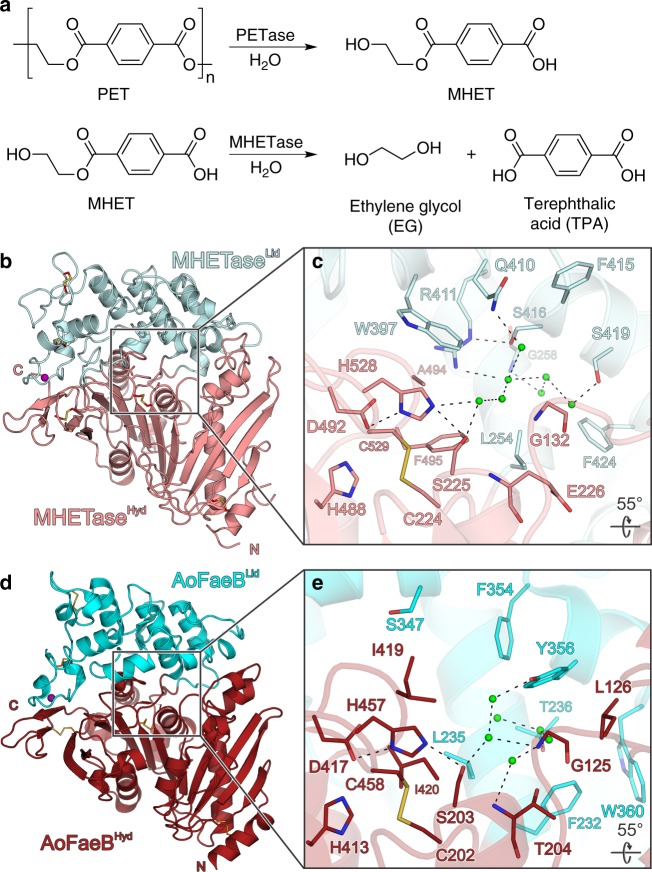
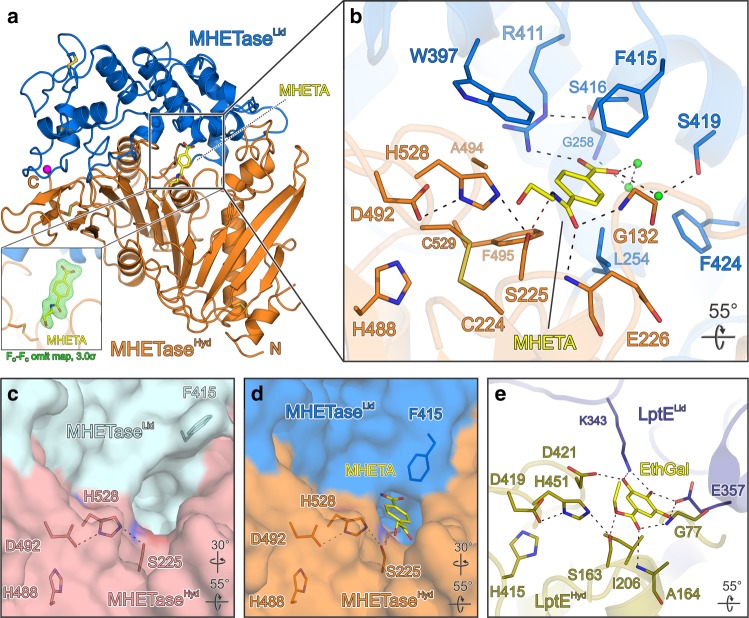
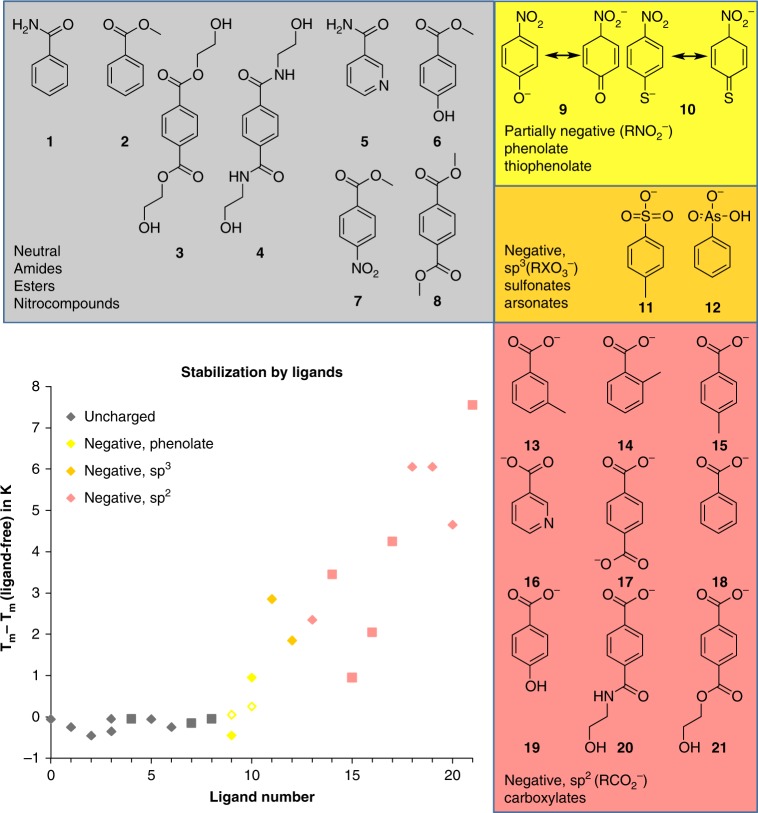
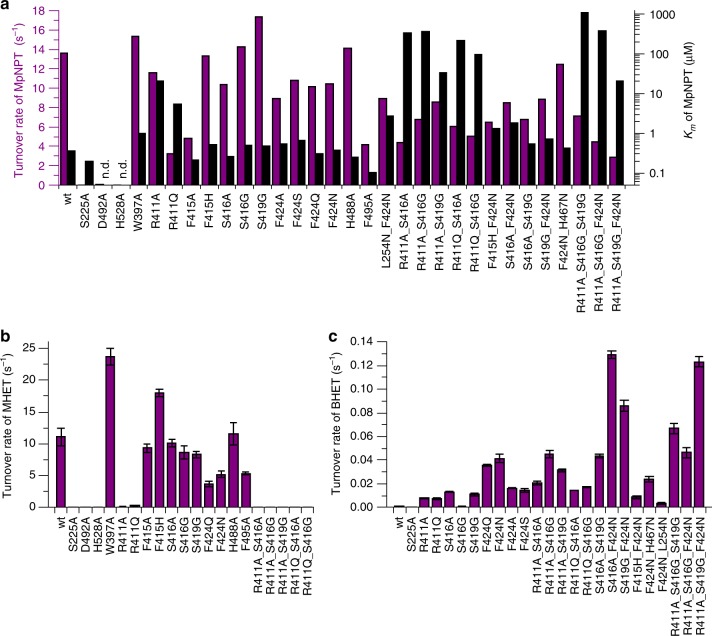
The extreme durability of polyethylene terephthalate (PET) debris has rendered it a long-term environmental burden. At the same time, current recycling efforts still lack sustainability. Two recently discovered bacterial enzymes that specifically degrade PET represent a promising solution. First, Ideonella sakaiensis PETase, a structurally well-characterized consensus α/β-hydrolase fold enzyme, converts PET to mono-(2-hydroxyethyl) terephthalate (MHET). MHETase, the second key enzyme, hydrolyzes MHET to the PET educts terephthalate and ethylene glycol. Here, we report the crystal structures of active ligand-free MHETase and MHETase bound to a nonhydrolyzable MHET analog. MHETase, which is reminiscent of feruloyl esterases, possesses a classic α/β-hydrolase domain and a lid domain conferring substrate specificity. In the light of structure-based mapping of the active site, activity assays, mutagenesis studies and a first structure-guided alteration of substrate specificity towards bis-(2-hydroxyethyl) terephthalate (BHET) reported here, we anticipate MHETase to be a valuable resource to further advance enzymatic plastic degradation.
Overview
The claims and statistics of this paper haven’t been checked yet.
Free: it reads the open-access text and checks the first 5 claims that cite a source we can check. Create a free account to check every claim.
Integrity signals
Registry
Cites
Statistics
Figures
Verification
Claims the paper makes
The claims and statistics of this paper haven’t been checked yet.
Free: it reads the open-access text and checks the first 5 claims that cite a source we can check. Create a free account to check every claim.
Self-check
Percentages, sums and reported differences re-computed from the paper’s own numbers.
The self-check needs the paper’s full text.
Citations
Cites
Basic local alignment search tool
Altschul, S. F., Gish, W., Miller, W., Myers, E. W., & Lipman, D. J. (1990) · Journal of Molecular Biology · doi:10.1006/jmbi.1990.9999 · Cited by 98,669
MEGA7: Molecular Evolutionary Genetics Analysis Version 7.0 for Bigger Datasets
Kumar, S., Stecher, G., & Tamura, K. (2016) · Molecular Biology and Evolution · doi:10.1093/molbev/msw054 · Cited by 44,059
Features and development of Coot
Emsley, P., Lohkamp, B., Scott, W. G., & Cowtan, K. (2010) · Acta Crystallographica Section D Biological Crystallography · doi:10.1107/s0907444910007493 · Cited by 29,915
Production, use, and fate of all plastics ever made
Geyer, R., Jambeck, J. R., & Law, K. L. (2017) · Science Advances · doi:10.1126/sciadv.1700782 · Cited by 18,606
Kabsch, W. (2010) · Acta Crystallographica Section D Biological Crystallography · doi:10.1107/s0907444909047337 · Cited by 16,463
Overview of the CCP 4 suite and current developments
Winn, M. D., Ballard, C. C., Cowtan, K. D., Dodson, E. J., Emsley, P., Evans, P. R., Keegan, R. M., Krissinel, E. B., Leslie, A. G. W., McCoy, A., et al. (2011) · Acta Crystallographica Section D Biological Crystallography · doi:10.1107/s0907444910045749 · Cited by 12,353
Lost at sea: where is all the plastic?
Thompson, R. C., Olsen, Y., Mitchell, R. P., Davis, A., Rowland, S. J., John, A. W. G., McGonigle, D., & Russell, A. E. (2004) · Science · doi:10.1126/science.1094559 · Cited by 7,765
The rapid generation of mutation data matrices from protein sequences
Jones, D. T., Taylor, W. R., & Thornton, J. M. (1992) · Bioinformatics · doi:10.1093/bioinformatics/8.3.275 · Cited by 6,947
Towards automated crystallographic structure refinement with phenix.refine
Afonine, P. V., Grosse-Kunstleve, R. W., Echols, N., Headd, J. J., Moriarty, N. W., Mustyakimov, M., Terwilliger, T. C., Urzhumtsev, A., Zwart, P. H., & Adams, P. D. (2012) · Acta Crystallographica Section D Biological Crystallography · doi:10.1107/s0907444912001308 · Cited by 5,511
Eriksen, M., Lebreton, L. C. M., Carson, H. S., Thiel, M., Moore, C. J., Borerro, J. C., Galgani, F., Ryan, P. G., & Reisser, J. (2014) · PLoS ONE · doi:10.1371/journal.pone.0111913 · Cited by 4,710
Cited by
Items 201–300 of 514
Muneer, F. (2021) · Materials research foundations · doi:10.21741/9781644901335-9 · Cited by 27
Recent studies on enzyme-catalysed recycling and biodegradation of synthetic polymers
Lens-Pechakova, L. S. (2021) · Advanced Industrial and Engineering Polymer Research · doi:10.1016/j.aiepr.2021.06.005 · Cited by 29
Mahto, J. K., Neetu, N., Sharma, M., Dubey, M., Vellanki, B. P., & Kumar, P. (2022) · Journal of Bacteriology · doi:10.1128/jb.00543-21 · Cited by 26
Chen, Y., Wang, Y., Xu, Y., Sun, J., Yang, L., Feng, C., Wang, J., Zhou, Y., Zhang, Z.-M., & Wang, Y. (2023) · Communications Chemistry · doi:10.1038/s42004-023-00846-0 · Cited by 24
The crystal structure of aFusarium oxysporumferuloyl esterase that belongs to the tannase family
Dimarogona, M., Topakas, E., Christakopoulos, P., & Chrysina, E. D. (2020) · FEBS Letters · doi:10.1002/1873-3468.13776 · Cited by 24
Ricarte, G. N., Dias, M. L., Sirelli, L., Langone, M. A. P., de Castro, A. M., Coelho, M. A. Z., & Ribeiro, B. D. (2021) · Journal of Chemical Technology & Biotechnology · doi:10.1002/jctb.6882 · Cited by 24
Taxeidis, G., Nikolaivits, E., Nikodinović‐Runić, J., & Topakas, E. (2024) · Environmental Pollution · doi:10.1016/j.envpol.2024.124347 · Cited by 25
Pham, D. D., Ho, T. H., Cao, A. N. T., Vu, T. V., Doan, T. L. L., Vo, D. N., Nguyen, D. L. T., & Nguyen, T. M. (2024) · Chemical Engineering Journal · doi:10.1016/j.cej.2024.153380 · Cited by 24
An overview on role of fungi in systematic plastic degradation
Varshney, S., Gupta, V., Yadav, A. N., Rahi, R. K., Devki, D., & Neelam, D. K. (2022) · Journal of Applied Biology & Biotechnology · doi:10.7324/jabb.2023.108929 · Cited by 26
Use of Lipases as a Sustainable and Efficient Method for the Synthesis and Degradation of Polymers
García, F. F., & Liñares, G. G. (2023) · Journal of Polymers and the Environment · doi:10.1007/s10924-023-03118-z · Cited by 25
“…PET-degrading bacteria Ide-onella sakaiensis led to the posterior isolation and characterization of a hydrolase with a catalytic preference of PET to aliphatic esters; thus, the enzyme was designed as an PETase [243]; an MHETase from the same biological source has also been described [243, 244].”
Satta, A., Ghiotto, G., Santinello, D., Giangeri, G., Bergantino, E., Modesti, M., Raga, R., Treu, L., Campanaro, S., & Zampieri, G. (2024) · The Science of The Total Environment · doi:10.1016/j.scitotenv.2024.174696 · Cited by 24
Jäckering, A., van der Kamp, M. W., Strodel, B., & Zinovjev, K. (2024) · Journal of Chemical Information and Modeling · doi:10.1021/acs.jcim.4c00776 · Cited by 22
“15,16 26,30 − 32 Product diffusion from the active site, necessary for subsequent substrate hydrolysis, may also be rate-limiting, as suggested by Shrimpton-Phoenix et al., 31 though others contest this notion.”
BackgroundComplete Depolymerization of PET Wastes by an Evolved PET Hydrolase from Directed Evolution
Shi, L., Liu, P., Tan, Z., Zhao, W., Gao, J., Gu, Q., Ma, H., Liu, H., & Zhu, L. (2023) · Angewandte Chemie · doi:10.1002/ange.202218390 · Cited by 22
Mechanoenzymatic reactions for the hydrolysis of PET
Ambrose-Dempster, E., Leipold, L., Dobrijevic, D., Bawn, M., Carter, E. M., Stojanovski, G., Sheppard, T. D., Jeffries, J. W. E., Ward, J. M., & Hailes, H. C. (2023) · RSC Advances · doi:10.1039/d3ra01708g · Cited by 23
Analytical tools to assess polymer biodegradation: A critical review and recommendations
Colachis, M., Lilly, J. L., Trigg, E., & Kucharzyk, K. H. (2024) · Science of The Total Environment · doi:10.1016/j.scitotenv.2024.176920 · Cited by 21
Wang, H., Zhu, J., Sun, M., Gu, M., Xie, X., Ying, T., Zhang, Z., & Zhong, W. (2024) · Synthetic and Systems Biotechnology · doi:10.1016/j.synbio.2024.08.001 · Cited by 21
“S1), indicating that I. sakaiensis has evolved a distinct strategy to mitigate the impact of product inhibition [10].”
BackgroundState-of-the-art advances in biotechnology for polyethylene terephthalate bio-depolymerization
Liu, Y., Zhou, J., Li, Y., Yan, X., Xu, A., Zhou, X., Liu, W., Xu, Y., Su, T., Wang, S., et al. (2025) · Green Carbon · doi:10.1016/j.greenca.2025.02.003 · Cited by 22
Sustainable degradation of synthetic plastics: A solution to rising environmental concerns
Shah, M. Z., Quraishi, M., Sreejith, A., Pandit, S., Roy, A., & Khandaker, M. U. (2024) · Chemosphere · doi:10.1016/j.chemosphere.2024.141451 · Cited by 21
Ding, K., Levitskaya, Z., Sana, B., Pasula, R. R., Kannan, S., Adam, A., Vadanan, S. V., Verma, C. S., Lim, S., & Ghadessy, J. F. (2024) · Biochemical Engineering Journal · doi:10.1016/j.bej.2024.109420 · Cited by 21
A Valuable Source of Promising Extremophiles in Microbial Plastic Degradation
Pham, V. H. T., Kim, J., & Chang, S. W. (2024) · Polymers · doi:10.3390/polym16152109 · Cited by 23
Leitão, A. L., & Enguita, F. J. (2021) · International Journal of Molecular Sciences · doi:10.3390/ijms22052332 · Cited by 22
“The catalytic center is typically constituted by three amino acids, Asp (D), His (H) and Ser (S), which are located in the walls of a deep surface pocket [38].”
BackgroundHuang, S., Jiang, F., Dong, Q., Yu, J., Fan, K., Wang, Z., Hao, S., & Qiao, Y. (2025) · Frontiers in Environmental Science · doi:10.3389/fenvs.2025.1674490 · Cited by 21
Dehal, A., Prajapati, A., Patil, M. P., & Kumar, A. R. (2023) · Chemistry and Ecology · doi:10.1080/02757540.2023.2290183 · Cited by 20
Microplastic accumulation in soils: Unlocking the mechanism and biodegradation pathway
Nguyen, M., Rakib, M. R. J., Hwangbo, M., & Kim, J.-S. (2025) · Journal of Hazardous Materials Advances · doi:10.1016/j.hazadv.2025.100629 · Cited by 29
Fu, Z., Zhu, Y., Teng, C., Fan, G., & Li, X. (2021) · 3 Biotech · doi:10.1007/s13205-021-03066-2 · Cited by 20
Zielli, S. O., Pascali, J. P., Mazzotti, A., Fais, P., Fini, M., Faldini, C., & Pelotti, S. (2026) · Talanta Open · doi:10.1016/j.talo.2026.100615 · Cited by 19
Widespread distribution of bacteria containing PETases with a functional motif across global oceans
Alam, I. S., Marasco, R., Momin, A. A., Aalismail, N., Laiolo, E., Martin, C., Sanz-Sáez, I., Foix, B. B., Sà, E. L., Kamau, A. A., et al. (2025) · The ISME Journal · doi:10.1093/ismejo/wraf121 · Cited by 22
Microbe‐mediated biodegradation of microplastics from wastes
Chettri, D., Pati, T., & Verma, A. K. (2023) · Water and Environment Journal · doi:10.1111/wej.12882 · Cited by 21
“…pathways such as the synthesis of different enzymes that bring about the degradation of MP for their use as a carbon source (Padervand et al., 2020 has been found to produce PETase and MHETase enzymes, which can bring about the degradation of PET (Palm et al., 2019; Tanasupawat et al., 2016).”
BackgroundInfluentialHan, Z., Nina, M. R. H., Zhang, X., Huang, H., Fan, D., & Bai, Y. (2024) · Journal of Hazardous Materials · doi:10.1016/j.jhazmat.2024.134532 · Cited by 19
Teiba, I. I., El-Bilawy, E. H., Abouelsaad, I. A., Shehata, A. I., Alhoshy, M., Habib, Y. J., Abu‐Elala, N. M., El-Khateeb, N. M. M., Belal, E. B., & Hussain, W. A. M. (2024) · Environmental Science and Pollution Research · doi:10.1007/s11356-024-35520-y · Cited by 22
“Similarly, Ideonella sakaiensis exhibits a remarkable synergistic action between its PETase and MHETase enzymes, effectively breaking down PET into TPA and ethylene glycol (Palm et al. 2019).”
β-sheet Engineering of IsPETase for PET Depolymerization
Gao, S., Shi, L., Wei, H., Liu, P., Zhao, W., Gong, L., Tan, Z., Zhai, H., Liu, W., Liu, H., et al. (2024) · Engineering · doi:10.1016/j.eng.2024.10.015 · Cited by 20
Evaluation of chemicals leached from PET and recycled PET containers into beverages
Steimel, K. E. G., Hwang, R., Dinh, D., Donnell, M. T., More, S. L., & Fung, E. S. (2022) · Reviews on Environmental Health · doi:10.1515/reveh-2022-0183 · Cited by 19
Self-Standing Single-Ion Borate Salt-Based Polymer Electrolyte for Lithium Metal Batteries
Han, C., Qiao, L., Xu, G. J., Chen, G., Chen, K., Zhang, S., Ma, J., Dong, S., Zhou, X., Han, Y., et al. (2023) · ACS Applied Materials & Interfaces · doi:10.1021/acsami.3c15703 · Cited by 18
Increased cytoplasmic expression of PETase enzymes in E. coli
Carter, L., MacFarlane, C. E., Karlock, S. P., Sen, T., Kaar, J. L., Berberich, J. A., & Boock, J. T. (2024) · Microbial Cell Factories · doi:10.1186/s12934-024-02585-w · Cited by 18
Chen, Z., Xiao, Y., Weber, G., Wei, R., & Wang, Z. (2021) · Methods in enzymology on CD-ROM/Methods in enzymology · doi:10.1016/bs.mie.2020.12.030 · Cited by 19
Self-citationA mini-review on the role of PETase in polyethylene terephthalate degradation
Ermiş, H. (2025) · Reviews in Environmental Science and Bio/Technology · doi:10.1007/s11157-025-09737-3 · Cited by 17
“Two α/β-hydrolase fold enzymes (α/β-hydrolases), PETase and MHETase, work together to degrade PET in two steps via MHET, yielding TPA and ethylene glycol-the building blocks required for a new round of PET synthesis (Palm, et al. 2019).”
Zhou, X., Zhou, X., Xu, Z., Zhang, M., & Zhu, H. (2024) · Frontiers in Bioengineering and Biotechnology · doi:10.3389/fbioe.2024.1349010 · Cited by 17
Miao, R., Xu, G., Ding, Y., Ding, Z., Woodard, J. C., Tu, T., Luo, H., Wu, N., Yao, B., Guan, F., et al. (2024) · Bioresource Technology · doi:10.1016/j.biortech.2024.131556 · Cited by 17
Upcycling of hydrolyzed PET by microbial conversion to a fatty acid derivative
Welsing, G., Wolter, B., Hintzen, H. M. T., Tiso, T., & Blank, L. M. (2021) · Methods in enzymology on CD-ROM/Methods in enzymology · doi:10.1016/bs.mie.2020.12.025 · Cited by 19
Magalhães, R. P., Fernandes, H. S., & Sousa, S. F. (2022) · Catalysis Science & Technology · doi:10.1039/d1cy02271g · Cited by 18
Managing plastic waste with nanotechnology: current sustainability prospects
Kandpal, A., Singh, A., Jain, D., Upadhyay, S. K., Siddiqui, A. J., Sharma, K., & Saxena, J. (2023) · Nanotechnology for Environmental Engineering · doi:10.1007/s41204-023-00346-5 · Cited by 18
“…by the action of extracellular enzymes, and these smaller subunits are then metabolized by microbes as carbon source and for their energy requirement, like recently discovered microbe; Ideonella sakaiensis PETase enzyme of bacterial strain Ideonella sakaiensis 201-F6 that can degrade PET [65].”
BackgroundSaunders, J. W., Damry, A. M., Vongsouthi, V., Spence, M. A., Frkic, R. L., Gomez, C., Yates, P., Matthews, D. S., Tokuriki, N., McLeod, M. D., et al. (2024) · Biochemistry · doi:10.1021/acs.biochem.4c00165 · Cited by 16
Tanaka, Y., Hiraga, K., & Inui, M. (2024) · FEBS Journal · doi:10.1111/febs.17240 · Cited by 16
Crystal structure of fungal tannase from Aspergillus niger
Dong, L., McKinstry, W. J., Pan, L., Newman, J. M., & Ren, B. (2021) · Acta Crystallographica Section D Structural Biology · doi:10.1107/s2059798320016484 · Cited by 16
Chen, L., Fan, F., Yang, M., Wang, L., Bai, Y., Qiu, S., Lyu, C., & Huang, J. (2023) · Physical Chemistry Chemical Physics · doi:10.1039/d3cp01700a · Cited by 16
Platero-Rochart, D., Krivobokova, T., Gastegger, M., Reibnegger, G., & Sánchez-Murcia, P. A. (2023) · Journal of Chemical Information and Modeling · doi:10.1021/acs.jcim.3c00772 · Cited by 15
“…degree of the initial plastic substrate; and (iv) there are currently available some experimental structures of the enzyme in complex with small molecules like the substrate analogue MHETA (PDB id. 6QGA), 65 and (v) because of the scientific and industrial relevance of PETases and related enzymes.”
InfluentialA broad horizon for sustainable catalytic oxidation of microplastics
Zhuo, M., Chen, Z., Liu, X., Wei, W., Shen, Y., & Ni, B. (2023) · Environmental Pollution · doi:10.1016/j.envpol.2023.122835 · Cited by 15
Review on impacts of micro- and nano-plastic on aquatic ecosystems and mitigation strategies
Scaria, S. S., Balasubramanian, B., Dandin, V. S., Meyyazhagan, A., Pappuswamy, M., Sattanathan, G., Liu, W., Joseph, K. S., & Park, S. (2023) · Aquatic Toxicology · doi:10.1016/j.aquatox.2023.106759 · Cited by 15
Recent advances in screening and identification of PET-degrading enzymes
Sun, S. (2024) · Environmental Reviews · doi:10.1139/er-2023-0107 · Cited by 16
Zhou, Y., Zhang, J., You, S., Lin, W., Zhang, B., Wang, M., Su, R., & Qi, W. D. (2024) · Bioresource Technology · doi:10.1016/j.biortech.2024.131461 · Cited by 15
Dewi, S., Horbach, T., Neumann, T., Jaeger, K., Streit, W. R., & Hartmann, L. (2025) · Journal of Polymer Science · doi:10.1002/pol.20250254 · Cited by 15
Structural analysis of PET-degrading enzymes PETase and MHETase from Ideonella sakaiensis
Graf, L. G., Michels, E. A. P., Yew, Y., Liu, W., Palm, G. J., & Weber, G. (2021) · Methods in enzymology on CD-ROM/Methods in enzymology · doi:10.1016/bs.mie.2020.12.015 · Cited by 15
Self-citationEugenio, E. D. Q., Campisano, I. S. P., de Castro, A. M., Coelho, M. A. Z., & Langone, M. A. P. (2021) · Journal of Biotechnology · doi:10.1016/j.jbiotec.2021.09.007 · Cited by 15
Eugenio, E. D. Q., Campisano, I. S. P., Dias, A. G., de Castro, A. M., Coelho, M. A. Z., & Langone, M. A. P. (2022) · Journal of Biotechnology · doi:10.1016/j.jbiotec.2022.08.019 · Cited by 15
Buhari, S. B., Nezhad, N. G., Normi, Y. M., Shariff, F. M., & Leow, T. C. (2024) · 3 Biotech · doi:10.1007/s13205-023-03882-8 · Cited by 16
“The structure of MHETase was first uncovered in 2019, and was found to show the common fold of the alpha/beta hydrolase superfamily (Palm et al. 2019).”
InfluentialAmanna, R., & Rakshit, S. K. (2023) · Biodegradation · doi:10.1007/s10532-023-10048-z · Cited by 14
“These features generate enzymes with increased substrate promis-cuity (Palm et al. 2019).”
Taxeidis, G., Djapovic, M., Nikolaivits, E., Maslak, V., Nikodinović‐Runić, J., & Topakas, E. (2024) · ACS Sustainable Chemistry & Engineering · doi:10.1021/acssuschemeng.4c00143 · Cited by 15
Genetically Engineered Plastic Munching Microbes: Recent Advancements and Perspectives
Saini, N., Bharti, D., Singh, S., Banoo, R., Bundela, V., Nain, P., & Sahgal, M. (2024) · Springer eBooks · doi:10.1007/978-3-031-55661-6_8 · Cited by 18
Chen, S., Huang, Q., Li, Y., Wu, J., Chen, S., & Yan, Z. (2024) · Journal of Hazardous Materials · doi:10.1016/j.jhazmat.2024.135895 · Cited by 14
Zheng, Y., Zhang, J., Gu, T., Wang, M., You, S., Su, R., & Qi, W. D. (2025) · ACS Synthetic Biology · doi:10.1021/acssynbio.5c00745 · Cited by 13
Safdar, A., Ismail, F., Safdar, M., & Imran, M. (2024) · Biodegradation · doi:10.1007/s10532-023-10062-1 · Cited by 15
“Additionally, the action of MHETase hydrolyzes MHET to produce TPA and ethylene glycol (EG) (Palm et al. 2019).”
Bai, J., Wang, Y., Li, W., Si, C., Lan, Z., Liu, Y., Nakanishi, H., & Li, Z. (2024) · International Journal of Biological Macromolecules · doi:10.1016/j.ijbiomac.2024.138308 · Cited by 13
Zhou, Y. K., Wang, L., Sui, J., Chen, F., Wang, T., Yang, J., Chen, S., Cui, X., Yang, Y. J., & Zhang, W. (2025) · Journal of Agricultural and Food Chemistry · doi:10.1021/acs.jafc.4c10387 · Cited by 13
Schnitzler, L., Zarzycki, J., Gerhard, M., Konde, S., Rexer, K., Erb, T. J., Maier, U. G., Koch, M., Hofmann, M. R., & Moog, D. (2021) · Marine Pollution Bulletin · doi:10.1016/j.marpolbul.2020.111950 · Cited by 15
Remediation of Water Pollution by Plastics
Muneer, F., Azam, M. H., Zubaır, M., Farooq, T., Ibrahim, M., Rasul, I., Afzal, M., Ahmad, A., & Nadeem, H. (2021) · Environmental chemistry for a sustainable world · doi:10.1007/978-3-030-52395-4_3 · Cited by 22
Jung, J. P., Lee, J., & Sharma, A. (2022) · ACS Applied Electronic Materials · doi:10.1021/acsaelm.1c01195 · Cited by 13
Enzymatic depolymerization of plastic materials by a highly efficient two-enzyme system
Sun, J., Pang, Y., Lei, Z., OuYang, B., Lai, W., Wang, Y., & Lan, D. (2024) · Biochemical Engineering Journal · doi:10.1016/j.bej.2024.109222 · Cited by 12
Effendi, S. S. W., Hu, R.-E., Hsiang, C., Ting, W., Huang, C., & Ng, I. (2024) · Process Biochemistry · doi:10.1016/j.procbio.2024.03.001 · Cited by 12
Fine tuning enzyme activity assays for monitoring the enzymatic hydrolysis of PET
Boros, K., Nagy, B. E., Tomoiagă, R. B., Tőtős, R., Toșa, M. I., Paizs, C., & Bencze, L. C. (2025) · Scientific Reports · doi:10.1038/s41598-024-84177-7 · Cited by 12
“Terephthalic acid (TPA) was purchased from Alfa Aesar, while mono-(2-hydroxyethyl) terephthalic acid (MHET) was synthesized following the reported procedure 40 .”
Baum, C. M., Sick, N., & Bröring, S. (2025) · Technovation · doi:10.1016/j.technovation.2025.103173 · Cited by 12
Guidelines toward ecologically-informed bioprospecting for microbial plastic degradation
Cai, F. M., Jiang, S., Daly, P., Bakhshi, M., Cartwright, K., & Druzhinina, I. S. (2025) · Biotechnology Advances · doi:10.1016/j.biotechadv.2025.108590 · Cited by 13
Xu, H., & Yu, Z. (2025) · The Journal of Physical Chemistry Letters · doi:10.1021/acs.jpclett.5c01299 · Cited by 13
Microbiome Diversity Analysis of the Bacterial Community in Idah River, Kogi State, Nigeria
Adedire, D. E., Jimoh, A. O., Kashim-Bello, Z., Shuaibu, B. A. W., Popoola, O. A., Pate, K. I., Uzor, O. S., Etingwa, E., Joda, J. F., Opaleye, O. O., et al. (2022) · Advances in Microbiology · doi:10.4236/aim.2022.125025 · Cited by 12
Biodegradability and current status of polyethylene terephthalate
Amobonye, A., Aruwa, C. E., & Pillai, S. (2023) · Elsevier eBooks · doi:10.1016/b978-0-323-89858-4.00011-7 · Cited by 17
Weiland, M. H. (2020) · ACS symposium series · doi:10.1021/bk-2020-1357.ch008 · Cited by 20
Harnessing proteins for engineered living materials
Xu, L., Wang, X., Sun, F., Cao, Y., Zhong, C., & Zhang, W. (2021) · Current Opinion in Solid State and Materials Science · doi:10.1016/j.cossms.2020.100896 · Cited by 13
Salam, M. D., Varma, A., Prashar, R., & Choudhary, D. (2021) · Applied ecology and environmental sciences/Applied ecology and environmental science · doi:10.12691/aees-9-7-8 · Cited by 12
Heinks, T., Hofmann, K., Last, S., Gamm, I., Blach, L., Wei, R., Bornscheuer, U. T., Hamel, C., & von Langermann, J. (2024) · ChemSusChem · doi:10.1002/cssc.202401759 · Cited by 15
Self-citationInsights Into the Efficiency and Health Impacts of Emerging Microplastic Bioremediation Approaches
Ngaba, M. J. Y., Rennenberg, H., & Hu, B. (2025) · Global Change Biology · doi:10.1111/gcb.70226 · Cited by 13
“It secretes enzymes that break down PET into smaller, nontoxic molecules, highlighting the potential of enhanced biodegradation for effective microplastic cleanup (Palm et al. 2019; Taniguchi et al. 2019; Yoshida et al. 2021).”
Kaur, K., Sharma, S., Shree, N., & Mehrotra, R. (2023) · Biosciences Biotechnology Research Asia · doi:10.13005/bbra/3063 · Cited by 11
Zhang, R., Zheng, X., Cheng, X., Xu, J., Li, Y., Zhou, Q., Xin, J., Yan, D., & Lü, X. (2024) · Materials · doi:10.3390/ma17071583 · Cited by 11
“Furthermore, while PET itself is considered nontoxic, certain additives and colorants present in PET products have the potential to accumulate in the body and lead to toxicity in organisms [5].”
BackgroundFu, Z., Fan, G., Zhu, Y., Teng, C., Li, H., Liu, Q., Yang, R., & Li, X. (2020) · Biotechnology & Biotechnological Equipment · doi:10.1080/13102818.2020.1803129 · Cited by 11
A distal regulatory strategy of enzymes: from local to global conformational dynamics
Xue, P., Lu, C., Pang, J., Liu, Z., & Lu, D. (2021) · Physical Chemistry Chemical Physics · doi:10.1039/d1cp01519b · Cited by 11
Zara, Z., Mishra, D., Pandey, S. K., Cséfalvay, E., Fadaei, F., Minofar, B., & Řeha, D. (2021) · Molecules · doi:10.3390/molecules27010119 · Cited by 11
“PETase works with a two-step process of degradation, at the first step, it degrades the PET into Mono-(2-hydroxyethyl) terephthalate (MHET) and then the different enzyme MHETase degrades the MHET into TPA and ethylene glycol [34].”
BackgroundTHE OCCURRENCE OF MICROPLASTICS ON THE START-UP PROCESS OF AN ANOXIC BIOFILM BATCH REACTOR
Nur, A. (2022) · International Journal of Geomate · doi:10.21660/2022.90.gxi289 · Cited by 14
Singh, S., Soni, M., Gupta, N., Sandhu, P., Tripathi, D., Pratap, J. V., Subramanian, S., & Manickam, N. (2024) · Biochemical and Biophysical Research Communications · doi:10.1016/j.bbrc.2024.150833 · Cited by 10
Emerging issues and challenges for plastic bioremediation
Mohan, L., Cherian, E., & Joshi, T. J. (2022) · Elsevier eBooks · doi:10.1016/b978-0-323-90452-0.00010-4 · Cited by 15
Almeida, D. V., Ciancaglini, I., Sandano, A. L. H., Román, E. K. B., Andrade, V. B., Nunes, A. B., Tramontina, R., da Silva, V. M., Gabel, F., Côrrea, T. L. R., et al. (2024) · Enzyme and Microbial Technology · doi:10.1016/j.enzmictec.2024.110498 · Cited by 10
Li, M., Chen, Z., Zhang, W., Wu, T., Qi, Q., & Huo, Y. (2025) · Advanced Science · doi:10.1002/advs.202413205 · Cited by 10
Duru, C. E., Enyoh, C. E., Duru, I. A., & Enedoh, M. C. (2023) · Journal of the Nigerian Society of Physical Sciences · doi:10.46481/jnsps.2023.1154 · Cited by 10
Feng, S., Xue, M., Xie, F., Zhao, H., & Xue, Y. (2024) · Journal of Agricultural and Food Chemistry · doi:10.1021/acs.jafc.4c01973 · Cited by 9
Hong, A., Vispute, A., Turner, S., Glazer, R., Weishampel, Z. A., Huang, A., Holmes, Z. A., Schleupner, B., Dunphy‐Daly, M. M., Eward, W. C., et al. (2024) · The Science of The Total Environment · doi:10.1016/j.scitotenv.2025.179075 · Cited by 9
Al‐Madhagi, H. (2025) · Green Chemistry Letters and Reviews · doi:10.1080/17518253.2025.2535390 · Cited by 9
“Together, PETase and MHETase degrade PET through an intermediate MHET stage, producing simpler components essential for synthesizing new PET ( 138,147 ).”
Ujuagu, G. I., Ejeromedoghene, O., Oladoye, P. O., Okoye, C. O., Alli, Y. A., Oladipo, M. E., & Gu, J. (2025) · Environmental Pollution and Management · doi:10.1016/j.epm.2025.07.006 · Cited by 11
Engineering IsPETase and Its Homologues: Advances in Enzyme Discovery and Host Optimisation
Ogunlusi, T. S., Ikoyo, S. S., Dadashipour, M., & Gao, H. (2025) · International Journal of Molecular Sciences · doi:10.3390/ijms26146797 · Cited by 9
“Is PETase exhibits increased activity at ambient temperatures and acts specifically on highly crystalline PET [10], while the high-resolution (0.92 Å) X-Ray crystal structure of Is PETase provided more information on the enzyme’s working mechanism and suggested that it is not fully optimised for…”
InfluentialRomero-Orejón, K. L., Karbalaei‐Heidari, H. R., Budiša, N., & Levin, D. B. (2026) · Journal of Hazardous Materials · doi:10.1016/j.jhazmat.2026.141170 · Cited by 9
Cea‐Rama, I., Coscolín, C., González-Alfonso, J. L., Raj, J., Vasiljević, M., Plou, F. J., Ferrer, M., & Sanz‐Aparicio, J. (2022) · FEBS Journal · doi:10.1111/febs.16554 · Cited by 9
Microbial Degradation of Plastics
Sebastian, A., Paul, A. M., Dominic, D., Shaji, M., Jose, P., Sasi, S., & Prasad, M. N. V. (2023) · Wiley eBooks · doi:10.1002/9781119879534.ch18 · Cited by 11
The structural and molecular mechanisms of type II PETases: a mini review
Duan, S., Zhang, N., Chao, T., Wu, Y., & Wang, M. (2023) · Biotechnology Letters · doi:10.1007/s10529-023-03418-3 · Cited by 9
Unveiling potential PET degrading eukaryotes through in silico bioprospecting of PETases
Méndez-Zamora, A., Diaz‐Vidal, T., Robles-Machuca, M., Pereira‐Santana, A., & Casas‐Godoy, L. (2024) · The Science of The Total Environment · doi:10.1016/j.scitotenv.2024.174978 · Cited by 9
Metadata
- Authors
- Palm, G. J., Reisky, L., Böttcher, D., Müller, H., Michels, E. A. P., Walczak, M. C., Berndt, L., Weiss, M. S., Bornscheuer, U. T., & Weber, G.
- Affiliations
- Universität Greifswald (DE)
- Helmholtz-Zentrum Berlin für Materialien und Energie (DE)
- Corresponding author
- Bornscheuer, Uwe T.
- Weber, Gert
- ORCID
- Venue
- Nature Communications
- Published
- 2019-04-12
- Volume
- 10
- Issue
- 1
- Pages
- 1717-1717
- ISSN
- 2041-1723 (ISSN-L)
- PMC
- PMC6461665
- OpenAlex
- W2935008047
- Semantic Scholar
- 42b9fbfede7afc036ca1302efa65d810541f4d76
- Cited by
- 491
- References
- 40
- Citations by year
- 2026: 69 · 2025: 55 · 2024: 93 · 2023: 75 · 2022: 72 · 2021: 83 · 2020: 34 · 2019: 10
- FWCI
- 17.96
- Type
- journal article
- Language
- en
- Open access
- gold
- doi.org
- Licence
- cc-by
- creativecommons.org/licenses/by/4.0 (tdm)
- creativecommons.org/licenses/by/4.0 (vor)
- Locations
- Nature Communications (publishedVersion, cc-by)
- PubMed Central (publishedVersion, cc-by)
- PubMed (publishedVersion)
- HZB Repository (Helmholtz-Zentrum Berlin für Materialien und Energie GmbH (HZB)) (submittedVersion, other-oa)
- RePEc: Research Papers in Economics (submittedVersion)
- DESY Publication Database (PUBDB) (Deutsches Elektronen-Synchrotron) (submittedVersion, cc-by)
- DOAJ (DOAJ: Directory of Open Access Journals) (submittedVersion)
- DOAJ (DOAJ: Directory of Open Access Journals) (submittedVersion, cc-by-sa)
- Funders
- Humboldt-Universität zu Berlin
- Freie Universität Berlin
- Helmholtz-Zentrum Berlin für Materialien und Energie
- Deutsches Elektronen-Synchrotron
- Leibniz-Gemeinschaft
- Topics
- Life Sciences › Biochemistry, Genetics and Molecular Biology › Structural Biology › Enzyme Structure and Function
- Life Sciences › Biochemistry, Genetics and Molecular Biology › Biotechnology › Enzyme Production and Characterization
- Physical Sciences › Materials Science › Biomaterials › biodegradable polymer synthesis and properties
- Keywords
- Ideonella sakaiensis, MHETase, polyethylene terephthalate degradation, plastic biodegradation, alpha/beta hydrolase fold, feruloyl esterase, lid domain, substrate specificity, active site mapping, bis(2-hydroxyethyl) terephthalate, crystal structure
- MeSH terms
- Protein Domains, Burkholderiales, Biodegradation, Environmental, Enzymes, Fluorometry, Hydrolases, Hydrolysis, Ligands, Phthalic Acids, Phylogeny, Plastics, Polyethylene Terephthalates, Substrate Specificity, Mutagenesis, Mutagenesis, Site-Directed, Protein Structure, Secondary, Protein Folding, Ethylene Glycol, Catalytic Domain
About these checks
Registry, retraction, Cites and statistics results are computed, not judged, with one exception: a printed reference that no index lists is read once by a model before it counts as a citation error. Claims are extracted by a model and kept only when their quote appears verbatim in the text; each cited source is then checked, with a model’s help, for whether it says what the claim relies on. Those verdicts can be wrong — read the claim’s quote and the cited source before relying on one.
Statistics and arithmetic are recomputed, not judged.
Confidence bands are shown only for fields calibrated on our annotated test set. None is calibrated yet, so no band is shown.
What counts as a claim ›How we measure confidence ›How we check this ›
Are you an author, or do you see a problem with this page? Request a review
Data sources
Bibliographic data: Semantic Scholar, OpenAlex, Crossref.
Contains information from the Semantic Scholar Academic Graph Datasets, made available under the ODC Attribution License (ODC-BY 1.0).
Semantic Scholar’s data is described in: Kinney, R., et al. (2023). The Semantic Scholar Open Data Platform. arXiv:2301.10140.
