

Ketamine disinhibits dendrites and enhances calcium signals in prefrontal dendritic spines
Open accessPublished version of a preprint
The DOI matches its Crossref record; 74 of the 74 references it cites were found in a registry or an index.
Abstract
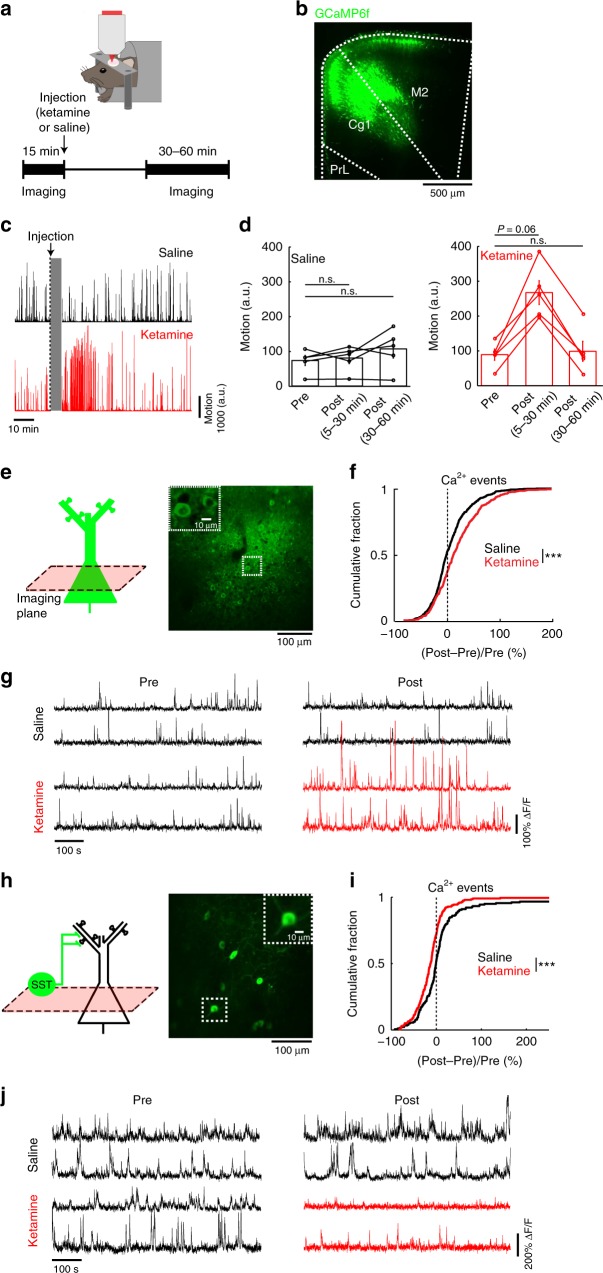
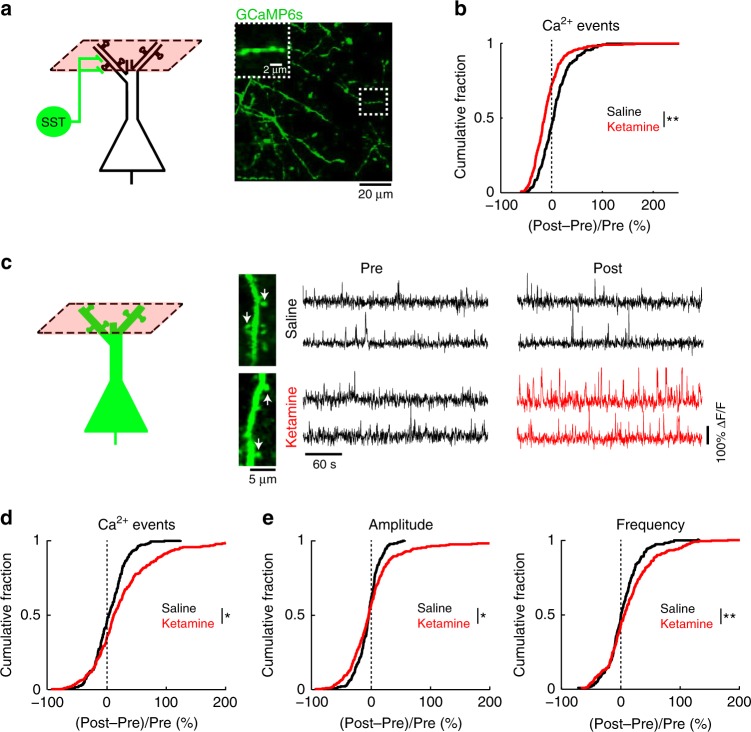
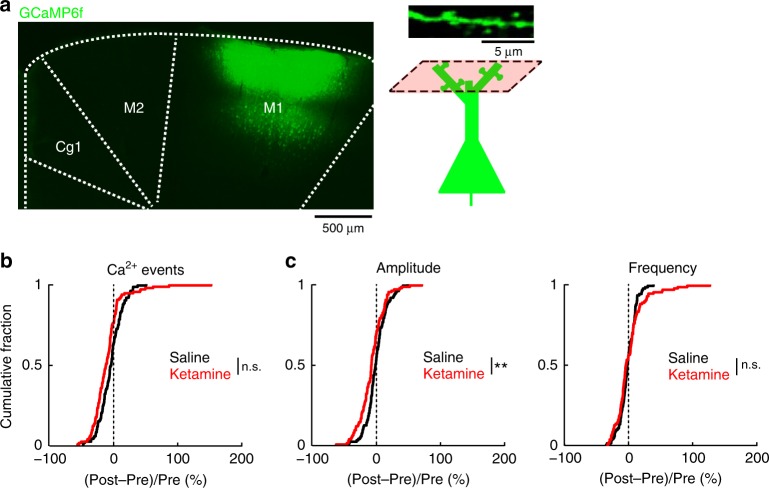
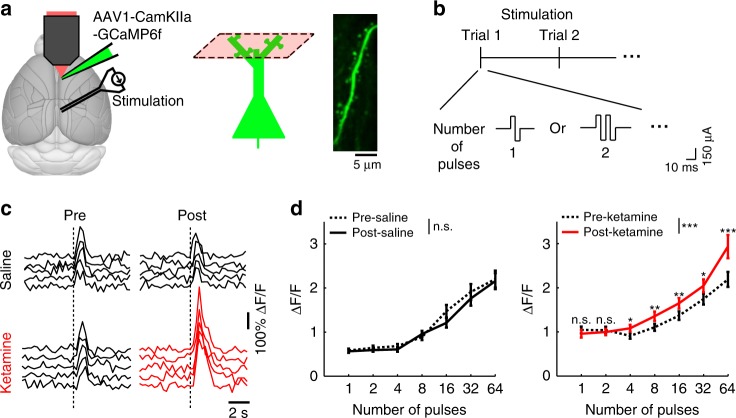
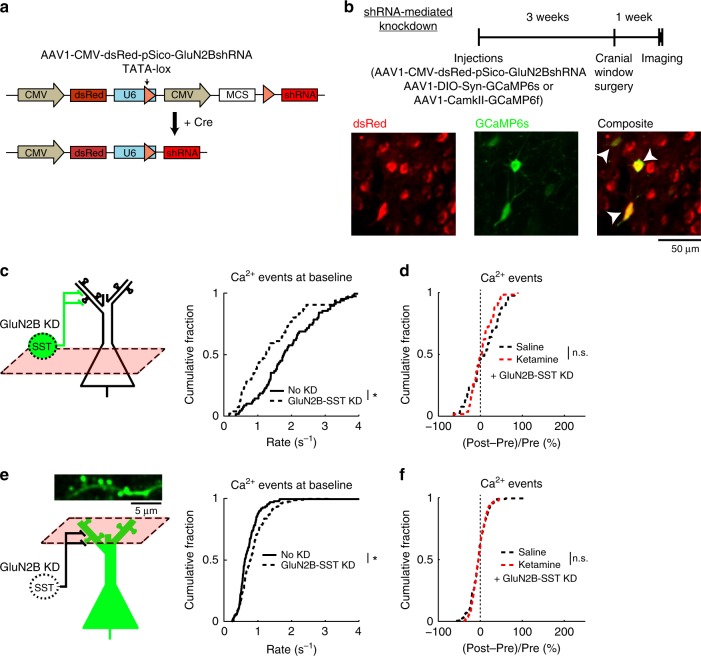
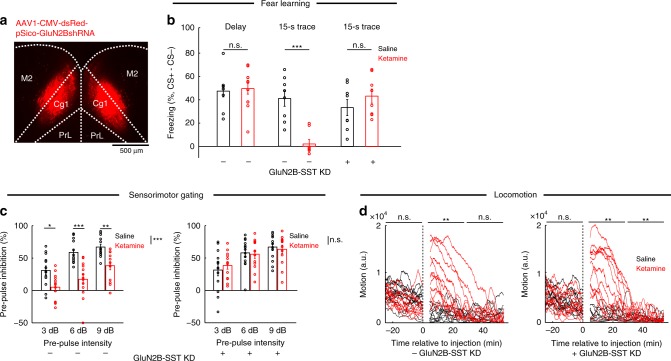
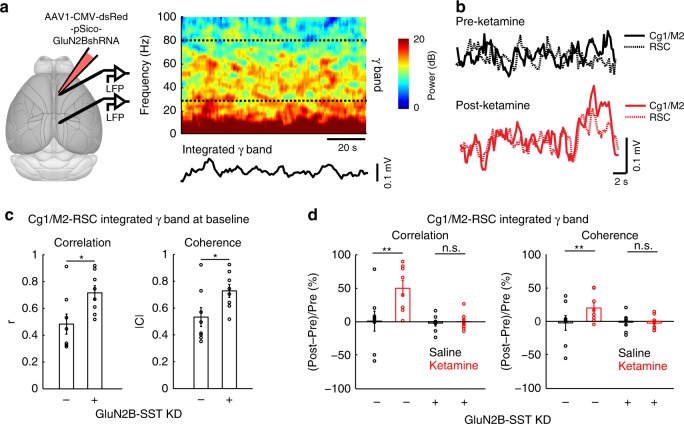
A subanesthetic dose of ketamine causes acute psychotomimetic symptoms and sustained antidepressant effects. In prefrontal cortex, the prevailing disinhibition hypothesis posits that N-methyl-d-aspartate receptor (NMDAR) antagonists such as ketamine act preferentially on GABAergic neurons. However, cortical interneurons are heterogeneous. In particular, somatostatin-expressing (SST) interneurons selectively inhibit dendrites and regulate synaptic inputs, yet their response to systemic NMDAR antagonism is unknown. Here, we report that ketamine acutely suppresses the activity of SST interneurons in the medial prefrontal cortex of the awake mouse. The deficient dendritic inhibition leads to greater synaptically evoked calcium transients in the apical dendritic spines of pyramidal neurons. By manipulating NMDAR signaling via GluN2B knockdown, we show that ketamine’s actions on the dendritic inhibitory mechanism has ramifications for frontal cortex-dependent behaviors and cortico-cortical connectivity. Collectively, these results demonstrate dendritic disinhibition and elevated calcium levels in dendritic spines as important local-circuit alterations driven by the administration of subanesthetic ketamine.
Overview
The claims and statistics of this paper haven’t been checked yet.
Free: it reads the open-access text and checks the first 5 claims that cite a source we can check. Create a free account to check every claim.
Integrity signals
Registry
Cites
Statistics
Figures
Verification
Claims the paper makes
The claims and statistics of this paper haven’t been checked yet.
Free: it reads the open-access text and checks the first 5 claims that cite a source we can check. Create a free account to check every claim.
Claims other papers make about this one
Each is checked against this paper’s own text: does it say what the citing paper says it does?
The cited source says what the claim attributes to it.
In the citing paper
“pyramidal neurons in the cingulate and secondary motor cortex were found to respond to ketamine (10 mg/kg) through an increase in Ca2+ event rate, particularly in dendritic spines, indicative of a hyperactive state which was facilitated by a reduction in Ca2+ events in SST interneurons (Ali et al., 2020).”
From Mechanisms of ketamine and its metabolites as antidepressants (2022) · cites this paper as Ali et al., 2020
The cited source says what the claim attributes to it.
In the citing paper
“knockdown of GluN2B in SST interneurons mimicked the effects of ketamine on SST Ca2+ dynamics and pyramidal neuron dendrites.”
From Mechanisms of ketamine and its metabolites as antidepressants (2022) · cites this paper as Ali et al., 2020
Self-check
Percentages, sums and reported differences re-computed from the paper’s own numbers.
The self-check needs the paper’s full text.
Citations
Cites
Ultrasensitive fluorescent proteins for imaging neuronal activity
Chen, T.-W., Wardill, T. J., Sun, Y., Pulver, S. R., Renninger, S. L., Baohan, A., Schreiter, E. R., Kerr, R. A., Orger, M. B., Jayaraman, V., et al. (2013) · Nature · doi:10.1038/nature12354 · Cited by 6,474
Antidepressant effects of ketamine in depressed patients
Berman, R. M., Cappiello, A., Anand, A., Oren, D. A., Heninger, G. R., Charney, D. S., & Krystal, J. H. (2000) · Biological Psychiatry · doi:10.1016/s0006-3223(99)00230-9 · Cited by 3,856 · cited 1×
“A three-way mixed ANOVA was performed with drug (saline, ketamine) as a between-subjects factor, and stimulation levels (1, 2, 4, 8, 16, 32, 64) and epoch (pre-injection, post-injection) as within-subjects factors.”
MethodA randomized trial of an N-methyl-D-aspartate antagonist in treatment-resistant major depression.
Zarate, C. A., Singh, J. B., Carlson, P. J., Brutsche, N. E., Ameli, R., Luckenbaugh, D. A., Charney, D. S., & Manji, H. K. (2006) · Archives of General Psychiatry · doi:10.1001/archpsyc.63.8.856 · Cited by 3,766
Krystal, J. H. (1994) · Archives of General Psychiatry · doi:10.1001/archpsyc.1994.03950030035004 · Cited by 3,330 · cited 6×
“The interaction effect was significant (F(1,14)= 6.”
BackgroundMethodInfluentialmTOR-Dependent Synapse Formation Underlies the Rapid Antidepressant Effects of NMDA Antagonists
Li, N., Lee, B., Liu, R.-J., Banasr, M., Dwyer, J. M., Iwata, M., Li, X.-Y., Aghajanian, G., & Duman, R. S. (2010) · Science · doi:10.1126/science.1190287 · Cited by 2,881
Self-citationArmbruster, B. N., Li, X., Pausch, M. H., Herlitze, S., & Roth, B. L. (2007) · Proceedings of the National Academy of Sciences · doi:10.1073/pnas.0700293104 · Cited by 2,046 · cited 2×
“9, P= 3 × 10⁻⁴), and a significant interaction (F(2,30)= 4.”
MethodA resource of Cre driver lines for genetic targeting of GABAergic neurons in cerebral cortex
Taniguchi, H., He, M., Wu, P., Kim, S., Paik, R., Sugino, K., Kvitsani, D., Fu, Y., Lu, J., Lin, Y., et al. (2011) · Neuron · doi:10.1016/j.neuron.2011.07.026 · Cited by 1,828
Moghaddam, B., Adams, B., Verma, A., & Daly, D. (1997) · The Journal of Neuroscience · doi:10.1523/jneurosci.17-08-02921.1997 · Cited by 1,793
Adult mouse cortical cell taxonomy revealed by single cell transcriptomics
Tasic, B., Menon, V., Nguyen, T. N., Kim, T. K., Jarsky, T., Yao, Z., Levi, B., Gray, L. T., Sorensen, S. A., Dolbeare, T., et al. (2016) · Nature Neuroscience · doi:10.1038/nn.4216 · Cited by 1,714
Whitfield-Gabrieli, S., Thermenos, H. W., Milanovic, S., Tsuang, M. T., Faraone, S. V., McCarley, R. W., Shenton, M. E., Green, A. I., Nieto-Castanon, A., LaViolette, P., et al. (2009) · Proceedings of the National Academy of Sciences · doi:10.1073/pnas.0809141106 · Cited by 1,435
Research works printed but not linked: 1
- Franklin, K. B. J. & Paxinos, G. The Mouse Brain In Stereotaxic Coordinates (Academic Press, 2007).
Cited by
Items 101–200 of 206
Widman, A. J., & McMahon, L. L. (2020) · Advances in pharmacology · doi:10.1016/bs.apha.2020.05.001 · Cited by 15
Li, X., Saiyin, H., Chen, X., Yu, Q., Ma, L., & Liang, W. (2022) · Molecular Psychiatry · doi:10.1038/s41380-022-01864-5 · Cited by 16
“Furthermore, Ali and colleagues reported that ketamine acutely suppressed the activity of somatostatin-expressing (SST) interneurons in the medial prefrontal cortex of adult mice, leading to greater synaptically evoked calcium transients in the apical dendritic spines of pyramidal neurons [50].”
BackgroundEffect of repeated semen ejaculation on sperm quality.
Nnatu, S., Giwa‐Osagie, O. F., & Essien, E. E. (1991) · PubMed · Cited by 15
The NMDA receptor subunit GluN2D is a potential target for rapid antidepressant action
Vestring, S., Veleanu, M., Perez, M. C., Schuberth, L. E., Bronnec, M., Li, A., Würz, L. M., Erdogdu, F., Stocker, J., Moos, J., et al. (2025) · Nature Communications · doi:10.1038/s41467-025-66774-w · Cited by 13
“S-ketamine has been shown to bind to GluN2B-containing NMDARs 101 , and GluN2B knockdown in somatostatin-expressing interneurons (SOM-INs) has been shown to reduce inter-neuron activity and prevent some behavioral effects of KET 6,42 .”
G protein-coupled receptors as targets for transformative neuropsychiatric therapeutics
Schmitz, G. P., & Roth, B. L. (2023) · American Journal of Physiology-Cell Physiology · doi:10.1152/ajpcell.00397.2022 · Cited by 13
Cheng, T., Formolo, D. A., Yu, J., Zhong, Y., Ma, Z., Hussain, A., Silveira, F. N. P., Zhang, L., Cheng, K. K. Y., Kranz, G. S., et al. (2025) · Molecular Psychiatry · doi:10.1038/s41380-025-03317-1 · Cited by 15
“These changes include transient increases in extracellular glutamate levels [11], enhanced glutamatergic neurotransmission and spinogenesis [12], and elevated fi ring rates of excitatory neurons [13].”
Mingardi, J., Ndoj, E., Bonifacino, T., Misztak, P., Bertoli, M., Via, L. L., Torazza, C., Russo, I., Milanese, M., Bonanno, G., et al. (2023) · International Journal of Molecular Sciences · doi:10.3390/ijms241310814 · Cited by 13
Melonakos, E. D., Siegmann, M. J., Rey, C., OʼBrien, C., Nikolaeva, K., Solt, K., & Nehs, C. J. (2021) · Anesthesiology · doi:10.1097/aln.0000000000003883 · Cited by 13
“Simultaneously, ketamine is thought to cause excitation of cortical pyramidal neurons by inhibition of GABAergic interneurons.(27,28) Because the parabrachial nucleus is a target of the preoptic area and a major, glutamatergic arousal nucleus, we hypothesized that parabrachial nucleus stimulation could elicit signs of…”
BackgroundKetamine Produces a Long-Lasting Enhancement of CA1 Neuron Excitability
Jang, G., & MacIver, M. B. (2021) · International Journal of Molecular Sciences · doi:10.3390/ijms22158091 · Cited by 14
“We speculate from the results of our MK-801 experiments that by inhibiting the calcium ion channels linked to NMDA receptors, ketamine may indirectly change levels of intracellular calcium [31] and increase intrinsic postsynaptic neuronal excitability by lowering the activation threshold of pyramidal neurons [11].”
ResultThe therapeutic potential of psilocybin beyond psychedelia through shared mechanisms with ketamine
Park, D., Lee, G., Lee, W.-G., Kim, B. S., Lee, Y., & Kim, J. (2025) · Molecular Psychiatry · doi:10.1038/s41380-025-03100-2 · Cited by 14
“These effects are largely mediated by the activation of BDNF – TrkB signaling, AMPA receptor potentiation, and activity-dependent spinogenesis and synaptogenesis [15, 16, 20, 69, 129, 155, 193].”
Mechanism-guided identification of antidepressant G protein-coupled receptor drug targets
Munguba, H., Arefin, A., Hasegawa, R., Posa, L., Romano, G. R., Peddada, T., Donatelle, A., Singh, A., Gutzeit, V. A., Vijay, A., et al. (2026) · Cell · doi:10.1016/j.cell.2026.04.006 · Cited by 12
Luessen, D. J., Gallinger, I. M., Ferranti, A. S., Foster, D. J., Melancon, B. J., Lindsley, C. W., Niswender, C. M., & Conn, P. J. (2022) · Neuropsychopharmacology · doi:10.1038/s41386-022-01350-0 · Cited by 13
“In support of this notion, systemic MK-801 administration in rodents increases pyramidal neuron firing and suppresses SST-IN activity in the PFC [23, 43].”
BackgroundQin, Y., Mahdavi, A., Bertschy, M., Anderson, P., Kulikova, S. P., & Pinault, D. (2022) · European Journal of Neuroscience · doi:10.1111/ejn.15845 · Cited by 14
“Of course, ketamine also acts on multiple cortical and subcortical structures, and there is increasing evidence that it suppresses the activity of GABAergic interneurons leading to disinhibition of glutamatergic neurons (Ali et al., 2020; Homayoun & Moghaddam, 2007).”
BackgroundAhtiainen, A., Annala, I., Rosenholm, M., Kohtala, S., Hyttinen, J., Tanskanen, J. M. A., & Rantamäki, T. (2023) · Neuropharmacology · doi:10.1016/j.neuropharm.2023.109481 · Cited by 12
“inhibitory interneurons at low doses, leading to disinhibition of pyramidal neurons and glutamate bursting (Ali et al., 2020; Gerhard et al., 2020; Homayoun and Moghaddam, 2007).”
Joffe, M. E., Santiago, C. I., Vermudez, S. A. D., Fisher, N. M., Dogra, S., Niswender, C. M., & Conn, P. J. (2021) · Neuropsychopharmacology · doi:10.1038/s41386-021-01041-2 · Cited by 12
“Like other NMDA receptor antagonists, ketamine administration can alter oscillatory activity within the gamma range [53, 54] and induce delirious side effects by inhibiting glutamate receptors expressed on inhibitory interneurons [55].”
BackgroundThe ABCs of psychedelics: a preclinical roadmap for drug discovery
Kwan, A. C., Mantsch, J. R., & McCorvy, J. D. (2025) · Trends in Pharmacological Sciences · doi:10.1016/j.tips.2025.07.017 · Cited by 12
“Speci fi cally, PPI is also bidirectio nally modulated by dopaminergic agents and attenuated by ketamine [60].”
Self-citationSpeigel, I. A., Patel, K., & Hemmings, H. C. (2022) · British Journal of Anaesthesia · doi:10.1016/j.bja.2022.01.014 · Cited by 11
Multi-scale network imaging in a mouse model of amyloidosis
Doostdar, N., Airey, J., Radulescu, C. I., Melgosa-Ecenarro, L., Zabouri, N., Pavlidi, P., Kopanitsa, M. V., Saito, T., Saido, T. C., & Barnes, S. J. (2021) · Cell Calcium · doi:10.1016/j.ceca.2021.102365 · Cited by 11
Nguyen, T. M. L., Jollant, F., Tritschler, L., Colle, R., Corruble, E., & Gardier, A. M. (2023) · Pharmaceuticals · doi:10.3390/ph16040634 · Cited by 11
Suárez-Santiago, J. E., Orozco-Suárez, S. A., Vega-García, A., Bautista-Orozco, L. Á., & Picazo, O. (2020) · Behavioural Pharmacology · doi:10.1097/fbp.0000000000000571 · Cited by 12
“Furthermore, manipulation of NMDARs signaling seems to inhibit dendritic branching and decrease spine density, especially affecting behaviors dependent on the frontal cortex and intracortical connectivity (Ali et al., 2020).”
BackgroundCortical Mechanisms Contributing to Ketamine-Induced Dissociation
Bera, K., Looger, L. L., Proekt, A., & Cichon, J. (2025) · The Neuroscientist · doi:10.1177/10738584251403946 · Cited by 10
“…of ketamine acutely enhance glutamatergic transmission (Moghaddam et al 1997; Abdallah, De Feyter, et al 2018), augment postsynaptic responses (Ali et al 2020), and increase the firing rates of cortical pyramidal neurons (Figure 4, top panel; Patel and Chapin 1990; Homayoun and Moghaddam…”
Freitas, A. E., Feng, B., Woo, T., Galli, S., Baker, C., Ban, Y., Truong, J., Beyeler, A., & Zou, Y. (2024) · Nature Communications · doi:10.1038/s41467-024-48257-6 · Cited by 10
“Although the molecular and cellular tar-getsandsomeofthemechanismsoftheacuteeffectsofketaminehave been better studied 21 – 23 , the mechanisms underlying long-term anti-depressant effects of ketamine (at least 7 days after the initial treatment) are much less known.”
Ready for a “breakthrough” with ketamine? A look at recent pharmacological insights!
Himmelseher, S., & Kochs, E. F. (2021) · Current Opinion in Anaesthesiology · doi:10.1097/aco.0000000000001017 · Cited by 10
Substance Abuse and Cognitive Decline: The Critical Role of Tau Protein as a Potential Biomarker
Rebolledo-Pérez, L., Hernández‐Bello, J., Martínez-Ramos, A., Castañeda‐Arellano, R., Fernández-Quezada, D., Sandoval-García, F., & Aguilar-García, I. G. (2025) · International Journal of Molecular Sciences · doi:10.3390/ijms26157638 · Cited by 9
“Dendritic spine loss and decreased synaptic density have been observed in these areas following prolonged ketamine exposure, which may explain the persistent cognitive deficits seen in both preclinical models and clinical case reports [93–96].”
Acero-Castillo, M. C., Correia, M. B. M., Caixeta, F. V., Motta, V., Barros, M., & Maior, R. S. (2024) · Neuropharmacology · doi:10.1016/j.neuropharm.2024.110088 · Cited by 8
Liu, X., Li, L., Li, H., Deng, Y., Liu, Y., Peng, D., Wu, G., & Zhou, X. (2025) · Journal of Affective Disorders · doi:10.1016/j.jad.2025.120156 · Cited by 11
Electrophysiological mechanisms of psychedelic drugs: A systematic review
Jiménez, J. H., Kaup, K., & Aru, J. (2026) · Neuroscience & Biobehavioral Reviews · doi:10.1016/j.neubiorev.2026.106649 · Cited by 8
Wang, K., Tan, X., Ding, K.-M., Feng, X.-Z., Zhao, Y.-Y., Zhu, W., Li, G.-H., & Li, S. (2024) · Pharmacological Research · doi:10.1016/j.phrs.2024.107236 · Cited by 8
GABA system in the prefrontal cortex involved in psychostimulant addiction
Shi, W., Li, M., Zhang, T., Yang, C., Zhao, D., & Bai, J. (2024) · Cerebral Cortex · doi:10.1093/cercor/bhae319 · Cited by 8
Li, X., Saiyin, H., Zhou, J.-H., Yu, Q., & Liang, W.-M. (2020) · Acta Pharmacologica Sinica · doi:10.1038/s41401-020-00521-3 · Cited by 8
Synaptic basis of rapid antidepressant action
Kavalali, E. T., & Monteggia, L. M. (2024) · European Archives of Psychiatry and Clinical Neuroscience · doi:10.1007/s00406-024-01898-6 · Cited by 7
“Block of these inhibitory interneuron resident NMDARs is postulated to suppress tonic release of GABA and disinhibit activity of the target excitatory neu - rons [ 22 ].”
Altered Synaptic Plasticity: Plausible Mechanisms Associated With Viral Infections
Saini, V., Rani, A., Kumar, A., Jha, K., Karnati, S., & Jha, H. C. (2023) · Future Virology · doi:10.2217/fvl-2023-0105 · Cited by 7
Irwin, M. N., & VandenBerg, A. (2021) · Mental Health Clinician · doi:10.9740/mhc.2021.05.200 · Cited by 7
“One of the primary mechanisms that has emerged as underlying the rapid antidepressant activity of ketamine is NMDAR blockade on fast-spiking c-aminobutyric acid (GABA) interneurons.(26,27) Fast-spiking GABA interneurons are so-named for the pattern of action potential they generate, and they play a major role in tonic…”
BackgroundPhysiological markers of rapid antidepressant effects of allopregnanolone
Lambert, P. M., Lu, X., Zorumski, C. F., & Mennerick, S. J. (2021) · Journal of Neuroendocrinology · doi:10.1111/jne.13023 · Cited by 7
Promises and Pitfalls of NMDA Receptor Antagonists in Treating Violent Aggression
Bartsch, C. J., & Nordman, J. C. (2022) · Frontiers in Behavioral Neuroscience · doi:10.3389/fnbeh.2022.938044 · Cited by 7
Shinohara, R., & Furuyashiki, T. (2022) · Neuroscience Research · doi:10.1016/j.neures.2022.12.015 · Cited by 7
SST interneurons facilitate dendritic calcium signaling via tonic activation of α5-GABA receptors
Chiu, C. Q., Morse, T. M., Ouares, K. A., Panzera, L. C., Patel, P. A., Nani, F., Knoflach, F., Hernandez, M., Jadi, M. P., & Higley, M. J. (2026) · Neuron · doi:10.1016/j.neuron.2026.04.017 · Cited by 8
“47 These earlier studies have broadly envisioned the primary role of SST-INs as a suppressor of postsynaptic activity.”
Altered GABAergic inhibition in CA1 pyramidal neurons modifies despair-like behavior in micePreprint
Yoon, S. H., Chung, G., Song, W. S., Oh, S. P., Kim, J.-J., Kim, S. J., & Kim, M. (2020) · bioRxiv (Cold Spring Harbor Laboratory) · doi:10.1101/2020.02.18.953786 · Cited by 7
Meyer-Dilhet, G., Ellouze, S., Raineteau, O., & Courchet, J. (2025) · Lab Animal · doi:10.1038/s41684-025-01633-1 · Cited by 6
“Pairwise comparison revealed a trend toward more mature spines in group 2, which could be due to the dissociative effect of ketamine and its compound effect on NMDA receptors in excitatory and inhibitory cortical neurons 11,12 .”
Rozov, S. V., Saarreharju, R., Khirug, S., Storvik, M., Rivera, C., & Rantamäki, T. (2024) · European Journal of Pharmacology · doi:10.1016/j.ejphar.2024.176426 · Cited by 6
Liu, C., Sun, M., Lin, Y., Zhang, X.-X., Huang, R., He, M., Luo, S., Luo, S., Huang, T., Jiang, N., et al. (2025) · Epilepsia · doi:10.1111/epi.18390 · Cited by 6
“21 Especially, hypo-NMDA function 42–44 leads to increased extracellular glutamate levels and intracellular Ca 2 + levels, 45 resulting in seizures.”
Rademacher, J., Grent-‘t-Jong, T., Rivolta, D., Sauer, A., Scheller, B., González‐Burgos, G., Metzner, C., & Uhlhaas, P. J. (2025) · PLoS Computational Biology · doi:10.1371/journal.pcbi.1013118 · Cited by 8
Unveiling the enigma of anxiety disorders and depression: from pathogenesis to treatment
Pan, H., Xia, T., Zhang, Y., Zhang, H., Xu, M., Guo, J., Liu, Y., Bai, X.-Y., Liu, Q., Liu, W.-Z., et al. (2025) · Science China Life Sciences · doi:10.1007/s11427-025-3024-y · Cited by 8
“This is associated with increased PV expression and PNN intensity surrounding PV + INs, contributing to heightened anxiety-like behavior (Murthy et al., 2019).”
InfluentialTan, Y., & Hashimoto, K. (2024) · Asian Journal of Psychiatry · doi:10.1016/j.ajp.2024.104246 · Cited by 6
Xia, M.-C., Guo, J., Ding, Y., Shi, Z., Du, F., Wang, K., Miao, C., & Liang, C. (2022) · Brain Sciences · doi:10.3390/brainsci12121720 · Cited by 6
“Low doses of ketamine can have antidepressant effects, while high doses can cause anesthesia [19].”
Nakamura, T., Dinh, T. H., Asai, M., Matsumoto, J., Nishimaru, H., Setogawa, T., Honda, S., Yamada, H., Mihara, T., & Nishijo, H. (2022) · Brain Research Bulletin · doi:10.1016/j.brainresbull.2022.12.006 · Cited by 7
“In addition, systemic administration of ketamine also suppressed the activity of somatostatin-positive interneurons and consequently disinhibited calcium responses in the dendritic spines of pyramidal neurons in the mouse cortex (Ali et al., 2020).”
Zhu, Y., Qu, Y., Zhang, J., Hou, J., Fang, J., Shen, J., Xu, C. S., Huang, M., Qiao, H., & An, S.-C. (2021) · Behavioural Pharmacology · doi:10.1097/fbp.0000000000000660 · Cited by 6
“Deficient dendritic inhibition leads to greater synaptically evoked calcium transients in the apical dendritic spines of pyramidal neurons (Ali et al., 2020).”
BackgroundLiu, C., Wang, Y., Yin, Y.-W., Wang, P., Ji, X., Sun, J., Zhao, S., Jia, Y., Liu, S., & Zhou, Z. (2025) · Journal of Pain Research · doi:10.2147/jpr.s498499 · Cited by 5
Mahmud, A., Hernández, G., Abboud, F., & Flores, C. (2025) · Biological Psychiatry Global Open Science · doi:10.1016/j.bpsgos.2025.100629 · Cited by 5
“…to CSDS in adult male mice has been shown to modify the activity of PFC neurons and their projection regions (22–24) and to reduce the dendritic arbor complexity and the spine density of PFC pyramidal neurons (25–32), an effect often observed to occur in a projection-specific manner (26,33–37).”
Li, B., Zhang, T., Tan, G., Pu, Z., & Shen, Y. (2024) · Current Eye Research · doi:10.1080/02713683.2024.2412304 · Cited by 4
“10,11 Overactivation of NMDA receptors induces retinal cell dysfunction and demise, echoing the pathophysiology observed in neurodegenerative ocular diseases.”
Fong, T. H., Li, T., Ma, X., Cai, X., & Zhou, Q. (2025) · Neuropsychopharmacology · doi:10.1038/s41386-025-02200-5 · Cited by 4
Mahadevan, V., Mitra, A., Zhang, Y., Yuan, X. Q., Peltekian, A., Chittajallu, R., Esnault, C., Maric, D., Rhodes, C. T., Pelkey, K. A., et al. (2020) · bioRxiv (Cold Spring Harbor Laboratory) · doi:10.1101/2020.06.10.144295 · Cited by 4
MeCP2 prevents against sustained ketamine-induced synaptic depression at inhibitory synapses
Piazza, M. K., Weit, A. R., Kavalali, E. T., Neul, J. L., & Monteggia, L. M. (2025) · iScience · doi:10.1016/j.isci.2025.112485 · Cited by 3
Guo, H., Ali, T., Yang, Q., Xia, J., Luo, Y., Ren, J., Chen, Z., Han, Y., & Li, S. (2026) · Molecular Psychiatry · doi:10.1038/s41380-026-03446-1 · Cited by 4
“A recent study reported that activating the BLA-projecting ACC pyramidal neurons suppressed reward consumption and produced depression-like behaviors [80].”
Subtype-specific modulation of inhibitory interneurons by general anesthetics
Sugino, T., Okada, T., Nomura, Y., Nakayama, R., Harada, M., Nakai, N., Obata, N., & Mizobuchi, S. (2026) · iScience · doi:10.1016/j.isci.2026.115140 · Cited by 3
“12,18,19 However, these earlier studies primarily used subanesthetic doses (3–10 mg/kg) in antidepressant paradigms.”
General Anesthesia Occludes Ketamine's Antidepressant Response in a Rodent Model of Chronic Stress
Markman, D., Wasilczuk, A. Z., & Cichon, J. (2024) · Psychedelic Medicine · doi:10.1089/psymed.2024.0007 · Cited by 3
“(J) Effect of KET alone or KET with Iso 0.6% or 1.2% on TST immobility time 24 h following treatment (Iso 0.6%: Kruskal–Wallis [13.5]: p = 0.001 following by Dunn’s multiple comparisons, pre-and post-KET: p = 0.04; pre-and post-KET with Iso 0.6%: p = 0.74; KET vs. KET with Iso: p = 0.0009; Iso…”
InfluentialIntranasal Delivery of Ketamine Induces Cortical Disinhibition
Qiao, X., Grieco, S. F., Yu, Z., Holmes, T. C., & Xu, X. (2023) · eNeuro · doi:10.1523/eneuro.0107-23.2023 · Cited by 3
“…hypothesis ” asserts that ketamine might promote neural plasticity by antagonizing NMDARs on GABAergic inhibitory neurons leading to cortical disinhibition (Homayoun and Moghaddam, 2007; Browne and Lucki, 2013; Krystal et al., 2013; Fan et al., 2018; Widman and McMahon, 2018; Ali et al., 2020).”
BackgroundLicit use of illicit drugs for treating depression: the pill and the process
Pacheco, A. T., & Moghaddam, B. (2024) · Journal of Clinical Investigation · doi:10.1172/jci180217 · Cited by 3
GluN2B on Adult-Born Granule Cells Modulates (R,S)-Ketamine’s Rapid-Acting Effects in Mice
Bulthuis, N. E., McGowan, J. C., Ladner, L. R., LaGamma, C. T., Lim, S. C., Shubeck, C., Brachman, R. A., Sydnor, E., Pavlova, I. P., Seo, D.-O., et al. (2024) · The International Journal of Neuropsychopharmacology · doi:10.1093/ijnp/pyae036 · Cited by 4
“Our data align with a previous study using a viral strategy to ablate GluN2B from somatostatin-expressing cortical neurons, which showed that in both male and female mice, ( R,S )-ketamine (10 mg/kg) reduced hyponeophagia and that knockdown of GluN2B occluded this effect (Gerhard et al., 2020).”
ResultColey, A. A., Batra, K., Delahanty, J., Keyes, L. R., Pamintuan, R., Ramot, A., Hagemann, J., Lee, C. R., Liu, V., Adivikolanu, H., et al. (2024) · Research Square · doi:10.1101/2024.12.18.629202 · Cited by 3
“Ketamine administration shows promise as an antidepressant for treatment-resistant patients and has notable effects on mPFC cortical neurons (21–23).”
Illuminating the impact of stress: In vivo approaches to track stress-related neural adaptations
Parekh, P. K. (2025) · Neurobiology of Stress · doi:10.1016/j.ynstr.2025.100712 · Cited by 2
“We observed that dmPFC neurons display coordinated ensemble activity at rest which is significantly disrupted by chronic stress.”
InfluentialDing, Y., Liu, S., Wang, K., Kang, J., Chen, W., Sun, S., Hu, Y., Han, Y., & Chen, X. (2025) · Current Neuropharmacology · doi:10.2174/011570159x375644250405041050 · Cited by 2
“More specifically, dendro-somatic decoupling in cortical pyramidal neurons may represent a cellular mechanism by which anesthesia disrupts cortico-cortical connectivity and, consequently, suppresses consciousness [89, 90].”
Njau, S. N., Zavaliangos‐Petropulu, A., Joshi, S. H., Brooks, J. O., O'Neill, J., Roger, W. P., Norris, V., Espinoza, R. T., & Narr, K. L. (2025) · Journal of Neuroscience Research · doi:10.1002/jnr.70102 · Cited by 2
Goldfinger, M. S., Fobian, A. D., Latzer, I. T., & Albert, D. V. F. (2025) · Seminars in Neurology · doi:10.1055/a-2769-6597 · Cited by 3
González, C. Á., Zaragozá, C., & Lopez-Munoz, F. J. (2020) · Revista de Investigación y Educación en Ciencias de la Salud (RIECS) · doi:10.37536/riecs.2020.5.2.214 · Cited by 5
Doan, J., Defaix, C., Mendez‐David, I., Gardier, A. M., Colle, R., Corruble, E., McGowan, J. C., David, D. J. P., Guilloux, J., & Tritschler, L. (2023) · Fundamental and Clinical Pharmacology · doi:10.1111/fcp.12917 · Cited by 2
“In recent years, the fast antidepressant activity of ( R,S )-ketamine (heretofore written as ketamine), a non-competitive antagonist of NMDA receptor, has been intensely studied [12 – 15].”
BackgroundWang, Z., He, X., Vo, K. L. L., & Ewing, A. G. (2021) · Analysis & Sensing · doi:10.1002/anse.202100026 · Cited by 2
Synaptic plasticity in fronto-insular circuits underlying stress susceptibility and resilience
Rocks, D., & Liston, C. M. (2024) · Neuroscience Research · doi:10.1016/j.neures.2024.12.006 · Cited by 2
Kohtala, S., Parekh, P. K., Baramaki, I., Kohtala, P., Ilkka, L., Antila, H., Lee, F. S., & Liston, C. M. (2025) · bioRxiv (Cold Spring Harbor Laboratory) · doi:10.1101/2025.02.13.638096 · Cited by 2
Psilocybin reshapes cortical inhibition through selective interneuron recruitmentPreprint
Davoudian, P. A., Jiang, Q., Knox, C. A., Savalia, N. K., Shao, L.-X., Wilson, J., Weiner, A. M., Chong, C. W., Liao, C., Nothnagel, J. D., et al. (2026) · bioRxiv (Cold Spring Harbor Laboratory) · doi:10.64898/2026.04.16.718963 · Cited by 3
Self-citationWang, X., Luo, F., & Li, B. (2025) · Neurobiology of Disease · doi:10.1016/j.nbd.2025.107186 · Cited by 1
Rozov, S. V., Rosenholm, M., Hintikka, S., & Rantamäki, T. (2021) · Neuroscience Letters · doi:10.1016/j.neulet.2021.136200 · Cited by 1
“Moreover, similar to tianeptine biphasic electrocorticographic response is typical for NMDA-receptor antagonists ketamine and N2O [9] and recent studies suggest NMDA-receptor block on gammaaminobutyric acid-ergic, supposedly somatostatin-positive, cortical interneurons may be the cause of ketamine-evoked elevated gamm…”
BackgroundWoodburn, S. C., Kuhn, A. M., Bosis, K. E., Dadosky, D. T., Mueller, E. J., Bollinger, J. L., Gonzalez, R. M. S., Robinson, J. E., Vollmer, L. L., & Wohleb, E. S. (2026) · Brain Behavior and Immunity · doi:10.1016/j.bbi.2026.106886 · Cited by 1
Dong, Y., Wu, Y., Zhao, Y.-L., Chen, Y.-M., Liu, T.-Y., Zhang, Y.-H., Xie, J.-Y., Zhang, J., Zhang, H., Chen, H., et al. (2025) · Acta Pharmacologica Sinica · doi:10.1038/s41401-025-01643-2 · Cited by 1
Ma, S., Wang, Z., Zhang, F., & Zhang, H. (2026) · Brain Behavior and Immunity · doi:10.1016/j.bbi.2026.106775 · Cited by 1
Cellular mechanisms of serotonergic psychedelics - apical hypercontextualisation
Kaup, K., Jiménez, J. H., & Aru, J. (2026) · Neuroscience & Biobehavioral Reviews · doi:10.1016/j.neubiorev.2026.106876 · Cited by 3
Liu, C.-Q., Lin, Y.-M., Zhang, X.-X., Peng, R., & Qiao, J. (2023) · Research Square · doi:10.21203/rs.3.rs-2533657/v1 · Cited by 1
Ketamine potentiates a central glutamatergic presynapsePreprint
Eshra, A., Lipstein, N., & Hallermann, S. (2023) · bioRxiv (Cold Spring Harbor Laboratory) · doi:10.1101/2023.12.17.571741 · Cited by 2
Cichon, J., Joseph, T. T., Wasilczuk, A. Z., Markman, D., Kelz, M. B., & Nägele, P. (2024) · Research Square · doi:10.21203/rs.3.rs-3706278/v1 · Cited by 2
Atasoy-Rodriguez, I. L., Johnson, K. W., Patel, K., Arain, H., Zaidi, S., Herold, K. F., Milner, T. A., Hemmings, H. C., & Platholi, J. (2026) · bioRxiv (Cold Spring Harbor Laboratory) · doi:10.64898/2026.01.02.697407 · Cited by 1
“These findings highlight that multiple distinct forms of plasticity 67, 68 and cell-type specific NMDAR mechanisms contribute to acute and sustained phases of antidepressant action.”
Impact of open channel blockers on the surface dynamics and organization of NMDA receptors
Fernandes, A. (2020) · theses.fr (ABES) · doi:10.70675/d12c14b2z7a80z4668z9c48z8e2c0e41c009 · Cited by 2
Robust Learning-Driven Structural and Functional Plasticity of Spines in the Mature Mouse CortexPreprint
Fariborzi, M., Eaves, D. G., Demir, L. Y., Wu, Y., Skeens, A., Hruska, M., & Ribic, A. (2026) · SSRN Electronic Journal · doi:10.2139/ssrn.6946705 · Cited by 1
Scharfman, H. E. (2023) · eLife · doi:10.7554/elife.86022.sa0
Luchetta, J., Ajit, S. K., & Meucci, O. (2023) · iDEA - Drexel University Institutional Repository · doi:10.17918/00001640
Janski, A. M., Hristidis, V. C., Zorumski, C. F., & Conway, C. R. (2023) · Elsevier eBooks · doi:10.1016/b978-0-323-95702-1.00064-6
(outdated draft) Somatostatin and the pathophysiology of Alzheimer’s diseasePreprint
Almeida, V. N. (2024) · Qeios · doi:10.32388/goy6dk.2
Piazza, M. K., Renthal, W. R., & Monteggia, L. M. (2024) · Elsevier eBooks · doi:10.1016/b978-0-443-19041-4.00005-4
Mitchell, J., Anijärv, T. E., Can, A., Dutton, M., Hermens, D. F., & Lagopoulos, J. (2024) · Brain and Behavior · doi:10.1002/brb3.70166 · Cited by 1
Somatostatine interneurons mediate dopamine-dependent sensory gating in the orbitofrontal cortexPreprint
Tripathi, A., Skold, T., Censoni, L., Lagerlöf, O., & Medini, P. (2025) · bioRxiv (Cold Spring Harbor Laboratory) · doi:10.1101/2025.03.14.643299
Ugidos, I. F., Iglesias, J., Milanes, S., Farahani, F., & Mostany, R. (2025) · bioRxiv (Cold Spring Harbor Laboratory) · doi:10.1101/2025.09.02.673642
“In addition, we assessed the capacity for induced plasticity in this region by the administration of a single, low, subanesthetic dose of ketamine, which has been shown to reliably promote spinogenesis in layer 5 pyramidal neurons of the MOs 28,29 .”
Ketamine’s Multifaceted Neuropharmacological and Neurobiological Actions
Kohtala, S., & Annala, I. (2025) · Neuromethods · doi:10.1007/978-1-0716-4603-8_2
Vishwanath, A., & Vishwanath, A. (2024) · UA Campus Repository (The University of Arizona)
Somatostatin Neurons in Prefrontal Cortical Microcircuits in Schizophrenia
Dienel, S. J. (2023) · D-Scholarship@Pitt (University of Pittsburgh)
Ketamiinin vaikutusmekanismit masennuksen hoidossa
Kaikkonen, V. (2024) · UTUPub (University of Turku)
Subtype-specific modulation of inhibitory interneurons by general anesthetics
Sugino, T., & Okada, T. (2025) · Institutional Repositories DataBase (IRDB) · doi:10.17632/nj6zs8psmf
Brain network modeling with The Virtual Brain derives pharmacodynamics of ketaminePreprint
Them, J., Deger, L., Taher, H., Stasinski, J., Martin, L., Meier, J. M., Stefanovski, L., & Ritter, P. (2026) · bioRxiv (Cold Spring Harbor Laboratory) · doi:10.64898/2026.02.24.707663
“Overall, various studies imply that low dose ketamine has opposing effects on PCs and IINs by impairing excito-inhibitory neurotransmission in the IIN leading to increased excitation in PCs and glutamate release in the cortex [10,12,21,22].”
Wang, X., Xia, J., Luo, H., Mao, H., Wang, D., Jin, J., & Xiong, W. (2026) · Biological Psychiatry · doi:10.1016/j.biopsych.2026.03.992
Esketamine ameliorates depression-like behavior in mice via modulation of the NRG1–ErbB4 pathway
Yu, H., Zhu, Y., Wang, J., He, Y., Li, H., Li, S., Wang, N., Chen, N., Chen, J., Song, H., et al. (2026) · Frontiers in Psychiatry · doi:10.3389/fpsyt.2026.1722336
“Esketamine ’ s antidepressant effect on GABA interneurons begins by blocking NMDAR, inhibiting interneuron activity (48), disinhibiting PFC glutamate release, rapidly increasing glutamate levels, activating AMPA receptors and postsynaptic membrane depolarization, and stimulating NMDAR and L-type…”
La kétamine, un antidépresseur d'action rapide et antagoniste du récepteur NMDA du glutamate
Nguyen, T. M. L. (2023) · theses.fr (ABES) · doi:10.70675/0ba94412ze24bz4514z9262z9ace4cb240c9
Metadata
- Authors
- Ali, F., Gerhard, D. M., Sweasy, K., Pothula, S., Pittenger, C., Duman, R. S., & Kwan, A. C.
- Affiliations
- Yale University (US)
- Corresponding author
- Kwan, Alex C.
- ORCID
- Venue
- Nature Communications
- Published
- 2020-01-07
- Volume
- 11
- Issue
- 1
- Pages
- 72-72
- ISSN
- 2041-1723 (ISSN-L)
- PMC
- PMC6946708
- OpenAlex
- W2999679415
- Cited by
- 196
- References
- 73
- Citations by year
- 2026: 15 · 2025: 30 · 2024: 32 · 2023: 26 · 2022: 35 · 2021: 35 · 2020: 19
- FWCI
- 13.18
- Type
- journal article
- Language
- en
- Update notices
- correction (2021-01-08)
- Open access
- gold
- doi.org
- Licence
- cc-by
- creativecommons.org/licenses/by/4.0 (tdm)
- creativecommons.org/licenses/by/4.0 (vor)
- Locations
- Nature Communications (publishedVersion, cc-by)
- bioRxiv (Cold Spring Harbor Laboratory) (acceptedVersion, cc-by-nc-nd)
- PubMed Central (publishedVersion, cc-by)
- PubMed (publishedVersion)
- RePEc: Research Papers in Economics (submittedVersion)
- DOAJ (DOAJ: Directory of Open Access Journals) (submittedVersion)
- DOAJ (DOAJ: Directory of Open Access Journals) (submittedVersion, cc-by-sa)
- Funders
- Alzheimer's Association (AARF-17-504924)
- National Alliance for Research on Schizophrenia and Depression
- National Institutes of Health (UL1TR001863)
- National Institute of Mental Health (R01MH112750, R21MH110712)
- National Center for Advancing Translational Sciences
- Topics
- Life Sciences › Neuroscience › Cellular and Molecular Neuroscience › Neuroscience and Neuropharmacology Research
- Health Sciences › Medicine › Pharmacology (medical) › Treatment of Major Depression
- Life Sciences › Neuroscience › Cellular and Molecular Neuroscience › Neurotransmitter Receptor Influence on Behavior
- Keywords
- ketamine, somatostatin interneurons, dendritic spines, calcium signaling, NMDA receptor antagonism, GluN2B, medial prefrontal cortex, pyramidal neurons, subanesthetic ketamine, antidepressant effects, psychotomimetic effects, corticocortical connections
- MeSH terms
- Animals, Calcium, Interneurons, Ketamine, Male, Mice, Inbred C57BL, Receptors, N-Methyl-D-Aspartate, Prefrontal Cortex, Dendritic Spines, Mice
About these checks
Registry, retraction, Cites and statistics results are computed, not judged, with one exception: a printed reference that no index lists is read once by a model before it counts as a citation error. Claims are extracted by a model and kept only when their quote appears verbatim in the text; each cited source is then checked, with a model’s help, for whether it says what the claim relies on. Those verdicts can be wrong — read the claim’s quote and the cited source before relying on one.
Statistics and arithmetic are recomputed, not judged.
Confidence bands are shown only for fields calibrated on our annotated test set. None is calibrated yet, so no band is shown.
What counts as a claim ›How we measure confidence ›How we check this ›
Are you an author, or do you see a problem with this page? Request a review
Data sources
Bibliographic data: Semantic Scholar, OpenAlex, Crossref.
Contains information from the Semantic Scholar Academic Graph Datasets, made available under the ODC Attribution License (ODC-BY 1.0).
Semantic Scholar’s data is described in: Kinney, R., et al. (2023). The Semantic Scholar Open Data Platform. arXiv:2301.10140.
