

Ketamine disinhibits dendrites and enhances calcium signals in prefrontal dendritic spines
Open accessPublished version of a preprint
The DOI matches its Crossref record; 74 of the 74 references it cites were found in a registry or an index.
Abstract
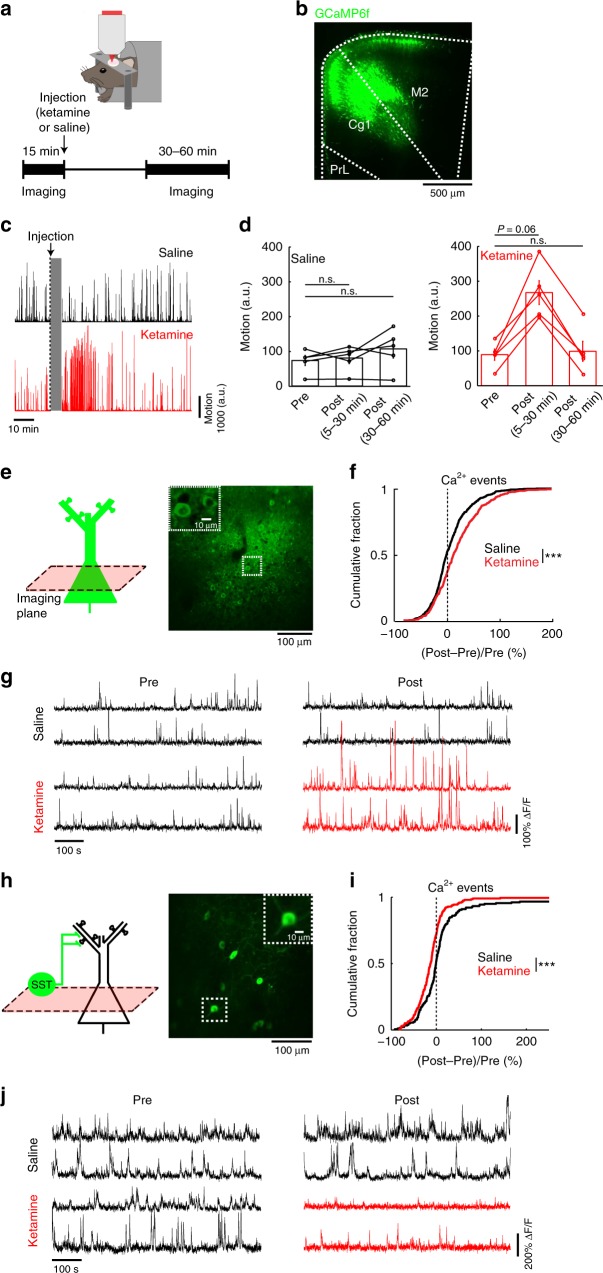
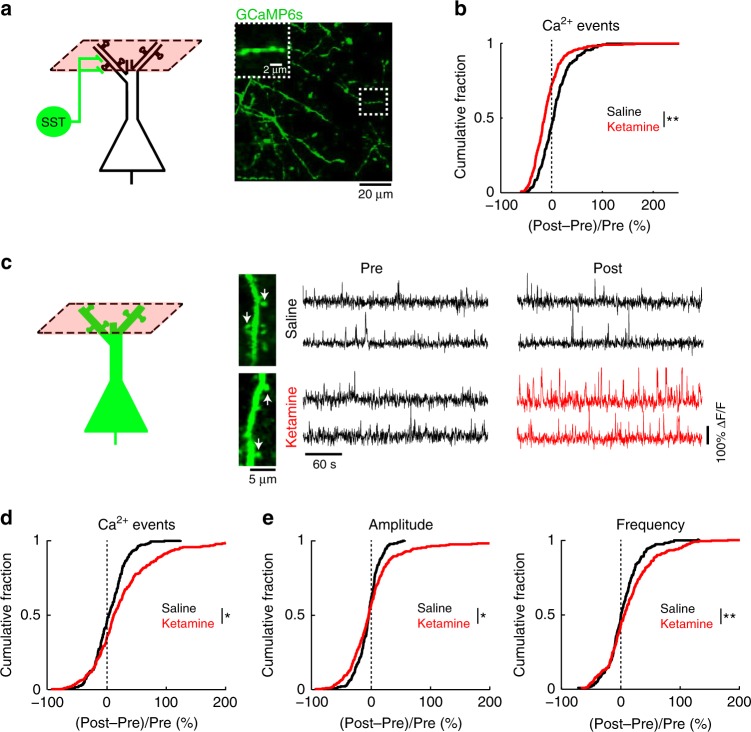
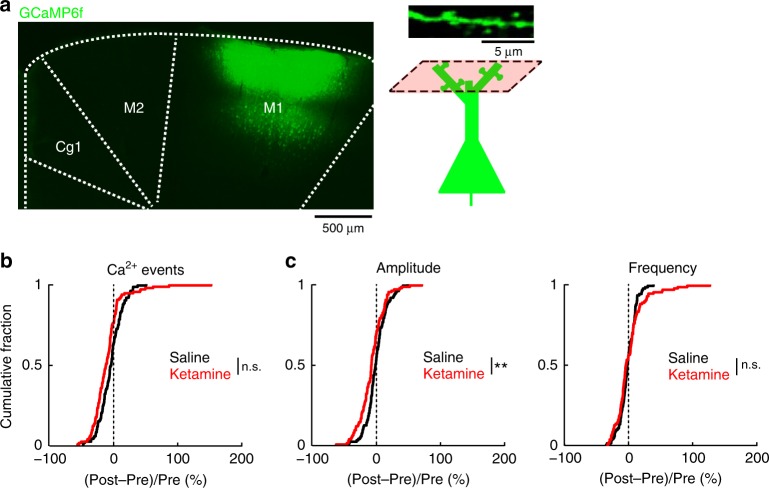
A subanesthetic dose of ketamine causes acute psychotomimetic symptoms and sustained antidepressant effects. In prefrontal cortex, the prevailing disinhibition hypothesis posits that N-methyl-d-aspartate receptor (NMDAR) antagonists such as ketamine act preferentially on GABAergic neurons. However, cortical interneurons are heterogeneous. In particular, somatostatin-expressing (SST) interneurons selectively inhibit dendrites and regulate synaptic inputs, yet their response to systemic NMDAR antagonism is unknown. Here, we report that ketamine acutely suppresses the activity of SST interneurons in the medial prefrontal cortex of the awake mouse. The deficient dendritic inhibition leads to greater synaptically evoked calcium transients in the apical dendritic spines of pyramidal neurons. By manipulating NMDAR signaling via GluN2B knockdown, we show that ketamine’s actions on the dendritic inhibitory mechanism has ramifications for frontal cortex-dependent behaviors and cortico-cortical connectivity. Collectively, these results demonstrate dendritic disinhibition and elevated calcium levels in dendritic spines as important local-circuit alterations driven by the administration of subanesthetic ketamine.
Overview
The claims and statistics of this paper haven’t been checked yet.
Free: it reads the open-access text and checks the first 5 claims that cite a source we can check. Create a free account to check every claim.
Integrity signals
Registry
Cites
Statistics
Figures
Verification
Claims the paper makes
The claims and statistics of this paper haven’t been checked yet.
Free: it reads the open-access text and checks the first 5 claims that cite a source we can check. Create a free account to check every claim.
Claims other papers make about this one
Each is checked against this paper’s own text: does it say what the citing paper says it does?
The cited source says what the claim attributes to it.
In the citing paper
“pyramidal neurons in the cingulate and secondary motor cortex were found to respond to ketamine (10 mg/kg) through an increase in Ca2+ event rate, particularly in dendritic spines, indicative of a hyperactive state which was facilitated by a reduction in Ca2+ events in SST interneurons (Ali et al., 2020).”
From Mechanisms of ketamine and its metabolites as antidepressants (2022) · cites this paper as Ali et al., 2020
The cited source says what the claim attributes to it.
In the citing paper
“knockdown of GluN2B in SST interneurons mimicked the effects of ketamine on SST Ca2+ dynamics and pyramidal neuron dendrites.”
From Mechanisms of ketamine and its metabolites as antidepressants (2022) · cites this paper as Ali et al., 2020
Self-check
Percentages, sums and reported differences re-computed from the paper’s own numbers.
The self-check needs the paper’s full text.
Citations
Cites
Ultrasensitive fluorescent proteins for imaging neuronal activity
Chen, T.-W., Wardill, T. J., Sun, Y., Pulver, S. R., Renninger, S. L., Baohan, A., Schreiter, E. R., Kerr, R. A., Orger, M. B., Jayaraman, V., et al. (2013) · Nature · doi:10.1038/nature12354 · Cited by 6,474
Antidepressant effects of ketamine in depressed patients
Berman, R. M., Cappiello, A., Anand, A., Oren, D. A., Heninger, G. R., Charney, D. S., & Krystal, J. H. (2000) · Biological Psychiatry · doi:10.1016/s0006-3223(99)00230-9 · Cited by 3,856 · cited 1×
“A three-way mixed ANOVA was performed with drug (saline, ketamine) as a between-subjects factor, and stimulation levels (1, 2, 4, 8, 16, 32, 64) and epoch (pre-injection, post-injection) as within-subjects factors.”
MethodA randomized trial of an N-methyl-D-aspartate antagonist in treatment-resistant major depression.
Zarate, C. A., Singh, J. B., Carlson, P. J., Brutsche, N. E., Ameli, R., Luckenbaugh, D. A., Charney, D. S., & Manji, H. K. (2006) · Archives of General Psychiatry · doi:10.1001/archpsyc.63.8.856 · Cited by 3,766
Krystal, J. H. (1994) · Archives of General Psychiatry · doi:10.1001/archpsyc.1994.03950030035004 · Cited by 3,330 · cited 6×
“The interaction effect was significant (F(1,14)= 6.”
BackgroundMethodInfluentialmTOR-Dependent Synapse Formation Underlies the Rapid Antidepressant Effects of NMDA Antagonists
Li, N., Lee, B., Liu, R.-J., Banasr, M., Dwyer, J. M., Iwata, M., Li, X.-Y., Aghajanian, G., & Duman, R. S. (2010) · Science · doi:10.1126/science.1190287 · Cited by 2,881
Self-citationArmbruster, B. N., Li, X., Pausch, M. H., Herlitze, S., & Roth, B. L. (2007) · Proceedings of the National Academy of Sciences · doi:10.1073/pnas.0700293104 · Cited by 2,046 · cited 2×
“9, P= 3 × 10⁻⁴), and a significant interaction (F(2,30)= 4.”
MethodA resource of Cre driver lines for genetic targeting of GABAergic neurons in cerebral cortex
Taniguchi, H., He, M., Wu, P., Kim, S., Paik, R., Sugino, K., Kvitsani, D., Fu, Y., Lu, J., Lin, Y., et al. (2011) · Neuron · doi:10.1016/j.neuron.2011.07.026 · Cited by 1,828
Moghaddam, B., Adams, B., Verma, A., & Daly, D. (1997) · The Journal of Neuroscience · doi:10.1523/jneurosci.17-08-02921.1997 · Cited by 1,793
Adult mouse cortical cell taxonomy revealed by single cell transcriptomics
Tasic, B., Menon, V., Nguyen, T. N., Kim, T. K., Jarsky, T., Yao, Z., Levi, B., Gray, L. T., Sorensen, S. A., Dolbeare, T., et al. (2016) · Nature Neuroscience · doi:10.1038/nn.4216 · Cited by 1,714
Whitfield-Gabrieli, S., Thermenos, H. W., Milanovic, S., Tsuang, M. T., Faraone, S. V., McCarley, R. W., Shenton, M. E., Green, A. I., Nieto-Castanon, A., LaViolette, P., et al. (2009) · Proceedings of the National Academy of Sciences · doi:10.1073/pnas.0809141106 · Cited by 1,435
ScanImage: Flexible software for operating laser scanning microscopes
Pologruto, T. A., Sabatini, B. L., & Svoboda, K. (2003) · BioMedical Engineering OnLine · doi:10.1186/1475-925x-2-13 · Cited by 1,294
Homayoun, H., & Moghaddam, B. (2007) · The Journal of Neuroscience · doi:10.1523/jneurosci.2213-07.2007 · Cited by 1,231 · cited 2×
“Ketamine reduced pre-pulse inhibition in control SST-IRES-Cre animals (main effects of pre-pulse intensity, F(2,12) = 27.”
MethodMaeng, S., Zarate, C. A., Du, J., Schloesser, R. J., McCammon, J., Chen, G., & Manji, H. K. (2008) · Biological Psychiatry · doi:10.1016/j.biopsych.2007.05.028 · Cited by 1,103
Moghaddam, B., & Javitt, D. (2012) · Neuropsychopharmacology · doi:10.1038/npp.2011.181 · Cited by 1,035
Lisman, J. E., Coyle, J. T., Green, R. W., Javitt, D. C., Benes, F. M., Heckers, S., & Grace, A. A. (2008) · Trends in Neurosciences · doi:10.1016/j.tins.2008.02.005 · Cited by 1,010
NoRMCorre: An online algorithm for piecewise rigid motion correction of calcium imaging data
Pnevmatikakis, E. A., & Giovannucci, A. (2017) · Journal of Neuroscience Methods · doi:10.1016/j.jneumeth.2017.07.031 · Cited by 1,007
Liston, C., Miller, M. M., Goldwater, D. S., Radley, J. J., Rocher, A. B., Hof, P. R., Morrison, J. H., & McEwen, B. S. (2006) · The Journal of Neuroscience · doi:10.1523/jneurosci.1184-06.2006 · Cited by 968
Principles of connectivity among morphologically defined cell types in adult neocortex
Jiang, X., Shen, S., Cadwell, C. R., Berens, P., Sinz, F., Ecker, A. S., Patel, S., & Tolias, A. S. (2015) · Science · doi:10.1126/science.aac9462 · Cited by 908
Chronux: A platform for analyzing neural signals
Bokil, H., Andrews, P., Kulkarni, J. E., Mehta, S., & Mitra, P. P. (2010) · Journal of Neuroscience Methods · doi:10.1016/j.jneumeth.2010.06.020 · Cited by 865
Postsynaptic Calcium Is Sufficient for Potentiation of Hippocampal Synaptic Transmission
Malenka, R. C., Kauer, J. A., Zucker, R. S., & Nicoll, R. A. (1988) · Science · doi:10.1126/science.2845577 · Cited by 829
Hierarchical organization of cortical and thalamic connectivity
Harris, J. A., Mihalas, S., Hirokawa, K. E., Whitesell, J. D., Choi, H., Bernard, A., Bohn, P., Caldejon, S., Casal, L., Cho, A., et al. (2019) · Nature · doi:10.1038/s41586-019-1716-z · Cited by 785
Postnatal NMDA receptor ablation in corticolimbic interneurons confers schizophrenia-like phenotypes
Belforte, J. E., Zsiros, V., Sklar, E. R., Jiang, Z., Yu, G., Li, Y., Quinlan, E. M., & Nakazawa, K. (2010) · Nature Neuroscience · doi:10.1038/nn.2447 · Cited by 752
Carlén, M., Meletis, K., Siegle, J. H., Cardin, J. A., Futai, K., Vierling-Claassen, D., Rühlmann, C., Jones, S. R., Deisseroth, K., Sheng, M., et al. (2012) · Molecular Psychiatry · doi:10.1038/mp.2011.31 · Cited by 669
Sustained rescue of prefrontal circuit dysfunction by antidepressant-induced spine formation
Moda-Sava, R. N., Murdock, M. H., Parekh, P. K., Fetcho, R. N., Huang, B. S., Huynh, T. N., Witztum, J., Shaver, D. C., Rosenthal, D. L., Alway, E. J., et al. (2019) · Science · doi:10.1126/science.aat8078 · Cited by 643
Cre-lox-regulated conditional RNA interference from transgenes
Ventura, A., Meissner, A., Dillon, C. P., McManus, M., Sharp, P. A., Van Parijs, L., Jaenisch, R., & Jacks, T. (2004) · Proceedings of the National Academy of Sciences · doi:10.1073/pnas.0403954101 · Cited by 625 · cited 2×
“For GluN2B-SST KD animals, two-way ANOVA revealed significant main effects of epoch (F(2,22)= 14.”
BackgroundMethodYuen, E. Y., Wei, J., Liu, W., Zhong, P., Li, X., & Yan, Z. (2012) · Neuron · doi:10.1016/j.neuron.2011.12.033 · Cited by 558
Dense Inhibitory Connectivity in Neocortex
Fino, E., & Yuste, R. (2011) · Neuron · doi:10.1016/j.neuron.2011.02.025 · Cited by 532
Realistic expectations of prepulse inhibition in translational models for schizophrenia research
Swerdlow, N. R., Weber, M., Qu, Y., Light, G. A., & Braff, D. L. (2008) · Psychopharmacology · doi:10.1007/s00213-008-1072-4 · Cited by 529 · cited 2×
“For mCherry+ CNO condition, a two-way within-subjects ANOVA found significant main effects of pre-pulse intensity (F(2,28)= 30.”
MethodHigh-speed in vivo calcium imaging reveals neuronal network activity with near-millisecond precision
Grewe, B. F., Langer, D., Kasper, H., Kampa, B. M., & Helmchen, F. (2010) · Nature Methods · doi:10.1038/nmeth.1453 · Cited by 522
Wang, Y., Toledo‐Rodriguez, M., Gupta, A., Wu, C., Silberberg, G., Luo, J., & Markram, H. (2004) · The Journal of Physiology · doi:10.1113/jphysiol.2004.073353 · Cited by 491 · cited 1×
“9, P= 2 × 10⁻⁴) but a non-significant main effect of drug (F(1,13)= 4.”
BackgroundLower synaptic density is associated with depression severity and network alterations
Holmes, S. E., Scheinost, D., Finnema, S. J., Naganawa, M., Davis, M. T., DellaGioia, N., Nabulsi, N., Matuskey, D., Angarita, G. A., Pietrzak, R. H., et al. (2019) · Nature Communications · doi:10.1038/s41467-019-09562-7 · Cited by 484
Self-citationUnique functional properties of somatostatin-expressing GABAergic neurons in mouse barrel cortex
Gentet, L. J., Kremer, Y., Taniguchi, H., Huang, Z. J., Staiger, J. F., & Petersen, C. C. H. (2012) · Nature Neuroscience · doi:10.1038/nn.3051 · Cited by 438
Jackson, M. E., Homayoun, H., & Moghaddam, B. (2004) · Proceedings of the National Academy of Sciences · doi:10.1073/pnas.0308455101 · Cited by 430 · cited 1×
“A three-way mixed ANOVA was performed with drug (saline, ketamine) as a between-subjects factor, and stimulation levels (1, 2, 4, 8, 16, 32, 64) and epoch (pre-injection, post-injection) as within-subjects factors.”
MethodXu, X., Roby, K. D., & Callaway, E. M. (2010) · Journal of Comparative Neurology · doi:10.1002/cne.22229 · Cited by 429 · cited 3×
“7 × 10⁻⁴, but non-significant drug effect, F(1,12)= 4.”
BackgroundTranscriptional Architecture of Synaptic Communication Delineates GABAergic Neuron Identity
Paul, A., Crow, M., Raudales, R., He, M., Gillis, J., & Huang, Z. J. (2017) · Cell · doi:10.1016/j.cell.2017.08.032 · Cited by 421 · cited 3×
“0, P= 2 × 10⁻⁴, two-way within-subjects ANOVA); however, it had no effect in mice with bilateral GluN2B-SST KD (main effect of pre-pulse intensity, F(2,24)= 6.”
BackgroundMethodPostsynaptic Membrane Fusion and Long-Term Potentiation
Lledo, P.-M., Zhang, X., Südhof, T. C., Malenka, R. C., & Nicoll, R. A. (1998) · Science · doi:10.1126/science.279.5349.399 · Cited by 413
Cognitive Dysfunction in Schizophrenia: Convergence of γ-Aminobutyric Acid and Glutamate Alterations
Lewis, D. A., & Moghaddam, B. (2006) · Archives of Neurology · doi:10.1001/archneur.63.10.1372 · Cited by 404
Kantrowitz, J. T., & Javitt, D. C. (2010) · Brain Research Bulletin · doi:10.1016/j.brainresbull.2010.04.006 · Cited by 396
Kim, Y., Yang, G. R., Pradhan, K., Venkataraju, K. U., Bota, M., García del Molino, L. C., Fitzgerald, G., Ram, K., He, M., Levine, J. M., et al. (2017) · Cell · doi:10.1016/j.cell.2017.09.020 · Cited by 389
Hierarchical Heterogeneity across Human Cortex Shapes Large-Scale Neural Dynamics
Demirtaş, M., Burt, J. B., Helmer, M., Ji, J. L., Adkinson, B. D., Glasser, M. F., Van Essen, D. C., Sotiropoulos, S. N., Anticevic, A., & Murray, J. D. (2019) · Neuron · doi:10.1016/j.neuron.2019.01.017 · Cited by 359
Activity in motor-sensory projections reveals distributed coding in somatosensation
Petreanu, L., Gutnisky, D. A., Huber, D., Xu, N.-L., O’Connor, D. H., Tian, L., Looger, L., & Svoboda, K. (2012) · Nature · doi:10.1038/nature11321 · Cited by 347
GABA interneurons are the cellular trigger for ketamine's rapid antidepressant actions
Gerhard, D. M., Pothula, S., Liu, R.-J., Wu, M., Li, X.-Y., Girgenti, M. J., Taylor, S. R., Duman, C. H., Delpire, E., Picciotto, M., et al. (2020) · Journal of Clinical Investigation · doi:10.1172/jci130808 · Cited by 345 · cited 1×
“For hM4D(Gi)+CNO condition, a two-way within-subjects ANOVA found a significant main effect of pre-pulse intensity (F(2,26)= 11.”
MethodSelf-citationKoester, H. J., & Sakmann, B. (1998) · Proceedings of the National Academy of Sciences · doi:10.1073/pnas.95.16.9596 · Cited by 339
Compartmentalization of GABAergic inhibition by dendritic spines
Chiu, C. Q., Lur, G., Morse, T. M., Carnevale, N. T., Ellis-Davies, G. C. R., & Higley, M. J. (2013) · Science · doi:10.1126/science.1234274 · Cited by 307
Mateo, C., Knutsen, P. M., Tsai, P. S., Shih, A. Y., & Kleinfeld, D. (2017) · Neuron · doi:10.1016/j.neuron.2017.10.012 · Cited by 303
Trace but not delay fear conditioning requires attention and the anterior cingulate cortex
Han, C. J., O'Tuathaigh, C. M., van Trigt, L., Quinn, J. J., Fanselow, M. S., Mongeau, R., Koch, C., & Anderson, D. J. (2003) · Proceedings of the National Academy of Sciences · doi:10.1073/pnas.2132313100 · Cited by 302
Secondary Motor Cortex: Where ‘Sensory’ Meets ‘Motor’ in the Rodent Frontal Cortex
Barthas, F., & Kwan, A. C. (2017) · Trends in Neurosciences · doi:10.1016/j.tins.2016.11.006 · Cited by 260
Self-citationHakami, T., Jones, N. C., Tolmacheva, E. A., Gaudias, J., Chaumont, J., Salzberg, M., O'Brien, T. J., & Pinault, D. (2009) · PLoS ONE · doi:10.1371/journal.pone.0006755 · Cited by 228 · cited 2×
“The interaction effect was significant (F(1,14)= 6.”
BackgroundFrom contextual fear to a dynamic view of memory systems
Fanselow, M. S. (2010) · Trends in Cognitive Sciences · doi:10.1016/j.tics.2009.10.008 · Cited by 227
Inhibitory Synapses Are Repeatedly Assembled and Removed at Persistent Sites In Vivo
Villa, K. L., Berry, K. P., Subramanian, J., Cha, J. W., Oh, W. C., Kwon, H.-B., Kubota, Y., So, P. T. C., & Nedivi, E. (2016) · Neuron · doi:10.1016/j.neuron.2016.01.010 · Cited by 204
Widman, A. J., & McMahon, L. L. (2018) · Proceedings of the National Academy of Sciences · doi:10.1073/pnas.1718883115 · Cited by 204 · cited 1×
“A three-way mixed ANOVA was performed with drug (saline, ketamine) as a between-subjects factor, and stimulation levels (1, 2, 4, 8, 16, 32, 64) and epoch (pre-injection, post-injection) as within-subjects factors.”
MethodCell Type-Specific Development of NMDA Receptors in the Interneurons of Rat Prefrontal Cortex
Wang, H.-X., & Gao, W.-J. (2009) · Neuropsychopharmacology · doi:10.1038/npp.2009.20 · Cited by 203
Krystal, J. H., Anticevic, A., Yang, G. J., Dragoi, G., Driesen, N. R., Wang, X.-J., & Murray, J. D. (2017) · Biological Psychiatry · doi:10.1016/j.biopsych.2017.01.004 · Cited by 195
Anticevic, A., Corlett, P. R., Cole, M. W., Savic, A., Gancsos, M., Tang, Y., Repovs, G., Murray, J. D., Driesen, N. R., Morgan, P. T., et al. (2015) · Biological Psychiatry · doi:10.1016/j.biopsych.2014.07.022 · Cited by 181
Altered Cortical Ensembles in Mouse Models of Schizophrenia
Hamm, J. P., Peterka, D. S., Gogos, J. A., & Yuste, R. (2017) · Neuron · doi:10.1016/j.neuron.2017.03.019 · Cited by 175
Lepack, A. E., Bang, E., Lee, B., Dwyer, J. M., & Duman, R. S. (2016) · Neuropharmacology · doi:10.1016/j.neuropharm.2016.09.011 · Cited by 174 · cited 1×
“A three-way mixed ANOVA was performed with drug (saline, ketamine) as a between-subjects factor, and stimulation levels (1, 2, 4, 8, 16, 32, 64) and epoch (pre-injection, post-injection) as within-subjects factors.”
MethodSelf-citationAnagnostaras, S. G. (2010) · Frontiers in Behavioral Neuroscience · doi:10.3389/fnbeh.2010.00158 · Cited by 169
A dendritic disinhibitory circuit mechanism for pathway-specific gating
Yang, G. R., Murray, J. D., & Wang, X.-J. (2016) · Nature Communications · doi:10.1038/ncomms12815 · Cited by 148
GABA interneurons mediate the rapid antidepressant-like effects of scopolamine
Wohleb, E. S., Wu, M., Gerhard, D. M., Taylor, S. R., Picciotto, M. R., Alreja, M., & Duman, R. S. (2016) · Journal of Clinical Investigation · doi:10.1172/jci85033 · Cited by 144
Self-citationSoumier, A., & Sibille, E. (2014) · Neuropsychopharmacology · doi:10.1038/npp.2014.76 · Cited by 136
Phoumthipphavong, V., Barthas, F., Hassett, S., & Kwan, A. C. (2016) · eneuro · doi:10.1523/eneuro.0133-15.2016 · Cited by 132
Self-citationDissection of Cortical Microcircuits by Single-Neuron Stimulation In Vivo
Kwan, A. C., & Dan, Y. (2012) · Current Biology · doi:10.1016/j.cub.2012.06.007 · Cited by 123 · cited 1×
“A three-way mixed ANOVA was performed with drug (saline, ketamine) as a between-subjects factor, and stimulation levels (1, 2, 4, 8, 16, 32, 64) and epoch (pre-injection, post-injection) as within-subjects factors.”
MethodSelf-citationBillingslea, E. N., Tatard-Leitman, V. M., Anguiano, J., Jutzeler, C. R., Suh, J., Saunders, J. A., Morita, S., Featherstone, R. E., Ortinski, P. I., Gandal, M. J., et al. (2014) · Neuropsychopharmacology · doi:10.1038/npp.2014.7 · Cited by 120
Inference of neuronal network spike dynamics and topology from calcium imaging data
Lütcke, H., Gerhard, F., Zenke, F., Gerstner, W., & Helmchen, F. (2013) · Frontiers in Neural Circuits · doi:10.3389/fncir.2013.00201 · Cited by 118
Duncan, G. E., Miyamoto, S., Leipzig, J. N., & Lieberman, J. A. (1999) · Brain Research · doi:10.1016/s0006-8993(99)01776-x · Cited by 117 · cited 1×
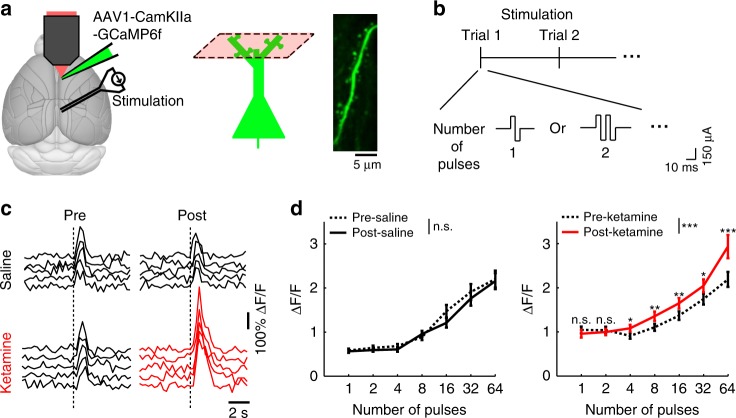
“Ketamine, but not saline, increased evoked responses in Cg1/M2 dendritic spines (ketamine: F(6,1146) = 6.”
BackgroundMiyamoto, S., Leipzig, J. N., Lieberman, J. A., & Duncan, G. E. (2000) · Neuropsychopharmacology · doi:10.1016/s0893-133x(99)00127-x · Cited by 115 · cited 4×
“6, P= 7 × 10⁻⁷), but not for saline (F(6,1218)= 20.”
BackgroundInfluentialHirsch, J. C., & Crépel, F. (1992) · Synapse · doi:10.1002/syn.890100211 · Cited by 110
Brief Bursts Self-Inhibit and Correlate the Pyramidal Network
Berger, T. K., Silberberg, G., Perin, R., & Markram, H. (2010) · PLoS Biology · doi:10.1371/journal.pbio.1000473 · Cited by 105
Tatard-Leitman, V. M., Jutzeler, C. R., Suh, J., Saunders, J. A., Billingslea, E. N., Morita, S., White, R., Featherstone, R. E., Ray, R., Ortinski, P. I., et al. (2015) · Biological Psychiatry · doi:10.1016/j.biopsych.2014.06.026 · Cited by 99
Attenuation of ketamine-evoked behavioral responses by mGluR5 positive modulators in mice
Chan, M., Chiu, P., Sou, J.-H., & Chen, H. (2008) · Psychopharmacology · doi:10.1007/s00213-008-1103-1 · Cited by 84
GABA-A Receptor Inhibition of Local Calcium Signaling in Spines and Dendrites
Marlin, J. J., & Carter, A. G. (2014) · The Journal of Neuroscience · doi:10.1523/jneurosci.0869-13.2014 · Cited by 77
All-optical synaptic electrophysiology probes mechanism of ketamine-induced disinhibition
Fan, L. Z., Nehme, R., Adam, Y., Jung, E. S., Wu, H., Eggan, K., Arnold, D. B., & Cohen, A. E. (2018) · Nature Methods · doi:10.1038/s41592-018-0142-8 · Cited by 46
Kwon, T., Merchán-Pérez, A., Rial Verde, E. M., Rodríguez, J.-R., DeFelipe, J., & Yuste, R. (2019) · Cerebral Cortex · doi:10.1093/cercor/bhy143 · Cited by 44
(2009) · Proceedings of the National Academy of Sciences · doi:10.1073/pnas.0900938106 · Cited by 5
Research works printed but not linked: 1
- Franklin, K. B. J. & Paxinos, G. The Mouse Brain In Stereotaxic Coordinates (Academic Press, 2007).
Cited by
Psilocybin induces rapid and persistent growth of dendritic spines in frontal cortex in vivo
Shao, L.-X., Liao, C., Gregg, I., Davoudian, P. A., Savalia, N. K., Delagarza, K., & Kwan, A. C. (2021) · Neuron · doi:10.1016/j.neuron.2021.06.008 · Cited by 626
Self-citationPsychedelics reopen the social reward learning critical period
Nardou, R., Sawyer, E., Song, Y. J., Wilkinson, M., Padovan-Hernandez, Y., de Deus, J. L., Wright, N., Lama, C., Faltin, S., Goff, L. A., et al. (2023) · Nature · doi:10.1038/s41586-023-06204-3 · Cited by 358
The neural basis of psychedelic action
Kwan, A. C., Olson, D. E., Preller, K. H., & Roth, B. L. (2022) · Nature Neuroscience · doi:10.1038/s41593-022-01177-4 · Cited by 302
Self-citationToward Circuit Mechanisms of Pathophysiology in Depression
Spellman, T., & Liston, C. (2020) · American Journal of Psychiatry · doi:10.1176/appi.ajp.2020.20030280 · Cited by 165
“In contrast, rapid effects on other functional properties of prefrontal cortical circuits—including inhibition of somatostatin interneurons and restoration of multicell ensemble events (98, 99)—may be involved in initiating ketamine’s antidepressant effects acutely.”
BackgroundThe Neural Circuits Underlying General Anesthesia and Sleep
Moody, O. A., Zhang, E. R., Vincent, K. F., Kato, R., Melonakos, E. D., Nehs, C. J., & Solt, K. (2021) · Anesthesia & Analgesia · doi:10.1213/ane.0000000000005361 · Cited by 162
Metadata
- Authors
- Ali, F., Gerhard, D. M., Sweasy, K., Pothula, S., Pittenger, C., Duman, R. S., & Kwan, A. C.
- Affiliations
- Yale University (US)
- Corresponding author
- Kwan, Alex C.
- ORCID
- Venue
- Nature Communications
- Published
- 2020-01-07
- Volume
- 11
- Issue
- 1
- Pages
- 72-72
- ISSN
- 2041-1723 (ISSN-L)
- PMC
- PMC6946708
- OpenAlex
- W2999679415
- Cited by
- 196
- References
- 73
- Citations by year
- 2026: 15 · 2025: 30 · 2024: 32 · 2023: 26 · 2022: 35 · 2021: 35 · 2020: 19
- FWCI
- 13.18
- Type
- journal article
- Language
- en
- Update notices
- correction (2021-01-08)
- Open access
- gold
- doi.org
- Licence
- cc-by
- creativecommons.org/licenses/by/4.0 (tdm)
- creativecommons.org/licenses/by/4.0 (vor)
- Locations
- Nature Communications (publishedVersion, cc-by)
- bioRxiv (Cold Spring Harbor Laboratory) (acceptedVersion, cc-by-nc-nd)
- PubMed Central (publishedVersion, cc-by)
- PubMed (publishedVersion)
- RePEc: Research Papers in Economics (submittedVersion)
- DOAJ (DOAJ: Directory of Open Access Journals) (submittedVersion)
- DOAJ (DOAJ: Directory of Open Access Journals) (submittedVersion, cc-by-sa)
- Funders
- Alzheimer's Association (AARF-17-504924)
- National Alliance for Research on Schizophrenia and Depression
- National Institutes of Health (UL1TR001863)
- National Institute of Mental Health (R01MH112750, R21MH110712)
- National Center for Advancing Translational Sciences
- Topics
- Life Sciences › Neuroscience › Cellular and Molecular Neuroscience › Neuroscience and Neuropharmacology Research
- Health Sciences › Medicine › Pharmacology (medical) › Treatment of Major Depression
- Life Sciences › Neuroscience › Cellular and Molecular Neuroscience › Neurotransmitter Receptor Influence on Behavior
- Keywords
- ketamine, somatostatin interneurons, dendritic spines, calcium signaling, NMDA receptor antagonism, GluN2B, medial prefrontal cortex, pyramidal neurons, subanesthetic ketamine, antidepressant effects, psychotomimetic effects, corticocortical connections
- MeSH terms
- Animals, Calcium, Interneurons, Ketamine, Male, Mice, Inbred C57BL, Receptors, N-Methyl-D-Aspartate, Prefrontal Cortex, Dendritic Spines, Mice
About these checks
Registry, retraction, Cites and statistics results are computed, not judged, with one exception: a printed reference that no index lists is read once by a model before it counts as a citation error. Claims are extracted by a model and kept only when their quote appears verbatim in the text; each cited source is then checked, with a model’s help, for whether it says what the claim relies on. Those verdicts can be wrong — read the claim’s quote and the cited source before relying on one.
Statistics and arithmetic are recomputed, not judged.
Confidence bands are shown only for fields calibrated on our annotated test set. None is calibrated yet, so no band is shown.
What counts as a claim ›How we measure confidence ›How we check this ›
Are you an author, or do you see a problem with this page? Request a review
Data sources
Bibliographic data: Semantic Scholar, OpenAlex, Crossref.
Contains information from the Semantic Scholar Academic Graph Datasets, made available under the ODC Attribution License (ODC-BY 1.0).
Semantic Scholar’s data is described in: Kinney, R., et al. (2023). The Semantic Scholar Open Data Platform. arXiv:2301.10140.
