

Sleep-dependent memory consolidation in infants protects new episodic memories from existing semantic memories
Open accessThe DOI matches its Crossref record; 56 of the 56 references it cites were found in a registry or an index.
Abstract
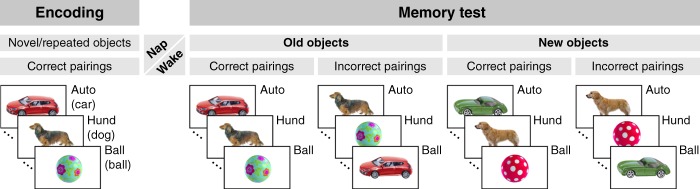
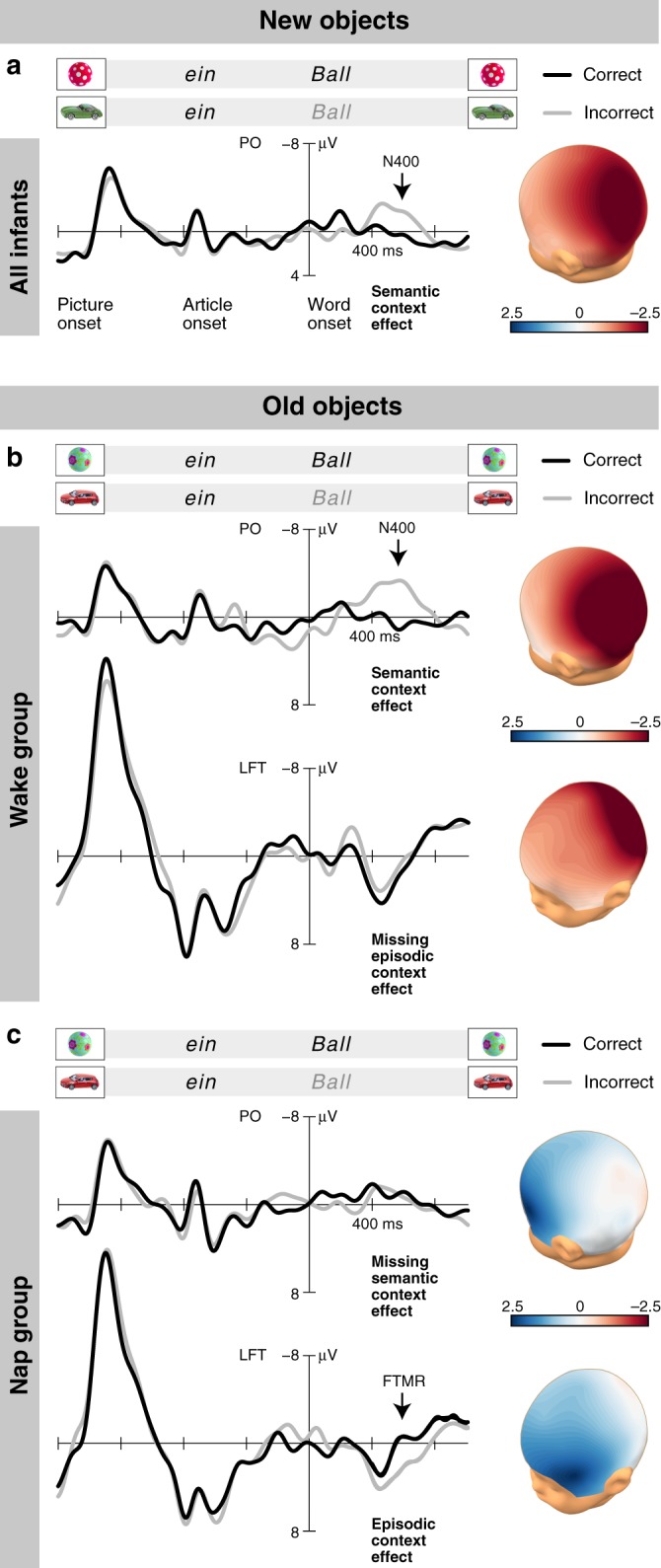
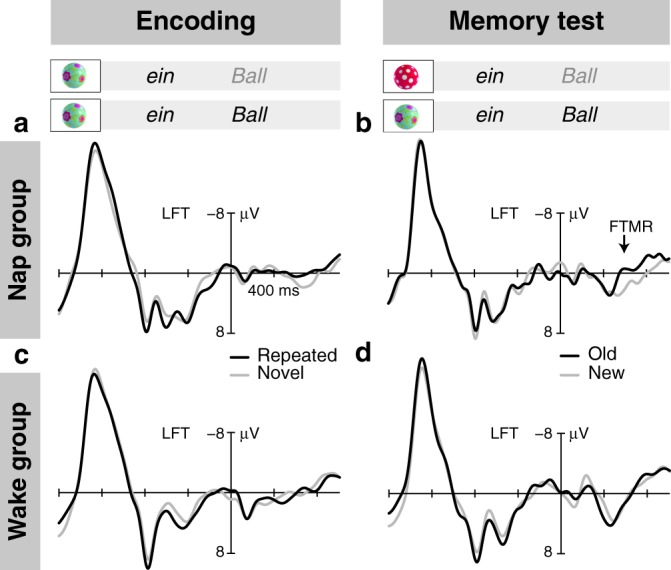
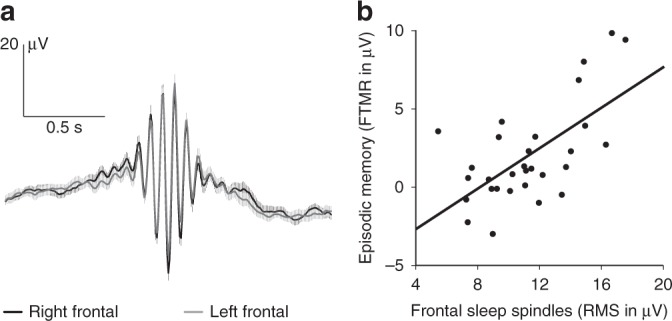
Any experienced event may be encoded and retained in detail as part of our episodic memory, and may also refer and contribute to our generalized knowledge stored in semantic memory. The beginnings of this declarative memory formation are only poorly understood. Even less is known about the interrelation between episodic and semantic memory during the earliest developmental stages. Here, we show that the formation of episodic memories in 14- to 17-month-old infants depends on sleep, subsequent to exposure to novel events. Infant brain responses reveal that, after sleep-dependent consolidation, the newly stored events are not processed semantically, although appropriate lexical-semantic memories are present and accessible by similar events that were not experienced before the nap. We propose that temporarily disabled semantic processing protects precise episodic memories from interference with generalized semantic memories. Selectively restricted semantic access could also trigger semantic refinement, and thus, might even improve semantic memory.
Overview
The claims and statistics of this paper haven’t been checked yet.
Free: it reads the open-access text and checks the first 5 claims that cite a source we can check. Create a free account to check every claim.
Integrity signals
Registry
Cites
Statistics
Figures
Verification
Claims the paper makes
The claims and statistics of this paper haven’t been checked yet.
Free: it reads the open-access text and checks the first 5 claims that cite a source we can check. Create a free account to check every claim.
Claims other papers make about this one
Each is checked against this paper’s own text: does it say what the citing paper says it does?
The cited source says what the claim attributes to it.
In the citing paper
“Interestingly, the ERP pattern at test indicated that after sleep-dependent consolidation, the newly stored word-object events are not processed semantically, although appropriate semantic memories were present and accessible by similar events that were not experienced right before the nap.”
From Sleep—A brain-state serving systems memory consolidation (2023) · cites this paper as [270]
The cited source says what the claim attributes to it.
In the citing paper
“the same group also demonstrated a facilitating effect of sleep on the formation of episodic-like memory, i.e., the memory for a unique word-object association.270”
From Sleep—A brain-state serving systems memory consolidation (2023) · cites this paper as [270]
The check wasn’t confident either way, so it gives no verdict — never disputed.
In the citing paper
“these studies revealed that, while biasing the content of memory reactivations toward the targeted memory information, TMR does not appear to increase the overall number of reactivation events.”
From Sleep—A brain-state serving systems memory consolidation (2023) · cites this paper as [130]
Experimental — accuracy not yet measuredThe check wasn’t confident either way, so it gives no verdict — never disputed.
In the citing paper
“TMR has also been used in rodent studies, confirming that auditory cues, which had been paired to specific trajectories dur-ing a spatial learning task, enhance hippocampal reactivation of the associated trajectory when delivered during subsequent sleep.”
From Sleep—A brain-state serving systems memory consolidation (2023) · cites this paper as [130]
Experimental — accuracy not yet measured
Self-check
Percentages, sums and reported differences re-computed from the paper’s own numbers.
The self-check needs the paper’s full text.
Citations
Cites
Reading Senseless Sentences: Brain Potentials Reflect Semantic Incongruity
Kutas, M., & Hillyard, S. A. (1980) · Science · doi:10.1126/science.7350657 · Cited by 4,888
Kutas, M., & Federmeier, K. D. (2011) · Annual Review of Psychology · doi:10.1146/annurev.psych.093008.131123 · Cited by 4,377
Diekelmann, S., & Born, J. (2010) · Nature Reviews Neuroscience · doi:10.1038/nrn2762 · Cited by 3,760
Self-citationOdor cues during slow-wave sleep prompt declarative memory consolidation
Rasch, B., Büchel, C., Gais, S., & Born, J. (2007) · Science · doi:10.1126/science.1138581 · Cited by 1,181
Self-citationEffects of early and late nocturnal sleep on declarative and procedural memory
Plihal, W., & Born, J. (1997) · Journal of Cognitive Neuroscience · doi:10.1162/jocn.1997.9.4.534 · Cited by 1,026
Learning-dependent increases in sleep spindle density
Gais, S., Mölle, M., Helms, K., & Born, J. (2002) · The Journal of Neuroscience · doi:10.1523/jneurosci.22-15-06830.2002 · Cited by 859
Self-citationAre spatial memories strengthened in the human hippocampus during slow wave sleep?
Peigneux, P., Laureys, S., Fuchs, S., Collette, F., Perrin, F., Reggers, J., Phillips, C., Degueldre, C., Del Fiore, G., Aerts, J., et al. (2004) · Neuron · doi:10.1016/j.neuron.2004.10.007 · Cited by 766
Sleep-dependent memory triage: evolving generalization through selective processing
Stickgold, R., & Walker, M. P. (2013) · Nature Neuroscience · doi:10.1038/nn.3303 · Cited by 755
Digital filter design for electrophysiological data – a practical approach
Widmann, A., Schröger, E., & Maess, B. (2015) · Journal of Neuroscience Methods · doi:10.1016/j.jneumeth.2014.08.002 · Cited by 711
The contribution of sleep to hippocampus-dependent memory consolidation
Marshall, L., & Born, J. (2007) · Trends in Cognitive Sciences · doi:10.1016/j.tics.2007.09.001 · Cited by 667
Cited by
Sleep—A brain-state serving systems memory consolidation
Brodt, S., Inostroza, M., Niethard, N., & Born, J. (2023) · Neuron · doi:10.1016/j.neuron.2023.03.005 · Cited by 343
Sleep and human cognitive development
Mason, G. M., Lokhandwala, S., Riggins, T., & Spencer, R. M. C. (2021) · Sleep Medicine Reviews · doi:10.1016/j.smrv.2021.101472 · Cited by 274
Mehta, K. J. (2022) · Humanities and Social Sciences Communications · doi:10.1057/s41599-021-01031-1 · Cited by 72
“Effect of sleep on cognition and academic performance Adequate sleep positively affects memory, learning, acquisition of skills and knowledge extraction (Fenn et al., 2003; Friedrich et al., 2020; Huber et al., 2004; Schönauer et al., 2017; Wagner et al., 2004).”
BackgroundSystematic review and meta-analyses on the effects of afternoon napping on cognition
Leong, R. L. F., Lo, J. C., & Chee, M. W. L. (2022) · Sleep Medicine Reviews · doi:10.1016/j.smrv.2022.101666 · Cited by 51
Development of the N400 for Word Learning in the First 2 Years of Life: A Systematic Review
Junge, C., Boumeester, M., Mills, D. L., Paul, M., & Cosper, S. H. (2021) · Frontiers in Psychology · doi:10.3389/fpsyg.2021.689534 · Cited by 53
Slow wave sleep in naps supports episodic memories in early childhood
Lokhandwala, S., & Spencer, R. M. C. (2021) · Developmental Science · doi:10.1111/desc.13035 · Cited by 41
“In contrast, work in infants (9–16 months) has found spindle activity to be associated with generalization (Friedrich, Wilhelm, Born, & Friederici, 2015) as well as episodic memory (14–17 months; Friedrich et al., 2020).”
ResultWhich Are the Central Aspects of Infant Sleep? The Dynamics of Sleep Composites across Infancy
Schoch, S. F., Huber, R., Kohler, M., & Kurth, S. (2020) · Sensors · doi:10.3390/s20247188 · Cited by 42
“The neurophysiology of sleep is linked to brain maturation, neural reorganization [2–4], as well as processes of learning and memory [5,6] (for an overview see [7]).”
BackgroundFacilitating early parent-infant emotional connection improves cortical networks in preterm infants
Yrjölä, P., Myers, M. M., Welch, M. G., Stevenson, N. J., Tokariev, A., & Vanhatalo, S. (2022) · Science Translational Medicine · doi:10.1126/scitranslmed.abq4786 · Cited by 34
“At the same time, QS is thought to support organization of large-scale networks via synaptic pruning and downscaling (43) implicated in, for example, memory consolidation (46).”
BackgroundSleep’s contribution to memory formation
Lutz, N. D., Harkotte, M., & Born, J. (2025) · Physiological Reviews · doi:10.1152/physrev.00054.2024 · Cited by 60
Consensus Paper: Situated and Embodied Language Acquisition
Reggin, L., Franco, L. E. G., Horchak, O. V., Labrecque, D., Lana, N., Rio, L., & Vigliocco, G. (2023) · Journal of Cognition · doi:10.5334/joc.308 · Cited by 38
“Only very few studies have investigated the development of the relationship between episodic and semantic memory in young children (Friedrich et al., 2020).”
BackgroundSleep and Memory in Infancy and Childhood
Mason, G. M., & Spencer, R. M. C. (2022) · Annual Review of Developmental Psychology · doi:10.1146/annurev-devpsych-121020-033411 · Cited by 34
Gossé, L. K., Wiesemann, F., Elwell, C. E., & Jones, E. J. H. (2021) · Infant Behavior and Development · doi:10.1016/j.infbeh.2021.101663 · Cited by 27
Page, J. M., Wakschlag, L. S., & Norton, E. S. (2021) · Developmental Psychobiology · doi:10.1002/dev.22202 · Cited by 19
Joechner, A., Wehmeier, S., & Werkle‐Bergner, M. (2021) · Psychophysiology · doi:10.1111/psyp.13829 · Cited by 16
The memory benefits of two naps per day during infancy: A pilot investigation
Mason, G. M., Kurdziel, L. B. F., & Spencer, R. M. C. (2021) · Infant Behavior and Development · doi:10.1016/j.infbeh.2021.101647 · Cited by 18
Johnson, E. G., Mooney, L., Graf Estes, K., Nordahl, C. W., & Ghetti, S. (2021) · Current Biology · doi:10.1016/j.cub.2021.09.058 · Cited by 13
Impact of In Utero Exposure to Antiepileptic Drugs on Neonatal Brain Function
Tokariev, A., Breakspear, M. J., Videman, M., Stjerna, S., Scholtens, L. H., van den Heuvel, M. P., Cocchi, L., & Vanhatalo, S. (2021) · Cerebral Cortex · doi:10.1093/cercor/bhab338 · Cited by 14
DeMasi, A., Horger, M. N., Allia, A. M., Scher, A., & Berger, S. E. (2021) · Infant Behavior and Development · doi:10.1016/j.infbeh.2021.101652 · Cited by 14
Memory for nonadjacent dependencies in the first year of life and its relation to sleep
Friedrich, M., Mölle, M., Born, J., & Friederici, A. D. (2022) · Nature Communications · doi:10.1038/s41467-022-35558-x · Cited by 12
Self-citationRole of Napping for Learning Across the Lifespan
Jones, B. J., & Spencer, R. M. C. (2020) · Current Sleep Medicine Reports · doi:10.1007/s40675-020-00193-9 · Cited by 14
Hacking the functions of sleep: noninvasive approaches to stimulate sleep neurophysiology
Krugliakova, E., Breuer, F., Adelhöfer, N., Alonso, A., Besedovsky, L., Murphy, K. R., Peters, E., Raczek, K., Rasch, B., Salvesen, L., et al. (2025) · Physiological Reviews · doi:10.1152/physrev.00007.2025 · Cited by 23
Napping and memory consolidation in early childhood: A systematic review and meta-analysis
Souabni, M., Souabni, M. J., Salem, A., Hammouda, O., Ammar, A., Saidi, O., Żmijewski, P., Jahrami, H., de Marco, G., Trabelsi, K., et al. (2025) · Sleep Medicine · doi:10.1016/j.sleep.2025.106649 · Cited by 14
Systematic Review of the Effects of Sleep on Memory and Word Learning in Infancy
Belia, M., Keren‐Portnoy, T., & Vihman, M. (2023) · Language Learning · doi:10.1111/lang.12544 · Cited by 9
Effects of Touchscreen Media Use on Toddlers’ Sleep: Insights from Longtime ECG Monitoring
Wimmer, S., Eglmaier, M. T. W., Eichen, L., Rettenbacher, K., Macher, D., Walter‐Laager, C., Lackner, H. K., Papousek, I., & Paechter, M. (2021) · Sensors · doi:10.3390/s21227515 · Cited by 11
Khazaei, M., Raeisi, K., Vanhatalo, S., Zappasodi, F., Comani, S., & Tokariev, A. (2023) · NeuroImage · doi:10.1016/j.neuroimage.2023.120342 · Cited by 10
“, 2017; Del Rio-Bermudez and Blumberg, 2018) whereas QS is important for memory consolidation (Friedrich et al., 2020).”
BackgroundUccella, S., Marazzotta, V., Preiti, D., Battaglini, M., Burlando, G., Roascio, M., Rossi, A., Arnulfo, G., Ramenghi, L. A., & Nobili, L. (2025) · Sleep Medicine · doi:10.1016/j.sleep.2025.106538 · Cited by 6
Age differences in generalization, memory specificity, and their overnight fate in childhood
Buchberger, E. S., Joechner, A., Ngo, C. T., Lindenberger, U., & Werkle‐Bergner, M. (2024) · Child Development · doi:10.1111/cdev.14089 · Cited by 9
Peña, M., Vásquez-Venegas, C., Cortés, P., Pittaluga, E., Herrera, M., Pino, E. J., Escobar, R. G., Dehaene‐Lambertz, G., & Guevara, P. (2024) · npj Science of Learning · doi:10.1038/s41539-024-00249-3 · Cited by 15
Qin, Q. Z., Wu, R., & Zhang, C. (2025) · Brain and Language · doi:10.1016/j.bandl.2025.105568 · Cited by 5
“Some studies further found that fast sleep spindles (13 – 15 Hz) preferentially play a key role in memory consolidation of language learning, possibly by enforcing slow oscillation-spindle cycles (M ¨ olle et al., 2011; Friedrich et al., 2020; Xia et al., 2023).”
Infant Sleep as a Cornerstone for Cognitive Development
Seehagen, S. (2022) · Policy Insights from the Behavioral and Brain Sciences · doi:10.1177/23727322211068006 · Cited by 8
“In experiments using this approach, sleep soon after encoding strengthened new memories early in life (Friedrich et al., 2015, 2020; Horváth et al., 2015, 2018; Seehagen et al., 2015).”
MethodSleep-dependent memory consolidation in young and aged brains
Kumar, D., Yanagisawa, M., & Funato, H. (2024) · Aging Brain · doi:10.1016/j.nbas.2024.100124 · Cited by 6
“A recent study explored whether sleep in 14-to 17-month-old infants supports the consolidation of object – word pairings as specific episodic-like memories [53].”
BackgroundWord form generalization across voices: The role of infant sleep
Belia, M., Keren‐Portnoy, T., & Vihman, M. M. (2024) · Journal of Experimental Child Psychology · doi:10.1016/j.jecp.2024.106106 · Cited by 5
A Novel Model of Narrative Memory for Conscious Agents
Azam, M., Rafiq, T., Naz, F. G., Ghafoor, M., Nisa, M. U., & Malik, H. (2024) · International Journal of Information Systems and Computer Technologies · doi:10.58325/ijisct.003.01.0080 · Cited by 7
Lima, R. B. D. S., & Barbosa, L. P. (2025) · Sleep Medicine · doi:10.1016/j.sleep.2025.106718 · Cited by 4
In the ear of the viewer: Toward an auditory dominance in early word learning
Mélanie Havy, A. (2023) · First Language · doi:10.1177/01427237231217249 · Cited by 3
“This result converges well with the long-standing literature that demonstrates the apparent alacrity with which young infants make an initial mapping (i.e. Fennell & Waxman, 2010; Friedrich et al., 2019, 2020; Friedrich & Friederici, 2008; Stager & Werker, 1997; Werker et al., 1998).”
ResultSleep and Selective Memory Consolidation in Infants: Exploring the Impact of Learning Contexts
Hermesch, N., Seehagen, S., Barr, R., Herbert, J. S., & Konrad, C. (2025) · Infancy · doi:10.1111/infa.70045 · Cited by 2
“Together with other studies investigating the same effect across different tasks and age groups (e.g., Berger and Scher 2017; DeMasi et al. 2021; Friedrich et al. 2015, 2020; Hupbach et al. 2009; Horváth et al. 2015; Kurdziel et al. 2013; Simon et al. 2017; Seehagen et al. 2015), this highlights…”
Age differences in generalization, memory specificity and their overnight fate in childhoodPreprint
Buchberger, E., Joechner, A., Ngo, C. T., Lindenberger, U., & Werkle‐Bergner, M. (2022) · doi:10.31234/osf.io/y6ndr · Cited by 2
The role of sleep in consolidating memory of learning in infants and toddlers
Zhilin, P. E. N. G., ZHENG, R., Hu, X., & ZHANG, D. (2023) · Advances in Psychological Science · doi:10.3724/sp.j.1042.2024.00287 · Cited by 2
Infant learning forms lasting memory schemas that influence adult behavior
Bessières, B., Prikas, E., Goodwin‐Groen, S., Silenzi, L., & Alberini, C. M. (2026) · Neuron · doi:10.1016/j.neuron.2026.03.018 · Cited by 5
Preschool children’s sleep problem and language disorder
Dan, K. A. N. G., Jiajia, L. I., & Cai, S. (2022) · Advances in Psychological Science · doi:10.3724/sp.j.1042.2022.01270 · Cited by 2
Long-term memory formation for voices during sleep in three-month-old infants
Bastian, L., Kurz, E., Näher, T., Zinke, K., Friedrich, M., & Born, J. (2024) · Neurobiology of Learning and Memory · doi:10.1016/j.nlm.2024.107987 · Cited by 5
Self-citationJohnson, E. G., Mooney, L., Nordahl, C., & Ghetti, S. (2021) · Social Science Research Network · doi:10.2139/ssrn.3774446
Sleep disturbances from the use of cannabis
Gelvez, A. I. L. (2022) · Salud Uninorte · doi:10.14482/sun.36.3.615.78 · Cited by 2
Sleep Patterns, Insomnia, and Well-Being Among Female High School Students: A Population-Based Study
Tufeq, Z. A., Ziyab, A. M., Ahmed, B., Rahho, M. K. N., & Abdulah, D. M. (2023) · Sleep Medicine Research · doi:10.17241/smr.2023.01683 · Cited by 1
“It has been proved that sufficient sleep passively improves memory, skills, learning, and the extraction of knowledge [27,28].”
BackgroundConsolidation and Reconsolidation of Auditory-Verbal Memory in Parkinson’s Disease
Izyumova, I. A. (2024) · SibScript · doi:10.21603/sibscript-2024-26-2-161-171
Ford, J. H. (2024) · Current Sleep Medicine Reports · doi:10.1007/s40675-024-00304-w
“It has been suggested that it is the maturation of the TD hippocampus at this stage of development [74] that supports this shift [70] but see [75].”
[Elisa S. Buchberger and Ann-Kathrin Joechner contributed equally to this work.]
Buchberger, E., Joechner, A., Ngo, C., Lindenberger, U., & Werkle‐Bergner, M. (2024) · MPG.PuRe (Max Planck Society)
Belia, M., Fabre, F., Borel, C., Aucouturier, J., Faivre, N., & Goupil, L. (2026) · Current Biology · doi:10.1016/j.cub.2026.09.089
Metadata
- Authors
- Friedrich, M., Mölle, M., Friederici, A. D., & Born, J.
- Affiliations
- Humboldt-Universität zu Berlin (DE)
- University of Lübeck (DE)
- Max Planck Institute for Human Cognitive and Brain Sciences (DE)
- Corresponding author
- Friedrich, Manuela
- Venue
- Nature Communications
- Published
- 2020-03-10
- Volume
- 11
- Issue
- 1
- Pages
- 1298-1298
- ISSN
- 2041-1723 (ISSN-L)
- PMC
- PMC7064567
- OpenAlex
- W2999608715
- Semantic Scholar
- 5be196f2136f95b53e35650b4b86e0583a87972f
- Cited by
- 49
- References
- 56
- Citations by year
- 2026: 2 · 2025: 7 · 2024: 10 · 2023: 6 · 2022: 9 · 2021: 12 · 2020: 3
- FWCI
- 4.03
- Type
- journal article
- Language
- en
- Open access
- gold
- doi.org
- Licence
- cc-by
- creativecommons.org/licenses/by/4.0 (tdm)
- creativecommons.org/licenses/by/4.0 (vor)
- Locations
- Nature Communications (publishedVersion, cc-by)
- Europe PMC (PubMed Central) (publishedVersion, cc-by)
- PubMed Central (publishedVersion, cc-by)
- PubMed (publishedVersion)
- RePEc: Research Papers in Economics (submittedVersion)
- DOAJ (DOAJ: Directory of Open Access Journals) (submittedVersion, cc-by-sa)
- MPG.PuRe (Max Planck Society) (submittedVersion, other-oa)
- Funders
- Deutsche Forschungsgemeinschaft (FR 1336/2‐1, FR 1336/2‐2)
- Topics
- Life Sciences › Neuroscience › Cognitive Neuroscience › Sleep and Wakefulness Research
- Life Sciences › Neuroscience › Cognitive Neuroscience › Memory and Neural Mechanisms
- Life Sciences › Neuroscience › Cognitive Neuroscience › Memory Processes and Influences
- Keywords
- sleep-dependent memory consolidation, episodic memory, semantic memory, semantic interference, semantic refinement
- MeSH terms
- Memory Consolidation, Evoked Potentials, Female, Humans, Infant, Male, Semantics, Sleep, Sleep, REM, Memory, Episodic
About these checks
Registry, retraction, Cites and statistics results are computed, not judged, with one exception: a printed reference that no index lists is read once by a model before it counts as a citation error. Claims are extracted by a model and kept only when their quote appears verbatim in the text; each cited source is then checked, with a model’s help, for whether it says what the claim relies on. Those verdicts can be wrong — read the claim’s quote and the cited source before relying on one.
Statistics and arithmetic are recomputed, not judged.
Confidence bands are shown only for fields calibrated on our annotated test set. None is calibrated yet, so no band is shown.
What counts as a claim ›How we measure confidence ›How we check this ›
Are you an author, or do you see a problem with this page? Request a review
Data sources
Bibliographic data: Semantic Scholar, OpenAlex, Crossref.
Contains information from the Semantic Scholar Academic Graph Datasets, made available under the ODC Attribution License (ODC-BY 1.0).
Semantic Scholar’s data is described in: Kinney, R., et al. (2023). The Semantic Scholar Open Data Platform. arXiv:2301.10140.
