

Sleep-dependent memory consolidation in infants protects new episodic memories from existing semantic memories
Open accessThe DOI matches its Crossref record; 56 of the 56 references it cites were found in a registry or an index.
Abstract
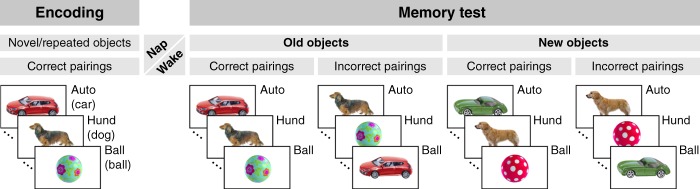
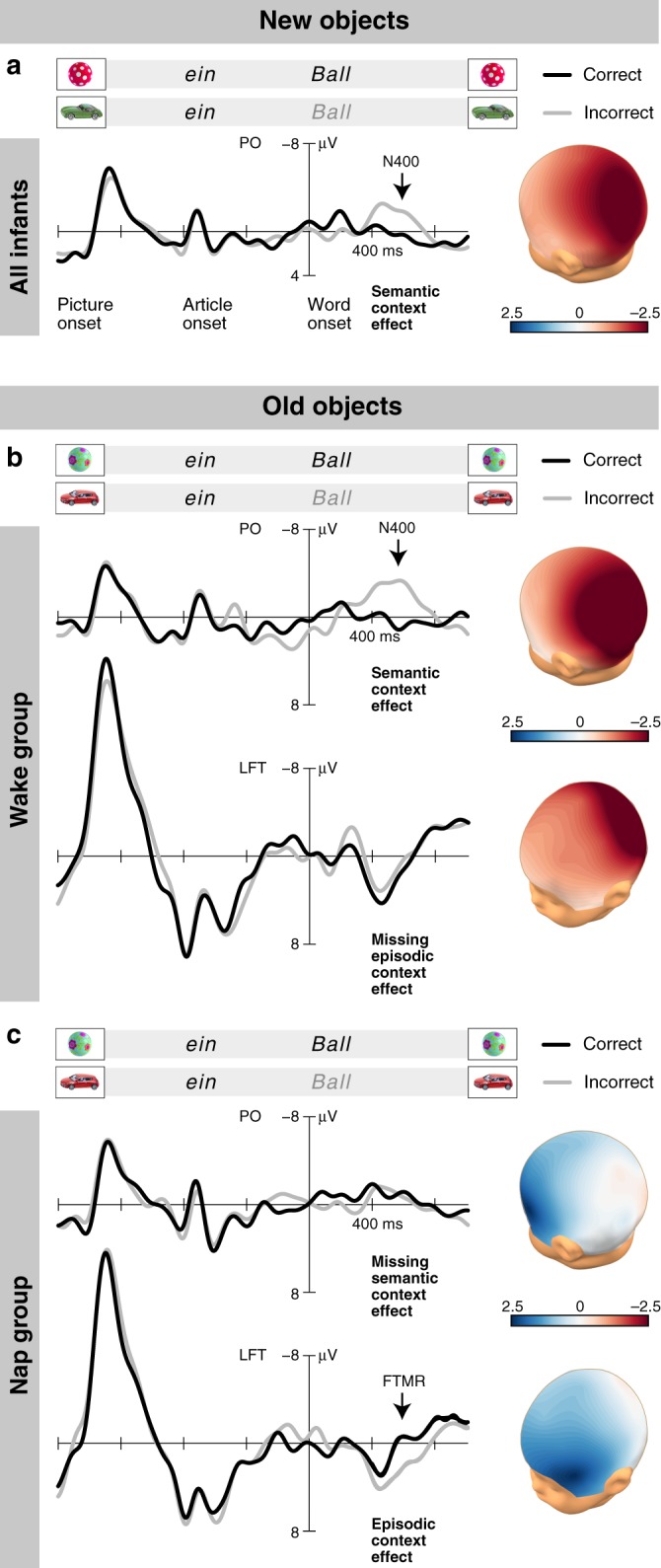
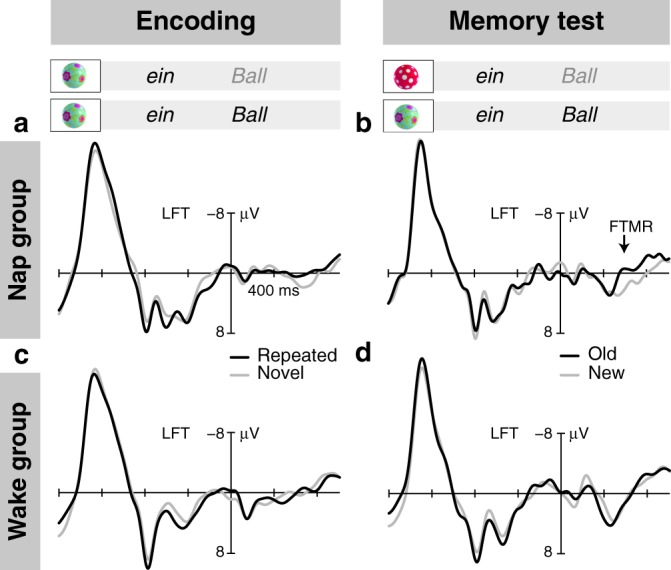
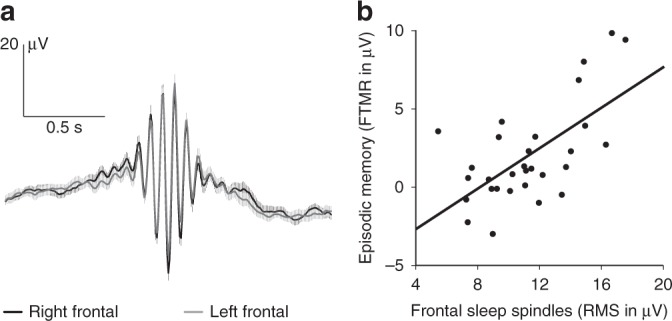
Any experienced event may be encoded and retained in detail as part of our episodic memory, and may also refer and contribute to our generalized knowledge stored in semantic memory. The beginnings of this declarative memory formation are only poorly understood. Even less is known about the interrelation between episodic and semantic memory during the earliest developmental stages. Here, we show that the formation of episodic memories in 14- to 17-month-old infants depends on sleep, subsequent to exposure to novel events. Infant brain responses reveal that, after sleep-dependent consolidation, the newly stored events are not processed semantically, although appropriate lexical-semantic memories are present and accessible by similar events that were not experienced before the nap. We propose that temporarily disabled semantic processing protects precise episodic memories from interference with generalized semantic memories. Selectively restricted semantic access could also trigger semantic refinement, and thus, might even improve semantic memory.
Overview
The claims and statistics of this paper haven’t been checked yet.
Free: it reads the open-access text and checks the first 5 claims that cite a source we can check. Create a free account to check every claim.
Integrity signals
Registry
Cites
Statistics
Figures
Verification
Claims the paper makes
The claims and statistics of this paper haven’t been checked yet.
Free: it reads the open-access text and checks the first 5 claims that cite a source we can check. Create a free account to check every claim.
Claims other papers make about this one
Each is checked against this paper’s own text: does it say what the citing paper says it does?
The cited source says what the claim attributes to it.
In the citing paper
“Interestingly, the ERP pattern at test indicated that after sleep-dependent consolidation, the newly stored word-object events are not processed semantically, although appropriate semantic memories were present and accessible by similar events that were not experienced right before the nap.”
From Sleep—A brain-state serving systems memory consolidation (2023) · cites this paper as [270]
The cited source says what the claim attributes to it.
In the citing paper
“the same group also demonstrated a facilitating effect of sleep on the formation of episodic-like memory, i.e., the memory for a unique word-object association.270”
From Sleep—A brain-state serving systems memory consolidation (2023) · cites this paper as [270]
The check wasn’t confident either way, so it gives no verdict — never disputed.
In the citing paper
“these studies revealed that, while biasing the content of memory reactivations toward the targeted memory information, TMR does not appear to increase the overall number of reactivation events.”
From Sleep—A brain-state serving systems memory consolidation (2023) · cites this paper as [130]
Experimental — accuracy not yet measuredThe check wasn’t confident either way, so it gives no verdict — never disputed.
In the citing paper
“TMR has also been used in rodent studies, confirming that auditory cues, which had been paired to specific trajectories dur-ing a spatial learning task, enhance hippocampal reactivation of the associated trajectory when delivered during subsequent sleep.”
From Sleep—A brain-state serving systems memory consolidation (2023) · cites this paper as [130]
Experimental — accuracy not yet measured
Self-check
Percentages, sums and reported differences re-computed from the paper’s own numbers.
The self-check needs the paper’s full text.
Citations
Cites
Reading Senseless Sentences: Brain Potentials Reflect Semantic Incongruity
Kutas, M., & Hillyard, S. A. (1980) · Science · doi:10.1126/science.7350657 · Cited by 4,888
Kutas, M., & Federmeier, K. D. (2011) · Annual Review of Psychology · doi:10.1146/annurev.psych.093008.131123 · Cited by 4,377
Diekelmann, S., & Born, J. (2010) · Nature Reviews Neuroscience · doi:10.1038/nrn2762 · Cited by 3,760
Self-citationOdor cues during slow-wave sleep prompt declarative memory consolidation
Rasch, B., Büchel, C., Gais, S., & Born, J. (2007) · Science · doi:10.1126/science.1138581 · Cited by 1,181
Self-citationEffects of early and late nocturnal sleep on declarative and procedural memory
Plihal, W., & Born, J. (1997) · Journal of Cognitive Neuroscience · doi:10.1162/jocn.1997.9.4.534 · Cited by 1,026
Learning-dependent increases in sleep spindle density
Gais, S., Mölle, M., Helms, K., & Born, J. (2002) · The Journal of Neuroscience · doi:10.1523/jneurosci.22-15-06830.2002 · Cited by 859
Self-citationAre spatial memories strengthened in the human hippocampus during slow wave sleep?
Peigneux, P., Laureys, S., Fuchs, S., Collette, F., Perrin, F., Reggers, J., Phillips, C., Degueldre, C., Del Fiore, G., Aerts, J., et al. (2004) · Neuron · doi:10.1016/j.neuron.2004.10.007 · Cited by 766
Sleep-dependent memory triage: evolving generalization through selective processing
Stickgold, R., & Walker, M. P. (2013) · Nature Neuroscience · doi:10.1038/nn.3303 · Cited by 755
Digital filter design for electrophysiological data – a practical approach
Widmann, A., Schröger, E., & Maess, B. (2015) · Journal of Neuroscience Methods · doi:10.1016/j.jneumeth.2014.08.002 · Cited by 711
The contribution of sleep to hippocampus-dependent memory consolidation
Marshall, L., & Born, J. (2007) · Trends in Cognitive Sciences · doi:10.1016/j.tics.2007.09.001 · Cited by 667
The cognitive neuroscience of remote episodic, semantic and spatial memory
Moscovitch, M., Nadel, L., Winocur, G., Gilboa, A., & Rosenbaum, R. S. (2006) · Current Opinion in Neurobiology · doi:10.1016/j.conb.2006.03.013 · Cited by 659
Memory consolidation during sleep: a neurophysiological perspective
BuzsÁk, G. (1998) · Journal of Sleep Research · doi:10.1046/j.1365-2869.7.s1.3.x · Cited by 575
Sleep Spindles and Their Significance for Declarative Memory Consolidation
Schabus, M., Gruber, G., Parapatics, S., Sauter, C., Klösch, G., Anderer, P., Klimesch, W., Saletu, B., & Zeitlhofer, J. (2004) · Sleep · doi:10.1093/sleep/27.7.1479 · Cited by 560
Mölle, M., Bergmann, T. O., Marshall, L., & Born, J. (2011) · Sleep · doi:10.5665/sleep.1290 · Cited by 557
Self-citationOverlapping memory replay during sleep builds cognitive schemata
Lewis, P. A., & Durrant, S. J. (2011) · Trends in Cognitive Sciences · doi:10.1016/j.tics.2011.06.004 · Cited by 512
Sleep spindle activity is associated with the integration of new memories and existing knowledge
Tamminen, J., Payne, J. D., Stickgold, R., Wamsley, E. J., & Gaskell, M. G. (2010) · The Journal of Neuroscience · doi:10.1523/jneurosci.3028-10.2010 · Cited by 478
Pattern-Specific Associative Long-Term Potentiation Induced by a Sleep Spindle-Related Spike Train
Rosanova, M., & Ulrich, D. (2005) · The Journal of Neuroscience · doi:10.1523/jneurosci.2149-05.2005 · Cited by 413
Overnight verbal memory retention correlates with the number of sleep spindles
Clemens, Z., Fabó, D., & Halász, P. (2005) · Neuroscience · doi:10.1016/j.neuroscience.2005.01.011 · Cited by 405
Memory trace reactivation in hippocampal and neocortical neuronal ensembles
Sutherland, G. (2000) · Current Opinion in Neurobiology · doi:10.1016/s0959-4388(00)00079-9 · Cited by 384
The Visual Scoring of Sleep and Arousal in Infants and Children
Grigg-Damberger, M., Gozal, D., Marcus, C. L., Quan, S. F., Rosen, C. L., Chervin, R. D., Wise, M., Picchietti, D. L., Sheldon, S. H., & Iber, C. (2007) · Journal of Clinical Sleep Medicine · doi:10.5664/jcsm.26819 · Cited by 361
The Critical Role of Sleep Spindles in Hippocampal-Dependent Memory: A Pharmacology Study
Mednick, S. C., McDevitt, E. A., Walsh, J. K., Wamsley, E., Paulus, M., Kanady, J. C., & Drummond, S. P. A. (2013) · The Journal of Neuroscience · doi:10.1523/jneurosci.3127-12.2013 · Cited by 317
Sleep for Preserving and Transforming Episodic Memory
Inostroza, M., & Born, J. (2013) · Annual Review of Neuroscience · doi:10.1146/annurev-neuro-062012-170429 · Cited by 266
Language comprehension and cerebral specialization from 13 to 20 months
Mills, D. L., Coffey‐Corina, S., & Neville, H. J. (1997) · Developmental Neuropsychology · doi:10.1080/87565649709540685 · Cited by 233
Overnight alchemy: sleep-dependent memory evolution
Walker, M. P., & Stickgold, R. (2010) · Nature Reviews Neuroscience · doi:10.1038/nrn2762-c1 · Cited by 229
Language Acquisition and Cerebral Specialization in 20-Month-Old Infants
Mills, D. L., Coffey-Corina, S. A., & Neville, H. J. (1993) · Journal of Cognitive Neuroscience · doi:10.1162/jocn.1993.5.3.317 · Cited by 222
Pomatto, L. C. D., Carney, C., Shen, B., Wong, S., Halaszynski, K., Salomon, M. P., Davies, K. J. A., & Tower, J. (2017) · Current Biology · doi:10.1016/j.cub.2016.10.044 · Cited by 210
Generalization of word meanings during infant sleep
Friedrich, M., Wilhelm, I., Born, J., & Friederici, A. D. (2015) · Nature Communications · doi:10.1038/ncomms7004 · Cited by 176
Self-citationMills, D. L., Prat, C., Zangl, R., Stager, C. L., Neville, H. J., & Werker, J. F. (2004) · Journal of Cognitive Neuroscience · doi:10.1162/0898929042304697 · Cited by 174
Volume of hippocampal subfields and episodic memory in childhood and adolescence
Lee, J. K., Ekstrom, A. D., & Ghetti, S. (2014) · NeuroImage · doi:10.1016/j.neuroimage.2014.03.019 · Cited by 171
Cortical dendritic activity correlates with spindle-rich oscillations during sleep in rodents
Seibt, J., Richard, C. J., Sigl-Glöckner, J., Takahashi, N., Kaplan, D. I., Doron, G., de Limoges, D., Bocklisch, C., & Larkum, M. E. (2017) · Nature Communications · doi:10.1038/s41467-017-00735-w · Cited by 165
Friedrich, M., & Friederici, A. D. (2005) · Journal of Cognitive Neuroscience · doi:10.1162/089892905774589172 · Cited by 159
Self-citationElectrophysiological evidence for prelinguistic infants' word recognition in continuous speech
Kooijman, V., Peter Hagoort, A., & Cutler, A. (2005) · Cognitive Brain Research · doi:10.1016/j.cogbrainres.2004.12.009 · Cited by 154
Deferred imitation by 6- and 9-month-old Infants: More evidence for declarative memory
Collie, R., & Hayne, H. (1999) · Developmental Psychobiology · doi:10.1002/(sici)1098-2302(199909)35:2<83::aid-dev1>3.0.co;2-s · Cited by 144
Episodic memory in 16- and 20-month-old children: Specifics are generalized but not forgotten.
Bauer, P. J., & Dow, G. A. (1994) · Developmental Psychology · doi:10.1037//0012-1649.30.3.403 · Cited by 140
Sleep-Dependent Facilitation of Episodic Memory Details
van der Helm, E., Gujar, N., Nishida, M., & Walker, M. P. (2011) · PLoS ONE · doi:10.1371/journal.pone.0027421 · Cited by 138
The dawning of a past: The emergence of long-term explicit memory in infancy.
Carver, L. J., & Bauer, P. J. (2001) · Journal of Experimental Psychology: General · doi:10.1037//0096-3445.130.4.726 · Cited by 137
Hippocampal maturity promotes memory distinctiveness in childhood and adolescence
Keresztes, A., Bender, A. R., Bodammer, N. C., Lindenberger, U., Shing, Y. L., & Werkle-Bergner, M. (2017) · Proceedings of the National Academy of Sciences · doi:10.1073/pnas.1710654114 · Cited by 127
Relational memory during infancy: evidence from eye tracking
Richmond, J., & Nelson, C. A. (2009) · Developmental Science · doi:10.1111/j.1467-7687.2009.00795.x · Cited by 123
Lexical priming and semantic integration reflected in the event-related potential of 14-month-olds
Friedrich, M., & Friederici, A. D. (2005) · NeuroReport · doi:10.1097/00001756-200504250-00028 · Cited by 121
Self-citationGELMAN, S. A., CROFT, W., FU, P., CLAUSNER, T., & GOTTFRIED, G. (1998) · Journal of Child Language · doi:10.1017/s0305000998003420 · Cited by 102
Neurophysiological correlates of online word learning in 14-month-old infants
Friedrich, M., & Friederici, A. D. (2008) · NeuroReport · doi:10.1097/wnr.0b013e328318f014 · Cited by 99
Self-citationLearning to remember: The early ontogeny of episodic memory
Mullally, S. L., & Maguire, E. A. (2014) · Developmental Cognitive Neuroscience · doi:10.1016/j.dcn.2013.12.006 · Cited by 97
Brain dynamics of word familiarization in 20-month-olds: Effects of productive vocabulary size
Torkildsen, J. V. K., Hansen, H. F., Svangstu, J. M., Smith, L., Simonsen, H. G., Moen, I., & Lindgren, M. P. (2008) · Brain and Language · doi:10.1016/j.bandl.2008.09.005 · Cited by 87
Conceptual and lexical hierarchies in young children
Gelman, S. A., Wilcox, S. A., & Clark, E. V. (1989) · Cognitive Development · doi:10.1016/s0885-2014(89)90022-1 · Cited by 83
Electrophysiological correlates of auditory semantic priming in 24-month-olds
Torkildsen, J. V. K., Syversen, G., Simonsen, H. G., Moen, I., & Lindgren, M. P. (2007) · Journal of Neurolinguistics · doi:10.1016/j.jneuroling.2007.02.003 · Cited by 81
Torkildsen, J. V. K., Svangstu, J. M., Hansen, H. F., Smith, L., Simonsen, H. G., Moen, I., & Lindgren, M. (2008) · Journal of Cognitive Neuroscience · doi:10.1162/jocn.2008.20087 · Cited by 80
Brain responses to lexical-semantic priming in children at-risk for dyslexia
Torkildsen, J. V. K., Syversen, G., Simonsen, H. G., Moen, I. H., & Lindgren, M. P. (2007) · Brain and Language · doi:10.1016/j.bandl.2006.11.010 · Cited by 79
Grimm, H. (2002) · Zeitschrift für Entwicklungspsychologie und Pädagogische Psychologie · doi:10.1026//0049-8637.34.2.122 · Cited by 78
The sleeping infant brain anticipates development
Friedrich, M., Wilhelm, I., Mölle, M., Born, J., & Friederici, A. D. (2017) · Current Biology · doi:10.1016/j.cub.2017.06.070 · Cited by 77
Self-citationNap sleep preserves associative but not item memory performance
Studte, S., Bridger, E. K., & Mecklinger, A. (2015) · Neurobiology of Learning and Memory · doi:10.1016/j.nlm.2015.02.012 · Cited by 56
Friedrich, M., & Friederici, A. D. (2017) · Developmental Science · doi:10.1111/desc.12357 · Cited by 47
Self-citationSleep benefits in parallel implicit and explicit measures of episodic memory
Weber, F. D., Wang, J.-Y., Born, J., & Inostroza, M. (2014) · Learning & Memory · doi:10.1101/lm.033530.113 · Cited by 45
Ontogeny of Sleep and Its Functions in Infancy, Childhood, and Adolescence
Grigg-Damberger, M. M. (2016) · Springer eBooks · doi:10.1007/978-3-319-28640-2_1 · Cited by 38
Friedrich, M., Mölle, M., Friederici, A. D., & Born, J. (2019) · Developmental Science · doi:10.1111/desc.12743 · Cited by 38
Self-citationBasic-level nouns: first learned but misunderstood
McDonough, L. (2002) · Journal of Child Language · doi:10.1017/s030500090200507x · Cited by 31
Event-related potentials during word mapping to object shape predict toddlers' vocabulary size
Borgström, K., Torkildsen, J. V. K., & Lindgren, M. P. (2015) · Frontiers in Psychology · doi:10.3389/fpsyg.2015.00143 · Cited by 27
Cited by
Sleep—A brain-state serving systems memory consolidation
Brodt, S., Inostroza, M., Niethard, N., & Born, J. (2023) · Neuron · doi:10.1016/j.neuron.2023.03.005 · Cited by 343
Sleep and human cognitive development
Mason, G. M., Lokhandwala, S., Riggins, T., & Spencer, R. M. C. (2021) · Sleep Medicine Reviews · doi:10.1016/j.smrv.2021.101472 · Cited by 274
Mehta, K. J. (2022) · Humanities and Social Sciences Communications · doi:10.1057/s41599-021-01031-1 · Cited by 72
“Effect of sleep on cognition and academic performance Adequate sleep positively affects memory, learning, acquisition of skills and knowledge extraction (Fenn et al., 2003; Friedrich et al., 2020; Huber et al., 2004; Schönauer et al., 2017; Wagner et al., 2004).”
BackgroundSystematic review and meta-analyses on the effects of afternoon napping on cognition
Leong, R. L. F., Lo, J. C., & Chee, M. W. L. (2022) · Sleep Medicine Reviews · doi:10.1016/j.smrv.2022.101666 · Cited by 51
Development of the N400 for Word Learning in the First 2 Years of Life: A Systematic Review
Junge, C., Boumeester, M., Mills, D. L., Paul, M., & Cosper, S. H. (2021) · Frontiers in Psychology · doi:10.3389/fpsyg.2021.689534 · Cited by 53
Metadata
- Authors
- Friedrich, M., Mölle, M., Friederici, A. D., & Born, J.
- Affiliations
- Humboldt-Universität zu Berlin (DE)
- University of Lübeck (DE)
- Max Planck Institute for Human Cognitive and Brain Sciences (DE)
- Corresponding author
- Friedrich, Manuela
- Venue
- Nature Communications
- Published
- 2020-03-10
- Volume
- 11
- Issue
- 1
- Pages
- 1298-1298
- ISSN
- 2041-1723 (ISSN-L)
- PMC
- PMC7064567
- OpenAlex
- W2999608715
- Cited by
- 49
- References
- 56
- Citations by year
- 2026: 2 · 2025: 7 · 2024: 10 · 2023: 6 · 2022: 9 · 2021: 12 · 2020: 3
- FWCI
- 4.03
- Type
- journal article
- Language
- en
- Open access
- gold
- doi.org
- Licence
- cc-by
- creativecommons.org/licenses/by/4.0 (tdm)
- creativecommons.org/licenses/by/4.0 (vor)
- Locations
- Nature Communications (publishedVersion, cc-by)
- Europe PMC (PubMed Central) (publishedVersion, cc-by)
- PubMed Central (publishedVersion, cc-by)
- PubMed (publishedVersion)
- RePEc: Research Papers in Economics (submittedVersion)
- DOAJ (DOAJ: Directory of Open Access Journals) (submittedVersion, cc-by-sa)
- MPG.PuRe (Max Planck Society) (submittedVersion, other-oa)
- Funders
- Deutsche Forschungsgemeinschaft (FR 1336/2‐1, FR 1336/2‐2)
- Topics
- Life Sciences › Neuroscience › Cognitive Neuroscience › Sleep and Wakefulness Research
- Life Sciences › Neuroscience › Cognitive Neuroscience › Memory and Neural Mechanisms
- Life Sciences › Neuroscience › Cognitive Neuroscience › Memory Processes and Influences
- Keywords
- sleep-dependent memory consolidation, episodic memory, semantic memory, semantic interference, semantic refinement
- MeSH terms
- Memory Consolidation, Evoked Potentials, Female, Humans, Infant, Male, Semantics, Sleep, Sleep, REM, Memory, Episodic
About these checks
Registry, retraction, Cites and statistics results are computed, not judged, with one exception: a printed reference that no index lists is read once by a model before it counts as a citation error. Claims are extracted by a model and kept only when their quote appears verbatim in the text; each cited source is then checked, with a model’s help, for whether it says what the claim relies on. Those verdicts can be wrong — read the claim’s quote and the cited source before relying on one.
Statistics and arithmetic are recomputed, not judged.
Confidence bands are shown only for fields calibrated on our annotated test set. None is calibrated yet, so no band is shown.
What counts as a claim ›How we measure confidence ›How we check this ›
Are you an author, or do you see a problem with this page? Request a review
Data sources
Bibliographic data: Semantic Scholar, OpenAlex, Crossref.
Contains information from the Semantic Scholar Academic Graph Datasets, made available under the ODC Attribution License (ODC-BY 1.0).
Semantic Scholar’s data is described in: Kinney, R., et al. (2023). The Semantic Scholar Open Data Platform. arXiv:2301.10140.
