

The DOI matches its Crossref record; 57 of the 57 references it cites were found in a registry or an index; 13 of the 29 sources its claims cite were checked for support.
Accurate deep neural network inference using computational phase-change memory
Open accessAbstract
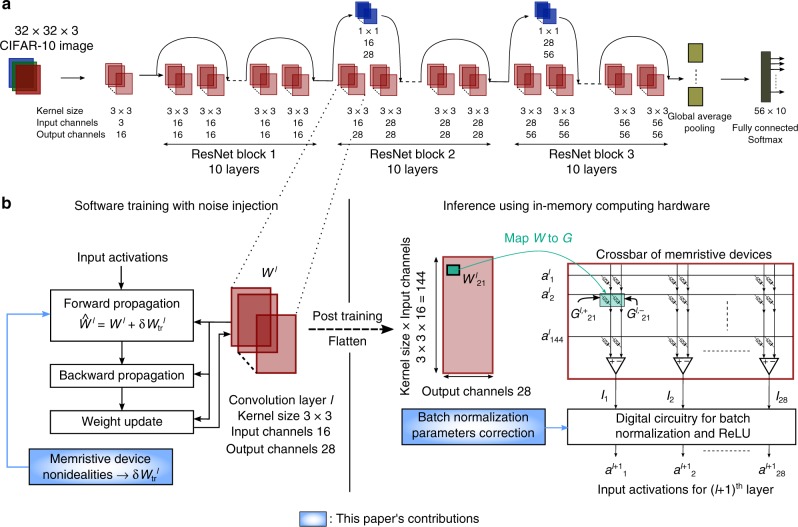
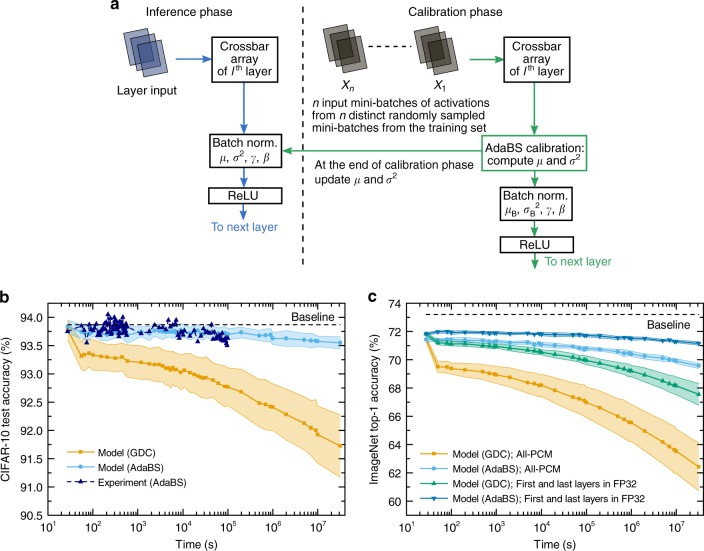
In-memory computing using resistive memory devices is a promising non-von Neumann approach for making energy-efficient deep learning inference hardware. However, due to device variability and noise, the network needs to be trained in a specific way so that transferring the digitally trained weights to the analog resistive memory devices will not result in significant loss of accuracy. Here, we introduce a methodology to train ResNet-type convolutional neural networks that results in no appreciable accuracy loss when transferring weights to phase-change memory (PCM) devices. We also propose a compensation technique that exploits the batch normalization parameters to improve the accuracy retention over time. We achieve a classification accuracy of 93.7% on CIFAR-10 and a top-1 accuracy of 71.6% on ImageNet benchmarks after mapping the trained weights to PCM. Our hardware results on CIFAR-10 with ResNet-32 demonstrate an accuracy above 93.5% retained over a one-day period, where each of the 361,722 synaptic weights is programmed on just two PCM devices organized in a differential configuration.
Overview
CoChat Summary
TL;DR
The paper shows that ResNet-style CNNs can be trained in software to tolerate phase-change memory (PCM) nonidealities, enabling accurate analog in-memory inference after weight transfer. With their training and compensation methods, they report 93.7% accuracy on CIFAR-10 and 71.6% top-1 on ImageNet after mapping weights to PCM, and 93.75% experimental accuracy on CIFAR-10 hardware that stayed above 92.6% for one day.
Key findings
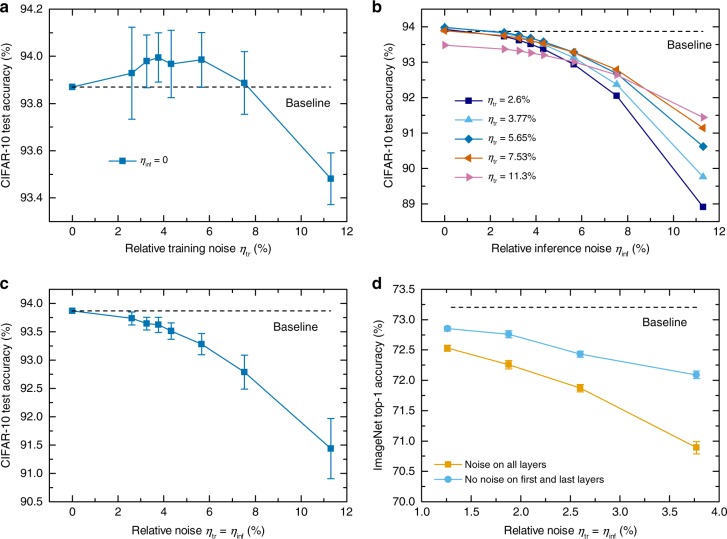
- Training ResNet-32 with injected Gaussian synaptic-weight noise yielded 93.7% test accuracy on CIFAR-10 after transfer to PCM, which was less than 0.2% below the FP32 baseline.
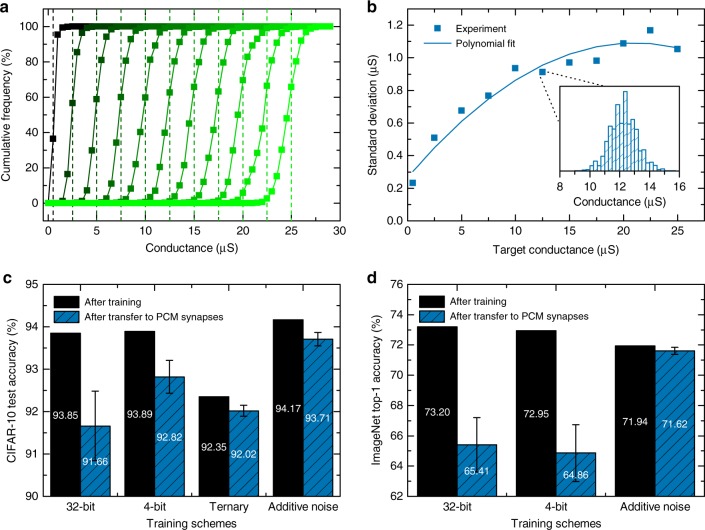
- For ResNet-34 on ImageNet, additive-noise training gave 71.6% top-1 accuracy after transfer to PCM, about 6% higher on PCM than FP32 and 4-bit training in their comparison.
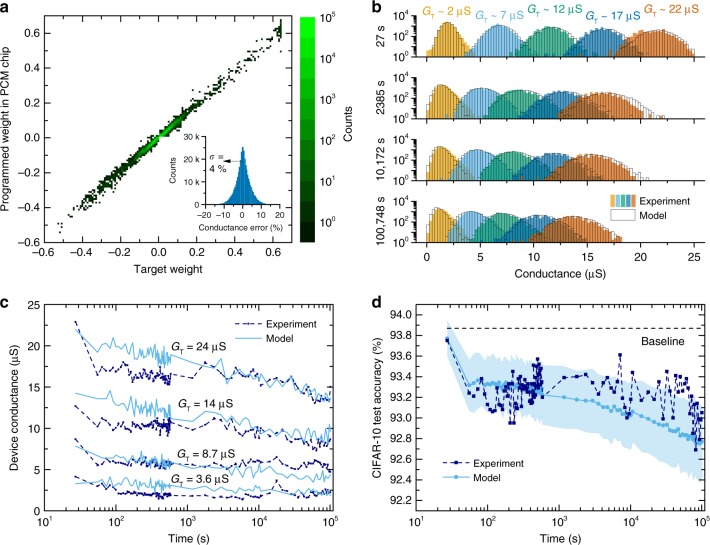
- In hardware/software CIFAR-10 experiments, all 361,722 synaptic weights of ResNet-32 were programmed on two PCM devices per weight; test accuracy was 93.75% at 25 s after programming and, with global drift compensation, stayed above 92.6% for 1 day.
- Adaptive batch normalization statistics update (AdaBS) improved drift retention further: on CIFAR-10 it kept accuracy above 93.5% over one day, an improvement of 0.9% over GDC; on ImageNet it improved one-year accuracy by 7% vs. GDC and retained above 71% for one year when combined with digital first/last layers.
Methods
- The study used ResNet-32 on CIFAR-10 and ResNet-34 on ImageNet, both trained with stochastic gradient descent and then mapped to PCM crossbar synapses.
- For training, they injected Gaussian noise into synaptic weights during the forward pass to emulate hardware read/write noise, combined with weight initialization from a pretrained baseline, weight clipping, and learning-rate scheduling; the noise scale was estimated from a one-time hardware characterization.
- Hardware validation used a prototype PCM chip with 1 million devices for the main experiments and 3 million devices in the platform; PCM weights were programmed with an iterative program-and-verify procedure, then read over time and evaluated in software inference, with GDC and AdaBS used for drift compensation.
Limitations
- The paper states that AdaBS increases accuracy at the cost of additional digital computations during calibration and requires off-chip memory/data transfers for calibration images.
- It also states that the experiments were not done on a fully integrated chip that supports all functions of deep learning inference; this is an explicit limitation in the Discussion.
- Evident from the text: the hardware/software experiment covers the network weights on the PCM array, but some parts of the inference stack are still simulated in software, so the results do not reflect a complete end-to-end deployed system.
Model-written summary. Check it against the paper before relying on it.
Integrity signals
Registry
Cites
Statistics
Figures
Verification
Claims the paper makes
11 Valid · 1 Not valid · 9 Not checked · 88 Own results and interpretations
The cited sources support only part of this claim — read each source’s verdict below.
In the paper
“Although a large body of efficient techniques to train DNNs with reduced digital precision has been reported32,33, it is unlikely that such procedures can generally be applied as-is to analog in-memory computing hardware due to the random nature of .”
§ Accurate deep neural network inference using computational phase-change memory > Results > Problem statement
What the sources say
- Not matchedcites [32] Gupta, S., Agrawal, A., Gopalakrishnan, K. & Narayanan, P. Deep learning with limited numerical precision. In Proc. of the 32nd International Conference on Machine Learning (ICML-15) 1737–1746 (PMLR, 2015).
Couldn’t be matched to a paper in Crossref, so it can’t be checked.
- Supportedcites [33] McKinstry, J. L. et al. Discovering low-precision networks close to full-precision networks for efficient embedded inference. Preprint at https://arxiv.org/abs/1809.04191 (2018). source
The citation is attached to the statement that techniques for training DNNs with reduced digital precision have been reported, not to the citing authors’ subsequent conclusion about analog in-memory hardware. The source describes a “vast diversity” of low-precision training approaches in §2.1 (p. 4) and presents its own method in §1.2 (p. 3). (LLM, conf=0.92)
hedgedstates a possible cause- Asserted: passes — The authors put it forward as true.
- Checkable: passes — It can be checked against evidence.
- Load-bearing: passes — The paper’s conclusions depend on it.
- Based: passes — The paper gives a reason why it holds.
- Not matched
The cited sources support only part of this claim — read each source’s verdict below.
In the paper
“For existing memristive technologies, the magnitude of may range from 1 to 10% of the magnitude of 11, which in general is not tolerable by DNNs trained with FP32 without any constrains.”
§ Accurate deep neural network inference using computational phase-change memory > Results > Problem statement
What the sources say
- Partly supportedcites [11] Le Gallo, M. et al. Mixed-precision in-memory computing. Nat. Electron. 1, 246–253 (2018). sourceExperimental — accuracy not yet measured
The introduction (p. 1) describes variability and low precision in memristive devices, and Section II (p. 3) identifies conductance-programming inaccuracies as a possible source of computational error. The paper does not give a δG range of 1–10% of Gmax or establish that such errors are generally intolerable to unconstrained FP32-trained DNNs; its demonstrated application is solving linear equations, with deep learning listed as a future direction in the Conclusions (p. 6). (LLM, conf=0.83)
hedgedstates a possible cause- Asserted: passes — The authors put it forward as true.
- Checkable: passes — It can be checked against evidence.
- Load-bearing: passes — The paper’s conclusions depend on it.
- Based: passes — The paper gives a reason why it holds.
- Partly supported
The cited sources that could be checked couldn’t confirm or dispute this claim.
In the paper
“Training with additive noise increases the accuracy by approximately 6% on PCM compared with FP32 and 4-bit33 training.”
§ Accurate deep neural network inference using computational phase-change memory > Results > Weight transfer to PCM-based synapses
What the sources say
- Could not verifycites [33] McKinstry, J. L. et al. Discovering low-precision networks close to full-precision networks for efficient embedded inference. Preprint at https://arxiv.org/abs/1809.04191 (2018). sourceExperimental — accuracy not yet measured
The Discussion (p. 9) describes compensating for quantization-related noise while fine-tuning 4- and 8-bit networks, not training with additive noise. The ImageNet results in §1.1 (p. 2) compare quantized networks with FP32 baselines, but our copy gives no PCM result or approximately 6% accuracy increase. I searched for additive noise, PCM, and the stated comparison. (LLM, conf=0.75)
plainstates a cause- Asserted: passes — The authors put it forward as true.
- Checkable: passes — It can be checked against evidence.
- Load-bearing: passes — The paper’s conclusions depend on it.
- Based: passes — The paper gives a reason why it holds.
- Could not verify
The cited sources support only part of this claim — read each source’s verdict below.
In the paper
“the ResNet-32 implementation with 5PP can result in potentially 2× improvement in pipeline stage latency with similar bandwidth requirements compared with a standard 2D-mesh.”
§ Accurate deep neural network inference using computational phase-change memory > Discussion
What the sources say
- Partly supportedcites [48] Dazzi, M. et al. 5 Parallel prism: a topology for pipelined implementations of convolutional neural networks using computational memory. In Proc. NeurIPS MLSys Workshop (NeurIPS, 2019). sourceExperimental — accuracy not yet measured
The Quantitative Evaluation (p. 7) says that 5PP avoids pipeline stalls while 2D meshes stall for ResNet-32, supporting a latency advantage. It compares bandwidth requirements in Figure 7b, but the available text does not establish a 2× ResNet-32 latency improvement or similar bandwidth requirements for ResNet-32 and a 2D mesh. (LLM, conf=0.82)
hedgedstates a possible cause- Asserted: passes — The authors put it forward as true.
- Checkable: passes — It can be checked against evidence.
- Load-bearing: unclear — It is unclear whether the paper’s conclusions depend on it.
- Based: passes — The paper gives a reason why it holds.
- Partly supported
Every source the paper cites for this claim was checked and supports it.
In the paper
“The proposed 5PP topology allows the mapping of all the primary connectivities of state-of-the-art neural networks, including ResNet, DenseNet and Inception-style networks48.”
§ Accurate deep neural network inference using computational phase-change memory > Discussion
What the sources say
- Supportedcites [48] Dazzi, M. et al. 5 Parallel prism: a topology for pipelined implementations of convolutional neural networks using computational memory. In Proc. NeurIPS MLSys Workshop (NeurIPS, 2019). source
The Introduction (p. 2) says the authors prove that networks with feedforward, residual, Inception-style, and dense connectivity can be mapped onto 5PP. The Conclusions (p. 8) specifically state that ResNet, Inception, and DenseNet are executable on the topology. (LLM, conf=0.94)
plainstates a cause- Asserted: passes — The authors put it forward as true.
- Checkable: passes — It can be checked against evidence.
- Load-bearing: passes — The paper’s conclusions depend on it.
- Based: passes — The paper gives a reason why it holds.
- Supported
57 more claims · 1 with their cited sources checked
Create a free account to see all 109 claims and every source verdict.
- It may state two separate claims as one. 40
- Probably not a substantial claim. 10
Claims other papers make about this one
Each is checked against this paper’s own text: does it say what the citing paper says it does?
The cited source says what the claim attributes to it.
In the citing paper
“These techniques can be more generally applied to other non-volatile resistive memory technologies such as phase-change memory8,17,21,23,24, magnetoresistive RAM48 and ferroelectric field-effect transistors49.”
From A compute-in-memory chip based on resistive random-access memory (2022) · cites this paper as [21]
The cited source says what the claim attributes to it.
In the citing paper
“A number of previous studies have shown that noise-aware training —simple injection of noise onto weights or activations during DNN training—can make DNNs more robust for AIMC deployment33,38–42.”
From Hardware-aware training for large-scale and diverse deep learning inference workloads using in-memory computing-based accelerators (2023) · cites this paper as [38]
The cited source says what the claim attributes to it.
In the citing paper
“We verified the effectiveness of our HWA training approach on the very same DNNs used in a previous study38 and found, on average, a >10% decrease in AIMC test error for long teval times.”
From Hardware-aware training for large-scale and diverse deep learning inference workloads using in-memory computing-based accelerators (2023) · cites this paper as [38]
The check wasn’t confident either way, so it gives no verdict — never disputed.
In the citing paper
“the NeuRRAM chip achieves 1.6-times to 2.3-times lower EDP and 7-times to 13-times higher computational density (measured by throughput per million of RRAMs) at various MVM input and output bit-precisions than previous state-of-the-art RRAM-based CIM chips, despite being fabricated at an older technology node17–27,36.”
From A compute-in-memory chip based on resistive random-access memory (2022) · cites this paper as [21]
Experimental — accuracy not yet measured
Citations
Cites
Deep Residual Learning for Image Recognition
He, K., Zhang, X., Ren, S., & Sun, J. (2016) · 2016 IEEE Conference on Computer Vision and Pattern Recognition (CVPR) · doi:10.1109/cvpr.2016.90 · Cited by 235,474
ImageNet Large Scale Visual Recognition Challenge
Russakovsky, O., Deng, J., Su, H., Krause, J., Satheesh, S., Ma, S., Huang, Z., Karpathy, A., Khosla, A., Bernstein, M., et al. (2015) · International Journal of Computer Vision · doi:10.1007/s11263-015-0816-y · Cited by 39,380
Delving Deep into Rectifiers: Surpassing Human-Level Performance on ImageNet Classification
He, K., Zhang, X., Ren, S., & Sun, J. (2015) · 2015 IEEE International Conference on Computer Vision (ICCV) · doi:10.1109/iccv.2015.123 · Cited by 19,741
Learning Deep Features for Discriminative Localization
Zhou, B., Khosla, A., Lapedriza, A., Oliva, A., & Torralba, A. (2016) · 2016 IEEE Conference on Computer Vision and Pattern Recognition (CVPR) · doi:10.1109/cvpr.2016.319 · Cited by 11,428
In-Datacenter Performance Analysis of a Tensor Processing Unit
Jouppi, N. P., Young, C., Patil, N., Patterson, D., Agrawal, G., Bajwa, R., Bates, S., Bhatia, S., Boden, N., Borchers, A., et al. (2017) · Proceedings of the 44th Annual International Symposium on Computer Architecture · doi:10.1145/3079856.3080246 · Cited by 4,537
XNOR-Net: ImageNet Classification Using Binary Convolutional Neural Networks
Rastegari, M., Ordonez, V., Redmon, J., & Farhadi, A. (2016) · Lecture Notes in Computer Science · doi:10.1007/978-3-319-46493-0_32 · Cited by 4,408
Improved regularization of convolutional neural networks with cutout
DeVries, T., & Taylor, G. W. (2017) · arXiv · doi:10.48550/arxiv.1708.04552 · Cited by 2,776
Memory devices and applications for in-memory computing
Sebastian, A., Le Gallo, M., Khaddam-Aljameh, R., & Eleftheriou, E. (2020) · Nature Nanotechnology · doi:10.1038/s41565-020-0655-z · Cited by 2,289
Self-citationFully hardware-implemented memristor convolutional neural network
Yao, P., Wu, H., Gao, B., Tang, J., Zhang, Q., Zhang, W., Yang, J. J., & Qian, H. (2020) · Nature · doi:10.1038/s41586-020-1942-4 · Cited by 2,179
ISAAC: a convolutional neural network accelerator with in-situ analog arithmetic in crossbars
Shafiee, A., Nag, A., Muralimanohar, N., Balasubramonian, R., Strachan, J. P., Hu, M., Williams, R. S., & Srikumar, V. (2016) · ACM SIGARCH Computer Architecture News · doi:10.1145/3007787.3001139 · Cited by 1,536
Research works printed but not linked: 5
- Blundell, C., Cornebise, J., Kavukcuoglu, K. & Wierstra, D. Weight uncertainty in neural networks. In Proc. of the 32nd International Conference on Machine Learning, Vol. 37 of ICML’15 1613–1622 (JMLR.org, 2015).
- Gulcehre, C., Moczulski, M., Denil, M. & Bengio, Y. Noisy activation functions. Proc. 33rd Int. Conf. Mach. Learn. 48, 3059–3068 (2016).
- Jim, K., Horne, B. G. & Giles, C. L. Effects of noise on convergence and generalization in recurrent networks. In Proc. of the 7th International Conference on Neural Information Processing Systems 649–656 (MIT Press, 1994).
- Courbariaux, M., Bengio, Y. & David, J.-P. Binaryconnect: training deep neural networks with binary weights during propagations. In Advances in Neural Information Processing Systems (eds Cortes, C., Lawrence, N. D., Lee, D. D., Sugiyama, M. & Garnett, R.) 3123–3131 (Curran Associates, Inc., 2015).
- Ioffe, S. & Szegedy, C. Batch normalization: accelerating deep network training by reducing internal covariate shift. In Proc. of the 32nd International Conference on Machine Learning, Vol. 37 of ICML’15 (ed. Bach, F. & Blei, D.) 448–456 (PMLR, 2015).
Cited by
Parallel convolutional processing using an integrated photonic tensor core
Feldmann, J., Youngblood, N., Karpov, M., Gehring, H., Li, X., Stappers, M., Le Gallo, M., Fu, X., Lukashchuk, A., Raja, A. S., et al. (2021) · Nature · doi:10.1038/s41586-020-03070-1 · Cited by 1,900
Self-citationA compute-in-memory chip based on resistive random-access memory
Wan, W., Kubendran, R., Schaefer, C., Eryilmaz, S. B., Zhang, W., Wu, D., Deiss, S., Raina, P., Qian, H., Gao, B., et al. (2022) · Nature · doi:10.1038/s41586-022-04992-8 · Cited by 943
“…results using a mixture of hardware characterization and software simulation, for example, emulate the array-level MVM process in software using measured device characteristics 3,5,21,24 , such an approach often fails to model the complete set of non-idealities existing in realistic hardware.”
InfluentialMemristive technologies for data storage, computation, encryption, and radio-frequency communication
Lanza, M., Sebastian, A., Lu, W. D., Le Gallo, M., Chang, M.-F., Akinwande, D., Puglisi, F. M., Alshareef, H. N., Liu, M., & Roldan, J. B. (2022) · Science · doi:10.1126/science.abj9979 · Cited by 708
“However, a critical aspect for IMC implementations is the custom offline training and/or on-chip retraining of the network needed to mitigate the effects of stuck-at devices, device noise, and circuit level non-ideality on network accuracy ( 61 ).”
BackgroundSelf-citationHardware implementation of memristor-based artificial neural networks
Aguirre, F., Sebastian, A., Le Gallo, M., Song, W., Wang, T., Yang, J. J., Lu, W., Chang, M.-F., Ielmini, D., Yang, Y., et al. (2024) · Nature Communications · doi:10.1038/s41467-024-45670-9 · Cited by 564
“To avoid this loss of accuracy, hardware-aware training methods, in which device non-idealities are incorporated during training have been proposed in the literature 189,190 .”
Self-citationEdge learning using a fully integrated neuro-inspired memristor chip
Zhang, W., Yao, P., Gao, B., Liu, Q., Wu, D., Zhang, Q., Li, Y., Qin, Q., Li, J., Zhu, Z., et al. (2023) · Science · doi:10.1126/science.ade3483 · Cited by 437
Metadata
- Authors
- Joshi, V., Le Gallo, M., Haefeli, S., Boybat, I., Nandakumar, S. R., Piveteau, C., Dazzi, M., Rajendran, B., Sebastian, A., & Eleftheriou, E.
- Affiliations
- King's College London (GB)
- ETH Zurich (CH)
- IBM Research - Zurich (CH)
- Corresponding author
- Sebastian, Abu
- ORCID
- Venue
- Nature Communications
- Published
- 2020-05-18
- Volume
- 11
- Issue
- 1
- Pages
- 2473-2473
- ISSN
- 2041-1723 (ISSN-L)
- PMC
- PMC7235046
- OpenAlex
- W2948661249
- Cited by
- 490
- References
- 51
- Citations by year
- 2026: 69 · 2025: 83 · 2024: 73 · 2023: 88 · 2022: 92 · 2021: 68 · 2020: 17
- FWCI
- 22.73
- Type
- journal article
- Language
- en
- Open access
- gold
- doi.org
- Licence
- cc-by
- creativecommons.org/licenses/by/4.0 (tdm)
- creativecommons.org/licenses/by/4.0 (vor)
- Locations
- Nature Communications (publishedVersion, cc-by)
- PubMed Central (publishedVersion, cc-by)
- PubMed (publishedVersion)
- arXiv (Cornell University) (submittedVersion)
- Infoscience (Ecole Polytechnique Fédérale de Lausanne) (submittedVersion, cc-by-nc-nd)
- DOAJ (DOAJ: Directory of Open Access Journals) (submittedVersion, cc-by-sa)
- Research Portal (King's College London) (submittedVersion, cc-by)
- arXiv (Cornell University)
- Funders
- European Commission (HORIZON2020, 682675)
- Topics
- Physical Sciences › Engineering › Electrical and Electronic Engineering › Advanced Memory and Neural Computing
- Physical Sciences › Computer Science › Computer Vision and Pattern Recognition › Advanced Neural Network Applications
- Physical Sciences › Computer Science › Artificial Intelligence › Neural Networks and Reservoir Computing
- Keywords
- phase-change memory, in-memory computing, resistive memory devices, deep neural network inference, weight mapping, device variability, ResNet, energy-efficient hardware, non-von Neumann architecture
About these checks
Registry, retraction, Cites and statistics results are computed, not judged, with one exception: a printed reference that no index lists is read once by a model before it counts as a citation error. Claims are extracted by a model and kept only when their quote appears verbatim in the text; each cited source is then checked, with a model’s help, for whether it says what the claim relies on. Those verdicts can be wrong — read the claim’s quote and the cited source before relying on one.
The claim verdicts this report counts are experimental: their accuracy is not yet measured.
A language model drew the claims from the paper on 2026-09-29, under version 3 of the claim definition (model deepseek-v4.1-flash, prompt extract-v3).
A second model labelled each claim on 2026-09-29 (model jev-1.13-20260917, definition revision gold-guideline-v0.2).
Cited sources are checked with a language model’s help (gpt-6-sol).
Statistics and arithmetic are recomputed, not judged.
Confidence bands are shown only for fields calibrated on our annotated test set. None is calibrated yet, so no band is shown.
What counts as a claim ›How we measure confidence ›How we check this ›
Are you an author, or do you see a problem with this page? Request a review
How to cite
Cite CoChat for the checks on this page, and the paper for its own findings.
- This page
- CoChat. (2026). Citation check: Accurate deep neural network inference using computational phase-change memory. https://app.cochat.ai/papers/10.1038/s41467-020-16108-9
- The paper
- Joshi, V., Le Gallo, M., Haefeli, S., Boybat, I., Nandakumar, S. R., Piveteau, C., Dazzi, M., Rajendran, B., Sebastian, A., & Eleftheriou, E. (2020). Accurate deep neural network inference using computational phase-change memory. Nature Communications. https://doi.org/10.1038/s41467-020-16108-9
Data sources
Bibliographic data: Semantic Scholar, OpenAlex, Crossref.
Contains information from the Semantic Scholar Academic Graph Datasets, made available under the ODC Attribution License (ODC-BY 1.0).
Semantic Scholar’s data is described in: Kinney, R., et al. (2023). The Semantic Scholar Open Data Platform. arXiv:2301.10140.
