

Adaptive self-healing electronic epineurium for chronic bidirectional neural interfaces
Open accessThe DOI matches its Crossref record; 50 of the 50 references it cites were found in a registry or an index.
Abstract
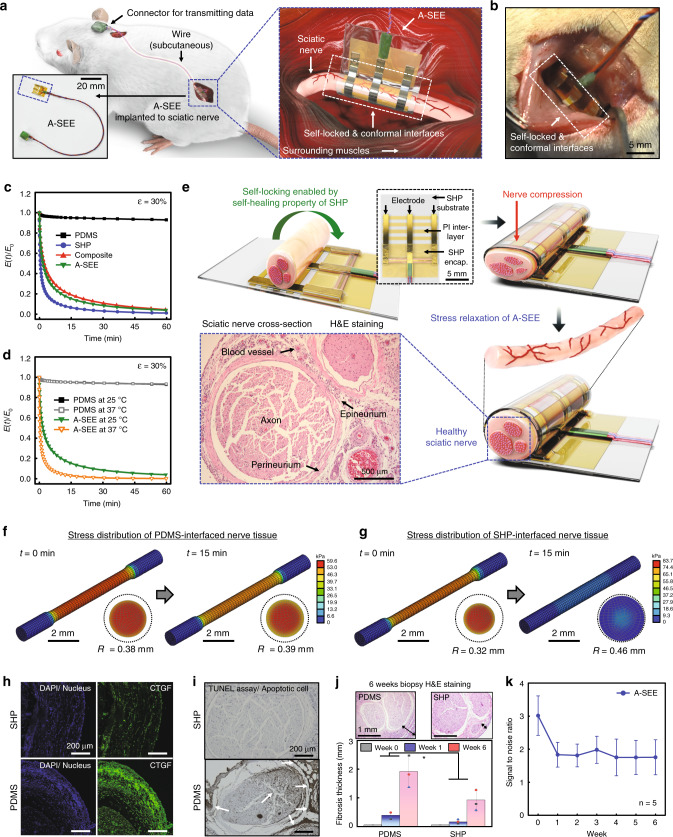
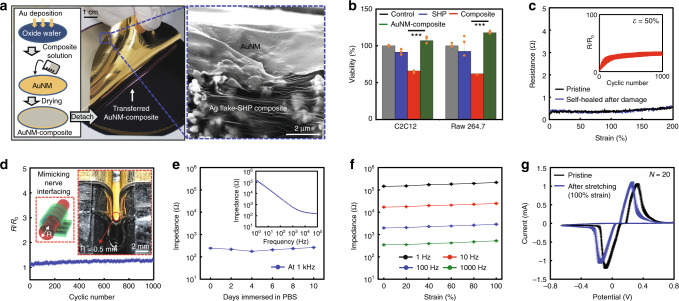
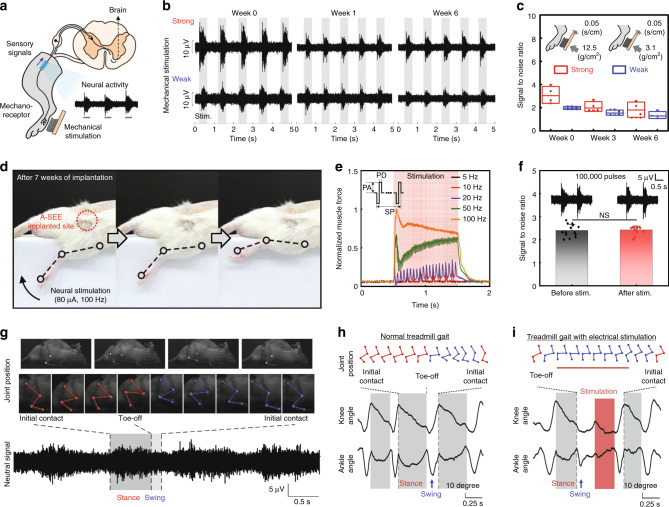
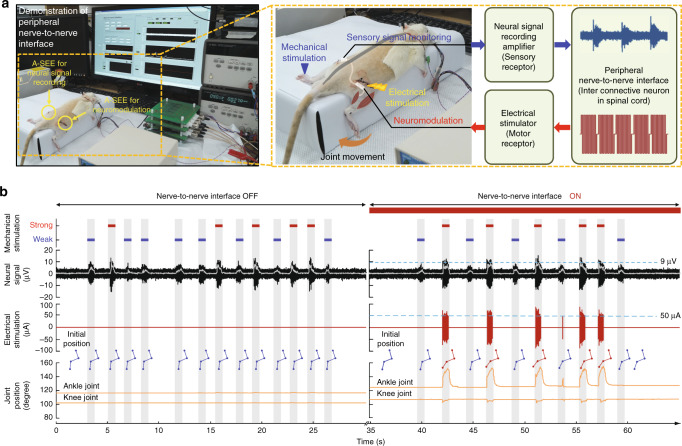
Realizing a clinical-grade electronic medicine for peripheral nerve disorders is challenging owing to the lack of rational material design that mimics the dynamic mechanical nature of peripheral nerves. Electronic medicine should be soft and stretchable, to feasibly allow autonomous mechanical nerve adaptation. Herein, we report a new type of neural interface platform, an adaptive self-healing electronic epineurium (A-SEE), which can form compressive stress-free and strain-insensitive electronics-nerve interfaces and enable facile biofluid-resistant self-locking owing to dynamic stress relaxation and water-proof self-bonding properties of intrinsically stretchable and self-healable insulating/conducting materials, respectively. Specifically, the A-SEE does not need to be sutured or glued when implanted, thereby significantly reducing complexity and the operation time of microneurosurgery. In addition, the autonomous mechanical adaptability of the A-SEE to peripheral nerves can significantly reduce the mechanical mismatch at electronics-nerve interfaces, which minimizes nerve compression-induced immune responses and device failure. Though a small amount of Ag leaked from the A-SEE is observed in vivo (17.03 ppm after 32 weeks of implantation), we successfully achieved a bidirectional neural signal recording and stimulation in a rat sciatic nerve model for 14 weeks. In view of our materials strategy and in vivo feasibility, the mechanically adaptive self-healing neural interface would be considered a new implantable platform for a wide range application of electronic medicine for neurological disorders in the human nervous system.
Overview
The claims and statistics of this paper haven’t been checked yet.
Free: it reads the open-access text and checks the first 5 claims that cite a source we can check. Create a free account to check every claim.
Integrity signals
Registry
Cites
Statistics
Figures
Verification
Claims the paper makes
The claims and statistics of this paper haven’t been checked yet.
Free: it reads the open-access text and checks the first 5 claims that cite a source we can check. Create a free account to check every claim.
Claims other papers make about this one
Each is checked against this paper’s own text: does it say what the citing paper says it does?
The source backs part of the claim, not all of it — or backs it for a different population, condition or comparison.
In the citing paper
“Most of these neural interfaces can be somehow flexible to improve mechanical compliance for adapting to the morphology of the peripheral nerve and improving biocompatibility.”
From Flexible Electronics and Devices as Human–Machine Interfaces for Medical Robotics (2022) · cites this paper as [357]
Experimental — accuracy not yet measured
Self-check
Percentages, sums and reported differences re-computed from the paper’s own numbers.
The self-check needs the paper’s full text.
Citations
Cites
Guide for the Care and Use of Laboratory Animals: Eighth Edition
(2011) · doi:10.17226/12910 · Cited by 16,199
Wavelet Methods for Time SeriesAnalysis
Percival, D. B., & Walden, A. T. (2000) · Cambridge University Press eBooks · doi:10.1017/cbo9780511841040 · Cited by 3,065
Wavelet methods for time series analysis
(2001) · Choice Reviews Online · doi:10.5860/choice.38-4508 · Cited by 2,574
Tough and Water‐Insensitive Self‐Healing Elastomer for Robust Electronic Skin
Kang, J., Son, D., Wang, G. N., Liu, Y., Lopez, J., Kim, Y., Oh, J. Y., Katsumata, T., Mun, J., Lee, Y., et al. (2018) · Advanced Materials · doi:10.1002/adma.201706846 · Cited by 1,124
Self-citationElectronic dura mater for long-term multimodal neural interfaces
Minev, I. R., Musienko, P., Hirsch, A., Barraud, Q., Wenger, N., Moraud, E. M., Gandar, J., Capogrosso, M., Milekovic, T., Asboth, L., et al. (2015) · Science · doi:10.1126/science.1260318 · Cited by 1,082
Bioresorbable silicon electronic sensors for the brain
Kang, S.-K., Murphy, R. K. J., Hwang, S.-W., Lee, S. M., Harburg, D. V., Krueger, N. A., Shin, J., Gamble, P., Cheng, H., Yu, S., et al. (2016) · Nature · doi:10.1038/nature16492 · Cited by 998
Self-citationChoi, S., Han, S. I., Jung, D., Hwang, H. J., Lim, C., Bae, S., Park, O. K., Tschabrunn, C. M., Lee, M., Bae, S. Y., et al. (2018) · Nature Nanotechnology · doi:10.1038/s41565-018-0226-8 · Cited by 984
Son, D., Kang, J., Vardoulis, O., Kim, Y., Matsuhisa, N., Oh, J. Y., To, J. W., Mun, J., Katsumata, T., Liu, Y., et al. (2018) · Nature Nanotechnology · doi:10.1038/s41565-018-0244-6 · Cited by 942
Self-citationVeiseh, O., Doloff, J. C., Ma, M., Vegas, A. J., Tam, H. H., Bader, A. R., Li, J., Langan, E., Wyckoff, J., Loo, W. S., et al. (2015) · Nature Materials · doi:10.1038/nmat4290 · Cited by 897
Navarro, X., Krueger, T. B., Lago, N., Micera, S., Stieglitz, T., & Dario, P. (2005) · Journal of the Peripheral Nervous System · doi:10.1111/j.1085-9489.2005.10303.x · Cited by 845
Research works printed but not linked: 1
- 15. Grill, W. M. & Mortimer, J. T. Neural and connective tissue response to long- term implantation of multiple contact nerve cuff electrodes. J. Biomed. Mater. Res. 50, 215-226 (2000). · doi:10.1002/(sici)1097-4636(200005)50:2<215::aid-jbm17>3.0.co;2-a
Cited by
Items 101–120 of 120
Woo, H. T., Yun, J., Lee, J., Song, K., & Chi, H. J. (2025) · Biomaterials · doi:10.1016/j.biomaterials.2025.123904 · Cited by 1
Self-citationA Laminating Strategy to Manyfold Enhance the Elastic Stretchability of Stretchable Electronics
Zhou, Z., Wu, X., Xu, X., Wang, F., Li, S., Li, H., & Su, Y. (2026) · Advanced Science · doi:10.1002/advs.202521763 · Cited by 1
“They enable real-time physiological monitoring and disease diagnosis [ 4–9 ], facilitate strain sensing on aircraft surfaces and adaptive smart skins [ 10–13 ], and are employed in soft robotics and for pipeline and pressure vessel health monitoring [ 14–16 ].”
Lee, H., Kang, J., Kim, J., & Lee, W. (2026) · Nature Communications · doi:10.1038/s41467-026-72754-5 · Cited by 1
“For example, to minimize mechanicalmismatchatthe tissue-device interface, a cuff-type neural interface was developed using SHPs, whose intrinsic self-healing and adaptive properties allowed conformal, suture-free integration with peripheral nerves 16 .”
Self-citationHMC3 revealed: how much do these “Microglia” really tell us?
Buccarello, L., Privitera, A., Partsinevelos, K., Serwa, K., Carota, G., Pietro, L. D., Cardaci, V., Mangione, R., Sibbitts, J., Lazzarino, G., et al. (2026) · Frontiers in Immunology · doi:10.3389/fimmu.2026.1778798 · Cited by 2
Dynamic biophysical coupling in bioelectronic interfaces for peripheral nerve modulation
Pan, W., Yang, J., Zhao, Y., Gao, Z., Liu, H., & Ma, D. (2026) · Nature Reviews Electrical Engineering · doi:10.1038/s44287-026-00301-x · Cited by 4
“Strain-tolerant, recoverable conductive networks allow local compression or partial detachment to heal rather than accumulate as failure 42,43”
Chen, Y., Dai, H., Hu, Z., Wei, J., Zhou, W., Duan, Z., Cui, Z., Wei, W., Zhang, G., Zhang, W., et al. (2023) · Applied Materials Today · doi:10.1016/j.apmt.2023.101836 · Cited by 3
Recent Trends in Adhesive Bioelectronics using Self-healing and Stretchable Materials
Park, J.-H., Kang, K., & Son, D. (2024) · Journal of Flexible and Printed Electronics · doi:10.56767/jfpe.2024.3.2.145 · Cited by 1
Self-citationStrain Balanced Self‐Supporting Single‐Crystalline LiNbO3 Thin Films for Flexible Electronics
Zhou, H., Zhang, S., Zheng, P., Wu, J., Zhang, L., Huang, H., You, T., Ren, Z., Hu, Y., Zhong, N., et al. (2022) · Advanced Electronic Materials · doi:10.1002/aelm.202100986 · Cited by 1
Park, K., Kang, K., Kim, J., Jin, S., Shin, M., & Son, D. (2022) · Research Square · doi:10.21203/rs.3.rs-2032206/v1
Self-citationKim, S., & Song, K. (2024) · Micromachines · doi:10.3390/mi15050594
“Durfee [23] demonstrated that the Crago [18] observed that recruitment characteristics were nonlinear and varied depending on the stimulators and muscle length.”
BackgroundMethodInfluentialSelf-citationIntisar, A., & Kim, M. S. (2024) · Current Opinion in Biomedical Engineering · doi:10.1016/j.cobme.2024.100563
Soft Materials for Implantable Biosensors for Humans
Ananthappan, P., Ramki, K., Jayalakshmi, M., Hashim, F. B., & Vasantha, V. S. (2025) · Wiley eBooks · doi:10.1002/9781394214143.ch13
Jang, N., Ji, S., Yu, S., Park, S., & Hwang, D. (2025) · Annual International Conference of the IEEE Engineering in Medicine and Biology Society (EMBC) · doi:10.1109/embc58623.2025.11253959
“Neural interfaces with various materials and mechanical properties have been proposed to solve these issues [26-30].”
Peixin, L., Ye, Y., Dong, Y., Hou, J., Gao, Y., Yan, Y., Wu, C., Yang, L., & Wang, H. (2026) · International Journal of Smart and Nano Materials · doi:10.1080/19475411.2026.2656225 · Cited by 1
Multilayer architecture for self-healing electronics beyond single material strategies
Lee, Y., Biswas, S., Bae, J., Yoo, H., & Kim, H. (2026) · Device · doi:10.1016/j.device.2026.101200
Choi, M.-K., Jeon, J.-H., Kim, Y.-G., & Kang, S. (2026) · Soft Science · doi:10.20517/ss.2026.71 · Cited by 2
Self-citationZuo, X., Sun, X., Cong, L., Wang, H., Liu, S., & Zhang, X. (2026) · Biosensors and Bioelectronics · doi:10.1016/j.bios.2026.119131
Shi, P., Ni, Z., Yang, Y., Wang, Y., Yuan, L., Shan, L., Zhu, S., Huang, B., & Liu, J. (2026) · ACS Nano · doi:10.1021/acsnano.6c12948
BioNICs: Biomaterial-enabled neural interfaces with closed-loop control for brain disorders
Ju, Y., Dou, Z., Yang, Y., & Yang, F. (2026) · EngMedicine · doi:10.1016/j.engmed.2026.100167
Kim, J., Park, J., Lee, Y., Kim, G., Shin, Y., Eom, S., & Jeong, J. (2026) · Gels · doi:10.3390/gels12100875
“This interface autonomously adapts to the dynamic expansion and contraction of the nerve, minimizing nerve-compression-induced immune responses and device failure, and thereby achieved stable bidirectional (recording and stimulation) neural signaling at the sciatic nerve over 14 weeks [74].”
Self-citation
Metadata
- Authors
- Song, K.-I., Seo, H., Seong, D., Kim, S., Yu, K. J., Kim, Y.-C., Kim, J., Kwon, S. J., Han, H.-S., Youn, I., Lee, H., & Son, D.
- Affiliations
- Daegu-Gyeongbuk Medical Innovation Foundation (KR)
- Korea Institute of Science and Technology (KR)
- Sungkyunkwan University (KR)
- Yonsei University (KR)
- Corresponding author
- Youn, Inchan
- Lee, Hyojin
- Son, Donghee
- ORCID
- Venue
- Nature Communications
- Published
- 2020-08-21
- Volume
- 11
- Issue
- 1
- Pages
- 4195-4195
- ISSN
- 2041-1723 (ISSN-L)
- PMC
- PMC7442836
- OpenAlex
- W3080891263
- Cited by
- 120
- References
- 50
- Citations by year
- 2026: 16 · 2025: 23 · 2024: 29 · 2023: 16 · 2022: 15 · 2021: 21
- FWCI
- 5.95
- Type
- journal article
- Language
- en
- Open access
- gold
- doi.org
- Licence
- cc-by
- creativecommons.org/licenses/by/4.0 (tdm)
- creativecommons.org/licenses/by/4.0 (vor)
- Locations
- Nature Communications (publishedVersion, cc-by)
- PubMed Central (publishedVersion, cc-by)
- PubMed (publishedVersion)
- RePEc: Research Papers in Economics (submittedVersion)
- DOAJ (DOAJ: Directory of Open Access Journals) (submittedVersion, cc-by-sa)
- Funders
- National Research Foundation
- Korea Institute of Science and Technology (2020R1C1C1005567, 2E29680, 2E29300, 2E30341)
- National Research Foundation of Korea (IITP-2020-0-01821, 2020R1C1C1005567, CAP-18-01-KIST, 2E30341)
- Ministry of Science and ICT, South Korea (2020-0-01821, CAP-18-01-KIST, IITP-2020-0-01821, 2E30341, 2020R1C1C1005567)
- Institute for Information and Communications Technology Promotion (IITP-2020-0-01821, 2020-0-01821)
- Topics
- Life Sciences › Neuroscience › Cellular and Molecular Neuroscience › Neuroscience and Neural Engineering
- Physical Sciences › Engineering › Biomedical Engineering › Advanced Sensor and Energy Harvesting Materials
- Physical Sciences › Materials Science › Polymers and Plastics › Conducting polymers and applications
- Keywords
- self-healing materials, stretchable electronics, peripheral nerve interfaces, implantable neural interfaces, mechanical mismatch, stress relaxation, sciatic nerve, peripheral nerve disorders
- MeSH terms
- Wearable Electronic Devices, Animals, Biomedical Engineering, Central Nervous System, Electronics, Medical, Gold, Humans, Male, Materials Testing, Nerve Tissue, Neurosurgery, Peripheral Nerves, Polymers, Sciatic Nerve, Prostheses and Implants, Models, Animal, Rats
About these checks
Registry, retraction, Cites and statistics results are computed, not judged, with one exception: a printed reference that no index lists is read once by a model before it counts as a citation error. Claims are extracted by a model and kept only when their quote appears verbatim in the text; each cited source is then checked, with a model’s help, for whether it says what the claim relies on. Those verdicts can be wrong — read the claim’s quote and the cited source before relying on one.
Statistics and arithmetic are recomputed, not judged.
Confidence bands are shown only for fields calibrated on our annotated test set. None is calibrated yet, so no band is shown.
What counts as a claim ›How we measure confidence ›How we check this ›
Are you an author, or do you see a problem with this page? Request a review
Data sources
Bibliographic data: Semantic Scholar, OpenAlex, Crossref.
Contains information from the Semantic Scholar Academic Graph Datasets, made available under the ODC Attribution License (ODC-BY 1.0).
Semantic Scholar’s data is described in: Kinney, R., et al. (2023). The Semantic Scholar Open Data Platform. arXiv:2301.10140.
