

Adaptive self-healing electronic epineurium for chronic bidirectional neural interfaces
Open accessThe DOI matches its Crossref record; 50 of the 50 references it cites were found in a registry or an index.
Abstract
Realizing a clinical-grade electronic medicine for peripheral nerve disorders is challenging owing to the lack of rational material design that mimics the dynamic mechanical nature of peripheral nerves. Electronic medicine should be soft and stretchable, to feasibly allow autonomous mechanical nerve adaptation. Herein, we report a new type of neural interface platform, an adaptive self-healing electronic epineurium (A-SEE), which can form compressive stress-free and strain-insensitive electronics-nerve interfaces and enable facile biofluid-resistant self-locking owing to dynamic stress relaxation and water-proof self-bonding properties of intrinsically stretchable and self-healable insulating/conducting materials, respectively. Specifically, the A-SEE does not need to be sutured or glued when implanted, thereby significantly reducing complexity and the operation time of microneurosurgery. In addition, the autonomous mechanical adaptability of the A-SEE to peripheral nerves can significantly reduce the mechanical mismatch at electronics-nerve interfaces, which minimizes nerve compression-induced immune responses and device failure. Though a small amount of Ag leaked from the A-SEE is observed in vivo (17.03 ppm after 32 weeks of implantation), we successfully achieved a bidirectional neural signal recording and stimulation in a rat sciatic nerve model for 14 weeks. In view of our materials strategy and in vivo feasibility, the mechanically adaptive self-healing neural interface would be considered a new implantable platform for a wide range application of electronic medicine for neurological disorders in the human nervous system.
Overview
The claims and statistics of this paper haven’t been checked yet.
Free: it reads the open-access text and checks the first 5 claims that cite a source we can check. Create a free account to check every claim.
Integrity signals
Registry
Cites
Statistics
Figures
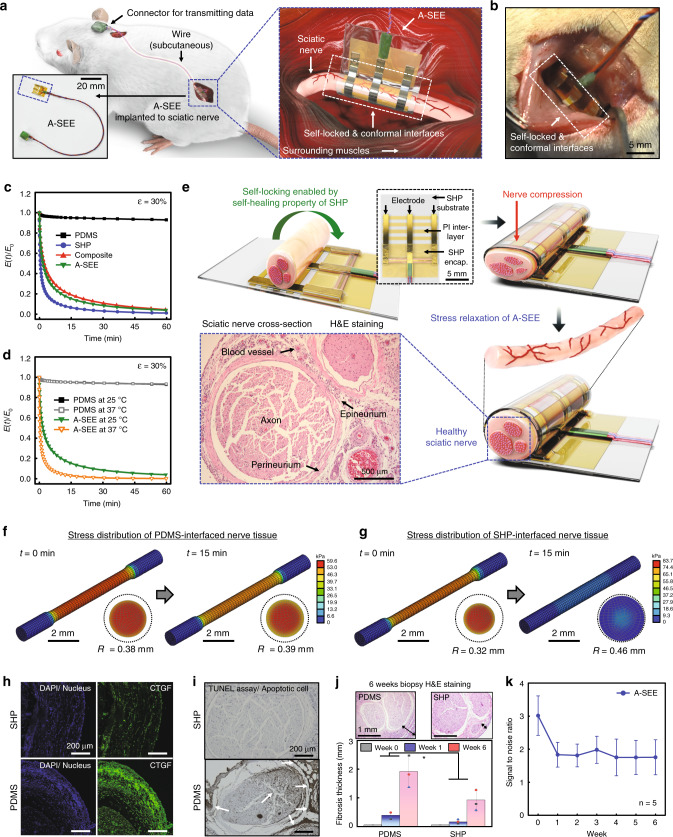
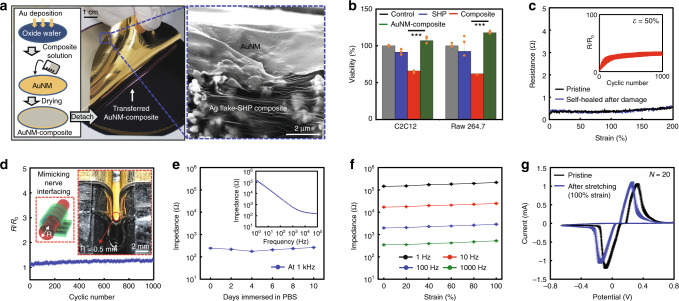
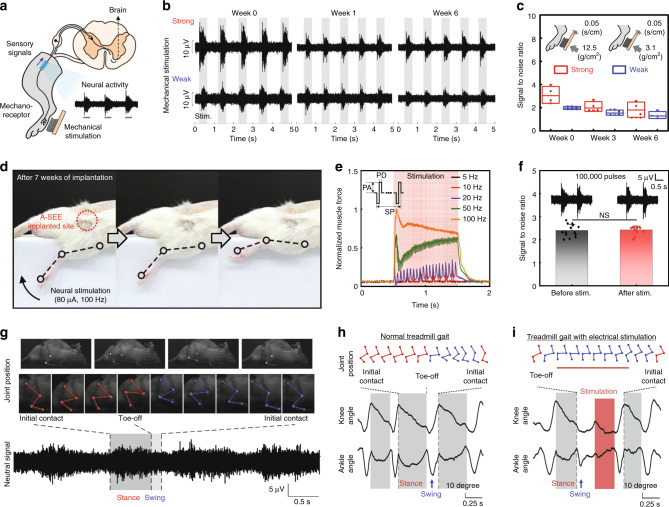
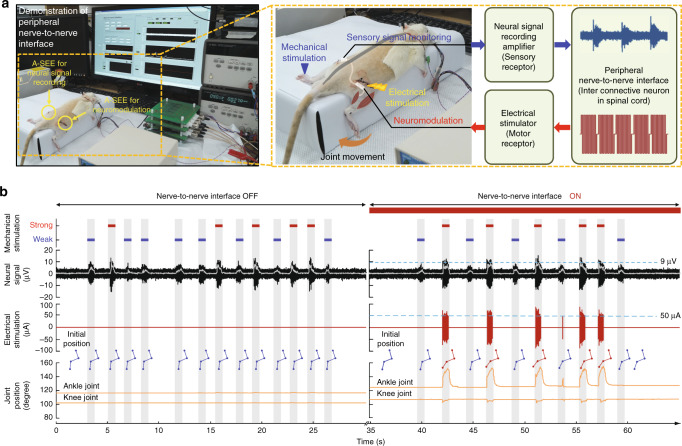
Verification
Claims the paper makes
The claims and statistics of this paper haven’t been checked yet.
Free: it reads the open-access text and checks the first 5 claims that cite a source we can check. Create a free account to check every claim.
Claims other papers make about this one
Each is checked against this paper’s own text: does it say what the citing paper says it does?
The source backs part of the claim, not all of it — or backs it for a different population, condition or comparison.
In the citing paper
“Most of these neural interfaces can be somehow flexible to improve mechanical compliance for adapting to the morphology of the peripheral nerve and improving biocompatibility.”
From Flexible Electronics and Devices as Human–Machine Interfaces for Medical Robotics (2022) · cites this paper as [357]
Experimental — accuracy not yet measured
Self-check
Percentages, sums and reported differences re-computed from the paper’s own numbers.
The self-check needs the paper’s full text.
Citations
Cites
Guide for the Care and Use of Laboratory Animals: Eighth Edition
(2011) · doi:10.17226/12910 · Cited by 16,199
Wavelet Methods for Time SeriesAnalysis
Percival, D. B., & Walden, A. T. (2000) · Cambridge University Press eBooks · doi:10.1017/cbo9780511841040 · Cited by 3,065
Wavelet methods for time series analysis
(2001) · Choice Reviews Online · doi:10.5860/choice.38-4508 · Cited by 2,574
Tough and Water‐Insensitive Self‐Healing Elastomer for Robust Electronic Skin
Kang, J., Son, D., Wang, G. N., Liu, Y., Lopez, J., Kim, Y., Oh, J. Y., Katsumata, T., Mun, J., Lee, Y., et al. (2018) · Advanced Materials · doi:10.1002/adma.201706846 · Cited by 1,124
Self-citationElectronic dura mater for long-term multimodal neural interfaces
Minev, I. R., Musienko, P., Hirsch, A., Barraud, Q., Wenger, N., Moraud, E. M., Gandar, J., Capogrosso, M., Milekovic, T., Asboth, L., et al. (2015) · Science · doi:10.1126/science.1260318 · Cited by 1,082
Bioresorbable silicon electronic sensors for the brain
Kang, S.-K., Murphy, R. K. J., Hwang, S.-W., Lee, S. M., Harburg, D. V., Krueger, N. A., Shin, J., Gamble, P., Cheng, H., Yu, S., et al. (2016) · Nature · doi:10.1038/nature16492 · Cited by 998
Self-citationChoi, S., Han, S. I., Jung, D., Hwang, H. J., Lim, C., Bae, S., Park, O. K., Tschabrunn, C. M., Lee, M., Bae, S. Y., et al. (2018) · Nature Nanotechnology · doi:10.1038/s41565-018-0226-8 · Cited by 984
Son, D., Kang, J., Vardoulis, O., Kim, Y., Matsuhisa, N., Oh, J. Y., To, J. W., Mun, J., Katsumata, T., Liu, Y., et al. (2018) · Nature Nanotechnology · doi:10.1038/s41565-018-0244-6 · Cited by 942
Self-citationVeiseh, O., Doloff, J. C., Ma, M., Vegas, A. J., Tam, H. H., Bader, A. R., Li, J., Langan, E., Wyckoff, J., Loo, W. S., et al. (2015) · Nature Materials · doi:10.1038/nmat4290 · Cited by 897
Navarro, X., Krueger, T. B., Lago, N., Micera, S., Stieglitz, T., & Dario, P. (2005) · Journal of the Peripheral Nervous System · doi:10.1111/j.1085-9489.2005.10303.x · Cited by 845
Soft and elastic hydrogel-based microelectronics for localized low-voltage neuromodulation
Liu, Y., Liu, J., Chen, S., Lei, T., Kim, Y., Niu, S., Wang, H., Wang, X., Foudeh, A. M., Tok, J. B.-H., et al. (2019) · Nature Biomedical Engineering · doi:10.1038/s41551-018-0335-6 · Cited by 811
Self-citationA neural interface provides long-term stable natural touch perception
Tan, D. W., Schiefer, M. A., Keith, M. W., Anderson, J. R., Tyler, J., & Tyler, D. J. (2014) · Science Translational Medicine · doi:10.1126/scitranslmed.3008669 · Cited by 751
Materials and technologies for soft implantable neuroprostheses
Lacour, S. P., Courtine, G., & Guck, J. (2016) · Nature Reviews Materials · doi:10.1038/natrevmats.2016.63 · Cited by 738
Novel electrode technologies for neural recordings
Hong, G., & Lieber, C. M. (2019) · Nature Reviews Neuroscience · doi:10.1038/s41583-019-0140-6 · Cited by 695
Mechanisms and Therapeutic Relevance of Neuro-immune Communication
Chavan, S. S., Pavlov, V. A., & Tracey, K. J. (2017) · Immunity · doi:10.1016/j.immuni.2017.06.008 · Cited by 663
Eduok, U., Faye, O., & Szpunar, J. (2017) · Progress in Organic Coatings · doi:10.1016/j.porgcoat.2017.05.012 · Cited by 661
Neural recording and modulation technologies
Chen, R., Canales, A., & Anikeeva, P. (2017) · Nature Reviews Materials · doi:10.1038/natrevmats.2016.93 · Cited by 655
Tissue–electronics interfaces: from implantable devices to engineered tissues
Feiner, R., & Dvir, T. (2017) · Nature Reviews Materials · doi:10.1038/natrevmats.2017.76 · Cited by 595
Yu, K. J., Kuzum, D., Hwang, S.-W., Kim, B. H., Juul, H., Kim, N. H., Won, S. M., Chiang, K., Trumpis, M., Richardson, A. G., et al. (2016) · Nature Materials · doi:10.1038/nmat4624 · Cited by 523
Self-citationNext-generation probes, particles, and proteins for neural interfacing
Rivnay, J., Wang, H., Fenno, L., Deisseroth, K., & Malliaras, G. G. (2017) · Science Advances · doi:10.1126/sciadv.1601649 · Cited by 514
Koo, J., MacEwan, M. R., Kang, S.-K., Won, S. M., Stephen, M., Gamble, P., Xie, Z., Yan, Y., Chen, Y.-Y., Shin, J., et al. (2018) · Nature Medicine · doi:10.1038/s41591-018-0196-2 · Cited by 496
Self-citationA spiral nerve cuff electrode for peripheral nerve stimulation
Naples, G. G., Mortimer, J. T., Scheiner, A., & Sweeney, J. D. (1988) · IEEE Transactions on Biomedical Engineering · doi:10.1109/10.8670 · Cited by 415
Topp, K. S., & Boyd, B. S. (2006) · Physical Therapy · doi:10.1093/ptj/86.1.92 · Cited by 361
Strain-enhanced stress relaxation impacts nonlinear elasticity in collagen gels
Nam, S., Hu, K. H., Butte, M. J., & Chaudhuri, O. (2016) · Proceedings of the National Academy of Sciences · doi:10.1073/pnas.1523906113 · Cited by 336
Zhang, Y., Zheng, N., Cao, Y., Wang, F., Wang, P., Ma, Y., Lu, B., Hou, G., Fang, Z., Liang, Z., et al. (2019) · Science Advances · doi:10.1126/sciadv.aaw1066 · Cited by 314
Electromechanical cardioplasty using a wrapped elasto-conductive epicardial mesh
Park, J., Choi, S., Janardhan, A. H., Lee, S.-Y., Raut, S., Soares, J., Shin, K., Yang, S., Lee, C., Kang, K.-W., et al. (2016) · Science Translational Medicine · doi:10.1126/scitranslmed.aad8568 · Cited by 253
Self-citationNonthrombogenic, stretchable, active multielectrode array for electroanatomical mapping
Lee, W., Kobayashi, S., Nagase, M., Jimbo, Y., Saito, I., Inoue, Y., Yambe, T., Sekino, M., Malliaras, G. G., Yokota, T., et al. (2018) · Science Advances · doi:10.1126/sciadv.aau2426 · Cited by 227
Recent Advances in Materials, Devices, and Systems for Neural Interfaces
Won, S. M., Song, E., Zhao, J., Li, J., Rivnay, J., & Rogers, J. A. (2018) · Advanced Materials · doi:10.1002/adma.201800534 · Cited by 206
Tan, D. W., Schiefer, M. A., Keith, M. W., Anderson, J. R., & Tyler, D. J. (2015) · Journal of Neural Engineering · doi:10.1088/1741-2560/12/2/026002 · Cited by 175
Implantable neurotechnologies: a review of micro- and nanoelectrodes for neural recording
Patil, A. C., & Thakor, N. V. (2016) · Medical & Biological Engineering & Computing · doi:10.1007/s11517-015-1430-4 · Cited by 175
A method for single-neuron chronic recording from the retina in awake mice
Hong, G., Fu, T.-M., Qiao, M., Viveros, R. D., Yang, X., Zhou, T., Lee, J. M., Park, H.-G., Sanes, J. R., & Lieber, C. M. (2018) · Science · doi:10.1126/science.aas9160 · Cited by 172
Kim, S. H., Seo, H., Kang, J., Hong, J., Seong, D., Kim, H.-J., Kim, J., Mun, J., Youn, I., Kim, J., et al. (2019) · ACS Nano · doi:10.1021/acsnano.9b00160 · Cited by 142
Self-citationNeural signals for command control and feedback in functional neuromuscular stimulation: a review.
Hoffer, J. A., Rb, S., Haugland, M. K., Sinkjær, T., Durfee, W. K., Schwartz, A., Loeb, G. E., & Kantor, C. (1996) · PubMed · Cited by 139
González‐Rivera, J., Iglio, R., Barillaro, G., Duce, C., & Tinè, M. R. (2018) · Polymers · doi:10.3390/polym10060616 · Cited by 121
Xiang, Z., Yen, S., Sheshadri, S., Wang, J., Lee, S., Liu, Y., Liao, L., Thakor, N. V., & Lee, C. (2016) · Advanced Materials · doi:10.1002/adma.201503423 · Cited by 116
Static Pressure Regulates Connective Tissue Growth Factor Expression in Human Mesangial Cells
Hishikawa, K., Oemar, B. S., & Nakaki, T. (2001) · Journal of Biological Chemistry · doi:10.1074/jbc.m010722200 · Cited by 106
Davis, L. A., Gordon, T., Hoffer, J. A., Jhamandas, J., & Stein, R. B. (1978) · The Journal of Physiology · doi:10.1113/jphysiol.1978.sp012588 · Cited by 103 · cited 1×
“The recording of sensory compound action potentials (CAPs) was also achieved by the spiral cuffs and utilized to demonstrate foot drop correction 13,14 .”
“Long-term stability of stimulating spiral nerve cuff electrodes on human peripheral nerves”
Christie, B. P., Freeberg, M., Memberg, W. D., Pinault, G. J. C., Hoyen, H. A., Tyler, D. J., & Triolo, R. J. (2017) · Journal of NeuroEngineering and Rehabilitation · doi:10.1186/s12984-017-0285-3 · Cited by 97
Update on Peripheral Nerve Electrodes for Closed-Loop Neuroprosthetics
Rijnbeek, E. H., Eleveld, N., & Olthuis, W. (2018) · Frontiers in Neuroscience · doi:10.3389/fnins.2018.00350 · Cited by 91
Fisher, L. E., Tyler, D. J., Anderson, J. S., & Triolo, R. J. (2009) · Journal of Neural Engineering · doi:10.1088/1741-2560/6/4/046010 · Cited by 89
Macrophage phenotypes in the collagen-induced foreign body reaction in rats
van Putten, S. M., Ploeger, D. T. A., Popa, E. R., & Bank, R. A. (2013) · Acta Biomaterialia · doi:10.1016/j.actbio.2013.01.022 · Cited by 88
Chu, J.-U., Song, K.-I., Han, S., Lee, S. H., Kim, J., Kang, J. Y., Hwang, D., Suh, J.-K. F., Choi, K., & Youn, I. (2012) · Physiological Measurement · doi:10.1088/0967-3334/33/6/943 · Cited by 47
Self-citationJowett, N., Kearney, R. E., Knox, C., & Hadlock, T. A. (2018) · Plastic & Reconstructive Surgery · doi:10.1097/prs.0000000000005164 · Cited by 44
Bypassing stroke-damaged neural pathways via a neural interface induces targeted cortical adaptation
Kato, K., Sawada, M., & Nishimura, Y. (2019) · Nature Communications · doi:10.1038/s41467-019-12647-y · Cited by 39 · cited 1×
“The interactive peripheral nerve-to-nerve interfacing technology would be helpful to improve future clinical electronic medicine or neuroprosthetics 42,43 .”
Thil, M., Duy, D. T., Colin, I. M., & Delbeke, J. (2007) · Journal of Neuroimmunology · doi:10.1016/j.jneuroim.2007.01.021 · Cited by 37
Song, K., Park, S. E., Lee, S., Kim, H., Lee, S. H., & Youn, I. (2018) · Scientific Reports · doi:10.1038/s41598-018-33695-2 · Cited by 27
Self-citationSong, K., Chu, J., Park, S. E., Hwang, D., & Youn, I. (2016) · IEEE Transactions on Biomedical Engineering · doi:10.1109/tbme.2016.2580705 · Cited by 20
Self-citationDelianides, C., Tyler, D., Pinault, G., Ansari, R., & Triolo, R. (2020) · Neuromodulation Technology at the Neural Interface · doi:10.1111/ner.13110 · Cited by 20 · cited 1×
“9, 10).”
Charkhkar, H., Christie, B. P., Pinault, G. J., Tyler, D. J., & Triolo, R. J. (2019) · Journal of Neuroscience Methods · doi:10.1016/j.jneumeth.2019.108414 · Cited by 19
Jeong (2000) · doi:10.1002/(sici)1097-4636(200005)50:2
Research works printed but not linked: 1
- 15. Grill, W. M. & Mortimer, J. T. Neural and connective tissue response to long- term implantation of multiple contact nerve cuff electrodes. J. Biomed. Mater. Res. 50, 215-226 (2000). · doi:10.1002/(sici)1097-4636(200005)50:2<215::aid-jbm17>3.0.co;2-a
Cited by
Neuromorphic sensorimotor loop embodied by monolithically integrated, low-voltage, soft e-skin
Wang, W., Jiang, Y., Zhong, D., Zhang, Z., Choudhury, S., Lai, J.-C., Gong, H., Niu, S., Yan, X., Zheng, Y., et al. (2023) · Science · doi:10.1126/science.ade0086 · Cited by 788
Self-citationFlexible Electronics and Devices as Human–Machine Interfaces for Medical Robotics
Heng, W., Solomon, S., & Gao, W. (2022) · Advanced Materials · doi:10.1002/adma.202107902 · Cited by 609
From Diagnosis to Treatment: Recent Advances in Patient-Friendly Biosensors and Implantable Devices
Li, P., Lee, G.-H., Kim, S. Y., Kwon, S. Y., Kim, H.-R., & Park, S. (2021) · ACS Nano · doi:10.1021/acsnano.0c06688 · Cited by 359
Self-citationWater-responsive supercontractile polymer films for bioelectronic interfaces
Yi, J., Zou, G., Huang, J., Ren, X., Tian, Q., Yu, Q., Wang, P., Yuan, Y., Tang, W., Wang, C., et al. (2023) · Nature · doi:10.1038/s41586-023-06732-y · Cited by 240
Motion artefact management for soft bioelectronics
Yin, J., Wang, S., Tat, T., & Chen, J. (2024) · Nature Reviews Bioengineering · doi:10.1038/s44222-024-00175-4 · Cited by 220
“To achieve tissue-level stretchability in soft bioelectronics, polymer materials are commonly used owing to their long-chain molecular structure, intermolecular slippages between chains 63 and the reversible dissipation of strain energy through dynamic bonds 64–68 .”
Metadata
- Authors
- Song, K.-I., Seo, H., Seong, D., Kim, S., Yu, K. J., Kim, Y.-C., Kim, J., Kwon, S. J., Han, H.-S., Youn, I., Lee, H., & Son, D.
- Affiliations
- Daegu-Gyeongbuk Medical Innovation Foundation (KR)
- Korea Institute of Science and Technology (KR)
- Sungkyunkwan University (KR)
- Yonsei University (KR)
- Corresponding author
- Youn, Inchan
- Lee, Hyojin
- Son, Donghee
- ORCID
- Venue
- Nature Communications
- Published
- 2020-08-21
- Volume
- 11
- Issue
- 1
- Pages
- 4195-4195
- ISSN
- 2041-1723 (ISSN-L)
- PMC
- PMC7442836
- OpenAlex
- W3080891263
- Cited by
- 120
- References
- 50
- Citations by year
- 2026: 16 · 2025: 23 · 2024: 29 · 2023: 16 · 2022: 15 · 2021: 21
- FWCI
- 5.95
- Type
- journal article
- Language
- en
- Open access
- gold
- doi.org
- Licence
- cc-by
- creativecommons.org/licenses/by/4.0 (tdm)
- creativecommons.org/licenses/by/4.0 (vor)
- Locations
- Nature Communications (publishedVersion, cc-by)
- PubMed Central (publishedVersion, cc-by)
- PubMed (publishedVersion)
- RePEc: Research Papers in Economics (submittedVersion)
- DOAJ (DOAJ: Directory of Open Access Journals) (submittedVersion, cc-by-sa)
- Funders
- National Research Foundation
- Korea Institute of Science and Technology (2020R1C1C1005567, 2E29680, 2E29300, 2E30341)
- National Research Foundation of Korea (IITP-2020-0-01821, 2020R1C1C1005567, CAP-18-01-KIST, 2E30341)
- Ministry of Science and ICT, South Korea (2020-0-01821, CAP-18-01-KIST, IITP-2020-0-01821, 2E30341, 2020R1C1C1005567)
- Institute for Information and Communications Technology Promotion (IITP-2020-0-01821, 2020-0-01821)
- Topics
- Life Sciences › Neuroscience › Cellular and Molecular Neuroscience › Neuroscience and Neural Engineering
- Physical Sciences › Engineering › Biomedical Engineering › Advanced Sensor and Energy Harvesting Materials
- Physical Sciences › Materials Science › Polymers and Plastics › Conducting polymers and applications
- Keywords
- self-healing materials, stretchable electronics, peripheral nerve interfaces, implantable neural interfaces, mechanical mismatch, stress relaxation, sciatic nerve, peripheral nerve disorders
- MeSH terms
- Wearable Electronic Devices, Animals, Biomedical Engineering, Central Nervous System, Electronics, Medical, Gold, Humans, Male, Materials Testing, Nerve Tissue, Neurosurgery, Peripheral Nerves, Polymers, Sciatic Nerve, Prostheses and Implants, Models, Animal, Rats
About these checks
Registry, retraction, Cites and statistics results are computed, not judged, with one exception: a printed reference that no index lists is read once by a model before it counts as a citation error. Claims are extracted by a model and kept only when their quote appears verbatim in the text; each cited source is then checked, with a model’s help, for whether it says what the claim relies on. Those verdicts can be wrong — read the claim’s quote and the cited source before relying on one.
Statistics and arithmetic are recomputed, not judged.
Confidence bands are shown only for fields calibrated on our annotated test set. None is calibrated yet, so no band is shown.
What counts as a claim ›How we measure confidence ›How we check this ›
Are you an author, or do you see a problem with this page? Request a review
Data sources
Bibliographic data: Semantic Scholar, OpenAlex, Crossref.
Contains information from the Semantic Scholar Academic Graph Datasets, made available under the ODC Attribution License (ODC-BY 1.0).
Semantic Scholar’s data is described in: Kinney, R., et al. (2023). The Semantic Scholar Open Data Platform. arXiv:2301.10140.
