

Triboelectric nanogenerator sensors for soft robotics aiming at digital twin applications
Open accessThe DOI matches its Crossref record; 46 of the 46 references it cites were found in a registry or an index.
Abstract
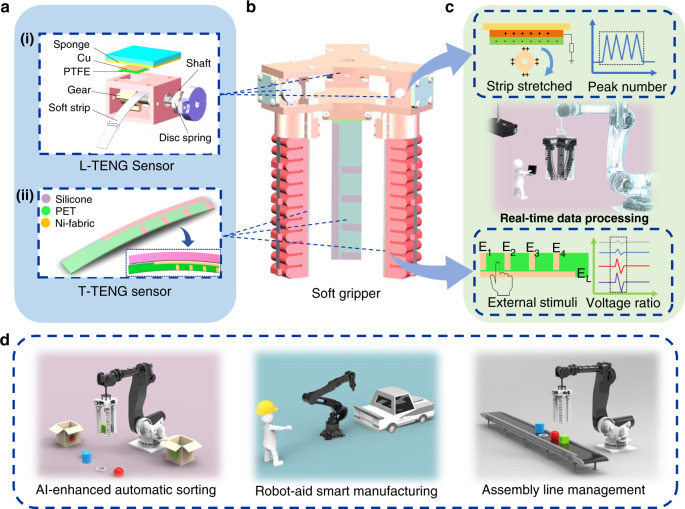
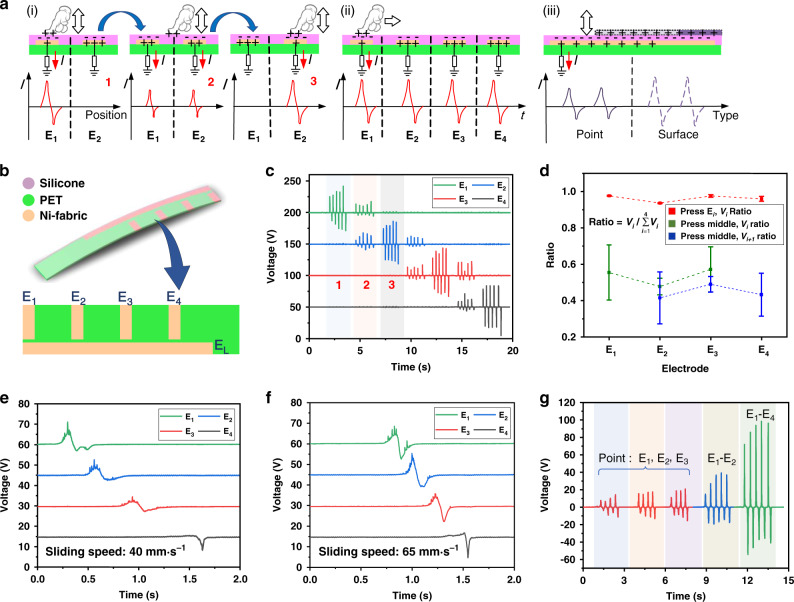
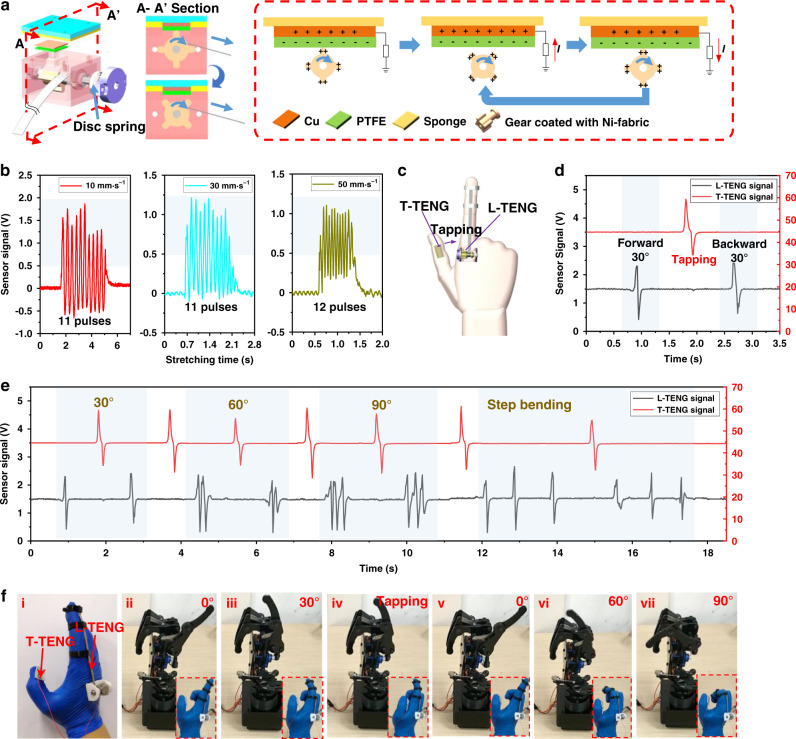
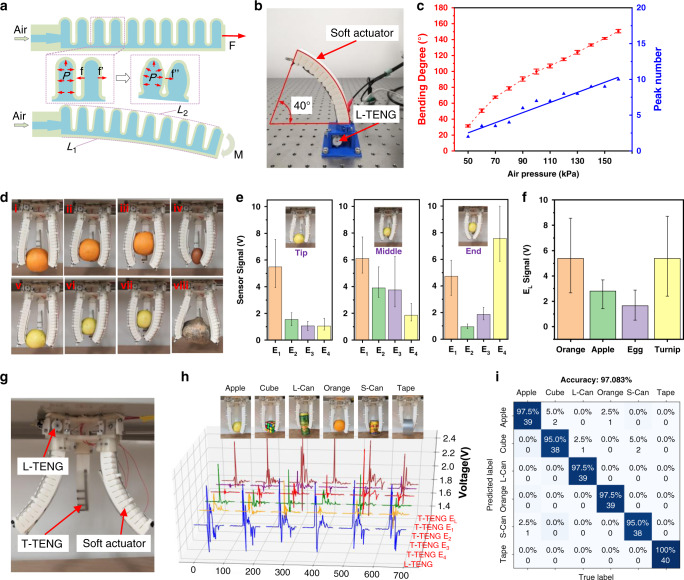
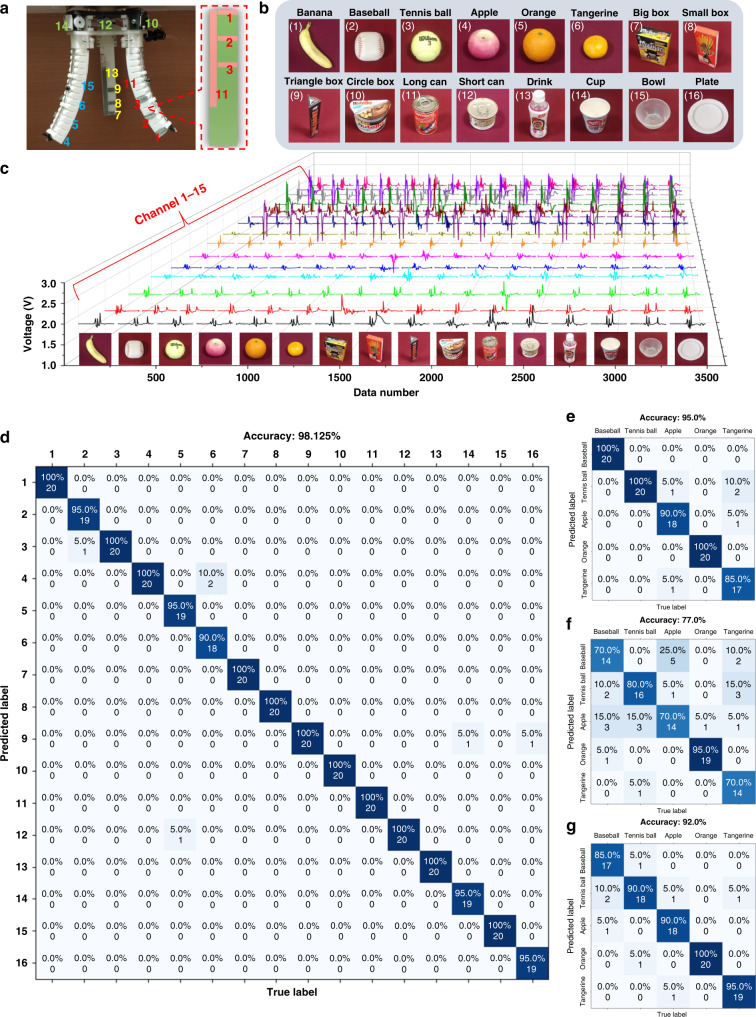
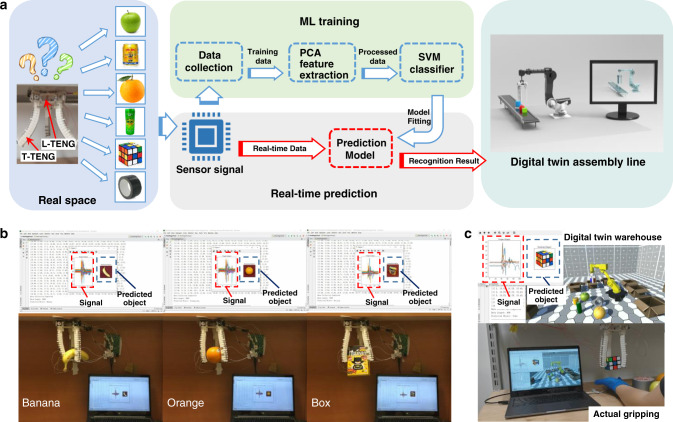
Designing efficient sensors for soft robotics aiming at human machine interaction remains a challenge. Here, we report a smart soft-robotic gripper system based on triboelectric nanogenerator sensors to capture the continuous motion and tactile information for soft gripper. With the special distributed electrodes, the tactile sensor can perceive the contact position and area of external stimuli. The gear-based length sensor with a stretchable strip allows the continuous detection of elongation via the sequential contact of each tooth. The triboelectric sensory information collected during the operation of soft gripper is further trained by support vector machine algorithm to identify diverse objects with an accuracy of 98.1%. Demonstration of digital twin applications, which show the object identification and duplicate robotic manipulation in virtual environment according to the real-time operation of the soft-robotic gripper system, is successfully created for virtual assembly lines and unmanned warehouse applications.
Overview
The claims and statistics of this paper haven’t been checked yet.
Free: it reads the open-access text and checks the first 5 claims that cite a source we can check. Create a free account to check every claim.
Integrity signals
Registry
Cites
Statistics
Figures
Verification
Claims the paper makes
The claims and statistics of this paper haven’t been checked yet.
Free: it reads the open-access text and checks the first 5 claims that cite a source we can check. Create a free account to check every claim.
Claims other papers make about this one
Each is checked against this paper’s own text: does it say what the citing paper says it does?
The cited source doesn’t support the claim as written.
In the citing paper
“By first preprocessing EMG data, ANNs were shown to classify 17 hand gestures from 6 EMG electrodes with an accuracy of 83%,[446]”
From Flexible Electronics and Devices as Human–Machine Interfaces for Medical Robotics (2022) · cites this paper as [446]
Checked by a reasoning model — may be wrong.
Experimental — accuracy not yet measured
Self-check
Percentages, sums and reported differences re-computed from the paper’s own numbers.
The self-check needs the paper’s full text.
Citations
Cites
1 retracted
Gul, J. Z., Sajid, M., & Choi, K. H. (2019) · Journal of Materials Chemistry C · doi:10.1039/c8tc03423k · Cited by 63
RetractedDesign, fabrication and control of soft robots
Rus, D., & Tolley, M. T. (2015) · Nature · doi:10.1038/nature14543 · Cited by 5,825
Digital twin and big data towards smart manufacturing and Industry 4.0: 360 degree comparison
Qi, Q., & Tao, F. (2018) · IEEE Access · doi:10.1109/access.2018.2793265 · Cited by 1,716
Soft Robotics: A Perspective—Current Trends and Prospects for the Future
Majidi, C. (2014) · Soft Robotics · doi:10.1089/soro.2013.0001 · Cited by 1,302
Learning the signatures of the human grasp using a scalable tactile glove
Sundaram, S., Kellnhofer, P., Li, Y., Zhu, J.-Y., Torralba, A., & Matusik, W. (2019) · Nature · doi:10.1038/s41586-019-1234-z · Cited by 1,162
Infrared Regulating Smart Window Based on Organic Materials
Khandelwal, H., Schenning, A. P. H. J., & Debije, M. G. (2017) · Advanced Energy Materials · doi:10.1002/aenm.201602209 · Cited by 1,027
Optoelectronically innervated soft prosthetic hand via stretchable optical waveguides
Zhao, H., O’Brien, K., Li, S., & Shepherd, R. F. (2016) · Science Robotics · doi:10.1126/scirobotics.aai7529 · Cited by 982
Boutry, C. M., Negre, M., Jorda, M., Vardoulis, O., Chortos, A., Khatib, O., & Bao, Z. (2018) · Science Robotics · doi:10.1126/scirobotics.aau6914 · Cited by 921
Zhu, M., Sun, Z., Zhang, Z., Shi, Q., He, T., Liu, H., Chen, T., & Lee, C. (2020) · Science Advances · doi:10.1126/sciadv.aaz8693 · Cited by 784
Self-citationToward Perceptive Soft Robots: Progress and Challenges
Wang, H., Totaro, M., & Beccai, L. (2018) · Advanced Science · doi:10.1002/advs.201800541 · Cited by 753
Zhuang, C., Liu, J., & Xiong, H. (2018) · The International Journal of Advanced Manufacturing Technology · doi:10.1007/s00170-018-1617-6 · Cited by 693
Soft robot perception using embedded soft sensors and recurrent neural networks
Thuruthel, T. G., Shih, B., Laschi, C., & Tolley, M. T. (2019) · Science Robotics · doi:10.1126/scirobotics.aav1488 · Cited by 678
Shi, Q., Dong, B., He, T., Sun, Z., Zhu, J., Zhang, Z., & Lee, C. (2020) · InfoMat · doi:10.1002/inf2.12122 · Cited by 661
Self-citationHigh-Force Soft Printable Pneumatics for Soft Robotic Applications
Yap, H. K., Ng, H. Y., & Yeow, C.-H. (2016) · Soft Robotics · doi:10.1089/soro.2016.0030 · Cited by 601
Wen, F., Sun, Z., He, T., Shi, Q., Zhu, M., Zhang, Z., Li, L., Zhang, T., & Lee, C. (2020) · Advanced Science · doi:10.1002/advs.202000261 · Cited by 478
Self-citationHierarchically patterned self-powered sensors for multifunctional tactile sensing
Wang, Y., Wu, H., Xu, L., Zhang, H., Yang, Y., & Wang, Z. L. (2020) · Science Advances · doi:10.1126/sciadv.abb9083 · Cited by 425
Lai, Y., Deng, J., Liu, R., Hsiao, Y., Zhang, S. L., Peng, W., Wu, H., Wang, X., & Wang, Z. L. (2018) · Advanced Materials · doi:10.1002/adma.201801114 · Cited by 347
Xu, W., Huang, L., Wong, M., Chen, L., Bai, G., & Hao, J. (2017) · Advanced Energy Materials · doi:10.1002/aenm.201601529 · Cited by 342
Zhu, M., He, T., & Lee, C. (2020) · Applied Physics Reviews · doi:10.1063/5.0016485 · Cited by 287
Self-citationProgress in Triboelectric Materials: Toward High Performance and Widespread Applications
Yu, A., Zhu, Y., Wang, W., & Zhai, J. (2019) · Advanced Functional Materials · doi:10.1002/adfm.201900098 · Cited by 247
Rotation sensing and gesture control of a robot joint via triboelectric quantization sensor
Pu, X., Guo, H., Tang, Q., Chen, J., Feng, L., Liu, G., Wang, X., Xi, Y., Hu, C., & Wang, Z. L. (2018) · Nano Energy · doi:10.1016/j.nanoen.2018.10.044 · Cited by 244
Keystroke dynamics enabled authentication and identification using triboelectric nanogenerator array
Wu, C., Ding, W., Liu, R., Wang, J., Wang, A. C., Wang, J., Li, S., Zi, Y., & Wang, Z. L. (2018) · Materials Today · doi:10.1016/j.mattod.2018.01.006 · Cited by 231
Large-scale fabrication of robust textile triboelectric nanogenerators
Wang, W., Yu, A., Liu, X., Liu, Y., Zhang, Y., Zhu, Y., Lei, Y., Jia, M., Zhai, J., & Wang, Z. L. (2020) · Nano Energy · doi:10.1016/j.nanoen.2020.104605 · Cited by 179
Wearable Triboelectric–Human–Machine Interface (THMI) Using Robust Nanophotonic Readout
Dong, B., Yang, Y., Shi, Q., Xu, S., Sun, Z., Zhu, S., Zhang, Z., Kwong, D.-L., Zhou, G., Ang, K.-W., et al. (2020) · ACS Nano · doi:10.1021/acsnano.0c03728 · Cited by 176
Self-citationHe, T., Sun, Z., Shi, Q., Zhu, M., Anaya, D. V., Xu, M., Chen, T., Yuce, M. R., Thean, A. V.-Y., & Lee, C. (2019) · Nano Energy · doi:10.1016/j.nanoen.2019.01.091 · Cited by 175
Self-citationBandari, N., Dargahi, J., & Packirisamy, M. (2019) · IEEE Access · doi:10.1109/access.2019.2962636 · Cited by 166
Lee, S., Shi, Q., & Lee, C. (2019) · APL Materials · doi:10.1063/1.5063498 · Cited by 164
Self-citationState of the Art in Artificial Wrists: A Review of Prosthetic and Robotic Wrist Design
Bajaj, N. M., Spiers, A. J., & Dollar, A. M. (2019) · IEEE Transactions on Robotics · doi:10.1109/tro.2018.2865890 · Cited by 158
Wen, F., He, T., Liu, H., Chen, H.-Y., Zhang, T., & Lee, C. (2020) · Nano Energy · doi:10.1016/j.nanoen.2020.105155 · Cited by 158
Self-citationZhang, W., Wang, P., Sun, K., Wang, C., & Diao, D. (2018) · Nano Energy · doi:10.1016/j.nanoen.2018.11.058 · Cited by 120
Song, S., Li, Z., Meng, M. Q. ‐., Yu, H., & Ren, H. (2015) · IEEE Sensors Journal · doi:10.1109/jsen.2015.2456181 · Cited by 118
Integrated sensing for ionic polymer–metal composite actuators using PVDF thin films
Chen, Z., Shen, Y., Xi, N., & Tan, X. (2007) · Smart Materials and Structures · doi:10.1088/0964-1726/16/2/s10 · Cited by 106
Eyes are faster than hands: A soft wearable robot learns user intention from the egocentric view
Kim, D., Kang, B. B., Kim, K. B., Choi, H., Ha, J., Cho, K., & Jo, S. (2019) · Science Robotics · doi:10.1126/scirobotics.aav2949 · Cited by 104
Toward a modular soft sensor-embedded glove for human hand motion and tactile pressure measurement
Hammond, F. L., Menguc, Y., & Wood, R. J. (2014) · 2014 IEEE/RSJ International Conference on Intelligent Robots and Systems · doi:10.1109/iros.2014.6943125 · Cited by 103
Human‐Like Electronic Skin‐Integrated Soft Robotic Hand
Yamaguchi, T., Kashiwagi, T., Arie, T., Akita, S., & Takei, K. (2019) · Advanced Intelligent Systems · doi:10.1002/aisy.201900018 · Cited by 102
Dong, B., Shi, Q., He, T., Zhu, S., Zhang, Z., Sun, Z., Ma, Y., Kwong, D., & Lee, C. (2020) · Advanced Science · doi:10.1002/advs.201903636 · Cited by 86
Self-citationYuan, Z., Shen, G., Pan, C., & Wang, Z. L. (2020) · Nano Energy · doi:10.1016/j.nanoen.2020.104764 · Cited by 81
Zhao, G., Yang, J., Chen, J., Zhu, G., Jiang, Z., Liu, X., Niu, G., Wang, Z. L., & Zhang, B. (2019) · Advanced Materials Technologies · doi:10.1002/admt.201800167 · Cited by 76
Flexible Optical Fiber Bending Transducer for Application in Glove-Based Sensors
Fujiwara, E., Ferreira Marques Dos Santos, M., & Suzuki, C. K. (2014) · IEEE Sensors Journal · doi:10.1109/jsen.2014.2330998 · Cited by 71
A Triboelectric Nanogenerator as a Self‐Powered Sensor for a Soft–Rigid Hybrid Actuator
Chen, J., Chen, B., Han, K., Tang, W., & Wang, Z. L. (2019) · Advanced Materials Technologies · doi:10.1002/admt.201900337 · Cited by 67
Review on Otological Robotic Systems: Toward Microrobot-Assisted Cholesteatoma Surgery
Dahroug, B., Tamadazte, B., Weber, S., Tavernier, L., & Andreff, N. (2018) · IEEE Reviews in Biomedical Engineering · doi:10.1109/rbme.2018.2810605 · Cited by 57
Curvature control of soft orthotics via low cost solid-state optics
Zhao, H., Huang, R., & Shepherd, R. F. (2016) · 2016 IEEE International Conference on Robotics and Automation (ICRA) · doi:10.1109/icra.2016.7487590 · Cited by 53
Capacitive Stretch Sensing for Robotic Skins
Tairych, A., & Anderson, I. A. (2019) · Soft Robotics · doi:10.1089/soro.2018.0055 · Cited by 50
Wu, X., Li, G., & Lee, D. (2016) · Applied Energy · doi:10.1016/j.apenergy.2016.04.028 · Cited by 38
A next-generation IoT-based collaborative framework for electronics assembly
Krishnamurthy, R., & Cecil, J. (2018) · The International Journal of Advanced Manufacturing Technology · doi:10.1007/s00170-017-1561-x · Cited by 37
Visual recognition system of cherry picking robot based on Lab color model
Zhang, Q., Zuo, J., Yu, T., & Wang, Y. (2017) · IOP Conference Series Earth and Environmental Science · doi:10.1088/1755-1315/100/1/012099 · Cited by 8
Self-citation
Cited by
Wearable Pressure Sensors for Pulse Wave Monitoring
Meng, K., Xiao, X., Wei, W., Chen, G., Nashalian, A., Shen, S., Xiao, X., & Chen, J. (2022) · Advanced Materials · doi:10.1002/adma.202109357 · Cited by 878
Wearable Sensors‐Enabled Human–Machine Interaction Systems: From Design to Application
Yin, R., Wang, D., Zhao, S., Lou, Z., & Shen, G. (2021) · Advanced Functional Materials · doi:10.1002/adfm.202008936 · Cited by 769
Flexible Electronics and Devices as Human–Machine Interfaces for Medical Robotics
Heng, W., Solomon, S., & Gao, W. (2022) · Advanced Materials · doi:10.1002/adma.202107902 · Cited by 609
Wen, F., Zhang, Z., He, T., & Lee, C. (2021) · Nature Communications · doi:10.1038/s41467-021-25637-w · Cited by 494
“In addition to the general HMIs using resistive and capacitive techniques 32 – 37 , self-powered triboelectric HMIs are also extensively investigated with different prototypes, such as touchpad, wrist band, sock, and glove 38 – 46 .”
MethodSelf-citationZhang, Z., Wen, F., Sun, Z., Guo, X., He, T., & Lee, C. (2022) · Advanced Intelligent Systems · doi:10.1002/aisy.202100228 · Cited by 464
Self-citation
Metadata
- Authors
- Jin, T., Sun, Z., Li, L., Zhang, Q., Zhu, M., Zhang, Z., Yuan, G., Chen, T., Tian, Y., Hou, X., & Lee, C.
- Affiliations
- Shanghai University (CN)
- National University of Singapore (SG)
- Soochow University (CN)
- Harbin Institute of Technology (CN)
- Corresponding author
- Tian, Yingzhong
- Hou, Xuyan
- Lee, Chengkuo
- ORCID
- Venue
- Nature Communications
- Published
- 2020-10-23
- Volume
- 11
- Issue
- 1
- Pages
- 5381-5381
- ISSN
- 2041-1723 (ISSN-L)
- PMC
- PMC7585441
- OpenAlex
- W3094212051
- Semantic Scholar
- 2ded44b2a8691ad09d60e086ebfa79cbaab4980a
- Cited by
- 695
- References
- 46
- Citations by year
- 2026: 87 · 2025: 120 · 2024: 139 · 2023: 141 · 2022: 132 · 2021: 73 · 2020: 3
- FWCI
- 27.39
- Type
- journal article
- Language
- en
- Open access
- gold
- doi.org
- Licence
- cc-by
- creativecommons.org/licenses/by/4.0 (tdm)
- creativecommons.org/licenses/by/4.0 (vor)
- Locations
- Nature Communications (publishedVersion, cc-by)
- PubMed Central (publishedVersion, cc-by)
- PubMed (publishedVersion)
- National University of Singapore (submittedVersion)
- DOAJ (DOAJ: Directory of Open Access Journals) (submittedVersion, cc-by-sa)
- Funders
- National University of Singapore (R263501012133, 2017‐01)
- National Natural Science Foundation of China (51705098, 61673287, 201701, and 51705098, 61973207, 2019YFB2004800)
- National Key Research and Development Program of China (2019YFB1310901, 2019YFB2004800)
- Topics
- Physical Sciences › Engineering › Biomedical Engineering › Advanced Sensor and Energy Harvesting Materials
- Physical Sciences › Engineering › Biomedical Engineering › Soft Robotics and Applications
- Physical Sciences › Engineering › Control and Systems Engineering › Robot Manipulation and Learning
- Keywords
- triboelectric nanogenerator, soft robotics, soft gripper, tactile sensing, digital twin, object recognition, support vector machine, stretchable electrodes, human-robot interaction
About these checks
Registry, retraction, Cites and statistics results are computed, not judged, with one exception: a printed reference that no index lists is read once by a model before it counts as a citation error. Claims are extracted by a model and kept only when their quote appears verbatim in the text; each cited source is then checked, with a model’s help, for whether it says what the claim relies on. Those verdicts can be wrong — read the claim’s quote and the cited source before relying on one.
Statistics and arithmetic are recomputed, not judged.
Confidence bands are shown only for fields calibrated on our annotated test set. None is calibrated yet, so no band is shown.
What counts as a claim ›How we measure confidence ›How we check this ›
Are you an author, or do you see a problem with this page? Request a review
Data sources
Bibliographic data: Semantic Scholar, OpenAlex, Crossref.
Contains information from the Semantic Scholar Academic Graph Datasets, made available under the ODC Attribution License (ODC-BY 1.0).
Semantic Scholar’s data is described in: Kinney, R., et al. (2023). The Semantic Scholar Open Data Platform. arXiv:2301.10140.
