

A molecular timescale for eukaryote evolution with implications for the origin of red algal-derived plastids
Open accessPublished version of a preprint
The DOI matches its Crossref record; 126 of the 126 references it cites were found in a registry or an index.
Abstract
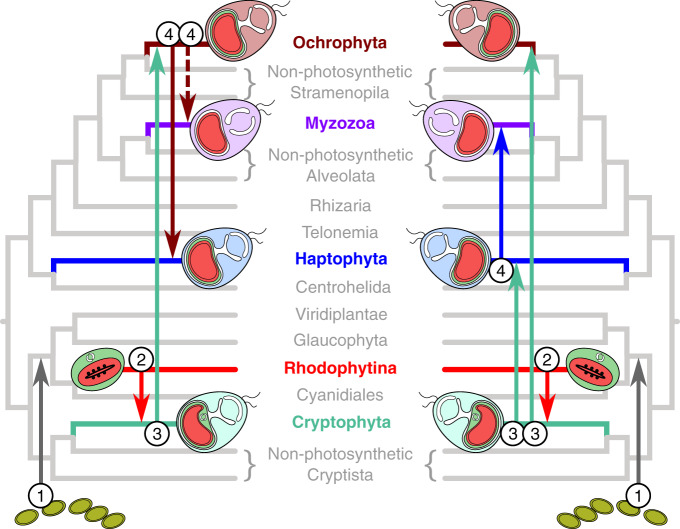
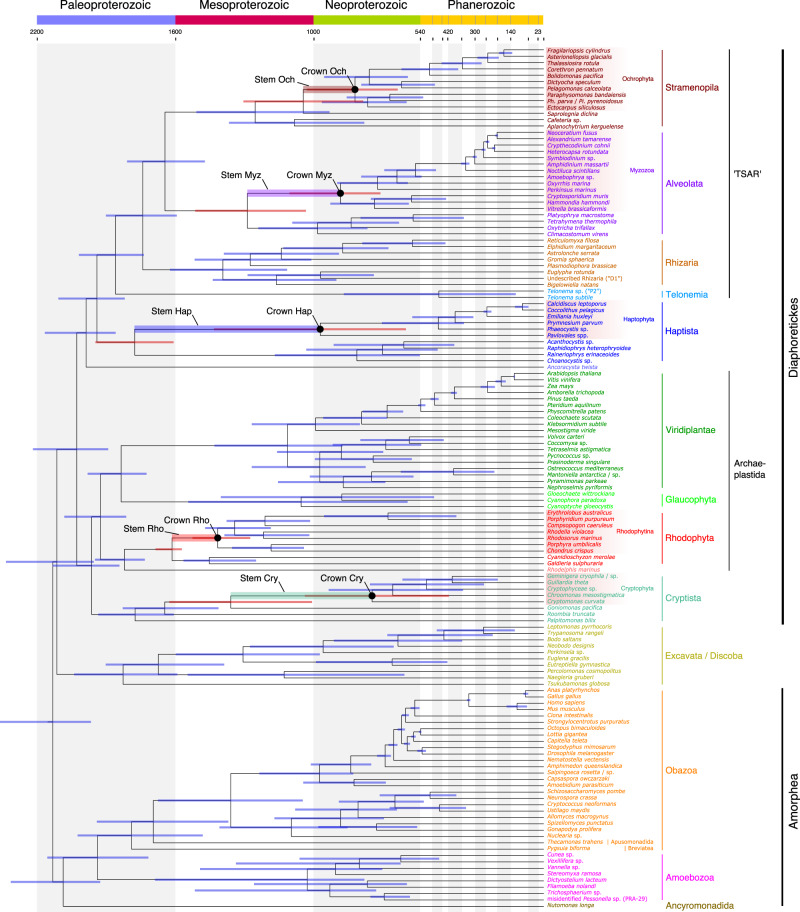
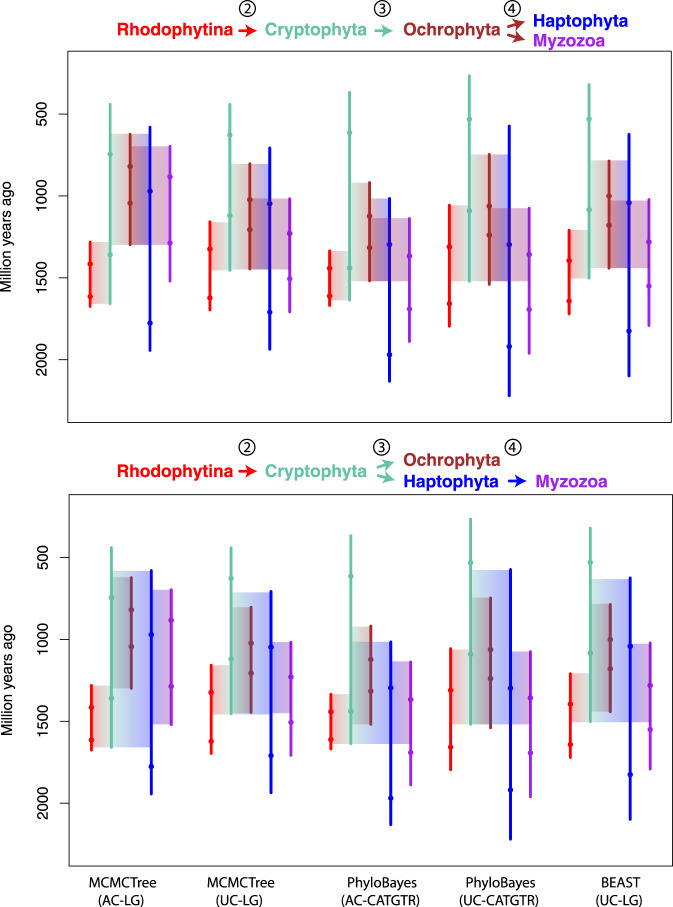
In modern oceans, eukaryotic phytoplankton is dominated by lineages with red algal-derived plastids such as diatoms, dinoflagellates, and coccolithophores. Despite the ecological importance of these groups and many others representing a huge diversity of forms and lifestyles, we still lack a comprehensive understanding of their evolution and how they obtained their plastids. New hypotheses have emerged to explain the acquisition of red algal-derived plastids by serial endosymbiosis, but the chronology of these putative independent plastid acquisitions remains untested. Here, we establish a timeframe for the origin of red algal-derived plastids under scenarios of serial endosymbiosis, using Bayesian molecular clock analyses applied on a phylogenomic dataset with broad sampling of eukaryote diversity. We find that the hypotheses of serial endosymbiosis are chronologically possible, as the stem lineages of all red plastid-containing groups overlap in time. This period in the Meso- and Neoproterozoic Eras set the stage for the later expansion to dominance of red algal-derived primary production in the contemporary oceans, which profoundly altered the global geochemical and ecological conditions of the Earth.
Overview
The claims and statistics of this paper haven’t been checked yet.
Free: it reads the open-access text and checks the first 5 claims that cite a source we can check. Create a free account to check every claim.
Integrity signals
Registry
Cites
Statistics
Figures
Verification
Claims the paper makes
The claims and statistics of this paper haven’t been checked yet.
Free: it reads the open-access text and checks the first 5 claims that cite a source we can check. Create a free account to check every claim.
Claims other papers make about this one
Each is checked against this paper’s own text: does it say what the citing paper says it does?
The source backs part of the claim, not all of it — or backs it for a different population, condition or comparison.
In the citing paper
“The LECA estimate (1.93–1.84 Ga, 95% highest posterior density) from our species tree analysis falls within published molecular clock estimates, placing LECA within a broad interval ~1–2.4 Ga25–27,97–99 (Fig. 5A, C, Supplementary Fig. 16, Supplementary Data 10).”
From ATP synthase evolution on a cross-braced dated tree of life (2023) · cites this paper as [99]
Experimental — accuracy not yet measuredThe source backs part of the claim, not all of it — or backs it for a different population, condition or comparison.
In the citing paper
“Some chromosomes in these lineages appear to have not undergone major fusions or translocations since their ancestor existed more than 600 million years ago (99), such as those of the myriazoan ALGs G, H, and P (69).”
From Topological Approaches in Animal Comparative Genomics (2026) · cites this paper as [99]
Experimental — accuracy not yet measuredThe check wasn’t confident either way, so it gives no verdict — never disputed.
In the citing paper
“Notably, the ancestor of this clade likely existed more than 600 million years ago (99).”
From Topological Approaches in Animal Comparative Genomics (2026) · cites this paper as [99]
Experimental — accuracy not yet measured
Self-check
Percentages, sums and reported differences re-computed from the paper’s own numbers.
The self-check needs the paper’s full text.
Citations
Cites
Basic local alignment search tool
Altschul, S. F., Gish, W., Miller, W., Myers, E. W., & Lipman, D. J. (1990) · Journal of Molecular Biology · doi:10.1006/jmbi.1990.9999 · Cited by 98,669
MAFFT Multiple Sequence Alignment Software Version 7: Improvements in Performance and Usability
Katoh, K., & Standley, D. M. (2013) · Molecular Biology and Evolution · doi:10.1093/molbev/mst010 · Cited by 46,209
RAxML version 8: a tool for phylogenetic analysis and post-analysis of large phylogenies
Stamatakis, A. (2014) · Bioinformatics · doi:10.1093/bioinformatics/btu033 · Cited by 32,291
IQ-TREE: A Fast and Effective Stochastic Algorithm for Estimating Maximum-Likelihood Phylogenies
Nguyen, L.-T., Schmidt, H. A., von Haeseler, A., & Minh, B. Q. (2015) · Molecular Biology and Evolution · doi:10.1093/molbev/msu300 · Cited by 26,046
PAML 4: Phylogenetic Analysis by Maximum Likelihood
Yang, Z. (2007) · Molecular Biology and Evolution · doi:10.1093/molbev/msm088 · Cited by 13,879
trimAl: a tool for automated alignment trimming in large-scale phylogenetic analyses
Capella-Gutiérrez, S., Silla-Martínez, J. M., & Gabaldón, T. (2009) · Bioinformatics · doi:10.1093/bioinformatics/btp348 · Cited by 12,751
Cd-hit: Accelerated for clustering the next-generation sequencing data
Fu, L., Niu, B., Zhu, Z., Wu, S., & Li, W. (2012) · Bioinformatics · doi:10.1093/bioinformatics/bts565 · Cited by 11,175
Posterior summarization in Bayesian phylogenetics using tracer 1.7
Rambaut, A., Drummond, A. J., Xie, D., Baele, G., & Suchard, M. A. (2018) · Systematic Biology · doi:10.1093/sysbio/syy032 · Cited by 11,159
UFBoot2: Improving the Ultrafast Bootstrap Approximation
Hoang, D. T., Chernomor, O., von Haeseler, A., Minh, B. Q., & Vinh, L. S. (2018) · Molecular Biology and Evolution · doi:10.1093/molbev/msx281 · Cited by 10,881
FastTree: Computing Large Minimum Evolution Trees with Profiles instead of a Distance Matrix
Price, M. N., Dehal, P. S., & Arkin, A. P. (2009) · Molecular Biology and Evolution · doi:10.1093/molbev/msp077 · Cited by 5,602
Bayesian phylogenetic and phylodynamic data integration using BEAST 1.10
Suchard, M. A., Lemey, P., Baele, G., Ayres, D. L., Drummond, A. J., & Rambaut, A. (2018) · Virus Evolution · doi:10.1093/ve/vey016 · Cited by 3,792
ASTRAL-III: polynomial time species tree reconstruction from partially resolved gene trees
Zhang, C., Rabiee, M., Sayyari, E., & Mirarab, S. (2018) · BMC Bioinformatics · doi:10.1186/s12859-018-2129-y · Cited by 2,471
Criscuolo, A., & Gribaldo, S. (2010) · BMC Evolutionary Biology · doi:10.1186/1471-2148-10-210 · Cited by 1,633
Endosymbiotic gene transfer: organelle genomes forge eukaryotic chromosomes
Timmis, J. N., Ayliffe, M. A., Huang, C. Y., & Martin, W. (2004) · Nature Reviews Genetics · doi:10.1038/nrg1271 · Cited by 1,568
The oxygenation of the atmosphere and oceans
Holland, H. D. (2006) · Philosophical Transactions of the Royal Society B: Biological Sciences · doi:10.1098/rstb.2006.1838 · Cited by 1,535
Revisions to the Classification, Nomenclature, and Diversity of Eukaryotes
Adl, S. M., Bass, D., Lane, C. E., Lukeš, J., Schoch, C. L., Smirnov, A., Agatha, S., Berney, C., Brown, M. W., Burki, F., et al. (2019) · Journal of Eukaryotic Microbiology · doi:10.1111/jeu.12691 · Cited by 1,396
Self-citationGlomalean Fungi from the Ordovician
Redecker, D., Kodner, R., & Graham, L. E. (2000) · Science · doi:10.1126/science.289.5486.1920 · Cited by 1,171
Complete Genome Sequence of the Apicomplexan, Cryptosporidium parvum
Abrahamsen, M. S., Templeton, T. J., Enomoto, S., Abrahante, J. E., Zhu, G., Lancto, C. A., Deng, M., Liu, C., Widmer, G., Tzipori, S., et al. (2004) · Science · doi:10.1126/science.1094786 · Cited by 971
Volcanic gases, black smokers, and the great oxidation event
Holland, H. D. (2002) · Geochimica et Cosmochimica Acta · doi:10.1016/s0016-7037(02)00950-x · Cited by 920
Burki, F., Roger, A. J., Brown, M. W., & Simpson, A. G. B. (2020) · Trends in Ecology & Evolution · doi:10.1016/j.tree.2019.08.008 · Cited by 913
Self-citationEstimating the timing of early eukaryotic diversification with multigene molecular clocks
Parfrey, L. W., Lahr, D. J. G., Knoll, A. H., & Katz, L. A. (2011) · Proceedings of the National Academy of Sciences · doi:10.1073/pnas.1110633108 · Cited by 899
Lartillot, N., Rodrigue, N., Stubbs, D., & Richer, J. (2013) · Systematic Biology · doi:10.1093/sysbio/syt022 · Cited by 871
Fast Coalescent-Based Computation of Local Branch Support from Quartet Frequencies
Sayyari, E., & Mirarab, S. (2016) · Molecular Biology and Evolution · doi:10.1093/molbev/msw079 · Cited by 869
Fossil steroids record the appearance of Demospongiae during the Cryogenian period
Love, G. D., Grosjean, E., Stalvies, C., Fike, D. A., Grotzinger, J. P., Bradley, A. S., Kelly, A. E., Bhatia, M., Meredith, W., Snape, C. E., et al. (2009) · Nature · doi:10.1038/nature07673 · Cited by 731
Butterfield, N. J. (2000) · Paleobiology · doi:10.1666/0094-8373(2000)026<0386:bpngns>2.0.co;2 · Cited by 714
CAVALIER‐SMITH, T. (1999) · Journal of Eukaryotic Microbiology · doi:10.1111/j.1550-7408.1999.tb04614.x · Cited by 621
The rise of algae in Cryogenian oceans and the emergence of animals
Brocks, J. J., Jarrett, A. J. M., Sirantoine, E., Hallmann, C., Hoshino, Y., & Liyanage, T. (2017) · Nature · doi:10.1038/nature23457 · Cited by 574
A common red algal origin of the apicomplexan, dinoflagellate, and heterokont plastids
Janouškovec, J., Horák, A., Oborník, M., Lukeš, J., & Keeling, P. J. (2010) · Proceedings of the National Academy of Sciences · doi:10.1073/pnas.1003335107 · Cited by 489
Uncertainty in the Timing of Origin of Animals and the Limits of Precision in Molecular Timescales
dos Reis, M., Thawornwattana, Y., Angelis, K., Telford, M. J., Donoghue, P. C. J., & Yang, Z. (2015) · Current Biology · doi:10.1016/j.cub.2015.09.066 · Cited by 471
Wang, H.-C., Minh, B. Q., Susko, E., & Roger, A. J. (2018) · Systematic Biology · doi:10.1093/sysbio/syx068 · Cited by 466
Evolution of the diatoms: insights from fossil, biological and molecular data
Sims, P. A., Mann, D. G., & Medlin, L. K. (2006) · Phycologia · doi:10.2216/05-22.1 · Cited by 449
Integrated genomic and fossil evidence illuminates life’s early evolution and eukaryote origin
Betts, H. C., Puttick, M. N., Clark, J. W., Williams, T. A., Donoghue, P. C. J., & Pisani, D. (2018) · Nature Ecology & Evolution · doi:10.1038/s41559-018-0644-x · Cited by 437
Self-citationApproximate Likelihood Calculation on a Phylogeny for Bayesian Estimation of Divergence Times
Reis, M. D., & Yang, Z. (2011) · Molecular Biology and Evolution · doi:10.1093/molbev/msr045 · Cited by 428
Paleobiological Perspectives on Early Eukaryotic Evolution
Knoll, A. H. (2014) · Cold Spring Harbor Perspectives in Biology · doi:10.1101/cshperspect.a016121 · Cited by 394
The single, ancient origin of chromist plastids
Yoon, H. S., Hackett, J. D., Pinto, G., & Bhattacharya, D. (2002) · Proceedings of the National Academy of Sciences · doi:10.1073/pnas.242379899 · Cited by 380
Calcareous nannoplankton evolution and diversity through time
Bown, P. R., Lees, J. A., & Young, J. R. (2004) · Coccolithophores · doi:10.1007/978-3-662-06278-4_18 · Cited by 370
Establishing a time‐scale for plant evolution
Clarke, J. T., Warnock, R. C. M., & Donoghue, P. C. J. (2011) · New Phytologist · doi:10.1111/j.1469-8137.2011.03794.x · Cited by 351
Bayesian molecular clock dating of species divergences in the genomics era
dos Reis, M., Donoghue, P. C. J., & Yang, Z. (2016) · Nature Reviews Genetics · doi:10.1038/nrg.2015.8 · Cited by 339
Porter, S. M., & Knoll, A. H. (2000) · Paleobiology · doi:10.1666/0094-8373(2000)026<0360:taitne>2.0.co;2 · Cited by 327
A plastid in the making: evidence for a second primary endosymbiosis
Marin, B., M. Nowack, E. C., & Melkonian, M. (2005) · Protist · doi:10.1016/j.protis.2005.09.001 · Cited by 324
Early photosynthetic eukaryotes inhabited low-salinity habitats
Sánchez-Baracaldo, P., Raven, J. A., Pisani, D., & Knoll, A. H. (2017) · Proceedings of the National Academy of Sciences · doi:10.1073/pnas.1620089114 · Cited by 322
(1995) · Choice Reviews Online · doi:10.5860/choice.33-0923 · Cited by 302
Burki, F., Kaplan, M., Tikhonenkov, D. V., Zlatogursky, V., Minh, B. Q., Radaykina, L. V., Smirnov, A., Mylnikov, A. P., & Keeling, P. J. (2016) · Proceedings of the Royal Society B: Biological Sciences · doi:10.1098/rspb.2015.2802 · Cited by 301
Self-citationPaleobiology of the Neoproterozoic Svanbergfjellet Formation, Spitsbergen
Butterfield, N. J., Knoll, A. H., & Swett, K. (1994) · Lethaia · doi:10.1111/j.1502-3931.1994.tb01558.x · Cited by 298
Ediacaran biota: the dawn of animal life in the shadow of giant protists
SEILACHER, A., GRAZHDANKIN, D., & LEGOUTA, A. (2003) · Paleontological Research · doi:10.2517/prpsj.7.43 · Cited by 290
Mixotrophic basis of Atlantic oligotrophic ecosystems
Hartmann, M., Grob, C., Tarran, G. A., Martin, A. P., Burkill, P. H., Scanlan, D. J., & Zubkov, M. V. (2012) · Proceedings of the National Academy of Sciences · doi:10.1073/pnas.1118179109 · Cited by 289
On the Age of Eukaryotes: Evaluating Evidence from Fossils and Molecular Clocks
Eme, L., Sharpe, S. C., Brown, M. W., & Roger, A. J. (2014) · Cold Spring Harbor Perspectives in Biology · doi:10.1101/cshperspect.a016139 · Cited by 287
Constraints on the timescale of animal evolutionary history
Benton, M., Donoghue, P., Vinther, J., Asher, R., Friedman, M., & Near, T. (2015) · Palaeontologia Electronica · doi:10.26879/424 · Cited by 284
Bengtson, S., Sallstedt, T., Belivanova, V., & Whitehouse, M. (2017) · PLOS Biology · doi:10.1371/journal.pbio.2000735 · Cited by 284
So many genes, so little time: A practical approach to divergence-time estimation in the genomic era
Smith, S. A., Brown, J. W., & Walker, J. F. (2018) · PLOS ONE · doi:10.1371/journal.pone.0197433 · Cited by 278
Origin and Radiation of the Earliest Vascular Land Plants
Steemans, P., Hérissé, A. L., Melvin, J., Miller, M. A., Paris, F., Verniers, J., & Wellman, C. H. (2009) · Science · doi:10.1126/science.1169659 · Cited by 271
PORTER, S. M., MEISTERFELD, R., & KNOLL, A. H. (2003) · Journal of Paleontology · doi:10.1666/0022-3360(2003)077<0409:vmftnc>2.0.co;2 · Cited by 257
Baurain, D., Brinkmann, H., Petersen, J., Rodriguez-Ezpeleta, N., Stechmann, A., Demoulin, V., Roger, A. J., Burger, G., Lang, B. F., & Philippe, H. (2010) · Molecular Biology and Evolution · doi:10.1093/molbev/msq059 · Cited by 249
Evolutionary Trajectories and Biogeochemical Impacts of Marine Eukaryotic Phytoplankton
Katz, M. E., Finkel, Z. V., Grzebyk, D., Knoll, A. H., & Falkowski, P. G. (2004) · Annual Review of Ecology, Evolution, and Systematics · doi:10.1146/annurev.ecolsys.35.112202.130137 · Cited by 240
EukProt: A database of genome-scale predicted proteins across the diversity of eukaryotes
Richter, D. J., Berney, C., Strassert, J. F. H., Poh, Y.-P., Herman, E. K., Muñoz-Gómez, S. A., Wideman, J. G., Burki, F., & de Vargas, C. (2022) · Peer Community Journal · doi:10.24072/pcjournal.173 · Cited by 230
Self-citationAn Alternative Root for the Eukaryote Tree of Life
He, D., Fiz-Palacios, O., Fu, C.-J., Fehling, J., Tsai, C.-C., & Baldauf, S. L. (2014) · Current Biology · doi:10.1016/j.cub.2014.01.036 · Cited by 225
Precise age of Bangiomorpha pubescens dates the origin of eukaryotic photosynthesis
Gibson, T. M., Shih, P. M., Cumming, V. M., Fischer, W. W., Crockford, P. W., Hodgskiss, M. S. W., Wörndle, S., Creaser, R. A., Rainbird, R. H., Skulski, T. M., et al. (2018) · Geology · doi:10.1130/g39829.1 · Cited by 217
Early evolution of the Eukaryota
Butterfield, N. J. (2015) · Palaeontology · doi:10.1111/pala.12139 · Cited by 213
Brasier, M. D., Antcliffe, J., Saunders, M., & Wacey, D. (2015) · Proceedings of the National Academy of Sciences · doi:10.1073/pnas.1405338111 · Cited by 210
Brenner, G. J. (2007) · Flowering Plant Origin, Evolution & Phylogeny · doi:10.1007/978-0-585-23095-5_5 · Cited by 206
Early fungi from the Proterozoic era in Arctic Canada
Loron, C. C., François, C., Rainbird, R. H., Turner, E. C., Borensztajn, S., & Javaux, E. J. (2019) · Nature · doi:10.1038/s41586-019-1217-0 · Cited by 203
Divergence time estimates and the evolution of major lineages in the florideophyte red algae
Yang, E. C., Boo, S. M., Bhattacharya, D., Saunders, G. W., Knoll, A. H., Fredericq, S., Graf, L., & Yoon, H. S. (2016) · Scientific Reports · doi:10.1038/srep21361 · Cited by 200
The evolution of photosynthesis in chromist algae through serial endosymbioses
Stiller, J. W., Schreiber, J., Yue, J., Guo, H., Ding, Q., & Huang, J. (2014) · Nature Communications · doi:10.1038/ncomms6764 · Cited by 194
Molecular fossils and microfossils of prokaryotes and protists from Proterozoic sediments
Summons, R. E., & Walter, M. (1990) · American Journal of Science · Cited by 193
Bacterial proteins pinpoint a single eukaryotic root
Derelle, R., Torruella, G., Klimeš, V., Brinkmann, H., Kim, E., Vlček, Č., Lang, B. F., & Eliáš, M. (2015) · Proceedings of the National Academy of Sciences · doi:10.1073/pnas.1420657112 · Cited by 191
SCaFoS: a tool for Selection, Concatenation and Fusion of Sequences for phylogenomics
Roure, B., Rodriguez-Ezpeleta, N., & Philippe, H. (2007) · BMC Evolutionary Biology · doi:10.1186/1471-2148-7-s1-s2 · Cited by 190
A one-billion-year-old multicellular chlorophyte
Tang, Q., Pang, K., Yuan, X., & Xiao, S. (2020) · Nature Ecology & Evolution · doi:10.1038/s41559-020-1122-9 · Cited by 186
Taylor, T. N., Hass, H., & Kerp, H. (1999) · Nature · doi:10.1038/21349 · Cited by 178
Rice, D. W., & Palmer, J. D. (2006) · BMC Biology · doi:10.1186/1741-7007-4-31 · Cited by 170
Fungi from the Rhynie chert: a view from the dark side
Taylor, T. N., Klavins, S. D., Krings, M., Taylor, E. L., Kerp, H., & Hass, H. (2003) · Transactions of the Royal Society of Edinburgh: Earth Sciences · doi:10.1017/s026359330000081x · Cited by 166
Weinkove, D., Halstead, J. R., Gems, D., & Divecha, N. (2006) · BMC Biology · doi:10.1186/1741-7007-4-1 · Cited by 165
Progress towards the Tree of Eukaryotes
Keeling, P. J., & Burki, F. (2019) · Current Biology · doi:10.1016/j.cub.2019.07.031 · Cited by 159
Self-citationDoyle, J. A. (1992) · Cretaceous Research · doi:10.1016/0195-6671(92)90039-s · Cited by 155
Phylogenomics Places Orphan Protistan Lineages in a Novel Eukaryotic Super-Group
Brown, M. W., Heiss, A. A., Kamikawa, R., Inagaki, Y., Yabuki, A., Tice, A. K., Shiratori, T., Ishida, K.-I., Hashimoto, T., Simpson, A. G. B., et al. (2018) · Genome Biology and Evolution · doi:10.1093/gbe/evy014 · Cited by 153
Genomic perspectives on the birth and spread of plastids
Archibald, J. M. (2015) · Proceedings of the National Academy of Sciences · doi:10.1073/pnas.1421374112 · Cited by 152
Chimeric origins of ochrophytes and haptophytes revealed through an ancient plastid proteome
Dorrell, R. G., Gile, G., McCallum, G., Méheust, R., Bapteste, E. P., Klinger, C. M., Brillet-Guéguen, L., Freeman, K. D., Richter, D. J., & Bowler, C. (2017) · eLife · doi:10.7554/elife.23717 · Cited by 152
PREQUAL: detecting non-homologous characters in sets of unaligned homologous sequences
Whelan, S., Irisarri, I., & Burki, F. (2018) · Bioinformatics · doi:10.1093/bioinformatics/bty448 · Cited by 152
Self-citationDo Red and Green Make Brown?: Perspectives on Plastid Acquisitions within Chromalveolates
Dorrell, R. G., & Smith, A. G. (2011) · Eukaryotic Cell · doi:10.1128/ec.00326-10 · Cited by 149
Non-photosynthetic predators are sister to red algae
Gawryluk, R. M. R., Tikhonenkov, D. V., Hehenberger, E., Husnik, F., Mylnikov, A. P., & Keeling, P. J. (2019) · Nature · doi:10.1038/s41586-019-1398-6 · Cited by 148
Flowering plant origin, evolution & phylogeny
(1997) · Choice Reviews Online · doi:10.5860/choice.34-2743 · Cited by 147
A New Lineage of Eukaryotes Illuminates Early Mitochondrial Genome Reduction
Janouškovec, J., Tikhonenkov, D. V., Burki, F., Howe, A. T., Rohwer, F. L., Mylnikov, A. P., & Keeling, P. J. (2017) · Current Biology · doi:10.1016/j.cub.2017.10.051 · Cited by 141
Self-citationThe Single, Ancient Origin of Chromist Plastids
Yoon, H. S., Hackett, J. D., Pinto, G., & Bhattacharya, D. (2002) · Journal of Phycology · doi:10.1046/j.1529-8817.38.s1.8.x · Cited by 137
Mixotrophy in nanoflagellates across environmental gradients in the ocean
Edwards, K. F. (2019) · Proceedings of the National Academy of Sciences · doi:10.1073/pnas.1814860116 · Cited by 137
Dinoflagellate phylogeny revisited: reconciling morphological and molecular based phylogenies
Fensome, R. A., Saldarriaga, J. F., & Taylor, “. F. J. R. (1999) · Grana · doi:10.1080/00173139908559216 · Cited by 132
From DNA to Diversity, Molecular Genetics and the Evolution of Animal Design. 2001
Hageman, S. J. (2003) · Journal of Paleontology · doi:10.1666/0022-3360(2003)077<0598:r>2.0.co;2 · Cited by 131
Identifying Clusters of High Confidence Homologies in Multiple Sequence Alignments
Ali, R. H., Bogusz, M., & Whelan, S. (2019) · Molecular Biology and Evolution · doi:10.1093/molbev/msz142 · Cited by 127
Petersen, J., Ludewig, A.-K., Michael, V., Bunk, B., Jarek, M., Baurain, D., & Brinkmann, H. (2014) · Genome Biology and Evolution · doi:10.1093/gbe/evu043 · Cited by 125
Ševčíková, T., Horák, A., Klimeš, V., Zbránková, V., Demir-Hilton, E., Sudek, S., Jenkins, J., Schmutz, J., Přibyl, P., Fousek, J., et al. (2015) · Scientific Reports · doi:10.1038/srep10134 · Cited by 125
Chromalveolate plastids: direct descent or multiple endosymbioses?
Bodył, A., Stiller, J. W., & Mackiewicz, P. (2009) · Trends in Ecology & Evolution · doi:10.1016/j.tree.2008.11.003 · Cited by 124
Strassert, J. F. H., Jamy, M., Mylnikov, A. P., Tikhonenkov, D. V., & Burki, F. (2019) · Molecular Biology and Evolution · doi:10.1093/molbev/msz012 · Cited by 123
Self-citationRuncaria , a Middle Devonian Seed Plant Precursor
Gerrienne, P., Meyer‐Berthaud, B., Fairon‐Demaret, M., Streel, M., & Steemans, P. (2004) · Science · doi:10.1126/science.1102491 · Cited by 120
ERAD-Derived Preprotein Transport across the Second Outermost Plastid Membrane of Diatoms
Hempel, F., Bullmann, L., Lau, J., Zauner, S., & Maier, U. G. (2009) · Molecular Biology and Evolution · doi:10.1093/molbev/msp079 · Cited by 119
Protein Import and the Origin of Red Complex Plastids
Gould, S. B., Maier, U., & Martin, W. F. (2015) · Current Biology · doi:10.1016/j.cub.2015.04.033 · Cited by 114
Endosymbiosis undone by stepwise elimination of the plastid in a parasitic dinoflagellate
Gornik, S. G., Febrimarsa, Cassin, A. M., MacRae, J. I., Ramaprasad, A., Rchiad, Z., McConville, M. J., Bacic, A., McFadden, G. I., Pain, A., et al. (2015) · Proceedings of the National Academy of Sciences · doi:10.1073/pnas.1423400112 · Cited by 114
Muñoz-Gómez, S. A., Mejía-Franco, F. G., Durnin, K., Colp, M., Grisdale, C. J., Archibald, J. M., & Slamovits, C. H. (2017) · Current Biology · doi:10.1016/j.cub.2017.04.054 · Cited by 114
Proterozoic photosynthesis – a critical review
Butterfield, N. J. (2015) · Palaeontology · doi:10.1111/pala.12211 · Cited by 113
A HYPOTHESIS FOR PLASTID EVOLUTION IN CHROMALVEOLATES1
Sanchez‐Puerta, M. V., & Delwiche, C. F. (2008) · Journal of Phycology · doi:10.1111/j.1529-8817.2008.00559.x · Cited by 110
Andersson, J. O., Hirt, R. P., Foster, P. G., & Roger, A. J. (2006) · BMC Evolutionary Biology · doi:10.1186/1471-2148-6-27 · Cited by 103
McIlroy, D., Green, O. R., & Brasier, M. D. (2001) · Lethaia · doi:10.1080/002411601300068170 · Cited by 102
Blank, C. E. (2013) · Journal of Phycology · doi:10.1111/jpy.12111 · Cited by 102
Barremian-Aptian angiospermid pollen records from southern England
Hughes, N. F., & McDougall, A. B. (1990) · Review of Palaeobotany and Palynology · doi:10.1016/0034-6667(90)90065-q · Cited by 100
STUDIES OF PALEOZOIC FUNGI. IV. WOOD‐DECAYING FUNGI IN CALLIXYLON NEWBERRYI FROM THE UPPER DEVONIAN
Stubblefield, S. P., Taylor, T. N., & Beck, C. B. (1985) · American Journal of Botany · doi:10.1002/j.1537-2197.1985.tb08449.x · Cited by 98
A Modern Descendant of Early Green Algal Phagotrophs
Maruyama, S., & Kim, E. (2013) · Current Biology · doi:10.1016/j.cub.2013.04.063 · Cited by 80
The transition from a cyanobacterial to algal world and the emergence of animals
Brocks, J. J. (2018) · Emerging Topics in Life Sciences · doi:10.1042/etls20180039 · Cited by 74
Felsner, G., Sommer, M. S., Gruenheit, N., Hempel, F., Moog, D., Zauner, S., Martin, W., & Maier, U. G. (2011) · Genome Biology and Evolution · doi:10.1093/gbe/evq074 · Cited by 72
Nozaki, H., Maruyama, S., Matsuzaki, M., Nakada, T., Kato, S., & Misawa, K. (2009) · Molecular Phylogenetics and Evolution · doi:10.1016/j.ympev.2009.08.015 · Cited by 67
EukProt: A database of genome-scale predicted proteins across the diversity of eukaryotesPreprint
Richter, D. J., Berney, C., Strassert, J. F. H., et al. (2020) · bioRxiv (Cold Spring Harbor Laboratory) · doi:10.1101/2020.06.30.180687 · Cited by 67
Self-citationKatz, L. A., & Grant, J. R. (2015) · Systematic Biology · doi:10.1093/sysbio/syu126 · Cited by 67
Fujiwara, S., Tsuzuki, M., Kawachi, M., Minaka, N., & Inouye, I. (2001) · Journal of Phycology · doi:10.1046/j.1529-8817.2001.037001121.x · Cited by 66
A single birth of all plastids?
Palmer, J. D. (2000) · Nature · doi:10.1038/35011184 · Cited by 62
EEF2 Analysis Challenges the Monophyly of Archaeplastida and Chromalveolata
Kim, E., & Graham, L. E. (2008) · PLoS ONE · doi:10.1371/journal.pone.0002621 · Cited by 58
Phylogenomic Insights into the Origin of Primary Plastids
Irisarri, I., Strassert, J. F. H., & Burki, F. (2021) · Systematic Biology · doi:10.1093/sysbio/syab036 · Cited by 57
Self-citationA Machine Learning Method for Detecting Autocorrelation of Evolutionary Rates in Large Phylogenies
Tao, Q., Tamura, K., U. Battistuzzi, F., & Kumar, S. (2019) · Molecular Biology and Evolution · doi:10.1093/molbev/msz014 · Cited by 54
Hempel, F., Felsner, G., & Maier, U. G. (2010) · Molecular Microbiology · doi:10.1111/j.1365-2958.2010.07142.x · Cited by 48
Phylogenomic Insights into the Origin of Primary PlastidsPreprint
Irisarri, I., Strassert, J. F. H., & Burki, F. (2020) · bioRxiv · doi:10.1101/2020.08.03.231043 · Cited by 48
Self-citationGray, J., & Boucot, A. J. (1989) · Lethaia · doi:10.1111/j.1502-3931.1989.tb01449.x · Cited by 47
Did some red alga‐derived plastids evolve via kleptoplastidy? A hypothesis
Bodył, A. (2018) · Biological Reviews · doi:10.1111/brv.12340 · Cited by 47
The Convoluted Evolution of Eukaryotes With Complex Plastids
Burki, F. (2017) · Advances in botanical research · doi:10.1016/bs.abr.2017.06.001 · Cited by 43
Self-citationTaylor, T. N., Remy, W., & Hass, H. (1994) · Nature · doi:10.1038/367601a0 · Cited by 41
Phylogenomics places orphan protistan lineages in a novel eukaryotic super-groupPreprint
Brown, M. W., Heiss, A. A., Kamikawa, R., Inagaki, Y., Yabuki, A., Tice, A. K., Shiratori, T., Ishida, K., Hashimoto, T., Simpson, A. G. B., et al. (2017) · bioRxiv (Cold Spring Harbor Laboratory) · doi:10.1101/227884 · Cited by 32
Testate Amoebae in the 407-Million-Year-Old Rhynie Chert.
Strullu-Derrien, C., Kenrick, P., Góral, T., & Knoll, A. (2019) · Current Biology · doi:10.1016/j.cub.2018.12.009 · Cited by 27
Fiz-Palacios, O., Leander, B. S., & Heger, T. J. (2014) · PLoS ONE · doi:10.1371/journal.pone.0095238 · Cited by 18
Donoghue, P. C. J. (2020) · Current Biology · doi:10.1016/j.cub.2020.02.063 · Cited by 12
Miller, J. J., & Delwiche, C. F. (2015) · Marine Genomics · doi:10.1016/j.margen.2015.02.008 · Cited by 10
Relative Mutation Rates in Nucleomorph-Bearing Algae
Grisdale, C. J., Smith, D. R., & Archibald, J. M. (2019) · Genome Biology and Evolution · doi:10.1093/gbe/evz056 · Cited by 9
YOUNG, J. R., Bown, P. R., & Burnett, J. A. (1994) · doi:10.1093/oso/9780198577720.003.0020 · Cited by 9
Cited by
Ancient gene linkages support ctenophores as sister to other animals
Schultz, D. T., Haddock, S. H. D., Bredeson, J. V., Green, R. E., Simakov, O., & Rokhsar, D. S. (2023) · Nature · doi:10.1038/s41586-023-05936-6 · Cited by 362
Diversity and ecology of protists revealed by metabarcoding
Burki, F., Sandin, M. M., & Jamy, M. (2021) · Current Biology · doi:10.1016/j.cub.2021.07.066 · Cited by 245
Self-citationBacterial and archaeal symbioses with protists
Husnik, F., Tashyreva, D., Boscaro, V., George, E. E., Lukeš, J., & Keeling, P. J. (2021) · Current Biology · doi:10.1016/j.cub.2021.05.049 · Cited by 163
The pyrenoid: the eukaryotic CO2-concentrating organelle
He, S., Crans, V. L., & Jonikas, M. C. (2023) · The Plant Cell · doi:10.1093/plcell/koad157 · Cited by 126
Single cell genomics reveals plastid-lacking Picozoa are close relatives of red algae
Schön, M. E., Zlatogursky, V. V., Singh, R. P., Poirier, C. L., Wilken, S., Mathur, V., Strassert, J. F. H., Pinhassi, J., Worden, A. Z., Keeling, P. J., et al. (2021) · Nature Communications · doi:10.1038/s41467-021-26918-0 · Cited by 119
Self-citation
Metadata
- Authors
- Strassert, J. F. H., Irisarri, I., Williams, T. A., & Burki, F.
- Affiliations
- Uppsala University (SE)
- University of Bristol (GB)
- Corresponding author
- Burki, Fabien
- Venue
- Nature Communications
- Published
- 2021-03-25
- Volume
- 12
- Issue
- 1
- Pages
- 1879-1879
- ISSN
- 2041-1723 (ISSN-L)
- PMC
- PMC7994803
- OpenAlex
- W3138022174
- Semantic Scholar
- 60f49d09119b55067e06207bcdb6011001f34075
- Cited by
- 298
- References
- 124
- Citations by year
- 2026: 40 · 2025: 61 · 2024: 77 · 2023: 53 · 2022: 53 · 2021: 14
- FWCI
- 15.78
- Type
- journal article
- Language
- en
- Update notices
- correction (2021-06-07)
- Open access
- gold
- doi.org
- Licence
- cc-by
- creativecommons.org/licenses/by/4.0 (tdm)
- creativecommons.org/licenses/by/4.0 (vor)
- Locations
- Nature Communications (publishedVersion, cc-by)
- bioRxiv (Cold Spring Harbor Laboratory) (acceptedVersion, cc-by-nc-nd)
- PubMed Central (publishedVersion, cc-by)
- PubMed (publishedVersion)
- Bristol Research (University of Bristol) (acceptedVersion, cc-by)
- Uppsala University Publications (Uppsala University) (submittedVersion, other-oa)
- RePEc: Research Papers in Economics (submittedVersion)
- DIGITAL.CSIC (Spanish National Research Council (CSIC)) (submittedVersion, cc-by)
- DOAJ (DOAJ: Directory of Open Access Journals) (submittedVersion, cc-by-sa)
- GoeScholar The Publication Server of the Georg-August-Universität Göttingen (Georg-August-Universität Göttingen) (submittedVersion)
- Explore Bristol Research (submittedVersion, cc-by)
- Funders
- Science for Life Laboratory
- Topics
- Life Sciences › Agricultural and Biological Sciences › Ecology, Evolution, Behavior and Systematics › Protist diversity and phylogeny
- Physical Sciences › Earth and Planetary Sciences › Paleontology › Evolution and Paleontology Studies
- Physical Sciences › Earth and Planetary Sciences › Paleontology › Paleontology and Stratigraphy of Fossils
- Keywords
- plastid origin, eukaryotic evolution, molecular clock, phylogenomics, diatoms, dinoflagellates, coccolithophores, primary production, red algae, eukaryotic phytoplankton
- MeSH terms
- Rhodophyta, Dinoflagellida, Biological Evolution, Oceans and Seas, Photosynthesis, Symbiosis, Diatoms, Plastids, Evolution, Molecular, Haptophyta
About these checks
Registry, retraction, Cites and statistics results are computed, not judged, with one exception: a printed reference that no index lists is read once by a model before it counts as a citation error. Claims are extracted by a model and kept only when their quote appears verbatim in the text; each cited source is then checked, with a model’s help, for whether it says what the claim relies on. Those verdicts can be wrong — read the claim’s quote and the cited source before relying on one.
Statistics and arithmetic are recomputed, not judged.
Confidence bands are shown only for fields calibrated on our annotated test set. None is calibrated yet, so no band is shown.
What counts as a claim ›How we measure confidence ›How we check this ›
Are you an author, or do you see a problem with this page? Request a review
Data sources
Bibliographic data: Semantic Scholar, OpenAlex, Crossref.
Contains information from the Semantic Scholar Academic Graph Datasets, made available under the ODC Attribution License (ODC-BY 1.0).
Semantic Scholar’s data is described in: Kinney, R., et al. (2023). The Semantic Scholar Open Data Platform. arXiv:2301.10140.
