CoChat

The XZZX surface code

Open access
Bonilla Ataides, J. Pablo, Tuckett, David K., Bartlett, Stephen D., Flammia, Steven T., Brown, Benjamin J. · 2021 · Nature Communications

The DOI matches its Crossref record; 67 of the 67 references it cites were found in a registry or an index.

Abstract

Performing large calculations with a quantum computer will likely require a fault-tolerant architecture based on quantum error-correcting codes. The challenge is to design practical quantum error-correcting codes that perform well against realistic noise using modest resources. Here we show that a variant of the surface code—the XZZX code—offers remarkable performance for fault-tolerant quantum computation. The error threshold of this code matches what can be achieved with random codes (hashing) for every single-qubit Pauli noise channel; it is the first explicit code shown to have this universal property. We present numerical evidence that the threshold even exceeds this hashing bound for an experimentally relevant range of noise parameters. Focusing on the common situation where qubit dephasing is the dominant noise, we show that this code has a practical, high-performance decoder and surpasses all previously known thresholds in the realistic setting where syndrome measurements are unreliable. We go on to demonstrate the favourable sub-threshold resource scaling that can be obtained by specialising a code to exploit structure in the noise. We show that it is possible to maintain all of these advantages when we perform fault-tolerant quantum computation.

Overview

The claims and statistics of this paper haven’t been checked yet.

Free: it reads the open-access text and checks the first 5 claims that cite a source we can check. Create a free account to check every claim.

A few free checks a day · papers already verified open instantly · results are public

Integrity signals

Registry

Crossref · 10.1038/s41467-021-22274-1

Cites

67 of 67 references verified0 citation errors · 0 not checkable

Statistics

Figures

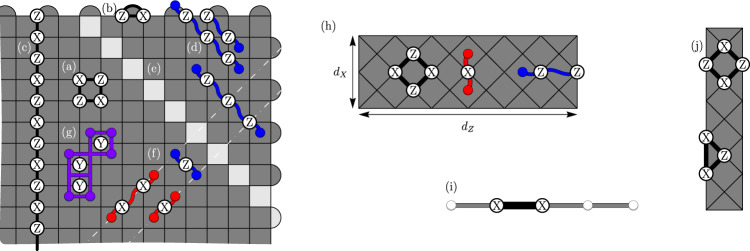
Fig. 1 The XZZX surface code. Qubits lie on the vertices of the square lattice. The codespace is the common +1 eigenspace of its stabilizers Sf for all faces of the lattice f. a An example of a stabilizer Sf associated with face f. We name the XZZX code according to its stabilizer operators that are the product of two Pauli-X terms and two Pauli-Z terms. Unlike the conventional surface code, the stabilizers are the same at every face. b A boundary stabilizer. c A logical operator that terminates at the boundary. d Pauli-Z errors give rise to string-like errors that align along a common direction, enabling a one-dimensional decoding strategy. e The product of stabilizer operators along a diagonal give rise to symmetries under an infinite bias dephasing noise model10,37. f Pauli-X errors align along lines with an orthogonal orientation. At finite bias, errors in conjugate bases couple the lines. g Pauli-Y errors can be decoded as in ref. 10. h A convenient choice of boundary conditions for the XZZX code are rectangular on a rotated lattice geometry. Changing the orientation of the lattice geometry means high-rate Pauli-Z errors only create strings oriented horizontally along the lattice. We can make a practical choice of lattice dimensions with dZ > dX to optimise the rates of logical failure caused by either low- or high-rate errors. Small-scale implementations of the XZZX code on rectangular lattices may be well suited for implementation with near-term devices. i In the limit where dX = 1 we find a repetition code. This may be a practical choice of code given a limited number of qubits that experience biased noise. j The next engineering challenge beyond a repetition code is an XZZX code on a rectangle with dX = 2. This code can detect a single low-rate error.
Fig. 1 The XZZX surface code. Qubits lie on the vertices of the square lattice. The codespace is the common +1 eigenspace of its stabilizers Sf for all faces of the lattice f. a An example of a stabilizer Sf associated with face f. We name the XZZX code according to its stabilizer operators that are the product of two Pauli-X terms and two Pauli-Z terms. Unlike the conventional surface code, the stabilizers are the same at every face. b A boundary stabilizer. c A logical operator that terminates at the boundary. d Pauli-Z errors give rise to string-like errors that align along a common direction, enabling a one-dimensional decoding strategy. e The product of stabilizer operators along a diagonal give rise to symmetries under an infinite bias dephasing noise model10,37. f Pauli-X errors align along lines with an orthogonal orientation. At finite bias, errors in conjugate bases couple the lines. g Pauli-Y errors can be decoded as in ref. 10. h A convenient choice of boundary conditions for the XZZX code are rectangular on a rotated lattice geometry. Changing the orientation of the lattice geometry means high-rate Pauli-Z errors only create strings oriented horizontally along the lattice. We can make a practical choice of lattice dimensions with dZ > dX to optimise the rates of logical failure caused by either low- or high-rate errors. Small-scale implementations of the XZZX code on rectangular lattices may be well suited for implementation with near-term devices. i In the limit where dX = 1 we find a repetition code. This may be a practical choice of code given a limited number of qubits that experience biased noise. j The next engineering challenge beyond a repetition code is an XZZX code on a rectangle with dX = 2. This code can detect a single low-rate error.CC BY · PubMed Central
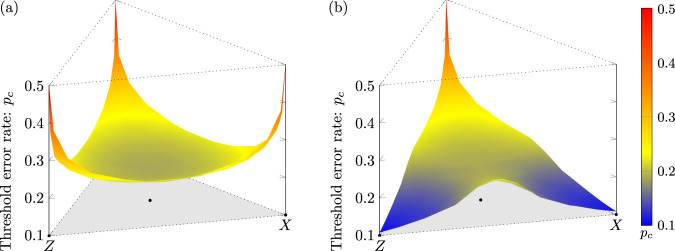
Fig. 2 Optimal code-capacity thresholds over all single-qubit Pauli channels. Threshold estimates pc are found using approximate maximum-likelihood decoding for a the XZZX surface code and b the CSS surface code with open boundaries (as in Fig. 1b). The grey triangle represents a parametrisation of all single-qubit Pauli channels, where the centre corresponds to depolarising noise, the labeled vertices correspond to pure X and Z noise, and the third vertex corresponds to pure Y noise. For the XZZX code, estimates closely match the zero-rate hashing bound (not shown) for all single-qubit Pauli channels. For the CSS code, estimates closely match the hashing bound for Y-biased noise but fall well below for X- and Z-biased noise. All estimates use d × d codes with distances d ∈ {13, 17, 21, 25}.
Fig. 2 Optimal code-capacity thresholds over all single-qubit Pauli channels. Threshold estimates pc are found using approximate maximum-likelihood decoding for a the XZZX surface code and b the CSS surface code with open boundaries (as in Fig. 1b). The grey triangle represents a parametrisation of all single-qubit Pauli channels, where the centre corresponds to depolarising noise, the labeled vertices correspond to pure X and Z noise, and the third vertex corresponds to pure Y noise. For the XZZX code, estimates closely match the zero-rate hashing bound (not shown) for all single-qubit Pauli channels. For the CSS code, estimates closely match the hashing bound for Y-biased noise but fall well below for X- and Z-biased noise. All estimates use d × d codes with distances d ∈ {13, 17, 21, 25}.CC BY · PubMed Central
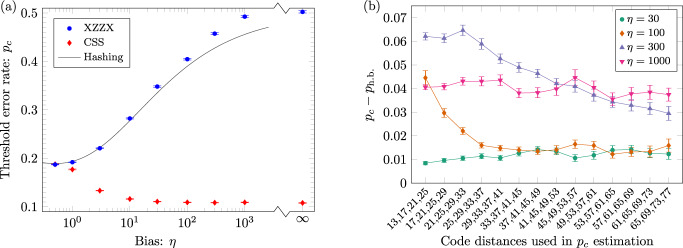
Fig. 3 Estimates of optimal XZZX surface code thresholds relative to the hashing bound. a Threshold estimates pc for the XZZX and CSS surface codes as a function of bias η with Z-biased (or, by code symmetry, X-biased) noise using approximate maximum-likelihood decoding and codes with open boundaries (as in Fig. 1b). The solid line is the zero-rate hashing bound for the associated Pauli noise channel, where the entropy of the channel equals 1 bit. For high bias, η ≥ 30, the estimates for the XZZX code exceed the hashing bound. To investigate this surprising effect, estimates for the XZZX code with 30 ≤ η ≤ 1000 use large d × d codes with distances d ∈ {65, 69, 73, 77}; other estimates use distances d ∈ {13, 17, 21, 25} (as used for Fig. 2). b Difference between threshold estimates for the XZZX code with Z-biased noise and the hashing bound pc − ph.b. as a function of code distances used in the estimation. Data is shown for biases η = 30, 100, 300, 1000. Threshold estimates exceed the hashing bound in all cases. The gap reduces, in most cases, with sets of greater code distance, but it persists and appears to stabilise for η = 30, 100 and 1000. In both plots, error bars indicate one standard deviation relative to the fitting procedure.
Fig. 3 Estimates of optimal XZZX surface code thresholds relative to the hashing bound. a Threshold estimates pc for the XZZX and CSS surface codes as a function of bias η with Z-biased (or, by code symmetry, X-biased) noise using approximate maximum-likelihood decoding and codes with open boundaries (as in Fig. 1b). The solid line is the zero-rate hashing bound for the associated Pauli noise channel, where the entropy of the channel equals 1 bit. For high bias, η ≥ 30, the estimates for the XZZX code exceed the hashing bound. To investigate this surprising effect, estimates for the XZZX code with 30 ≤ η ≤ 1000 use large d × d codes with distances d ∈ {65, 69, 73, 77}; other estimates use distances d ∈ {13, 17, 21, 25} (as used for Fig. 2). b Difference between threshold estimates for the XZZX code with Z-biased noise and the hashing bound pc − ph.b. as a function of code distances used in the estimation. Data is shown for biases η = 30, 100, 300, 1000. Threshold estimates exceed the hashing bound in all cases. The gap reduces, in most cases, with sets of greater code distance, but it persists and appears to stabilise for η = 30, 100 and 1000. In both plots, error bars indicate one standard deviation relative to the fitting procedure.CC BY · PubMed Central
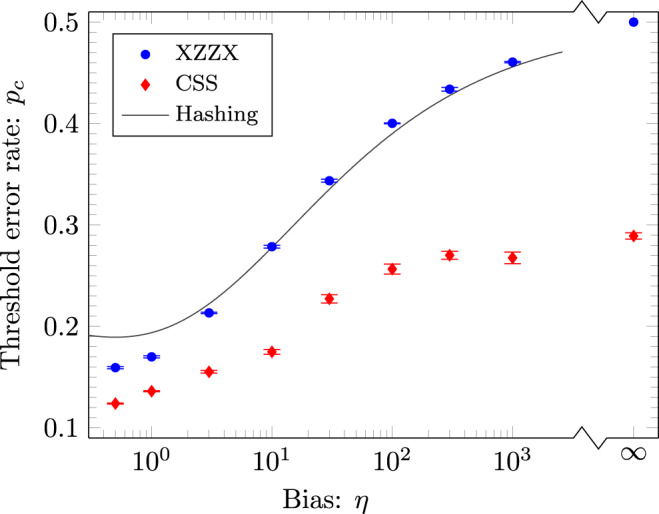
Fig. 4 Thresholds for the XZZX code using a matching decoder. Code-capacity thresholds pc for the XZZX code with rectangular boundary conditions (as in Fig. 1h) shown as a function of noise bias η using a matching decoder. The threshold error rates for the XZZX code experiencing Pauli-Z-biased noise (blue) significantly outperform those found using the matching decoder presented in ref. 10 experiencing Pauli-Y-biased noise for the CSS surface code (red). For the XZZX code, we evaluated separate thresholds for logical Pauli-X and Pauli-Z errors, with the lowest of the two shown here (although the discrepancy between the two different thresholds is negligible). Data points are found with ~105 Monte-Carlo samples for each physical error rate sampled and each lattice size used. We study the XZZX code for large lattices with dZ = AηdX where aspect ratios take values 1 ≤ Aη ≤ 157 such that A1/2 = 1 and A1000 = 157. We find the XZZX code matches the zero-rate hashing bound at η ~10 (solid line). For larger biases the data appear to exceed the hashing bound. For instance, at η = 100 we found pc − ph.b. ~ 1%. We obtained this threshold using code sizes dX = 7, 11, 15 and A100 = 23. Error bars indicate one standard deviation obtained by jackknife resampling over code distance.
Fig. 4 Thresholds for the XZZX code using a matching decoder. Code-capacity thresholds pc for the XZZX code with rectangular boundary conditions (as in Fig. 1h) shown as a function of noise bias η using a matching decoder. The threshold error rates for the XZZX code experiencing Pauli-Z-biased noise (blue) significantly outperform those found using the matching decoder presented in ref. 10 experiencing Pauli-Y-biased noise for the CSS surface code (red). For the XZZX code, we evaluated separate thresholds for logical Pauli-X and Pauli-Z errors, with the lowest of the two shown here (although the discrepancy between the two different thresholds is negligible). Data points are found with ~105 Monte-Carlo samples for each physical error rate sampled and each lattice size used. We study the XZZX code for large lattices with dZ = AηdX where aspect ratios take values 1 ≤ Aη ≤ 157 such that A1/2 = 1 and A1000 = 157. We find the XZZX code matches the zero-rate hashing bound at η ~10 (solid line). For larger biases the data appear to exceed the hashing bound. For instance, at η = 100 we found pc − ph.b. ~ 1%. We obtained this threshold using code sizes dX = 7, 11, 15 and A100 = 23. Error bars indicate one standard deviation obtained by jackknife resampling over code distance.CC BY · PubMed Central
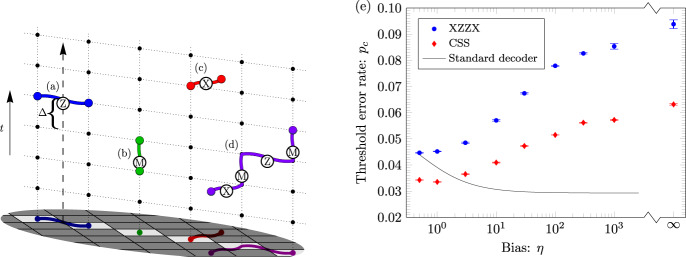
Fig. 5 Fault-tolerant thresholds for the XZZX code. a–d Spacetime where stabilizer measurements are unreliable. Time t progresses upwards and stabilizers are measured at moments marked by black vertices. We identify a defect when a stabilizer measurement differs from its previous outcome. a The dashed line shows the worldline of one qubit. If a Pauli-Z error occurs in the time interval Δ, a horizontal string is created in the spacetime with defects at its endpoints at the following round of stabilizer measurements. b Measurement errors produce two sequential defects that we interpret as strings that align along the vertical direction. c Pauli-X errors create string-like errors that align orthogonally to the Pauli-Z errors and measurement errors. d In general errors compound to make longer strings. In the limit where there are no Pauli-X errors all strings are confined to the square lattice we show. e Fault-tolerant threshold error rates pc as a function of noise bias η and measurement error rates q = ph.r. + pl.r.. The results found using our matching decoder for the XZZX code experiencing Pauli-Z-biased noise (blue) are compared with the results found using the matching decoder presented in ref. 10 experiencing Pauli-Y-biased noise for the CSS surface code (red). Equivalent results to the red points are obtained with Pauli-Z-biased noise using the tailored code of ref. 7. The XZZX code significantly outperforms the CSS code for all noise biases. At a fixed bias, data points are found with 3 × 10⁴ Monte-Carlo samples for each physical error rate sampled and for each square lattice with distance d ∈ {12, 14, …, 20} at finite bias and d ∈ {24, 28, …, 40} at infinite bias. Error bars indicate one standard deviation obtained by jackknife resampling over code distance. The solid line shows the threshold of the conventional matching decoder for the CSS surface code undergoing phenomenological noise where bit-flip and dephasing errors are decoded independently. Specifically, it follows the function ph.r. + pl.r. = 0.029 where ~2.9% is the phenomenological threshold45. We note that our decoder is equivalent to the conventional matching decoder at η = 1/2.
Fig. 5 Fault-tolerant thresholds for the XZZX code. a–d Spacetime where stabilizer measurements are unreliable. Time t progresses upwards and stabilizers are measured at moments marked by black vertices. We identify a defect when a stabilizer measurement differs from its previous outcome. a The dashed line shows the worldline of one qubit. If a Pauli-Z error occurs in the time interval Δ, a horizontal string is created in the spacetime with defects at its endpoints at the following round of stabilizer measurements. b Measurement errors produce two sequential defects that we interpret as strings that align along the vertical direction. c Pauli-X errors create string-like errors that align orthogonally to the Pauli-Z errors and measurement errors. d In general errors compound to make longer strings. In the limit where there are no Pauli-X errors all strings are confined to the square lattice we show. e Fault-tolerant threshold error rates pc as a function of noise bias η and measurement error rates q = ph.r. + pl.r.. The results found using our matching decoder for the XZZX code experiencing Pauli-Z-biased noise (blue) are compared with the results found using the matching decoder presented in ref. 10 experiencing Pauli-Y-biased noise for the CSS surface code (red). Equivalent results to the red points are obtained with Pauli-Z-biased noise using the tailored code of ref. 7. The XZZX code significantly outperforms the CSS code for all noise biases. At a fixed bias, data points are found with 3 × 10⁴ Monte-Carlo samples for each physical error rate sampled and for each square lattice with distance d ∈ {12, 14, …, 20} at finite bias and d ∈ {24, 28, …, 40} at infinite bias. Error bars indicate one standard deviation obtained by jackknife resampling over code distance. The solid line shows the threshold of the conventional matching decoder for the CSS surface code undergoing phenomenological noise where bit-flip and dephasing errors are decoded independently. Specifically, it follows the function ph.r. + pl.r. = 0.029 where ~2.9% is the phenomenological threshold45. We note that our decoder is equivalent to the conventional matching decoder at η = 1/2.CC BY · PubMed Central
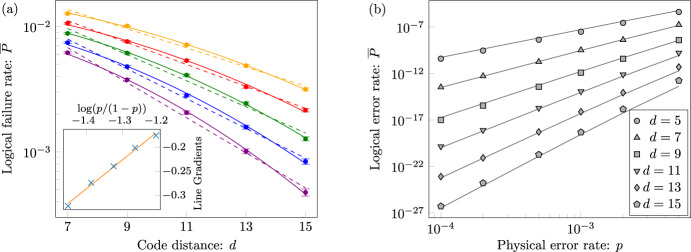
Fig. 6 Sub-threshold scaling of the logical failure rate with the XZZX code. a Logical failure rate P¯ at high bias near to threshold plotted as a function of code distance d. We use a lattice with coprime dimensions d × (d + 1) for d ∈ {7, 9, 11, 13, 15} at bias η = 300, assuming ideal measurements. The data were collected using (N=5×10)⁵ iterations of Monte-Carlo (MC) samples for each physical rate sampled and for each lattice dimension used. The physical error rates used are, from the bottom to the top curves in the main plot, p = 0.19, 0.20, 0.21, 0.22 and 0.23. Error bars represent one standard deviation for the Monte-Carlo simulations. The solid lines are a fit of the data to P¯quad.=Ae^Bd², consistent with Eq. (2), and the dashed lines a fit to P¯lin.=Ae^Bd, consistent with Eq. (3) where we would expect B=log(p/(1−p))/2, see Methods. The data fit the former very well; for the latter, the gradients of the best fit dashed lines, as shown on the inset plot as a function of log(p/(1−p)), give a linear slope of 0.61(3). Because this slope exceeds the value of 0.5, we conclude that the sub-threshold scaling is not consistent with P¯lin.=Ae^Bd. b Logical failure rates P¯ at modest bias far below threshold plotted as a function of the physical error rate p. The data (markers) were collected at bias η = 3 and coprime d × (d + 1) code dimensions of d ∈ {5, 7, 9, 11, 13, 15} assuming ideal measurements. Data is collected using the Metropolis algorithm and splitting method presented in refs. 76,77. The solid lines represent the prediction of Eq. (3). The data show very good agreement with the single parameter fitting for all system sizes as p tends to zero.
Fig. 6 Sub-threshold scaling of the logical failure rate with the XZZX code. a Logical failure rate P¯ at high bias near to threshold plotted as a function of code distance d. We use a lattice with coprime dimensions d × (d + 1) for d ∈ {7, 9, 11, 13, 15} at bias η = 300, assuming ideal measurements. The data were collected using (N=5×10)⁵ iterations of Monte-Carlo (MC) samples for each physical rate sampled and for each lattice dimension used. The physical error rates used are, from the bottom to the top curves in the main plot, p = 0.19, 0.20, 0.21, 0.22 and 0.23. Error bars represent one standard deviation for the Monte-Carlo simulations. The solid lines are a fit of the data to P¯quad.=Ae^Bd², consistent with Eq. (2), and the dashed lines a fit to P¯lin.=Ae^Bd, consistent with Eq. (3) where we would expect B=log(p/(1−p))/2, see Methods. The data fit the former very well; for the latter, the gradients of the best fit dashed lines, as shown on the inset plot as a function of log(p/(1−p)), give a linear slope of 0.61(3). Because this slope exceeds the value of 0.5, we conclude that the sub-threshold scaling is not consistent with P¯lin.=Ae^Bd. b Logical failure rates P¯ at modest bias far below threshold plotted as a function of the physical error rate p. The data (markers) were collected at bias η = 3 and coprime d × (d + 1) code dimensions of d ∈ {5, 7, 9, 11, 13, 15} assuming ideal measurements. Data is collected using the Metropolis algorithm and splitting method presented in refs. 76,77. The solid lines represent the prediction of Eq. (3). The data show very good agreement with the single parameter fitting for all system sizes as p tends to zero.CC BY · PubMed Central
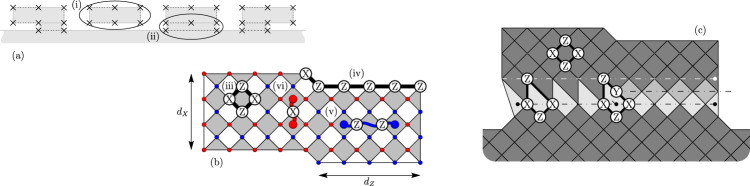
Fig. 7 Generalised lattice surgery. Details of generalised lattice surgery are given in refs. 31,62. a Pairs of qubits are encoded on surface codes with six twist defects lying on their boundaries30 (i). Entangling operations are performed by making parity measurements with an ancillary surface code, (ii). Circled areas are described in terms of the microscopic details of the architecture in parts b and c of the figure, respectively. b Initialising a hexon surface code. Red(blue) vertices are initialised in Pauli-X(Pauli-Z) basis. The system is prepared in an eigenstate of the stabilizers shown on the shaded faces, (iii) and the logical Pauli-Z operators, (iv). This initialisation strategy is robust to biased noise. Pauli-Z errors that can occur on red vertices are detected by the shaded faces (v). We can also detect low-rate Pauli-X errors on blue vertices with this method of initialisation (vi). We can decode all of these initialisation errors on this subset of faces using the minimum-weight perfect-matching decoder in the same way we decode the XZZX code as a memory. c The hexon surface code fused to the ancillary surface code to perform a logical Pauli-Y measurement. The lattice surgery procedure introduces a twist in the centre of the lattice. We show the symmetry with respect to the Pauli-Z errors by lightly colored faces. Again, decoding this model in the infinite bias limit is reduced to decoding one-dimensional repetition codes, except at the twist where there is a single branching point.
Fig. 7 Generalised lattice surgery. Details of generalised lattice surgery are given in refs. 31,62. a Pairs of qubits are encoded on surface codes with six twist defects lying on their boundaries30 (i). Entangling operations are performed by making parity measurements with an ancillary surface code, (ii). Circled areas are described in terms of the microscopic details of the architecture in parts b and c of the figure, respectively. b Initialising a hexon surface code. Red(blue) vertices are initialised in Pauli-X(Pauli-Z) basis. The system is prepared in an eigenstate of the stabilizers shown on the shaded faces, (iii) and the logical Pauli-Z operators, (iv). This initialisation strategy is robust to biased noise. Pauli-Z errors that can occur on red vertices are detected by the shaded faces (v). We can also detect low-rate Pauli-X errors on blue vertices with this method of initialisation (vi). We can decode all of these initialisation errors on this subset of faces using the minimum-weight perfect-matching decoder in the same way we decode the XZZX code as a memory. c The hexon surface code fused to the ancillary surface code to perform a logical Pauli-Y measurement. The lattice surgery procedure introduces a twist in the centre of the lattice. We show the symmetry with respect to the Pauli-Z errors by lightly colored faces. Again, decoding this model in the infinite bias limit is reduced to decoding one-dimensional repetition codes, except at the twist where there is a single branching point.CC BY · PubMed Central
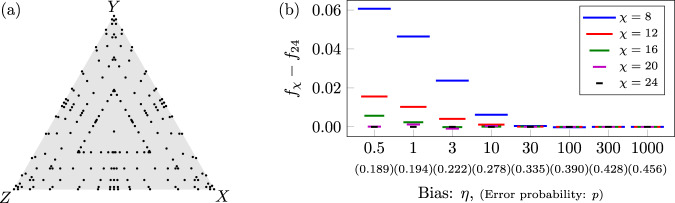
Fig. 8 Optimal threshold sample distribution and decoder convergence. a Distribution of 211 samples over the surface of all single-qubit Pauli noise channels. To construct each threshold surface of Fig. 2, by code symmetry, thresholds are estimated for 111 of these samples. b Tensor-network decoder convergence for the 77 × 77 XZZX surface code with Z-biased noise, represented by shifted logical failure rate fχ − f24, as a function of truncated bond dimension χ at a physical error probability p near the zero-rate hashing bound for the given bias η. Each data point corresponds to 30,000 runs with identical errors generated across all χ for a given bias.
Fig. 8 Optimal threshold sample distribution and decoder convergence. a Distribution of 211 samples over the surface of all single-qubit Pauli noise channels. To construct each threshold surface of Fig. 2, by code symmetry, thresholds are estimated for 111 of these samples. b Tensor-network decoder convergence for the 77 × 77 XZZX surface code with Z-biased noise, represented by shifted logical failure rate fχ − f24, as a function of truncated bond dimension χ at a physical error probability p near the zero-rate hashing bound for the given bias η. Each data point corresponds to 30,000 runs with identical errors generated across all χ for a given bias.CC BY · PubMed Central
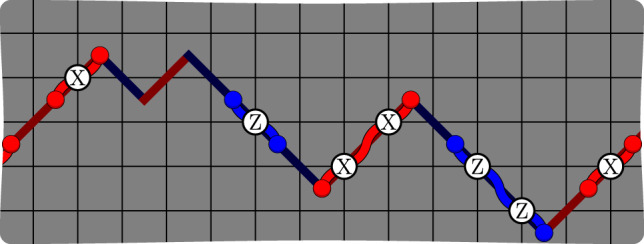
Fig. 9 A low-weight error that causes a logical failure. The error consists of ~d/4 high-rate errors and ~d/4 low-rate errors along the support of a weight d logical operator.
Fig. 9 A low-weight error that causes a logical failure. The error consists of ~d/4 high-rate errors and ~d/4 low-rate errors along the support of a weight d logical operator.CC BY · PubMed Central
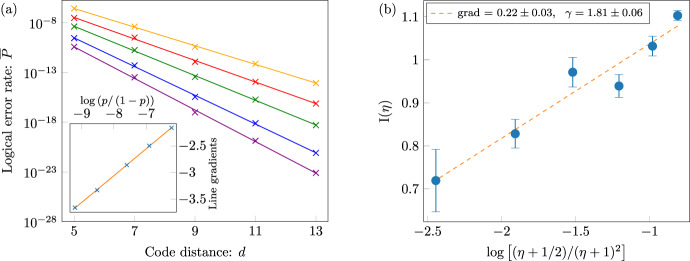
Fig. 10 Analysis of the XZZX code at low error rates. a Plot showing logical failure rate P¯ as a function of code distance d for data where noise bias η = 3. The physical error rates used are, from the bottom to the top curves in the main plot, 0.0001, 0.0002, 0.0005, 0.001 and 0.002. We estimate G(p, η) for each physical error rate p by taking the gradient of each line. Low error rate data are collected using the method proposed in refs. 76,77. The inset plot shows the gradients G(p, η) as function of log[p/(1−p)] for η = 3. Values for G(p, η), see Eq. (8), are estimated using the linear fittings. Gradient of line of best fit to these data points is 0.504(4) in agreement with the expected gradient 1/2. b Plot showing intercepts I(η) shown as a function of log[(η+1/2)/(η+1)²]. The intercept function is defined in Eq. (9) and estimated from the intercept of lines such as that shown in the inset of plot a. Error bars indicate one standard deviation relative to the fitting procedure.
Fig. 10 Analysis of the XZZX code at low error rates. a Plot showing logical failure rate P¯ as a function of code distance d for data where noise bias η = 3. The physical error rates used are, from the bottom to the top curves in the main plot, 0.0001, 0.0002, 0.0005, 0.001 and 0.002. We estimate G(p, η) for each physical error rate p by taking the gradient of each line. Low error rate data are collected using the method proposed in refs. 76,77. The inset plot shows the gradients G(p, η) as function of log[p/(1−p)] for η = 3. Values for G(p, η), see Eq. (8), are estimated using the linear fittings. Gradient of line of best fit to these data points is 0.504(4) in agreement with the expected gradient 1/2. b Plot showing intercepts I(η) shown as a function of log[(η+1/2)/(η+1)²]. The intercept function is defined in Eq. (9) and estimated from the intercept of lines such as that shown in the inset of plot a. Error bars indicate one standard deviation relative to the fitting procedure.CC BY · PubMed Central

Verification

Claims the paper makes

The claims and statistics of this paper haven’t been checked yet.

Free: it reads the open-access text and checks the first 5 claims that cite a source we can check. Create a free account to check every claim.

A few free checks a day · papers already verified open instantly · results are public

Claims other papers make about this one

Each is checked against this paper’s own text: does it say what the citing paper says it does?

Self-check

Percentages, sums and reported differences re-computed from the paper’s own numbers.

The self-check needs the paper’s full text.

Citations

Cites

Show all 67 references

Research works printed but not linked: 12

  1. Shor, P. W. Fault-tolerant quantum computation. in Proc. 37th Annual Symposium on Foundations of Computer Science, FOCS ’96 (IEEE Computer Society, 1996).
  2. Gidney, C. & Ekerå, M. How to factor 2048 bit RSA integers in 8 hours using 20 million noisy qubits. arXiv http://arxiv.org/abs/1905.09749 (2019). · arXiv
  3. Li, M., Miller, D., Newman, M., Wu, Y. & Brown, K. R. 2d compass codes. Phys. Rev. X 9, 021041 (2019).
  4. Wilde, M. M. Theorem 24.6.2 Quantum Information Theory, 2nd edn. (Cambridge University Press, 2017).
  5. Bausch, J. & Leditzky, F. Error thresholds for arbitrary Pauli noise. arXiv http://arxiv.org/abs/1910.00471 (2019). · arXiv
  6. Brown, B. J., Laubscher, K., Kesselring, M. S. & Wootton, J. R. Poking holes and cutting corners to achieve Clifford gates with the surface code. Phys. Rev. X 7, 021029 (2017).
  7. Hastings, M. B. Decoding in hyperbolic space: LDPC codes with linear rate and efficient error correction. Quant. Inf. Comput. 14, 1187 (2014).
  8. Fowler, A. G., Wang, D. S. & Hollenberg, L. C. L. Surface code quantum error correction incorporating accurate error propagation. Quant. Inf. Comput. 11, 0008 (2011).
  9. Krishna, A. & Poulin, D. Fault-tolerant gates on hypergraph product codes. Phys. Rev. X 11, 011023 (2021).
  10. Breuckmann, N. P. & Londe, V. Single-shot decoding of linear rate LDPC quantum codes with high performance. arXiv http://arxiv.org/abs/2001.03568 (2020). · arXiv
  11. Hastings, M. B., Haah, J. & O’Donnell, R. Fiber bundle codes: breaking the $${n}^{1/2}\ {\rm{polylog}}(n)$$ barrier for quantum LDPC codes. arXiv http://arxiv.org/abs/2009.03921 (2020). · arXiv
  12. Tuckett, D. K. Tailoring surface codes: Improvements in quantum error correction with biased noise. Ph.D. thesis, University of Sydney (2020).

Cited by

See all 264

Metadata

Authors
Bonilla Ataides, J. P., Tuckett, D. K., Bartlett, S. D., Flammia, S. T., & Brown, B. J.
Affiliations
The University of Sydney (AU)
Corresponding author
Brown, Benjamin J.
Venue
Nature Communications
Published
2021-04-12
Volume
12
Issue
1
Pages
2172-2172
ISSN
2041-1723 (ISSN-L)
OpenAlex
W3085306040
Cited by
262
References
63
Citations by year
2026: 29 · 2025: 94 · 2024: 45 · 2023: 52 · 2022: 34 · 2021: 8
FWCI
12.28
Type
journal article
Language
en
Open access
Licence
Locations
  • Nature Communications (publishedVersion, cc-by)
  • PubMed Central (publishedVersion, cc-by)
  • PubMed (publishedVersion)
  • arXiv (Cornell University) (submittedVersion)
  • DOAJ (DOAJ: Directory of Open Access Journals) (submittedVersion, cc-by-sa)
  • arXiv (Cornell University)
Funders
  • National Computational Infrastructure
  • Australian Government (CE170100009)
  • University of Sydney
  • Australian Research Council (CE170100009, W911NF-21-1-0007)
  • National Cancer Institute
  • Army Research Office (W911NF-21-1-, W911NF-21-1-0007, W911NF)
Topics
  • Physical Sciences › Computer Science › Artificial Intelligence › Quantum Computing Algorithms and Architecture
  • Physical Sciences › Physics and Astronomy › Atomic and Molecular Physics, and Optics › Quantum Information and Cryptography
  • Physical Sciences › Physics and Astronomy › Atomic and Molecular Physics, and Optics › Quantum many-body systems
Keywords
surface code, quantum error correction, fault-tolerant quantum computing, error threshold, qubit dephasing, decoder performance, resource scaling

About these checks

Registry, retraction, Cites and statistics results are computed, not judged, with one exception: a printed reference that no index lists is read once by a model before it counts as a citation error. Claims are extracted by a model and kept only when their quote appears verbatim in the text; each cited source is then checked, with a model’s help, for whether it says what the claim relies on. Those verdicts can be wrong — read the claim’s quote and the cited source before relying on one.

Statistics and arithmetic are recomputed, not judged.

Confidence bands are shown only for fields calibrated on our annotated test set. None is calibrated yet, so no band is shown.

What counts as a claim ›How we measure confidence ›How we check this ›

Are you an author, or do you see a problem with this page? Request a review

How to cite

Cite CoChat for the checks on this page, and the paper for its own findings.

This page
CoChat. (2026). Citation check: The XZZX surface code. https://app.cochat.ai/papers/10.1038/s41467-021-22274-1
The paper
Bonilla Ataides, J. P., Tuckett, D. K., Bartlett, S. D., Flammia, S. T., & Brown, B. J. (2021). The XZZX surface code. Nature Communications. https://doi.org/10.1038/s41467-021-22274-1

Data sources

Bibliographic data: Semantic Scholar, OpenAlex, Crossref.

Contains information from the Semantic Scholar Academic Graph Datasets, made available under the ODC Attribution License (ODC-BY 1.0).

Semantic Scholar’s data is described in: Kinney, R., et al. (2023). The Semantic Scholar Open Data Platform. arXiv:2301.10140.