

The XZZX surface code
Open accessThe DOI matches its Crossref record; 67 of the 67 references it cites were found in a registry or an index.
Abstract
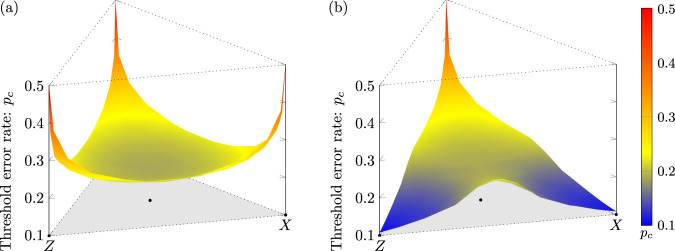
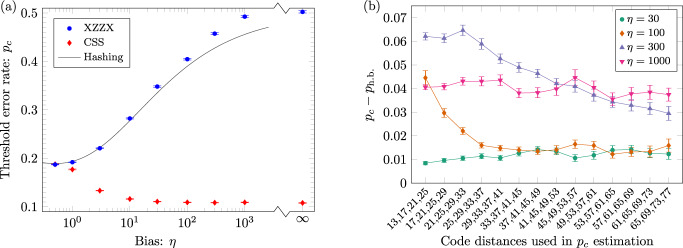
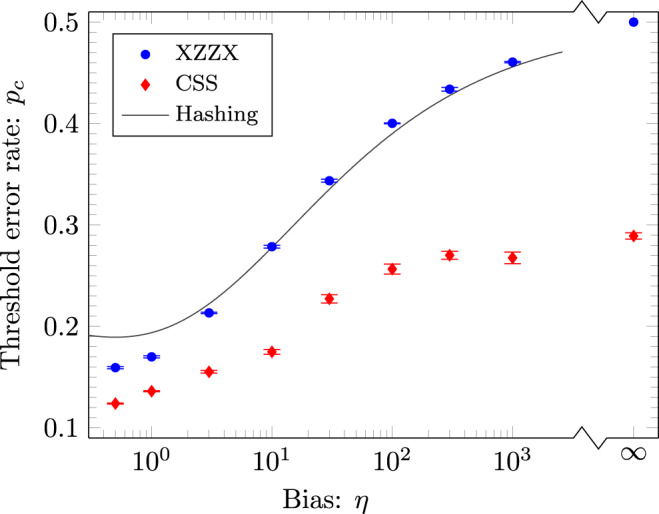
Performing large calculations with a quantum computer will likely require a fault-tolerant architecture based on quantum error-correcting codes. The challenge is to design practical quantum error-correcting codes that perform well against realistic noise using modest resources. Here we show that a variant of the surface code—the XZZX code—offers remarkable performance for fault-tolerant quantum computation. The error threshold of this code matches what can be achieved with random codes (hashing) for every single-qubit Pauli noise channel; it is the first explicit code shown to have this universal property. We present numerical evidence that the threshold even exceeds this hashing bound for an experimentally relevant range of noise parameters. Focusing on the common situation where qubit dephasing is the dominant noise, we show that this code has a practical, high-performance decoder and surpasses all previously known thresholds in the realistic setting where syndrome measurements are unreliable. We go on to demonstrate the favourable sub-threshold resource scaling that can be obtained by specialising a code to exploit structure in the noise. We show that it is possible to maintain all of these advantages when we perform fault-tolerant quantum computation.
Overview
The claims and statistics of this paper haven’t been checked yet.
Free: it reads the open-access text and checks the first 5 claims that cite a source we can check. Create a free account to check every claim.
Integrity signals
Registry
Cites
Statistics
Figures
Verification
Claims the paper makes
The claims and statistics of this paper haven’t been checked yet.
Free: it reads the open-access text and checks the first 5 claims that cite a source we can check. Create a free account to check every claim.
Claims other papers make about this one
Each is checked against this paper’s own text: does it say what the citing paper says it does?
The source backs part of the claim, not all of it — or backs it for a different population, condition or comparison.
In the citing paper
“We also remove certain Hadamard gates to implement the ZXXZ variant of the surface code44,45, which helps symmetrize the X- and Z-basis logical error rates.”
From Suppressing quantum errors by scaling a surface code logical qubit (2023) · cites this paper as [45]
Experimental — accuracy not yet measuredThe source backs part of the claim, not all of it — or backs it for a different population, condition or comparison.
In the citing paper
“At the same time, various proposals have been put forward to further scale bosonic QEC by concatenating it with an outer code across multiple bosonic modes6,8–16,18,40, leveraging the protection offered in each bosonic mode to reduce the overall resource overhead for QEC.”
From Hardware-efficient quantum error correction via concatenated bosonic qubits (2025) · cites this paper as [14]
Experimental — accuracy not yet measuredThe cited source says what the claim attributes to it.
In the citing paper
“The large physical-qubit overhead associated with error correction motivates the search for more hardware-efficient approaches6–18.”
From Hardware-efficient quantum error correction via concatenated bosonic qubits (2025) · cites this paper as [14]
Self-check
Percentages, sums and reported differences re-computed from the paper’s own numbers.
The self-check needs the paper’s full text.
Citations
Cites
Harris, C. R., Millman, K. J., van der Walt, S. J., Gommers, R., Virtanen, P., Cournapeau, D., Wieser, E., Taylor, J., Berg, S., Smith, N. J., et al. (2020) · Nature · doi:10.1038/s41586-020-2649-2 · Cited by 23,826
Fault-tolerant quantum computation by anyons
Kitaev, A. Y. (2003) · Annals of Physics · doi:10.1016/s0003-4916(02)00018-0 · Cited by 7,238 · cited 2×
“[12] A.”
BackgroundMixed-state entanglement and quantum error correction
Bennett, C. H., DiVincenzo, D. P., Smolin, J. A., & Wootters, W. K. (1996) · Physical Review A · doi:10.1103/physreva.54.3824 · Cited by 5,272 · cited 2×
“[17] C.”
BackgroundSurface codes: Towards practical large-scale quantum computation
Fowler, A. G., Mariantoni, M., Martinis, J. M., & Cleland, A. N. (2012) · Physical Review A · doi:10.1103/physreva.86.032324 · Cited by 3,059
Efficient estimation of free energy differences from Monte Carlo data
Bennett, C. H. (1976) · Journal of Computational Physics · doi:10.1016/0021-9991(76)90078-4 · Cited by 2,755
Good quantum error-correcting codes exist
Calderbank, A. R., & Shor, P. W. (1996) · Physical Review A · doi:10.1103/physreva.54.1098 · Cited by 2,516 · cited 1×
“To contrast the XZZX surface code with its conventional counterpart, we refer to the latter as the CSS surface code because it is of Calderbank-Shor-Steane type [34, 35].”
MethodEdmonds, J. (1965) · Canadian Journal of Mathematics · doi:10.4153/cjm-1965-045-4 · Cited by 2,428
Dennis, E., Kitaev, A., Landahl, A., & Preskill, J. (2002) · Journal of Mathematical Physics · doi:10.1063/1.1499754 · Cited by 1,768
Universal quantum computation with ideal Clifford gates and noisy ancillas
Bravyi, S., & Kitaev, A. (2005) · Physical Review A · doi:10.1103/physreva.71.022316 · Cited by 1,525 · cited 2×
“[51] S.”
Quantum computations: algorithms and error correction
Kitaev, A. Y. (1997) · Russian Mathematical Surveys · doi:10.1070/rm1997v052n06abeh002155 · Cited by 1,424
Multiple-particle interference and quantum error correction
(1996) · Proceedings of the Royal Society of London. Series A: Mathematical, Physical and Engineering Sciences · doi:10.1098/rspa.1996.0136 · Cited by 1,284 · cited 1×
“To contrast the 129 XZZX surface code with its conventional counterpart, we 130 refer to the latter as the CSS surface code because it is 131 of Calderbank-Shor-Steane type [34, 35].”
MethodFault-Tolerant Quantum Computation with High Threshold in Two Dimensions
Raussendorf, R., & Harrington, J. (2007) · Physical Review Letters · doi:10.1103/physrevlett.98.190504 · Cited by 812 · cited 1×
“Because our decoder is based on minimum-weight 584 matching, there are no fundamental obstacles to adapt it 585 to the more complex setting of circuit noise [40, 49, 60].”
MethodFault-tolerant quantum computation with constant error
Aharonov, D., & Ben-Or, M. (1997) · Proceedings of the twenty-ninth annual ACM symposium on Theory of computing - STOC '97 · doi:10.1145/258533.258579 · Cited by 631
Topological fault-tolerance in cluster state quantum computation
Raussendorf, R., Harrington, J., & Goyal, K. (2007) · New Journal of Physics · doi:10.1088/1367-2630/9/6/199 · Cited by 617
Surface code quantum computing by lattice surgery
Horsman, D., Fowler, A. G., Devitt, S., & Meter, R. V. (2012) · New Journal of Physics · doi:10.1088/1367-2630/14/12/123011 · Cited by 598
High-threshold universal quantum computation on the surface code
Fowler, A. G., Stephens, A. M., & Groszkowski, P. (2009) · Physical Review A · doi:10.1103/physreva.80.052312 · Cited by 486
Stabilization and operation of a Kerr-cat qubit
Grimm, A., Frattini, N. E., Puri, S., Mundhada, S. O., Touzard, S., Mirrahimi, M., Girvin, S. M., Shankar, S., & Devoret, M. H. (2020) · Nature · doi:10.1038/s41586-020-2587-z · Cited by 460
Quantum Orders in an Exact Soluble Model
Wen, X.-G. (2003) · Physical Review Letters · doi:10.1103/physrevlett.90.016803 · Cited by 422 · cited 2×
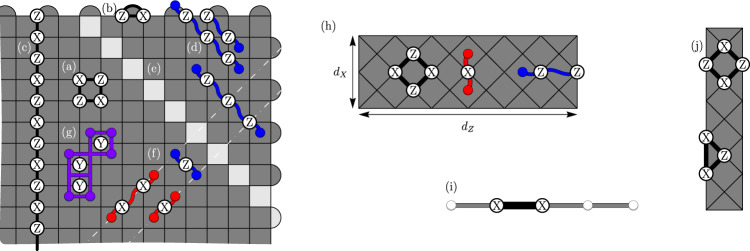
“Our central tool is a variant of the surface code [12– 14] where the stabilizer checks are given by the product XZZX of Pauli operators around each face on a square lattice [15].”
BackgroundMethodBlossom V: a new implementation of a minimum cost perfect matching algorithm
Kolmogorov, V. (2009) · Mathematical Programming Computation · doi:10.1007/s12532-009-0002-8 · Cited by 414
A Game of Surface Codes: Large-Scale Quantum Computing with Lattice Surgery
Litinski, D. (2019) · Quantum · doi:10.22331/q-2019-03-05-128 · Cited by 408 · cited 1×
“Figure 6 Generalized lattice surgery [31, 47].”
A fault-tolerant one-way quantum computer
Raussendorf, R., Harrington, J., & Goyal, K. (2006) · Annals of Physics · doi:10.1016/j.aop.2006.01.012 · Cited by 397 · cited 1×
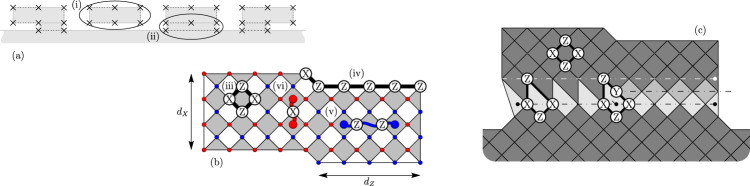
“A code deformation is a type of fault-tolerant logic gate where we manipulate encoded information by changing the stabilizer group we measure [48, 50].”
Quantum codes on a lattice with boundary
Bravyi, S. B., & Kitaev, A. Y. (1998) · arXiv · doi:10.48550/arxiv.quant-ph/9811052 · Cited by 394
Topological Order with a Twist: Ising Anyons from an Abelian Model
Bombin, H. (2010) · Physical Review Letters · doi:10.1103/physrevlett.105.030403 · Cited by 369 · cited 2×
“These approaches include braiding punc468 tures [48–50, 53], lattice surgery [29, 30, 47, 54] and com469 putation with twist defects [30, 55, 56].”
MethodWang, C., Harrington, J., & Preskill, J. (2003) · Annals of Physics · doi:10.1016/s0003-4916(02)00019-2 · Cited by 330 · cited 5×
“[39] and, unless otherwise stated, error bars are obtained by jackknife resampling over code distance.”
BackgroundMethodInfluentialA symmetry principle for topological quantum order
Nussinov, Z., & Ortiz, G. (2009) · Annals of Physics · doi:10.1016/j.aop.2008.11.002 · Cited by 310
Quantum-channel capacity of very noisy channels
DiVincenzo, D. P., Shor, P. W., & Smolin, J. A. (1998) · Physical Review A · doi:10.1103/physreva.57.830 · Cited by 297
Quantum Self-Correction in the 3D Cubic Code Model
Bravyi, S., & Haah, J. (2013) · Physical Review Letters · doi:10.1103/physrevlett.111.200501 · Cited by 291 · cited 1×
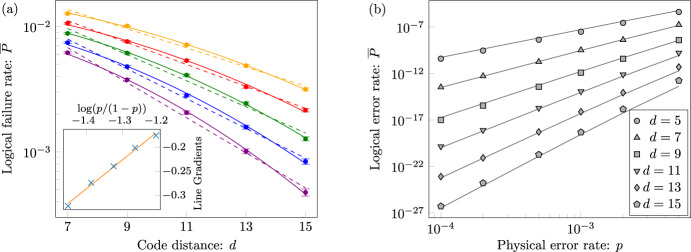
“In this regime, the logical failure rate of a code is 430 expected to decay as P ∼ p below threshold [5, 43, 44].”
BackgroundTillich, J.-P., & Zemor, G. (2014) · IEEE Transactions on Information Theory · doi:10.1109/tit.2013.2292061 · Cited by 288
Exponential suppression of bit-flips in a qubit encoded in an oscillator
Lescanne, R., Villiers, M., Peronnin, T., Sarlette, A., Delbecq, M., Huard, B., Kontos, T., Mirrahimi, M., & Leghtas, Z. (2020) · Nature Physics · doi:10.1038/s41567-020-0824-x · Cited by 276
Repetition Cat Qubits for Fault-Tolerant Quantum Computation
Guillaud, J., & Mirrahimi, M. (2019) · Physical Review X · doi:10.1103/physrevx.9.041053 · Cited by 243
Topological and Subsystem Codes on Low-Degree Graphs with Flag Qubits
Chamberland, C., Zhu, G., Yoder, T. J., Hertzberg, J. B., & Cross, A. W. (2020) · Physical Review X · doi:10.1103/physrevx.10.011022 · Cited by 223
Ultrahigh Error Threshold for Surface Codes with Biased Noise
Tuckett, D. K., Bartlett, S. D., & Flammia, S. T. (2018) · Physical Review Letters · doi:10.1103/physrevlett.120.050505 · Cited by 216
Self-citationEfficient algorithms for maximum likelihood decoding in the surface code
Bravyi, S., Suchara, M., & Vargo, A. (2014) · Physical Review A · doi:10.1103/physreva.90.032326 · Cited by 214 · cited 5×
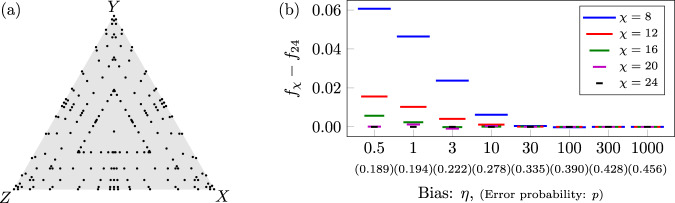
“An algorithm due to Bravyi, Suchara, and Vargo [36] efficiently approximates maximum-likelihood decoding by mapping coset probabilities to tensor-network contractions.”
MethodInfluentialEfficient learning of quantum noise
Harper, R., Flammia, S. T., & Wallman, J. J. (2020) · Nature Physics · doi:10.1038/s41567-020-0992-8 · Cited by 212 · cited 2×
“We expect that the largest performance gains will be obtained by using information from a fully characterized Pauli noise model [61–63] that goes beyond the single-qubit error models considered here.”
MethodSelf-citationFault-tolerant quantum computation against biased noise
Aliferis, P., & Preskill, J. (2008) · Physical Review A · doi:10.1103/physreva.78.052331 · Cited by 204 · cited 2×
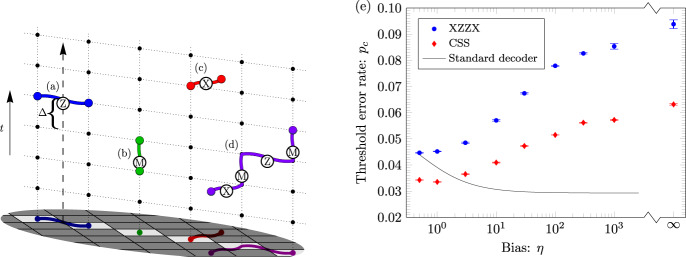
“Thus, we should expect to achieve low logical failure rates using a modest number of physical qubits for experimentally plausible values of the noise bias where, say 10 ∼ η ∼ 1000 [24, 25] Finally, we consider fault-tolerant quantum computation with biased noise [26–28], and we show that the advantages of the XZZX cod…”
BackgroundBias-preserving gates with stabilized cat qubits
Puri, S., St-Jean, L., Gross, J. A., Grimm, A., Frattini, N. E., Iyer, P. S., Krishna, A., Touzard, S., Jiang, L., Blais, A., et al. (2020) · Science Advances · doi:10.1126/sciadv.aay5901 · Cited by 201 · cited 1×
“We expect that the high numerical thresholds we observe for phenomenological noise will, when adapted to circuit level noise, continue to outperform the conventional surface code, especially when using gates that preserve the structure of the noise [27, 28].”
BackgroundSelf-citationFault-Tolerant quantum computation with constant overhead
Gottesman, D. (2014) · Quantum Information and Computation · doi:10.26421/qic14.15-16-5 · Cited by 172 · cited 1×
“[65] D.”
Degenerate Quantum Codes for Pauli Channels
Smith, G., & Smolin, J. A. (2007) · Physical Review Letters · doi:10.1103/physrevlett.98.030501 · Cited by 142 · cited 2×
“Thus, this code could potentially provide a practical demonstration of the superadditivity of coherent information [19–23].”
BackgroundFault-tolerant thresholds for quantum error correction with the surface code
Stephens, A. M. (2014) · Physical Review A · doi:10.1103/physreva.89.022321 · Cited by 133 · cited 3×
“We also remark that 316 hook errors [40, 41] are low-rate events with this circuit 317 as the control qubit of entangling gates commutes with 318 the high-rate Pauli-Z errors, and so high-rate errors are 319”
BackgroundMethodTailoring Surface Codes for Highly Biased Noise
Tuckett, D. K., Darmawan, A. S., Chubb, C. T., Bravyi, S., Bartlett, S. D., & Flammia, S. T. (2019) · Physical Review X · doi:10.1103/physrevx.9.041031 · Cited by 124
Self-citationEfficient Estimation of Pauli Channels
Flammia, S. T., & Wallman, J. J. (2020) · ACM Transactions on Quantum Computing · doi:10.1145/3408039 · Cited by 122 · cited 2×
“We expect that the largest performance gains will be obtained by using information from a fully characterized Pauli noise model [61–63] that goes beyond the single-qubit error models considered here.”
MethodSelf-citationFault-Tolerant Thresholds for the Surface Code in Excess of 5% Under Biased Noise
Tuckett, D. K., Bartlett, S. D., Flammia, S. T., & Brown, B. J. (2020) · Physical Review Letters · doi:10.1103/physrevlett.124.130501 · Cited by 118
Self-citationPoulin, D., Tillich, J.-P., & Ollivier, H. (2009) · IEEE Transactions on Information Theory · doi:10.1109/tit.2009.2018339 · Cited by 116
Constant overhead quantum fault tolerance with quantum expander codes
Fawzi, O., Grospellier, A., & Leverrier, A. (2021) · Communications of the ACM · doi:10.1145/3434163 · Cited by 111 · cited 1×
“A key future direction of research would be to carry these improvements over to codes and architectures that promise improved (even constant) overheads [64– 66].”
BackgroundQuantum measurements and gates by code deformation
Bombin, H., & Martin-Delgado, M. A. (2009) · Journal of Physics A: Mathematical and Theoretical · doi:10.1088/1751-8113/42/9/095302 · Cited by 107 · cited 1×
“A code deformation is a type of fault-tolerant logic gate where we manipulate encoded information by changing the stabilizer group we measure [48, 50].”
Threshold Accuracy for Quantum Computation
Knill, E., Laflamme, R., & Zurek, W. (1996) · arXiv · doi:10.48550/arxiv.quant-ph/9610011 · Cited by 99 · cited 3×
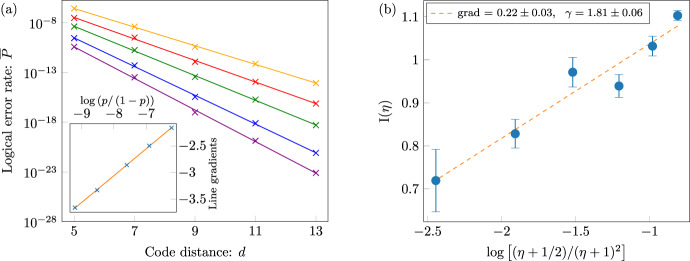
“(3) where we would expect B 1⁄4 log ðp=ð1 pÞÞ=2, see Methods.”
BackgroundInfluentialFault-tolerant computing with biased-noise superconducting qubits: a case study
Aliferis, P., Brito, F., DiVincenzo, D. P., Preskill, J., Steffen, M., & Terhal, B. M. (2009) · New Journal of Physics · doi:10.1088/1367-2630/11/1/013061 · Cited by 98 · cited 1×
“Similar results have been obtained in, e.g. [16, 26, 57–59] with other codes.”
ResultYoder, T. J., & Kim, I. H. (2017) · Quantum · doi:10.22331/q-2017-04-25-2 · Cited by 98 · cited 1×
“These approaches include braiding punc468 tures [48–50, 53], lattice surgery [29, 30, 47, 54] and com469 putation with twist defects [30, 55, 56].”
Lattice Surgery with a Twist: Simplifying Clifford Gates of Surface Codes
Litinski, D., & Oppen, F. V. (2018) · Quantum · doi:10.22331/q-2018-05-04-62 · Cited by 86
Lower bounds on the nonzero capacity of Pauli channels
Fern, J., & Whaley, K. B. (2008) · Physical Review A · doi:10.1103/physreva.78.062335 · Cited by 72
Quantum Error-Correcting Codes Need Not Completely Reveal the Error Syndrome
Shor, P. W., & Smolin, J. A. (1996) · arXiv (Cornell University) · doi:10.48550/arxiv.quant-ph/9604006 · Cited by 68
Fast fault-tolerant decoder for qubit and qudit surface codes
Watson, F. H. E., Anwar, H., & Browne, D. E. (2015) · Physical Review A · doi:10.1103/physreva.92.032309 · Cited by 60 · cited 1×
“In this regime, the logical failure rate of a code is expected to decay as P ∼ p below threshold [5, 43, 44].”
BackgroundParallelized quantum error correction with fracton topological codes
Brown, B. J., & Williamson, D. J. (2020) · Physical Review Research · doi:10.1103/physrevresearch.2.013303 · Cited by 59 · cited 4×
“We can understand this phe156 nomenon in more formal terms from the perspective of 157 symmetries [10, 32].”
BackgroundMethodInfluentialSelf-citationAnalysing correlated noise on the surface code using adaptive decoding algorithms
Nickerson, N. H., & Brown, B. J. (2019) · Quantum · doi:10.22331/q-2019-04-08-131 · Cited by 58 · cited 2×
“We expect that the largest performance gains will be obtained by using information from a fully characterized Pauli noise model [61–63] that goes beyond the single-qubit error models considered here.”
MethodSelf-citationCode deformation and lattice surgery are gauge fixing
Vuillot, C., Lao, L., Criger, B., García Almudéver, C., Bertels, K., & Terhal, B. M. (2019) · New Journal of Physics · doi:10.1088/1367-2630/ab0199 · Cited by 56
Quantum error correcting codes and 4-dimensional arithmetic hyperbolic manifolds
Guth, L., & Lubotzky, A. (2014) · Journal of Mathematical Physics · doi:10.1063/1.4891487 · Cited by 53 · cited 2×
“[68] L.”
BackgroundSimulation of rare events in quantum error correction
Bravyi, S., & Vargo, A. (2013) · Physical Review A · doi:10.1103/physreva.88.062308 · Cited by 52 · cited 1×
“Data is collected using the metropolis algorithm and splitting method presented in [45, 46].”
MethodFault-tolerant quantum computation with asymmetric Bacon-Shor codes
Brooks, P., & Preskill, J. (2013) · Physical Review A · doi:10.1103/physreva.87.032310 · Cited by 49
Tailored Codes for Small Quantum Memories
Robertson, A., Granade, C., Bartlett, S. D., & Flammia, S. T. (2017) · Physical Review Applied · doi:10.1103/physrevapplied.8.064004 · Cited by 45
Self-citationReducing the overhead for quantum computation when noise is biased
Webster, P., Bartlett, S. D., & Poulin, D. (2015) · Physical Review A · doi:10.1103/physreva.92.062309 · Cited by 43 · cited 1×
“460 Although initialization circuits have been proposed to 461 exploit a bias in the noise [52], here we focus on fault462 tolerant Clifford operations and the fault-tolerant prepa463 ration of logical qubits in the computational basis.”
BackgroundSelf-citationThe role of entropy in topological quantum error correction
Beverland, M. E., Brown, B. J., Kastoryano, M. J., & Marolleau, Q. (2019) · Journal of Statistical Mechanics Theory and Experiment · doi:10.1088/1742-5468/ab25de · Cited by 37
Self-citationHigh-threshold topological quantum error correction against biased noise
Stephens, A. M., Munro, W. J., & Nemoto, K. (2013) · Physical Review A · doi:10.1103/physreva.88.060301 · Cited by 35
Generating topological order from a two-dimensional cluster state using a duality mapping
Brown, B. J., Son, W., Kraus, C. V., Fazio, R., & Vedral, V. (2011) · New Journal of Physics · doi:10.1088/1367-2630/13/6/065010 · Cited by 33
Self-citationCapabilities of a Perturbed Toric Code as a Quantum Memory
Kay, A. (2011) · Physical Review Letters · doi:10.1103/physrevlett.107.270502 · Cited by 29
Topological wormholes: Nonlocal defects on the toric code
Krishna, A., & Poulin, D. (2020) · Physical Review Research · doi:10.1103/physrevresearch.2.023116 · Cited by 26
Reduced space-time and time costs Ising dislocation codes and arbitrary ancillas
Hastings, M. B., & Geller, A. (2015) · Quantum Information and Computation · doi:10.26421/qic15.11-12-6 · Cited by 25 · cited 1×
“These approaches include braiding punctures [48–50, 53], lattice surgery [29, 30, 47, 54] and computation with twist defects [30, 55, 56].”
BackgroundHigh-Threshold Code for Modular Hardware With Asymmetric Noise
Xu, X., Zhao, Q., Yuan, X., & Benjamin, S. C. (2019) · Physical Review Applied · doi:10.1103/physrevapplied.12.064006 · Cited by 11
Research works printed but not linked: 12
- Shor, P. W. Fault-tolerant quantum computation. in Proc. 37th Annual Symposium on Foundations of Computer Science, FOCS ’96 (IEEE Computer Society, 1996).
- Gidney, C. & Ekerå, M. How to factor 2048 bit RSA integers in 8 hours using 20 million noisy qubits. arXiv http://arxiv.org/abs/1905.09749 (2019). · arXiv
- Li M Miller D Newman M Wu Y Brown KR 2d compass codes Phys. Rev. X 2019 9 021041
- Wilde, M. M. Theorem 24.6.2 Quantum Information Theory, 2nd edn. (Cambridge University Press, 2017).
- Bausch, J. & Leditzky, F. Error thresholds for arbitrary Pauli noise. arXiv http://arxiv.org/abs/1910.00471 (2019). · arXiv
- Brown BJ Laubscher K Kesselring MS Wootton JR Poking holes and cutting corners to achieve Clifford gates with the surface code Phys. Rev. X 2017 7 021029
- Hastings MB Decoding in hyperbolic space: LDPC codes with linear rate and efficient error correction Quant. Inf. Comput. 2014 14 1187
- Fowler AG Wang DS Hollenberg LCL Surface code quantum error correction incorporating accurate error propagation Quant. Inf. Comput. 2011 11 0008
- Krishna A Poulin D Fault-tolerant gates on hypergraph product codes Phys. Rev. X 2021 11 011023
- Breuckmann, N. P. & Londe, V. Single-shot decoding of linear rate LDPC quantum codes with high performance. arXiv http://arxiv.org/abs/2001.03568 (2020). · arXiv
- Hastings, M. B., Haah, J. & O’Donnell, R. Fiber bundle codes: breaking the barrier for quantum LDPC codes. arXiv http://arxiv.org/abs/2009.03921 (2020). · arXiv
- Tuckett, D. K. Tailoring surface codes: Improvements in quantum error correction with biased noise. Ph.D. thesis, University of Sydney (2020).
Cited by
Suppressing quantum errors by scaling a surface code logical qubit
Google Quantum, A. I., Acharya, R., Aleiner, I., Allen, R., Andersen, T. I., Ansmann, M., Arute, F., Arya, K., Asfaw, A., Atalaya, J., et al. (2023) · Nature · doi:10.1038/s41586-022-05434-1 · Cited by 1,103
Quantum error correction below the surface code threshold
Collaborators, G. Q. A. A., Acharya, R., Abanin, D. A., Aghababaie-Beni, L., Aleiner, I., Andersen, T. I., Ansmann, M., Arute, F., Arya, K., Asfaw, A., et al. (2025) · Nature · doi:10.1038/s41586-024-08449-y · Cited by 778
“Note that this metric does not favor qubits with extremely biased noise [32–34 S4.”
High-fidelity gates and mid-circuit erasure conversion in an atomic qubit
Ma, S., Liu, G., Peng, P., Zhang, B., Jandura, S., Claes, J., Burgers, A. P., Pupillo, G., Puri, S., & Thompson, J. D. (2023) · Nature · doi:10.1038/s41586-023-06438-1 · Cited by 228
“For example, for eventual application in quantum error correction, it is advantageous to realize qubits with structured error models, such as biased Pauli errors 9 or conversion of errors into detectable erasures 10 .”
MethodQuantum Computing for High-Energy Physics: State of the Art and Challenges
Di Meglio, A., Jansen, K., Tavernelli, I., Alexandrou, C., Arunachalam, S., Bauer, C. W., Borras, K., Carrazza, S., Crippa, A., Croft, V., et al. (2024) · PRX Quantum · doi:10.1103/prxquantum.5.037001 · Cited by 215
Erasure conversion for fault-tolerant quantum computing in alkaline earth Rydberg atom arrays
Wu, Y., Kolkowitz, S., Puri, S., & Thompson, J. D. (2022) · Nature Communications · doi:10.1038/s41467-022-32094-6 · Cited by 196
Metadata
- Authors
- Bonilla Ataides, J. P., Tuckett, D. K., Bartlett, S. D., Flammia, S. T., & Brown, B. J.
- Affiliations
- The University of Sydney (AU)
- Corresponding author
- Brown, Benjamin J.
- ORCID
- Venue
- Nature Communications
- Published
- 2021-04-12
- Volume
- 12
- Issue
- 1
- Pages
- 2172-2172
- ISSN
- 2041-1723 (ISSN-L)
- PMC
- PMC8042007
- OpenAlex
- W3085306040
- Cited by
- 262
- References
- 63
- Citations by year
- 2026: 29 · 2025: 94 · 2024: 45 · 2023: 52 · 2022: 34 · 2021: 8
- FWCI
- 12.28
- Type
- journal article
- Language
- en
- Open access
- gold
- doi.org
- Licence
- cc-by
- creativecommons.org/licenses/by/4.0 (tdm)
- creativecommons.org/licenses/by/4.0 (vor)
- Locations
- Nature Communications (publishedVersion, cc-by)
- PubMed Central (publishedVersion, cc-by)
- PubMed (publishedVersion)
- arXiv (Cornell University) (submittedVersion)
- DOAJ (DOAJ: Directory of Open Access Journals) (submittedVersion, cc-by-sa)
- arXiv (Cornell University)
- Funders
- National Computational Infrastructure
- Australian Government (CE170100009)
- University of Sydney
- Australian Research Council (CE170100009, W911NF-21-1-0007)
- National Cancer Institute
- Army Research Office (W911NF-21-1-, W911NF-21-1-0007, W911NF)
- Topics
- Physical Sciences › Computer Science › Artificial Intelligence › Quantum Computing Algorithms and Architecture
- Physical Sciences › Physics and Astronomy › Atomic and Molecular Physics, and Optics › Quantum Information and Cryptography
- Physical Sciences › Physics and Astronomy › Atomic and Molecular Physics, and Optics › Quantum many-body systems
- Keywords
- surface code, quantum error correction, fault-tolerant quantum computing, error threshold, qubit dephasing, decoder performance, resource scaling
About these checks
Registry, retraction, Cites and statistics results are computed, not judged, with one exception: a printed reference that no index lists is read once by a model before it counts as a citation error. Claims are extracted by a model and kept only when their quote appears verbatim in the text; each cited source is then checked, with a model’s help, for whether it says what the claim relies on. Those verdicts can be wrong — read the claim’s quote and the cited source before relying on one.
Statistics and arithmetic are recomputed, not judged.
Confidence bands are shown only for fields calibrated on our annotated test set. None is calibrated yet, so no band is shown.
What counts as a claim ›How we measure confidence ›How we check this ›
Are you an author, or do you see a problem with this page? Request a review
Data sources
Bibliographic data: Semantic Scholar, OpenAlex, Crossref.
Contains information from the Semantic Scholar Academic Graph Datasets, made available under the ODC Attribution License (ODC-BY 1.0).
Semantic Scholar’s data is described in: Kinney, R., et al. (2023). The Semantic Scholar Open Data Platform. arXiv:2301.10140.
