

The XZZX surface code
Open accessThe DOI matches its Crossref record; 67 of the 67 references it cites were found in a registry or an index.
Abstract
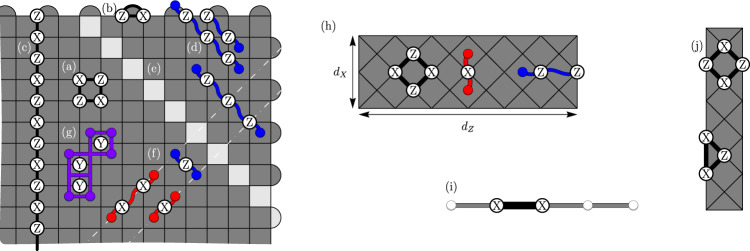
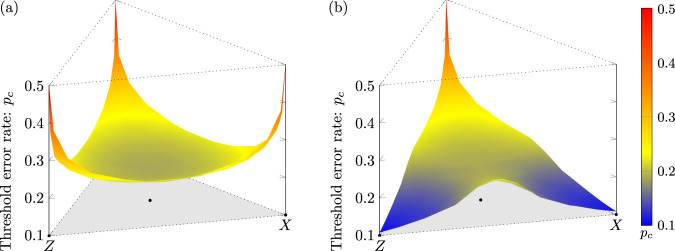
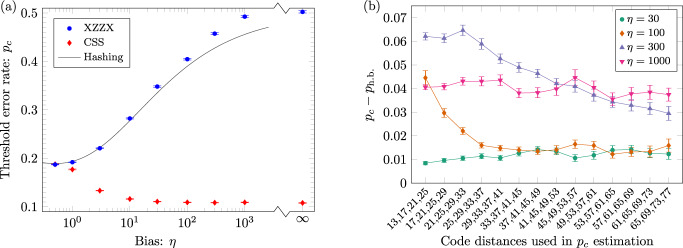
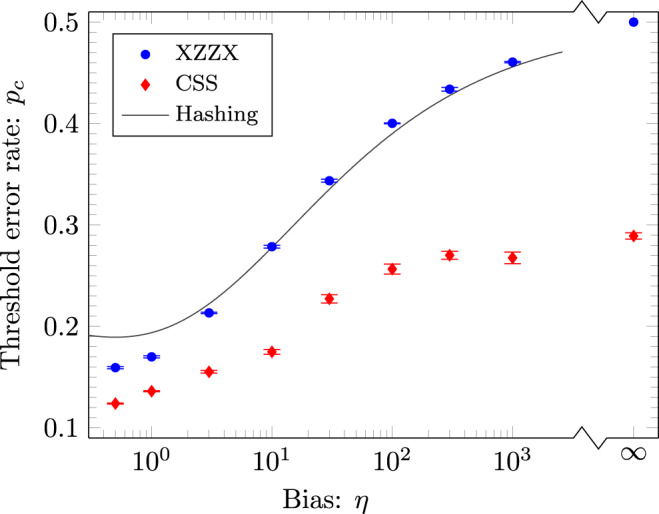
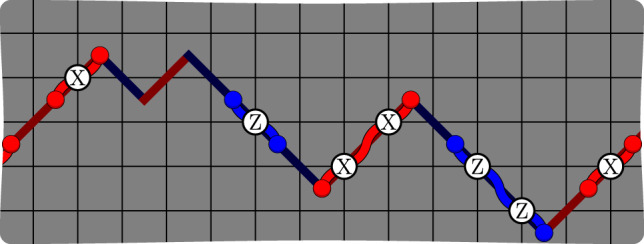
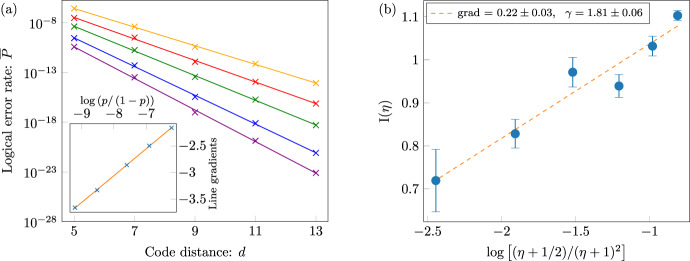
Performing large calculations with a quantum computer will likely require a fault-tolerant architecture based on quantum error-correcting codes. The challenge is to design practical quantum error-correcting codes that perform well against realistic noise using modest resources. Here we show that a variant of the surface code—the XZZX code—offers remarkable performance for fault-tolerant quantum computation. The error threshold of this code matches what can be achieved with random codes (hashing) for every single-qubit Pauli noise channel; it is the first explicit code shown to have this universal property. We present numerical evidence that the threshold even exceeds this hashing bound for an experimentally relevant range of noise parameters. Focusing on the common situation where qubit dephasing is the dominant noise, we show that this code has a practical, high-performance decoder and surpasses all previously known thresholds in the realistic setting where syndrome measurements are unreliable. We go on to demonstrate the favourable sub-threshold resource scaling that can be obtained by specialising a code to exploit structure in the noise. We show that it is possible to maintain all of these advantages when we perform fault-tolerant quantum computation.
Overview
The claims and statistics of this paper haven’t been checked yet.
Free: it reads the open-access text and checks the first 5 claims that cite a source we can check. Create a free account to check every claim.
Integrity signals
Registry
Cites
Statistics
Figures
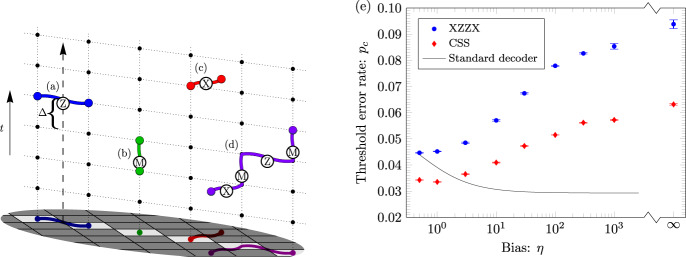
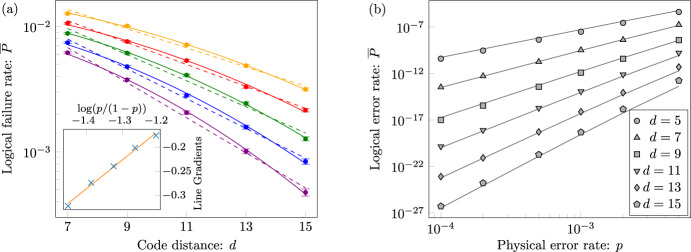
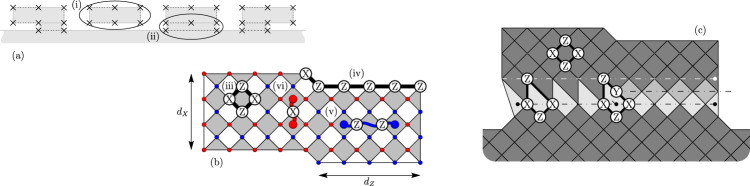
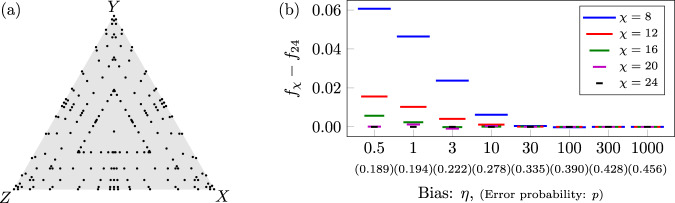
Verification
Claims the paper makes
The claims and statistics of this paper haven’t been checked yet.
Free: it reads the open-access text and checks the first 5 claims that cite a source we can check. Create a free account to check every claim.
Claims other papers make about this one
Each is checked against this paper’s own text: does it say what the citing paper says it does?
The source backs part of the claim, not all of it — or backs it for a different population, condition or comparison.
In the citing paper
“We also remove certain Hadamard gates to implement the ZXXZ variant of the surface code44,45, which helps symmetrize the X- and Z-basis logical error rates.”
From Suppressing quantum errors by scaling a surface code logical qubit (2023) · cites this paper as [45]
Experimental — accuracy not yet measuredThe source backs part of the claim, not all of it — or backs it for a different population, condition or comparison.
In the citing paper
“At the same time, various proposals have been put forward to further scale bosonic QEC by concatenating it with an outer code across multiple bosonic modes6,8–16,18,40, leveraging the protection offered in each bosonic mode to reduce the overall resource overhead for QEC.”
From Hardware-efficient quantum error correction via concatenated bosonic qubits (2025) · cites this paper as [14]
Experimental — accuracy not yet measuredThe cited source says what the claim attributes to it.
In the citing paper
“The large physical-qubit overhead associated with error correction motivates the search for more hardware-efficient approaches6–18.”
From Hardware-efficient quantum error correction via concatenated bosonic qubits (2025) · cites this paper as [14]
Self-check
Percentages, sums and reported differences re-computed from the paper’s own numbers.
The self-check needs the paper’s full text.
Citations
Cites
Harris, C. R., Millman, K. J., van der Walt, S. J., Gommers, R., Virtanen, P., Cournapeau, D., Wieser, E., Taylor, J., Berg, S., Smith, N. J., et al. (2020) · Nature · doi:10.1038/s41586-020-2649-2 · Cited by 23,826
Fault-tolerant quantum computation by anyons
Kitaev, A. Y. (2003) · Annals of Physics · doi:10.1016/s0003-4916(02)00018-0 · Cited by 7,238 · cited 2×
“[12] A.”
BackgroundMixed-state entanglement and quantum error correction
Bennett, C. H., DiVincenzo, D. P., Smolin, J. A., & Wootters, W. K. (1996) · Physical Review A · doi:10.1103/physreva.54.3824 · Cited by 5,272 · cited 2×
“[17] C.”
BackgroundSurface codes: Towards practical large-scale quantum computation
Fowler, A. G., Mariantoni, M., Martinis, J. M., & Cleland, A. N. (2012) · Physical Review A · doi:10.1103/physreva.86.032324 · Cited by 3,059
Efficient estimation of free energy differences from Monte Carlo data
Bennett, C. H. (1976) · Journal of Computational Physics · doi:10.1016/0021-9991(76)90078-4 · Cited by 2,755
Good quantum error-correcting codes exist
Calderbank, A. R., & Shor, P. W. (1996) · Physical Review A · doi:10.1103/physreva.54.1098 · Cited by 2,516 · cited 1×
“To contrast the XZZX surface code with its conventional counterpart, we refer to the latter as the CSS surface code because it is of Calderbank-Shor-Steane type [34, 35].”
MethodEdmonds, J. (1965) · Canadian Journal of Mathematics · doi:10.4153/cjm-1965-045-4 · Cited by 2,428
Dennis, E., Kitaev, A., Landahl, A., & Preskill, J. (2002) · Journal of Mathematical Physics · doi:10.1063/1.1499754 · Cited by 1,768
Universal quantum computation with ideal Clifford gates and noisy ancillas
Bravyi, S., & Kitaev, A. (2005) · Physical Review A · doi:10.1103/physreva.71.022316 · Cited by 1,525 · cited 2×
“[51] S.”
Quantum computations: algorithms and error correction
Kitaev, A. Y. (1997) · Russian Mathematical Surveys · doi:10.1070/rm1997v052n06abeh002155 · Cited by 1,424
Research works printed but not linked: 12
- Shor, P. W. Fault-tolerant quantum computation. in Proc. 37th Annual Symposium on Foundations of Computer Science, FOCS ’96 (IEEE Computer Society, 1996).
- Gidney, C. & Ekerå, M. How to factor 2048 bit RSA integers in 8 hours using 20 million noisy qubits. arXiv http://arxiv.org/abs/1905.09749 (2019). · arXiv
- Li M Miller D Newman M Wu Y Brown KR 2d compass codes Phys. Rev. X 2019 9 021041
- Wilde, M. M. Theorem 24.6.2 Quantum Information Theory, 2nd edn. (Cambridge University Press, 2017).
- Bausch, J. & Leditzky, F. Error thresholds for arbitrary Pauli noise. arXiv http://arxiv.org/abs/1910.00471 (2019). · arXiv
- Brown BJ Laubscher K Kesselring MS Wootton JR Poking holes and cutting corners to achieve Clifford gates with the surface code Phys. Rev. X 2017 7 021029
- Hastings MB Decoding in hyperbolic space: LDPC codes with linear rate and efficient error correction Quant. Inf. Comput. 2014 14 1187
- Fowler AG Wang DS Hollenberg LCL Surface code quantum error correction incorporating accurate error propagation Quant. Inf. Comput. 2011 11 0008
- Krishna A Poulin D Fault-tolerant gates on hypergraph product codes Phys. Rev. X 2021 11 011023
- Breuckmann, N. P. & Londe, V. Single-shot decoding of linear rate LDPC quantum codes with high performance. arXiv http://arxiv.org/abs/2001.03568 (2020). · arXiv
- Hastings, M. B., Haah, J. & O’Donnell, R. Fiber bundle codes: breaking the barrier for quantum LDPC codes. arXiv http://arxiv.org/abs/2009.03921 (2020). · arXiv
- Tuckett, D. K. Tailoring surface codes: Improvements in quantum error correction with biased noise. Ph.D. thesis, University of Sydney (2020).
Cited by
Suppressing quantum errors by scaling a surface code logical qubit
Google Quantum, A. I., Acharya, R., Aleiner, I., Allen, R., Andersen, T. I., Ansmann, M., Arute, F., Arya, K., Asfaw, A., Atalaya, J., et al. (2023) · Nature · doi:10.1038/s41586-022-05434-1 · Cited by 1,103
Quantum error correction below the surface code threshold
Collaborators, G. Q. A. A., Acharya, R., Abanin, D. A., Aghababaie-Beni, L., Aleiner, I., Andersen, T. I., Ansmann, M., Arute, F., Arya, K., Asfaw, A., et al. (2025) · Nature · doi:10.1038/s41586-024-08449-y · Cited by 778
“Note that this metric does not favor qubits with extremely biased noise [32–34 S4.”
High-fidelity gates and mid-circuit erasure conversion in an atomic qubit
Ma, S., Liu, G., Peng, P., Zhang, B., Jandura, S., Claes, J., Burgers, A. P., Pupillo, G., Puri, S., & Thompson, J. D. (2023) · Nature · doi:10.1038/s41586-023-06438-1 · Cited by 228
“For example, for eventual application in quantum error correction, it is advantageous to realize qubits with structured error models, such as biased Pauli errors 9 or conversion of errors into detectable erasures 10 .”
MethodQuantum Computing for High-Energy Physics: State of the Art and Challenges
Di Meglio, A., Jansen, K., Tavernelli, I., Alexandrou, C., Arunachalam, S., Bauer, C. W., Borras, K., Carrazza, S., Crippa, A., Croft, V., et al. (2024) · PRX Quantum · doi:10.1103/prxquantum.5.037001 · Cited by 215
Erasure conversion for fault-tolerant quantum computing in alkaline earth Rydberg atom arrays
Wu, Y., Kolkowitz, S., Puri, S., & Thompson, J. D. (2022) · Nature Communications · doi:10.1038/s41467-022-32094-6 · Cited by 196
PyMatching: A Python Package for Decoding Quantum Codes with Minimum-Weight Perfect Matching
Higgott, O. (2022) · ACM Transactions on Quantum Computing · doi:10.1145/3505637 · Cited by 181
“Note that we can decode Pauli X errors with the same method, and MWPM can also be easily adapted to decode certain non-CSS codes (such as the XZZX surface code [10]).”
BackgroundMethodProspects for quantum enhancement with diabatic quantum annealing
Crosson, E. J., & Lidar, D. A. (2021) · Nature Reviews Physics · doi:10.1038/s42254-021-00313-6 · Cited by 134
Learning high-accuracy error decoding for quantum processors
Bausch, J., Senior, A. W., Heras, F. J. H., Edlich, T., Davies, A., Newman, M., Jones, C., Satzinger, K., Niu, M. Y., Blackwell, S., et al. (2024) · Nature · doi:10.1038/s41586-024-08148-8 · Cited by 106
“S3 for an XZZX variant of the rotated surface code [11].”
Hardware-efficient quantum error correction via concatenated bosonic qubits
Putterman, H., Noh, K., Hann, C. T., MacCabe, G. S., Aghaeimeibodi, S., Patel, R. N., Lee, M., Jones, W. M., Moradinejad, H., Rodriguez, R., et al. (2025) · Nature · doi:10.1038/s41586-025-08642-7 · Cited by 108
“Control lines are present on both the bottom tantalum-based die and the top aluminum-based die.”
Low-overhead fault-tolerant quantum computing using long-range connectivity
Cohen, L. Z., Kim, I. H., Bartlett, S. D., & Brown, B. J. (2022) · Science Advances · doi:10.1126/sciadv.abn1717 · Cited by 98
Self-citationBlueprint for a High-Performance Fluxonium Quantum Processor
Nguyen, L. B., Koolstra, G., Kim, Y., Morvan, A., Chistolini, T., Singh, S., Nesterov, K., Jünger, C., Chen, L., Pedramrazi, Z., et al. (2022) · PRX Quantum · doi:10.1103/prxquantum.3.037001 · Cited by 125
“In this section, we investigate the performance of the XZZX surface code [74] using fluxonium qubits, as illustrated in Fig.”
MethodInfluentialImproved Decoding of Circuit Noise and Fragile Boundaries of Tailored Surface Codes
Higgott, O., Bohdanowicz, T. C., Kubica, A., Flammia, S. T., & Campbell, E. T. (2023) · Physical Review X · doi:10.1103/physrevx.13.031007 · Cited by 82
Self-citationUniversal Quantum Computing with Twist-Free and Temporally Encoded Lattice Surgery
Chamberland, C., & Campbell, E. T. (2022) · PRX Quantum · doi:10.1103/prxquantum.3.010331 · Cited by 80
Erasure Qubits: Overcoming the T1 Limit in Superconducting Circuits
Kubica, A., Haim, A., Vaknin, Y., Levine, H., Brandão, F. G. S. L., & Retzker, A. (2023) · Physical Review X · doi:10.1103/physrevx.13.041022 · Cited by 149
Relaxing Hardware Requirements for Surface Code Circuits using Time-dynamics
McEwen, M., Bacon, D., & Gidney, C. (2023) · Quantum · doi:10.22331/q-2023-11-07-1172 · Cited by 78
Quantum Error Correction with Metastable States of Trapped Ions Using Erasure Conversion
Kang, M., Campbell, W. C., & Brown, K. R. (2023) · PRX Quantum · doi:10.1103/prxquantum.4.020358 · Cited by 117
Dual-rail encoding with superconducting cavities
Teoh, J. D., Winkel, P., Babla, H. K., Chapman, B. J., Claes, J., de Graaf, S. J., Garmon, J. W. O., Kalfus, W. D., Lu, Y., Maiti, A., et al. (2023) · Proceedings of the National Academy of Sciences · doi:10.1073/pnas.2221736120 · Cited by 69
“Hence, the dual-rail cavity qubit exhibits a favorable hierarchy of error rates and is expected to perform well below the relevant QEC thresholds with today’s coherence times.”
High-Threshold Codes for Neutral-Atom Qubits with Biased Erasure Errors
Sahay, K., Jin, J., Claes, J., Thompson, J. D., & Puri, S. (2023) · Physical Review X · doi:10.1103/physrevx.13.041013 · Cited by 65
“This amounts to using a thin, rectangular XZZX surface code, which becomes a repetition code when Re = 1 and the erasures are infinitely biased [13].”
InfluentialAutonomous quantum error correction and fault-tolerant quantum computation with squeezed cat qubits
Xu, Q., Zheng, G., Wang, Y.-X., Zoller, P., Clerk, A. A., & Jiang, L. (2023) · npj Quantum Information · doi:10.1038/s41534-023-00746-0 · Cited by 64
Anyon Condensation and the Color Code
Kesselring, M. S., Magdalena de la Fuente, J. C., Thomsen, F., Eisert, J., Bartlett, S. D., & Brown, B. J. (2024) · PRX Quantum · doi:10.1103/prxquantum.5.010342 · Cited by 62
Self-citationFloquet Codes without Parent Subsystem Codes
Davydova, M. D., Tantivasadakarn, N., & Balasubramanian, S. (2023) · PRX Quantum · doi:10.1103/prxquantum.4.020341 · Cited by 114
Materials for Silicon Quantum Dots and their Impact on Electron Spin Qubits
Saraiva, A., Lim, W. H., Yang, C. H., Escott, C. C., Laucht, A., & Dzurak, A. S. (2021) · Advanced Functional Materials · doi:10.1002/adfm.202105488 · Cited by 70
Decoding algorithms for surface codes
deMarti iOlius, A., Fuentes, P., Orús, R., Crespo, P. M., & Etxezarreta Martinez, J. (2024) · Quantum · doi:10.22331/q-2024-10-10-1498 · Cited by 60
“Nevertheless, the decoding methods discussed in this review apply for all surface codes including the tailored versions proposed through the past years (Bonilla Ataides et al., 2021; deMarti iOlius et al., 2022a; Higgott et al., 2023; Tuckett et al., 2018) or the different lattices considered (Bombin and Martin-Delgad…”
BackgroundMethodInfluentialQuantum Coding with Low-Depth Random Circuits
Gullans, M. J., Krastanov, S., Huse, D. A., Jiang, L., & Flammia, S. T. (2021) · Physical Review X · doi:10.1103/physrevx.11.031066 · Cited by 76
Self-citationCombined Dissipative and Hamiltonian Confinement of Cat Qubits
Gautier, R., Sarlette, A., & Mirrahimi, M. (2022) · PRX Quantum · doi:10.1103/prxquantum.3.020339 · Cited by 54
High-Rate and High-Fidelity Modular Interconnects between Neutral Atom Quantum Processors
Li, Y., & Thompson, J. D. (2024) · PRX Quantum · doi:10.1103/prxquantum.5.020363 · Cited by 97
“For example, a bias towards a single type of Pauli error [54, 55] or information about the location of errors in the form of erasures [30, 31, 56, 57] or soft information [58] have been shown to reduce logical error rates by several orders of magnitude.”
BackgroundTime-Efficient Constant-Space-Overhead Fault-Tolerant Quantum Computation
Yamasaki, H., & Koashi, M. (2024) · Nature Physics · doi:10.1038/s41567-023-02325-8 · Cited by 132
“…is achievable by encoding each level-0 qubit of 𝒬𝒬 ( L ) for our protocol into the logical qubit of a constant-size surface code at a logical error rate below the threshold constant p th here, which can take the advantage of the surface code in tolerating biased noise on physical qubits 55–58 .”
Optimizing Rydberg Gates for Logical-Qubit Performance
Jandura, S., Thompson, J. D., & Pupillo, G. (2023) · PRX Quantum · doi:10.1103/prxquantum.4.020336 · Cited by 51
“For this purpose, we adopt the XZZX surface code [44] and the strongly erasurebiased metastable (171)Yb qubit [37].”
MethodHigh-fidelity teleportation of a logical qubit using transversal gates and lattice surgery
Ryan-Anderson, C., Brown, N. C., Baldwin, C. H., Dreiling, J. M., Foltz, C., Gaebler, J. P., Gatterman, T. M., Hewitt, N., Holliman, C., Horst, C. V., et al. (2024) · Science · doi:10.1126/science.adp6016 · Cited by 52
Frattini, N., Cortiñas, R. G., Venkatraman, J., Xiao, X., Su, Q. D., Lei, C. U., Chapman, B. J., Joshi, V. R., Girvin, S. M., Schoelkopf, R. J., et al. (2024) · Physical Review X · doi:10.1103/physrevx.14.031040 · Cited by 132
Scaling and logic in the colour code on a superconducting quantum processor
Lacroix, N., Bourassa, A., Heras, F. J. H., Zhang, L. M., Bausch, J., Senior, A. W., Edlich, T., Shutty, N., Sivak, V., Bengtsson, A., et al. (2025) · Nature · doi:10.1038/s41586-025-09061-4 · Cited by 51
Engineering fast bias-preserving gates on stabilized cat qubits
Xu, Q., Iverson, J. K., Brandão, F. G. S. L., & Jiang, L. (2022) · Physical Review Research · doi:10.1103/physrevresearch.4.013082 · Cited by 67
Subsystem codes with high thresholds by gauge fixing and reduced qubit overhead
Higgott, O., & Breuckmann, N. P. (2021) · Physical Review X · doi:10.1103/physrevx.11.031039 · Cited by 48
Heterogeneous integration of spin–photon interfaces with a CMOS platform
Li, L., Santis, L. D., Harris, I., Chen, K. C., Gao, Y., Christen, I., Choi, H., Trusheim, M. E., Song, Y., Errando-Herranz, C., et al. (2024) · Nature · doi:10.1038/s41586-024-07371-7 · Cited by 82
“1a) for its high error threshold and performances in decoding and magic state distillation 36 , as well as hashing-bound saturation in handling biased errors 37 .”
Bias-tailored quantum LDPC codes
Roffe, J., Cohen, L. Z., Quintavalle, A. O., Chandra, D., & Campbell, E. T. (2023) · Quantum · doi:10.22331/q-2023-05-15-1005 · Cited by 77
“The XZZX surface code is a modified version of the CSS surface code that has recently been shown to perform exceptionally well under biased-noise [7, 8, 10].”
BackgroundInfluentialHigh-Threshold Quantum Computing by Fusing One-Dimensional Cluster States
Paesani, S., & Brown, B. J. (2023) · Physical Review Letters · doi:10.1103/physrevlett.131.120603 · Cited by 76
Self-citationA scalable and fast artificial neural network syndrome decoder for surface codes
Gicev, S., Hollenberg, L. C. L., & Usman, M. (2023) · Quantum · doi:10.22331/q-2023-07-12-1058 · Cited by 42
“It has been reported that qubit dephasing noise (Z errors) is the dominant source of noise in quantum hardware [41], therefore a desirable property of surface code decoders is to handle noise which is biased towards Z errors.”
BackgroundMajorana Loop Models for Measurement-Only Quantum Circuits
Klocke, K., & Buchhold, M. (2023) · Physical Review X · doi:10.1103/physrevx.13.041028 · Cited by 58
“This relates the setup to an important class of quantum error correcting codes [157] and to topological phase transitions: for suitable measurement rates, the circuit hosts both a symmetry protected topological order and a bulk symmetry breaking order [102, 158].”
BackgroundIntroduction to quantum error correction and fault tolerance
Girvin, S. M. (2023) · SciPost Physics Lecture Notes · doi:10.21468/scipostphyslectnotes.70 · Cited by 70
“The so-called ‘surface code’ [31,62] and its modern variant the XZZX code [63,64] for quantum error correction has received wide theoretical scrutiny and many experimental efforts are underway to realize it to create topologically protected logical quantum bits.”
BackgroundStabilizing a Bosonic Qubit Using Colored Dissipation
Putterman, H., Iverson, J. K., Xu, Q., Jiang, L., Painter, O. J., Brandão, F. G. S. L., & Noh, K. (2022) · Physical Review Letters · doi:10.1103/physrevlett.128.110502 · Cited by 61
Vasmer, M., & Kubica, A. (2022) · PRX Quantum · doi:10.1103/prxquantum.3.030319 · Cited by 39
Tailored XZZX codes for biased noise
Xu, Q., Mannucci, N., Seif, A., Kubica, A., Flammia, S. T., & Jiang, L. (2023) · Physical Review Research · doi:10.1103/physrevresearch.5.013035 · Cited by 55
“[16] only considers this special instance and has a limited discussion on its performance when the bias is finite.”
BackgroundMethodInfluentialSelf-citationDecoder for the Triangular Color Code by Matching on a Möbius Strip
Sahay, K., & Brown, B. J. (2022) · PRX Quantum · doi:10.1103/prxquantum.3.010310 · Cited by 38
Self-citationHyyppä, E., Kundu, S., Chan, C. F., Gunyhó, A., Hotari, J., Janzso, D., Júlíusson, K., Kiuru, O., Kotilahti, J., Landra, A., et al. (2022) · Nature Communications · doi:10.1038/s41467-022-34614-w · Cited by 60
“To this end, we calibrate single-qubit gates of duration t g ∈ [13.3, 46.6] ns using microwave pulses parametrized according to the derivative removal by adiabatic gate (DRAG) framework 56,57 .”
InfluentialErasure Detection of a Dual-Rail Qubit Encoded in a Double-Post Superconducting Cavity
Koottandavida, A., Tsioutsios, I., Kargioti, A., Smith, C. R., Joshi, V., Dai, W., Teoh, J. D., Curtis, J. C., Frunzio, L., Schoelkopf, R. J., et al. (2024) · Physical Review Letters · doi:10.1103/physrevlett.132.180601 · Cited by 65
FPGA-Based Distributed Union-Find Decoder for Surface Codes
(2024) · doi:10.1109/tqe.2024.3467271 · Cited by 36
“One promising approach for QEC is surface codes [1], [2], [3], in which information of a single qubit (called a logical qubit) is redundantly encoded across many physical data qubits, with a set of ancillary qubits interacting with the data qubits.”
BackgroundProbing the Kitaev honeycomb model on a neutral-atom quantum computer
Evered, S. J., Kalinowski, M., Geim, A. A., Manovitz, T., Bluvstein, D., Li, S. H., Maskara, N., Zhou, H., Ebadi, S., Xu, M., et al. (2025) · Nature · doi:10.1038/s41586-025-09475-0 · Cited by 173
“First, we prepare a ZXXZ surface code state [39, 77] on one of the data qubit sublattices (black sites), using entanglement operations with ancilla qubits to project the data-qubit state into an eigenstate of the weight-4 ZXXZ operators.”
Quantum Lego: Building Quantum Error Correction Codes from Tensor Networks
Cao, C., & Lackey, B. (2022) · PRX Quantum · doi:10.1103/prxquantum.3.020332 · Cited by 68
Gouzien, É., Ruiz, D., Régent, F.-M. L., Guillaud, J., & Sangouard, N. (2023) · Physical Review Letters · doi:10.1103/physrevlett.131.040602 · Cited by 85
Clifford-Deformed Surface Codes
Dua, A., Kubica, A., Jiang, L., Flammia, S. T., & Gullans, M. J. (2024) · PRX Quantum · doi:10.1103/prxquantum.5.010347 · Cited by 72
Self-citationScalable Quantum Error Correction for Surface Codes Using FPGA
Liyanage, N., Wu, Y., Deters, A., & Zhong, L. (2023) · IEEE International Conference on Quantum Computing and Engineering (QCE) · doi:10.1109/qce57702.2023.00106 · Cited by 69
“One promising approach for QEC is surface codes [1–3] in which information of a single qubit (called a logical qubit) is redundantly encoded across many physical data qubits, with a set of ancillary qubits interacting with the data qubits.”
BackgroundLocal Predecoder to Reduce the Bandwidth and Latency of Quantum Error Correction
Smith, S. C., Brown, B. J., & Bartlett, S. D. (2023) · Physical Review Applied · doi:10.1103/physrevapplied.19.034050 · Cited by 52
Self-citationHigh-rate quantum LDPC codes for long-range-connected neutral atom registers
Pecorari, L., Jandura, S., Brennen, G. K., & Pupillo, G. (2025) · Nature Communications · doi:10.1038/s41467-025-56255-5 · Cited by 91
“Other noise biases [32, 33] can easily be incorporated into our construction in full analogy with the XZZX surface code [34].”
Quantum Computing is Scalable on a Planar Array of Qubits with Fabrication Defects
Strikis, A., Benjamin, S. C., & Brown, B. J. (2023) · Physical Review Applied · doi:10.1103/physrevapplied.19.064081 · Cited by 57
Self-citationHyperoptimized Approximate Contraction of Tensor Networks with Arbitrary Geometry
Gray, J., & Chan, G. K. (2024) · Physical Review X · doi:10.1103/physrevx.14.011009 · Cited by 67
Learning Correlated Noise in a 39-Qubit Quantum Processor
Harper, R., & Flammia, S. T. (2023) · PRX Quantum · doi:10.1103/prxquantum.4.040311 · Cited by 48
Self-citationSuperconducting quantum computers: who is leading the future?
AbuGhanem, M. (2025) · EPJ Quantum Technology · doi:10.1140/epjqt/s40507-025-00405-7 · Cited by 61
High-Coherence Kerr-Cat Qubit in 2D Architecture
Hajr, A., Qing, B., Wang, K., Koolstra, G., Pedramrazi, Z., Kang, Z., Chen, L., Nguyen, L. B., Jünger, C., Goss, N., et al. (2024) · Physical Review X · doi:10.1103/physrevx.14.041049 · Cited by 56
Quantum computation with cat qubits
Guillaud, J., Cohen, J., & Mirrahimi, M. (2023) · SciPost Physics Lecture Notes · doi:10.21468/scipostphyslectnotes.72 · Cited by 62
Robust Teleportation of a Surface Code and Cascade of Topological Quantum Phase Transitions
Eckstein, F., Han, B., Trebst, S., & Zhu, G. (2024) · PRX Quantum · doi:10.1103/prxquantum.5.040313 · Cited by 49
Circuit-level protocol and analysis for twist-based lattice surgery
Chamberland, C., & Campbell, E. T. (2022) · Physical Review Research · doi:10.1103/physrevresearch.4.023090 · Cited by 43
Conservation Laws and Quantum Error Correction: Toward a Generalized Matching Decoder
Brown, B. J. (2022) · IEEE BITS the Information Theory Magazine · doi:10.1109/mbits.2023.3246025 · Cited by 48
“We therefore obtain an exceptionally high threshold in the infinitely biased limit [15].”
BackgroundInfluentialSelf-citationData-driven decoding of quantum error correcting codes using graph neural networks
Lange, M., Havström, P., Srivastava, B., Bengtsson, I., Bergentall, V., Hammar, K., Heuts, O., van Nieuwenburg, E., & Granath, M. (2025) · Physical Review Research · doi:10.1103/physrevresearch.7.023181 · Cited by 76
The XYZ 2 hexagonal stabilizer code
Srivastava, B., Kockum, A. F., & Granath, M. (2022) · Quantum · doi:10.22331/q-2022-04-27-698 · Cited by 32
“For the XZZX code, this property was exploited by Ataides et al [36] to build an efficient matching-based decoder.”
MethodQuantum variational learning for quantum error-correcting codes
Cao, C., Zhang, C., Wu, Z., Grassl, M., & Zeng, B. (2022) · Quantum · doi:10.22331/q-2022-10-06-828 · Cited by 50
Experimental fault-tolerant code switching
Pogorelov, I., Butt, F., Postler, L., Marciniak, C. D., Schindler, P., Müller, M., & Monz, T. (2025) · Nature Physics · doi:10.1038/s41567-024-02727-2 · Cited by 78
“Furthermore, tailoring QEC protocols to systems with biased noise 39–42 has the possibility of reaching higher fidelities for In the near future, code switching may be beneficial in hardware systems where the cost of mid-circuit measurements is low compared to the cost of using more auxiliary…”
Pauli channels can be estimated from syndrome measurements in quantum error correction
Wagner, T., Kampermann, H., Bruß, D., & Kliesch, M. (2022) · Quantum · doi:10.22331/q-2022-09-19-809 · Cited by 60
Tailoring quantum error correction to spin qubits
Hetényi, B., & Wootton, J. R. (2024) · Physical Review A · doi:10.1103/physreva.109.032433 · Cited by 29
“In the recent years several new candidates appeared that challenge the surface code in terms of error threshold [17], required connectivity [18– 20], and prospects for fault-tolerant logical gates [15, 16].”
BackgroundInfluentialCorrecting non-independent and non-identically distributed errors with surface codes
Tiurev, K., Derks, P.-J. H. S., Roffe, J., Eisert, J., & Reiner, J.-M. (2023) · Quantum · doi:10.22331/q-2023-09-26-1123 · Cited by 47
Designing open quantum systems with known steady states: Davies generators and beyond
Guo, J., Hart, O., Chen, C.-F., Friedman, A. J., & Lucas, A. (2025) · Quantum · doi:10.22331/q-2025-01-28-1612 · Cited by 52
Tensor networks for quantum computing
Berezutskii, A. V., Liu, M., Acharya, A., Ellerbrock, R., Gray, J., Haghshenas, R., He, Z., Khan, A., Kuzmin, V., Lyakh, D. I., et al. (2025) · Nature Reviews Physics · doi:10.1038/s42254-025-00853-1 · Cited by 124
Fast Tunable Coupling Scheme of Kerr Parametric Oscillators Based on Shortcuts to Adiabaticity
Masuda, S., Kanao, T., Goto, H., Matsuzaki, Y., Ishikawa, T., & Kawabata, S. (2022) · Physical Review Applied · doi:10.1103/physrevapplied.18.034076 · Cited by 24
Fault-Tolerant Quantum Computation by Hybrid Qubits with Bosonic Cat Code and Single Photons
Lee, J., Kang, N., Lee, S.-H., Jeong, H., Jiang, L., & Lee, S.-W. (2024) · PRX Quantum · doi:10.1103/prxquantum.5.030322 · Cited by 47
Hierarchical memories: Simulating quantum LDPC codes with local gates
Pattison, C. A., Krishna, A., & Preskill, J. P. (2025) · Quantum · doi:10.22331/q-2025-05-05-1728 · Cited by 74
Constraints on magic state protocols from the statistical mechanics of Wigner negativity
Koukoulekidis, N., & Jennings, D. (2022) · npj Quantum Information · doi:10.1038/s41534-022-00551-1 · Cited by 27
Tailoring Three-Dimensional Topological Codes for Biased Noise
Huang, E., Pesah, A. C., Chubb, C. T., Vasmer, M., & Dua, A. (2023) · PRX Quantum · doi:10.1103/prxquantum.4.030338 · Cited by 40
“Thus this strategy results in a threshold error rate of 50% [7].”
BackgroundMethodInfluentialHierarchical memories: Simulating quantum LDPC codes with local gates
Pattison, C. A., Krishna, A., & Preskill, J. (2023) · arXiv · doi:10.48550/arxiv.2303.04798 · Cited by 20
General tensor network decoding of 2D Pauli codes
Chubb, C. T. (2021) · arXiv · doi:10.48550/arxiv.2101.04125 · Cited by 20
“[36, 53–56].”
MethodSimulators for quantum network modeling: A comprehensive review
Bel, O., & Kiran, M. (2025) · Computer Networks · doi:10.1016/j.comnet.2025.111204 · Cited by 33
High-fidelity magic-state preparation with a biased-noise architecture
Singh, S., Darmawan, A. S., Brown, B. J., & Puri, S. (2022) · Physical Review A · doi:10.1103/physreva.105.052410 · Cited by 34
Self-citationA Novel Approach for Asymmetric Quantum Error Correction With Syndrome Measurement
Mummadi, S., & Rudra, B. (2022) · IEEE Access · doi:10.1109/access.2022.3170039 · Cited by 24
Quantum Lego Expansion Pack: Enumerators from Tensor Networks
Cao, C., Gullans, M. J., Lackey, B., & Wang, Z. (2024) · PRX Quantum · doi:10.1103/prxquantum.5.030313 · Cited by 38
“Similarly, if choosing every other tensor to be a Hadamard, then one arrives at the XZZX code [54].”
BackgroundOptimal local unitary encoding circuits for the surface code
Higgott, O., Wilson, M., Hefford, J., Dborin, J., Hanif, F., Burton, S., & Browne, D. E. (2021) · Quantum · doi:10.22331/q-2021-08-05-517 · Cited by 33
Performance enhancement of surface codes via recursive minimum-weight perfect-match decoding
iOlius, A. D., Martínez, J. E., Fuentes, P., & Crespo, P. M. (2023) · Physical Review A · doi:10.1103/physreva.108.022401 · Cited by 26
Tailored cluster states with high threshold under biased noise
Claes, J., Bourassa, J. E., & Puri, S. (2023) · npj Quantum Information · doi:10.1038/s41534-023-00677-w · Cited by 34
“This method of creating fault-tolerant cluster states can also be used to generate cluster states that realize the tailored [25–27] or XZZX [28] surface codes (Fig.”
BackgroundMethodDesigning High-Fidelity Zeno Gates for Dissipative Cat Qubits
Gautier, R., Mirrahimi, M., & Sarlette, A. (2023) · PRX Quantum · doi:10.1103/prxquantum.4.040316 · Cited by 37
A cellular automaton decoder for a noise-bias tailored color code
Miguel, J. F. S., Williamson, D. J., & Brown, B. J. (2023) · Quantum · doi:10.22331/q-2023-03-09-940 · Cited by 31
“In contrast, other examples such as the XZZX code [9, 76] and the tailored surface code [72] give rise to lineons [9] and type-I fractons [56, 74], respectively, under an infinite bias noise model.”
BackgroundInfluentialSelf-citationConcatenation of the Gottesman-Kitaev-Preskill code with the XZZX surface code
Zhang, J., Wu, Y.-C., & Guo, G. (2023) · Physical Review A · doi:10.1103/physreva.107.062408 · Cited by 22
Low-overhead quantum computing with the color code
Thomsen, F., Kesselring, M. S., Bartlett, S. D., & Brown, B. J. (2024) · Physical Review Research · doi:10.1103/physrevresearch.6.043125 · Cited by 15
Self-citationEfficient Formal Verification of Quantum Error Correcting Programs
Huang, Q., Zhou, L., Fang, W. S., Zhao, M., & Ying, M. (2025) · Proceedings of the ACM on Programming Languages · doi:10.1145/3729293 · Cited by 36
Closest Lattice Point Decoding for Multimode Gottesman-Kitaev-Preskill Codes
Lin, M., Chamberland, C., & Noh, K. (2023) · PRX Quantum · doi:10.1103/prxquantum.4.040334 · Cited by 24
Logical Error Rates of XZZX and Rotated Quantum Surface Codes
Forlivesi, D., Valentini, L., & Chiani, M. (2024) · IEEE Journal on Selected Areas in Communications · doi:10.1109/jsac.2024.3380088 · Cited by 23
“We analyze codes over quantum channels assuming the different qubits in the code experience independent and identically distributed errors, a model which is commonly adopted to compare quantum error correcting codes [2], [6], [12], [17], [26], [29]–[31].”
BackgroundMethodInfluentialEncoded-Fusion-Based Quantum Computation for High Thresholds with Linear Optics
Song, W., Kang, N., Kim, Y., & Lee, S.-W. (2024) · Physical Review Letters · doi:10.1103/physrevlett.133.050605 · Cited by 32
“A variation of surface code for biased noises, i.e., XZZX code [30, 31], can be implemented by constructing a XZZX lattice fusion network [17].”
BackgroundLong-range-enhanced surface codes
Hong, Y., Marinelli, M., Kaufman, A. M., & Lucas, A. (2024) · Physical Review A · doi:10.1103/physreva.110.022607 · Cited by 33
“Unfortunately, quantum computation with ∼ 10 3 logical qubits in a surface code architecture with typical error rates of ∼ 10 − 3 may require an architecture with ∼ 10 7 physical qubits [5], which could be prohibitively difficult to build in the near term.”
BackgroundBenchmarking Quantum Gates and Circuits
Tripathi, V., Kowsari, D., Saurav, K., Zhang, H., Levenson-Falk, E. M., & Lidar, D. A. (2025) · Chemical Reviews · doi:10.1021/acs.chemrev.4c00870 · Cited by 41
Fault-tolerant quantum architectures based on erasure qubits
Gu, S., Retzker, A., & Kubica, A. (2025) · Physical Review Research · doi:10.1103/physrevresearch.7.013249 · Cited by 51
Optimizing Quantum Error-Correction Protocols with Erasure Qubits
Gu, S., Vaknin, Y., Retzker, A., & Kubica, A. (2025) · PRX Quantum · doi:10.1103/985g-58gd · Cited by 37
“We consider the XZZX surface code [42–45], which can exploit bias in the underlying noise.”
He, T., Lin, W., Wang, R., Li, Y., Bei, J., Cai, J., Cao, S., Chen, D., Chen, K., Chen, X., et al. (2025) · Physical Review Letters · doi:10.1103/rqkg-dw31 · Cited by 14
Leveraging Qubit Loss Detection in Fault-Tolerant Quantum Algorithms
Baranes, G., Cain, M., Ataides, J. P. B., Bluvstein, D., Sinclair, J., Vuletić, V., Zhou, H., & Lukin, M. D. (2026) · Physical Review X · doi:10.1103/ycwc-3myc · Cited by 66
“In Appendix Section C, we investigate the interplay between biased errors and delayed erasure errors across multiple SE methods, employing the XZZX surface code [29] and the XZZX cluster state [31] for teleportation-based SE.”
Design of quantum error correcting code for biased error on heavy-hexagon structure
Kim, Y.-H., Kang, J., & Kwon, Y. (2023) · Quantum Information Processing · doi:10.1007/s11128-023-03979-2 · Cited by 18
Metadata
- Authors
- Bonilla Ataides, J. P., Tuckett, D. K., Bartlett, S. D., Flammia, S. T., & Brown, B. J.
- Affiliations
- The University of Sydney (AU)
- Corresponding author
- Brown, Benjamin J.
- ORCID
- Venue
- Nature Communications
- Published
- 2021-04-12
- Volume
- 12
- Issue
- 1
- Pages
- 2172-2172
- ISSN
- 2041-1723 (ISSN-L)
- PMC
- PMC8042007
- OpenAlex
- W3085306040
- Semantic Scholar
- 059f1d3b4d12d486afcd70c6c9ce5a96f1727c8b
- Cited by
- 262
- References
- 63
- Citations by year
- 2026: 29 · 2025: 94 · 2024: 45 · 2023: 52 · 2022: 34 · 2021: 8
- FWCI
- 12.28
- Type
- journal article
- Language
- en
- Open access
- gold
- doi.org
- Licence
- cc-by
- creativecommons.org/licenses/by/4.0 (tdm)
- creativecommons.org/licenses/by/4.0 (vor)
- Locations
- Nature Communications (publishedVersion, cc-by)
- PubMed Central (publishedVersion, cc-by)
- PubMed (publishedVersion)
- arXiv (Cornell University) (submittedVersion)
- DOAJ (DOAJ: Directory of Open Access Journals) (submittedVersion, cc-by-sa)
- arXiv (Cornell University)
- Funders
- National Computational Infrastructure
- Australian Government (CE170100009)
- University of Sydney
- Australian Research Council (CE170100009, W911NF-21-1-0007)
- National Cancer Institute
- Army Research Office (W911NF-21-1-, W911NF-21-1-0007, W911NF)
- Topics
- Physical Sciences › Computer Science › Artificial Intelligence › Quantum Computing Algorithms and Architecture
- Physical Sciences › Physics and Astronomy › Atomic and Molecular Physics, and Optics › Quantum Information and Cryptography
- Physical Sciences › Physics and Astronomy › Atomic and Molecular Physics, and Optics › Quantum many-body systems
- Keywords
- surface code, quantum error correction, fault-tolerant quantum computing, error threshold, qubit dephasing, decoder performance, resource scaling
About these checks
Registry, retraction, Cites and statistics results are computed, not judged, with one exception: a printed reference that no index lists is read once by a model before it counts as a citation error. Claims are extracted by a model and kept only when their quote appears verbatim in the text; each cited source is then checked, with a model’s help, for whether it says what the claim relies on. Those verdicts can be wrong — read the claim’s quote and the cited source before relying on one.
Statistics and arithmetic are recomputed, not judged.
Confidence bands are shown only for fields calibrated on our annotated test set. None is calibrated yet, so no band is shown.
What counts as a claim ›How we measure confidence ›How we check this ›
Are you an author, or do you see a problem with this page? Request a review
Data sources
Bibliographic data: Semantic Scholar, OpenAlex, Crossref.
Contains information from the Semantic Scholar Academic Graph Datasets, made available under the ODC Attribution License (ODC-BY 1.0).
Semantic Scholar’s data is described in: Kinney, R., et al. (2023). The Semantic Scholar Open Data Platform. arXiv:2301.10140.
