

The XZZX surface code
Open accessThe DOI matches its Crossref record; 67 of the 67 references it cites were found in a registry or an index.
Abstract
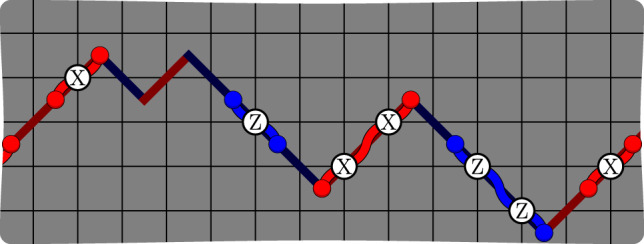
Performing large calculations with a quantum computer will likely require a fault-tolerant architecture based on quantum error-correcting codes. The challenge is to design practical quantum error-correcting codes that perform well against realistic noise using modest resources. Here we show that a variant of the surface code—the XZZX code—offers remarkable performance for fault-tolerant quantum computation. The error threshold of this code matches what can be achieved with random codes (hashing) for every single-qubit Pauli noise channel; it is the first explicit code shown to have this universal property. We present numerical evidence that the threshold even exceeds this hashing bound for an experimentally relevant range of noise parameters. Focusing on the common situation where qubit dephasing is the dominant noise, we show that this code has a practical, high-performance decoder and surpasses all previously known thresholds in the realistic setting where syndrome measurements are unreliable. We go on to demonstrate the favourable sub-threshold resource scaling that can be obtained by specialising a code to exploit structure in the noise. We show that it is possible to maintain all of these advantages when we perform fault-tolerant quantum computation.
Overview
The claims and statistics of this paper haven’t been checked yet.
Free: it reads the open-access text and checks the first 5 claims that cite a source we can check. Create a free account to check every claim.
Integrity signals
Registry
Cites
Statistics
Figures
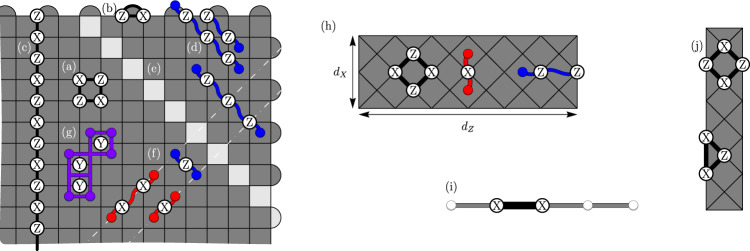
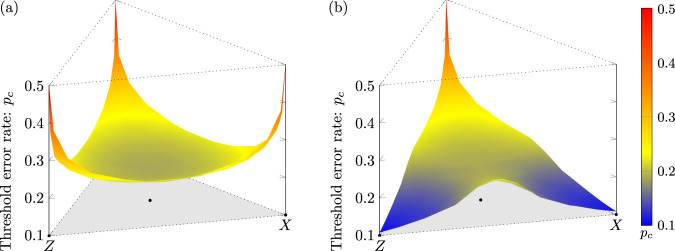
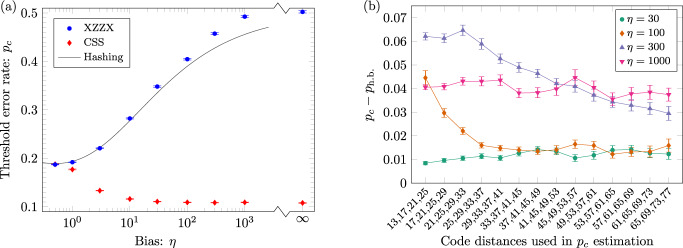
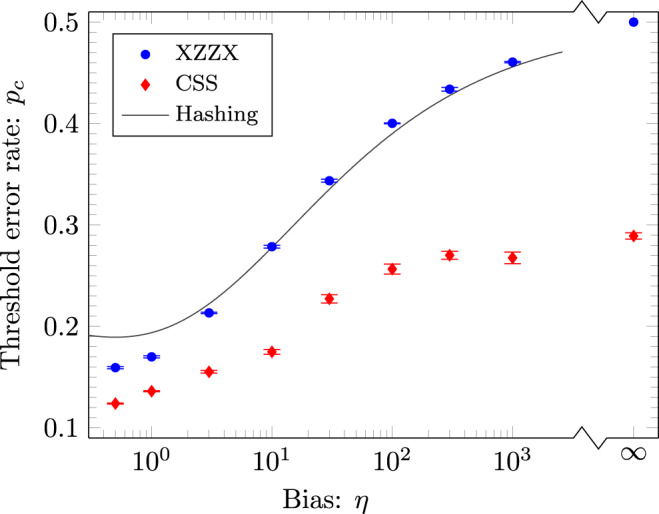
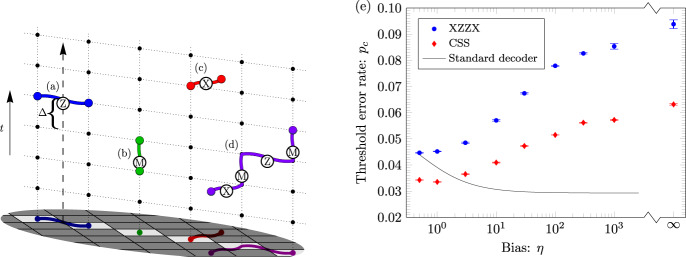
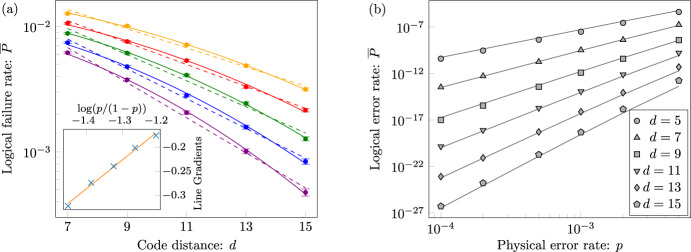
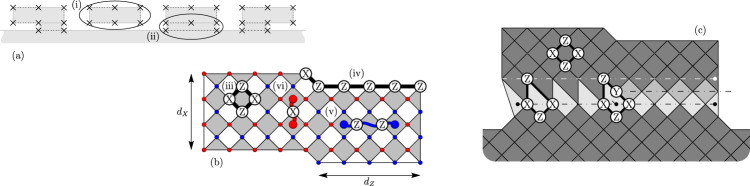
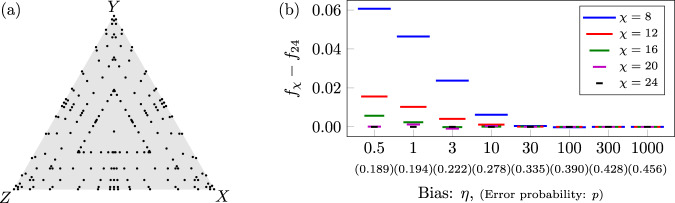
Verification
Claims the paper makes
The claims and statistics of this paper haven’t been checked yet.
Free: it reads the open-access text and checks the first 5 claims that cite a source we can check. Create a free account to check every claim.
Claims other papers make about this one
Each is checked against this paper’s own text: does it say what the citing paper says it does?
The source backs part of the claim, not all of it — or backs it for a different population, condition or comparison.
In the citing paper
“We also remove certain Hadamard gates to implement the ZXXZ variant of the surface code44,45, which helps symmetrize the X- and Z-basis logical error rates.”
From Suppressing quantum errors by scaling a surface code logical qubit (2023) · cites this paper as [45]
Experimental — accuracy not yet measuredThe source backs part of the claim, not all of it — or backs it for a different population, condition or comparison.
In the citing paper
“At the same time, various proposals have been put forward to further scale bosonic QEC by concatenating it with an outer code across multiple bosonic modes6,8–16,18,40, leveraging the protection offered in each bosonic mode to reduce the overall resource overhead for QEC.”
From Hardware-efficient quantum error correction via concatenated bosonic qubits (2025) · cites this paper as [14]
Experimental — accuracy not yet measuredThe cited source says what the claim attributes to it.
In the citing paper
“The large physical-qubit overhead associated with error correction motivates the search for more hardware-efficient approaches6–18.”
From Hardware-efficient quantum error correction via concatenated bosonic qubits (2025) · cites this paper as [14]
Self-check
Percentages, sums and reported differences re-computed from the paper’s own numbers.
The self-check needs the paper’s full text.
Citations
Cites
Harris, C. R., Millman, K. J., van der Walt, S. J., Gommers, R., Virtanen, P., Cournapeau, D., Wieser, E., Taylor, J., Berg, S., Smith, N. J., et al. (2020) · Nature · doi:10.1038/s41586-020-2649-2 · Cited by 23,826
Fault-tolerant quantum computation by anyons
Kitaev, A. Y. (2003) · Annals of Physics · doi:10.1016/s0003-4916(02)00018-0 · Cited by 7,238 · cited 2×
“[12] A.”
BackgroundMixed-state entanglement and quantum error correction
Bennett, C. H., DiVincenzo, D. P., Smolin, J. A., & Wootters, W. K. (1996) · Physical Review A · doi:10.1103/physreva.54.3824 · Cited by 5,272 · cited 2×
“[17] C.”
BackgroundSurface codes: Towards practical large-scale quantum computation
Fowler, A. G., Mariantoni, M., Martinis, J. M., & Cleland, A. N. (2012) · Physical Review A · doi:10.1103/physreva.86.032324 · Cited by 3,059
Efficient estimation of free energy differences from Monte Carlo data
Bennett, C. H. (1976) · Journal of Computational Physics · doi:10.1016/0021-9991(76)90078-4 · Cited by 2,755
Good quantum error-correcting codes exist
Calderbank, A. R., & Shor, P. W. (1996) · Physical Review A · doi:10.1103/physreva.54.1098 · Cited by 2,516 · cited 1×
“To contrast the XZZX surface code with its conventional counterpart, we refer to the latter as the CSS surface code because it is of Calderbank-Shor-Steane type [34, 35].”
MethodEdmonds, J. (1965) · Canadian Journal of Mathematics · doi:10.4153/cjm-1965-045-4 · Cited by 2,428
Dennis, E., Kitaev, A., Landahl, A., & Preskill, J. (2002) · Journal of Mathematical Physics · doi:10.1063/1.1499754 · Cited by 1,768
Universal quantum computation with ideal Clifford gates and noisy ancillas
Bravyi, S., & Kitaev, A. (2005) · Physical Review A · doi:10.1103/physreva.71.022316 · Cited by 1,525 · cited 2×
“[51] S.”
Quantum computations: algorithms and error correction
Kitaev, A. Y. (1997) · Russian Mathematical Surveys · doi:10.1070/rm1997v052n06abeh002155 · Cited by 1,424
Research works printed but not linked: 12
- Shor, P. W. Fault-tolerant quantum computation. in Proc. 37th Annual Symposium on Foundations of Computer Science, FOCS ’96 (IEEE Computer Society, 1996).
- Gidney, C. & Ekerå, M. How to factor 2048 bit RSA integers in 8 hours using 20 million noisy qubits. arXiv http://arxiv.org/abs/1905.09749 (2019). · arXiv
- Li M Miller D Newman M Wu Y Brown KR 2d compass codes Phys. Rev. X 2019 9 021041
- Wilde, M. M. Theorem 24.6.2 Quantum Information Theory, 2nd edn. (Cambridge University Press, 2017).
- Bausch, J. & Leditzky, F. Error thresholds for arbitrary Pauli noise. arXiv http://arxiv.org/abs/1910.00471 (2019). · arXiv
- Brown BJ Laubscher K Kesselring MS Wootton JR Poking holes and cutting corners to achieve Clifford gates with the surface code Phys. Rev. X 2017 7 021029
- Hastings MB Decoding in hyperbolic space: LDPC codes with linear rate and efficient error correction Quant. Inf. Comput. 2014 14 1187
- Fowler AG Wang DS Hollenberg LCL Surface code quantum error correction incorporating accurate error propagation Quant. Inf. Comput. 2011 11 0008
- Krishna A Poulin D Fault-tolerant gates on hypergraph product codes Phys. Rev. X 2021 11 011023
- Breuckmann, N. P. & Londe, V. Single-shot decoding of linear rate LDPC quantum codes with high performance. arXiv http://arxiv.org/abs/2001.03568 (2020). · arXiv
- Hastings, M. B., Haah, J. & O’Donnell, R. Fiber bundle codes: breaking the barrier for quantum LDPC codes. arXiv http://arxiv.org/abs/2009.03921 (2020). · arXiv
- Tuckett, D. K. Tailoring surface codes: Improvements in quantum error correction with biased noise. Ph.D. thesis, University of Sydney (2020).
Cited by
Items 201–265 of 265
Quantum benchmarking of high-fidelity noise-biased operations on a detuned Kerr-cat qubit
Qing, B., Hajr, A., Wang, K., Koolstra, G., Nguyen, L. B., Hines, J., Huang, I., Bhandari, B., Chen, L., Kang, Z., et al. (2026) · Proceedings of the National Academy of Sciences · doi:10.1073/pnas.2520479123 · Cited by 20
“QEC codes tailored for noise-biased qubits (15–17), which are resilient to some of the Pauli noises, such as the XZZX codes (18–20), have gained extensive attention.”
Revisiting Nishimori multicriticality through the lens of information measures
Wan, Z., Dai, X. W., & Zhu, G. (2026) · Physical Review Research · doi:10.1103/b8y5-k3y6 · Cited by 15
A Performance Model for Estimating the Cost of Scaling to Practical Quantum Advantage
Camps, D., Klymko, K., Austin, B. M., & Wright, N. J. (2023) · International Conference for High Performance Computing, Networking, Storage and Analysis (SC) · doi:10.1145/3624062.3625533 · Cited by 3
“Finally, it is very likely that further improvements in both quantum algorithms and quantum error correction schemes will reduce the overhead by orders of magnitude [3, 4, 7]; for example, it is well known that the surface code requires many physical qubits.”
BackgroundCorrecting biased noise using Gottesman-Kitaev-Preskill repetition code with noisy ancilla
Li, Z., & Su, D. (2024) · Physical Review A · doi:10.1103/physreva.109.052420 · Cited by 8
Preservation of entanglement in local noisy channels
Ghosh, P., Sen, K., & Sen, U. (2024) · Physical Review A · doi:10.1103/physreva.110.022419 · Cited by 2
Generalizing the matching decoder for the Chamon code
Schwartzman-Nowik, Z., & Brown, B. J. (2025) · Quantum · doi:10.22331/q-2025-06-18-1775 · Cited by 4
“Otherwise, the recovery process resulting from the decoder are all single-qubit Paulis that were applied in the sweeping process.”
Self-citationMinimising surface-code failures using a color-code decoder
Benhemou, A., Sahay, K., Lao, L., & Brown, B. J. (2025) · Quantum · doi:10.22331/q-2025-02-17-1632 · Cited by 10
“…codes, and have been demonstrated to be highly versatile in that they can be adapted to correct for different noise models [32, 33, 34, 35, 36, 37, 38, 39, 40], as well as different codes [41, 42, 43], including the color code [44, 45, 46, 47, 48, 49] and surface code variants [50, 51, 52, 53,…”
Self-citationTransversal cnot gate with multicycle error correction
Kim, Y., Sevior, M. E., & Usman, M. (2025) · Physical Review Applied · doi:10.1103/physrevapplied.23.024074 · Cited by 7
“…is a 2D graph where each node and edge represents a syndrome bit or error, with the weight of each edge corresponding to the error probability [58–60 , Figure 3 (c) depicts the syndrome graph for a case where the syndrome extraction circuits are applied 2R times, featuring a structure comprised…”
Quantum X Y Z cyclic codes for biased noise
Liang, Z., Yang, F., Yi, Z., & Wang, X. (2025) · Physical Review A · doi:10.1103/6qbg-xslr · Cited by 5
Implementation of magic state injection within heavy-hexagon architectures
Kim, H., Choi, W., & Kwon, Y. (2025) · Quantum Information Processing · doi:10.1007/s11128-025-05004-0 · Cited by 5
“When such an error bias exists, other QEC codes, such as the XZZX code[45, 46], often outperform surface codes by exploiting this characteristic.”
Entanglement of Signal Paths via Noisy Superconducting Quantum Devices
Shi, W., & Malaney, R. (2023) · Entropy · doi:10.3390/e25010153 · Cited by 2
Entanglement Sharing Across a Damping-Dephasing Channel
Siddhu, V., Abdelhadi, D., Jochym-O’Connor, T., & Smolin, J. A. (2024) · IEEE International Symposium on Information Theory (ISIT) · doi:10.1109/isit57864.2024.10619242 · Cited by 8
Manabe, H., Suzuki, Y., & Darmawan, A. S. (2025) · New Journal of Physics · doi:10.1088/1367-2630/ae1529 · Cited by 13
Effect of multiqubit correlated noise on surface-code thresholds
Wang, S., Yan, Y., Xia, Z., & Wang, X. (2025) · Physical Review A · doi:10.1103/hjqn-lyh2 · Cited by 4
“It is characterized by a high error threshold and utilizes gates performed between nearest-neighbor qubits arranged in a two-dimensional grid[6–10].”
Fan, Z.-C., Tian, C., Xiao, B., & Ma, H. (2025) · International Journal of Theoretical Physics · doi:10.1007/s10773-025-06188-y · Cited by 2
Enhancing the yield of bucket brigade quantum random access memory using redundancy repair
Kim, D., Heng, S., Lee, S., & Han, Y. (2025) · Scientific Reports · doi:10.1038/s41598-025-32955-2 · Cited by 5
Approximate Quantum Error Correction with 1D Log-Depth Circuits
Liu, G., Du, Z., Liu, Z.-W., & Ma, X. (2026) · PRX Quantum · doi:10.1103/7rzk-2jyh · Cited by 12
Chen, Y., Zhang, S., & Shi, Q. (2026) · Physical review. B./Physical review. B · doi:10.1103/yvx1-nmg5 · Cited by 5
Existence of Pauli-like stabilizers for every quantum error-correcting code
Kao, J.-Y., & Goan, H. (2023) · Physical Review A · doi:10.1103/physreva.108.032414 · Cited by 2
Mitigating Temporal Fragility in the XY Surface Code
Tsai, P.-K., Wu, Y., & Puri, S. (2024) · Physical Review X · doi:10.1103/physrevx.14.031003 · Cited by 2
Near-term applications of superconducting digital quantum simulation
Yao, Y., & Wang, Z. (2024) · Journal of Zhejiang University. Science A · doi:10.1631/jzus.a2400397 · Cited by 1
Microscopic parametrizations for gate set tomography under coloured noise
Viñas, P., & Bermúdez, A. (2025) · npj Quantum Information · doi:10.1038/s41534-025-00976-4 · Cited by 13
“As shown in this work, even in this situations, one can still benefit from a detailed microscopic modelling of the non-Lindblad and non-Pauli channel through a reduced parametrization of GST.”
Xiao, B., Fan, Z.-C., 孙, H.-Q. 汇. S., Ma, H., & Fan, X. (2025) · Chinese Physics B · doi:10.1088/1674-1056/adbadb · Cited by 1
P lanar : A software for exact decoding quantum error correction codes with planar structure
Feng, D., Cao, H., & Zhang, P. (2025) · Chinese Physics B · doi:10.1088/1674-1056/adcb26 · Cited by 4
Logical Noise Bias in Magic State Injection
Fazio, N., Harper, R., & Bartlett, S. D. (2025) · Quantum · doi:10.22331/q-2025-06-24-1779 · Cited by 8
“Finally, in section II C we review the schemes that we use to perform logical tomography of encoded magic state injection.”
Self-citationMartínez, J. E., Schnabl, P., del Moral, J. O., Dastbasteh, R., Crespo, P. M., & Otxoa, R. M. (2026) · Physical Review Applied · doi:10.1103/q7w6-nljp · Cited by 10
“As seen for code capacity models in [4], even a slight increase in the bias resulted in huge threshold improvements and, here, we are observing the same effect for the residual bias in the noisy CNOT gates used for extraction.”
InfluentialEnabling full fault tolerant quantum computing with silicon based VLSI technologies
Vinet, M. (2022) · Technical digest - International Electron Devices Meeting/Technical digest · doi:10.1109/iedm45625.2022.10019418
Spin-augmented observables for efficient photonic quantum error correction
Callus, E., & Kok, P. (2023) · Physical Review A · doi:10.1103/physreva.108.042613 · Cited by 1
Symmetry Verification and Circuit Implementation using Qiskit
Chung, Y., Ha, J., Kang, Y., & Heo, J. (2023) · International Conference on Information and Communication Technology Convergence (ICTC) · doi:10.1109/ictc58733.2023.10392960
“Surface code is the most common architecture due to its high threshold and its advantage of being composed of near-neighbor operations [2,3].”
BackgroundBias-preserving computation with the bit-flip code
Tsutsui, S., & Kanno, K. (2024) · Physical Review Research · doi:10.1103/physrevresearch.6.023290 · Cited by 1
Biased-noise thresholds of zero-rate holographic codes with tensor-network decoding
Fan, J., Steinberg, M., Jahn, A., Cao, C., & Feld, S. (2026) · Physical Review A · doi:10.1103/rcxg-x3hy · Cited by 8
“5 [16–18].”
InfluentialRecursive expansion of Tanner graph: A method to construct stabilizer codes with high coding rate
Yi, Z., Liang, Z., Wang, Z., Chen, J., Qiu, C., Wu, Y., & Wang, X. (2024) · Physical Review A · doi:10.1103/physreva.110.032425 · Cited by 1
Kramers-Protected Hardware-Efficient Error Correction with Andreev Spin Qubits
Lu, H., Day, I. A., Akhmerov, A., van Heck, B., & Fatemi, V. (2025) · Physical Review Letters · doi:10.1103/lqf3-6r5z · Cited by 12
Resilience–runtime tradeoff relations for quantum algorithms
García-Pintos, L. P., O’Leary, T., Biswas, T., Bringewatt, J., Cincio, Ł., Brady, L. T., & Liu, Y.-K. (2025) · Reports on Progress in Physics · doi:10.1088/1361-6633/adac8b · Cited by 7
“For example, consider two quantum error detection parity-check circuits, the planar surface code [5] and the XZZX surface code [27] at distance d = 2.”
BackgroundA Novel Approach for Quantum Simulation Software Framework
Jin, K., On, J., & Cha, G. (2025) · International Conference on Consumer Electronics · doi:10.1109/icce63647.2025.10930073
Hualei, 尹. Y., Xuyang, 卢. L., Qinghang, 张. Z., & Zengbing, 陈. C. (2025) · Laser & Optoelectronics Progress · doi:10.3788/lop250774
Fan, J., Zhang, Q., Zhang, Z., & Li, J. (2025) · Communications in Theoretical Physics · doi:10.1088/1572-9494/ade49c · Cited by 1
“Now, according to the algorithm 1, we simulate the data results for the XZZX code [[ 129,8,3 ]] .”
Exploring quasi-geometric frameworks for quantum error-correcting codes: a systematic review
Nyirahafashimana, V., Shah, N. M., Halim, U. A., & Othman, М. (2025) · Quantum Information Processing · doi:10.1007/s11128-025-04904-5 · Cited by 2
“After that, authors provide geometric codes like the surface code, which encodes qubits on a 2D grid [75], and topological codes such as toric and color codes, using global topological properties for error correction [68, 84].”
Liang, Z., Wang, Z., Yi, Z., Yang, F., & Wang, X. (2025) · Entropy · doi:10.3390/e27090940 · Cited by 3
“For some QSCs, such as the planar surface code [5,6], the XZZX surface code [7], and D -dimensional ( D ≥ 2) toric codes [8–11], their code distance can be determined by the properties of their topological structure.”
Weighted Range-Constrained Ising-Model Decoder for Quantum Error Correction
Guo, X., Awano, H., & Sato, T. G. (2025) · ACM/IEEE Design Automation Conference (DAC) · doi:10.1109/dac63849.2025.11133309
Method for 3D structure of measurement-free fault tolerant surface codePreprint
Min, G., & Heo, J. (2025) · Research Square · doi:10.21203/rs.3.rs-7596333/v1
Breakdown of the Kerr-Cat Qubit Tunneling Time Induced by Auxiliary Circuit Modes
Benhayoune-Khadraoui, O., Lledó, C., & Blais, A. (2026) · Physical Review X · doi:10.1103/z8jm-q289 · Cited by 11
High-dimensional quantum X Y Z product codes for biased noise
Liang, Z., Yi, Z., Yang, F., Chen, J., Wang, Z., & Wang, X. (2025) · Physical Review A · doi:10.1103/rrfk-1b51 · Cited by 3
Guo, X., Miao, G., Nishizawa, S., Awano, H., Kimura, S., & Sato, T. (2025) · doi:10.1109/iccad66269.2025.11240965
“However, the proposed decoder is also applicable to other surface codes, such as the rotated surface code [34], [35] and the color code [36].”
Bayesian inference of general noise-model parameters from the syndrome statistics of surface codes
Kobori, T., & Todo, S. (2025) · Physical Review A · doi:10.1103/wg5h-spy6 · Cited by 6
“Additionally, the grid shape and Clifford deformation of its stabilizer generators have been shown to influence the code’s performance and can also be optimized [20–23].”
Chadwick, J. D., Teo, M. H., Viszlai, J., Yang, W., & Chong, F. T. (2025) · IEEE International Conference on Quantum Computing and Engineering (QCE) · doi:10.1109/qce65121.2025.00077 · Cited by 5
“While typical noise models used to simulate and evaluate QEC assume that physical one-and two-qubit errors are random, uniformly distributed Pauli operators, significant gains in QEC efficiency can be found under alternative noise models [8]–[13].”
Single-Shot Decoding of Biased-Tailored Quantum LDPC Codes
Campbell, D. (2025) · IEEE International Conference on Quantum Computing and Engineering (QCE) · doi:10.1109/qce65121.2025.10336 · Cited by 1
Generalized code distance through rotated logical states in quantum error correction
Nyirahafashimana, V., Shah, N. M., Halim, U. A., & Othman, M. (2026) · Theoretical Computer Science · doi:10.1016/j.tcs.2026.115795
“Recent studies show that QECCs achieve high thresholds against depolarizing noise and their performance can be significantly increased by adapting the code to specific noise models, particularly in the presence of structured noise [9,11–13].”
Enhancing decoding performance using efficient error learning
Iyer, P. S., Jain, A., Bartlett, S. D., & Emerson, J. (2026) · Physical Review Applied · doi:10.1103/vtj7-nh6l · Cited by 6
“These include the development of new quantum error correcting codes [12, 100], and enhancing the error correction capabilities for existing ones [10, 51, 89, 108].”
Self-citationScalable fluxonium-transmon architecture for error-corrected quantum processors
Heunisch, L., Huang, L., Eckstein, T., Tasler, S., Schirk, J., Wallner, F., Feulner, V., Sarma, B., Liegener, K., Schneider, C. M. F., et al. (2026) · Physical Review Research · doi:10.1103/ts1j-nfg1 · Cited by 6
“The surface code [26–28] is considered the most promising candidate for superconducting circuits since it is well suited for two-dimensional lattice geometries and has a high error threshold.”
Inter-transition interference in spectrum of Kerr parametric oscillators
Masuda, S. (2026) · New Journal of Physics · doi:10.1088/1367-2630/ae34dd · Cited by 1
“KPO offers a promising route to a quantum computer [2, 3, 10, 19–26] and find applications to quantum annealing [4, 9, 27–35] and Boltzmann sampling [36], and offer a platform to study quantum phase transitions [37–40], quantum tunneling [41, 42] and chaos [43–46].”
Leptons as Elementary Qubits: Feasibility and Challenges
Kervalishvili, P. J. (2026) · Ukrainian Journal of Physics · doi:10.15407/ujpe71.2.146
“A key insight is that if the time of decay can be detected, the error can be treated as an erasure [18].”
Laser-Induced Plasma Deposition for High-Purity 2D and 3D Spintronic and Spin-Qubit Devices
Kervalishvili, P. J. (2026) · Springer eBooks · doi:10.1007/978-3-319-48281-1_206-1
Erasure Conversion in Integer Fluxonium Qubits
Wang, J., Mencia, R., Manucharyan, V., & Vavilov, M. (2026) · PRX Quantum · doi:10.1103/jszm-48h7 · Cited by 5
“Leveraging the noise structure can effectively reduce the cost of quantum error correction (QEC) in fault-tolerant quantum computing [1–3].”
Decoding of LDPC quantum codes
Grouès, L. (2022) · theses.fr (ABES) · doi:10.70675/4405a9b9z4ce7z49bez9fc0z6b5a10ebf2d1 · Cited by 2
Green quantum computing: evaluating energy efficient error correction mechanisms
Rani, A., & Kour, S. (2026) · Proceedings of the Indian National Science Academy · doi:10.1007/s43538-026-00737-7
Quantum Error Correction using cat qubits
Marquet, A. (2023) · theses.fr (ABES) · doi:10.70675/6748815fz4d8fz484dz94cfz143f5f473a21
Wayo, D. D. K., Onah, C., Goliatt, L., & Groppe, S. (2026) · Fortschritte der Physik · doi:10.1002/prop.70124
Two-Stage Neural Residual Decoding for FastSurface-Code Quantum Error CorrectionPreprint
Chen, J. Y., Peng, J., & Liu, J. (2026) · Research Square · doi:10.21203/rs.3.rs-10123128/v1
Recent Advances in Quantum Error Correction Codes for Superconducting Quantum Computing
Wang, Z., Gao, G., & 武光明 (2026) · International Symposium on Computer Technology and Information Science (ISCTIS) · doi:10.1109/isctis70043.2026.11572651
“This converts high-frequency Z errors into one-dimensional propagating error chains, significantly improving decoder matching efficiency and achieving the hashing bound under a single-qubit Pauli channel [21].”
Mitigating residual exchange coupling in resonant singlet-triplet qubits
Anonymous, Torres-Leal, F., & Nichol, J. M. (2026) · Physical Review Applied · doi:10.1103/gjn5-kc41 · Cited by 3
“Recent experimental advances have demonstrated both single-and two-qubit gate fideli-ties exceeding 99% for single-spin-1 / 2 qubits [5, 24–26], reaching the threshold required for error correction using the surface code [27, 28].”
Simulated-annealing decoder for the XZZX code with greedy-matching initialization
Anonymous (2026) · APS Open Science · doi:10.1103/5z6j-y33z · Cited by 1
“[9] is not publicly available.”
InfluentialFast Gates for Bit-Flip Protected Superconducting Qubits
Siegele, C. A., Соколова, А., Kapoor, L. N., Hassani, F., & Fink, J. M. (2026) · PRX Quantum · doi:10.1103/1kmf-6fz9 · Cited by 2
Photonic Quantum Computing on Spin Memory Architecture with Tree-Encoded Fusion
Ren, X., Huang, Y., Zhang, Z., Zhu, Y., Ho, T.-Y., Barbalace, A., & Liang, Z. (2026) · Proceedings - International Symposium on Computer Architecture/Proceedings · doi:10.1109/isca66397.2026.00164 · Cited by 2
Quantum Error Correction Survey
Mahmud, M.-E.-H., Jain, R. K., Yang, Z., Tian, C., Kompella, R. R., Nejabati, R., Kaur, E., Erbad, A., & Abdallah, M. M. (2026) · IEEE Access · doi:10.1109/access.2026.3737721
“When the resulting effective Pauli channel is strongly Z -biased, bias-tailored constructions such as the XZZX surface code can exploit that asymmetry [13].”
Metadata
- Authors
- Bonilla Ataides, J. P., Tuckett, D. K., Bartlett, S. D., Flammia, S. T., & Brown, B. J.
- Affiliations
- The University of Sydney (AU)
- Corresponding author
- Brown, Benjamin J.
- ORCID
- Venue
- Nature Communications
- Published
- 2021-04-12
- Volume
- 12
- Issue
- 1
- Pages
- 2172-2172
- ISSN
- 2041-1723 (ISSN-L)
- PMC
- PMC8042007
- OpenAlex
- W3085306040
- Semantic Scholar
- 059f1d3b4d12d486afcd70c6c9ce5a96f1727c8b
- Cited by
- 262
- References
- 63
- Citations by year
- 2026: 29 · 2025: 94 · 2024: 45 · 2023: 52 · 2022: 34 · 2021: 8
- FWCI
- 12.28
- Type
- journal article
- Language
- en
- Open access
- gold
- doi.org
- Licence
- cc-by
- creativecommons.org/licenses/by/4.0 (tdm)
- creativecommons.org/licenses/by/4.0 (vor)
- Locations
- Nature Communications (publishedVersion, cc-by)
- PubMed Central (publishedVersion, cc-by)
- PubMed (publishedVersion)
- arXiv (Cornell University) (submittedVersion)
- DOAJ (DOAJ: Directory of Open Access Journals) (submittedVersion, cc-by-sa)
- arXiv (Cornell University)
- Funders
- National Computational Infrastructure
- Australian Government (CE170100009)
- University of Sydney
- Australian Research Council (CE170100009, W911NF-21-1-0007)
- National Cancer Institute
- Army Research Office (W911NF-21-1-, W911NF-21-1-0007, W911NF)
- Topics
- Physical Sciences › Computer Science › Artificial Intelligence › Quantum Computing Algorithms and Architecture
- Physical Sciences › Physics and Astronomy › Atomic and Molecular Physics, and Optics › Quantum Information and Cryptography
- Physical Sciences › Physics and Astronomy › Atomic and Molecular Physics, and Optics › Quantum many-body systems
- Keywords
- surface code, quantum error correction, fault-tolerant quantum computing, error threshold, qubit dephasing, decoder performance, resource scaling
About these checks
Registry, retraction, Cites and statistics results are computed, not judged, with one exception: a printed reference that no index lists is read once by a model before it counts as a citation error. Claims are extracted by a model and kept only when their quote appears verbatim in the text; each cited source is then checked, with a model’s help, for whether it says what the claim relies on. Those verdicts can be wrong — read the claim’s quote and the cited source before relying on one.
Statistics and arithmetic are recomputed, not judged.
Confidence bands are shown only for fields calibrated on our annotated test set. None is calibrated yet, so no band is shown.
What counts as a claim ›How we measure confidence ›How we check this ›
Are you an author, or do you see a problem with this page? Request a review
Data sources
Bibliographic data: Semantic Scholar, OpenAlex, Crossref.
Contains information from the Semantic Scholar Academic Graph Datasets, made available under the ODC Attribution License (ODC-BY 1.0).
Semantic Scholar’s data is described in: Kinney, R., et al. (2023). The Semantic Scholar Open Data Platform. arXiv:2301.10140.
