

The DOI matches its Crossref record; 94 of the 97 references it cites were found in a registry or an index.
Promoter G-quadruplexes and transcription factors cooperate to shape the cell type-specific transcriptome
Open accessPublished version of a preprint
Abstract
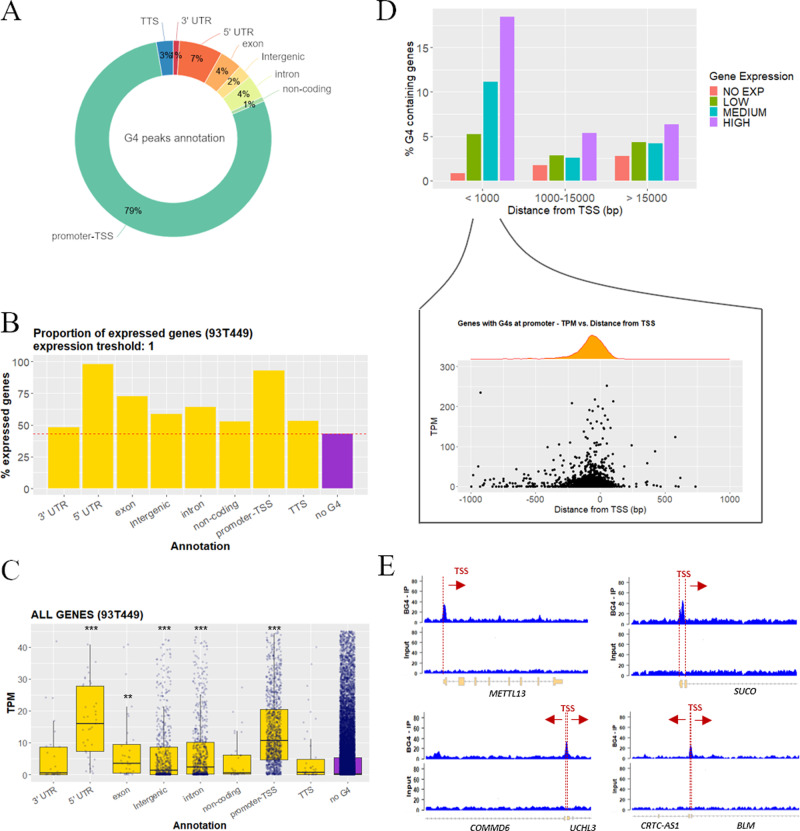
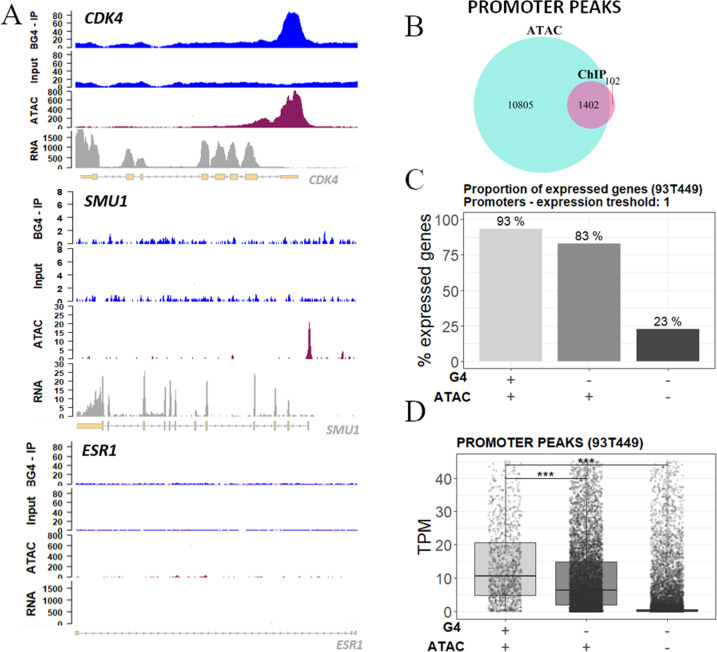
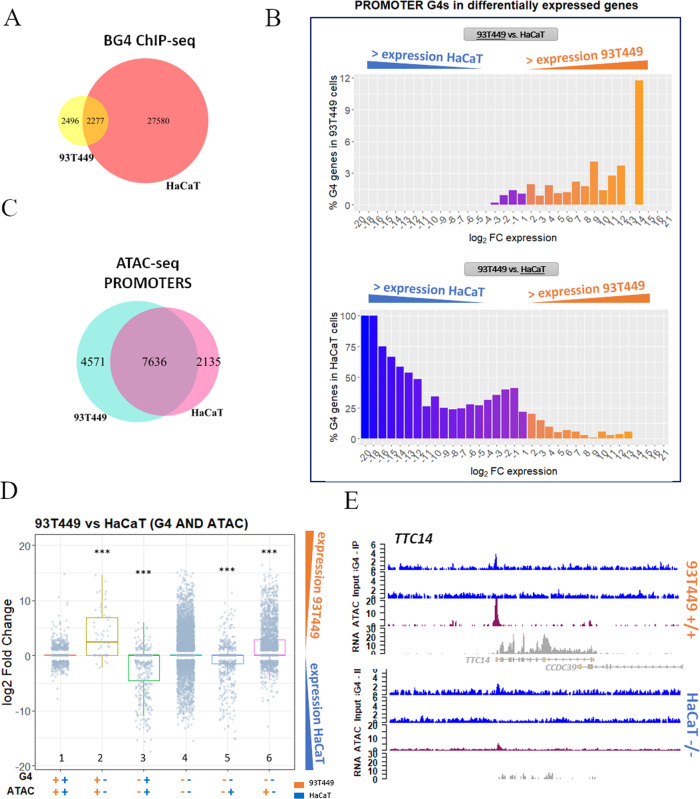
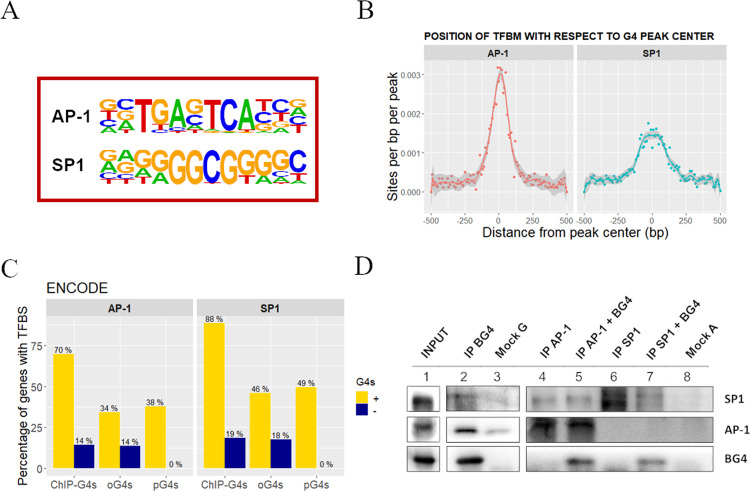
Cell identity is maintained by activation of cell-specific gene programs, regulated by epigenetic marks, transcription factors and chromatin organization. DNA G-quadruplex (G4)-folded regions in cells were reported to be associated with either increased or decreased transcriptional activity. By G4-ChIP-seq/RNA-seq analysis on liposarcoma cells we confirmed that G4s in promoters are invariably associated with high transcription levels in open chromatin. Comparing G4 presence, location and transcript levels in liposarcoma cells to available data on keratinocytes, we showed that the same promoter sequences of the same genes in the two cell lines had different G4-folding state: high transcript levels consistently associated with G4-folding. Transcription factors AP-1 and SP1, whose binding sites were the most significantly represented in G4-folded sequences, coimmunoprecipitated with their G4-folded promoters. Thus, G4s and their associated transcription factors cooperate to determine cell-specific transcriptional programs, making G4s to strongly emerge as new epigenetic regulators of the transcription machinery.
Overview
The claims and statistics of this paper haven’t been checked yet.
Run the check — free, no account needed. It reads the open-access text and checks the sources it cites.
Integrity signals
Registry
Cites
Statistics
Figures
Verification
Claims the paper makes
The claims and statistics of this paper haven’t been checked yet.
Run the check — free, no account needed. It reads the open-access text and checks the sources it cites.
Claims other papers make about this one
Each is checked against this paper’s own text: does it say what the citing paper says it does?
The source backs part of the claim, not all of it — or backs it for a different population, condition or comparison.
In the citing paper
“However, G4s hold various regulatory functions in transcription and translation (20)”
From G-quadruplex-mediated genomic instability drives SNVs in cancer (2024) · cites this paper as [20]
Experimental — accuracy not yet measured
Self-check
Percentages, sums and reported differences re-computed from the paper’s own numbers.
The self-check needs the paper’s full text.
Citations
Cites
Hallmarks of Cancer: The Next Generation
Hanahan, D., & Weinberg, R. A. (2011) · Cell · doi:10.1016/j.cell.2011.02.013 · Cited by 66,590
The Sequence Alignment/Map format and SAMtools
Li, H., Handsaker, B., Wysoker, A., Fennell, T., Ruan, J., Homer, N., Marth, G., Abecasis, G., Durbin, R., & 1000 Genome Project Data Processing Subgroup (2009) · Bioinformatics · doi:10.1093/bioinformatics/btp352 · Cited by 62,041
BEDTools: a flexible suite of utilities for comparing genomic features
Quinlan, A. R., & Hall, I. M. (2010) · Bioinformatics · doi:10.1093/bioinformatics/btq033 · Cited by 27,437
Model-based Analysis of ChIP-Seq (MACS)
Zhang, Y., Liu, T., Meyer, C. A., Eeckhoute, J., Johnson, D. S., Bernstein, B. E., Nusbaum, C., Myers, R. M., Brown, M., Li, W., et al. (2008) · Genome Biology · doi:10.1186/gb-2008-9-9-r137 · Cited by 18,386
ATAC-seq: a method for assaying chromatin accessibility genome-wide
Buenrostro, J. D., Wu, B., Chang, H. Y., & Greenleaf, W. J. (2015) · Current Protocols in Molecular Biology · doi:10.1002/0471142727.mb2129s109 · Cited by 3,289
An improved ATAC-seq protocol reduces background and enables interrogation of frozen tissues
Corces, M. R., Trevino, A. E., Hamilton, E. G., Greenside, P. G., Sinnott-Armstrong, N. A., Vesuna, S., Satpathy, A. T., Rubin, A. J., Montine, K. S., Wu, B., et al. (2017) · Nature Methods · doi:10.1038/nmeth.4396 · Cited by 2,496
Siddiqui-Jain, A., Grand, C. L., Bearss, D. J., & Hurley, L. H. (2002) · Proceedings of the National Academy of Sciences · doi:10.1073/pnas.182256799 · Cited by 2,274
Quantitative visualization of DNA G-quadruplex structures in human cells
Biffi, G., Tannahill, D., McCafferty, J., & Balasubramanian, S. (2013) · Nature Chemistry · doi:10.1038/nchem.1548 · Cited by 2,173
Zhu, A., Ibrahim, J. G., & Love, M. I. (2018) · Bioinformatics · doi:10.1093/bioinformatics/bty895 · Cited by 2,142
Prevalence of quadruplexes in the human genome
Huppert, J. L., & Balasubramanian, S. (2005) · Nucleic Acids Research · doi:10.1093/nar/gki609 · Cited by 1,795
Research works printed but not linked: 1
- Hänsel-Hertsch, R. et al. G-quadruplex structures mark human regulatory chromatin. Nat Genet. 48, 1267–1272 (2016). · DOI · Paper page
Cited by
Sorted by citations
Items 201–204 of 204
Amaral, E. D. O. S., Espejo, M. A. J., & Line, S. R. P. (2024) · Journal of Mammalian Evolution · doi:10.1007/s10914-024-09719-2 · Cited by 1
“They also can play an epigenetic role, influencing the transcriptome of cell types (Lago et al. 2021) and modulating higher-order chromatin architecture (Hou et al. 2019).”
Abentung, A., Sakshaug, T., Dumaru, R., Liabakk, N., Yang, M.-Y., Wang, J., Bjørås, M., & Scheffler, K. (2024) · bioRxiv · doi:10.1101/2024.04.16.589756
“G4 structures occur at CpG rich regions and have been implicated in gene regulation 57,58 .”
BackgroundChromatin Molecular Complexes—Functional Organization, Protection and Regulation of the Genome
Hofr, C. (2022) · International Journal of Molecular Sciences · doi:10.3390/ijms23147516
“proposed that G-quadruplexes cooperate with associated transcription factors to determine cell-specific transcriptional programs [5].”
BackgroundMiclot, T., Hognon, C., Bignon, E., Terenzi, A., Grandemange, S., Barone, G., & Monari, A. (2021) · bioRxiv · doi:10.1101/2021.12.01.470770
Metadata
- Authors
- Lago, S., Nadai, M., Cernilogar, F. M., Kazerani, M., Domíniguez Moreno, H., Schotta, G., & Richter, S. N.
- Affiliations
- University of Padua (IT)
- Ludwig-Maximilians-Universität München (DE)
- Corresponding author
- Lago, Sara
- Schotta, Gunnar
- Richter, Sara N.
- Venue
- Nature Communications
- Published
- 2021-06-23
- Volume
- 12
- Issue
- 1
- Pages
- 3885-3885
- ISSN
- 2041-1723 (ISSN-L)
- PMC
- PMC8222265
- OpenAlex
- W3173676343
- Cited by
- 269
- References
- 97
- Citations by year
- 2026: 26 · 2025: 53 · 2024: 72 · 2023: 65 · 2022: 41 · 2021: 10
- FWCI
- 14.76
- Type
- journal article
- Language
- en
- Open access
- gold
- doi.org
- Locations
- Nature Communications (publishedVersion, cc-by)
- bioRxiv (Cold Spring Harbor Laboratory) (acceptedVersion, cc-by-nc)
- PubMed Central (publishedVersion, cc-by)
- PubMed (publishedVersion)
- RePEc: Research Papers in Economics (submittedVersion)
- DOAJ (DOAJ: Directory of Open Access Journals) (submittedVersion, cc-by-sa)
- Padua Research Archive (University of Padova) (submittedVersion, cc-by)
- Funders
- Deutsche Forschungsgemeinschaft (213249687, SFB1064, SFB1321, 329628492)
- Associazione Italiana per la Ricerca sul Cancro (21850)
- Fondazione Italiana per la Ricerca sul Cancro (21850)
- Topics
- Life Sciences › Biochemistry, Genetics and Molecular Biology › Molecular Biology › DNA and Nucleic Acid Chemistry
- Life Sciences › Biochemistry, Genetics and Molecular Biology › Molecular Biology › Genomics and Chromatin Dynamics
- Life Sciences › Biochemistry, Genetics and Molecular Biology › Molecular Biology › Epigenetics and DNA Methylation
- Keywords
- G-quadruplex, transcription factors, cell type-specific transcriptome, epigenetic regulation of transcription, AP-1, Sp1, keratinocytes, chromatin accessibility
- MeSH terms
- Base Sequence, Binding Sites, Cell Line, DNA, Humans, Nucleic Acid Conformation, Promoter Regions, Genetic, Protein Binding, Transcription Factors, Sp1 Transcription Factor, Transcription Factor AP-1, Gene Expression Profiling, Cell Line, Tumor, G-Quadruplexes, Transcriptome
About these checks
Registry, retraction, Cites and statistics results are computed, not judged, with one exception: a printed reference that no index lists is read once by a model before it counts as a citation error. Claims are extracted by a model and kept only when their quote appears verbatim in the text; each cited source is then checked, with a model’s help, for whether it says what the claim relies on. Those verdicts can be wrong — read the claim’s quote and the cited source before relying on one.
Statistics and arithmetic are recomputed, not judged.
Confidence bands are shown only for fields calibrated on our annotated test set. None is calibrated yet, so no band is shown.
What counts as a claim ›How we measure confidence ›How we check this ›
Are you an author, or do you see a problem with this page? Request a review
