

A distributed fMRI-based signature for the subjective experience of fear
Open accessThe DOI matches its Crossref record; 72 of the 74 references it cites were found in a registry or an index.
Abstract
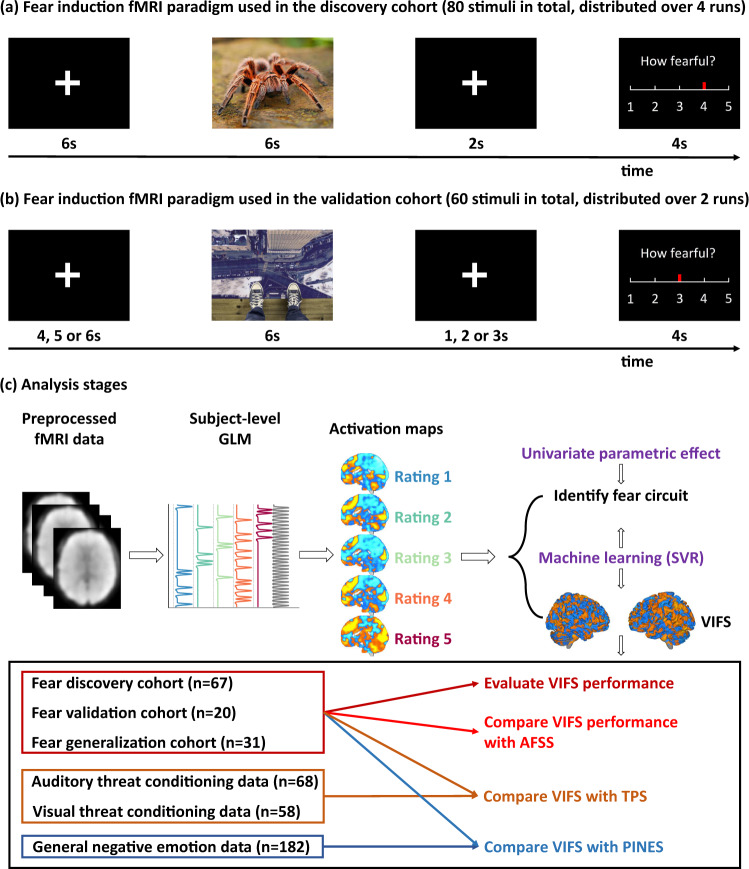
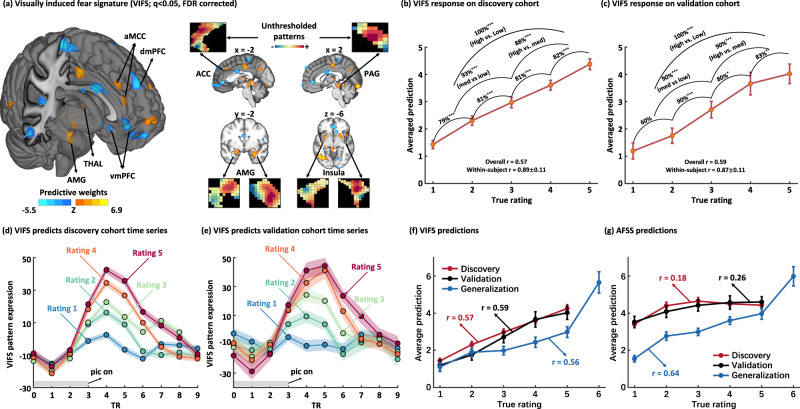
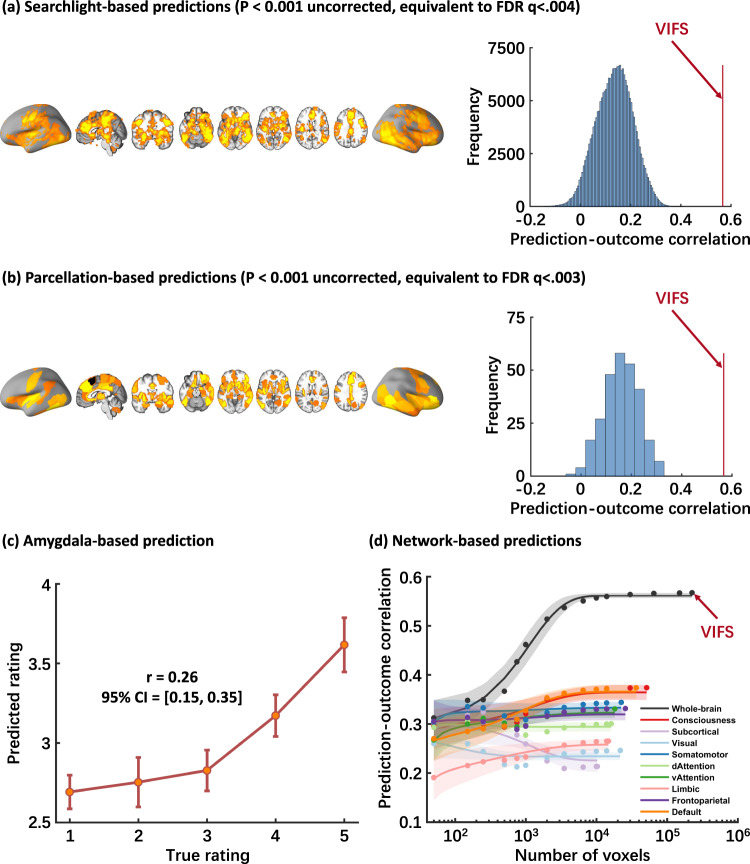
The specific neural systems underlying the subjective feeling of fear are debated in affective neuroscience. Here, we combine functional MRI with machine learning to identify and evaluate a sensitive and generalizable neural signature predictive of the momentary self-reported subjective fear experience across discovery (n = 67), validation (n = 20) and generalization (n = 31) cohorts. We systematically demonstrate that accurate fear prediction crucially requires distributed brain systems, with important contributions from cortical (e.g., prefrontal, midcingulate and insular cortices) and subcortical (e.g., thalamus, periaqueductal gray, basal forebrain and amygdala) regions. We further demonstrate that the neural representation of subjective fear is distinguishable from the representation of conditioned threat and general negative affect. Overall, our findings suggest that subjective fear, which exhibits distinct neural representation with some other aversive states, is encoded in distributed systems rather than isolated ‘fear centers’.
Overview
The claims and statistics of this paper haven’t been checked yet.
Free: it reads the open-access text and checks the first 5 claims that cite a source we can check. Create a free account to check every claim.
Integrity signals
Registry
Cites
Statistics
Figures
Verification
Claims the paper makes
The claims and statistics of this paper haven’t been checked yet.
Free: it reads the open-access text and checks the first 5 claims that cite a source we can check. Create a free account to check every claim.
Claims other papers make about this one
Each is checked against this paper’s own text: does it say what the citing paper says it does?
The source backs part of the claim, not all of it — or backs it for a different population, condition or comparison.
In the citing paper
“In early blocks of phobic stimuli, clearly visible exposure activated subcortical and cortical regions comprising the “fear network” (e.g., amygdala, hippocamus, thalamus, periaqueductal gray, brain stem, insula; Shin & Liberzon, 2010; Zhou, Zhao, Qi, Geng et al. 2021), including regions that have been shown to subserve the subjective experience of fear (middle frontal gyrus, dorsal medial PFC,”
From Advancing the treatment of anxiety disorders in transition‐age youth: a review of the therapeutic effects of unconscious exposure. (2025) · cites this paper as Zhou, Zhao, Qi, Geng et al. 2021
Experimental — accuracy not yet measuredThe source backs part of the claim, not all of it — or backs it for a different population, condition or comparison.
In the citing paper
“Even the supposed prototypic brain 'biomarkers' for a given emotion category vary substantially across studies, 65,[72][73][74][75][76] and across subjects within a given study.34,55,63,65,69,[77][78][79][80][81][82][83]”
From A new science of emotion: implications for functional neurological disorder (2022) · cites this paper as [76]
Experimental — accuracy not yet measured
Self-check
Percentages, sums and reported differences re-computed from the paper’s own numbers.
The self-check needs the paper’s full text.
Citations
Cites
The organization of the human cerebral cortex estimated by intrinsic functional connectivity
Thomas Yeo, B. T., Krienen, F. M., Sepulcre, J., Sabuncu, M. R., Lashkari, D., Hollinshead, M., Roffman, J. L., Smoller, J. W., Zöllei, L., Polimeni, J. R., et al. (2011) · Journal of Neurophysiology · doi:10.1152/jn.00338.2011 · Cited by 9,182
The organization of the human cerebellum estimated by intrinsic functional connectivity
Buckner, R. L., Krienen, F. M., Castellanos, A., Diaz, J. C., & Yeo, B. T. T. (2011) · Journal of Neurophysiology · doi:10.1152/jn.00339.2011 · Cited by 7,304
(1998) · Cited by 4,012
Large-scale automated synthesis of human functional neuroimaging data.
Yarkoni, T., Poldrack, R. A., Nichols, T. E., Van Essen, D. C., & Wager, T. D. (2011) · Nature Methods · doi:10.1038/nmeth.1635 · Cited by 3,686
Self-citationThe Human Brainnetome Atlas: A New Brain Atlas Based on Connectional Architecture
Fan, L., Li, H., Zhuo, J., Zhang, Y., Wang, J., Chen, L., Yang, Z., Chu, C., Xie, S., Laird, A. R., et al. (2016) · Cerebral Cortex · doi:10.1093/cercor/bhw157 · Cited by 2,998
The role of the amygdala in fear and anxiety
Davis, M. (1992) · Annual Review of Neuroscience · doi:10.1146/annurev.ne.15.030192.002033 · Cited by 2,357
The brain basis of emotion: a meta-analytic review
Lindquist, K. A., Wager, T. D., Kober, H., Bliss-Moreau, E., & Barrett, L. F. (2012) · Behavioral and Brain Sciences · doi:10.1017/s0140525x11000446 · Cited by 2,320
Self-citationCan cognitive processes be inferred from neuroimaging data?
POLDRACK, R. (2006) · Trends in Cognitive Sciences · doi:10.1016/j.tics.2005.12.004 · Cited by 2,249
Information-based functional brain mapping
Kriegeskorte, N., Goebel, R., & Bandettini, P. (2006) · Proceedings of the National Academy of Sciences · doi:10.1073/pnas.0600244103 · Cited by 2,113
The Neurocircuitry of Fear, Stress, and Anxiety Disorders
Shin, L. M., & Liberzon, I. (2010) · Neuropsychopharmacology · doi:10.1038/npp.2009.83 · Cited by 2,083
Research works printed but not linked: 2
- Clore, G. L. & Ortony, A. Appraisal theories: How cognition shapes affect into emotion. In Handbook of emotions (eds Lewis, M., Haviland-Jones, J. M. & Barrett, L. F.) (pp. 628-642) (The Guilford Press, New York City, 2008).
- Zhou, F. et al. Empathic pain evoked by sensory and emotional- communicative cues share common and process-specific neural representations. Elife 9, e56929 (2020). · DOI
Cited by
Items 101–154 of 154
Willems, A. L., Oudenhove, L. V., & Vervliet, B. (2023) · eLife · doi:10.7554/elife.91400.1 · Cited by 3
Multivariate analysis of the neural representation of the physical and psychological self
Knyazev, G. G., Savostyanov, A. N., Bocharov, A. V., Saprigyn, A. E., Levin, E. A., & Lebedkin, D. A. (2026) · Neuroscience and Behavioral Physiology · doi:10.1007/s11055-026-01940-1 · Cited by 1
Guo, X., Zhang, L., Zhang, Q., Kendrick, K. M., & Yao, S. (2026) · Neuroscience & Biobehavioral Reviews · doi:10.1016/j.neubiorev.2026.106679 · Cited by 1
Self-citationLatent neural architecture organising shared aesthetic evaluations of visual artworks
Liang, X., Zhuang, K., Wang, Y., Su, Y., Feng, J., Zhou, F., Becker, B., & Vatansever, D. (2026) · Nature Communications · doi:10.1038/s41467-026-73153-6 · Cited by 5
Self-citationPaloyelis, Y. (2023) · Biological Psychiatry Cognitive Neuroscience and Neuroimaging · doi:10.1016/j.bpsc.2023.01.002 · Cited by 1
McVeigh, K., Kleckner, I. R., Quigley, K. S., & Satpute, A. B. (2022) · doi:10.31234/osf.io/7uk4z · Cited by 1
Franke, L. K., Miedl, S. F., Danböck, S. K., Liedlgruber, M., Grill, M., Kronbichler, M., Flor, H., & Wilhelm, F. H. (2022) · Pain · doi:10.1097/j.pain.0000000000002713 · Cited by 2
Sensing fear: Fast-and-precise threat evaluation in human sensory cortexPreprint
Li, W., & Keil, A. (2022) · doi:10.31234/osf.io/gndcu · Cited by 1
Xu, T., Chen, Z., Zhou, X., Wang, L., Zhou, F., Yao, D., Zhou, B., & Becker, B. (2023) · bioRxiv (Cold Spring Harbor Laboratory) · doi:10.1101/2023.03.20.533428 · Cited by 1
Self-citationA neural signature of social support mitigates negative emotionPreprint
Pei, R., Courtney, A. L., Ferguson, I. T., Brennan, C. M., & Zaki, J. (2023) · doi:10.31234/osf.io/9dapm · Cited by 1
Willems, A. L., Oudenhove, L. V., & Vervliet, B. (2024) · eLife · doi:10.7554/elife.91400.2 · Cited by 1
Zhang, X., Qing, P., Liu, Q., Liu, C., Liu, L., Gan, X., Fu, K., Lan, C., Zhou, X., Kendrick, K. M., et al. (2024) · bioRxiv (Cold Spring Harbor Laboratory) · doi:10.1101/2024.05.19.594630 · Cited by 1
Self-citationWillems, A. L., Oudenhove, L. V., & Vervliet, B. (2024) · eLife · doi:10.7554/elife.91400.3 · Cited by 1
Baranger, D. A. A., Gorelik, A. J., Sullivan, M. L. C., Paul, S. E., Hatoum, A. S., Dosenbach, N. U. F., & Bogdan, R. (2025) · medRxiv · doi:10.1101/2025.01.30.25321355 · Cited by 2
Dynamic fMRI networks of human emotion
Janssen, N., Elvira, U. K., Janssen, J., & van Erp, T. G. M. (2025) · eLife · doi:10.1101/2025.02.05.636581 · Cited by 1
Social-affective functioning and learning in psychopathy
Brazil, I. A. (2023) · Handbook of clinical neurology · doi:10.1016/b978-0-12-821375-9.00014-1
Variability in neural representations of fear: insights from computational modeling
Wang, Y. (2023) · Digital Repository Service (Northeastern University) · doi:10.17760/d20537507
Lor, C. S., Steyrl, D., Zhang, M., Zhou, F., Becker, B., Herdener, M., Quednow, B. B., Haugg, A., & Scharnowski, F. (2024) · bioRxiv (Cold Spring Harbor Laboratory) · doi:10.1101/2023.12.31.573585
Self-citationDecoding the spatiotemporal dynamic neural representation of repetitive facial expression imitationPreprint
Liu, Q., Zhou, X., Zhu, S., Liu, C., Yang, Y., Lan, C., Song, X., Becker, B., Kendrick, K. M., & Zhao, W. (2024) · bioRxiv (Cold Spring Harbor Laboratory) · doi:10.1101/2024.02.26.582020
Self-citationBORCĂ, M. A., Borcă, A., Ciobica, A. S., & Beraru, G. (2024) · Bulletin of Integrative Psychiatry · doi:10.36219/bpi.2024.2.09
Becker, B., Fu, K., Xu, S., Zhang, Z., Liu, D., Xu, T., Zhang, Y., Zhou, F., Zhang, X., Lan, C., et al. (2024) · Research Square · doi:10.21203/rs.3.rs-4317487/v1
Self-citationIndependent regulation of memory and emotion by selective retrievalPreprint
Wang, Y., Zhu, Z., Sankarasubramanian, S., Li, Y., Fang, F., & Anderson, M. C. (2025) · bioRxiv (Cold Spring Harbor Laboratory) · doi:10.1101/2025.01.02.631155
Brain Atlases: An Updated View
Pappas, I., & Toga, A. W. (2025) · Neuromethods · doi:10.1007/978-1-0716-4438-6_9 · Cited by 2
Dynamic fMRI networks of emotionPreprint
Janssen, N., Elvira, U. K., Janssen, J., & van Erp, T. G. M. (2025) · eLife · doi:10.7554/elife.106070.1 · Cited by 1
Song, G., Li, H., Su, S., Shuang, X., Xiao, B., & Lin, S. (2025) · International Journal of High Speed Electronics and Systems · doi:10.1142/s0129156425409106
Gan, X., Zheng, Z., Zhang, R., Zhou, F., Xu, T., Qiu, N., Wang, J., Jiang, H., Gao, S., Wu, Y., et al. (2026) · Human Brain Mapping · doi:10.1002/hbm.70577
Self-citationImpact of fear on pediatric pain assessment: A retrospective study
Aïche, M., Toniolo, J., Auditeau, E., Thurillet, S., & Fourcade, L. (2025) · PLoS ONE · doi:10.1371/journal.pone.0320995
The neural basis of emotional generalization in empathyPreprint
Xiao, J., Allawala, A. B., Adkinson, J. A., Fan, X., Franch, M. C., Gates, V., Mathura, R. K., Mocchi, M. M., Myers, J., Pascuzzi, B., et al. (2025) · bioRxiv (Cold Spring Harbor Laboratory) · doi:10.1101/2025.10.18.683207 · Cited by 2
A Neural Signature of Similarity Assessment between a Face and One’s Own FacePreprint
Knyazev, G. G., Savostyanov, A. N., Bocharov, A. V., Saprigyn, A. E., Levin, E. A., & Lebedkin, D. A. (2025) · Research Square · doi:10.21203/rs.3.rs-7570992/v1
Yao, S., Qing, Y., Yang, L., Zhang, Y., Gan, X., Wang, J., Cheng, L., Qi, S., Zhang, Q., Mobbs, D., et al. (2025) · Research Square · doi:10.21203/rs.3.rs-7708056/v1
Self-citationInclusionary and Exclusionary Preferences: A Test of Three Cognitive Mechanisms
Landau-Wells, M., Lydic, K. O., Kennedy, J., Mittman, B. G., Thompson, T. W., Gupta, A., & Saxe, R. R. (2025) · Political Behavior · doi:10.1007/s11109-025-10091-x
A Sensitive and Specific Neural Signature Robustly Predicts Graded Computations of Moral WrongnessPreprint
Hopp, F. R., Youk, S., Sinnott-Armstrong, W. P., & Weber, R. (2025) · Research Square · doi:10.21203/rs.3.rs-7935407/v1 · Cited by 2
Yang, Y., Zhang, X., Fu, K., Liu, Q., Xu, X., Chen, Y., Zhou, X., Kendrick, K. M., Yao, D., Becker, B., et al. (2025) · Biological Psychiatry Cognitive Neuroscience and Neuroimaging · doi:10.1016/j.bpsc.2025.11.011
Self-citationDynamic fMRI networks of emotionPreprint
Janssen, N., Elvira, U. K., Janssen, J., & van Erp, T. G. (2025) · eLife · doi:10.7554/elife.106070.2 · Cited by 2
Do Recent Advances in Neuroimaging Provide New Insights into the Mind-Brain Problem?
Knyazev, G. G. (2026) · Mind and Matter · doi:10.53765/mm2025.147
A neural pattern for fear of neck movement: Development and response to targeted treatment
Murillo, C., Timmers, I., López‐Solà, M., Meeus, M., Cagnie, B. J., & Ashar, Y. K. (2026) · Journal of Pain · doi:10.1016/j.jpain.2026.106198
Gowin, J. L., Ashar, Y. K., McRae, K., Sheller, C., & Sloan, M. E. (2026) · Social Cognitive and Affective Neuroscience · doi:10.1093/scan/nsag007
liu, M., Song, F., Si, B., Zhou, L., & Zhou, K. (2026) · bioRxiv (Cold Spring Harbor Laboratory) · doi:10.64898/2026.02.15.705979
Revamping neuroimaging analysis to reveal biomarkers of adolescent mental health
Busch, E. L., Turk‐Browne, N. B., & Baskin-sommers, A. R. (2026) · Nature Mental Health · doi:10.1038/s44220-026-00610-y · Cited by 1
Wired for conflict? Neurocognitive mechanisms linking threat perception and support for war
Avinent, J. R., & Caspar, É. A. (2026) · Neuroscience & Biobehavioral Reviews · doi:10.1016/j.neubiorev.2026.106713
Wang, J., Zixin, Y. U. A. N., Wikgren, J., Gan, X., Becker, B., Zhou, Y., & Lei, Y. (2026) · Journal of Affective Disorders · doi:10.1016/j.jad.2026.121901
Self-citationIs the representation of fear distributed across the whole brain?Preprint
Côté, M., Valevicius, D., Davignon, L., Marin, M., & Taschereau‐Dumouchel, V. (2026) · Research Square · doi:10.21203/rs.3.rs-9456965/v1
Tamimi, M. G., & Daliri, M. R. (2026) · Behavioral and Brain Functions · doi:10.1186/s12993-026-00345-x
Zhuang, K., Liang, X., Smallwood, J., Jefferies, E., & Vatansever, D. (2026) · Nature Communications · doi:10.1038/s41467-026-75841-9 · Cited by 1
Liu, C., Fu, K., Liu, Q., Zhang, X., Zhu, S., Zhou, X., Zhang, R., Becker, B., Kendrick, K. M., & Zhao, W. (2026) · medRxiv · doi:10.64898/2026.08.07.26359962
Self-citationFu, K., Xu, S., Liu, D., Zhang, Z., Liu, Q., He, J., Xu, T., Liu, C., Wang, J., Zhang, Y., et al. (2026) · medRxiv · doi:10.64898/2026.08.11.26360155
Self-citationWrapped Gaussian process neural network model for manifold-valued data
Bian, Y., Zhou, S., & Zhou, X. (2026) · Journal of Statistical Computation and Simulation · doi:10.1080/00949655.2026.2710729
How is facial similarity to one’s own face encoded in the brain?
Knyazev, G. G., Савостьянов, А. Н., Bocharov, A. V., Saprigyn, A. E., Levin, E. A., & Lebedkin, D. A. (2026) · Neuroscience and Behavioral Physiology · doi:10.1007/s11055-026-02054-4
Emotional brain responses and pattern expressions in right temporal variant frontotemporal dementia
Adams, J., Gündem, D., Yargholi, E., Luo, Q., Sunaert, S. G., Peeters, R., Winter, F. D., Wager, T. D., Vandenbulcke, M., & den Stock, J. V. (2026) · Journal of Neurology · doi:10.1007/s00415-026-14117-0
Self-citationGuan, F., Xie, W., Wang, F., Ma, H., Li, Y., Zhang, Y., & Peng, K. (2026) · Brain Research Bulletin · doi:10.1016/j.brainresbull.2026.112127
Rapid offline integration of learned experiences is shaped by valence and biases future decisionsPreprint
Becker, B., Xu, T., Chen, Z., Zhang, L., Gan, X., Zhou, F., Zhang, R., Zhao, W., Fu, K., Wang, L., et al. (2026) · Research Square · doi:10.21203/rs.3.rs-10900455/v1
Self-citationSocially embedded predictive construction: a model of emotional experience
Grimaldi, R. (2026) · Academia Neuroscience and Brain Research · doi:10.20935/acadneurosci8594
A brain signature of vaping cue-elicited cravingPreprint
Zhao, S., Yu, H., Koban, L., Wang, Y., Peng, Q., Ye, T., Amlung, M. T., MacKillop, J. M., Sweet, L. H., & Liu, J. (2026) · bioRxiv (Cold Spring Harbor Laboratory) · doi:10.64898/2026.10.15.759290
What can machine learning discover about the nature of emotion?
McVeigh, K., Smart, A., Satpute, A. B., Quigley, K. S., Theriault-Brown, J. E., & Barrett, L. F. (2026) · Trends in Cognitive Sciences · doi:10.1016/j.tics.2026.09.007
Metadata
- Authors
- Zhou, F., Zhao, W., Qi, Z., Geng, Y., Yao, S., Kendrick, K. M., Wager, T. D., & Becker, B.
- Affiliations
- Dartmouth College (US)
- University of Electronic Science and Technology of China (CN)
- Corresponding author
- Wager, Tor D.
- Becker, Benjamin
- Venue
- Nature Communications
- Published
- 2021-11-17
- Volume
- 12
- Issue
- 1
- Pages
- 6643-6643
- ISSN
- 2041-1723 (ISSN-L)
- PMC
- PMC8599690
- OpenAlex
- W3214010604
- Cited by
- 155
- References
- 74
- Citations by year
- 2026: 28 · 2025: 37 · 2024: 33 · 2023: 30 · 2022: 27
- FWCI
- 11.83
- Type
- journal article
- Language
- en
- Open access
- gold
- doi.org
- Licence
- cc-by
- creativecommons.org/licenses/by/4.0 (tdm)
- creativecommons.org/licenses/by/4.0 (vor)
- Locations
- Nature Communications (publishedVersion, cc-by)
- PubMed Central (publishedVersion, cc-by)
- PubMed (publishedVersion)
- RePEc: Research Papers in Economics (submittedVersion)
- DOAJ (DOAJ: Directory of Open Access Journals) (submittedVersion, cc-by-sa)
- Funders
- China Postdoctoral Science Foundation (2018M643432)
- National Natural Science Foundation of China (31530032)
- U.S. Department of Health & Human Services | NIH | National Institute of Mental Health (R01MH076136, R01MH116026)
- National Key Research and Development Program of China
- Topics
- Life Sciences › Neuroscience › Cognitive Neuroscience › Memory and Neural Mechanisms
- Life Sciences › Neuroscience › Cognitive Neuroscience › Neural and Behavioral Psychology Studies
- Social Sciences › Psychology › Experimental and Cognitive Psychology › Anxiety, Depression, Psychometrics, Treatment, Cognitive Processes
- Keywords
- subjective fear, neural signatures, amygdala, thalamus, periaqueductal gray, insula, prefrontal cortex, midcingulate cortex, negative affect, aversive states, affective neuroscience
- MeSH terms
- Brain, Brain Mapping, Conditioning, Classical, Emotions, Fear, Female, Humans, Magnetic Resonance Imaging, Male, Nerve Net, Photic Stimulation, Reproducibility of Results, Cohort Studies, Young Adult
About these checks
Registry, retraction, Cites and statistics results are computed, not judged, with one exception: a printed reference that no index lists is read once by a model before it counts as a citation error. Claims are extracted by a model and kept only when their quote appears verbatim in the text; each cited source is then checked, with a model’s help, for whether it says what the claim relies on. Those verdicts can be wrong — read the claim’s quote and the cited source before relying on one.
Statistics and arithmetic are recomputed, not judged.
Confidence bands are shown only for fields calibrated on our annotated test set. None is calibrated yet, so no band is shown.
What counts as a claim ›How we measure confidence ›How we check this ›
Are you an author, or do you see a problem with this page? Request a review
Data sources
Bibliographic data: Semantic Scholar, OpenAlex, Crossref.
Contains information from the Semantic Scholar Academic Graph Datasets, made available under the ODC Attribution License (ODC-BY 1.0).
Semantic Scholar’s data is described in: Kinney, R., et al. (2023). The Semantic Scholar Open Data Platform. arXiv:2301.10140.
