

Synergistic insights into human health from aptamer- and antibody-based proteomic profiling
Open accessThe DOI matches its Crossref record; 67 of the 67 references it cites were found in a registry or an index.
Abstract
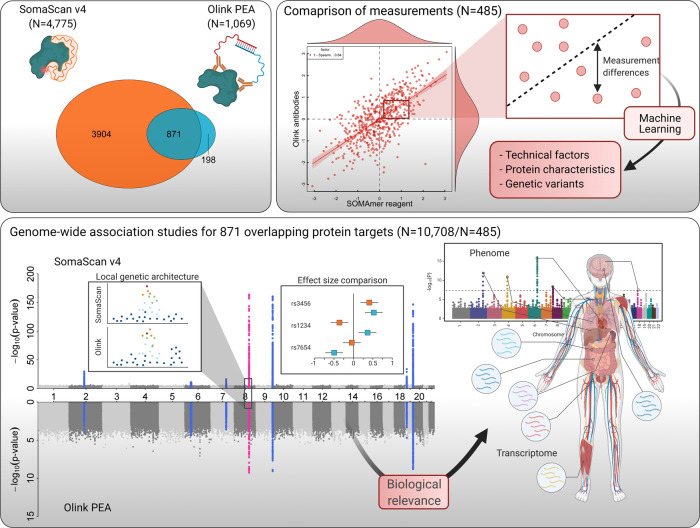
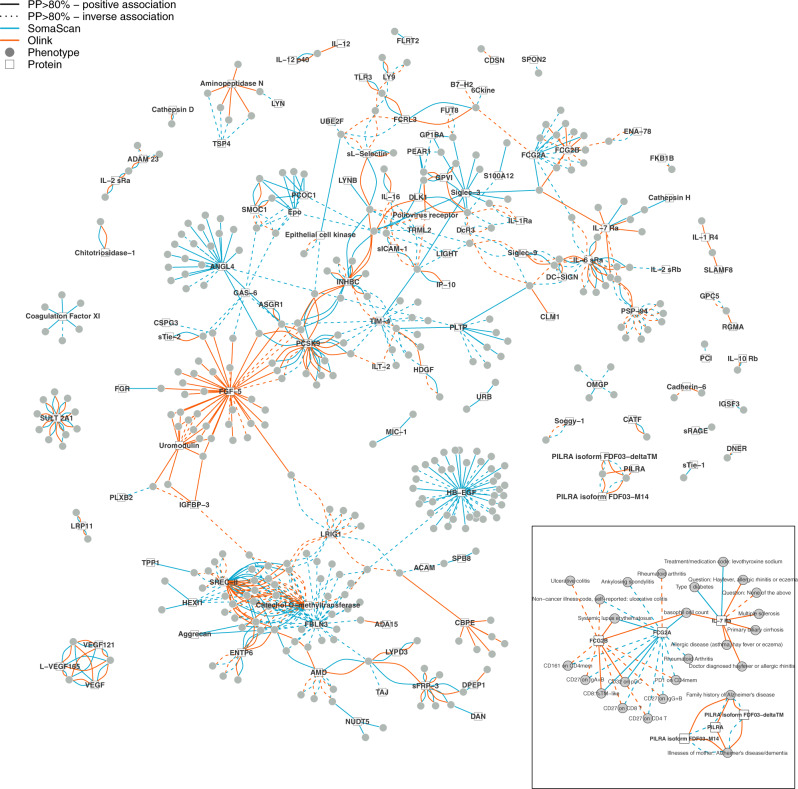
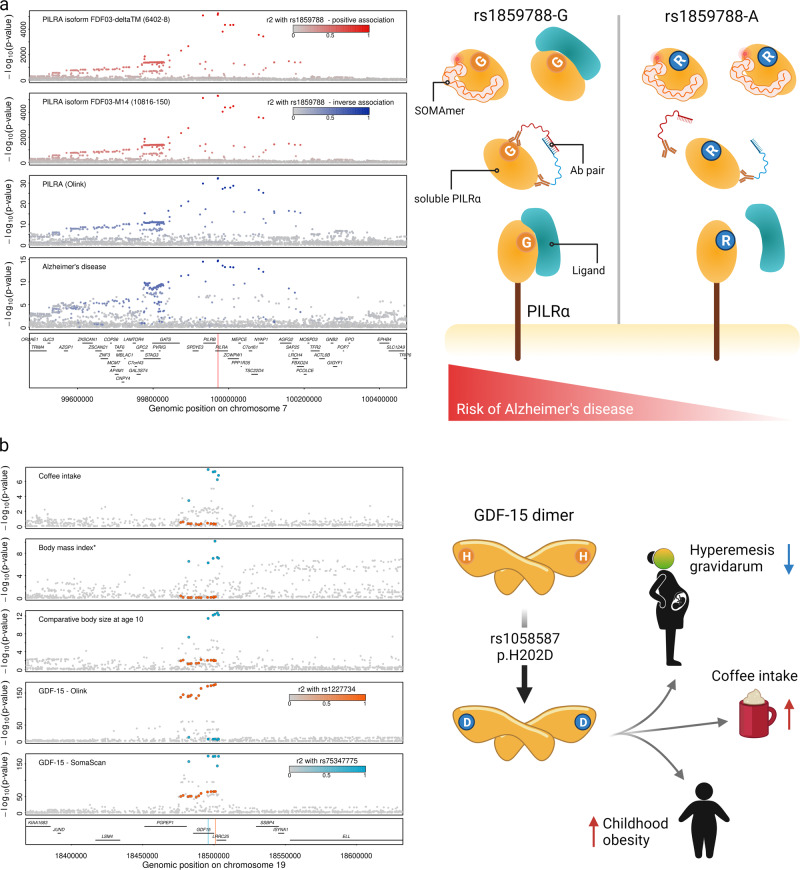
Affinity-based proteomics has enabled scalable quantification of thousands of protein targets in blood enhancing biomarker discovery, understanding of disease mechanisms, and genetic evaluation of drug targets in humans through protein quantitative trait loci (pQTLs). Here, we integrate two partly complementary techniques—the aptamer-based SomaScan ® v4 assay and the antibody-based Olink assays—to systematically assess phenotypic consequences of hundreds of pQTLs discovered for 871 protein targets across both platforms. We create a genetically anchored cross-platform proteome-phenome network comprising 547 protein–phenotype connections, 36.3% of which were only seen with one of the two platforms suggesting that both techniques capture distinct aspects of protein biology. We further highlight discordance of genetically predicted effect directions between assays, such as for PILRA and Alzheimer’s disease. Our results showcase the synergistic nature of these technologies to better understand and identify disease mechanisms and provide a benchmark for future cross-platform discoveries.
Overview
The claims and statistics of this paper haven’t been checked yet.
Free: it reads the open-access text and checks the first 5 claims that cite a source we can check. Create a free account to check every claim.
Integrity signals
Registry
Cites
Statistics
Figures
Verification
Claims the paper makes
The claims and statistics of this paper haven’t been checked yet.
Free: it reads the open-access text and checks the first 5 claims that cite a source we can check. Create a free account to check every claim.
Claims other papers make about this one
Each is checked against this paper’s own text: does it say what the citing paper says it does?
The source backs part of the claim, not all of it — or backs it for a different population, condition or comparison.
In the citing paper
“The detection of a cis-pQTL for a given protein measure is often used as a metric to confirm on-target affinity-probe binding12,15,16; existing studies comparing SomaScan and Olink measures have established that the detection of a cis-pQTL is a strong predictor of inter-platform correlation coefficients for a given protein12,15,16.”
From Cross-ancestry comparison of aptamer and antibody protein measures (2026) · cites this paper as [16]
Experimental — accuracy not yet measuredThe source backs part of the claim, not all of it — or backs it for a different population, condition or comparison.
In the citing paper
“This protein showed strong platform-discordant measures (Pearson’s r = -0.35) across the present and prior studies16,17 (Fig. 4A).”
From Cross-ancestry comparison of aptamer and antibody protein measures (2026) · cites this paper as [16]
Experimental — accuracy not yet measuredThe source backs part of the claim, not all of it — or backs it for a different population, condition or comparison.
In the citing paper
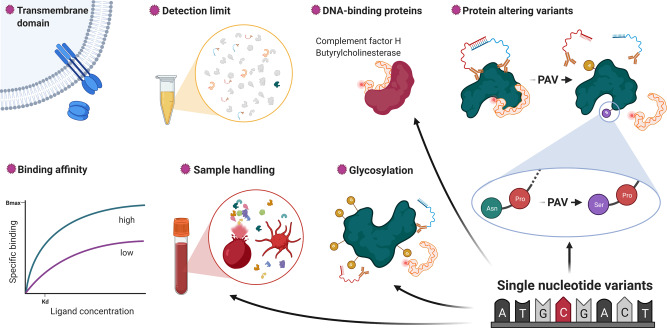
“One prior study demonstrated that biological (such as presence of a trans-membrane domain, protein length) and technical factors (percentage of outlier or below limit of detection protein measures, etc.) can explain this wide range of correlation coefficients16.”
From Cross-ancestry comparison of aptamer and antibody protein measures (2026) · cites this paper as [16]
Experimental — accuracy not yet measuredThe source backs part of the claim, not all of it — or backs it for a different population, condition or comparison.
In the citing paper
“We observed similar proportions of protein measures associated with any cis-pQTL on each platform (39% SomaScan, 48% Olink), with more distinct cis-pQTL identified for Olink overall (for the set of 2157 proteins measured on both platforms), consistent with single-ancestry genetic comparisons of earlier versions of SomaScan and Olink platforms12,16,17.”
From Cross-ancestry comparison of aptamer and antibody protein measures (2026) · cites this paper as [16]
Experimental — accuracy not yet measuredThe source backs part of the claim, not all of it — or backs it for a different population, condition or comparison.
In the citing paper
“Here, and across prior studies, cis-pQTL presence/absence is thought to provide one predictor of on-target protein measures12,15,16.”
From Cross-ancestry comparison of aptamer and antibody protein measures (2026) · cites this paper as [16]
Experimental — accuracy not yet measured
5 more claims about this paper
Create a free account to see every claim other papers make about this one.
Self-check
Percentages, sums and reported differences re-computed from the paper’s own numbers.
The self-check needs the paper’s full text.
Citations
Cites
Sudlow, C., Gallacher, J., Allen, N., Beral, V., Burton, P., Danesh, J., Downey, P., Elliott, P., Green, J., Landray, M., et al. (2015) · PLOS Medicine · doi:10.1371/journal.pmed.1001779 · Cited by 12,728
The UK Biobank resource with deep phenotyping and genomic data
Bycroft, C., Freeman, C., Petkova, D., Band, G., Elliott, L. T., Sharp, K., Motyer, A., Vukcevic, D., Delaneau, O., O’Connell, J., et al. (2018) · Nature · doi:10.1038/s41586-018-0579-z · Cited by 8,876
The Ensembl Variant Effect Predictor
McLaren, W., Gil, L., Hunt, S. E., Riat, H. S., Ritchie, G. R. S., Thormann, A., Flicek, P., & Cunningham, F. (2016) · Genome Biology · doi:10.1186/s13059-016-0974-4 · Cited by 8,099
Feature Selection with the Boruta Package
Kursa, M. B., & Rudnicki, W. R. (2010) · Journal of Statistical Software · doi:10.18637/jss.v036.i11 · Cited by 5,659
The GTEx Consortium atlas of genetic regulatory effects across human tissues
The GTEx Consortium, Aguet, F., Anand, S., Ardlie, K. G., Gabriel, S., Getz, G. A., Graubert, A., Hadley, K., Handsaker, R. E., Huang, K. H., et al. (2020) · Science · doi:10.1126/science.aaz1776 · Cited by 5,547
METAL: fast and efficient meta-analysis of genomewide association scans
Willer, C. J., Li, Y., & Abecasis, G. R. (2010) · Bioinformatics · doi:10.1093/bioinformatics/btq340 · Cited by 5,205
Giambartolomei, C., Vukcevic, D., Schadt, E. E., Franke, L., Hingorani, A. D., Wallace, C., & Plagnol, V. (2014) · PLoS Genetics · doi:10.1371/journal.pgen.1004383 · Cited by 4,261
Self-citationBuniello, A., MacArthur, J. A. L., Cerezo, M., Harris, L. W., Hayhurst, J., Malangone, C., McMahon, A., Morales, J., Mountjoy, E., Sollis, E., et al. (2019) · Nucleic Acids Research · doi:10.1093/nar/gky1120 · Cited by 4,000
A reference panel of 64,976 haplotypes for genotype imputation
the Haplotype Reference Consortium (2016) · Nature Genetics · doi:10.1038/ng.3643 · Cited by 2,836
A comprehensive map of molecular drug targets
Santos, R., Ursu, O., Gaulton, A., Bento, A. P., Donadi, R. S., Bologa, C. G., Karlsson, A., Al-Lazikani, B., Hersey, A., Oprea, T. I., et al. (2017) · Nature Reviews Drug Discovery · doi:10.1038/nrd.2016.230 · Cited by 2,427
Cited by
Items 101–200 of 237
Dang, T., Fermin, A. S. R., & Machizawa, M. G. (2023) · Frontiers in Neuroinformatics · doi:10.3389/fninf.2023.1266713 · Cited by 9
Gadd, D. A., Smith, H. M., Mullin, D. S., Chybowska, O., Hillary, R. F., Kimenai, D. M., Bernabeu, E., Cheng, Y., Fawns‐Ritchie, C., Campbell, A., et al. (2024) · Clinical Epigenetics · doi:10.1186/s13148-024-01734-7 · Cited by 11
“A particular example of interest from this study was GDF15 levels, which was highlighted as a protein that may have different conformational shapes (isoforms) that are targeted by the two assay methods [43].”
BackgroundDorian, D., Gustafson, D., Quinn, R., Bentley, R. F., Dorian, P., Goodman, J. M., Fish, J. E., & Connelly, K. A. (2024) · Journal of the American Heart Association · doi:10.1161/jaha.123.033640 · Cited by 11
“…this respect, biochemical profiling of plasma proteins using aptamers has gained recognition for its ability to discover gene–protein interactions, 17 drug pharmacology, 18 and biomarkers for individual disease risks such as cardiovascular disease 19 owing to its dynamic range (≈100 fmol/L–1 μ…”
BackgroundRichardson, T. G., Leyden, G. M., & Smith, G. D. (2023) · eLife · doi:10.7554/elife.84646 · Cited by 10
Fairhurst-Hunter, Z., Lin, K., Millwood, I. Y., Pozarickij, A., Chen, T., Torres, J., Lun, J.-A., Kartsonaki, C., Gan, W., Mahajan, A., et al. (2022) · medRxiv · doi:10.1101/2022.07.05.22277254 · Cited by 11
Self-citationAssessment of Variability in the Plasma 7k SomaScan Proteomics AssayPreprint
Candia, J., Daya, G. N., Tanaka, T., Ferrucci, L., & Walker, K. A. (2022) · bioRxiv (Cold Spring Harbor Laboratory) · doi:10.1101/2022.09.14.507978 · Cited by 8
Mesenchymal Stem Cell-Derived Exosomes: A Novel Approach to Diabetes-Associated Cognitive Impairment
Ran, Q., He, T., Lin, J. X., Wang, H., Wang, B., Chen, Z., Song, D. F., & Gong, C. (2023) · Journal of Inflammation Research · doi:10.2147/jir.s429532 · Cited by 7
“117 With advancements in technology, employing high-throughput sequencing and Olink 118 for quantitative analysis of various miRNAs and proteins may provide precise prevention and treatment for neurodegenerative diseases caused by diabetes.”
MethodAthira Raj, T., Aravind, G. B., Arun, M., & Aneesh, E. M. (2025) · Egyptian Journal of Forensic Sciences · doi:10.1186/s41935-025-00484-8 · Cited by 10
“The advent of next-generation affinity-based proteomic platforms such as Olink and SOMAscan adds another layer of precision and scalability [Pietzner et al. 2021].”
Proteome and genome integration analysis of obesity
Zhao, Q., Han, B., Xu, Q., Wang, T., Chen, F., Li, R., Zhang, L., & Pei, Y. (2023) · Chinese Medical Journal · doi:10.1097/cm9.0000000000002644 · Cited by 9
“Soon after, considering the complementarity between different sequencing technologies, Pietzner et al[44] integrated two protein sequencing technologies, the SomaScan v4 assay and the Olink proximity extension assay, and identified the phenotypic consequences of 871 protein targets across hundreds of pQTLs.”
MethodYellin, B., Lahav, C., Sela, I., Yahalom, G., Raveh, S., Elon, Y., Fuller, J., & Harel, M. (2023) · Journal of Pharmaceutical and Biomedical Analysis · doi:10.1016/j.jpba.2023.115803 · Cited by 11
Xia, F., Duan, Q., Zhang, Q., Feng, W., Ding, D., Ji, D., Wang, X., & Tan, W. (2025) · Acta Biomaterialia · doi:10.1016/j.actbio.2025.01.037 · Cited by 9
Genetics of circulating proteins in newborn babies at high risk of type 1 diabetes
Tutino, M., Yu, N., Hatzikotoulas, K., Park, Y., Kreitmaier, P., Katsoula, G., Berner, R., Casteels, K., Larsson, H. E., Kordonouri, O., et al. (2025) · Nature Communications · doi:10.1038/s41467-025-58972-3 · Cited by 7
“AKT2,which is targeted by 3 differentSomaScanprobes, showed good correlation between Olink measurement and SomaScan measurement from all 3 probes, ranging from 0.45 to 0.76.”
InfluentialGenetically Determined Inflammation‐Related Proteins in Asthma and Type‐2 Signatures
Hernandez‐Pacheco, N., Björkander, S., Merid, S. K., Kere, M. M., Kumar, A., Klevebro, S., Mogensen, I., Ekström, S., Janson, C., Palmberg, L., et al. (2025) · Allergy · doi:10.1111/all.16608 · Cited by 7
Mendelian randomization with proxy exposures: challenges and opportunities
Rahu, I., Tambets, R., Fauman, E. B., & Alasoo, K. (2025) · Genetics · doi:10.1093/genetics/iyaf210 · Cited by 8
“…and protein abundance might be poorly correlated with protein function due to the existence of distinct functional isoforms (Gotthardt et al., 2023; Park et al., 2018; Wright et al., 2022) or because of assay-specific quantification artefacts (Eldjarn et al., 2023; Pietzner et al., 2021).”
BackgroundBlood proteomics for quantitative biomarkers of cellular therapies
Gafken, P. R., & Paczesny, S. (2025) · Biomarker Research · doi:10.1186/s40364-025-00837-4 · Cited by 6
“More recently, a larger effort to compare these platforms demonstrated very poor correlation between a large number of reagents targeting the same protein [54].”
Multi-cohort high-dimensional proteomics reveals early risk markers for lymphoid cancer subtypes
Kolijn, P. M., Smith-Byrne, K., Burk, V. A., Viallon, V., Lee, M. A., Papier, K., Wang, Z., Langerak, A. W., Späth, F., Diepstra, A., et al. (2025) · Nature Communications · doi:10.1038/s41467-025-64534-4 · Cited by 11
Akenroye, A. T., Nopsopon, T., Cho, L., Moll, M. R., & Weiss, S. T. (2023) · Respiratory Research · doi:10.1186/s12931-023-02620-1 · Cited by 6
“Details of Somalogic’s data stand-ardization and quality control processes have also been previously described [20, 21].”
Identifying novel biomarkers using proteomics to predict cancer-associated thrombosis
Fernández, M. J., Patell, R. D., & Zwicker, J. I. (2024) · Bleeding Thrombosis and Vascular Biology · doi:10.4081/btvb.2024.120 · Cited by 10
“46 To address this issue, various methods have been developed to validate the target of the binding agent.”
BackgroundMethodLiu, S., Zhu, J., Zhong, H., Wu, C., Xue, H., Darst, B. F., Guo, X., Durda, P., Tracy, R. P., Liu, Y., et al. (2024) · Diabetologia · doi:10.1007/s00125-024-06277-3 · Cited by 8
Karim, M. A., Ariano, B., Schwartzentruber, J., Roldán‐Romero, J. M., Mountjoy, E., Hayhurst, J. D., Buniello, A., Mohammed, E. S. E., Carmona, M., Holmes, M. V., et al. (2023) · Research Square · doi:10.1101/2023.06.01.23290252 · Cited by 6
Liu, L., Li, M., Qin, Y., Liu, Y., Li, M., Lian, B., Guo, R., Xiao, Y., & Yin, C. (2025) · Scientific Reports · doi:10.1038/s41598-025-07357-z · Cited by 11
“Proteomic data may serve as a bridge to investigate the relationships between the gut microbiota and disease 8 .”
Plasma GDF15 affects long-term dementia risk and alters neuroimmune signaling
Blew, C., Duggan, M. R., Tsitsipatis, D., Gómez, G., Rodriguez-Hernandez, Z., Pilling, L. C., Chen, J., Jacobsen, E. M., Dark, H. E., Lu, Y., et al. (2026) · Science Advances · doi:10.1126/sciadv.aec7614 · Cited by 11
Pietzner, M., Williamson, A., Hunt, K. A., Koprulu, M., Kohleick, L., Demircan, K., van Heel, D. A., Finer, S., Carrasco-Zanini, J., van Heel, D. A., et al. (2026) · Nature Genetics · doi:10.1038/s41588-026-02697-6 · Cited by 9
“Technical rather than biological factors thereby contributed to differential platform coverage (for example, amino acid content of proteins and blood cell contamination) and largely accounted for poor cross-platform correlation 13,19,24–26 , particularly assay detectability (Supplementary Note 1).”
InfluentialSelf-citationBai, S., Yu, Y., Yang, X., Hu, G., Wu, J., Tong, K., Yin, Y., Deng, J., Chen, C., & Tan, C. (2024) · Frontiers in Endocrinology · doi:10.3389/fendo.2024.1387482 · Cited by 5
SomaModules: A Pathway Enrichment Approach Tailored to SomaScan Data
Candia, J., Fantoni, G., Delgado‐Peraza, F., Shehadeh, N., Tanaka, T., Moaddel, R., Walker, K. A., & Ferrucci, L. (2025) · Journal of Proteome Research · doi:10.1021/acs.jproteome.4c01114 · Cited by 4
Lian, J., Zhang, X., Shi, S., Li, X., Wang, Z., Pang, H., Wang, T., Gao, W., & Liu, X. (2025) · Hereditas · doi:10.1186/s41065-025-00562-w · Cited by 6
“The integration of expression quantitative trait loci (eQTLs) and protein quantitative trait loci (pQTLs) with disease-associated variants addresses this critical gap by establishing mechanistic links between genetic determinants and their molecular effectors [8].”
Sex-aware causal inference assessment of the immune system in complex neurodegenerative diseases
Lona‐Durazo, F., Ross, B., Pilon, M., Greicius, M. D., Dubé, M., Belloy, M. E., McLaughlin, R. L., & Taliun, S. A. G. (2025) · Brain · doi:10.1093/brain/awaf474 · Cited by 5
“30 ) of the significant proteins that we used for validation (Supplementary Table 7).”
Proteomic aging clocks in epidemiological studies: advances, applications and prospects
Xiao, H., Lau, C. E., Dehghan, A., & Robinson, O. (2026) · Nature Aging · doi:10.1038/s43587-026-01118-x · Cited by 6
“Argentieri et al. 23 trained the clock based on the European population and successfully validated it in East Asian samples for its associations with the most common age-related diseases.”
InfluentialProteome-wide mendelian randomization identifies causal plasma proteins in interstitial lung disease
Yu, K., Li, W., Long, W., Li, Y., Li, Y., Liao, H., & Liu, J. (2025) · Scientific Reports · doi:10.1038/s41598-025-85338-y · Cited by 4
“Thus, researchers widely accept that these two technologies, capturing different features of protein chemistry, serve as complementary tools for biomarker discovery 56 .”
Hasebe, M., Su, C., Kiel, D. P., & Yoshiji, S. (2025) · Current Osteoporosis Reports · doi:10.1007/s11914-025-00941-2 · Cited by 5
“In addition, serum and plasma are convenient matrices but may incompletely capture tissue-specific processes in bone, carti - lage, or muscle, raising concerns about how well circulating signals reflect musculoskeletal tissue biology [ 24, 95, 98 ].”
Circulating Proteomic Profiles Are Associated With Incident Type 2 Diabetes in Asian Populations
Liang, Y., Lim, C. G. Y., Ritchie, S. C., Bertin, N., Chai, J. F., Yao, J., Li, Y., Tai, E. S., van Dam, R. M., & Sim, X. (2025) · The Journal of Clinical Endocrinology & Metabolism · doi:10.1210/clinem/dgaf045 · Cited by 10
Liu, Y., Wang, X., Zhao, Q., Wei, J. S., & Yang, S. (2025) · Frontiers in Neurology · doi:10.3389/fneur.2024.1450735 · Cited by 4
Proteomic Profile of the ICAM1 p.K56M HFpEF Risk Variant
Giro, P., Filipp, M. E., Zhang, M. J., Moser, E. D., Thorp, E. B., Dalal, P., Shah, R. V., Ellinor, P. T., Cunningham, J. W., Jurgens, S. J., et al. (2024) · JACC Basic to Translational Science · doi:10.1016/j.jacbts.2024.05.016 · Cited by 4
Pietzner, M., Williamson, A., Hunt, K. A., Koprulu, M., Kohleick, L., Demircan, K., Genes & Health Research Team, Finer, S., Zanini, J. C., van Heel, D. A., et al. (2025) · doi:10.1101/2025.08.12.25333522 · Cited by 4
Self-citationPlasma proteomics and carotid intima-media thickness in the UK biobank cohort
Chen, M., Kho, P. F., Guarischi‐Sousa, R., Zhou, J., Panyard, D. J., Azizi, Z., Gupte, T. P., Watson, K. T., Abbasi, F., & Assimes, T. L. (2024) · Frontiers in Cardiovascular Medicine · doi:10.3389/fcvm.2024.1478600 · Cited by 6
Multi-Omics Analysis Identifies Genetic Mechanisms and Therapeutic Targets for Acne Vulgaris
Qiu, X., Feng, Y., Mo, X., & Ju, Q. (2025) · Journal of Investigative Dermatology · doi:10.1016/j.jid.2025.04.032 · Cited by 5
The evolution of analytical techniques for multiplex analysis of protein biomarkers
Kim, H., Hall, D. R., Nierves, L. A., Lin, T., Kitata, R. B., Shi, T., & Liu, T. (2025) · Expert Review of Proteomics · doi:10.1080/14789450.2025.2529185 · Cited by 6
“Median correlation coefficients for overlapping measurements were found to [110].”
Robinson, S. D., Haile, B., Reily-Bell, M., Iwanowytsch, O., Palmer, S., Nørøxe, D. S., Filippou, P. S., Renaut, J., Lazarus, A., Αντωνίου, Γ., et al. (2026) · Cell Reports Medicine · doi:10.1016/j.xcrm.2026.102744 · Cited by 7
“77,78 Briefly, hybridisation normalisation was performed through the addition of control reagents prior to imaging to mitigate variation arising from the readout steps, within-plate and across-plate technical variation was controlled for by the inclusion of five pooled reference standards and three…”
Proteomic signatures for fibrosis in MASLD: a biopsy-proven dual-cohort study
Blomdahl, J., Åberg, M., Fridén, M., Ahlström, H. K., Hockings, P. D., Hulthe, J., Eriksson, N., Gabrysch, K., Nasr, P., Risérus, U., et al. (2025) · Scandinavian Journal of Gastroenterology · doi:10.1080/00365521.2025.2490996 · Cited by 6
“The correlation between Olink® and SomaScan® for reagents targeting the same protein appears to be relatively poor [32,33].”
Multiomics genetic insights into potential molecular targets for intracranial aneurysm
Jia, Y., Lin, F., Li, R., Yang, Y., Chen, X., & Wang, S. (2025) · Stroke and Vascular Neurology · doi:10.1136/svn-2025-004175 · Cited by 4
“17 Details regarding GTEx V.8, eQTLGen and proteomics Open access studies were provided in online supplemental methods (2).”
Jiang, M.-Z., Gaynor, S. M., Li, X., Buren, E. V., Stilp, A. M., Buth, E., Wang, F. F., Manansala, R., Gogarten, S. M., Li, Z., et al. (2023) · bioRxiv (Cold Spring Harbor Laboratory) · doi:10.1101/2023.09.10.555215 · Cited by 5
“Correlation both between ELISAs themselves and between ELISA and aptamer assays (as well as between Olink and SomaScan) varies, and will impact expected replication rates (79–81).”
BackgroundPozarickij, A., Wang, B., Mohamed, A., Lin, K., Morris, S., Kartsonaki, C., Wright, N., Fry, H., Chen, Y., Du, H., et al. (2026) · 中国科学通报:英文版 · doi:10.64898/2026.02.05.26345625 · Cited by 3
Zhong, Q., Zhu, Y., Tan, Y., Deng, W., Wang, C., Yang, S., & Tong, N. (2025) · Frontiers in Endocrinology · doi:10.3389/fendo.2025.1664691 · Cited by 4
Luo, J., He, J., Xie, Z., Chen, Y., Liang, H., Zhao, X., Li, Z., Li, D., Wen, J., Xiao, M., et al. (2026) · Biochemical and Biophysical Research Communications · doi:10.1016/j.bbrc.2026.153348 · Cited by 2
Huang, J. V., Gill, D., Zuber, V., Matthews, P. M., Elliott, P., Tzoulaki, I., & Dehghan, A. (2023) · Frontiers in Genetics · doi:10.3389/fgene.2023.1124431 · Cited by 2
“However, MPO measured by the two technologies are expected to be highly correlated (Pietzner et al., 2021).”
BackgroundWatson, K. T., Keller, J., Spiro, C. M., Satz, I. B., Goncalves, S. V., Pankow, H., Chang, M., Kosti, I., Sequeira, A., Bunney, W. E., et al. (2024) · Brain Behavior & Immunity - Health · doi:10.1016/j.bbih.2024.100731 · Cited by 3
“It is acknowledged, however, that achieving consistency remains a challenge due to factors including variability across platforms and differences in protein concentrations among biological samples (Lehallier et al., 2019; Katz et al., 2022; Pietzner et al., 2021).”
BackgroundProteomics applications in next generation induced pluripotent stem cell models
Manda, V., Pavelka, J., & Lau, E. (2024) · Expert Review of Proteomics · doi:10.1080/14789450.2024.2334033 · Cited by 2
“…approaches are also in use, including affinity-based platforms like reverse phase protein array (RPPA) [101], SomaScan [102], and Olink [103], which can be used separately or in conjunction [104] to quantify hundreds to thousands of pre-determined protein targets in upward of thousands of samples.”
BackgroundZhou, X., Iakovliev, A., McGurnaghan, S. J., Erabadda, B., Hayward, C., McKeigue, P., Spiliopoulou, A., & Colhoun, H. M. (2025) · Diabetes · doi:10.2337/db25-0067 · Cited by 3
“The agreement between measurements of the same proteins on So-malogic and Olink platforms (both in terms of pQTL and of the measured protein levels) is poor for some proteins (6,12,14,48–51).”
Proteome Analysis of Serum Purified Using Solanum tuberosum and Lycopersicon esculentum Lectins
Nakajima, D., Konno, R., Miyashita, Y., Ishikawa, M., Ohara, O., & Kawashima, Y. (2024) · International Journal of Molecular Sciences · doi:10.3390/ijms25021315 · Cited by 4
Panyard, D. J., McKetney, J., Deming, Y. K., Morrow, A. R., Ennis, G. E., Jonaitis, E. M., Hulle, C. A. V., Yang, C., Sung, Y. J., Ali, M., et al. (2021) · medRxiv · doi:10.1101/2021.09.02.21262642 · Cited by 2
Eldjárn, G. H., Ferkingstad, E., Lund, S. H., Helgason, H., Magnússon, Ó. Þ., Olafsdottir, T. A., Halldórsson, B. V., Olason, P. I., Zink, F., Gudjonsson, S. A., et al. (2022) · bioRxiv (Cold Spring Harbor Laboratory) · doi:10.1101/2022.02.18.481034 · Cited by 3
Sánchez‐Rivera, L., Iglesias, M. J., Ibrahim‐Kosta, M., Kral-Pointner, J. B., Havervall, S., Goumidi, L., Farm, M., Munsch, G., Germain, M., Smith, P., et al. (2022) · medRxiv · doi:10.1101/2022.04.20.22274046 · Cited by 2
Changes in the cerebrospinal fluid proteome precede and stratify the course of Parkinson’s DiseasePreprint
Tsukita, K., Sakamaki‐Tsukita, H., Kaiser, S., Zhang, L., Messa, M., Serrano‐Fernández, P., & Takahashi, R. (2022) · medRxiv · doi:10.1101/2022.06.08.22276035 · Cited by 2
Koprulu, M., Carrasco-Zanini, J., Wheeler, E., Lockhart, S. M., Kerrison, N. D., Wareham, N. J., Pietzner, M., & Langenberg, C. (2022) · medRxiv · doi:10.1101/2022.08.19.22278984 · Cited by 2
“5%) successfully replicated cis-pQTLs (5-18) (Supplementary Table 2), illustrating 98 that complementary proteomic technologies can still identify genetic variants that would have 99 been anticipated to be seen in previous studies (Fig.”
BackgroundMethodInfluentialSelf-citationLiang, Y., Lim, C. G. Y., Ritchie, S. C., Bertin, N., Chai, J. F., Yao, J., Li, Y., Tai, E. S., van Dam, R. M., & Sim, X. (2024) · medRxiv · doi:10.1101/2024.05.28.24308009 · Cited by 2
An exposome-wide assessment of 6600 SomaScan proteins with non-genetic factors in Chinese adultsPreprint
Chan, K. H., Clarke, J., Kakkoura, M., Iona, A., Wang, B., Clarke, C., Wright, N., Yao, P., Mazidi, M., Im, P. K., et al. (2024) · medRxiv · doi:10.1101/2024.10.24.24316041 · Cited by 3
Probabilistic Fine-mapping of Putative Causal GenesPreprint
Okamoto, J., Yin, X., Ryan, B., Chiou, J., Luca, F., Piqué-Regi, R., Im, H. K., Morrison, J., Burant, C., Fauman, E. B., et al. (2024) · bioRxiv (Cold Spring Harbor Laboratory) · doi:10.1101/2024.10.27.620482 · Cited by 2
“Third, our analysis of METSIM metabolites exclusively uses UK Biobank cis -pQTLs due to concerns about the quality and reliability of available trans -pQTLs obtained through current proteomic technologies [28, 29].”
MethodHomann, J., Smith, A., Morgan, S. L., Frick, E. A., Liu, F., Viallon, V., Maurya, R., Korologou‐Linden, R., Dobričić, V., Ohlei, O., et al. (2025) · medRxiv · doi:10.1101/2025.07.30.25332433 · Cited by 4
Self-citationKumar, R., Beric, A., Western, D., Yang, Z., Lin, W., Timsina, J., Cruchaga, C., & Ibáñez, L. (2025) · medRxiv · doi:10.1101/2025.09.25.25336658 · Cited by 3
“[14-18] In the past few years, numerous studies have utilized MS[19-26], SomaScan[9, 27-30], and Olink Explore[7, 31-36] in PD research, but orthogonal comparison studies have been limited.”
Khunsriraksakul, C., Zhang, F., Wang, L., Chen, S., Markus, H., Chen, D., Shenoy, G., Lopez-Silva, C., Jabboure, F. J., Kesaf, A. E., et al. (2025) · medRxiv · doi:10.1101/2025.10.06.25336803 · Cited by 2
High-throughput plasma proteomic platforms: Insights from a multi-ethnic Asian cohortPreprint
Bahai, A., Wang, H., Jain, P., Ward, L. D., Boychenko, O., Ding, Z., Frederiksen, J., Ngeow, J. Y. Y., Lee, J., Ríboli, E., et al. (2025) · bioRxiv (Cold Spring Harbor Laboratory) · doi:10.1101/2025.10.24.682486 · Cited by 2
cpiVAE: Robust and Interpretable Cross-Platform Proteomics ImputationPreprint
Li, Y., Duong, T., Rooney, M. R., Ballantyne, C. M., Coresh, J., Brody, J. A., Sotoodehnia, N., Arking, D. E., & Bader, J. S. (2025) · bioRxiv (Cold Spring Harbor Laboratory) · doi:10.1101/2025.11.20.689433 · Cited by 3
“Indeed, an integrative analysis discovered additional health-related protein signals using both Olink and SomaScan, which would have been missed by either platform alone [14].”
Leveraging large-scale biobanks for therapeutic target discovery
Ferolito, B. R., Dashti, H., Giambartolomei, C., Peloso, G. M., Golden, D. J., Gravel-Pucillo, K., Rasooly, D., Horimoto, A. R. V. R., Matty, R., Gaziano, L., et al. (2025) · Human Genetics and Genomics Advances · doi:10.1016/j.xhgg.2025.100556 · Cited by 11
Self-citationYang, Q., Zhang, R., Li, N., Hao, B., Qin, R., Guo, Z., Zhang, Y., Cai, T., Yao, Y., Shi, Y., et al. (2026) · Analytical Chemistry · doi:10.1021/acs.analchem.5c07989 · Cited by 1
Zhang, B., Dong, L., Gao, J., Yuan, L., Wang, W., Zhou, Z., Wang, N., & Chen, Z. (2026) · Integrated Diagnostics · doi:10.1016/j.intdia.2026.100003 · Cited by 1
van der Burgt, Y. E. M., & Cobbaert, C. M. (2026) · Clinical Chemistry and Laboratory Medicine (CCLM) · doi:10.1515/cclm-2026-0109 · Cited by 2
“The performance and output of the SomaScan assay and PEA have been evaluated in head-to-head analyses and compared with MS-based proteomics data [40 – 47].”
Rajapaksha, R. D., & Farmer, J. T. (2026) · Bioanalysis · doi:10.1080/17576180.2026.2658614 · Cited by 1
Chan, K. H., Clarke, J., Kakkoura, M., Iona, A., Wang, B., Clarke, C., Wright, N., Yao, P., Mazidi, M., Im, P. K., et al. (2026) · Scientific Reports · doi:10.1038/s41598-026-41444-z · Cited by 1
“This is consistent with the previous report in CKB and with some previous studies using different approaches to proteomic profiling 67–69 .”
Zhang, X., Yan, W., Fan, X., Zhang, P., Gao, Y., Wang, Y., Shen, H. R., Cai, C., Zeng, S., & Zhu, J. (2026) · Genome Medicine · doi:10.1186/s13073-026-01696-w · Cited by 1
“Large-scale assays now quantify thousands of circulating proteins in population cohorts, revealing robust links between individual proteins and future diseases [3, 4].”
Plaza‐Florido, A., Olvera‐Rojas, M., Alcántara, J. M. A., Radom‐Aizik, S., & Ortega, F. B. (2024) · American Journal of Human Biology · doi:10.1002/ajhb.24113 · Cited by 1
“It is possible that the different direction of the associations in the cohort and Mendelian randomization analyses might be caused by different proteomic profiling assays (Pietzner et al., 2021; Yuan et al., 2023).”
Lopez, L. N., Durbin-Johnson, B. P., Vargas, C. R., RUZINSKI, J. T., Goodling, A., Mehrotra, R., Vaisar, T., Rocke, D. M., & Afkarian, M. (2024) · Journal of Proteome Research · doi:10.1021/acs.jproteome.4c00322 · Cited by 3
Yang, S., Liu, Y., Wang, S., Peng, H., Hui, X., & Yang, A. (2024) · Cytokine · doi:10.1016/j.cyto.2024.156789 · Cited by 2
Correlation between Olink and SomaScan proteomics platforms in adults with a Fontan circulation
Assi, I., Landzberg, M. J., Becker, K. C. D., Renaud, D., Reyes, F. B., Leone, D. M., Benson, M., Michel, M., Gerszten, R. E., & Opotowsky, A. R. (2025) · International Journal of Cardiology Congenital Heart Disease · doi:10.1016/j.ijcchd.2025.100584 · Cited by 7
Richmond, A., Robertson, J. A., Smith, H. M., Hillary, R. F., Zelezniak, A., Vernardis, S. I., Chybowska, A. D., Grauslys, A., Mur, J., Campbell, A., et al. (2026) · Nature Communications · doi:10.1038/s41467-026-76474-8 · Cited by 1
Corrigendum to: Proteomics for the prediction and prevention of atherosclerotic disease
(2022) · European Heart Journal · doi:10.1093/eurheartj/ehac130
Abe, K., Beer, J. C., Nguyen, T. T., Ariyapala, I. S., Holmes, T. H., Feng, W., Zhang, B., Kuo, D., Luo, Y., Ma, X.-J., et al. (2023) · bioRxiv (Cold Spring Harbor Laboratory) · doi:10.1101/2023.10.24.563866 · Cited by 1
Aberrant STAT signaling drives T cell dysregulation in a targetable pediatric sepsis endotypePreprint
Lindell, R. B., Sayed, S. U., Campos, J. S., Sheetz, S. A., Babu, A., Knight, M., Mauracher, A. A., Hay, C. A., Conrey, P. E., Fitzgerald, J. C., et al. (2024) · medRxiv · doi:10.1101/2024.06.11.24308709 · Cited by 1
“It will also benefit from validation across multiple proteomics platforms, as aptamer-based and antibody-based approaches are susceptible to both technical and genetic variation among samples ( 82 ).”
BackgroundGaziano, L., Allara, E., Giambartolomei, C., Stacey, D., Zhao, J. H., Dashti, H., Jiang, T., Ritchie, S. C., Ferolito, B. R., Rasooly, D., et al. (2024) · medRxiv · doi:10.1101/2024.06.27.24309406 · Cited by 1
“…a different gene/protein to the one being instrumented), we used locally-acting ( cis ), conditionally-independent, protein quantitative trait loci ( cis -pQTLs) to instrument levels of 1,497 plasma proteins assayed using the SomaScan V4 platform in the Fenland study 17 ( Supplementary Table 1 ).”
MethodSelf-citationCandia, J., Fantoni, G., Moaddel, R., Delgado‐Peraza, F., Shehadeh, N., Tanaka, T., & Ferrucci, L. (2024) · bioRxiv (Cold Spring Harbor Laboratory) · doi:10.1101/2024.09.21.613295 · Cited by 1
“Pietzner et al. 21 used SomaScan and Olink to create a genetically anchored cross-platform proteome-phenome network comprising 547 protein–phenotype connections, 36 .”
Forecasting off-target drug toxicity using proteomic and genetic data: insights from TorcetrapibPreprint
Brody, J. A., Sitlani, C. M., Psaty, B. M., Ye, T., Ganz, P., Floyd, J. S., & Davies, N. M. (2025) · medRxiv · doi:10.64898/2025.12.03.25341213 · Cited by 2
Plasma titration provides a physical ruler for cross-platform proteomicsPreprint
Liu, Y., Wang, H., Zhang, Y., Lu, R., Xu, W., Hou, W., Zhu, Y., Li, X., Chen, Q., Gao, Y., et al. (2026) · bioRxiv (Cold Spring Harbor Laboratory) · doi:10.64898/2026.08.09.740864 · Cited by 1
Biddanda, A., de Arce, K. P., Eze-Echesi, G., Nwuba, C., Ibrahim, Y., Oyedele, O., Joshi, E., Alalade, B. A., Ajayi, O., Nwatu, C. B., et al. (2022) · bioRxiv (Cold Spring Harbor Laboratory) · doi:10.1101/2022.12.09.519773
“protein measurements between these two technologies have been investigated in great detail, with the current established consensus that each of these assays vary substantially in their relative protein quantification measurements [62,63].”
BackgroundUntangling the Complexities of Single Cell Protein Analysis
Cowen, L. (2022) · Inside Precision Medicine · doi:10.1089/ipm.09.06.04
Noh, D., Yu, M., Kim, Y., & Oh, T. Y. (2023) · Springer eBooks · doi:10.1007/978-981-19-7630-8_9
Evaluation of Circulating Plasma Proteins in Breast Cancer: A Mendelian Randomization AnalysisPreprint
Mälarstig, A., Grassman, F., Dahl, L., Dimitriou, M., McLeod, D., Gabrielson, M., Smith‐Byrne, K., Thomas, C. E., Huang, T.-H., Forsberg, S. K. G., et al. (2023) · Research Square · doi:10.21203/rs.3.rs-2749047/v1
Xia, X., Chan, K. H., Niu, Y., Liu, C., Guo, Y., Ho, K., Yim, S. H. L., Wang, B., Doherty, A., Avery, D., et al. (2024) · Research Square · doi:10.21203/rs.3.rs-4547455/v1
Proteomic scores and dietary patterns
Wareham, N. J. (2024) · Nature Food · doi:10.1038/s43016-024-01078-8
Self-citationThe proteomics revolution: Forging a new path to personalized health care
Williams, S. A. (2024) · Elsevier eBooks · doi:10.1016/b978-0-323-98808-7.00013-8
Self-citationCurrent status and future perspectives of proteogenomics
Ohara, O. (2024) · SEIBUTSU BUTSURI KAGAKU · doi:10.2198/electroph.68.97
Wang, P., Wang, J., Zhang, P., & Xiao, W. (2025) · Gastroenterology · doi:10.1053/j.gastro.2025.01.259
Schmidt, L. E., Suna, G., & Mayr, M. (2025) · Elsevier eBooks · doi:10.1016/b978-0-443-15734-9.00035-2
A genomic-led strategy to anticipate drug safety effects
Ferolito, B. R., Horimoto, A. R. V. R., Gravel-Pucillo, K., Golden, D. J., Dashti, H., Giambartolomei, C., Rasooly, D., Matty, R., Gaziano, L., Tsepilov, Y. A., et al. (2026) · PLoS Genetics · doi:10.1371/journal.pgen.1012211
Self-citationGoswami, C., Juang, J. J., Lu, T., Yang, J., Chattopadhyay, A. S., & Chuang, E. Y.-Y. (2025) · Bioinformatics and Biology Insights · doi:10.1177/11779322251385926
“16,17,21,22 The Multi-ethnic Imputation System (MI-System) was utilized for all imputations in this study.”
Liu, P. J., Ferguson, H. R., Gushterov, N., Kessler, B. M., Liu, G., Halner, A., Hankey, L., Kaneva, I. N., Dupalliwar, M., Syed, J., et al. (2025) · Research Square · doi:10.21203/rs.3.rs-7660411/v1
Additional file 1 of Proteomics for heart failure risk stratification: a systematic review
Kuku, K. O., Oyetoro, R. O., Hashemian, M., Livinski, A. A., Shearer, J. J., Joo, J., Psaty, B. M., Levy, D. A., Ganz, P., & Roger, V. L. (2024) · Figshare · doi:10.6084/m9.figshare.26672721
Gadd, D. A., Smith, H. M., Mullin, D. S., Chybowska, O., Hillary, R. F., Kimenai, D. M., Bernabeu, E., Cheng, Y., Fawns‐Ritchie, C., Campbell, A., et al. (2024) · Figshare · doi:10.6084/m9.figshare.26981934
Cronjé, H. T., Karhunen, V., Hovingh, G. K., Coppieters, K. T., Lagerstedt, J. O., Nyberg, M., & Gill, D. (2024) · Figshare · doi:10.6084/m9.figshare.26585241
Akenroye, A. T., Nopsopon, T., Cho, L., Moll, M. R., & Weiss, S. T. (2024) · Figshare · doi:10.6084/m9.figshare.26650296
Cronjé, H. T., Karhunen, V., Hovingh, G. K., Coppieters, K. T., Lagerstedt, J. O., Nyberg, M., & Gill, D. (2024) · Figshare · doi:10.6084/m9.figshare.26585238
Gadd, D. A., Smith, H. M., Mullin, D. S., Chybowska, O., Hillary, R. F., Kimenai, D. M., Bernabeu, E., Cheng, Y., Fawns‐Ritchie, C., Campbell, A., et al. (2024) · Discovery Research Portal (University of Dundee) · doi:10.6084/m9.figshare.26981931
Metadata
- Authors
- Pietzner, M., Wheeler, E., Carrasco-Zanini, J., Kerrison, N. D., Oerton, E., Koprulu, M., Luan, J., Hingorani, A. D., Williams, S. A., Wareham, N. J., & Langenberg, C.
- Affiliations
- University of Cambridge (GB)
- Health Data Research UK (GB)
- Corresponding author
- Langenberg, Claudia
- ORCID
- Venue
- Nature Communications
- Published
- 2021-11-24
- Volume
- 12
- Issue
- 1
- Pages
- 6822-6822
- ISSN
- 2041-1723 (ISSN-L)
- PMC
- PMC8613205
- OpenAlex
- W3212460220
- Cited by
- 234
- References
- 67
- Citations by year
- 2026: 55 · 2025: 49 · 2024: 55 · 2023: 44 · 2022: 29 · 2021: 2
- FWCI
- 18.50
- Type
- journal article
- Language
- en
- Open access
- gold
- doi.org
- Licence
- cc-by
- creativecommons.org/licenses/by/4.0 (tdm)
- creativecommons.org/licenses/by/4.0 (vor)
- Locations
- Nature Communications (publishedVersion, cc-by)
- PubMed Central (publishedVersion, cc-by)
- PubMed (publishedVersion)
- RePEc: Research Papers in Economics (submittedVersion)
- DOAJ (DOAJ: Directory of Open Access Journals) (submittedVersion, cc-by-sa)
- UCL Discovery (University College London) (submittedVersion)
- Queen Mary Research Online (Queen Mary University of London) (submittedVersion, cc-by)
- Apollo (University of Cambridge) (submittedVersion)
- Apollo (University of Cambridge) (submittedVersion, cc-by)
- Apollo
- Apollo (cc-by)
- Funders
- Wellcome Trust
- UK Research and Innovation (MR/V033867/1)
- National Institute for Health and Care Research (MC_UU_12015/1, NIHR202383)
- British Heart Foundation (AA/18/6/34223)
- University of Cambridge (00001)
- Cambridge Trust
- Medical Research Council (MC_UU_12015/1, MC_PC_13046, MC_UU_12015, MR/V033867/1)
- Topics
- Life Sciences › Biochemistry, Genetics and Molecular Biology › Genetics › Genetic Associations and Epidemiology
- Life Sciences › Biochemistry, Genetics and Molecular Biology › Molecular Biology › Advanced Biosensing Techniques and Applications
- Physical Sciences › Chemistry › Spectroscopy › Advanced Proteomics Techniques and Applications
- Keywords
- protein quantitative trait loci, pQTL, aptamer-based proteomics, SomaScan, Alzheimer's disease, biomarker discovery, disease mechanisms
- MeSH terms
- Adult, Alzheimer Disease, Antibodies, Female, Humans, Male, Membrane Glycoproteins, Middle Aged, Phenotype, Receptors, Immunologic, Cohort Studies, Proteome, Protein Interaction Mapping, Quantitative Trait Loci, Proteomics, Aptamers, Peptide, Protein Interaction Maps
About these checks
Registry, retraction, Cites and statistics results are computed, not judged, with one exception: a printed reference that no index lists is read once by a model before it counts as a citation error. Claims are extracted by a model and kept only when their quote appears verbatim in the text; each cited source is then checked, with a model’s help, for whether it says what the claim relies on. Those verdicts can be wrong — read the claim’s quote and the cited source before relying on one.
Statistics and arithmetic are recomputed, not judged.
Confidence bands are shown only for fields calibrated on our annotated test set. None is calibrated yet, so no band is shown.
What counts as a claim ›How we measure confidence ›How we check this ›
Are you an author, or do you see a problem with this page? Request a review
Data sources
Bibliographic data: Semantic Scholar, OpenAlex, Crossref.
Contains information from the Semantic Scholar Academic Graph Datasets, made available under the ODC Attribution License (ODC-BY 1.0).
Semantic Scholar’s data is described in: Kinney, R., et al. (2023). The Semantic Scholar Open Data Platform. arXiv:2301.10140.
